
Commissioning of the LHC superconducting magnets systems Why
![. . . where are we today cool down status Sector Average T [K]](https://slidetodoc.com/presentation_image_h2/085276941f733b546471ab1e28124f67/image-41.jpg ". . . where are we today cool down status Sector Average T [K]")
- Slides: 43
Commissioning of the LHC superconducting magnets systems: Why an LHC Hardware Commissioning? Specificity and complexity of this machine Roberto Saban – 2008 Academic Training Lecture 1
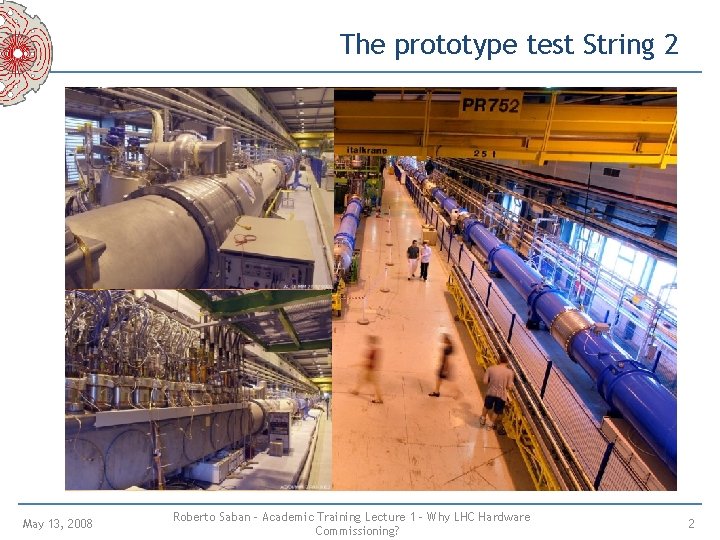
The prototype test String 2 May 13, 2008 Roberto Saban – Academic Training Lecture 1 – Why LHC Hardware Commissioning? 2
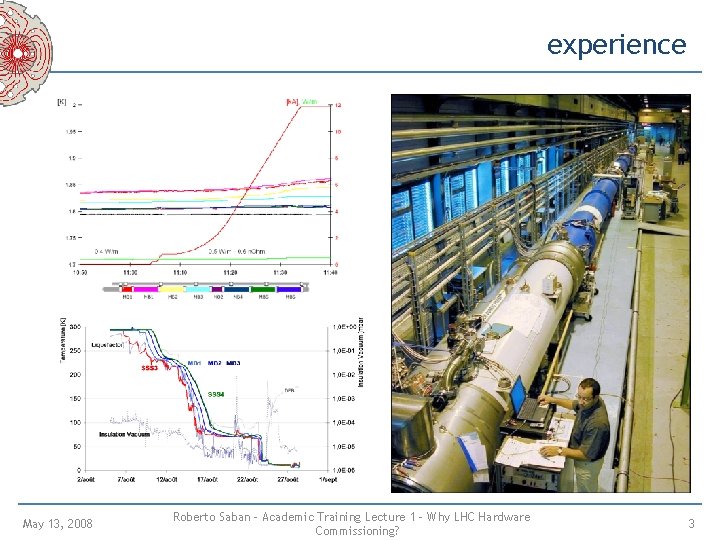
experience May 13, 2008 Roberto Saban – Academic Training Lecture 1 – Why LHC Hardware Commissioning? 3
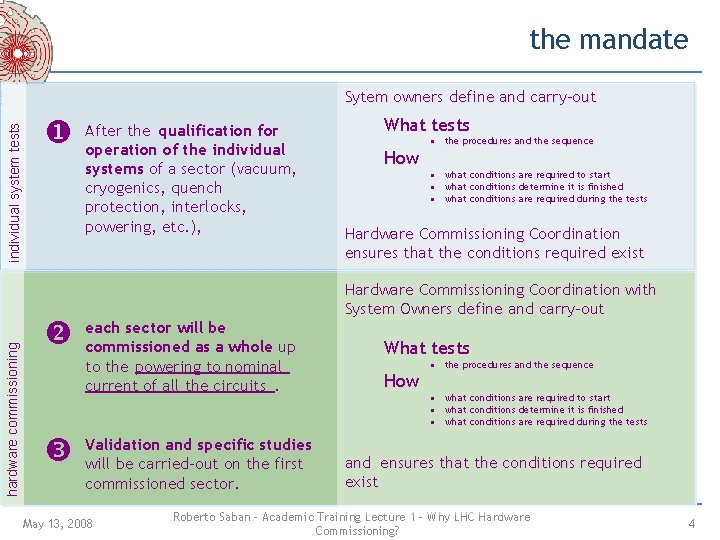
the mandate hardware commissioning individual system tests Sytem owners define and carry-out After the qualification for operation of the individual systems of a sector (vacuum, cryogenics, quench protection, interlocks, powering, etc. ), What tests • the procedures and the sequence How • what conditions are required to start • what conditions determine it is finished • what conditions are required during the tests Hardware Commissioning Coordination ensures that the conditions required exist Hardware Commissioning Coordination with System Owners define and carry-out each sector will be commissioned as a whole up to the powering to nominal current of all the circuits. Validation and specific studies will be carried-out on the first commissioned sector. May 13, 2008 What tests • the procedures and the sequence How • what conditions are required to start • what conditions determine it is finished • what conditions are required during the tests and ensures that the conditions required exist Roberto Saban – Academic Training Lecture 1 – Why LHC Hardware Commissioning? 4
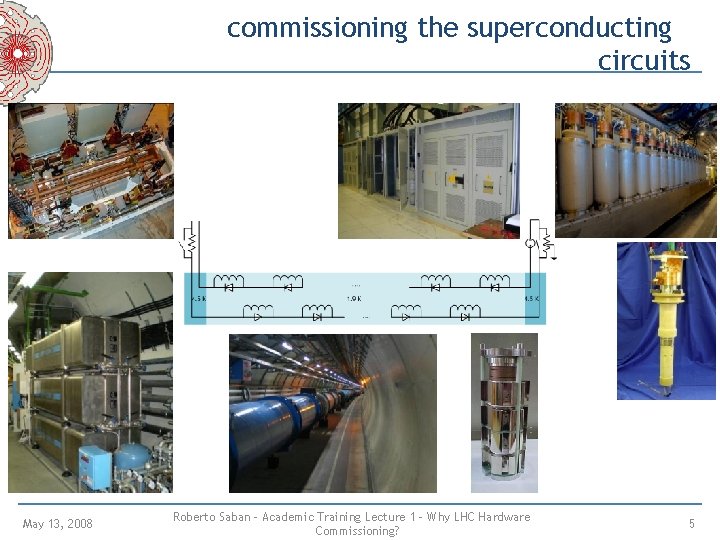
commissioning the superconducting circuits May 13, 2008 Roberto Saban – Academic Training Lecture 1 – Why LHC Hardware Commissioning? 5
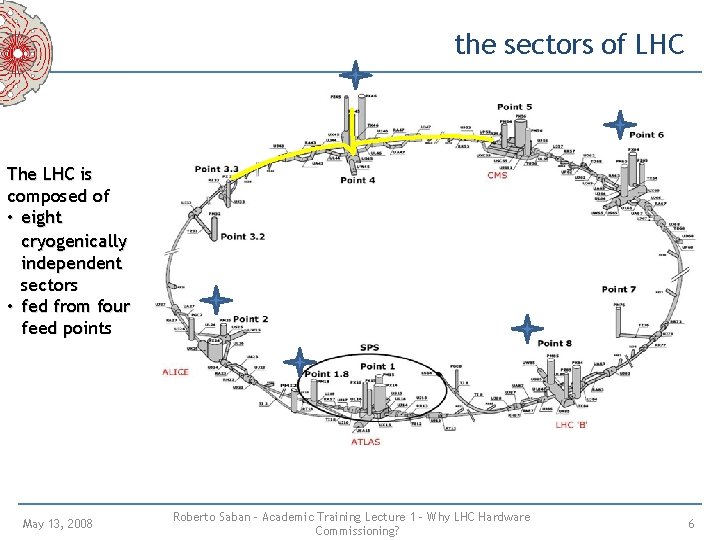
the sectors of LHC The LHC is composed of • eight cryogenically independent sectors • fed from four feed points May 13, 2008 Roberto Saban – Academic Training Lecture 1 – Why LHC Hardware Commissioning? 6
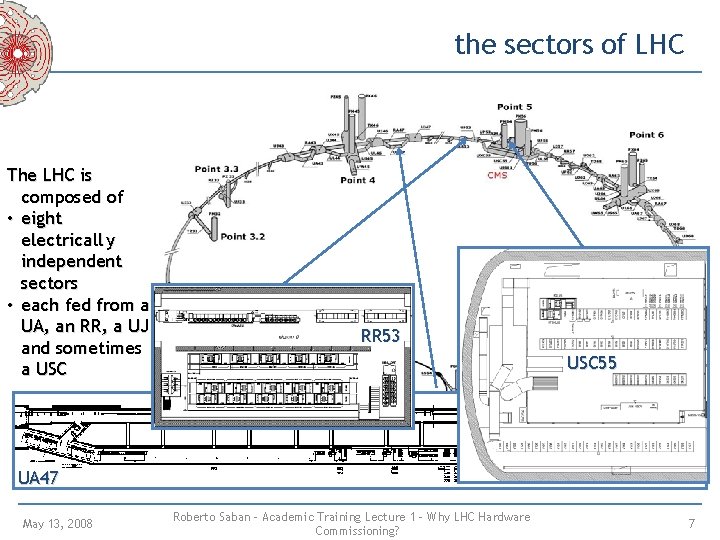
the sectors of LHC The LHC is composed of • eight electricall y independent sectors • each fed from a UA, an RR, a UJ and sometimes a USC RR 53 USC 55 UA 47 May 13, 2008 Roberto Saban – Academic Training Lecture 1 – Why LHC Hardware Commissioning? 7
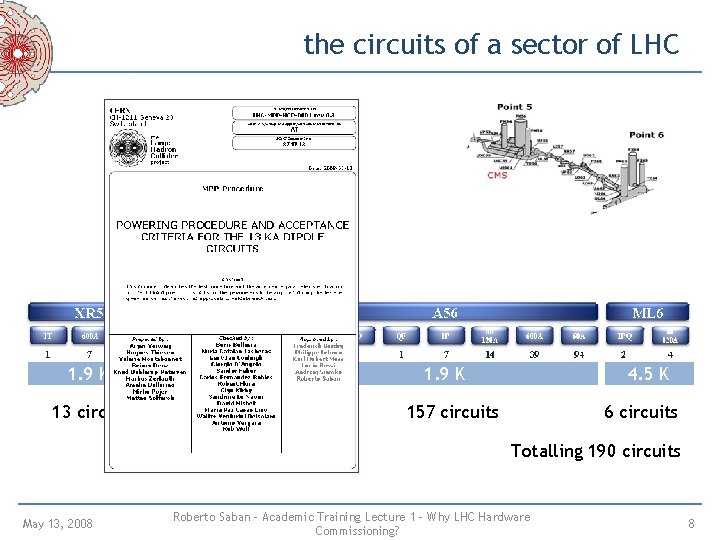
the circuits of a sector of LHC 1. 9 K 13 circuits 4. 5 K 14 circuits 1. 9 K 4. 5 K 157 circuits 6 circuits Totalling 190 circuits May 13, 2008 Roberto Saban – Academic Training Lecture 1 – Why LHC Hardware Commissioning? 8
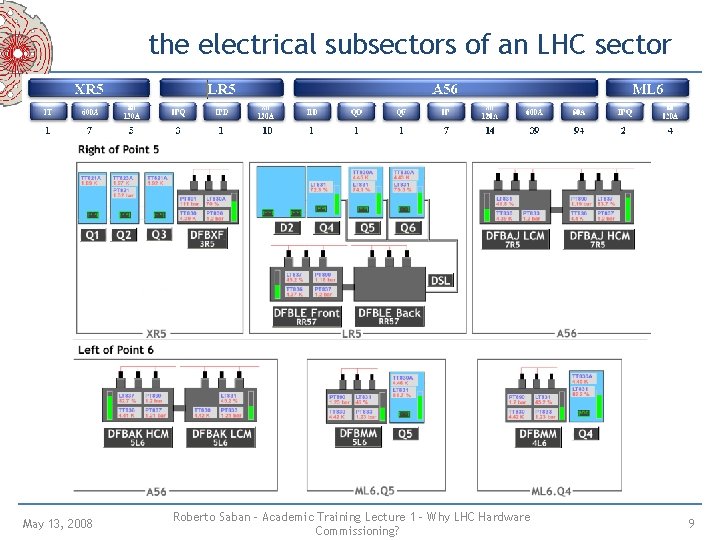
the electrical subsectors of an LHC sector May 13, 2008 Roberto Saban – Academic Training Lecture 1 – Why LHC Hardware Commissioning? 9
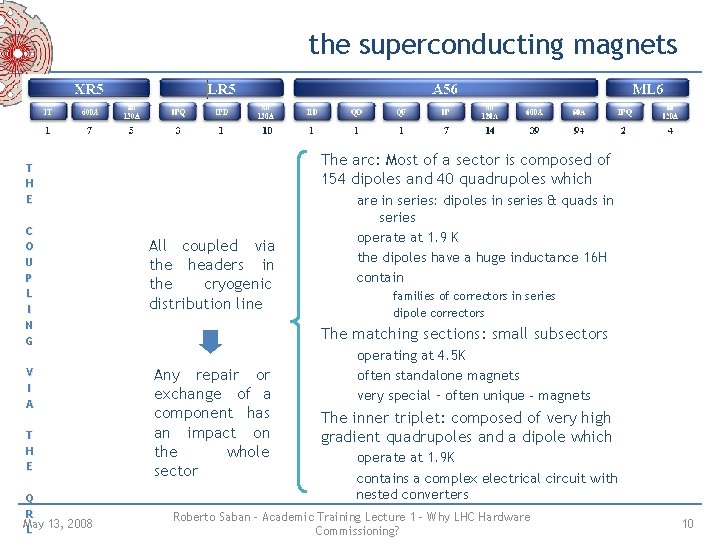
the superconducting magnets The arc: Most of a sector is composed of 154 dipoles and 40 quadrupoles which T H E C O U P L I N G V I A T H E Q R May L 13, 2008 All coupled via the headers in the cryogenic distribution line are in series: dipoles in series & quads in series operate at 1. 9 K the dipoles have a huge inductance 16 H contain families of correctors in series dipole correctors The matching sections: small subsectors Any repair or exchange of a component has an impact on the whole sector operating at 4. 5 K often standalone magnets very special – often unique - magnets The inner triplet: composed of very high gradient quadrupoles and a dipole which operate at 1. 9 K contains a complex electrical circuit with nested converters Roberto Saban – Academic Training Lecture 1 – Why LHC Hardware Commissioning? 10
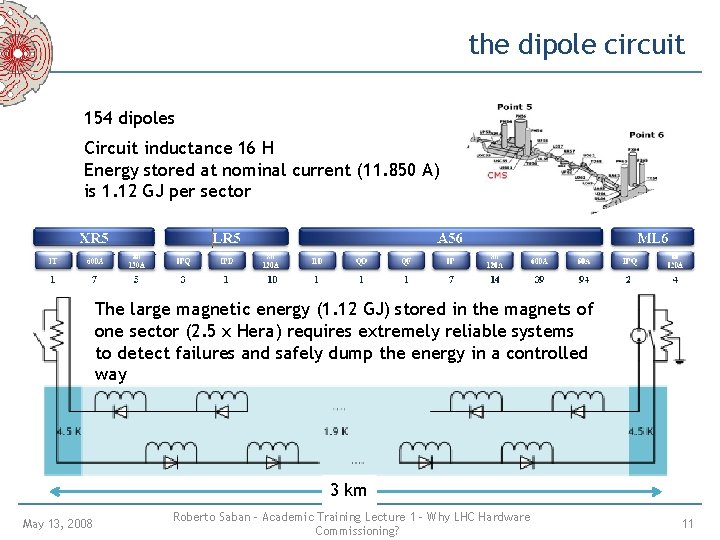
the dipole circuit 154 dipoles Circuit inductance 16 H Energy stored at nominal current (11. 850 A) is 1. 12 GJ per sector The large magnetic energy (1. 12 GJ) stored in the magnets of one sector (2. 5 x Hera) requires extremely reliable systems to detect failures and safely dump the energy in a controlled way 3 km May 13, 2008 Roberto Saban – Academic Training Lecture 1 – Why LHC Hardware Commissioning? 11
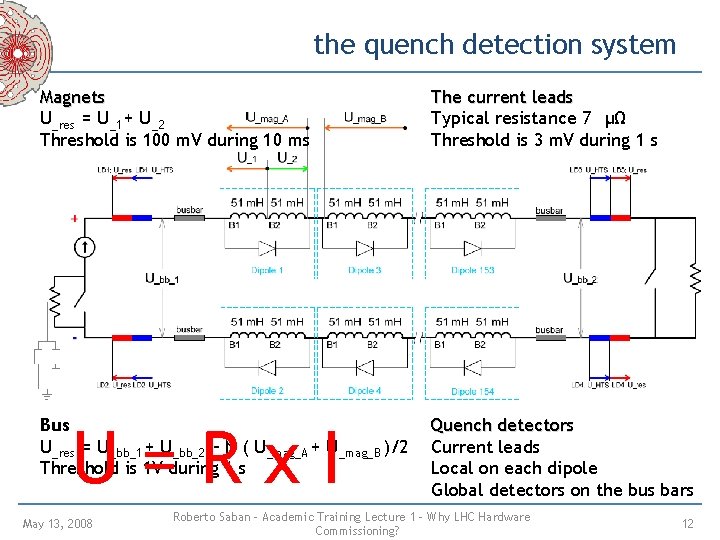
the quench detection system Magnets U_res = U _1 + U _2 Threshold is 100 m. V during 10 ms The current leads Typical resistance 7 μΩ Threshold is 3 m. V during 1 s Bus U_res = U _bb_1 + U _bb_2 – N ( U _mag_A + U _mag_B )/2 Threshold is 1 V during 1 s Quench detectors Current leads Local on each dipole Global detectors on the bus bars U=Rx. I May 13, 2008 Roberto Saban – Academic Training Lecture 1 – Why LHC Hardware Commissioning? 12
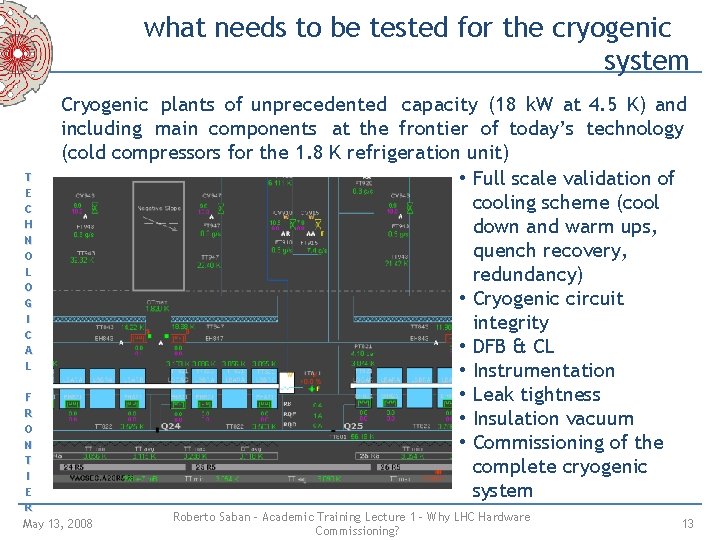
what needs to be tested for the cryogenic system T E C H N O L O G I C A L F R O N T I E R Cryogenic plants of unprecedented capacity (18 k. W at 4. 5 K) and including main components at the frontier of today’s technology (cold compressors for the 1. 8 K refrigeration unit) • Full scale validation of cooling scheme (cool down and warm ups, quench recovery, redundancy) • Cryogenic circuit integrity • DFB & CL • Instrumentation • Leak tightness • Insulation vacuum • Commissioning of the complete cryogenic system May 13, 2008 Roberto Saban – Academic Training Lecture 1 – Why LHC Hardware Commissioning? 13
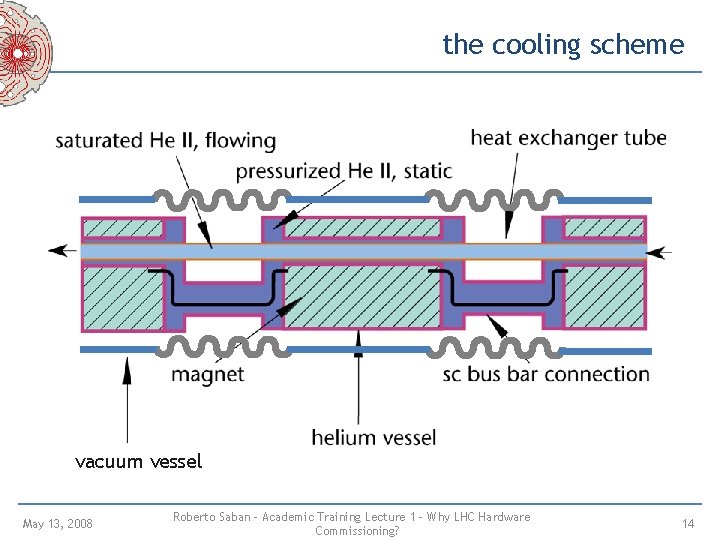
the cooling scheme vacuum vessel May 13, 2008 Roberto Saban – Academic Training Lecture 1 – Why LHC Hardware Commissioning? 14
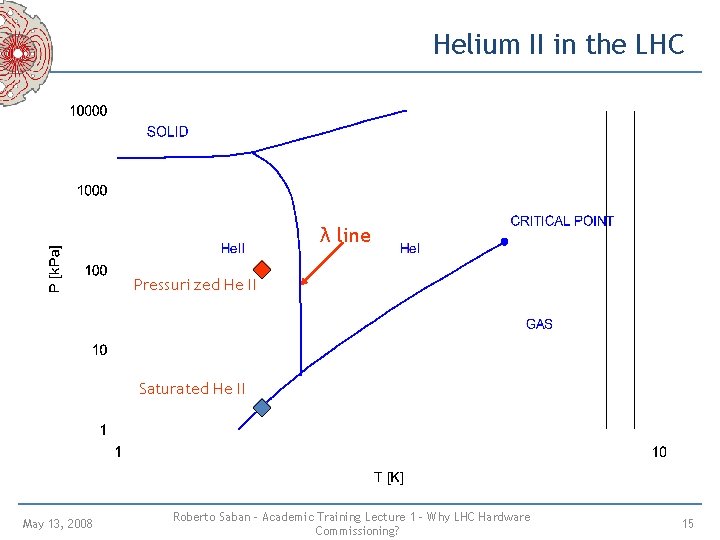
Helium II in the LHC λ line Pressuri zed He II Saturated He II May 13, 2008 Roberto Saban – Academic Training Lecture 1 – Why LHC Hardware Commissioning? 15
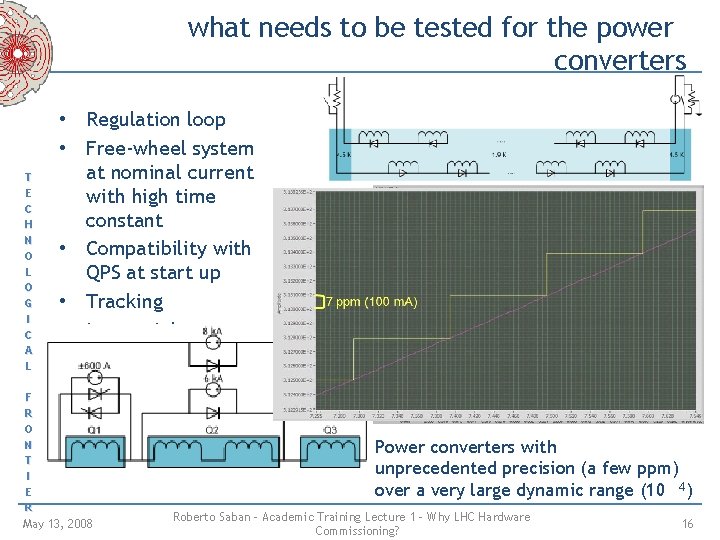
what needs to be tested for the power converters T E C H N O L O G I C A L • Regulation loop • Free-wheel system at nominal current with high time constant • Compatibility with QPS at start up • Tracking • Inner triplet F R O N T I E R May 13, 2008 2 ppm Power converters with unprecedented precision (a few ppm) over a very large dynamic range (10 4 ) Roberto Saban – Academic Training Lecture 1 – Why LHC Hardware Commissioning? 16
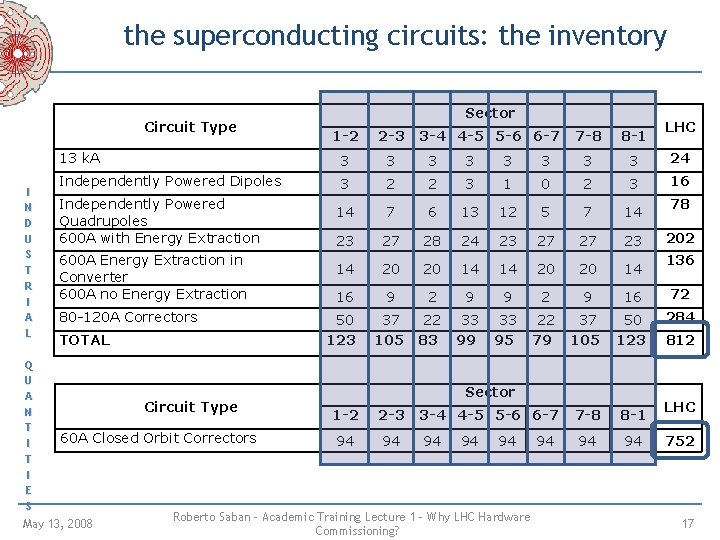
the superconducting circuits: the inventory Circuit Type I N D U S T R I A L Q U A N T I E S Sector 1 -2 2 -3 13 k. A 3 3 3 Independently Powered Dipoles 3 2 2 3 14 7 6 23 27 14 Independently Powered Quadrupoles 600 A with Energy Extraction 600 A Energy Extraction in Converter 600 A no Energy Extraction 80 -120 A Correctors TOTAL Circuit Type 60 A Closed Orbit Correctors May 13, 2008 3 -4 4 -5 5 -6 6 -7 LHC 7 -8 8 -1 3 3 3 24 1 0 2 3 16 13 12 5 7 14 28 24 23 27 27 23 20 20 14 14 20 20 14 16 9 2 9 16 72 50 123 37 105 22 83 33 99 33 95 22 79 37 105 50 123 284 Sector 1 -2 2 -3 3 -4 4 -5 5 -6 6 -7 7 -8 8 -1 94 94 Roberto Saban – Academic Training Lecture 1 – Why LHC Hardware Commissioning? 94 78 202 136 812 LHC 752 17
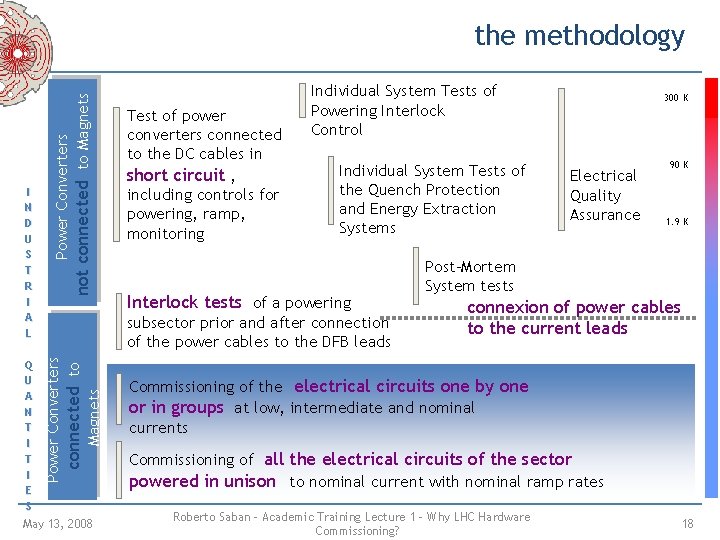
Q U A N T I E S Test of power converters connected to the DC cables in short circuit , including controls for powering, ramp, monitoring Individual System Tests of Powering Interlock Control Individual System Tests of the Quench Protection and Energy Extraction Systems Interlock tests of a powering subsector prior and after connection of the power cables to the DFB leads Power Converters connected to Magnets I N D U S T R I A L Power Converters not connected to Magnets the methodology May 13, 2008 300 K Electrical Quality Assurance 90 K 1. 9 K Post-Mortem System tests connexion of power cables to the current leads Commissioning of the electrical circuits one by one or in groups at low, intermediate and nominal currents Commissioning of all the electrical circuits of the sector powered in unison to nominal current with nominal ramp rates Roberto Saban – Academic Training Lecture 1 – Why LHC Hardware Commissioning? 18
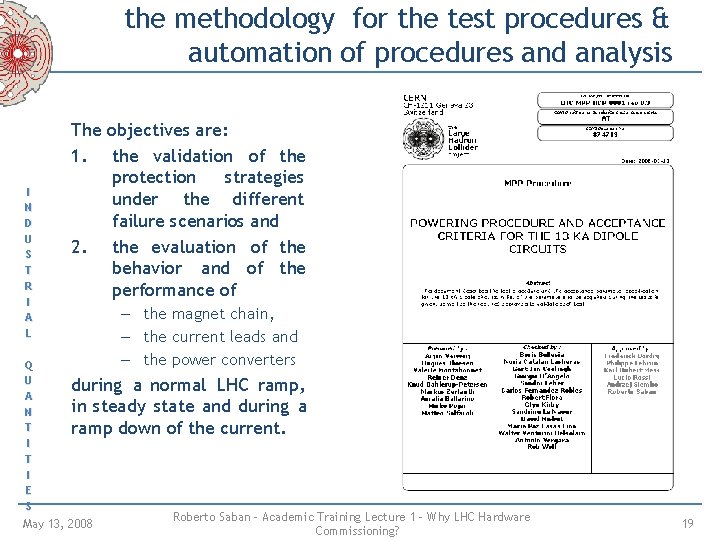
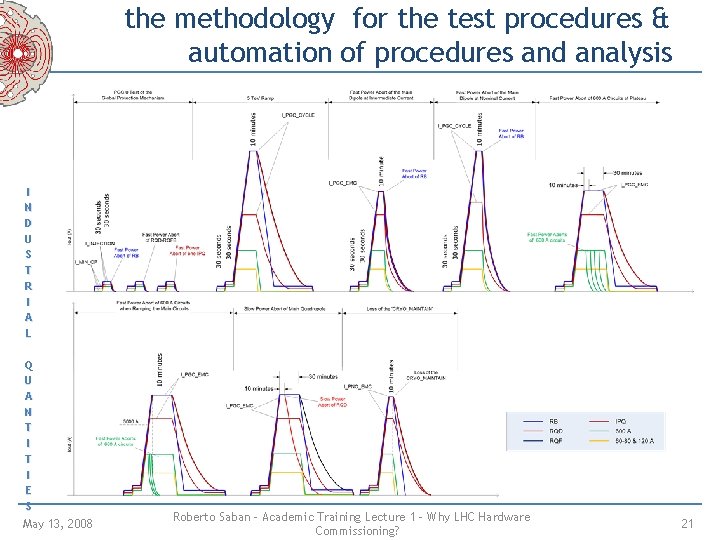
the methodology for the test procedures & automation of procedures and analysis I N D U S T R I A L Q U A N T I E S The objectives are: 1. the validation of the protection strategies under the different failure scenarios and 2. the evaluation of the behavior and of the performance of – the magnet chain, – the current leads and – the power converters during a normal LHC ramp, in steady state and during a ramp down of the current. May 13, 2008 Roberto Saban – Academic Training Lecture 1 – Why LHC Hardware Commissioning? 19
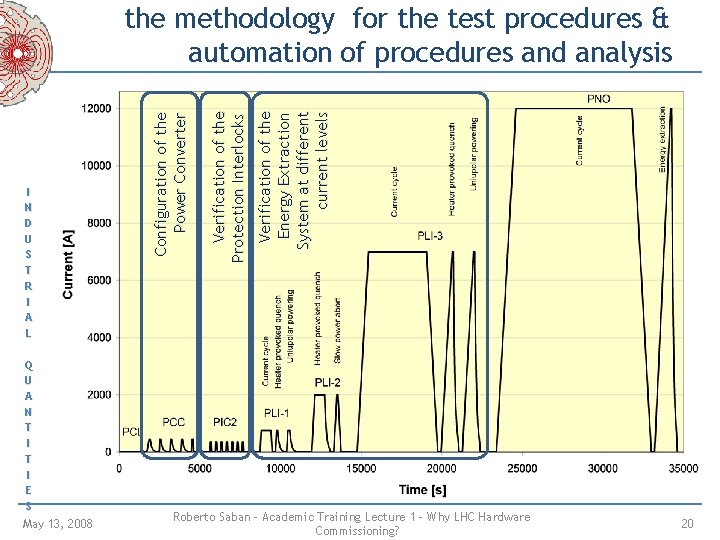
Q U A N T I E S May 13, 2008 Verification of the Energy Extraction System at different current levels Verification of the Protection Interlocks I N D U S T R I A L Configuration of the Power Converter the methodology for the test procedures & automation of procedures and analysis Roberto Saban – Academic Training Lecture 1 – Why LHC Hardware Commissioning? 20
the methodology for the test procedures & automation of procedures and analysis I N D U S T R I A L Q U A N T I E S May 13, 2008 Roberto Saban – Academic Training Lecture 1 – Why LHC Hardware Commissioning? 21
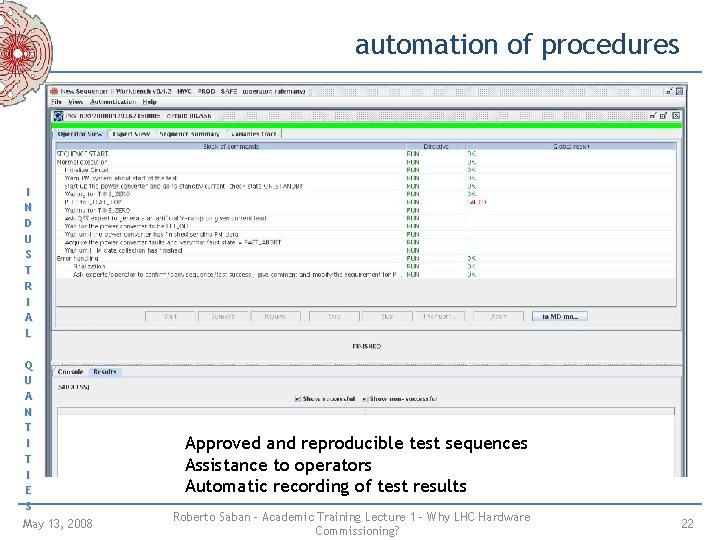
automation of procedures I N D U S T R I A L Q U A N T I E S May 13, 2008 Approved and reproducible test sequences Assistance to operators Automatic recording of test results Roberto Saban – Academic Training Lecture 1 – Why LHC Hardware Commissioning? 22
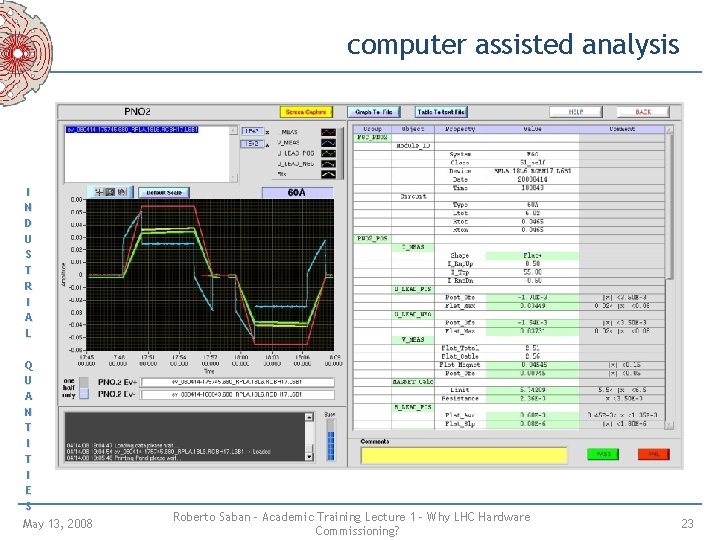
computer assisted analysis I N D U S T R I A L Q U A N T I E S May 13, 2008 Roberto Saban – Academic Training Lecture 1 – Why LHC Hardware Commissioning? 23
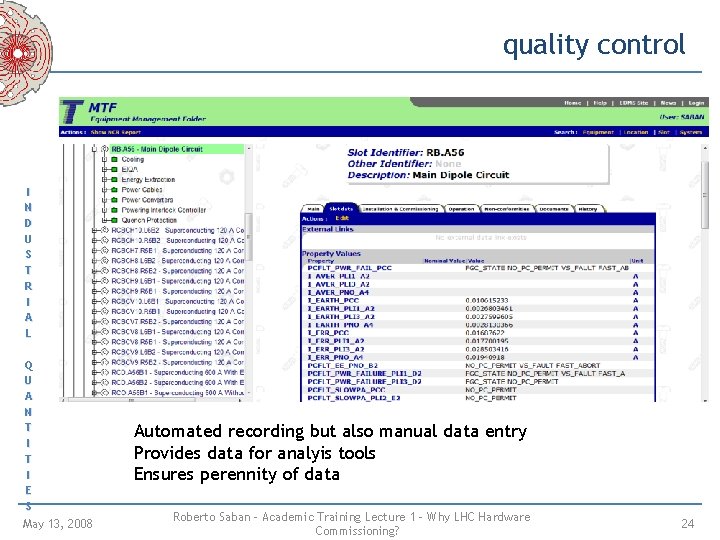
quality control I N D U S T R I A L Q U A N T I E S May 13, 2008 Automated recording but also manual data entry Provides data for analyis tools Ensures perennity of data Roberto Saban – Academic Training Lecture 1 – Why LHC Hardware Commissioning? 24
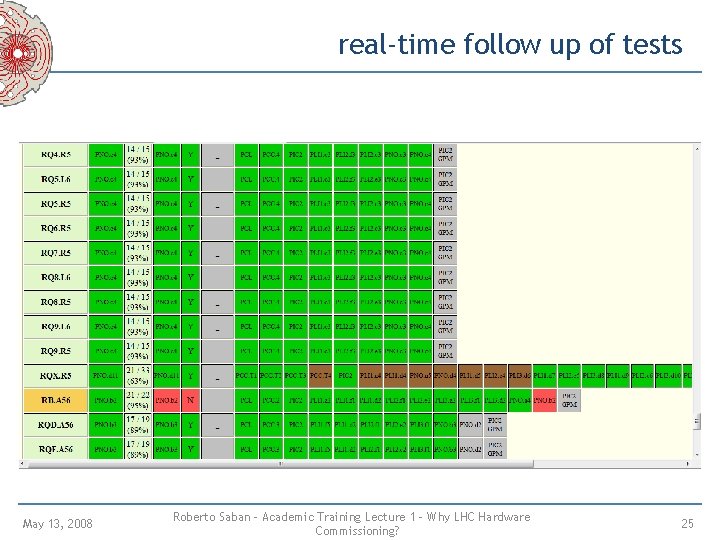
real-time follow up of tests May 13, 2008 Roberto Saban – Academic Training Lecture 1 – Why LHC Hardware Commissioning? 25
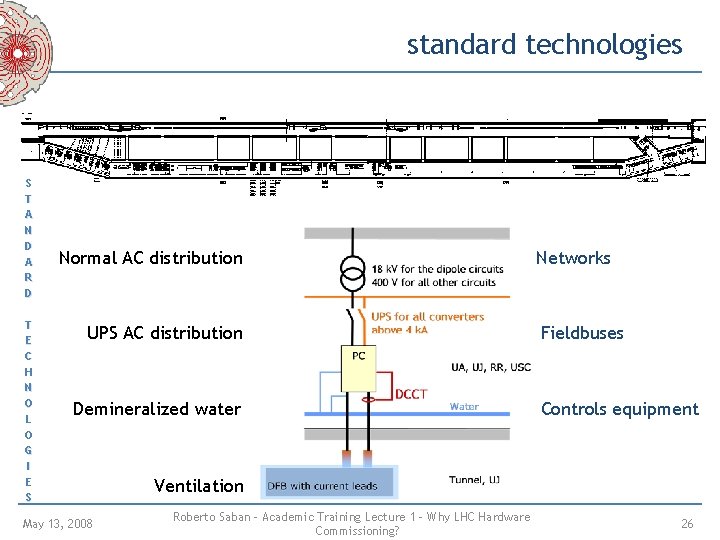
standard technologies S T A N D A R D T E C H N O L O G I E S Normal AC distribution UPS AC distribution Demineralized water May 13, 2008 Networks Fieldbuses Controls equipment Ventilation Roberto Saban – Academic Training Lecture 1 – Why LHC Hardware Commissioning? 26
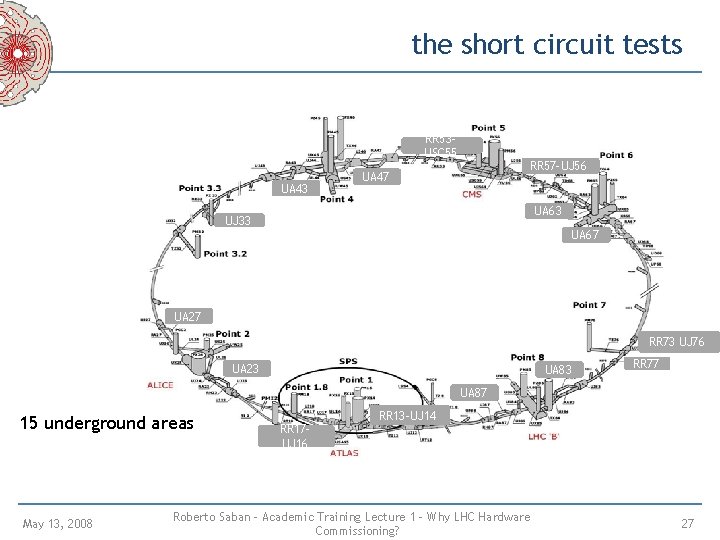
the short circuit tests RR 53 USC 55 UA 43 RR 57 -UJ 56 UA 47 UA 63 UJ 33 UA 67 UA 27 RR 73 UJ 76 UA 23 UA 83 RR 77 UA 87 15 underground areas May 13, 2008 RR 17 UJ 16 RR 13 -UJ 14 Roberto Saban – Academic Training Lecture 1 – Why LHC Hardware Commissioning? 27
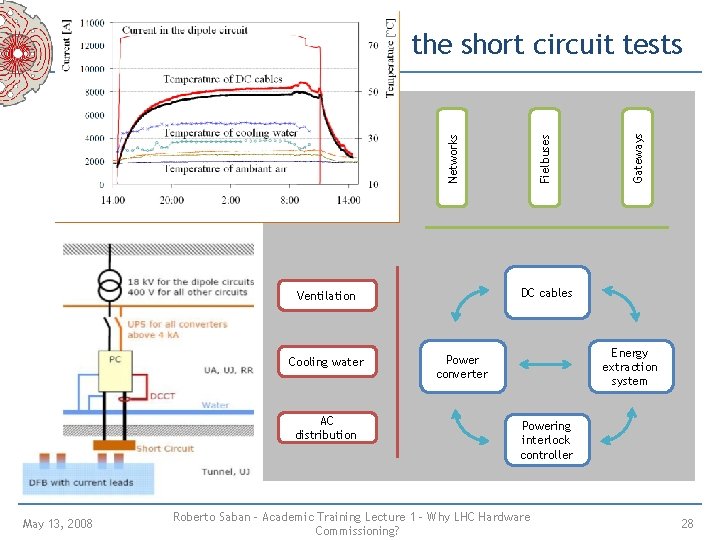
AC distribution May 13, 2008 Gateways DC cables Ventilation Cooling water Fielbuses Networks the short circuit tests Energy extraction system Power converter Powering interlock controller Roberto Saban – Academic Training Lecture 1 – Why LHC Hardware Commissioning? 28
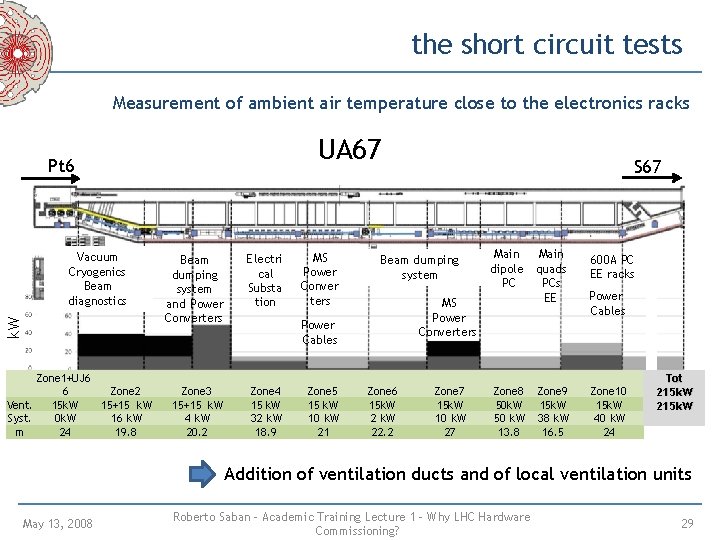
the short circuit tests Measurement of ambient air temperature close to the electronics racks UA 67 Pt 6 k. W Vacuum Cryogenics Beam diagnostics Zone 1+UJ 6 6 Zone 2 Vent. 15 k. W 15+15 k. W Syst. 0 k. W 16 k. W m 24 19. 8 Beam dumping system and Power Converters Electri cal Substa tion Zone 3 15+15 k. W 4 k. W 20. 2 Zone 4 15 k. W 32 k. W 18. 9 MS Power Conver ters Beam dumping system Main dipole PC Main quads PCs EE Zone 8 50 k. W 50 k. W 13. 8 Zone 9 15 k. W 38 k. W 16. 5 MS Power Converters Power Cables Zone 5 15 k. W 10 k. W 21 S 67 Zone 6 15 k. W 22. 2 Zone 7 15 k. W 10 k. W 27 600 A PC EE racks Power Cables Zone 10 15 k. W 40 k. W 24 Tot 215 k. W Addition of ventilation ducts and of local ventilation units May 13, 2008 Roberto Saban – Academic Training Lecture 1 – Why LHC Hardware Commissioning? 29
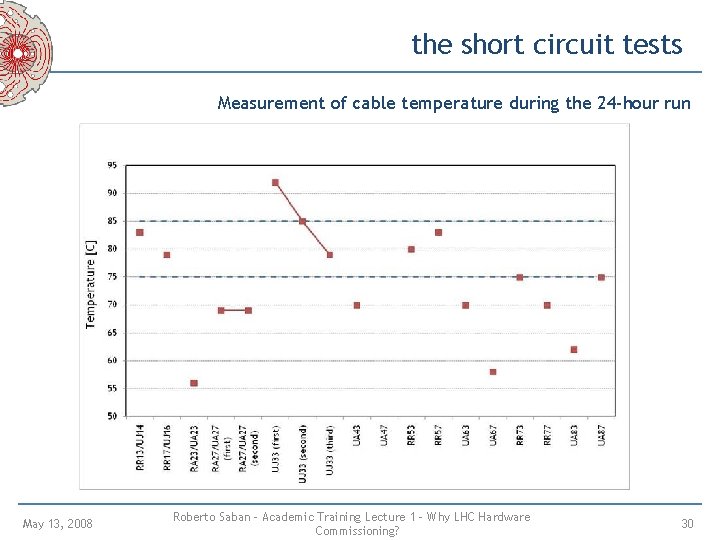
the short circuit tests Measurement of cable temperature during the 24 -hour run May 13, 2008 Roberto Saban – Academic Training Lecture 1 – Why LHC Hardware Commissioning? 30
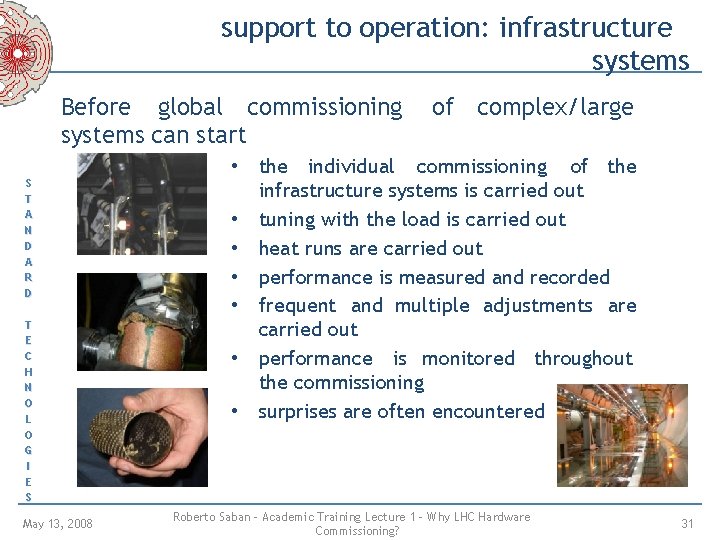
support to operation: infrastructure systems Before global commissioning systems can start S T A N D A R D T E C H N O L O G I E S May 13, 2008 • • of complex/large the individual commissioning of the infrastructure systems is carried out tuning with the load is carried out heat runs are carried out performance is measured and recorded frequent and multiple adjustments are carried out performance is monitored throughout the commissioning surprises are often encountered Roberto Saban – Academic Training Lecture 1 – Why LHC Hardware Commissioning? 31
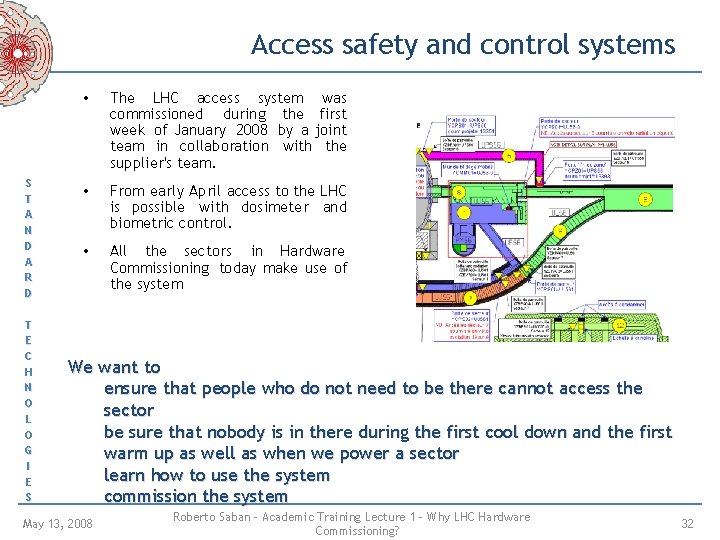
Access safety and control systems S T A N D A R D T E C H N O L O G I E S • The LHC access system was commissioned during the first week of January 2008 by a joint team in collaboration with the supplier's team. • From early April access to the LHC is possible with dosimeter and biometric control. • All the sectors in Hardware Commissioning today make use of the system We want to ensure that people who do not need to be there cannot access the sector be sure that nobody is in there during the first cool down and the first warm up as well as when we power a sector learn how to use the system commission the system May 13, 2008 Roberto Saban – Academic Training Lecture 1 – Why LHC Hardware Commissioning? 32
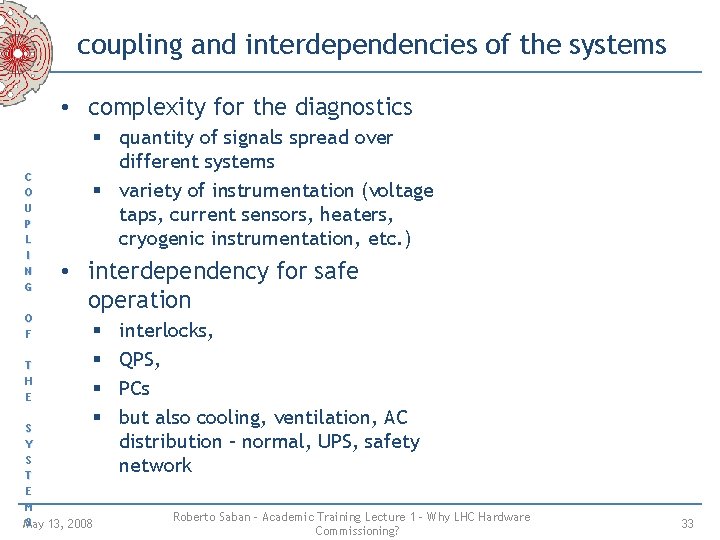
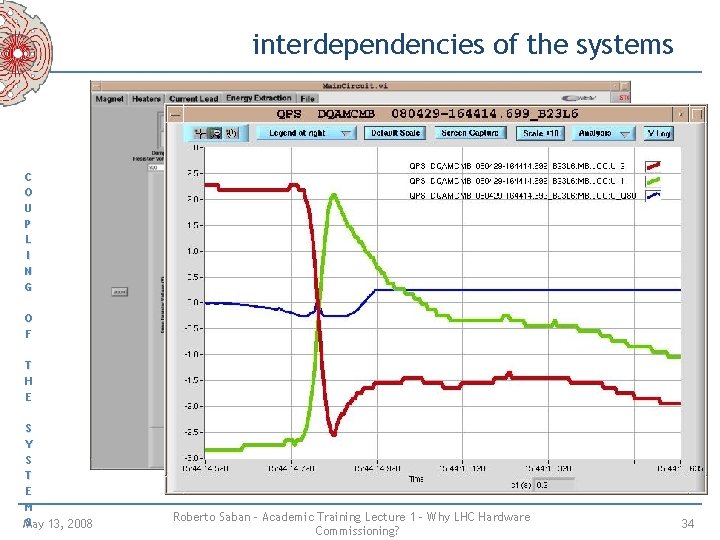
coupling and interdependencies of the systems • complexity for the diagnostics C O U P L I N G O F T H E § quantity of signals spread over different systems § variety of instrumentation (voltage taps, current sensors, heaters, cryogenic instrumentation, etc. ) • interdependency for safe operation § § S Y S T E M S 13, 2008 May interlocks, QPS, PCs but also cooling, ventilation, AC distribution – normal, UPS, safety network Roberto Saban – Academic Training Lecture 1 – Why LHC Hardware Commissioning? 33
interdependencies of the systems C O U P L I N G O F T H E S Y S T E M S 13, 2008 May Roberto Saban – Academic Training Lecture 1 – Why LHC Hardware Commissioning? 34
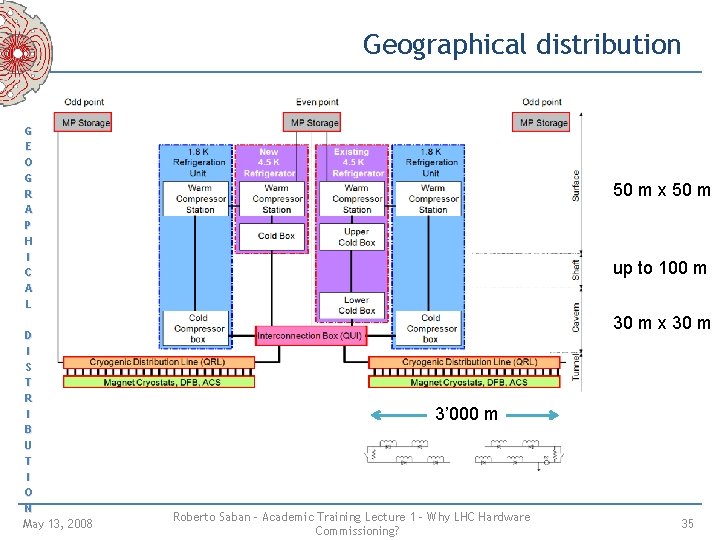
Geographical distribution G E O G R A P H I C A L D I S T R I B U T I O N May 13, 2008 50 m x 50 m up to 100 m 30 m x 30 m 3’ 000 m Roberto Saban – Academic Training Lecture 1 – Why LHC Hardware Commissioning? 35
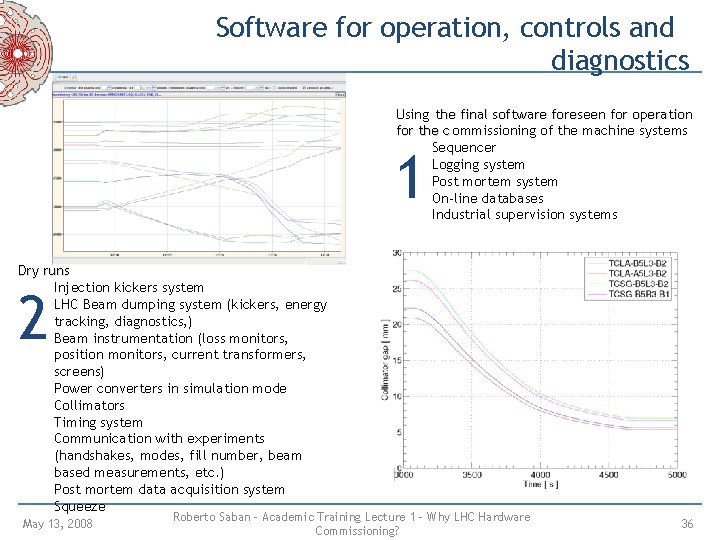
Software for operation, controls and diagnostics Using the final software foreseen for operation for the c ommissioning of the machine systems Sequencer Logging system Post mortem system On-line databases Industrial supervision systems 1 Dry runs Injection kickers system LHC Beam dumping system (kickers, energy tracking, diagnostics, ) Beam instrumentation (loss monitors, position monitors, current transformers, screens) Power converters in simulation mode Collimators Timing system Communication with experiments (handshakes, modes, fill number, beam based measurements, etc. ) Post mortem data acquisition system Squeeze 2 May 13, 2008 Roberto Saban – Academic Training Lecture 1 – Why LHC Hardware Commissioning? 36
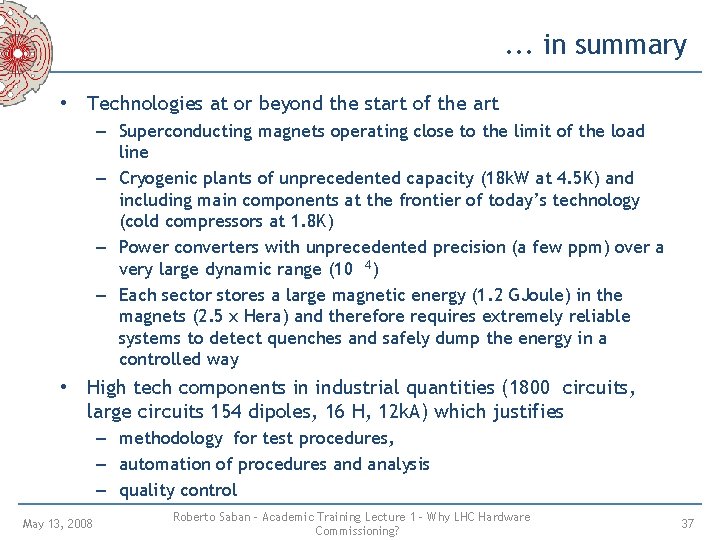
. . . in summary • Technologies at or beyond the start of the art – Superconducting magnets operating close to the limit of the load line – Cryogenic plants of unprecedented capacity (18 k. W at 4. 5 K) and including main components at the frontier of today’s technology (cold compressors at 1. 8 K) – Power converters with unprecedented precision (a few ppm) over a very large dynamic range (10 4 ) – Each sector stores a large magnetic energy (1. 2 GJoule) in the magnets (2. 5 x Hera) and therefore requires extremely reliable systems to detect quenches and safely dump the energy in a controlled way • High tech components in industrial quantities (1800 circuits, large circuits 154 dipoles, 16 H, 12 k. A) which justifies – methodology for test procedures, – automation of procedures and analysis – quality control May 13, 2008 Roberto Saban – Academic Training Lecture 1 – Why LHC Hardware Commissioning? 37
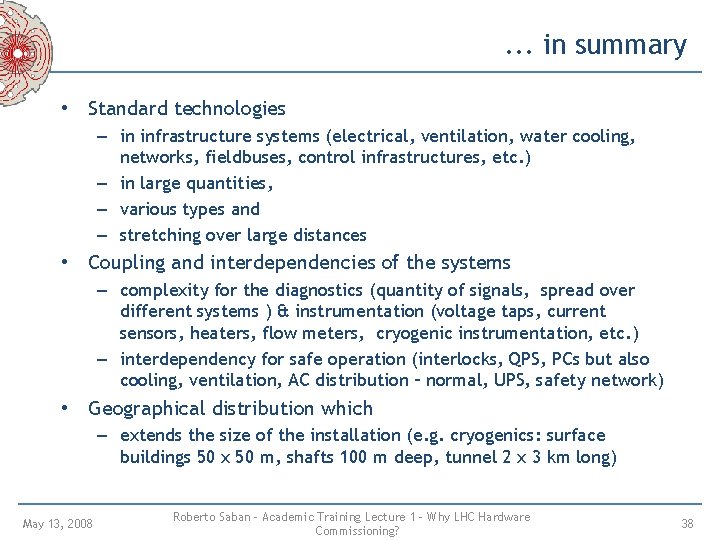
. . . in summary • Standard technologies – in infrastructure systems (electrical, ventilation, water cooling, networks, fieldbuses, control infrastructures, etc. ) – in large quantities, – various types and – stretching over large distances • Coupling and interdependencies of the systems – complexity for the diagnostics (quantity of signals, spread over different systems ) & instrumentation (voltage taps, current sensors, heaters, flow meters, cryogenic instrumentation, etc. ) – interdependency for safe operation (interlocks, QPS, PCs but also cooling, ventilation, AC distribution – normal, UPS, safety network) • Geographical distribution which – extends the size of the installation (e. g. cryogenics: surface buildings 50 x 50 m, shafts 100 m deep, tunnel 2 x 3 km long) May 13, 2008 Roberto Saban – Academic Training Lecture 1 – Why LHC Hardware Commissioning? 38
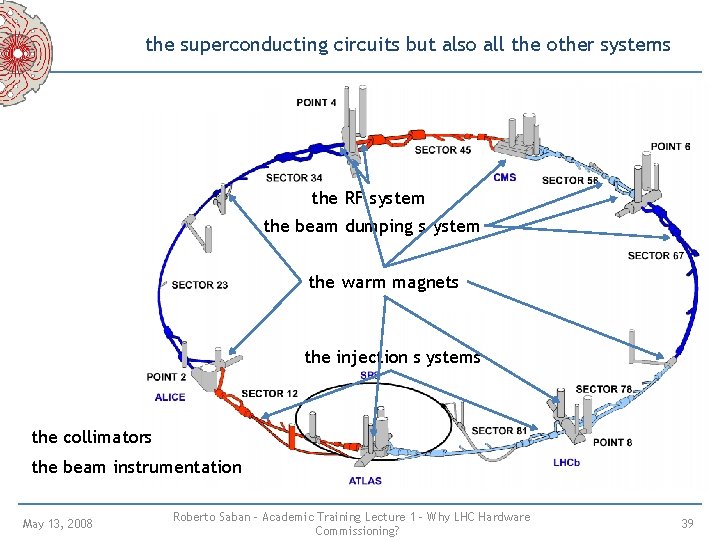
the superconducting circuits but also all the other systems the RF system the beam dumping s ystem the warm magnets the injection s ystems the collimators the beam instrumentation May 13, 2008 Roberto Saban – Academic Training Lecture 1 – Why LHC Hardware Commissioning? 39
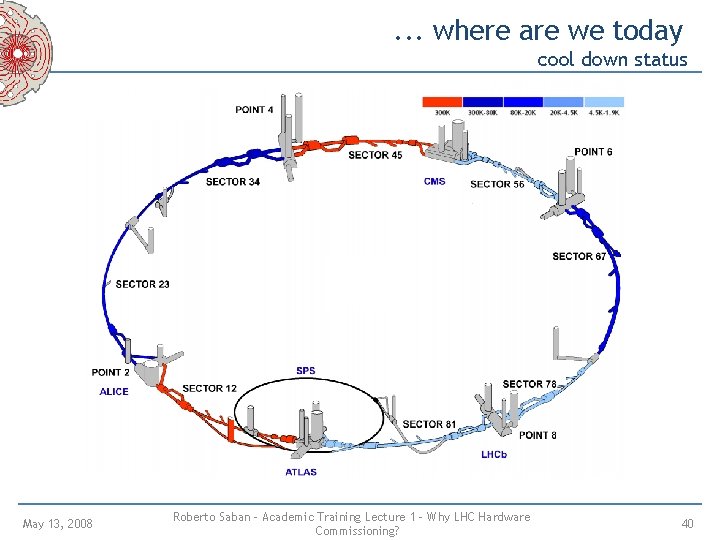
. . . where are we today cool down status May 13, 2008 Roberto Saban – Academic Training Lecture 1 – Why LHC Hardware Commissioning? 40
. . . where are we today cool down status Sector Average T [K] 12 300 Flushing 23 22 Cool down 34 177 Cool down 45 300 Commissioned to 5 Te. V except for the triplet Inner triplet now connected Consolidation complete Cool down starts in two weeks 56 2 Fully commissioned to 5 Te. V Dipoles and quadrupoles being trained to 7 Te. V 67 25 Cool down 78 2 Partially tested in June 2007 Inner triplet connected Powering tests start tomorrow 81 2 Powering tests start in one week May 13, 2008 Status Roberto Saban – Academic Training Lecture 1 – Why LHC Hardware Commissioning? 41
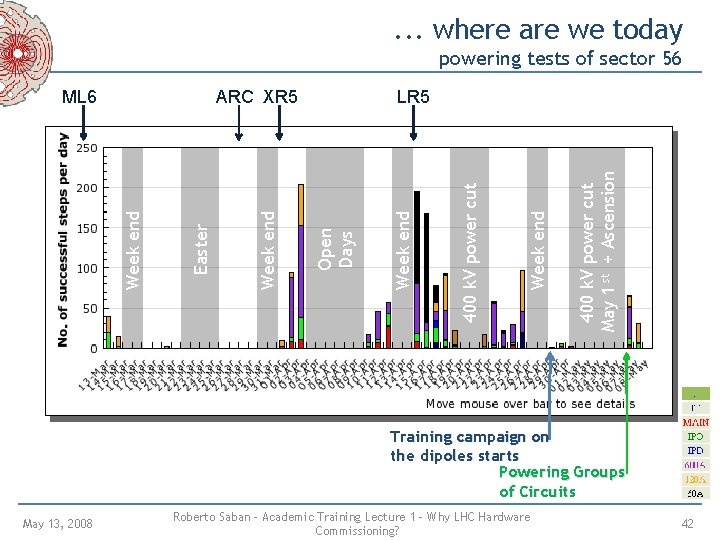
. . . where are we today powering tests of sector 56 400 k. V power cut May 1 st + Ascension Week end 400 k. V power cut Week end LR 5 Open Days Week end Easter ARC XR 5 Week end ML 6 Training campaign on the dipoles starts Powering Groups of Circuits May 13, 2008 Roberto Saban – Academic Training Lecture 1 – Why LHC Hardware Commissioning? 42
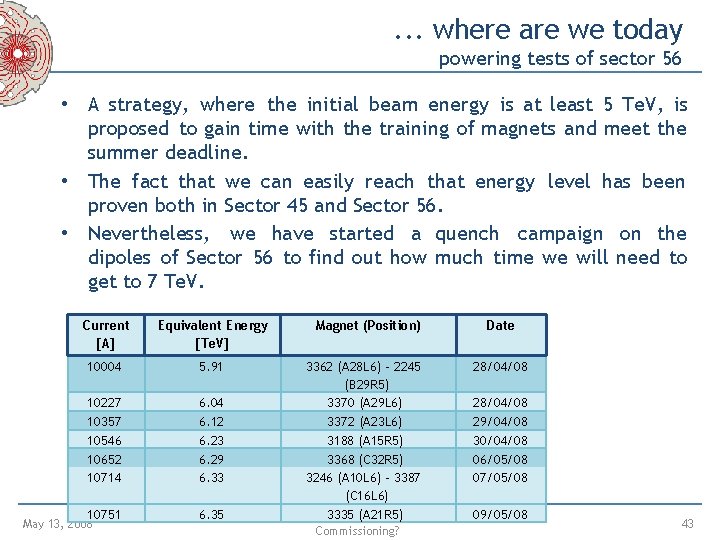
. . . where are we today powering tests of sector 56 • A strategy, where the initial beam energy is at least 5 Te. V, is proposed to gain time with the training of magnets and meet the summer deadline. • The fact that we can easily reach that energy level has been proven both in Sector 45 and Sector 56. • Nevertheless, we have started a quench campaign on the dipoles of Sector 56 to find out how much time we will need to get to 7 Te. V. Current [A] Equivalent Energy [Te. V] 10004 5. 91 10227 10357 10546 10652 10714 10751 May 13, 2008 Magnet (Position) Date 3362 (A 28 L 6) - 2245 28/04/08 (B 29 R 5) 6. 04 3370 (A 29 L 6) 28/04/08 6. 12 3372 (A 23 L 6) 29/04/08 6. 23 3188 (A 15 R 5) 30/04/08 6. 29 3368 (C 32 R 5) 06/05/08 6. 33 3246 (A 10 L 6) - 3387 07/05/08 (C 16 L 6) 6. 35 Saban – Academic Training 3335 (A 21 R 5) Roberto Lecture 1 – Why LHC 09/05/08 Hardware Commissioning? 43