
Commissioning of the CLAS 12 Torus Detector Magnet
- Slides: 24
Commissioning of the CLAS 12 Torus Detector Magnet at Jefferson Laboratory Cesar Luongo Thomas Jefferson National Accelerator Facility Newport News, Virginia, USA G. Biallas, K. Bruhwel, R. Fair , P. Ghoshal, D. Kashy , S. Mandal, J. Matalevich, M. Mestayer, R. Miller, R. Rajput-Ghoshal , C. Rode, N. Sandoval, G. Young Thomas Jefferson National Accelerator Facility , Newport News, VA, USA 2016 Applied Superconductivity Conference Denver, CO, USA September 4 -9, 2016 ASC-2016, Denver, CO – September 4 -9, 2016 1
Outline • Overview of Jefferson Lab and the Hall B-CLAS 12 Upgrade • The CLAS 12 Torus Detector Magnet – Coil Fabrication – Magnet Installation • Commissioning of the Torus Magnet – Administrative Steps and Safety Reviews – Phases of Commissioning • Leak-checking and vacuum pumping • Cooldown • Magnet energization • Field mapping ASC-2016, Denver, CO – September 4 -9, 2016 2
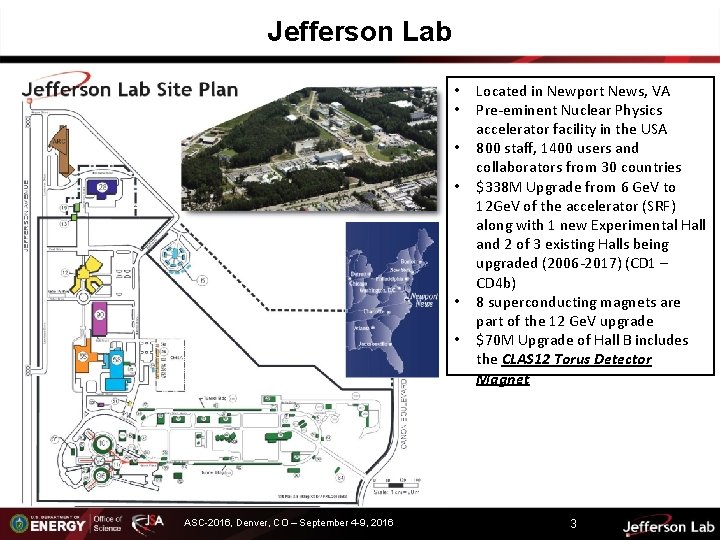
Jefferson Lab • • • ASC-2016, Denver, CO – September 4 -9, 2016 Located in Newport News, VA Pre-eminent Nuclear Physics accelerator facility in the USA 800 staff, 1400 users and collaborators from 30 countries $338 M Upgrade from 6 Ge. V to 12 Ge. V of the accelerator (SRF) along with 1 new Experimental Hall and 2 of 3 existing Halls being upgraded (2006 -2017) (CD 1 – CD 4 b) 8 superconducting magnets are part of the 12 Ge. V upgrade $70 M Upgrade of Hall B includes the CLAS 12 Torus Detector Magnet 3
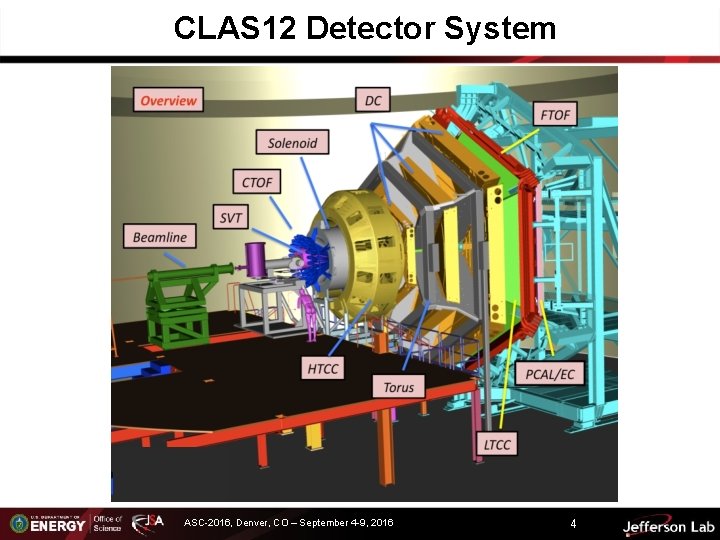
CLAS 12 Detector System ASC-2016, Denver, CO – September 4 -9, 2016 4
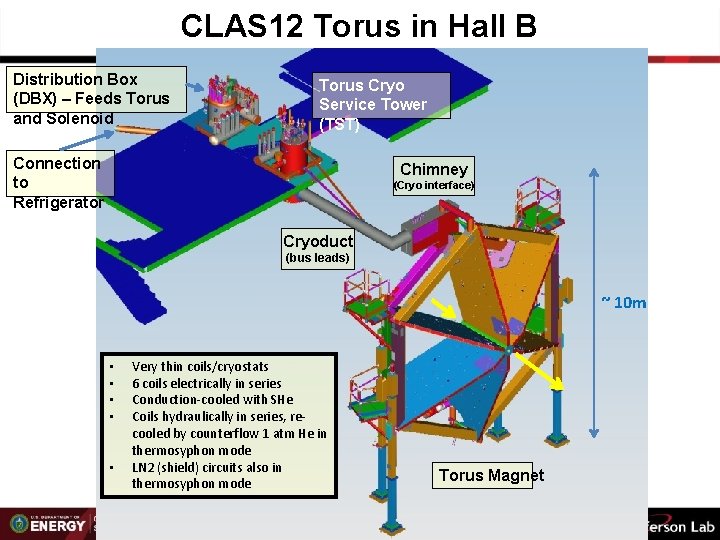
CLAS 12 Torus in Hall B Distribution Box (DBX) – Feeds Torus and Solenoid Torus Cryo Service Tower (TST) Connection to Refrigerator Chimney (Cryo interface) Cryoduct (bus leads) ~ 10 m • • • Very thin coils/cryostats 6 coils electrically in series Conduction-cooled with SHe Coils hydraulically in series, recooled by counterflow 1 atm He in thermosyphon mode LN 2 (shield) circuits also in thermosyphon mode ASC-2016, Denver, CO – September 4 -9, 2016 Torus Magnet 5
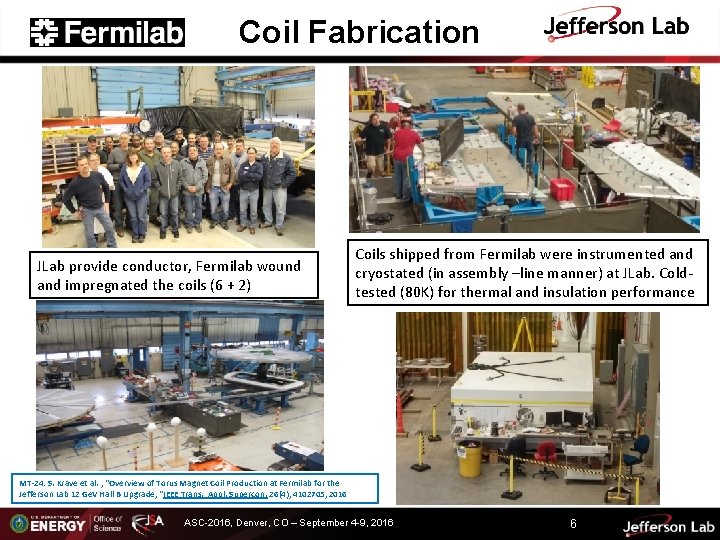
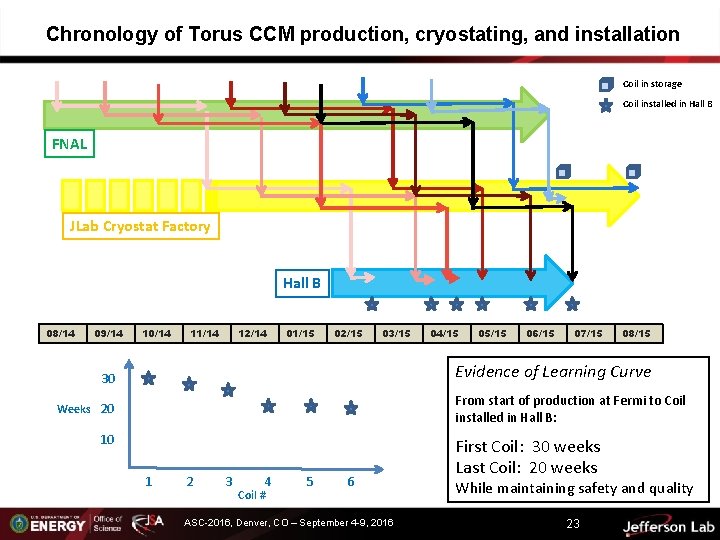
Coil Fabrication JLab provide conductor, Fermilab wound and impregnated the coils (6 + 2) Coils shipped from Fermilab were instrumented and cryostated (in assembly –line manner) at JLab. Coldtested (80 K) for thermal and insulation performance MT-24: S. Krave et al. , “Overview of Torus Magnet Coil Production at Fermilab for the Jefferson Lab 12 Ge. V Hall B Upgrade, “IEEE Trans. Appl. Supercon. 26(4), 4102705, 2016 ASC-2016, Denver, CO – September 4 -9, 2016 6
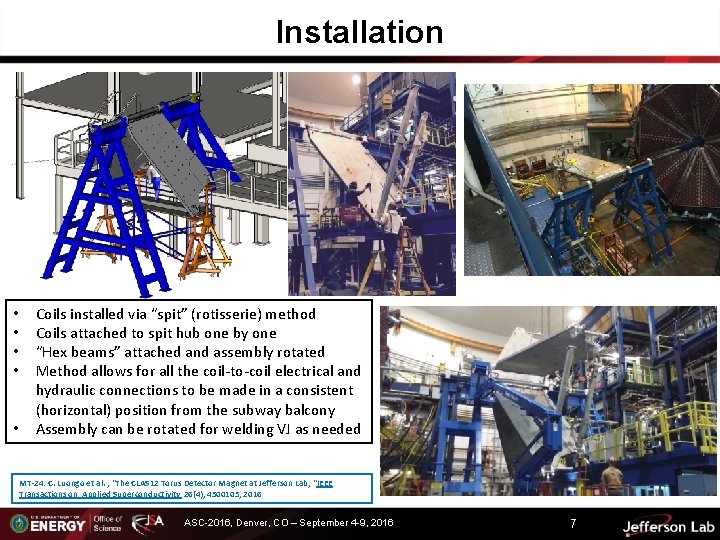
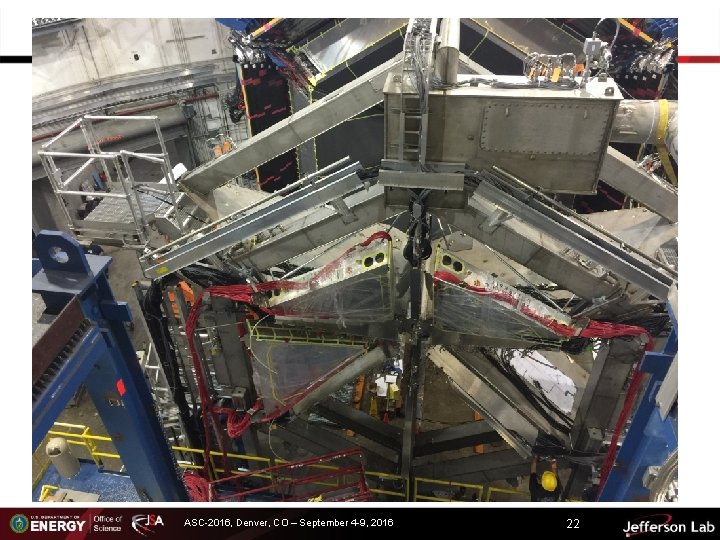
Installation • • • Coils installed via “spit” (rotisserie) method Coils attached to spit hub one by one “Hex beams” attached and assembly rotated Method allows for all the coil-to-coil electrical and hydraulic connections to be made in a consistent (horizontal) position from the subway balcony Assembly can be rotated for welding VJ as needed MT-24: C. Luongo et al. , “The CLAS 12 Torus Detector Magnet at Jefferson Lab, “IEEE Transactions on Applied Superconductivity 26(4), 4500105, 2016 ASC-2016, Denver, CO – September 4 -9, 2016 7
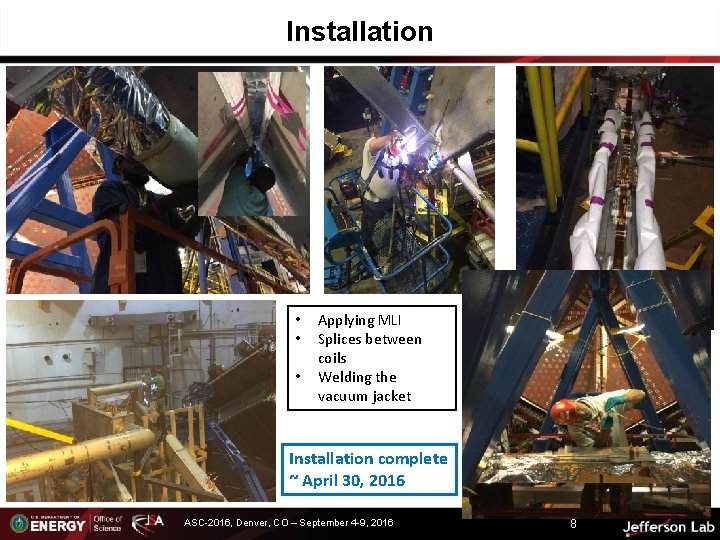
Installation • • • Applying MLI Splices between coils Welding the vacuum jacket Installation complete ~ April 30, 2016 ASC-2016, Denver, CO – September 4 -9, 2016 8
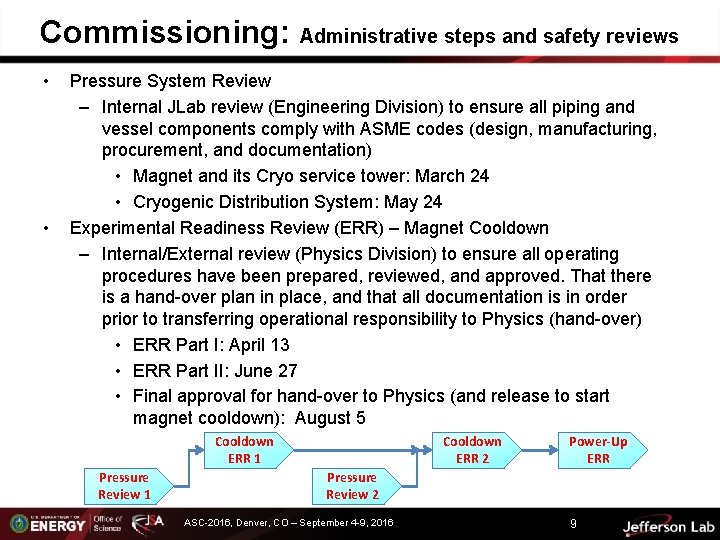
Commissioning: Administrative steps and safety reviews • • Pressure System Review – Internal JLab review (Engineering Division) to ensure all piping and vessel components comply with ASME codes (design, manufacturing, procurement, and documentation) • Magnet and its Cryo service tower: March 24 • Cryogenic Distribution System: May 24 Experimental Readiness Review (ERR) – Magnet Cooldown – Internal/External review (Physics Division) to ensure all operating procedures have been prepared, reviewed, and approved. That there is a hand-over plan in place, and that all documentation is in order prior to transferring operational responsibility to Physics (hand-over) • ERR Part I: April 13 • ERR Part II: June 27 • Final approval for hand-over to Physics (and release to start magnet cooldown): August 5 Cooldown ERR 1 Pressure Review 1 Cooldown ERR 2 Power-Up ERR Pressure Review 2 ASC-2016, Denver, CO – September 4 -9, 2016 9
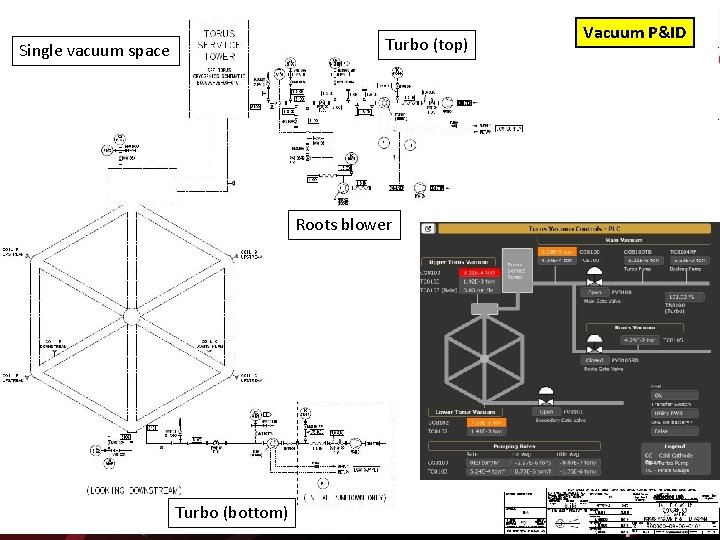
Single vacuum space Vacuum P&ID Turbo (top) Roots blower Turbo (bottom) ASC-2016, Denver, CO – September 4 -9, 2016 10
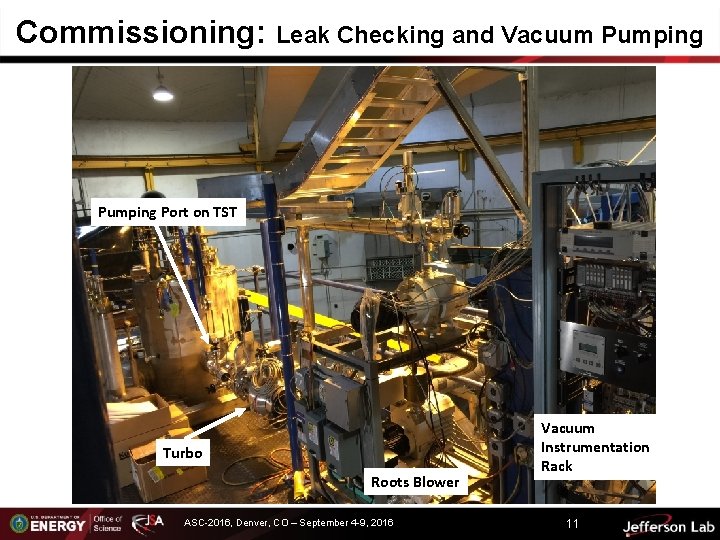
Commissioning: Leak Checking and Vacuum Pumping Port on TST Turbo Roots Blower ASC-2016, Denver, CO – September 4 -9, 2016 Vacuum Instrumentation Rack 11
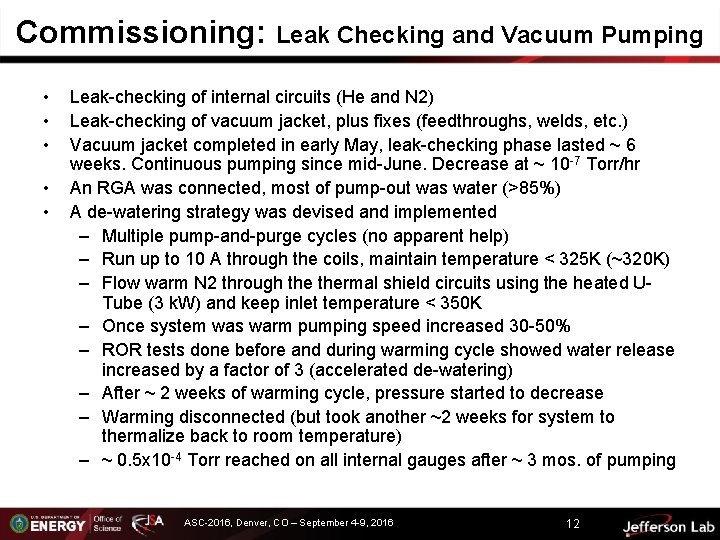
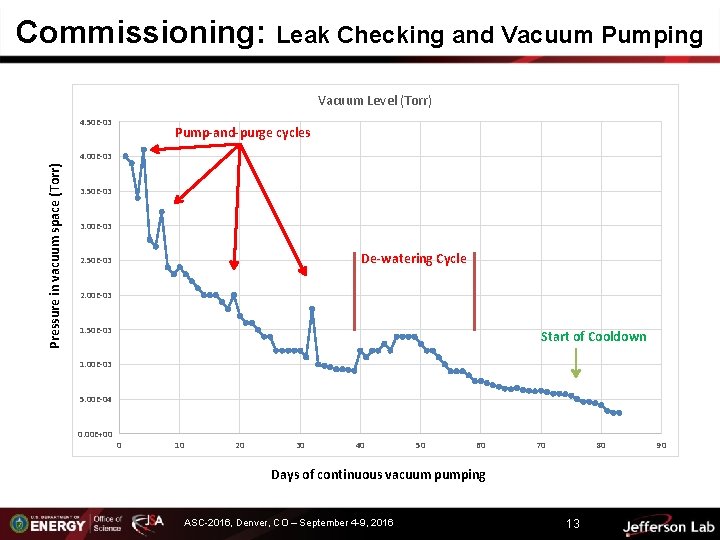
Commissioning: Leak Checking and Vacuum Pumping • • • Leak-checking of internal circuits (He and N 2) Leak-checking of vacuum jacket, plus fixes (feedthroughs, welds, etc. ) Vacuum jacket completed in early May, leak-checking phase lasted ~ 6 weeks. Continuous pumping since mid-June. Decrease at ~ 10 -7 Torr/hr An RGA was connected, most of pump-out was water (>85%) A de-watering strategy was devised and implemented – Multiple pump-and-purge cycles (no apparent help) – Run up to 10 A through the coils, maintain temperature < 325 K (~320 K) – Flow warm N 2 through thermal shield circuits using the heated UTube (3 k. W) and keep inlet temperature < 350 K – Once system was warm pumping speed increased 30 -50% – ROR tests done before and during warming cycle showed water release increased by a factor of 3 (accelerated de-watering) – After ~ 2 weeks of warming cycle, pressure started to decrease – Warming disconnected (but took another ~2 weeks for system to thermalize back to room temperature) – ~ 0. 5 x 10 -4 Torr reached on all internal gauges after ~ 3 mos. of pumping ASC-2016, Denver, CO – September 4 -9, 2016 12
Commissioning: Leak Checking and Vacuum Pumping Vacuum Level (Torr) 4. 50 E-03 Pump-and-purge cycles Pressure in vacuum space (Torr) 4. 00 E-03 3. 50 E-03 3. 00 E-03 De-watering Cycle 2. 50 E-03 2. 00 E-03 1. 50 E-03 Start of Cooldown 1. 00 E-03 5. 00 E-04 0. 00 E+00 0 10 20 30 40 50 60 70 80 Days of continuous vacuum pumping ASC-2016, Denver, CO – September 4 -9, 2016 13 90
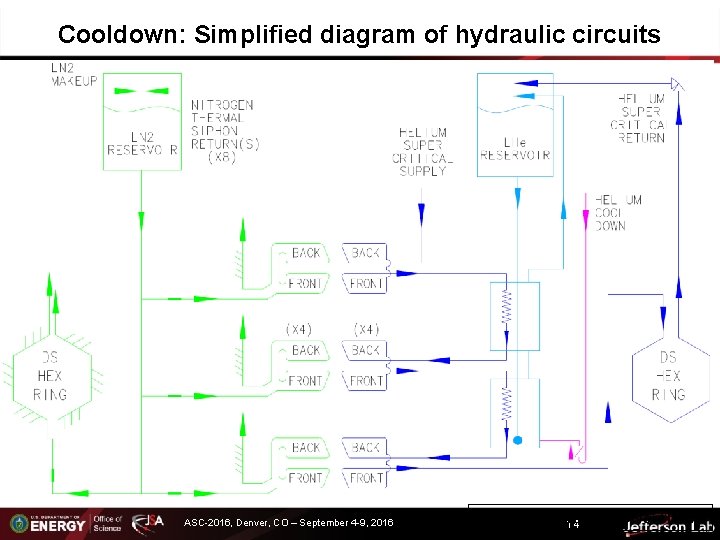
Cooldown: Simplified diagram of hydraulic circuits ASC-2016, Denver, CO – September 4 -9, 2016 * Pressure Relief 14 Valves Not Shown
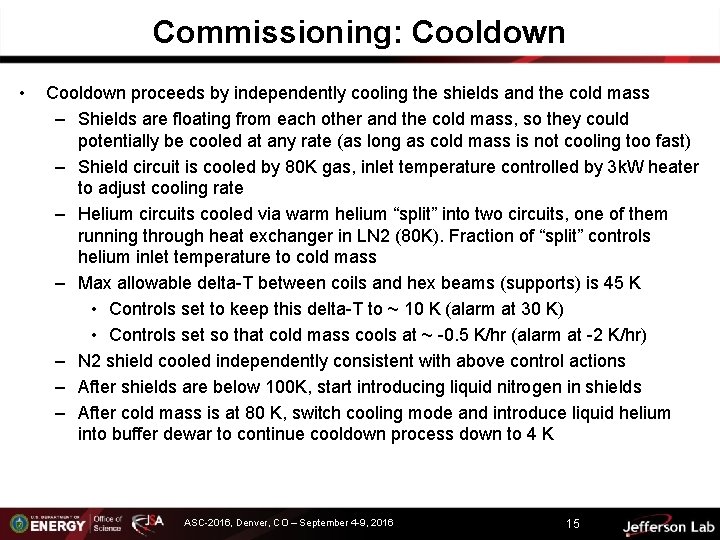
Commissioning: Cooldown • Cooldown proceeds by independently cooling the shields and the cold mass – Shields are floating from each other and the cold mass, so they could potentially be cooled at any rate (as long as cold mass is not cooling too fast) – Shield circuit is cooled by 80 K gas, inlet temperature controlled by 3 k. W heater to adjust cooling rate – Helium circuits cooled via warm helium “split” into two circuits, one of them running through heat exchanger in LN 2 (80 K). Fraction of “split” controls helium inlet temperature to cold mass – Max allowable delta-T between coils and hex beams (supports) is 45 K • Controls set to keep this delta-T to ~ 10 K (alarm at 30 K) • Controls set so that cold mass cools at ~ -0. 5 K/hr (alarm at -2 K/hr) – N 2 shield cooled independently consistent with above control actions – After shields are below 100 K, start introducing liquid nitrogen in shields – After cold mass is at 80 K, switch cooling mode and introduce liquid helium into buffer dewar to continue cooldown process down to 4 K ASC-2016, Denver, CO – September 4 -9, 2016 15
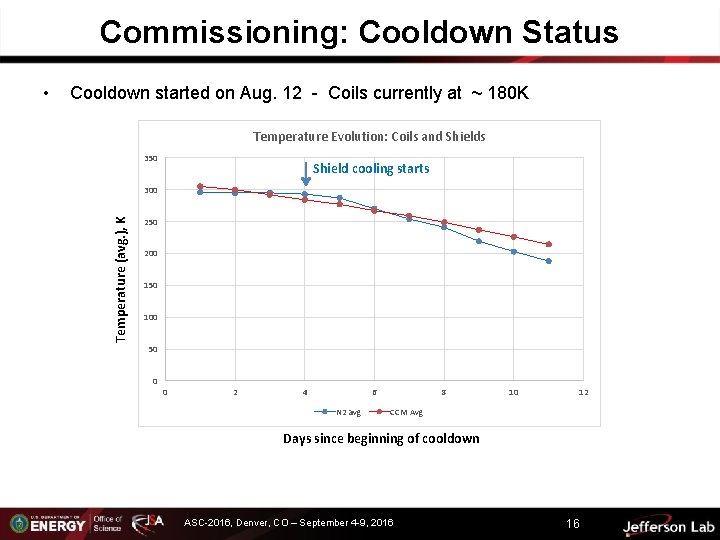
Commissioning: Cooldown Status Cooldown started on Aug. 12 - Coils currently at ~ 180 K Temperature Evolution: Coils and Shields 350 Shield cooling starts 300 Temperature (avg. ), K • 250 200 150 100 50 0 0 2 4 6 N 2 avg 8 10 12 CCM Avg Days since beginning of cooldown ASC-2016, Denver, CO – September 4 -9, 2016 16
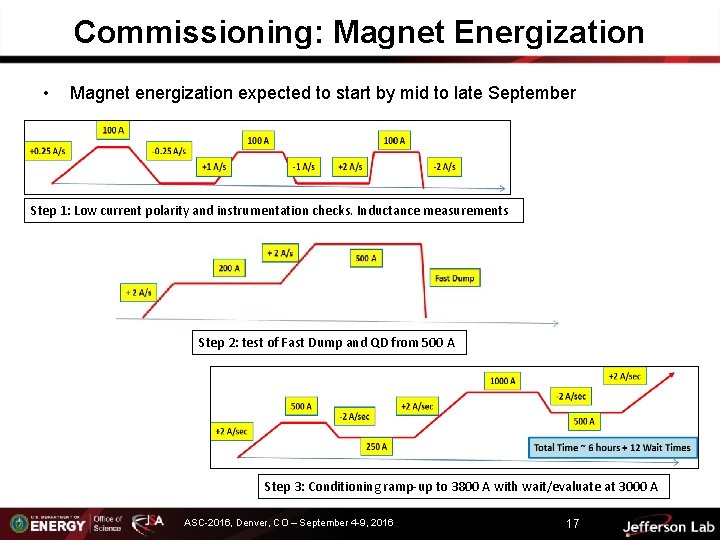
Commissioning: Magnet Energization • Magnet energization expected to start by mid to late September Step 1: Low current polarity and instrumentation checks. Inductance measurements Step 2: test of Fast Dump and QD from 500 A Step 3: Conditioning ramp-up to 3800 A with wait/evaluate at 3000 A ASC-2016, Denver, CO – September 4 -9, 2016 17
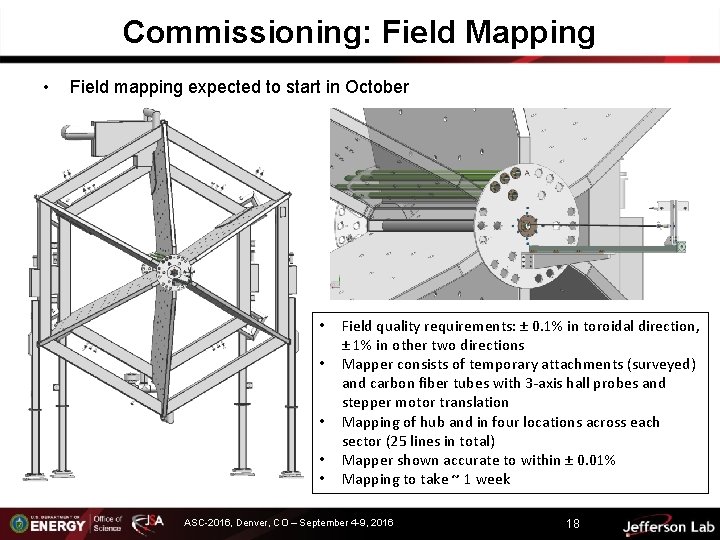
Commissioning: Field Mapping • Field mapping expected to start in October • • • Field quality requirements: ± 0. 1% in toroidal direction, ± 1% in other two directions Mapper consists of temporary attachments (surveyed) and carbon fiber tubes with 3 -axis hall probes and stepper motor translation Mapping of hub and in four locations across each sector (25 lines in total) Mapper shown accurate to within ± 0. 01% Mapping to take ~ 1 week ASC-2016, Denver, CO – September 4 -9, 2016 18
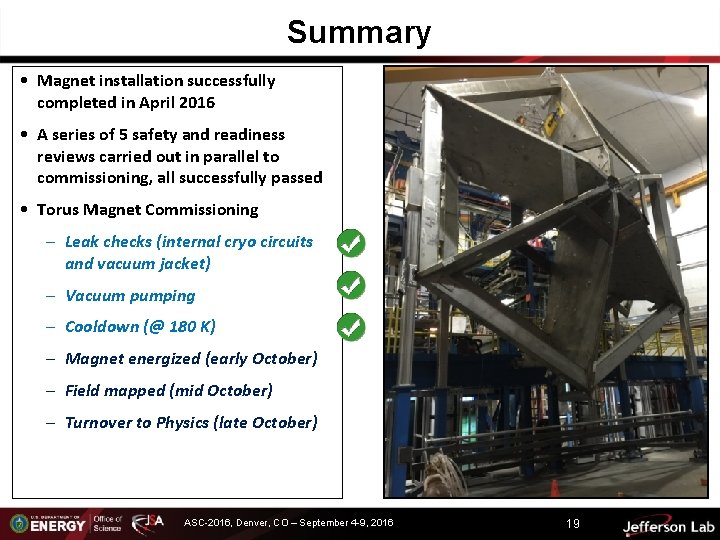
Summary • Magnet installation successfully completed in April 2016 • A series of 5 safety and readiness reviews carried out in parallel to commissioning, all successfully passed • Torus Magnet Commissioning – Leak checks (internal cryo circuits and vacuum jacket) – Vacuum pumping – Cooldown (@ 180 K) – Magnet energized (early October) – Field mapped (mid October) – Turnover to Physics (late October) ASC-2016, Denver, CO – September 4 -9, 2016 19
BACK-UPS ASC-2016, Denver, CO – September 4 -9, 2016 20
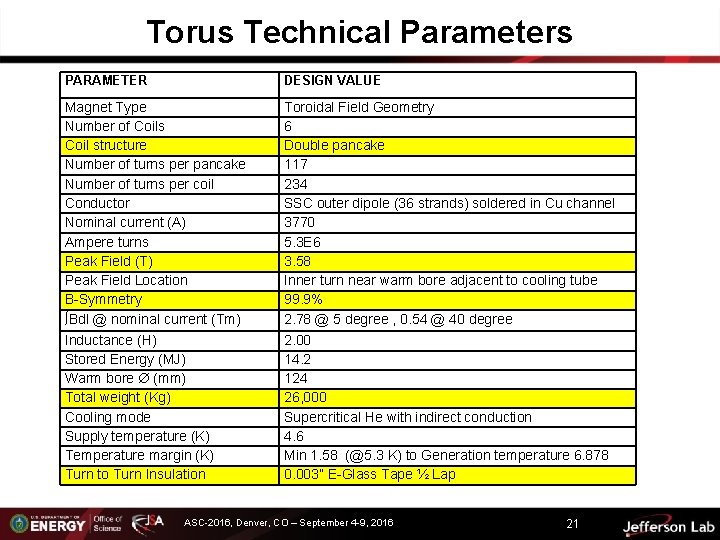
Torus Technical Parameters PARAMETER DESIGN VALUE Magnet Type Number of Coils Coil structure Number of turns per pancake Number of turns per coil Conductor Nominal current (A) Ampere turns Peak Field (T) Peak Field Location B-Symmetry Bdl @ nominal current (Tm) Toroidal Field Geometry 6 Double pancake 117 234 SSC outer dipole (36 strands) soldered in Cu channel 3770 5. 3 E 6 3. 58 Inner turn near warm bore adjacent to cooling tube 99. 9% 2. 78 @ 5 degree , 0. 54 @ 40 degree Inductance (H) Stored Energy (MJ) Warm bore (mm) Total weight (Kg) Cooling mode Supply temperature (K) Temperature margin (K) Turn to Turn Insulation 2. 00 14. 2 124 26, 000 Supercritical He with indirect conduction 4. 6 Min 1. 58 (@5. 3 K) to Generation temperature 6. 878 0. 003” E-Glass Tape ½ Lap ASC-2016, Denver, CO – September 4 -9, 2016 21
ASC-2016, Denver, CO – September 4 -9, 2016 22
Chronology of Torus CCM production, cryostating, and installation Coil in storage Coil installed in Hall B FNAL JLab Cryostat Factory Hall B 08/14 09/14 10/14 11/14 12/14 01/15 02/15 03/15 04/15 05/15 06/15 07/15 08/15 Evidence of Learning Curve 30 From start of production at Fermi to Coil installed in Hall B: Weeks 20 10 1 2 3 4 Coil # 5 6 ASC-2016, Denver, CO – September 4 -9, 2016 First Coil: 30 weeks Last Coil: 20 weeks While maintaining safety and quality 23
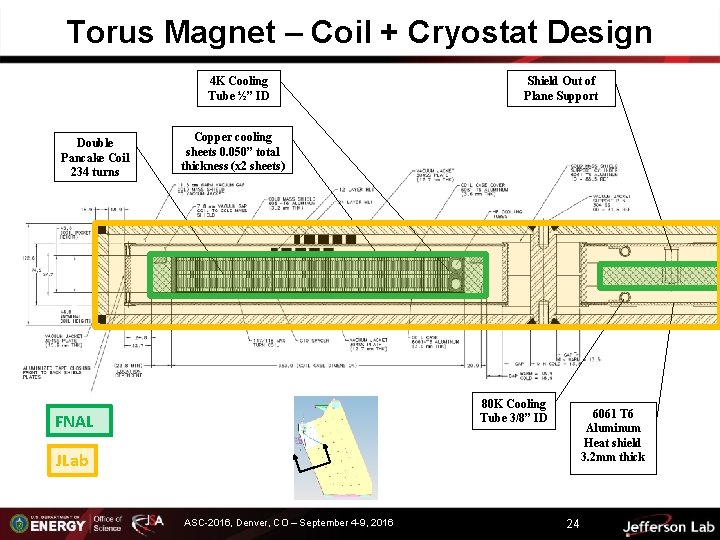
Torus Magnet – Coil + Cryostat Design 4 K Cooling Tube ½” ID Double Pancake Coil 234 turns Shield Out of Plane Support Copper cooling sheets 0. 050” total thickness (x 2 sheets) 80 K Cooling Tube 3/8” ID FNAL 6061 T 6 Aluminum Heat shield 3. 2 mm thick JLab ASC-2016, Denver, CO – September 4 -9, 2016 24