
Commissioning and Operation of the Horizontal Test Apparatus

- Slides: 21
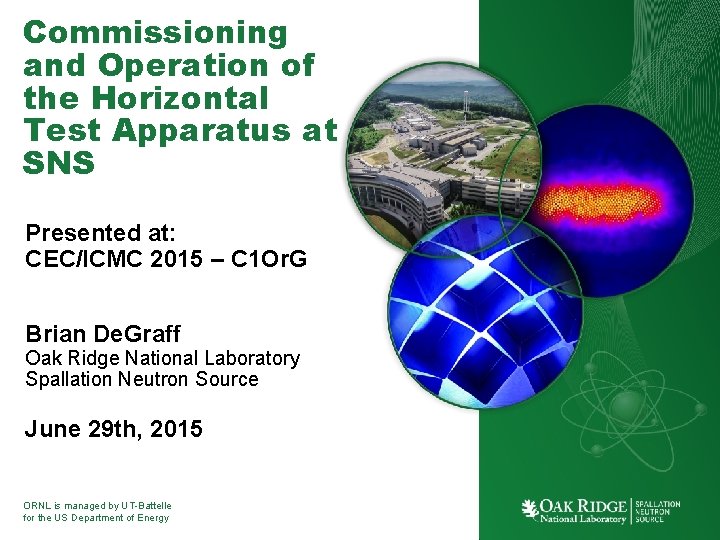
Commissioning and Operation of the Horizontal Test Apparatus at SNS Presented at: CEC/ICMC 2015 – C 1 Or. G Brian De. Graff Oak Ridge National Laboratory Spallation Neutron Source June 29 th, 2015 ORNL is managed by UT-Battelle for the US Department of Energy
Overview • Background • Design & Fabrication • Commissioning & Operation • Current R&D using HTA • Summary 2 CEC/ICMC 2015 – De. Graff HTA Presentation
Background 3 CEC/ICMC 2015 – De. Graff HTA Presentation
Motivation for HTA at SNS • SNS in operation since 2006 – Highest average proton beam linac in the world, 1. 4 MW demonstrated • SCL: 81 SRF cavities in 23 cryomodules • Cryoplant: 2. 4 k. W at 2. 1 K – Excellent availability of SCL systems ~98% (including supporting sub-systems) – Linac output energy 940 Me. V • Limiting factor for SRF cavity performance – Electron activity (field emission, multipacting) resulting in end group quench – End groups made of reactor grade niobium with lower thermal conductivity • Testing cavity performance in horizontal configuration – Aim to reach 1 Ge. V to provide margin for reliable 1. 4 MW operation – Horizontal Test Apparatus for R&D in cryomodule-like environment • Better understand limiting factors of SNS cavities • R&D for performance improvement 4 CEC/ICMC 2015 – De. Graff HTA Presentation
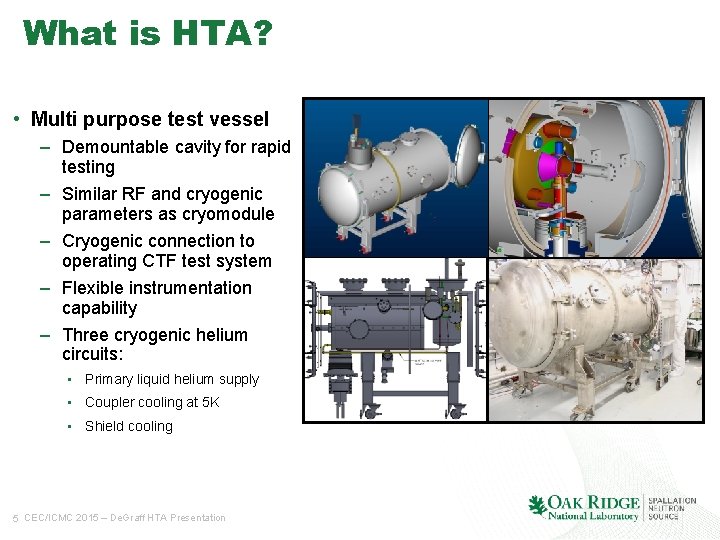
What is HTA? • Multi purpose test vessel – Demountable cavity for rapid testing – Similar RF and cryogenic parameters as cryomodule – Cryogenic connection to operating CTF test system – Flexible instrumentation capability – Three cryogenic helium circuits: • Primary liquid helium supply • Coupler cooling at 5 K • Shield cooling 5 CEC/ICMC 2015 – De. Graff HTA Presentation
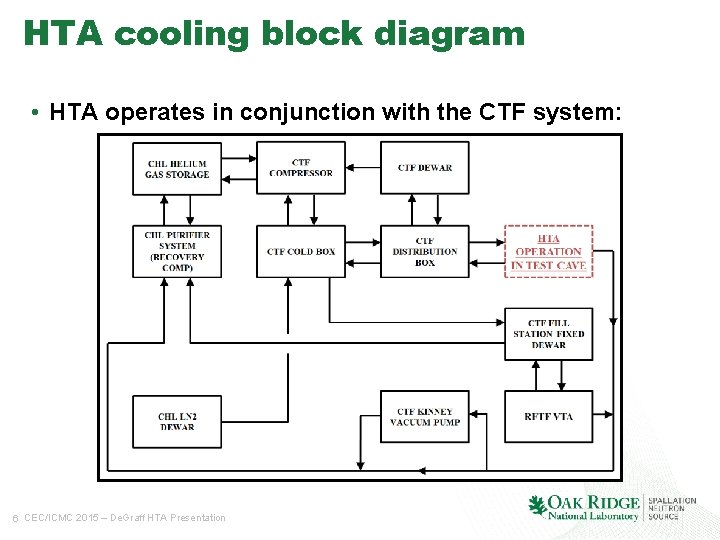
HTA cooling block diagram • HTA operates in conjunction with the CTF system: 6 CEC/ICMC 2015 – De. Graff HTA Presentation
Design & Fabrication 7 CEC/ICMC 2015 – De. Graff HTA Presentation
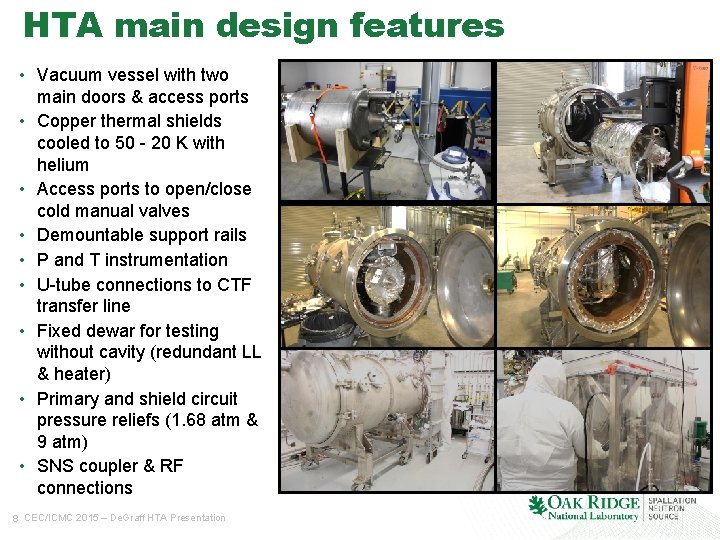
HTA main design features • Vacuum vessel with two main doors & access ports • Copper thermal shields cooled to 50 - 20 K with helium • Access ports to open/close cold manual valves • Demountable support rails • P and T instrumentation • U-tube connections to CTF transfer line • Fixed dewar for testing without cavity (redundant LL & heater) • Primary and shield circuit pressure reliefs (1. 68 atm & 9 atm) • SNS coupler & RF connections 8 CEC/ICMC 2015 – De. Graff HTA Presentation
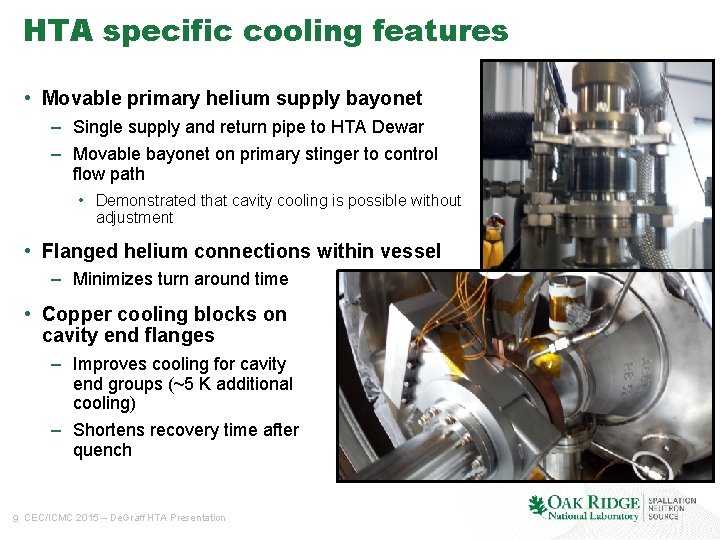
HTA specific cooling features • Movable primary helium supply bayonet – Single supply and return pipe to HTA Dewar – Movable bayonet on primary stinger to control flow path • Demonstrated that cavity cooling is possible without adjustment • Flanged helium connections within vessel – Minimizes turn around time • Copper cooling blocks on cavity end flanges – Improves cooling for cavity end groups (~5 K additional cooling) – Shortens recovery time after quench 9 CEC/ICMC 2015 – De. Graff HTA Presentation
Examples of HTA instrumentation • Instrumentation box outside of HTA – Connected to the beam tube extension through the HTA door – Phosphorous screen and faraday cup to monitor eactivity – Camera with direct view of cavity volume • Additional diodes – Monitoring of end-group temperatures – Help better understand their thermal behavior 10 CEC/ICMC 2015 – De. Graff HTA Presentation
Commissioning & Operation 11 CEC/ICMC 2015 – De. Graff HTA Presentation
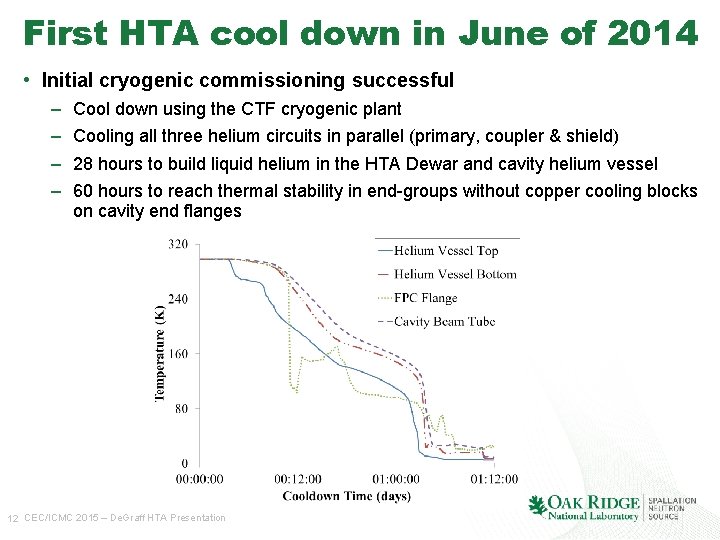
First HTA cool down in June of 2014 • Initial cryogenic commissioning successful – – Cool down using the CTF cryogenic plant Cooling all three helium circuits in parallel (primary, coupler & shield) 28 hours to build liquid helium in the HTA Dewar and cavity helium vessel 60 hours to reach thermal stability in end-groups without copper cooling blocks on cavity end flanges 12 CEC/ICMC 2015 – De. Graff HTA Presentation
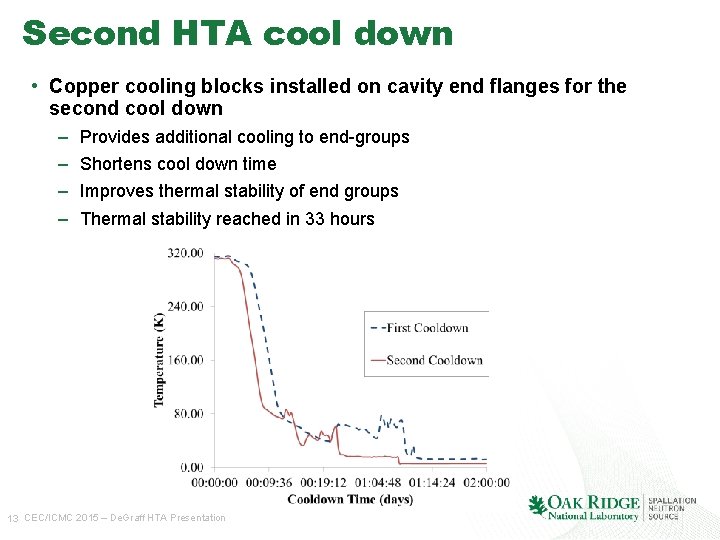
Second HTA cool down • Copper cooling blocks installed on cavity end flanges for the second cool down – – Provides additional cooling to end-groups Shortens cool down time Improves thermal stability of end groups Thermal stability reached in 33 hours 13 CEC/ICMC 2015 – De. Graff HTA Presentation
HTA cryogenic loads • Static heat load – 9. 6 W static heat load to the cavity liquid helium bath calculated by measuring the liquid level drop with the primary JT valve closed – Static heat load to the shield circuit not determined as no flow meter is available • Dynamic heat load – Cavity heat dissipation below CTF cooling capacity • Liquefaction load to secondary He circuit – Circuit cooling the FPC & end-groups cooling blocks – Cooling flow measured with the outlet valve fully open • 0. 75 g/s in the range of 6 K to 10 K 14 CEC/ICMC 2015 – De. Graff HTA Presentation
Current R&D using HTA 15 CEC/ICMC 2015 – De. Graff HTA Presentation
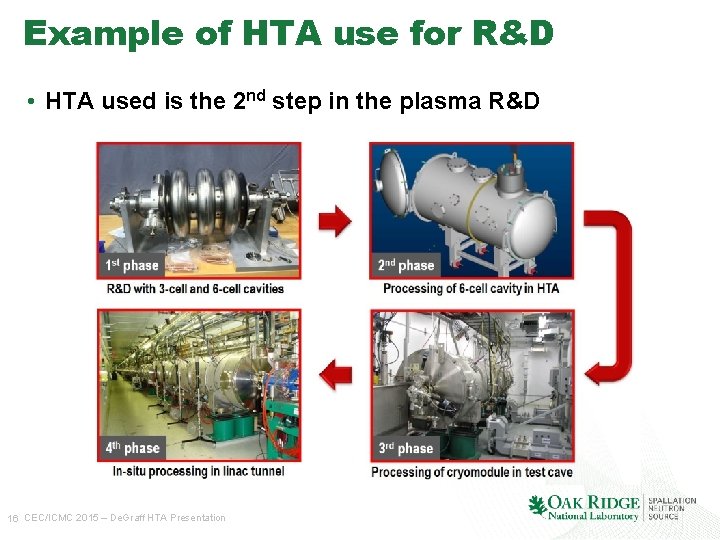
Example of HTA use for R&D • HTA used is the 2 nd step in the plasma R&D 16 CEC/ICMC 2015 – De. Graff HTA Presentation
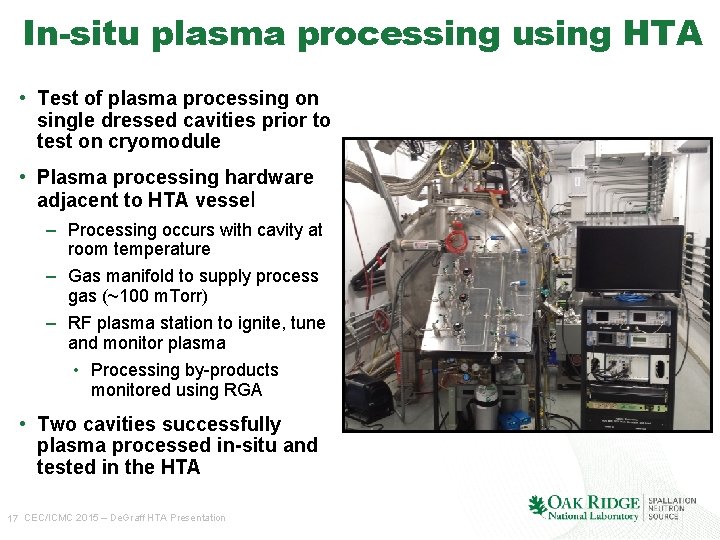
In-situ plasma processing using HTA • Test of plasma processing on single dressed cavities prior to test on cryomodule • Plasma processing hardware adjacent to HTA vessel – Processing occurs with cavity at room temperature – Gas manifold to supply process gas (~100 m. Torr) – RF plasma station to ignite, tune and monitor plasma • Processing by-products monitored using RGA • Two cavities successfully plasma processed in-situ and tested in the HTA 17 CEC/ICMC 2015 – De. Graff HTA Presentation
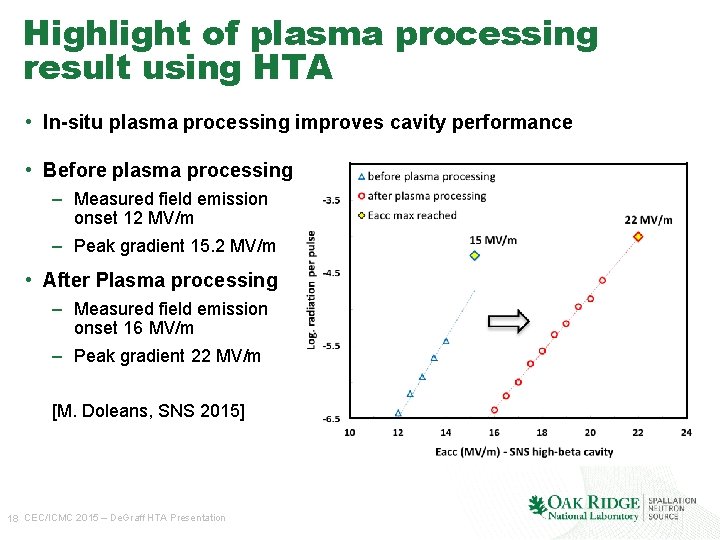
Highlight of plasma processing result using HTA • In-situ plasma processing improves cavity performance • Before plasma processing – Measured field emission onset 12 MV/m – Peak gradient 15. 2 MV/m • After Plasma processing – Measured field emission onset 16 MV/m – Peak gradient 22 MV/m [M. Doleans, SNS 2015] 18 CEC/ICMC 2015 – De. Graff HTA Presentation
Summary • The HTA was successfully commissioned in 2014 • It performed as desired over five cryogenic tests over the past two years • Ideal platform for testing cavities and subsystems in a cryomodule like environment while providing great flexibility for instrumentation, for example – Two Cavities were successfully plasma processed in-situ and tested using the HTA • Planned activities – Cold-test of cavity with high RRR end-groups – Test of 700 k. W fundamental power coupler with a cavity – 2 K HTA operation using Kinney system 19 CEC/ICMC 2015 – De. Graff HTA Presentation
Acknowledgements THANKS! I would like to thank many colleagues and support groups at SNS and Ability Engineering for their assistance in performing the HTA testing described in this paper, especially personnel from controls, electrical, RF and water groups. This work was supported by SNS through UT-Battelle, LLC, under contract DE-AC 05 -00 OR 22725 for the U. S. DOE. 20 CEC/ICMC 2015 – De. Graff HTA Presentation
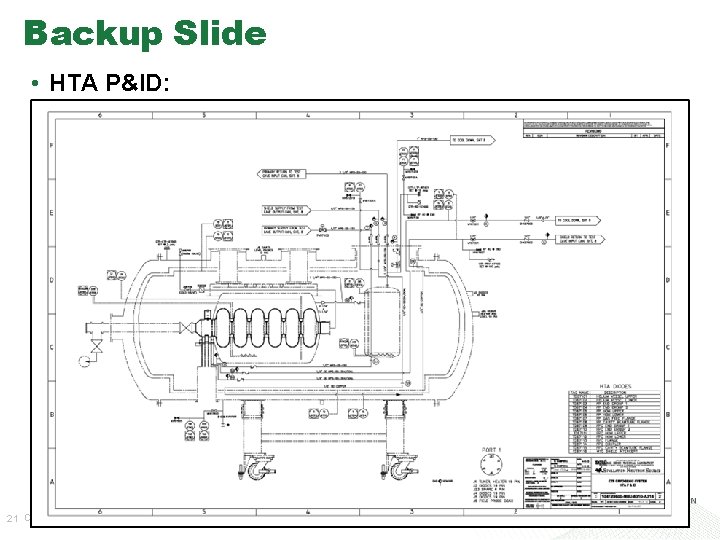
Backup Slide • HTA P&ID: 21 CEC/ICMC 2015 – De. Graff HTA Presentation