
COMMISSION AND TRADE DISCOUNT Course Code and Title



- Slides: 43
COMMISSION AND TRADE DISCOUNT Course Code and Title: ISD 151 Business Mathematics Lecturer: Abdul Samed Muntaka
OUTLINE Definition of Commission Essence of Commission and Discount in Business Types of Commission Commercial Discount Trade Discount Retail Discount Returned Merchandise and Freight Charges
COMMISSION
DEFINITION OF COMMISSION A commission is an amount paid to a sales officer or an agent for performing a service or business transaction on behalf of an individual or organisation. It is usually calculated as a proportion/percentage of total sales or the total amount collected/earned from the transaction. Commission = Sales (Amount involved) × Rate of Commission
DEFINITION OF COMMISSION CONT’D Some organisations require their sales staff to make a certain level of sales before they earn a commission or their basic salary. This level of sales the sales officer must make is referred to as a Quota A Quota is a level of sale (or an amount) that an agent or sales officer must meet to earn a commission or their basic salary. Where a quota exist, commission is calculated on a commission amount. Commission = Commission Amount × Rate of Commission Amount = Sales – Quota NB: Commission amount is the amount on which commission is calculated or paid
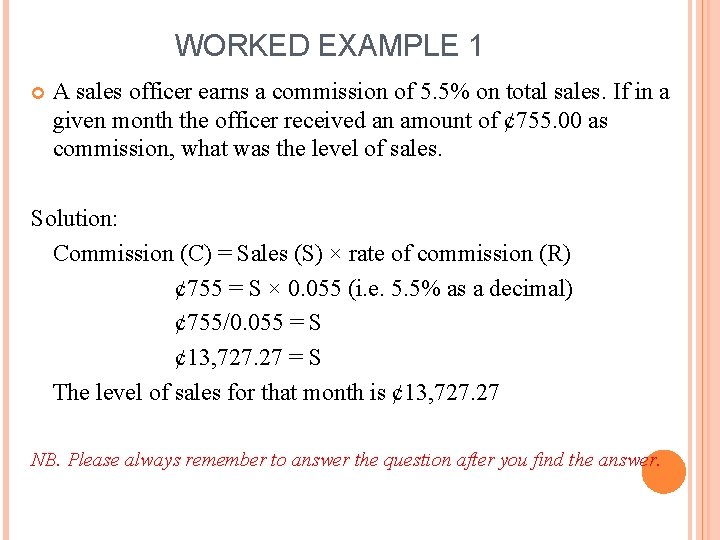
WORKED EXAMPLE 1 A sales officer earns a commission of 5. 5% on total sales. If in a given month the officer received an amount of ¢ 755. 00 as commission, what was the level of sales. Solution: Commission (C) = Sales (S) × rate of commission (R) ¢ 755 = S × 0. 055 (i. e. 5. 5% as a decimal) ¢ 755/0. 055 = S ¢ 13, 727. 27 = S The level of sales for that month is ¢ 13, 727. 27 NB. Please always remember to answer the question after you find the answer.
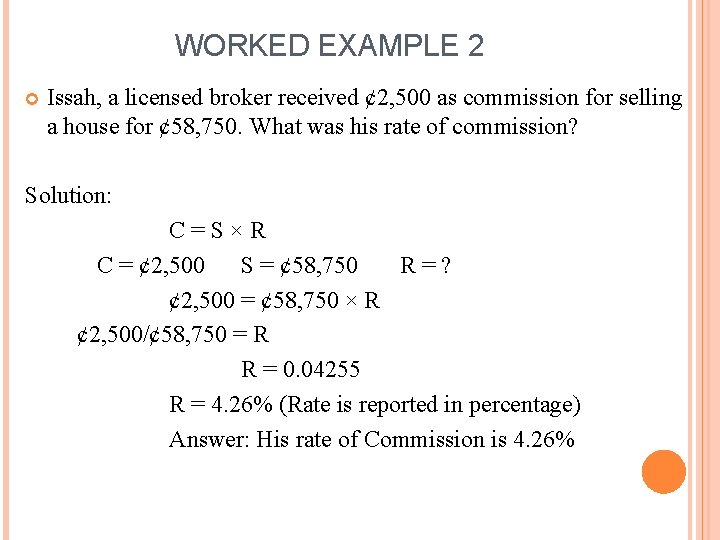
WORKED EXAMPLE 2 Issah, a licensed broker received ¢ 2, 500 as commission for selling a house for ¢ 58, 750. What was his rate of commission? Solution: C=S×R C = ¢ 2, 500 S = ¢ 58, 750 R=? ¢ 2, 500 = ¢ 58, 750 × R ¢ 2, 500/¢ 58, 750 = R R = 0. 04255 R = 4. 26% (Rate is reported in percentage) Answer: His rate of Commission is 4. 26%
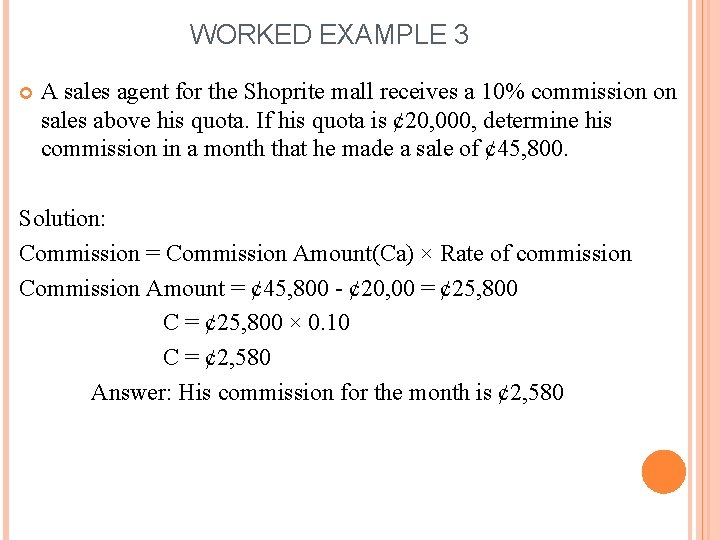
WORKED EXAMPLE 3 A sales agent for the Shoprite mall receives a 10% commission on sales above his quota. If his quota is ¢ 20, 000, determine his commission in a month that he made a sale of ¢ 45, 800. Solution: Commission = Commission Amount(Ca) × Rate of commission Commission Amount = ¢ 45, 800 - ¢ 20, 00 = ¢ 25, 800 C = ¢ 25, 800 × 0. 10 C = ¢ 2, 580 Answer: His commission for the month is ¢ 2, 580
TYPES OF COMMISSION Generally, there about 5 types of commissions. They are: Straight commission – a type of commission in which the agent or salesman's earnings is based on commission alone. It is usually ‘one’ percent. E. G 4. Marcus earns a 5% commission on sales. What is his earning if his sale is ¢ 2, 000. In this example, Marcus’s earning is based on the 5% commission alone. Solution: C=S×R C = ¢ 2, 000 × 0. 05 C = ¢ 100 1.
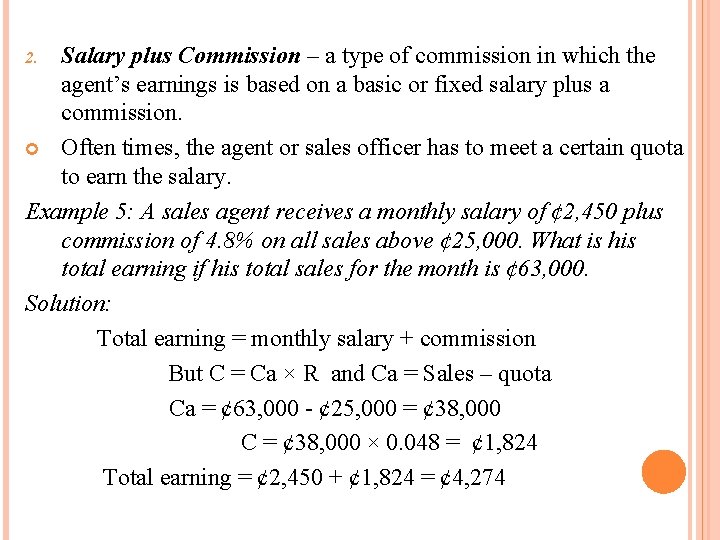
Salary plus Commission – a type of commission in which the agent’s earnings is based on a basic or fixed salary plus a commission. Often times, the agent or sales officer has to meet a certain quota to earn the salary. Example 5: A sales agent receives a monthly salary of ¢ 2, 450 plus commission of 4. 8% on all sales above ¢ 25, 000. What is his total earning if his total sales for the month is ¢ 63, 000. Solution: Total earning = monthly salary + commission But C = Ca × R and Ca = Sales – quota Ca = ¢ 63, 000 - ¢ 25, 000 = ¢ 38, 000 C = ¢ 38, 000 × 0. 048 = ¢ 1, 824 Total earning = ¢ 2, 450 + ¢ 1, 824 = ¢ 4, 274 2.
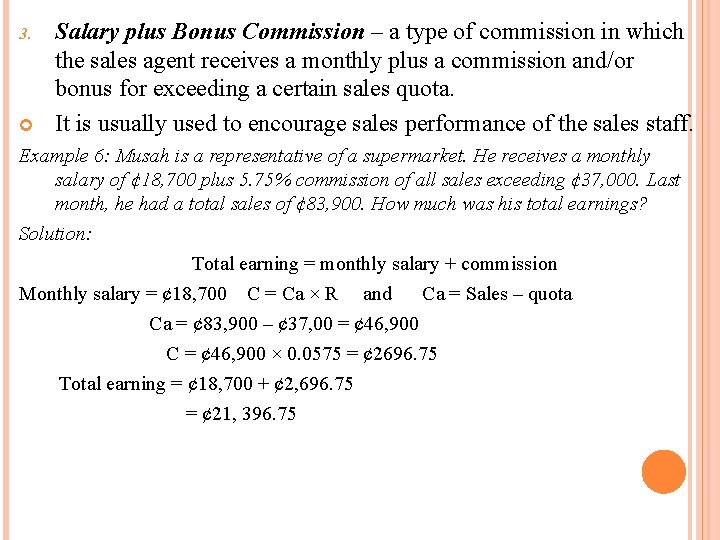
3. Salary plus Bonus Commission – a type of commission in which the sales agent receives a monthly plus a commission and/or bonus for exceeding a certain sales quota. It is usually used to encourage sales performance of the sales staff. Example 6: Musah is a representative of a supermarket. He receives a monthly salary of ¢ 18, 700 plus 5. 75% commission of all sales exceeding ¢ 37, 000. Last month, he had a total sales of ¢ 83, 900. How much was his total earnings? Solution: Total earning = monthly salary + commission Monthly salary = ¢ 18, 700 C = Ca × R and Ca = Sales – quota Ca = ¢ 83, 900 – ¢ 37, 00 = ¢ 46, 900 C = ¢ 46, 900 × 0. 0575 = ¢ 2696. 75 Total earning = ¢ 18, 700 + ¢ 2, 696. 75 = ¢ 21, 396. 75
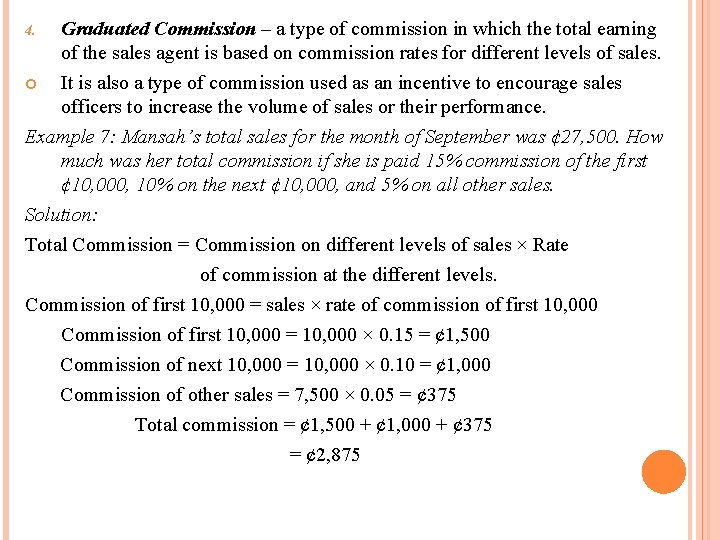
Graduated Commission – a type of commission in which the total earning of the sales agent is based on commission rates for different levels of sales. It is also a type of commission used as an incentive to encourage sales officers to increase the volume of sales or their performance. Example 7: Mansah’s total sales for the month of September was ¢ 27, 500. How much was her total commission if she is paid 15% commission of the first ¢ 10, 000, 10% on the next ¢ 10, 000, and 5% on all other sales. Solution: Total Commission = Commission on different levels of sales × Rate of commission at the different levels. Commission of first 10, 000 = sales × rate of commission of first 10, 000 Commission of first 10, 000 = 10, 000 × 0. 15 = ¢ 1, 500 Commission of next 10, 000 = 10, 000 × 0. 10 = ¢ 1, 000 Commission of other sales = 7, 500 × 0. 05 = ¢ 375 Total commission = ¢ 1, 500 + ¢ 1, 000 + ¢ 375 = ¢ 2, 875 4.
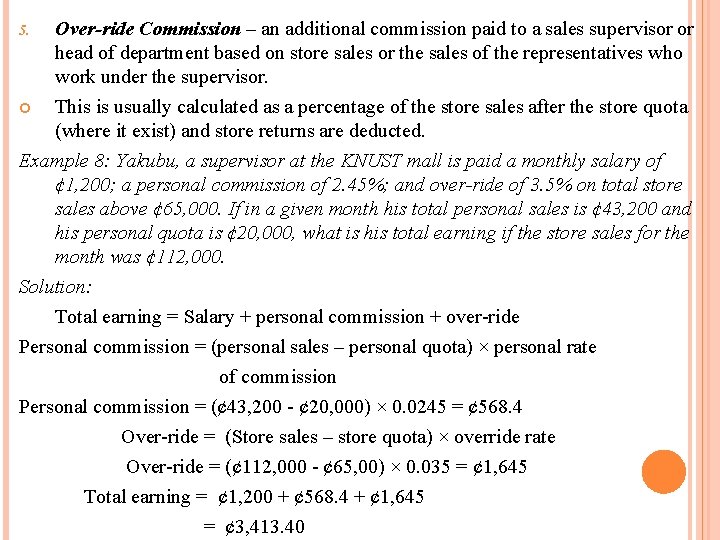
5. Over-ride Commission – an additional commission paid to a sales supervisor or head of department based on store sales or the sales of the representatives who work under the supervisor. This is usually calculated as a percentage of the store sales after the store quota (where it exist) and store returns are deducted. Example 8: Yakubu, a supervisor at the KNUST mall is paid a monthly salary of ¢ 1, 200; a personal commission of 2. 45%; and over-ride of 3. 5% on total store sales above ¢ 65, 000. If in a given month his total personal sales is ¢ 43, 200 and his personal quota is ¢ 20, 000, what is his total earning if the store sales for the month was ¢ 112, 000. Solution: Total earning = Salary + personal commission + over-ride Personal commission = (personal sales – personal quota) × personal rate of commission Personal commission = (¢ 43, 200 - ¢ 20, 000) × 0. 0245 = ¢ 568. 4 Over-ride = (Store sales – store quota) × override rate Over-ride = (¢ 112, 000 - ¢ 65, 00) × 0. 035 = ¢ 1, 645 Total earning = ¢ 1, 200 + ¢ 568. 4 + ¢ 1, 645 = ¢ 3, 413. 40
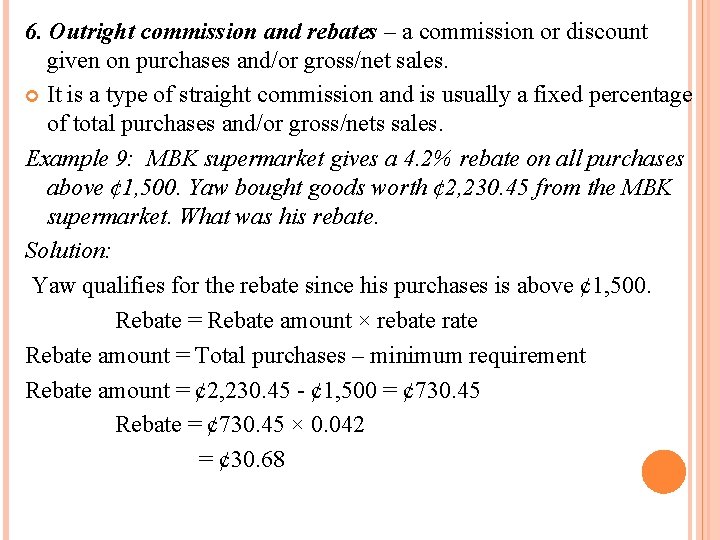
6. Outright commission and rebates – a commission or discount given on purchases and/or gross/net sales. It is a type of straight commission and is usually a fixed percentage of total purchases and/or gross/nets sales. Example 9: MBK supermarket gives a 4. 2% rebate on all purchases above ¢ 1, 500. Yaw bought goods worth ¢ 2, 230. 45 from the MBK supermarket. What was his rebate. Solution: Yaw qualifies for the rebate since his purchases is above ¢ 1, 500. Rebate = Rebate amount × rebate rate Rebate amount = Total purchases – minimum requirement Rebate amount = ¢ 2, 230. 45 - ¢ 1, 500 = ¢ 730. 45 Rebate = ¢ 730. 45 × 0. 042 = ¢ 30. 68
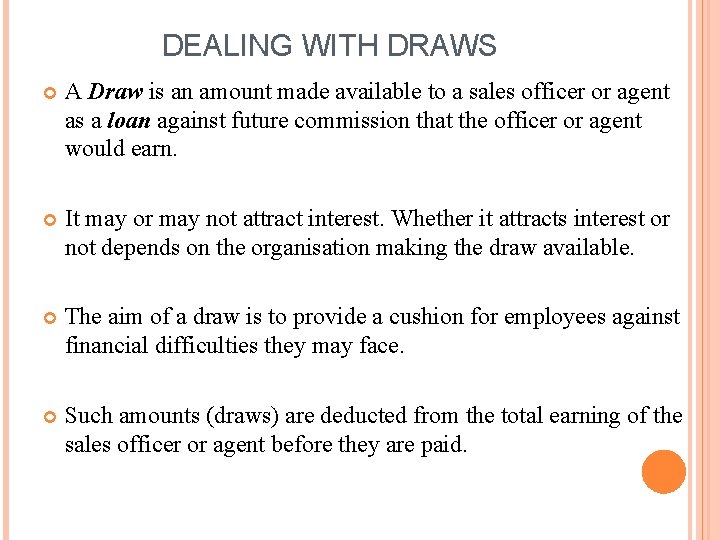
DEALING WITH DRAWS A Draw is an amount made available to a sales officer or agent as a loan against future commission that the officer or agent would earn. It may or may not attract interest. Whether it attracts interest or not depends on the organisation making the draw available. The aim of a draw is to provide a cushion for employees against financial difficulties they may face. Such amounts (draws) are deducted from the total earning of the sales officer or agent before they are paid.
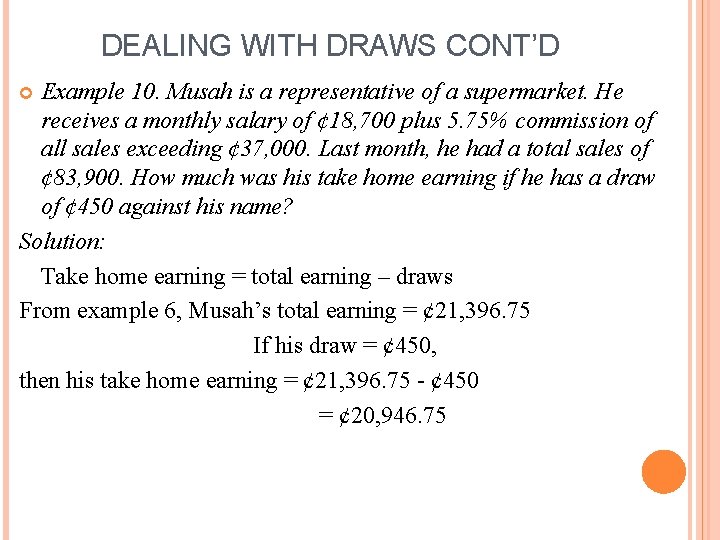
DEALING WITH DRAWS CONT’D Example 10. Musah is a representative of a supermarket. He receives a monthly salary of ¢ 18, 700 plus 5. 75% commission of all sales exceeding ¢ 37, 000. Last month, he had a total sales of ¢ 83, 900. How much was his take home earning if he has a draw of ¢ 450 against his name? Solution: Take home earning = total earning – draws From example 6, Musah’s total earning = ¢ 21, 396. 75 If his draw = ¢ 450, then his take home earning = ¢ 21, 396. 75 - ¢ 450 = ¢ 20, 946. 75
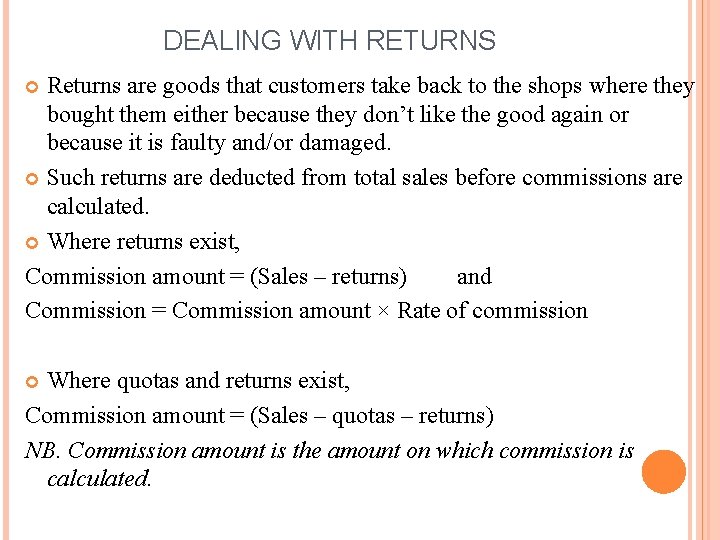
DEALING WITH RETURNS Returns are goods that customers take back to the shops where they bought them either because they don’t like the good again or because it is faulty and/or damaged. Such returns are deducted from total sales before commissions are calculated. Where returns exist, Commission amount = (Sales – returns) and Commission = Commission amount × Rate of commission Where quotas and returns exist, Commission amount = (Sales – quotas – returns) NB. Commission amount is the amount on which commission is calculated.
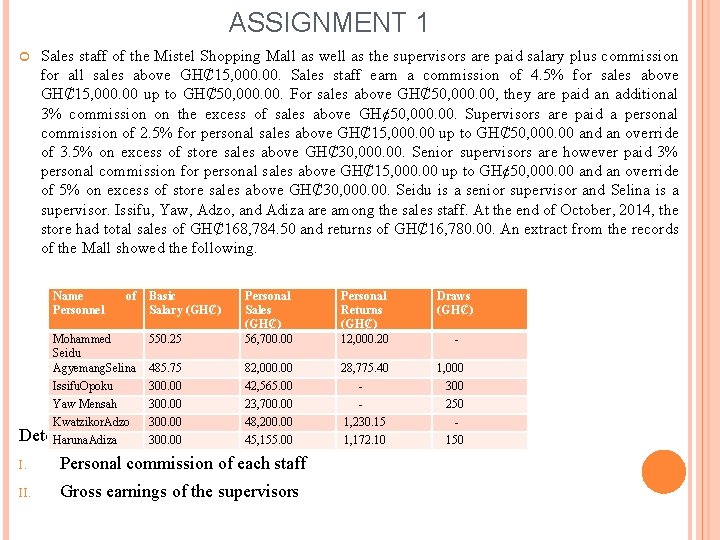
ASSIGNMENT 1 Sales staff of the Mistel Shopping Mall as well as the supervisors are paid salary plus commission for all sales above GHȻ 15, 000. Sales staff earn a commission of 4. 5% for sales above GHȻ 15, 000. 00 up to GHȻ 50, 000. For sales above GHȻ 50, 000. 00, they are paid an additional 3% commission on the excess of sales above GH¢ 50, 000. Supervisors are paid a personal commission of 2. 5% for personal sales above GHȻ 15, 000. 00 up to GHȻ 50, 000. 00 and an override of 3. 5% on excess of store sales above GHȻ 30, 000. Senior supervisors are however paid 3% personal commission for personal sales above GHȻ 15, 000. 00 up to GH¢ 50, 000. 00 and an override of 5% on excess of store sales above GHȻ 30, 000. Seidu is a senior supervisor and Selina is a supervisor. Issifu, Yaw, Adzo, and Adiza are among the sales staff. At the end of October, 2014, the store had total sales of GHȻ 168, 784. 50 and returns of GHȻ 16, 780. 00. An extract from the records of the Mall showed the following. Name Personnel of Mohammed Seidu Agyemang. Selina Issifu. Opoku Yaw Mensah Kwatzikor. Adzo Determine: Haruna. Adiza Basic Salary (GHȻ) Personal Returns (GHȻ) 12, 000. 20 Draws (GHȻ) 550. 25 Personal Sales (GHȻ) 56, 700. 00 485. 75 300. 00 82, 000. 00 42, 565. 00 23, 700. 00 48, 200. 00 45, 155. 00 28, 775. 40 1, 230. 15 1, 172. 10 1, 000 300 250 150 I. Personal commission of each staff II. Gross earnings of the supervisors -
TRADE DISCOUNTS
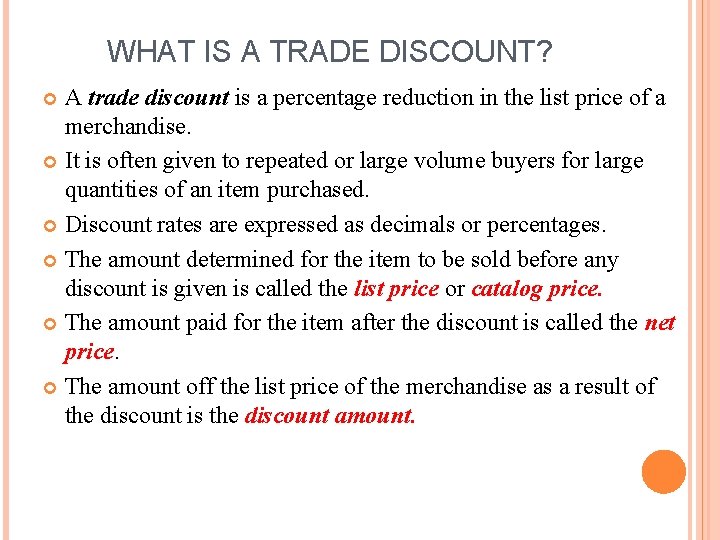
WHAT IS A TRADE DISCOUNT? A trade discount is a percentage reduction in the list price of a merchandise. It is often given to repeated or large volume buyers for large quantities of an item purchased. Discount rates are expressed as decimals or percentages. The amount determined for the item to be sold before any discount is given is called the list price or catalog price. The amount paid for the item after the discount is called the net price. The amount off the list price of the merchandise as a result of the discount is the discount amount.
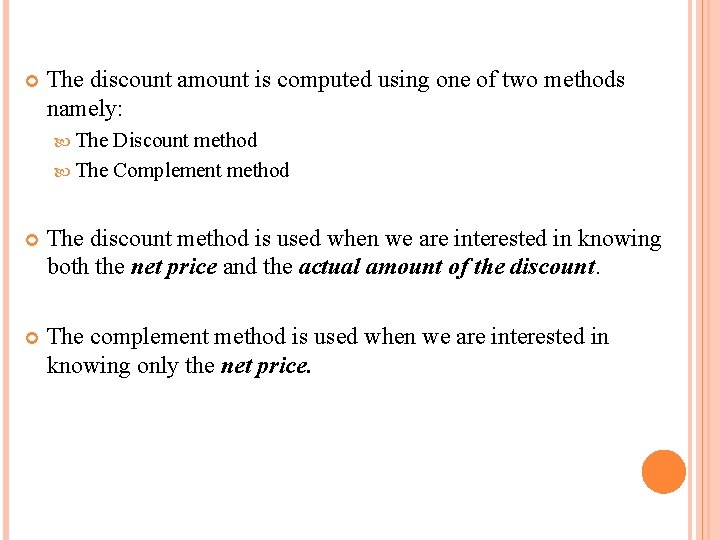
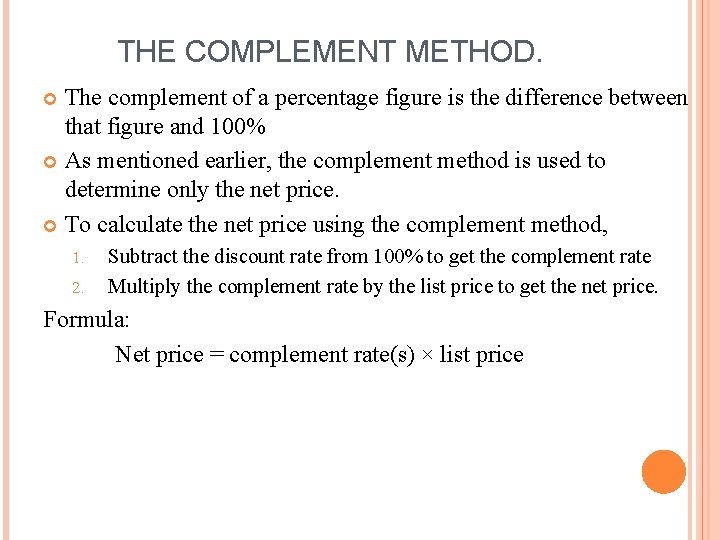
The discount amount is computed using one of two methods namely: The Discount method The Complement method The discount method is used when we are interested in knowing both the net price and the actual amount of the discount. The complement method is used when we are interested in knowing only the net price.
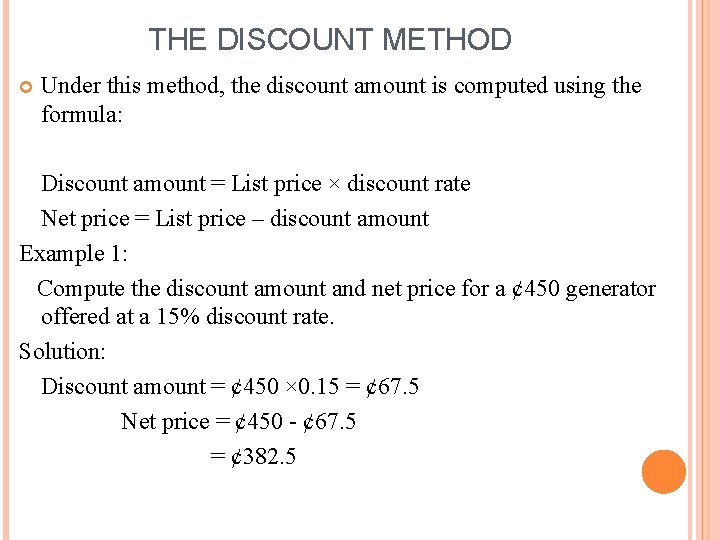
THE DISCOUNT METHOD Under this method, the discount amount is computed using the formula: Discount amount = List price × discount rate Net price = List price – discount amount Example 1: Compute the discount amount and net price for a ¢ 450 generator offered at a 15% discount rate. Solution: Discount amount = ¢ 450 × 0. 15 = ¢ 67. 5 Net price = ¢ 450 - ¢ 67. 5 = ¢ 382. 5
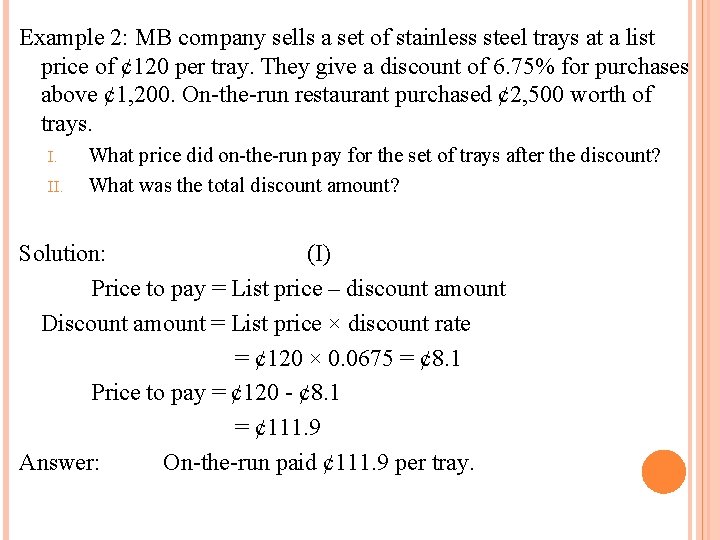
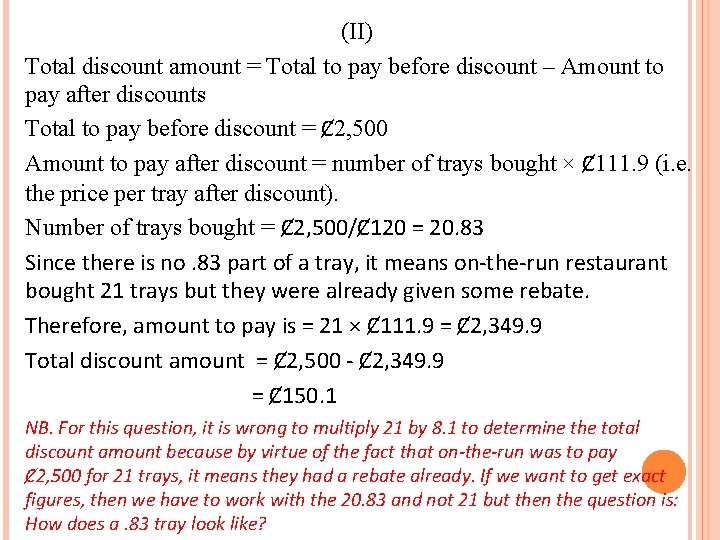
Example 2: MB company sells a set of stainless steel trays at a list price of ¢ 120 per tray. They give a discount of 6. 75% for purchases above ¢ 1, 200. On-the-run restaurant purchased ¢ 2, 500 worth of trays. I. II. What price did on-the-run pay for the set of trays after the discount? What was the total discount amount? Solution: (I) Price to pay = List price – discount amount Discount amount = List price × discount rate = ¢ 120 × 0. 0675 = ¢ 8. 1 Price to pay = ¢ 120 - ¢ 8. 1 = ¢ 111. 9 Answer: On-the-run paid ¢ 111. 9 per tray.
(II) Total discount amount = Total to pay before discount – Amount to pay after discounts Total to pay before discount = Ȼ 2, 500 Amount to pay after discount = number of trays bought × Ȼ 111. 9 (i. e. the price per tray after discount). Number of trays bought = Ȼ 2, 500/Ȼ 120 = 20. 83 Since there is no. 83 part of a tray, it means on-the-run restaurant bought 21 trays but they were already given some rebate. Therefore, amount to pay is = 21 × Ȼ 111. 9 = Ȼ 2, 349. 9 Total discount amount = Ȼ 2, 500 - Ȼ 2, 349. 9 = Ȼ 150. 1 NB. For this question, it is wrong to multiply 21 by 8. 1 to determine the total discount amount because by virtue of the fact that on-the-run was to pay Ȼ 2, 500 for 21 trays, it means they had a rebate already. If we want to get exact figures, then we have to work with the 20. 83 and not 21 but then the question is: How does a. 83 tray look like?
THE COMPLEMENT METHOD. The complement of a percentage figure is the difference between that figure and 100% As mentioned earlier, the complement method is used to determine only the net price. To calculate the net price using the complement method, 1. 2. Subtract the discount rate from 100% to get the complement rate Multiply the complement rate by the list price to get the net price. Formula: Net price = complement rate(s) × list price
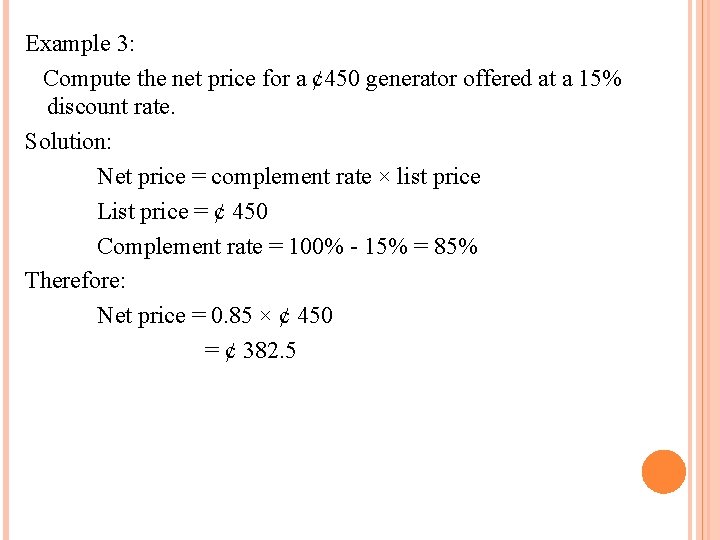
Example 3: Compute the net price for a ¢ 450 generator offered at a 15% discount rate. Solution: Net price = complement rate × list price List price = ¢ 450 Complement rate = 100% - 15% = 85% Therefore: Net price = 0. 85 × ¢ 450 = ¢ 382. 5
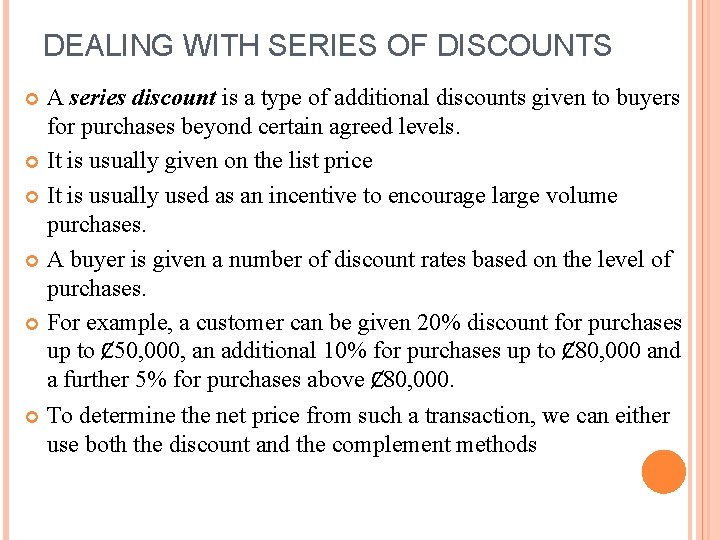
DEALING WITH SERIES OF DISCOUNTS A series discount is a type of additional discounts given to buyers for purchases beyond certain agreed levels. It is usually given on the list price It is usually used as an incentive to encourage large volume purchases. A buyer is given a number of discount rates based on the level of purchases. For example, a customer can be given 20% discount for purchases up to Ȼ 50, 000, an additional 10% for purchases up to Ȼ 80, 000 and a further 5% for purchases above Ȼ 80, 000. To determine the net price from such a transaction, we can either use both the discount and the complement methods
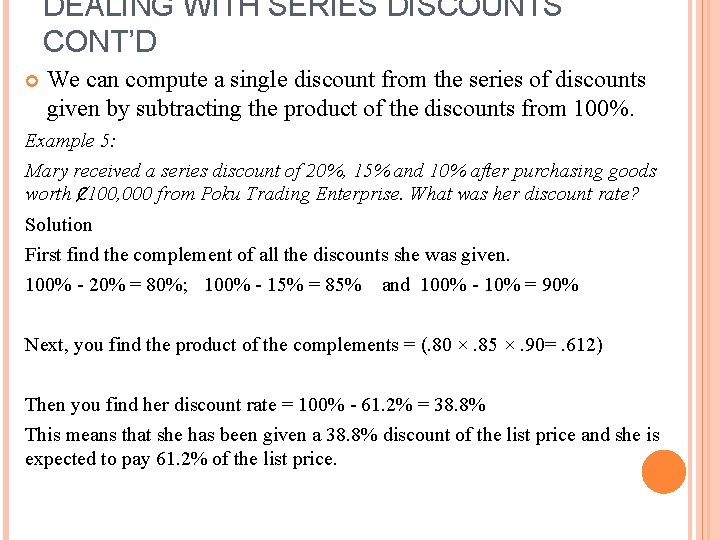
DEALING WITH SERIES DISCOUNTS CONT’D We can compute a single discount from the series of discounts given by subtracting the product of the discounts from 100%. Example 5: Mary received a series discount of 20%, 15% and 10% after purchasing goods worth Ȼ 100, 000 from Poku Trading Enterprise. What was her discount rate? Solution First find the complement of all the discounts she was given. 100% - 20% = 80%; 100% - 15% = 85% and 100% - 10% = 90% Next, you find the product of the complements = (. 80 ×. 85 ×. 90=. 612) Then you find her discount rate = 100% - 61. 2% = 38. 8% This means that she has been given a 38. 8% discount of the list price and she is expected to pay 61. 2% of the list price.
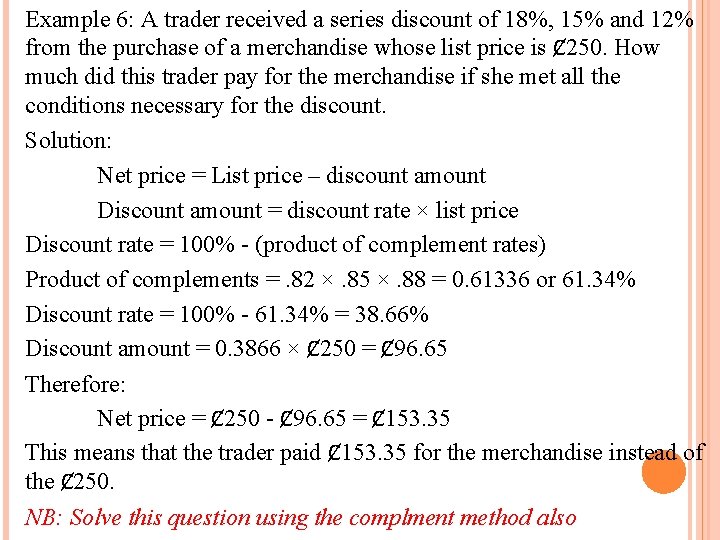
Example 6: A trader received a series discount of 18%, 15% and 12% from the purchase of a merchandise whose list price is Ȼ 250. How much did this trader pay for the merchandise if she met all the conditions necessary for the discount. Solution: Net price = List price – discount amount Discount amount = discount rate × list price Discount rate = 100% - (product of complement rates) Product of complements =. 82 ×. 85 ×. 88 = 0. 61336 or 61. 34% Discount rate = 100% - 61. 34% = 38. 66% Discount amount = 0. 3866 × Ȼ 250 = Ȼ 96. 65 Therefore: Net price = Ȼ 250 - Ȼ 96. 65 = Ȼ 153. 35 This means that the trader paid Ȼ 153. 35 for the merchandise instead of the Ȼ 250. NB: Solve this question using the complment method also
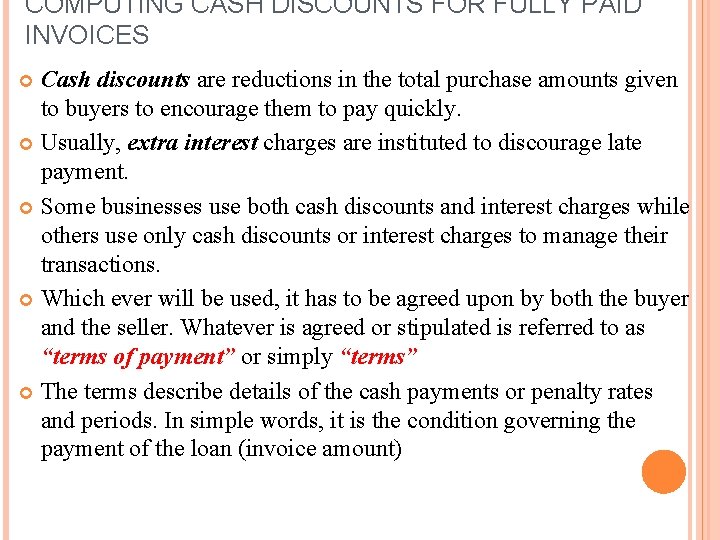
COMPUTING CASH DISCOUNTS FOR FULLY PAID INVOICES Cash discounts are reductions in the total purchase amounts given to buyers to encourage them to pay quickly. Usually, extra interest charges are instituted to discourage late payment. Some businesses use both cash discounts and interest charges while others use only cash discounts or interest charges to manage their transactions. Which ever will be used, it has to be agreed upon by both the buyer and the seller. Whatever is agreed or stipulated is referred to as “terms of payment” or simply “terms” The terms describe details of the cash payments or penalty rates and periods. In simple words, it is the condition governing the payment of the loan (invoice amount)
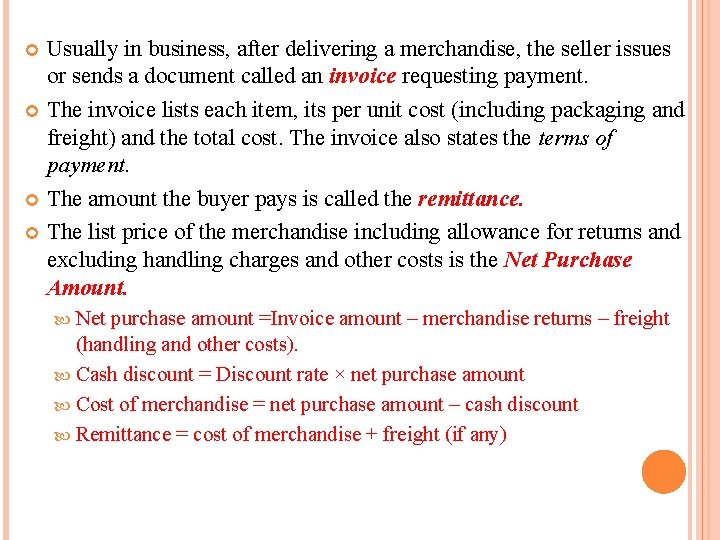
Usually in business, after delivering a merchandise, the seller issues or sends a document called an invoice requesting payment. The invoice lists each item, its per unit cost (including packaging and freight) and the total cost. The invoice also states the terms of payment. The amount the buyer pays is called the remittance. The list price of the merchandise including allowance for returns and excluding handling charges and other costs is the Net Purchase Amount. Net purchase amount =Invoice amount – merchandise returns – freight (handling and other costs). Cash discount = Discount rate × net purchase amount Cost of merchandise = net purchase amount – cash discount Remittance = cost of merchandise + freight (if any)
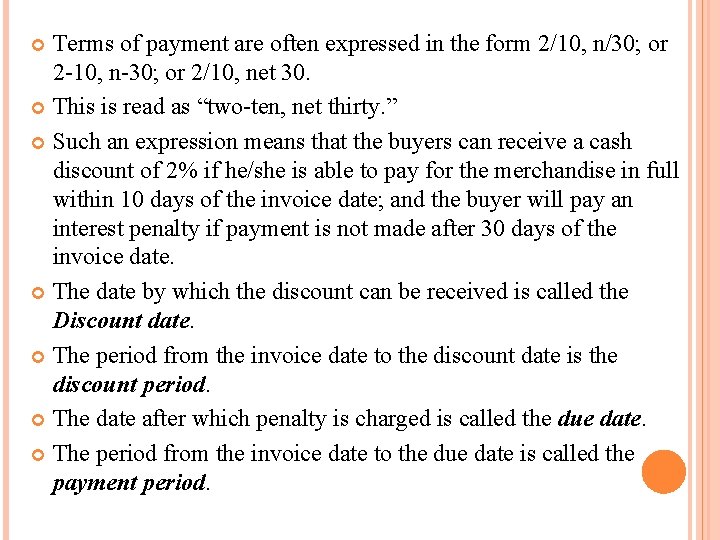
Terms of payment are often expressed in the form 2/10, n/30; or 2 -10, n-30; or 2/10, net 30. This is read as “two-ten, net thirty. ” Such an expression means that the buyers can receive a cash discount of 2% if he/she is able to pay for the merchandise in full within 10 days of the invoice date; and the buyer will pay an interest penalty if payment is not made after 30 days of the invoice date. The date by which the discount can be received is called the Discount date. The period from the invoice date to the discount date is the discount period. The date after which penalty is charged is called the due date. The period from the invoice date to the due date is called the payment period.
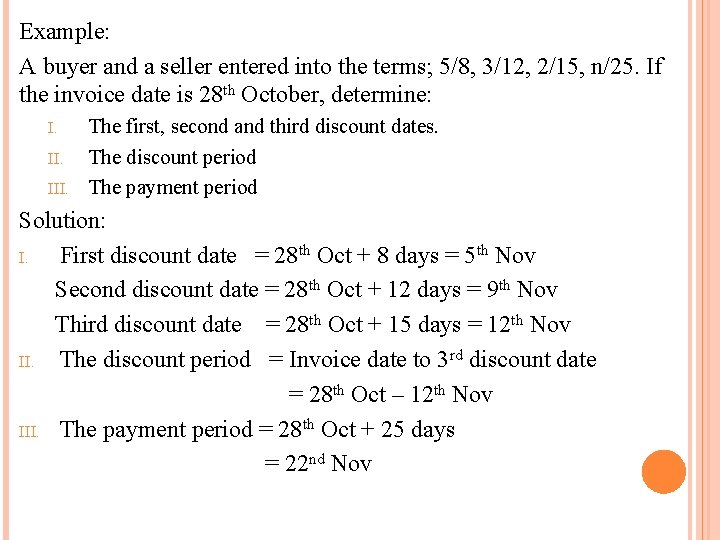
Example: A buyer and a seller entered into the terms; 5/8, 3/12, 2/15, n/25. If the invoice date is 28 th October, determine: The first, second and third discount dates. II. The discount period III. The payment period I. Solution: I. First discount date = 28 th Oct + 8 days = 5 th Nov Second discount date = 28 th Oct + 12 days = 9 th Nov Third discount date = 28 th Oct + 15 days = 12 th Nov II. The discount period = Invoice date to 3 rd discount date = 28 th Oct – 12 th Nov III. The payment period = 28 th Oct + 25 days = 22 nd Nov
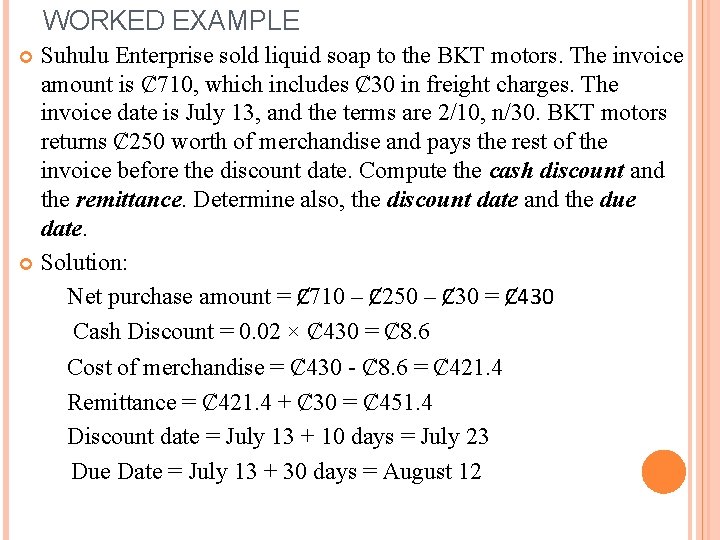
WORKED EXAMPLE Suhulu Enterprise sold liquid soap to the BKT motors. The invoice amount is Ȼ 710, which includes Ȼ 30 in freight charges. The invoice date is July 13, and the terms are 2/10, n/30. BKT motors returns Ȼ 250 worth of merchandise and pays the rest of the invoice before the discount date. Compute the cash discount and the remittance. Determine also, the discount date and the due date. Solution: Net purchase amount = Ȼ 710 – Ȼ 250 – Ȼ 30 = Ȼ 430 Cash Discount = 0. 02 × Ȼ 430 = Ȼ 8. 6 Cost of merchandise = Ȼ 430 - Ȼ 8. 6 = Ȼ 421. 4 Remittance = Ȼ 421. 4 + Ȼ 30 = Ȼ 451. 4 Discount date = July 13 + 10 days = July 23 Due Date = July 13 + 30 days = August 12
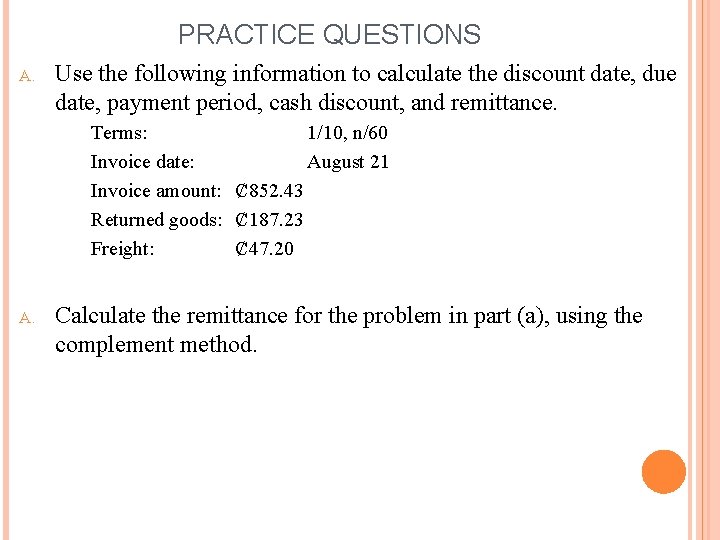
PRACTICE QUESTIONS A. Use the following information to calculate the discount date, due date, payment period, cash discount, and remittance. Terms: 1/10, n/60 Invoice date: August 21 Invoice amount: Ȼ 852. 43 Returned goods: Ȼ 187. 23 Freight: Ȼ 47. 20 A. Calculate the remittance for the problem in part (a), using the complement method.
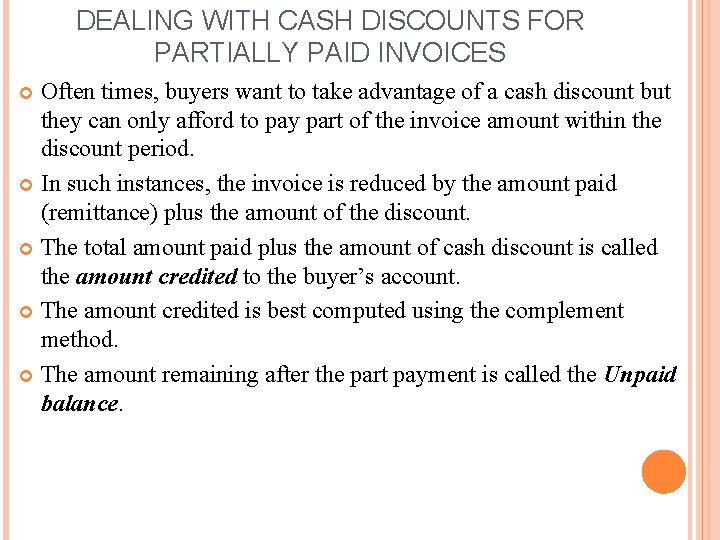
DEALING WITH CASH DISCOUNTS FOR PARTIALLY PAID INVOICES Often times, buyers want to take advantage of a cash discount but they can only afford to pay part of the invoice amount within the discount period. In such instances, the invoice is reduced by the amount paid (remittance) plus the amount of the discount. The total amount paid plus the amount of cash discount is called the amount credited to the buyer’s account. The amount credited is best computed using the complement method. The amount remaining after the part payment is called the Unpaid balance.
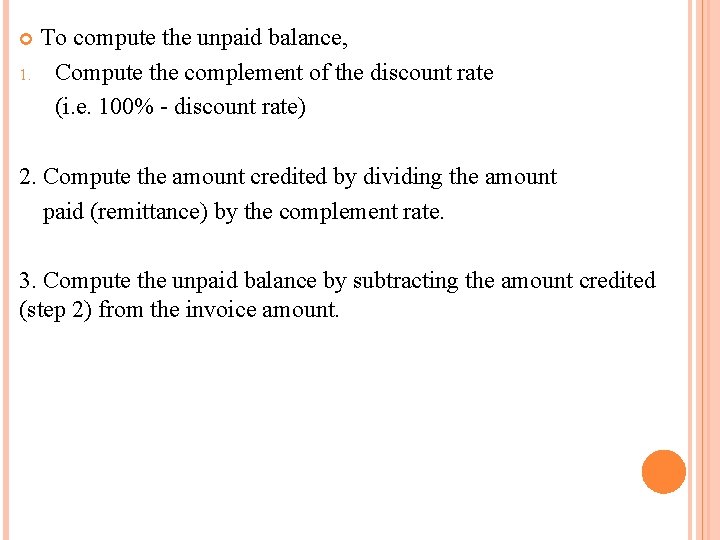
1. To compute the unpaid balance, Compute the complement of the discount rate (i. e. 100% - discount rate) 2. Compute the amount credited by dividing the amount paid (remittance) by the complement rate. 3. Compute the unpaid balance by subtracting the amount credited (step 2) from the invoice amount.
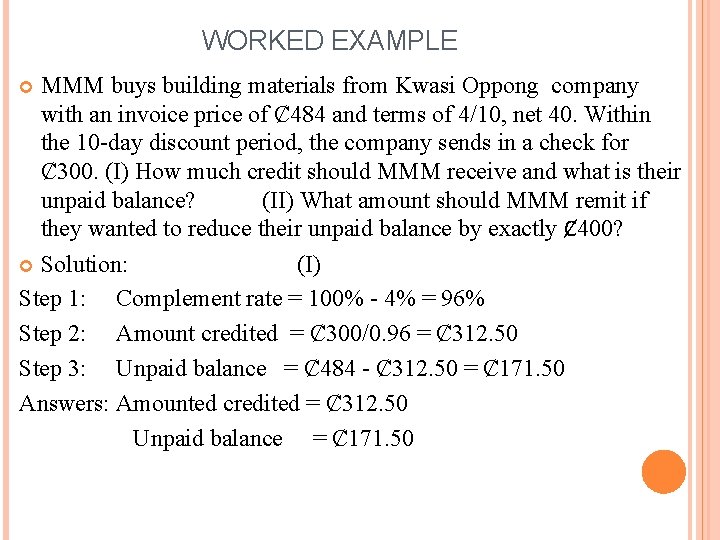
WORKED EXAMPLE MMM buys building materials from Kwasi Oppong company with an invoice price of Ȼ 484 and terms of 4/10, net 40. Within the 10 -day discount period, the company sends in a check for Ȼ 300. (I) How much credit should MMM receive and what is their unpaid balance? (II) What amount should MMM remit if they wanted to reduce their unpaid balance by exactly Ȼ 400? Solution: (I) Step 1: Complement rate = 100% - 4% = 96% Step 2: Amount credited = Ȼ 300/0. 96 = Ȼ 312. 50 Step 3: Unpaid balance = Ȼ 484 - Ȼ 312. 50 = Ȼ 171. 50 Answers: Amounted credited = Ȼ 312. 50 Unpaid balance = Ȼ 171. 50
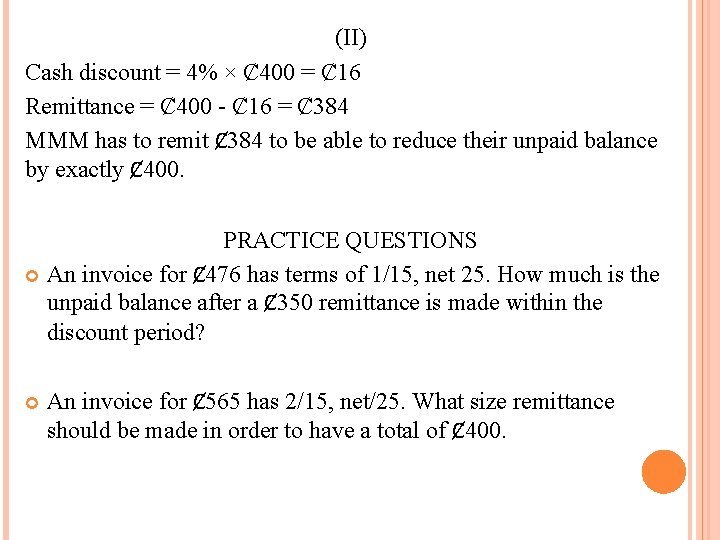
(II) Cash discount = 4% × Ȼ 400 = Ȼ 16 Remittance = Ȼ 400 - Ȼ 16 = Ȼ 384 MMM has to remit Ȼ 384 to be able to reduce their unpaid balance by exactly Ȼ 400. PRACTICE QUESTIONS An invoice for Ȼ 476 has terms of 1/15, net 25. How much is the unpaid balance after a Ȼ 350 remittance is made within the discount period? An invoice for Ȼ 565 has 2/15, net/25. What size remittance should be made in order to have a total of Ȼ 400.
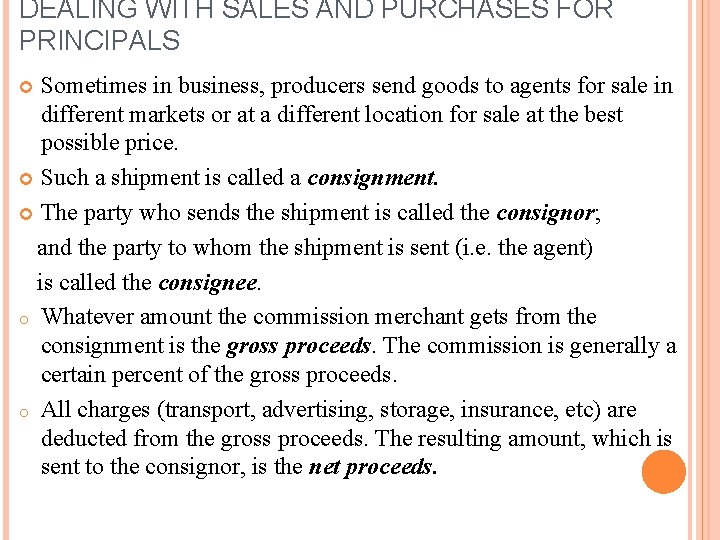
DEALING WITH SALES AND PURCHASES FOR PRINCIPALS Sometimes in business, producers send goods to agents for sale in different markets or at a different location for sale at the best possible price. Such a shipment is called a consignment. The party who sends the shipment is called the consignor; and the party to whom the shipment is sent (i. e. the agent) is called the consignee. o Whatever amount the commission merchant gets from the consignment is the gross proceeds. The commission is generally a certain percent of the gross proceeds. o All charges (transport, advertising, storage, insurance, etc) are deducted from the gross proceeds. The resulting amount, which is sent to the consignor, is the net proceeds.
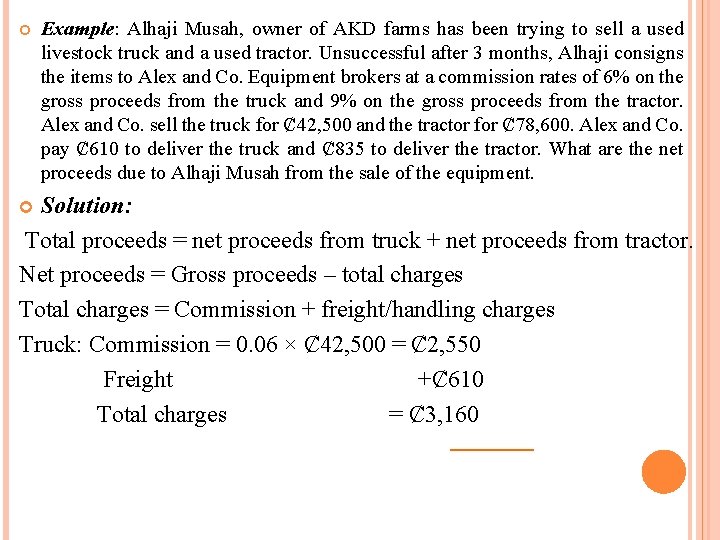
Example: Alhaji Musah, owner of AKD farms has been trying to sell a used livestock truck and a used tractor. Unsuccessful after 3 months, Alhaji consigns the items to Alex and Co. Equipment brokers at a commission rates of 6% on the gross proceeds from the truck and 9% on the gross proceeds from the tractor. Alex and Co. sell the truck for Ȼ 42, 500 and the tractor for Ȼ 78, 600. Alex and Co. pay Ȼ 610 to deliver the truck and Ȼ 835 to deliver the tractor. What are the net proceeds due to Alhaji Musah from the sale of the equipment. Solution: Total proceeds = net proceeds from truck + net proceeds from tractor. Net proceeds = Gross proceeds – total charges Total charges = Commission + freight/handling charges Truck: Commission = 0. 06 × Ȼ 42, 500 = Ȼ 2, 550 Freight +Ȼ 610 Total charges = Ȼ 3, 160
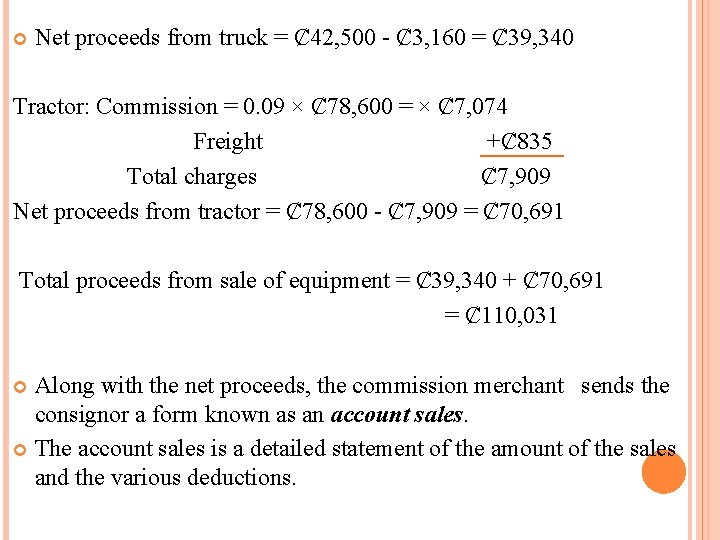
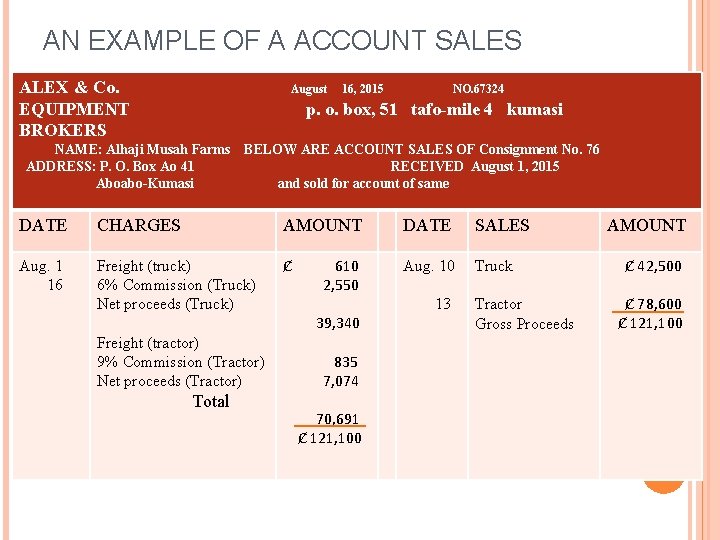
Net proceeds from truck = Ȼ 42, 500 - Ȼ 3, 160 = Ȼ 39, 340 Tractor: Commission = 0. 09 × Ȼ 78, 600 = × Ȼ 7, 074 Freight +Ȼ 835 Total charges Ȼ 7, 909 Net proceeds from tractor = Ȼ 78, 600 - Ȼ 7, 909 = Ȼ 70, 691 Total proceeds from sale of equipment = Ȼ 39, 340 + Ȼ 70, 691 = Ȼ 110, 031 Along with the net proceeds, the commission merchant sends the consignor a form known as an account sales. The account sales is a detailed statement of the amount of the sales and the various deductions.
AN EXAMPLE OF A ACCOUNT SALES ALEX & Co. EQUIPMENT BROKERS August 16, 2015 NO. 67324 p. o. box, 51 tafo-mile 4 kumasi NAME: Alhaji Musah Farms ADDRESS: P. O. Box Ao 41 Aboabo-Kumasi BELOW ARE ACCOUNT SALES OF Consignment No. 76 RECEIVED August 1, 2015 and sold for account of same DATE CHARGES AMOUNT DATE SALES Aug. 1 16 Freight (truck) 6% Commission (Truck) Net proceeds (Truck) Ȼ Aug. 10 Truck 610 2, 550 13 39, 340 Freight (tractor) 9% Commission (Tractor) Net proceeds (Tractor) Total 835 7, 074 70, 691 Ȼ 121, 100 Tractor Gross Proceeds AMOUNT Ȼ 42, 500 Ȼ 78, 600 Ȼ 121, 100