
Commercial Real Estate Transactions 2016 Getting the Parties
- Slides: 23
Commercial Real Estate Transactions 2016: Getting the Parties Right (9: 05 am – 9: 30 am) By: Brennan Carroll (Partner, Borden Ladner Gervais LLP) Brennan Carroll, Borden Ladner Gervais LLP September 13, 2016
Overview I. III. IV. V. VII. Know Your Client What Type of Entity May One See as Counterparty Potential Parties Issues in Real Estate Transactions: HST Issues in Real Estate Transactions: Pre-Incorporation Contracts Issues in Real Estate Transactions: Conflicts of Interest Issues in Real Estate Transactions: Assignment
I. Know Your Client “It is not the practice in Ontario to presume that a person is who they say they are” By-Law 7. 1 (Law Society Act, ss. 21– 23) Ø Purpose – to fight money laundering and other illegal activity Ø Lawyers are required to identify and verify the identify of the client and any third party directing, instructing or who has to authority to direct or instruct the client Ø Lawyers are also required to retain a record of the information obtained Ø Some exceptions apply, see By-Law 7. 1 for complete list of exceptions
I. Know Your Client Ø Individual Ø Ø Full name Home address and telephone number Occupation Business address and business telephone number, if applicable Ø Company or Public Body Ø Full name Ø Business address and business number Ø In addition, except for when client is a financial institution (bank), a public body (government), or a reporting issuer (public company), you must also obtain: Ø Incorporation or business identification number and where it was issued, if applicable Ø general nature of its business Ø must record the name, position and contact information of the person or persons giving you instructions in the matter Ø Where receiving, paying or transferring funds is involved, must also use reasonable efforts to collect: Ø Name and occupation of each director of the organization Ø Name, address and occupation of each person who owns ≥ 25% of the organization
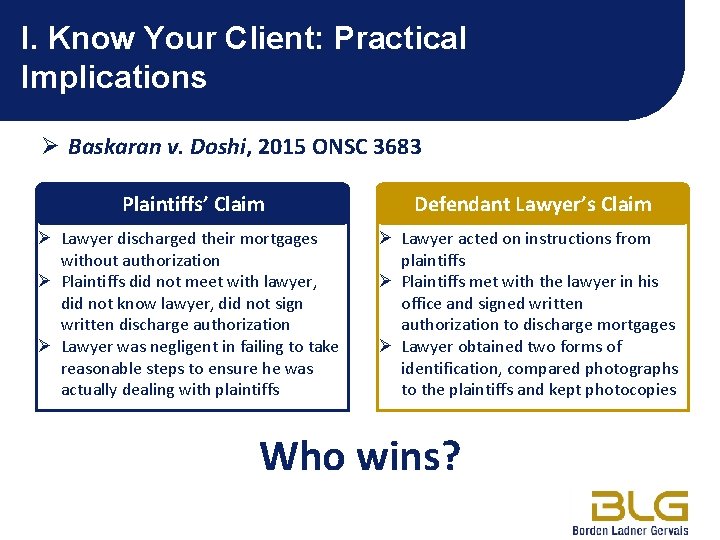
I. Know Your Client: Practical Implications Ø Baskaran v. Doshi, 2015 ONSC 3683 Plaintiffs’ Claim Defendant Lawyer’s Claim Ø Lawyer discharged their mortgages without authorization Ø Plaintiffs did not meet with lawyer, did not know lawyer, did not sign written discharge authorization Ø Lawyer was negligent in failing to take reasonable steps to ensure he was actually dealing with plaintiffs Ø Lawyer acted on instructions from plaintiffs Ø Plaintiffs met with the lawyer in his office and signed written authorization to discharge mortgages Ø Lawyer obtained two forms of identification, compared photographs to the plaintiffs and kept photocopies Who wins?
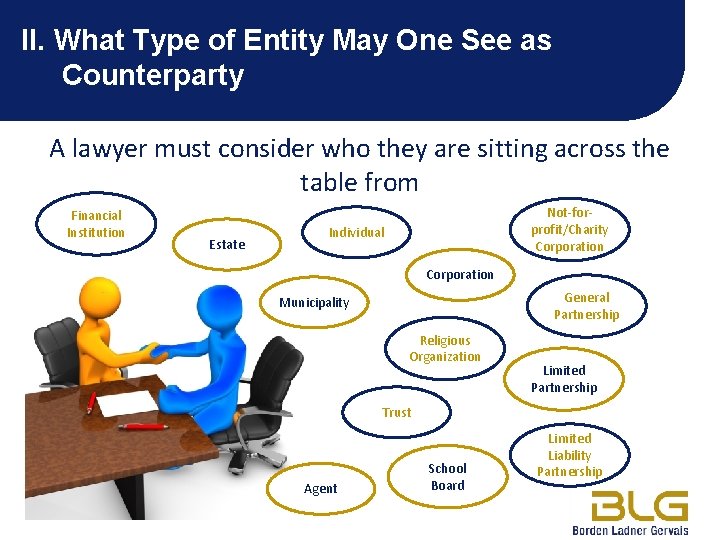
II. What Type of Entity May One See as Counterparty A lawyer must consider who they are sitting across the table from Financial Institution Estate Not-forprofit/Charity Corporation Individual Corporation General Partnership Municipality Religious Organization Limited Partnership Trust Agent School Board Limited Liability Partnership
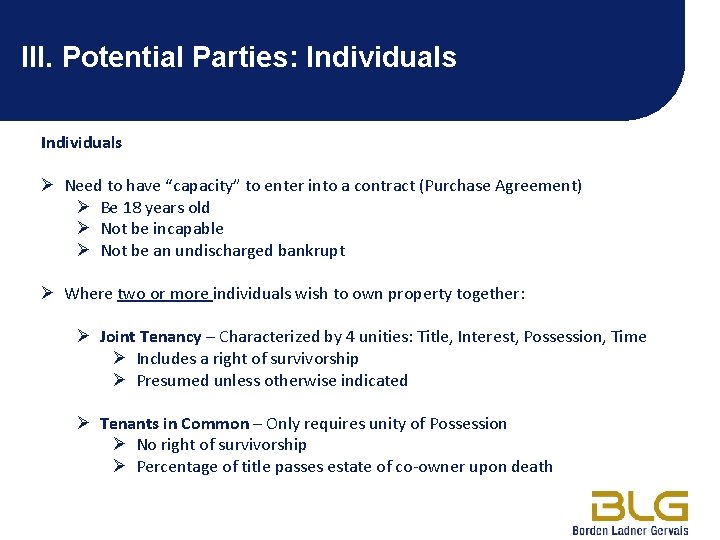
III. Potential Parties: Individuals Ø Need to have “capacity” to enter into a contract (Purchase Agreement) Ø Be 18 years old Ø Not be incapable Ø Not be an undischarged bankrupt Ø Where two or more individuals wish to own property together: Ø Joint Tenancy – Characterized by 4 unities: Title, Interest, Possession, Time Ø Includes a right of survivorship Ø Presumed unless otherwise indicated Ø Tenants in Common – Only requires unity of Possession Ø No right of survivorship Ø Percentage of title passes estate of co-owner upon death
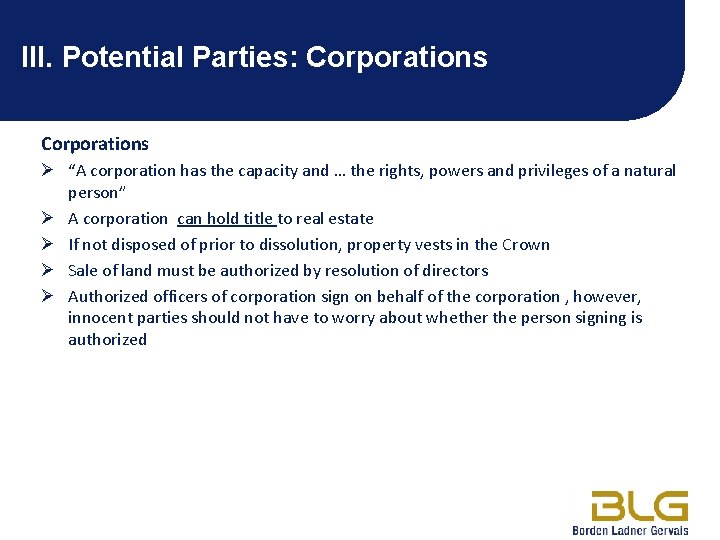
III. Potential Parties: Corporations Ø “A corporation has the capacity and … the rights, powers and privileges of a natural person” Ø A corporation can hold title to real estate Ø If not disposed of prior to dissolution, property vests in the Crown Ø Sale of land must be authorized by resolution of directors Ø Authorized officers of corporation sign on behalf of the corporation , however, innocent parties should not have to worry about whether the person signing is authorized
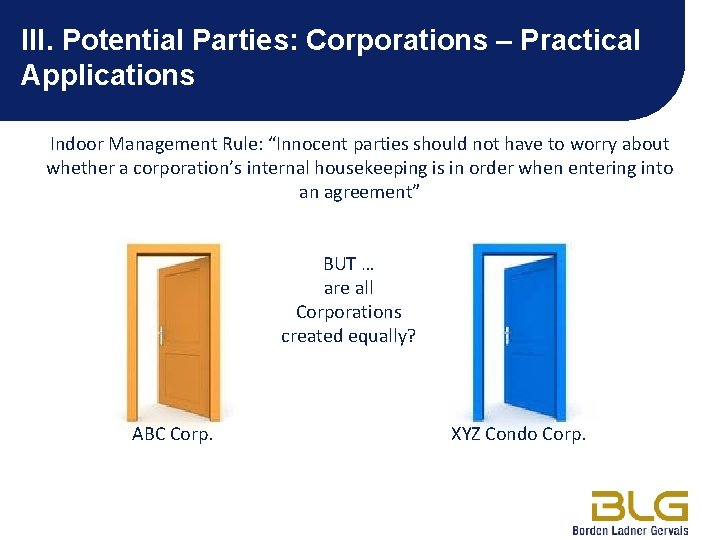
III. Potential Parties: Corporations – Practical Applications Indoor Management Rule: “Innocent parties should not have to worry about whether a corporation’s internal housekeeping is in order when entering into an agreement” BUT … are all Corporations created equally? ABC Corp. XYZ Condo Corp.
III. Potential Parties: Agents Ø Agents may enter into real estate transactions on behalf of their principal, but authority must be “clear, express and unequivocal” (Gilmour v. Simon, 37 SCR 422) Ø Terms of agreement must also be explicitly as authorized – In Levitt v. Webster, action for specific performance was denied because vendor wanted partial takeback mortgage and agent negotiated all cash deal Ø Power of Attorney implemented to avoid common law agency rule where agency terminates upon mental incapability of donor Ø Powers of Attorney may do anything in respect of property that a grantor could do other than make a will Ø Powers of Attorney and Agency agreements can present risk of fraud Ø Best practice is: Ø verify grantor signature and witness signatures for power of attorney Ø Verify authority and personal liability of agent for agency agreements
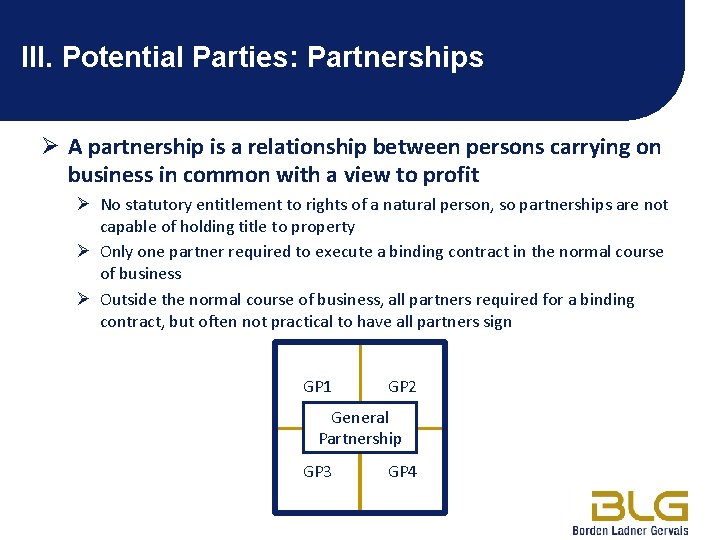
III. Potential Parties: Partnerships Ø A partnership is a relationship between persons carrying on business in common with a view to profit Ø No statutory entitlement to rights of a natural person, so partnerships are not capable of holding title to property Ø Only one partner required to execute a binding contract in the normal course of business Ø Outside the normal course of business, all partners required for a binding contract, but often not practical to have all partners sign GP 1 GP 2 General Partnership GP 3 GP 4
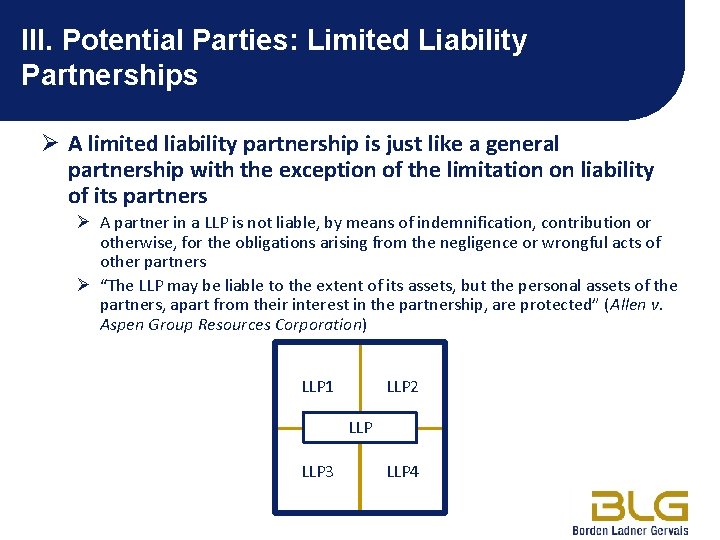
III. Potential Parties: Limited Liability Partnerships Ø A limited liability partnership is just like a general partnership with the exception of the limitation on liability of its partners Ø A partner in a LLP is not liable, by means of indemnification, contribution or otherwise, for the obligations arising from the negligence or wrongful acts of other partners Ø “The LLP may be liable to the extent of its assets, but the personal assets of the partners, apart from their interest in the partnership, are protected” (Allen v. Aspen Group Resources Corporation) LLP 1 LLP 2 LLP 3 LLP 4
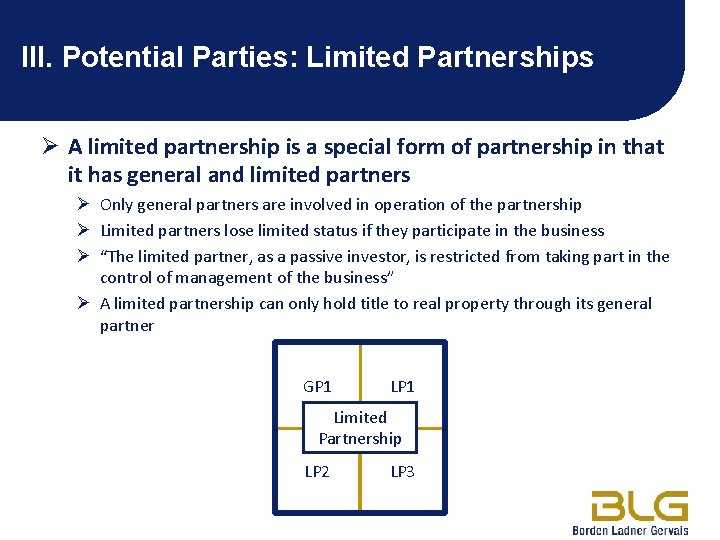
III. Potential Parties: Limited Partnerships Ø A limited partnership is a special form of partnership in that it has general and limited partners Ø Only general partners are involved in operation of the partnership Ø Limited partners lose limited status if they participate in the business Ø “The limited partner, as a passive investor, is restricted from taking part in the control of management of the business” Ø A limited partnership can only hold title to real property through its general partner GP 1 Limited Partnership LP 2 LP 3
II. Potential Parties: Nominee Parties Ø Bare trusts are exceptions to the rule that trustees are not agents of their beneficiaries Ø Bare Trustees have no independent power or discretion and are obligated to carry out the instructions of the beneficiaries of the trust Ø Nominee corporations are often bare trustees of REITs (Real Estate Investment Trusts) Ø REITs are not legal entities and cannot be party to a contract; primary liability under an APS involving a REIT falls on the individual trustee who signed the agreement (Canada Deposit Insurance Corp v. Canadian Commercial Bank, [1987] AWLD 1694)
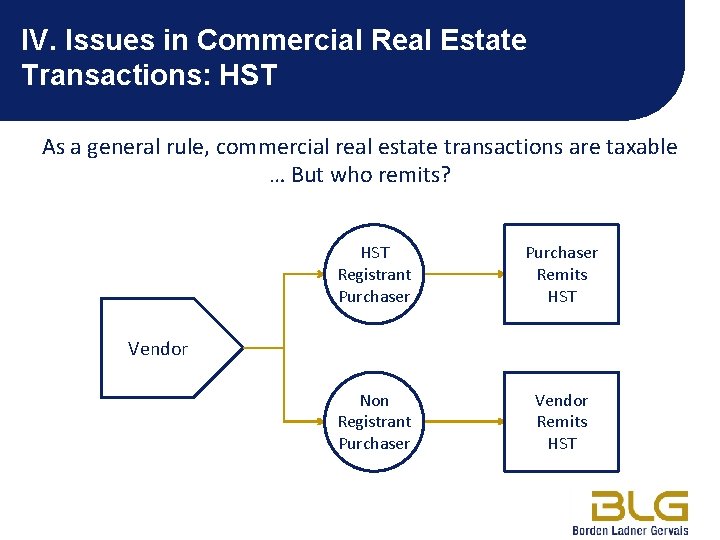
IV. Issues in Commercial Real Estate Transactions: HST As a general rule, commercial real estate transactions are taxable … But who remits? HST Registrant Purchaser Remits HST Non Registrant Purchaser Vendor Remits HST Vendor
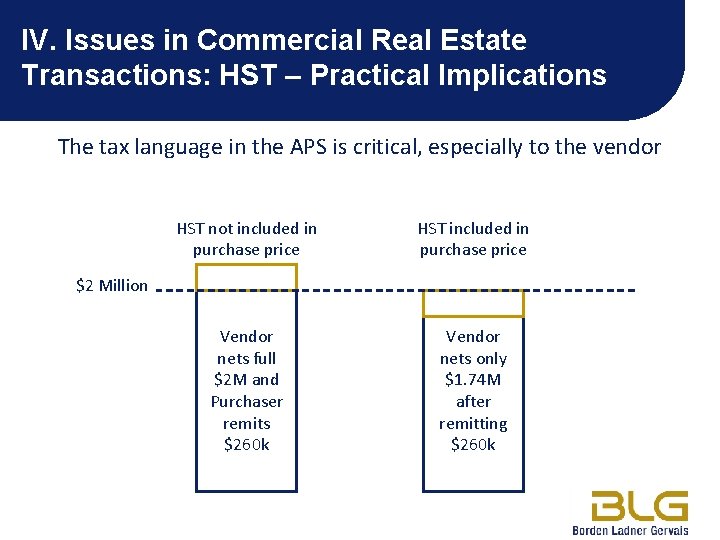
IV. Issues in Commercial Real Estate Transactions: HST – Practical Implications The tax language in the APS is critical, especially to the vendor HST not included in purchase price HST included in purchase price Vendor nets full $2 M and Purchaser remits $260 k Vendor nets only $1. 74 M after remitting $260 k $2 Million
V. Issues in Real Estate Transactions: Pre. Incorporation Contracts Ø Section 21 of the OBCA was a legislative response to the common law rule from Kelner v. Baxter Ø A contract made by promoters prior to the incorporation of a company binds only the promoters, and that the company cannot ratify such a contract after incorporation Ø “A corporation may, within a reasonable time after it comes into existence … adopt an oral or written contract made before it came into existence in its name or on its behalf” Ø Corporation becomes bound by contract and entitled to its benefits Ø If expressly provided in the contract, person acting on behalf of corporation to be incorporated is not bound by the agreement
V. Issues in Real Estate Transactions: Pre. Incorporation Contracts – Practical Implications Ø 1394918 Ontario Ltd. V. 1310210 Ontario Inc. et al. involved an agreement to sell land to “Raymond Stern in trust for a company to be incorporated and not in his personal capacity” Ø “It is an agreement that fits squarely into s. 21(4)” Ø Agreements under s. 21(4) involve “an entity called a ‘contract’ under the statute, but no one is entitled to sue for its breach … [it is termed] a nascent contract, its enforceability being suspended” Ø Having a party to a contract that is without liability is risky, and should generally be avoided by vendor’s counsel Ø “Where the contract expressly provides that the individual is not liable in the meantime, there is no contract” – Simon P. Crawford, “Ghost Offers in Real Estate Transactions”
VI. Issues in Real Estate Transactions: Conflicts of Interest Ø Rule 3. 4 -1 of the Law Society Rules of Professional Conduct prevents a lawyer from acting where there is a conflict of interest. Ø A conflict of interests exists when there is a substantial risk that a lawyer’s loyalty to or representation of a client would be materially or adversely affected by the lawyer’s own interest or the lawyer’s duties to another client, a former client, or third person. Ø Rules 3. 4 -16. 7 – 3. 4 -16. 9 specifically address joint retainers in real estate transactions: Ø A lawyer may not act for both transferor and transferee of title to real property unless: Ø Permitted by the Land Registration Reform Act; Ø The parties are “related persons” under s. 251 of the ITA; or Ø The lawyer practices in a remote location, and requiring another lawyer would unduly inconvenience the clients Ø Two lawyers in the same firm may represent a transferor and transferee of title
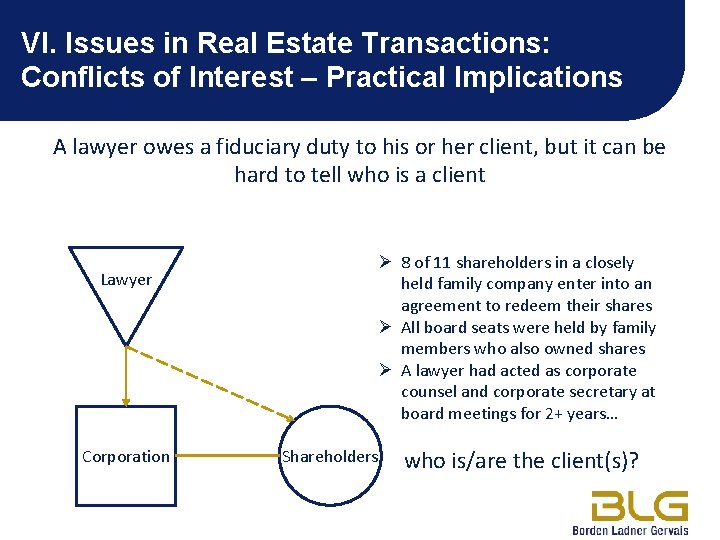
VI. Issues in Real Estate Transactions: Conflicts of Interest – Practical Implications A lawyer owes a fiduciary duty to his or her client, but it can be hard to tell who is a client Ø 8 of 11 shareholders in a closely held family company enter into an agreement to redeem their shares Ø All board seats were held by family members who also owned shares Ø A lawyer had acted as corporate counsel and corporate secretary at board meetings for 2+ years… Lawyer Corporation Shareholders who is/are the client(s)?
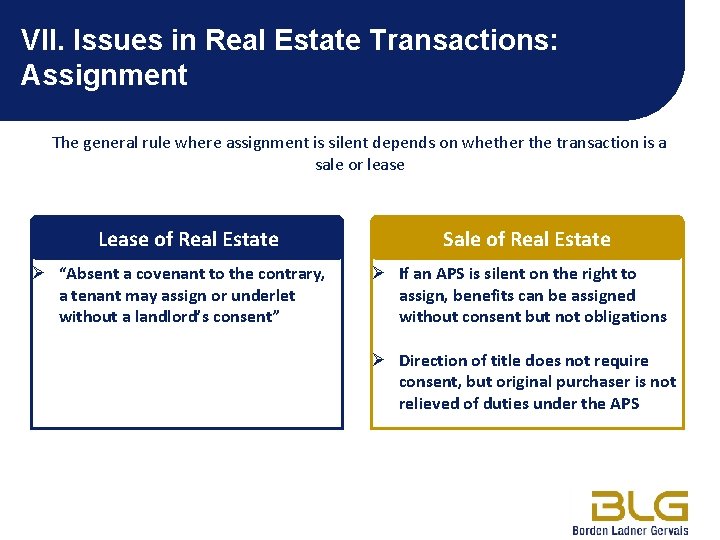
VII. Issues in Real Estate Transactions: Assignment The general rule where assignment is silent depends on whether the transaction is a sale or lease Lease of Real Estate Ø “Absent a covenant to the contrary, a tenant may assign or underlet without a landlord’s consent” Sale of Real Estate Ø If an APS is silent on the right to assign, benefits can be assigned without consent but not obligations Ø Direction of title does not require consent, but original purchaser is not relieved of duties under the APS
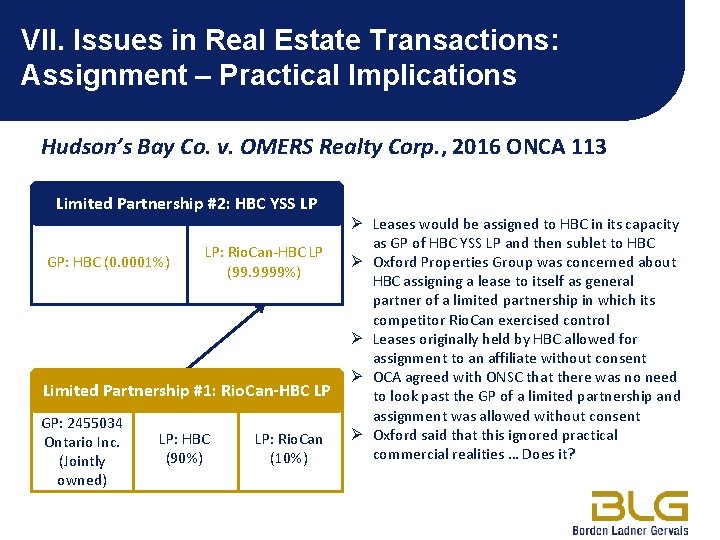
VII. Issues in Real Estate Transactions: Assignment – Practical Implications Hudson’s Bay Co. v. OMERS Realty Corp. , 2016 ONCA 113 Limited Partnership #2: HBC YSS LP GP: HBC (0. 0001%) LP: Rio. Can-HBC LP (99. 9999%) Limited Partnership #1: Rio. Can-HBC LP GP: 2455034 Ontario Inc. (Jointly owned) LP: HBC (90%) LP: Rio. Can (10%) Ø Leases would be assigned to HBC in its capacity as GP of HBC YSS LP and then sublet to HBC Ø Oxford Properties Group was concerned about HBC assigning a lease to itself as general partner of a limited partnership in which its competitor Rio. Can exercised control Ø Leases originally held by HBC allowed for assignment to an affiliate without consent Ø OCA agreed with ONSC that there was no need to look past the GP of a limited partnership and assignment was allowed without consent Ø Oxford said that this ignored practical commercial realities … Does it?
Discussion