
Commercial Pilot Oral Exam Guide Written By Shelby

Commercial Pilot Oral Exam Guide Written By: Shelby Balogh
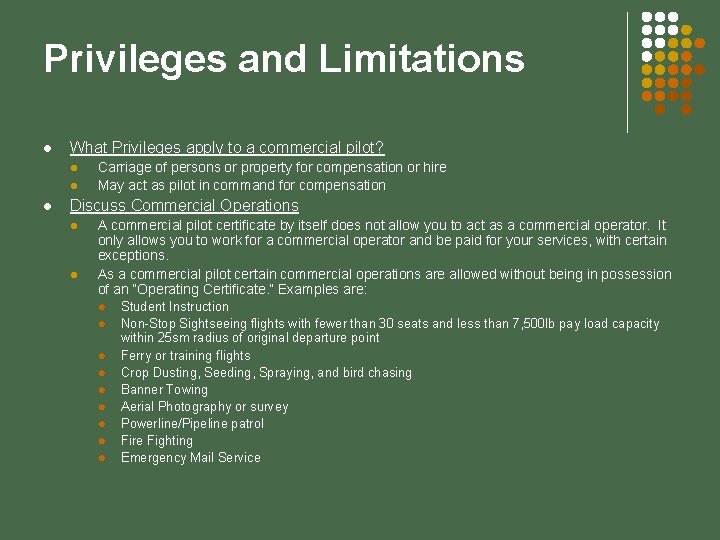
Privileges and Limitations l What Privileges apply to a commercial pilot? l l l Carriage of persons or property for compensation or hire May act as pilot in command for compensation Discuss Commercial Operations l l A commercial pilot certificate by itself does not allow you to act as a commercial operator. It only allows you to work for a commercial operator and be paid for your services, with certain exceptions. As a commercial pilot certain commercial operations are allowed without being in possession of an “Operating Certificate. ” Examples are: l l l l l Student Instruction Non-Stop Sightseeing flights with fewer than 30 seats and less than 7, 500 lb pay load capacity within 25 sm radius of original departure point Ferry or training flights Crop Dusting, Seeding, Spraying, and bird chasing Banner Towing Aerial Photography or survey Powerline/Pipeline patrol Fire Fighting Emergency Mail Service
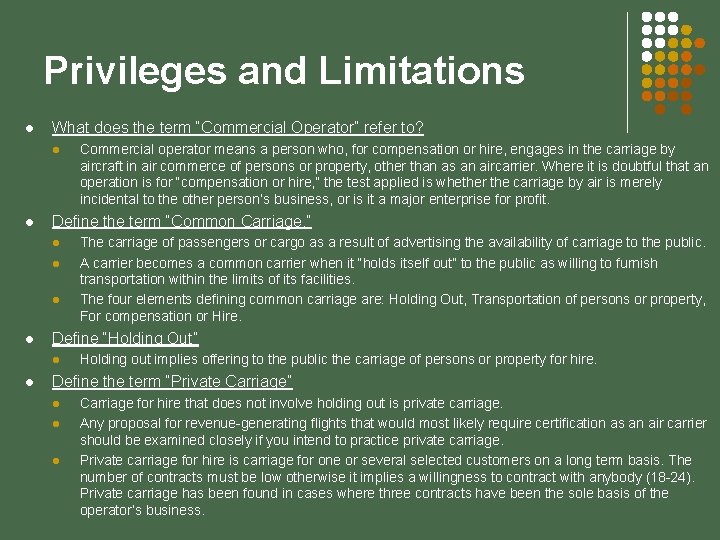
Privileges and Limitations l What does the term “Commercial Operator” refer to? l l Define the term “Common Carriage. ” l l The carriage of passengers or cargo as a result of advertising the availability of carriage to the public. A carrier becomes a common carrier when it “holds itself out” to the public as willing to furnish transportation within the limits of its facilities. The four elements defining common carriage are: Holding Out, Transportation of persons or property, For compensation or Hire. Define “Holding Out” l l Commercial operator means a person who, for compensation or hire, engages in the carriage by aircraft in air commerce of persons or property, other than as an aircarrier. Where it is doubtful that an operation is for “compensation or hire, ” the test applied is whether the carriage by air is merely incidental to the other person’s business, or is it a major enterprise for profit. Holding out implies offering to the public the carriage of persons or property for hire. Define the term “Private Carriage” l l l Carriage for hire that does not involve holding out is private carriage. Any proposal for revenue-generating flights that would most likely require certification as an air carrier should be examined closely if you intend to practice private carriage. Private carriage for hire is carriage for one or several selected customers on a long term basis. The number of contracts must be low otherwise it implies a willingness to contract with anybody (18 -24). Private carriage has been found in cases where three contracts have been the sole basis of the operator’s business.
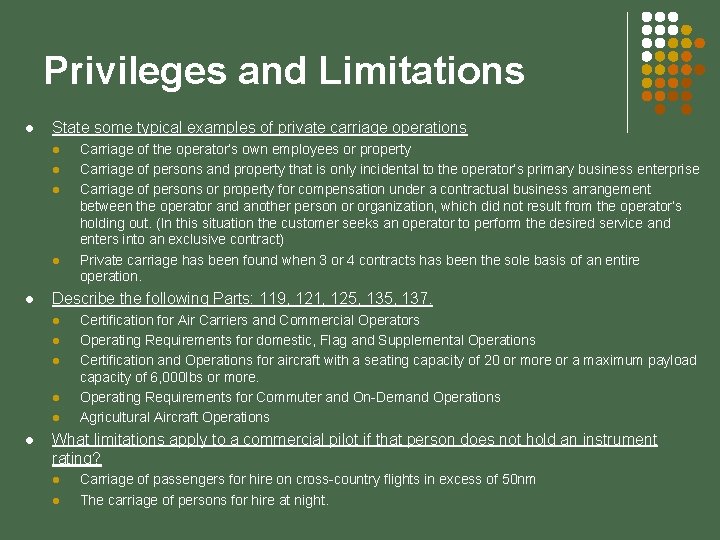
Privileges and Limitations l State some typical examples of private carriage operations l l l Describe the following Parts: 119, 121, 125, 137. l l l Carriage of the operator’s own employees or property Carriage of persons and property that is only incidental to the operator’s primary business enterprise Carriage of persons or property for compensation under a contractual business arrangement between the operator and another person or organization, which did not result from the operator’s holding out. (In this situation the customer seeks an operator to perform the desired service and enters into an exclusive contract) Private carriage has been found when 3 or 4 contracts has been the sole basis of an entire operation. Certification for Air Carriers and Commercial Operators Operating Requirements for domestic, Flag and Supplemental Operations Certification and Operations for aircraft with a seating capacity of 20 or more or a maximum payload capacity of 6, 000 lbs or more. Operating Requirements for Commuter and On-Demand Operations Agricultural Aircraft Operations What limitations apply to a commercial pilot if that person does not hold an instrument rating? l l Carriage of passengers for hire on cross-country flights in excess of 50 nm The carriage of persons for hire at night.
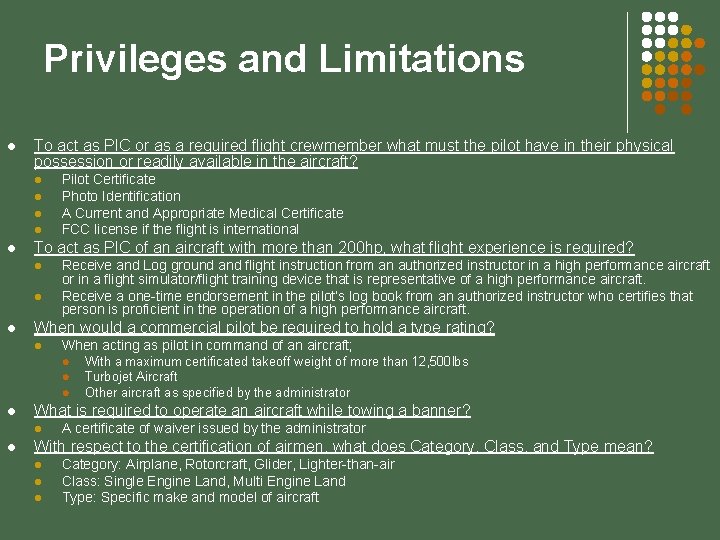
Privileges and Limitations l To act as PIC or as a required flight crewmember what must the pilot have in their physical possession or readily available in the aircraft? l l l To act as PIC of an aircraft with more than 200 hp, what flight experience is required? l l l Pilot Certificate Photo Identification A Current and Appropriate Medical Certificate FCC license if the flight is international Receive and Log ground and flight instruction from an authorized instructor in a high performance aircraft or in a flight simulator/flight training device that is representative of a high performance aircraft. Receive a one-time endorsement in the pilot’s log book from an authorized instructor who certifies that person is proficient in the operation of a high performance aircraft. When would a commercial pilot be required to hold a type rating? l When acting as pilot in command of an aircraft; l l What is required to operate an aircraft while towing a banner? l l With a maximum certificated takeoff weight of more than 12, 500 lbs Turbojet Aircraft Other aircraft as specified by the administrator A certificate of waiver issued by the administrator With respect to the certification of airmen, what does Category, Class, and Type mean? l l l Category: Airplane, Rotorcraft, Glider, Lighter-than-air Class: Single Engine Land, Multi Engine Land Type: Specific make and model of aircraft
Privileges and Limitations l When may a pilot log second in command time? l Holds the appropriate category, class, and instrument rating if required for the aircraft to be flown and more than one pilot is required under the certification of the aircraft or regulations under which the flight is conducted.
Currency Requirements l What are the requirements to remain current as a commercial pilot? l l l What class of medical certificate is required for commercial pilots? l l A second class medical is required in order to exercise the commercial pilot certificates What is the duration of a second class medical certificate? l l Flight review within the preceding 24 calendar months. 3 takeoffs and landings within the previous 90 days as the sole manipulator of the flight controls in the appropriate category, class, and type if required. From the period between 1 hour after sunset to 1 hour before sunrise that pilot must have completed 3 takeoffs and landings to a full stop within that period. For IFR 6 instrument approaches within the preceding six calendar months that include intercepting and tracking of navigational aids, holding, Expires at the last day of the 12 th month after the date of examination. When is a commercial pilot required to log flight time? l l Training and aeronautical experience for the requirements of a certificate or rating Recency of flight experience and/or flight review
Aircraft Documents/Maintenance l What documents are required on board an aircraft prior to flight? l l l How can a pilot determine if his/her aircraft is equipped with a Mode C transponder? l l Refer to the current weight and balance equipment list for that aircraft. What are the required maintenance inspections for aircraft? l l Airworthiness Certificate Registration Certificate Radio License (if operated outside the U. S. ) Operating Limitations Weight and Balance Annual Flight Inspection 100 -hr inspection if carriage of persons or property for hire or giving flight instruction for hire. 4 phase 60 hour progressive inspections within 12 calendar months. What are the required tests and inspections of aircraft and equipment to be legal for both VFR and IFR flights? l l l l Annual Inspection 100 -hour inspection if required Static System within 24 calendar months Transponder within 24 calendar months Altimeter within 24 calendar months VOR operational check within 30 days ELT must have been inspected within the previous 12 calendar months or when ½ the shelf life has been used or when 1 hour of cumulative operation has occurred.
Aircraft Maintenance l Define Preventative Maintenance l l Means simple or minor preservation operations and the replacement of small standard parts on involving complex assembly operations. Examples of such are: oil changes, wheel bearing lubrication, and hydraulic fluid refills. A record of preventative maintenance must be entered in the appropriate records.
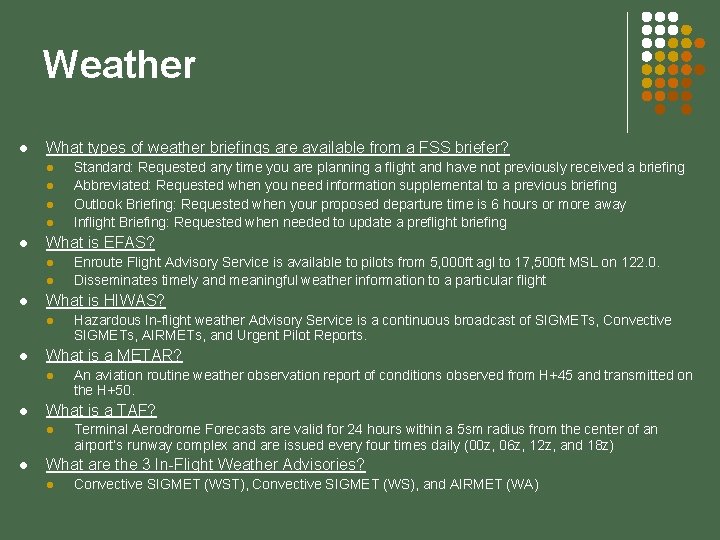
Weather l What types of weather briefings are available from a FSS briefer? l l l What is EFAS? l l l An aviation routine weather observation report of conditions observed from H+45 and transmitted on the H+50. What is a TAF? l l Hazardous In-flight weather Advisory Service is a continuous broadcast of SIGMETs, Convective SIGMETs, AIRMETs, and Urgent Pilot Reports. What is a METAR? l l Enroute Flight Advisory Service is available to pilots from 5, 000 ft agl to 17, 500 ft MSL on 122. 0. Disseminates timely and meaningful weather information to a particular flight What is HIWAS? l l Standard: Requested any time you are planning a flight and have not previously received a briefing Abbreviated: Requested when you need information supplemental to a previous briefing Outlook Briefing: Requested when your proposed departure time is 6 hours or more away Inflight Briefing: Requested when needed to update a preflight briefing Terminal Aerodrome Forecasts are valid for 24 hours within a 5 sm radius from the center of an airport’s runway complex and are issued every four times daily (00 z, 06 z, 12 z, and 18 z) What are the 3 In-Flight Weather Advisories? l Convective SIGMET (WST), Convective SIGMET (WS), and AIRMET (WA)
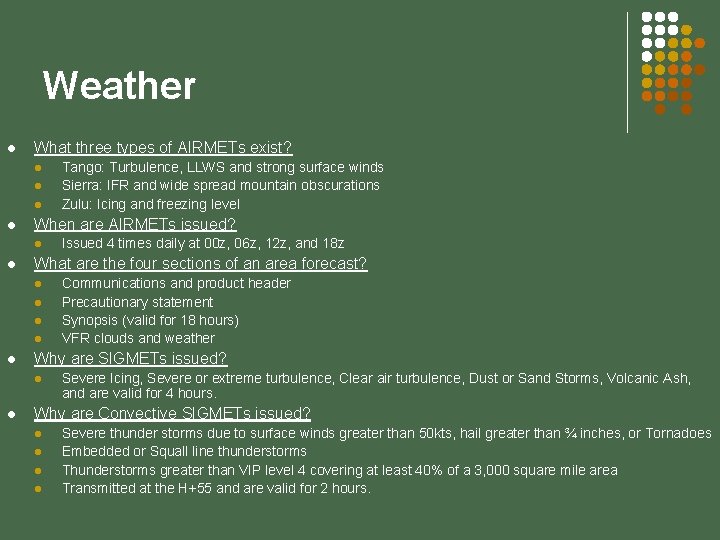
Weather l What three types of AIRMETs exist? l l When are AIRMETs issued? l l l Communications and product header Precautionary statement Synopsis (valid for 18 hours) VFR clouds and weather Why are SIGMETs issued? l l Issued 4 times daily at 00 z, 06 z, 12 z, and 18 z What are the four sections of an area forecast? l l Tango: Turbulence, LLWS and strong surface winds Sierra: IFR and wide spread mountain obscurations Zulu: Icing and freezing level Severe Icing, Severe or extreme turbulence, Clear air turbulence, Dust or Sand Storms, Volcanic Ash, and are valid for 4 hours. Why are Convective SIGMETs issued? l l Severe thunder storms due to surface winds greater than 50 kts, hail greater than ¾ inches, or Tornadoes Embedded or Squall line thunderstorms Thunderstorms greater than VIP level 4 covering at least 40% of a 3, 000 square mile area Transmitted at the H+55 and are valid for 2 hours.
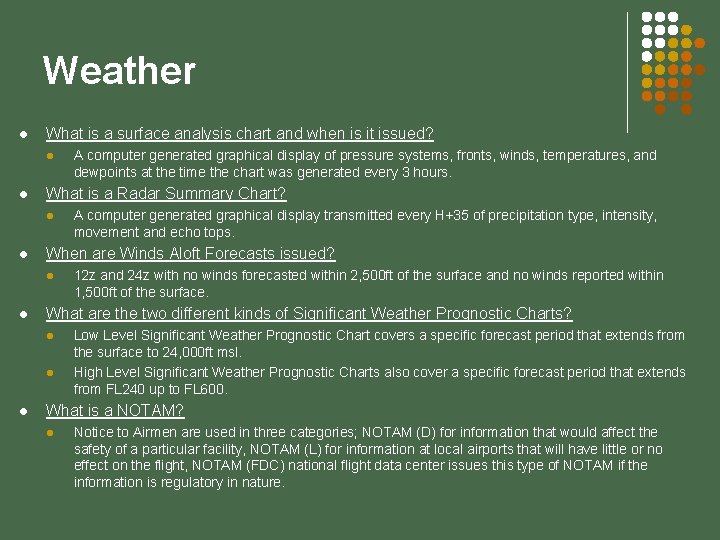
Weather l What is a surface analysis chart and when is it issued? l l What is a Radar Summary Chart? l l 12 z and 24 z with no winds forecasted within 2, 500 ft of the surface and no winds reported within 1, 500 ft of the surface. What are the two different kinds of Significant Weather Prognostic Charts? l l l A computer generated graphical display transmitted every H+35 of precipitation type, intensity, movement and echo tops. When are Winds Aloft Forecasts issued? l l A computer generated graphical display of pressure systems, fronts, winds, temperatures, and dewpoints at the time the chart was generated every 3 hours. Low Level Significant Weather Prognostic Chart covers a specific forecast period that extends from the surface to 24, 000 ft msl. High Level Significant Weather Prognostic Charts also cover a specific forecast period that extends from FL 240 up to FL 600. What is a NOTAM? l Notice to Airmen are used in three categories; NOTAM (D) for information that would affect the safety of a particular facility, NOTAM (L) for information at local airports that will have little or no effect on the flight, NOTAM (FDC) national flight data center issues this type of NOTAM if the information is regulatory in nature.
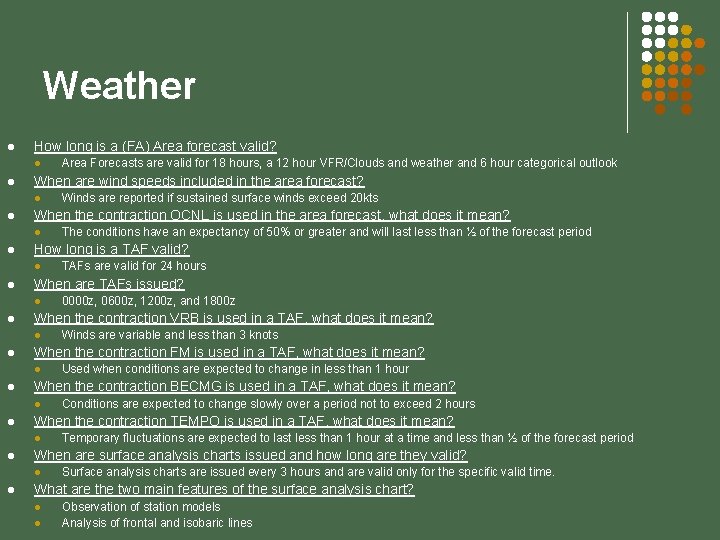
Weather l How long is a (FA) Area forecast valid? l l When are wind speeds included in the area forecast? l l Temporary fluctuations are expected to last less than 1 hour at a time and less than ½ of the forecast period When are surface analysis charts issued and how long are they valid? l l Conditions are expected to change slowly over a period not to exceed 2 hours When the contraction TEMPO is used in a TAF, what does it mean? l l Used when conditions are expected to change in less than 1 hour When the contraction BECMG is used in a TAF, what does it mean? l l Winds are variable and less than 3 knots When the contraction FM is used in a TAF, what does it mean? l l 0000 z, 0600 z, 1200 z, and 1800 z When the contraction VRB is used in a TAF, what does it mean? l l TAFs are valid for 24 hours When are TAFs issued? l l The conditions have an expectancy of 50% or greater and will last less than ½ of the forecast period How long is a TAF valid? l l Winds are reported if sustained surface winds exceed 20 kts When the contraction OCNL is used in the area forecast, what does it mean? l l Area Forecasts are valid for 18 hours, a 12 hour VFR/Clouds and weather and 6 hour categorical outlook Surface analysis charts are issued every 3 hours and are valid only for the specific valid time. What are the two main features of the surface analysis chart? l l Observation of station models Analysis of frontal and isobaric lines
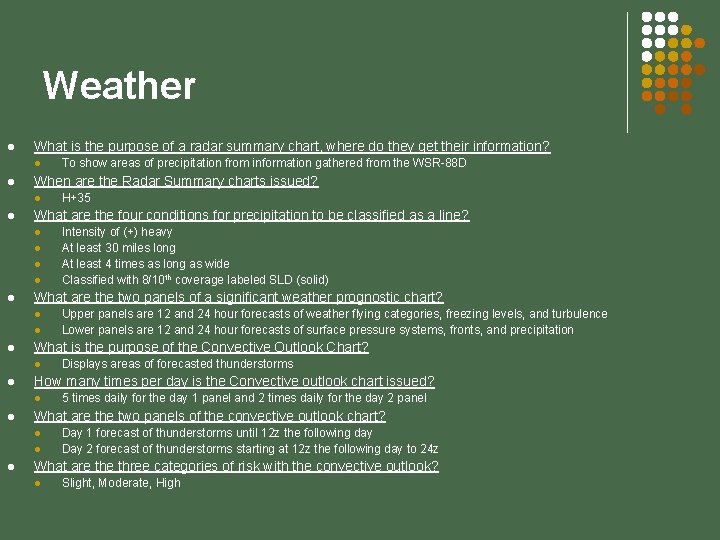
Weather l What is the purpose of a radar summary chart, where do they get their information? l l When are the Radar Summary charts issued? l l l 5 times daily for the day 1 panel and 2 times daily for the day 2 panel What are the two panels of the convective outlook chart? l l l Displays areas of forecasted thunderstorms How many times per day is the Convective outlook chart issued? l l Upper panels are 12 and 24 hour forecasts of weather flying categories, freezing levels, and turbulence Lower panels are 12 and 24 hour forecasts of surface pressure systems, fronts, and precipitation What is the purpose of the Convective Outlook Chart? l l Intensity of (+) heavy At least 30 miles long At least 4 times as long as wide Classified with 8/10 th coverage labeled SLD (solid) What are the two panels of a significant weather prognostic chart? l l H+35 What are the four conditions for precipitation to be classified as a line? l l To show areas of precipitation from information gathered from the WSR-88 D Day 1 forecast of thunderstorms until 12 z the following day Day 2 forecast of thunderstorms starting at 12 z the following day to 24 z What are three categories of risk with the convective outlook? l Slight, Moderate, High
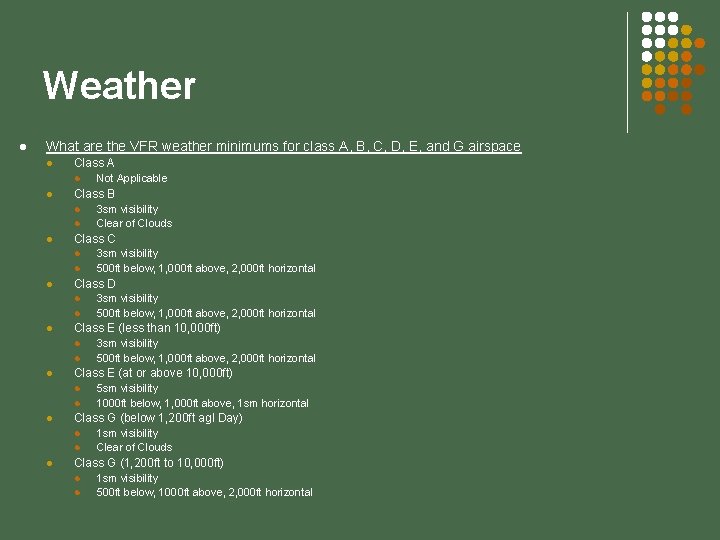
Weather l What are the VFR weather minimums for class A, B, C, D, E, and G airspace l Class A l l Class B l l l l 5 sm visibility 1000 ft below, 1, 000 ft above, 1 sm horizontal Class G (below 1, 200 ft agl Day) l l l 3 sm visibility 500 ft below, 1, 000 ft above, 2, 000 ft horizontal Class E (at or above 10, 000 ft) l l 3 sm visibility 500 ft below, 1, 000 ft above, 2, 000 ft horizontal Class E (less than 10, 000 ft) l l 3 sm visibility 500 ft below, 1, 000 ft above, 2, 000 ft horizontal Class D l l 3 sm visibility Clear of Clouds Class C l l Not Applicable 1 sm visibility Clear of Clouds Class G (1, 200 ft to 10, 000 ft) l l 1 sm visibility 500 ft below, 1000 ft above, 2, 000 ft horizontal
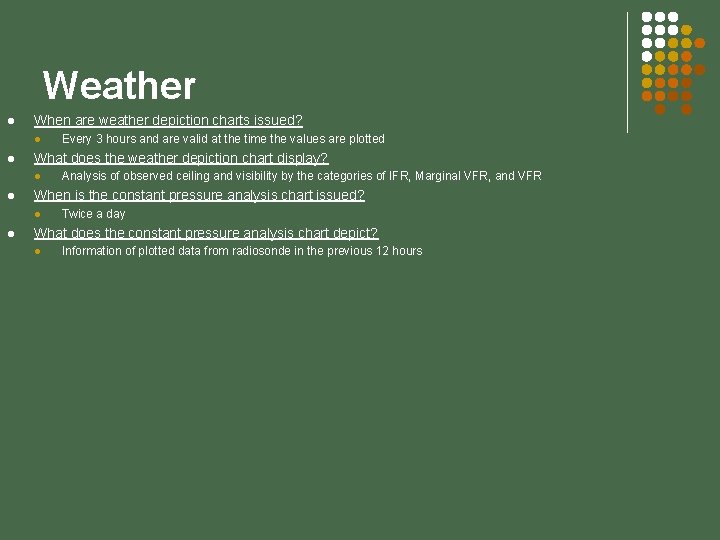
Weather l When are weather depiction charts issued? l l What does the weather depiction chart display? l l Analysis of observed ceiling and visibility by the categories of IFR, Marginal VFR, and VFR When is the constant pressure analysis chart issued? l l Every 3 hours and are valid at the time the values are plotted Twice a day What does the constant pressure analysis chart depict? l Information of plotted data from radiosonde in the previous 12 hours
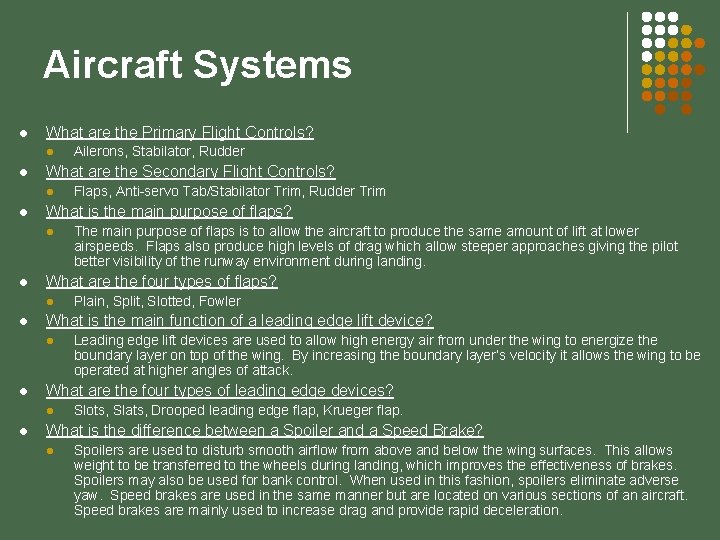
Aircraft Systems l What are the Primary Flight Controls? l l What are the Secondary Flight Controls? l l Leading edge lift devices are used to allow high energy air from under the wing to energize the boundary layer on top of the wing. By increasing the boundary layer’s velocity it allows the wing to be operated at higher angles of attack. What are the four types of leading edge devices? l l Plain, Split, Slotted, Fowler What is the main function of a leading edge lift device? l l The main purpose of flaps is to allow the aircraft to produce the same amount of lift at lower airspeeds. Flaps also produce high levels of drag which allow steeper approaches giving the pilot better visibility of the runway environment during landing. What are the four types of flaps? l l Flaps, Anti-servo Tab/Stabilator Trim, Rudder Trim What is the main purpose of flaps? l l Ailerons, Stabilator, Rudder Slots, Slats, Drooped leading edge flap, Krueger flap. What is the difference between a Spoiler and a Speed Brake? l Spoilers are used to disturb smooth airflow from above and below the wing surfaces. This allows weight to be transferred to the wheels during landing, which improves the effectiveness of brakes. Spoilers may also be used for bank control. When used in this fashion, spoilers eliminate adverse yaw. Speed brakes are used in the same manner but are located on various sections of an aircraft. Speed brakes are mainly used to increase drag and provide rapid deceleration.
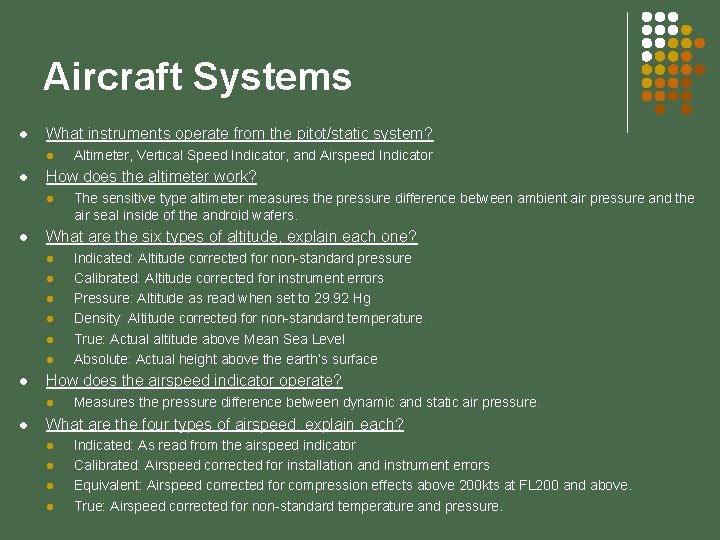
Aircraft Systems l What instruments operate from the pitot/static system? l l How does the altimeter work? l l l l Indicated: Altitude corrected for non-standard pressure Calibrated: Altitude corrected for instrument errors Pressure: Altitude as read when set to 29. 92 Hg Density: Altitude corrected for non-standard temperature. True: Actual altitude above Mean Sea Level Absolute: Actual height above the earth’s surface How does the airspeed indicator operate? l l The sensitive type altimeter measures the pressure difference between ambient air pressure and the air seal inside of the android wafers. What are the six types of altitude, explain each one? l l Altimeter, Vertical Speed Indicator, and Airspeed Indicator Measures the pressure difference between dynamic and static air pressure. What are the four types of airspeed, explain each? l l Indicated: As read from the airspeed indicator Calibrated: Airspeed corrected for installation and instrument errors Equivalent: Airspeed corrected for compression effects above 200 kts at FL 200 and above. True: Airspeed corrected for non-standard temperature and pressure.
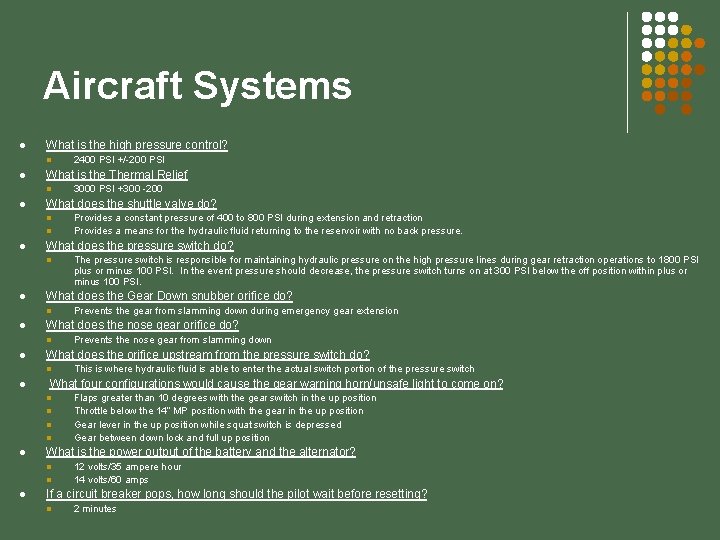
Aircraft Systems l What is the high pressure control? l 2400 PSI +/-200 PSI l What is the Thermal Relief l What does the shuttle valve do? l l l l Flaps greater than 10 degrees with the gear switch in the up position Throttle below the 14” MP position with the gear in the up position Gear lever in the up position while squat switch is depressed Gear between down lock and full up position What is the power output of the battery and the alternator? l l l This is where hydraulic fluid is able to enter the actual switch portion of the pressure switch What four configurations would cause the gear warning horn/unsafe light to come on? l l Prevents the nose gear from slamming down What does the orifice upstream from the pressure switch do? l l Prevents the gear from slamming down during emergency gear extension What does the nose gear orifice do? l l The pressure switch is responsible for maintaining hydraulic pressure on the high pressure lines during gear retraction operations to 1800 PSI plus or minus 100 PSI. In the event pressure should decrease, the pressure switch turns on at 300 PSI below the off position within plus or minus 100 PSI. What does the Gear Down snubber orifice do? l l Provides a constant pressure of 400 to 800 PSI during extension and retraction Provides a means for the hydraulic fluid returning to the reservoir with no back pressure. What does the pressure switch do? l l 3000 PSI +300 -200 12 volts/35 ampere hour 14 volts/60 amps If a circuit breaker pops, how long should the pilot wait before resetting? l 2 minutes
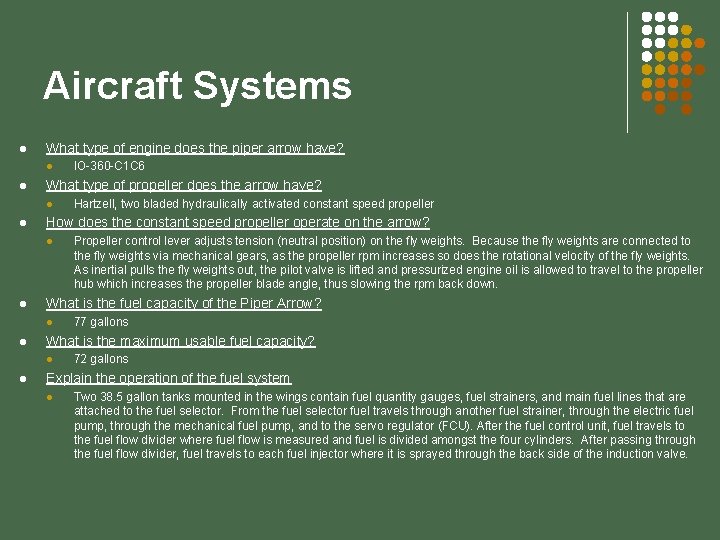
Aircraft Systems l What type of engine does the piper arrow have? l l What type of propeller does the arrow have? l l 77 gallons What is the maximum usable fuel capacity? l l Propeller control lever adjusts tension (neutral position) on the fly weights. Because the fly weights are connected to the fly weights via mechanical gears, as the propeller rpm increases so does the rotational velocity of the fly weights. As inertial pulls the fly weights out, the pilot valve is lifted and pressurized engine oil is allowed to travel to the propeller hub which increases the propeller blade angle, thus slowing the rpm back down. What is the fuel capacity of the Piper Arrow? l l Hartzell, two bladed hydraulically activated constant speed propeller How does the constant speed propeller operate on the arrow? l l IO-360 -C 1 C 6 72 gallons Explain the operation of the fuel system l Two 38. 5 gallon tanks mounted in the wings contain fuel quantity gauges, fuel strainers, and main fuel lines that are attached to the fuel selector. From the fuel selector fuel travels through another fuel strainer, through the electric fuel pump, through the mechanical fuel pump, and to the servo regulator (FCU). After the fuel control unit, fuel travels to the fuel flow divider where fuel flow is measured and fuel is divided amongst the four cylinders. After passing through the fuel flow divider, fuel travels to each fuel injector where it is sprayed through the back side of the induction valve.
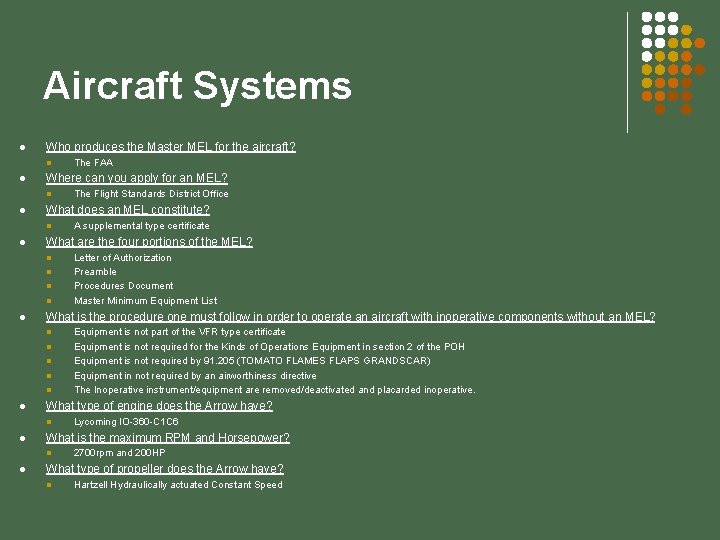
Aircraft Systems l Who produces the Master MEL for the aircraft? l l Where can you apply for an MEL? l l l l l Lycoming IO-360 -C 1 C 6 What is the maximum RPM and Horsepower? l l Equipment is not part of the VFR type certificate Equipment is not required for the Kinds of Operations Equipment in section 2 of the POH Equipment is not required by 91. 205 (TOMATO FLAMES FLAPS GRANDSCAR) Equipment in not required by an airworthiness directive The Inoperative instrument/equipment are removed/deactivated and placarded inoperative. What type of engine does the Arrow have? l l Letter of Authorization Preamble Procedures Document Master Minimum Equipment List What is the procedure one must follow in order to operate an aircraft with inoperative components without an MEL? l l A supplemental type certificate What are the four portions of the MEL? l l The Flight Standards District Office What does an MEL constitute? l l The FAA 2700 rpm and 200 HP What type of propeller does the Arrow have? l Hartzell Hydraulically actuated Constant Speed
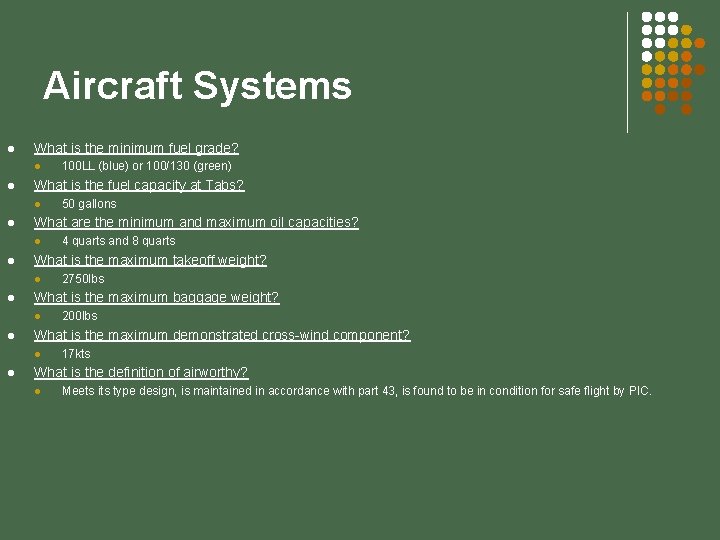
Aircraft Systems l What is the minimum fuel grade? l l What is the fuel capacity at Tabs? l l 200 lbs What is the maximum demonstrated cross-wind component? l l 2750 lbs What is the maximum baggage weight? l l 4 quarts and 8 quarts What is the maximum takeoff weight? l l 50 gallons What are the minimum and maximum oil capacities? l l 100 LL (blue) or 100/130 (green) 17 kts What is the definition of airworthy? l Meets its type design, is maintained in accordance with part 43, is found to be in condition for safe flight by PIC.
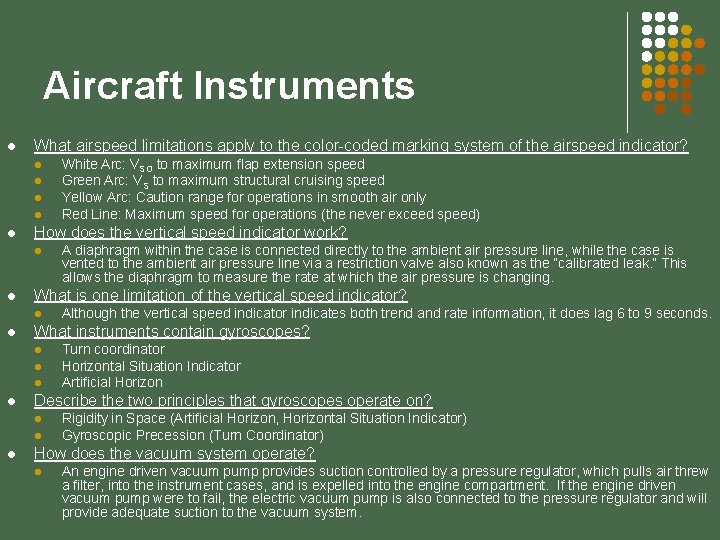
Aircraft Instruments l What airspeed limitations apply to the color-coded marking system of the airspeed indicator? l l l How does the vertical speed indicator work? l l Turn coordinator Horizontal Situation Indicator Artificial Horizon Describe the two principles that gyroscopes operate on? l l l Although the vertical speed indicator indicates both trend and rate information, it does lag 6 to 9 seconds. What instruments contain gyroscopes? l l A diaphragm within the case is connected directly to the ambient air pressure line, while the case is vented to the ambient air pressure line via a restriction valve also known as the “calibrated leak. ” This allows the diaphragm to measure the rate at which the air pressure is changing. What is one limitation of the vertical speed indicator? l l White Arc: VSO to maximum flap extension speed Green Arc: VS to maximum structural cruising speed Yellow Arc: Caution range for operations in smooth air only Red Line: Maximum speed for operations (the never exceed speed) Rigidity in Space (Artificial Horizon, Horizontal Situation Indicator) Gyroscopic Precession (Turn Coordinator) How does the vacuum system operate? l An engine driven vacuum pump provides suction controlled by a pressure regulator, which pulls air threw a filter, into the instrument cases, and is expelled into the engine compartment. If the engine driven vacuum pump were to fail, the electric vacuum pump is also connected to the pressure regulator and will provide adequate suction to the vacuum system.
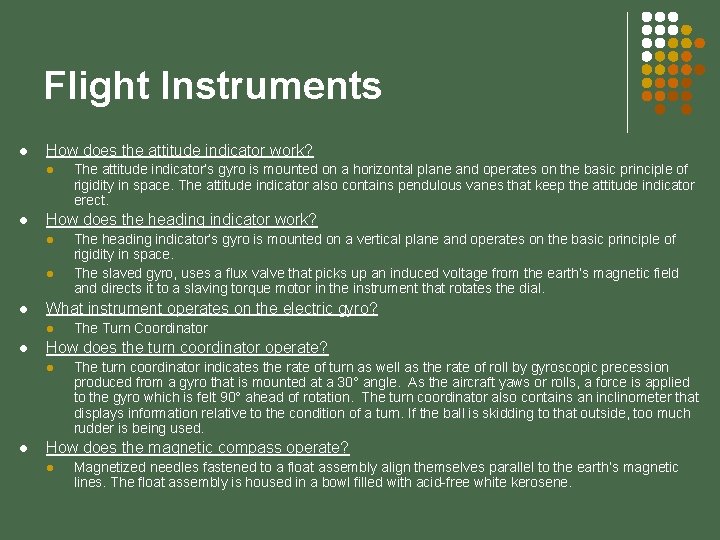
Flight Instruments l How does the attitude indicator work? l l How does the heading indicator work? l l l The Turn Coordinator How does the turn coordinator operate? l l The heading indicator’s gyro is mounted on a vertical plane and operates on the basic principle of rigidity in space. The slaved gyro, uses a flux valve that picks up an induced voltage from the earth’s magnetic field and directs it to a slaving torque motor in the instrument that rotates the dial. What instrument operates on the electric gyro? l l The attitude indicator’s gyro is mounted on a horizontal plane and operates on the basic principle of rigidity in space. The attitude indicator also contains pendulous vanes that keep the attitude indicator erect. The turn coordinator indicates the rate of turn as well as the rate of roll by gyroscopic precession produced from a gyro that is mounted at a 30° angle. As the aircraft yaws or rolls, a force is applied to the gyro which is felt 90° ahead of rotation. The turn coordinator also contains an inclinometer that displays information relative to the condition of a turn. If the ball is skidding to that outside, too much rudder is being used. How does the magnetic compass operate? l Magnetized needles fastened to a float assembly align themselves parallel to the earth’s magnetic lines. The float assembly is housed in a bowl filled with acid-free white kerosene.
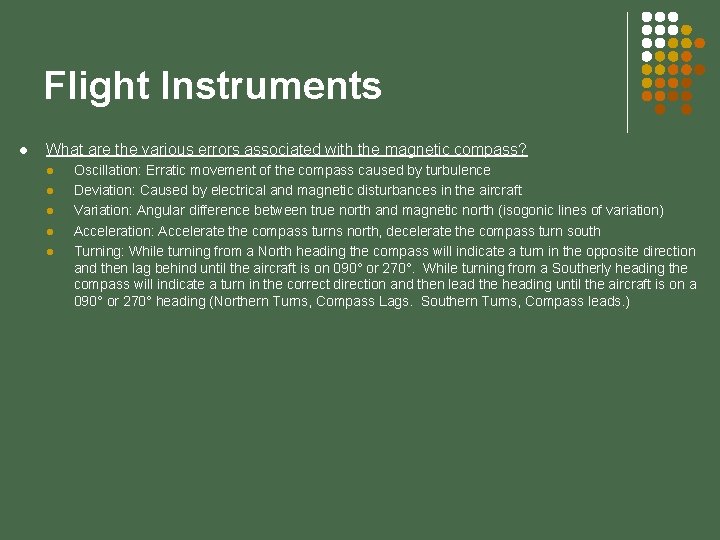
Flight Instruments l What are the various errors associated with the magnetic compass? l l l Oscillation: Erratic movement of the compass caused by turbulence Deviation: Caused by electrical and magnetic disturbances in the aircraft Variation: Angular difference between true north and magnetic north (isogonic lines of variation) Acceleration: Accelerate the compass turns north, decelerate the compass turn south Turning: While turning from a North heading the compass will indicate a turn in the opposite direction and then lag behind until the aircraft is on 090° or 270°. While turning from a Southerly heading the compass will indicate a turn in the correct direction and then lead the heading until the aircraft is on a 090° or 270° heading (Northern Turns, Compass Lags. Southern Turns, Compass leads. )
Supplemental Oxygen l What are the two types of oxygen breathing systems? l l Can any type of oxygen be used for aviation? l l Cabin pressurization is the maintenance of a cabin altitude lower than the actual flight altitude. This is accomplished by compressing air in the aircraft cabin. Cabin pressurization is mainly used to allow flights at higher altitudes without the effects of decompression sickness, eliminates the need for an oxygen mask and increases passenger comfort. What is the difference between an explosive decompression and a rapid decompression? l l No, medical or welding oxygen may contain excess amounts of water vapor that could condense and freeze at high altitude operations. “Aviator’s breathing oxygen” is 99. 5% pure oxygen with not more than two milliliters of water per liter of oxygen. What is cabin pressurization, why is it used? l l The two types of oxygen breathing systems are continuous flow and pressure demand. A continuous flow type oxygen system provides oxygen to the pilot or passengers through the use of a mask or oxygen tube. A pressure demand type system is safe for use at altitudes above 40, 000 ft because the mask is air tight and provides a positive pressure that allows the user’s lungs to be pressurized with oxygen. During an explosive decompression, the lungs cannot decompress as fast as the cabin and lung damage can occur. What are some factors that a pilot should be concerned about while carrying passengers that have been scuba diving? l Passengers that have been scuba diving have absorbed much more nitrogen than the average human which prevents their lungs from absorbing oxygen as well. As a result, any passenger that has been on a dive not requiring a controlled ascent should wait at least 12 hours before flying at any altitude below 8, 000 ft and at least 24 hours for any flight about 8, 000 ft. Any passenger that has been on a scuba dive that required a controlled ascent must wait at least 24 hours before flying on any aircraft.
Pressurization l Describe how an aircraft pressurization system operates? l l l What are the two methods by which cabin pressurization is controlled? l l l To pressurize an aircraft the cabin structure must be strong enough to withstand the normal forces of flight as well as serve as an air tight cabin. The aircraft must have a source of compressed air which is provided by 1) a flow control unit that takes air from the turbo chargers, 2) bleed air from the jet engine, 3) a pressurizing pump. The aircraft must be able to control the temperature of the cabin by use of heat exchangers and intercoolers The aircraft must be able to control the rate of pressure change with isobaric control, which automatically controls the pressure to maintain a specific cabin altitude or with differential controllers that limit cabin pressure to ensure limitations of the cabin structure are not exceeded. The aircraft must also have an outflow valve and a safety valve to ensure all cabin pressure is released before the cabin door can be opened. Specific Cabin Pressure Altitude Differential Pressure Value What are the oxygen requirements for pressurized aircraft? l l At flight altitudes above FL 250 at least a 10 minute supply of oxygen For flights above FL 350 one pilot at the controls is wearing and using a mask that is secured and sealed that supplies oxygen continuous or automatically when cabin altitude exceeds 14, 000 ft, except if both pilots have quick donning masks which can be used up to FL 410.
Ice prevention and Elimination l What is the difference between a deice system and an anti-ice system? l l What types of systems are used in the prevention and elimination of ice? l l Pneumatic boots: This system consists of inflatable boots attached to the leading edges of the wings and tail surfaces. Compressed air from the pressure side of the engine vacuum pump or bleed air is cycled through ducts or tubes in the boots causing the boots to inflate. Heated Leading Edge: Bleed air from the compressor fan is routed through tubes connected to the leading edge surfaces which remove or prevent the formation of ice. Weeping wings: Uses leading edge panels with laser drilled holes which allow the gradual seepage of ethylene glycol and isopropyl alcohol which melts ice for 2 hours or more during moderate icing conditions. What types of systems are used to prevent or eliminate propeller ice? l l l A deice system is used to eliminate ice that has already formed. An anti-ice system is used to prevent the formation of ice. Electronically heated boots Fluid system that distributes isopropyl alcohol that is distributed along the propeller with the help of inertia. What types of systems are utilized to prevent or eliminate windshield ice? l l Electrical systems are used to heat elements embedded in the windshield or a device attached to the windshield Fluid Systems that utilize an electronic pump to spray alcohol onto the windshield to prevent the formation of ice.
Avionics l What are static discharge wicks used for? l l How does the automatic direction finder operate? l l l The station transmits two signals, a reference phase signal broadcasted in all direction to determine To/From information and a variable phase signal which transmits on each of the 360° radials. The signals are directly in phase as the signal crosses north and directly out of phase as the signal passes through south. What frequency band does the VOR operate? l l 400 to 1020 Hz How does the VHF-Omni Range (VOR) operate? l l There is a directional antenna that contains loops of wires that receive radio signals in one direction better than in an other. This information is used to determine angular relation to the station. (radial) There is a sense antenna with equal efficiency in all directions and is used to determine the direction to or from the station. What frequency band does the ADF operate within? l l Static wicks are used to discharge static electricity that builds during operations in precipitation that could interfere with navigation and communication equipment. 108. 0 to 117. 95 MHz What are three types of VORs? l High altitude l l Low altitude l l 60, 000 -45, 000 ft/100 nm : 45, 000 -18, 000 ft/130 nm : 18, 000 ft-14, 500/100 nm : 14, 500 -1, 000 ft/40 nm 18, 000 -1, 000 ft/40 nm Terminal l 12, 000 ft-1000 ft/25 nm

Avionics l How does the Distance Measuring Equipment Operate? l l What is the range for DME and its accuracy? l l Requires 4 satellites for navigation, 5 satellites for Receiver Autonomous Integrity Monitoring System and a minimum of 6 satellites to isolate a corrupt satellite. What are three modes of GPS? l l The global positions system uses 24 satellites that operate on the two principles of ranging and triangulation. Each satellite transmits a course acquisition code that contains the location, GPS time, health, and accuracy of the signal. What are the system requirements to navigate using GPS? l l 199 nm with an accuracy of ½ or 3% of the total distance Describe the basic operating principle of the GPS system? l l Paired pulses are sent from the aircraft to the DME station. The ground station sends paired pulses back to the aircraft at the same intervals on a different frequency and the time required for the process is measured and is translated into a distance. Enroute (More than 30 nm) with a sensitivity of 5 nm full scale Terminal (less than 30 nm) with a sensitivity of 1 nm full scale Approach Mode (prior to the FAP) with a sensitivity of. 3 nm full scale What are the four VOR equipment checks and their required accuracies? l l VOT check: ± 4° Ground check: ± 4° Airborne check: ± 6° Dual VOR check: ± 4°
Emergencies l Explain each item on the following emergency checklists l Emergency Failure Below VR l l Emergency Failure Above VR l l Throttle Idle: The throttle is brought to idle incase the engine restarts while aborting the takeoff. Brakes As Required: If possible bring the aircraft to a full stop on the remaining runway Engine Shut Down if Necessary: If the aircraft can’t be stopped on the remaining runway the engine should be shut down to prevent damage to the aircraft and to reduce the risk of fire. Airspeed Maintain Safe: At all times maintain a safe airspeed to avoid stalling Gear Down: The gear should be down unless the landing area makes a gear up landing preferable. Engine Shutdown: Mixture should be brought to Idle-Cut Off for obvious safety reasons Engine Failure-Flight l l l Fuel Selector Switch Tanks: Switch tanks to eliminate fuel exhaustion or contamination. This is the first item on the checklist because it may take several seconds for fuel flow to be returned. Alternate Air Open: A blockage in the induction system may have caused the failure, switching to alternate air will draw unfiltered air from the engine compartment should restore air flow. Fuel Pump ON: A failure of the engine driven fuel pump may have caused the failure. Mixture Rich: Lean mixtures could cause a failure, enriching the mixture will correct this problem. Engine Instruments Check: This could help you determine the cause for the failure Magnetos: Operation on the L, R or both positions could restore power if a magneto has failed.
Emergencies l Explain each item on the following emergency checklists l l Power Off Landing l Airspeed 79 kias: Maintaining the L/D max will ensure the maximum gliding range l Place to land Pilot Option: A suitable place to land should be selected ASAP l Cockpit/Passengers Prepare: Cockpit should be prepared by securing loose items, having passengers remove head sets, sunglass and assume the crash position. The pilot should also consider opening the door to prevent it from jamming shut. If time and altitude Permit l Squawk 7700: ATC facilities will detect this and provide emergencies services, priority handling, and will help with search and rescue. l Radio Transmit: Use the term mayday to ensure other pilots will not use the frequency. Transmit the nature of the emergency, position, altitude, number of persons on board, and intentions. If not already communicating with ATC, transmit on 121. 5 because ALL ATC frequencies monitor this frequency. l ELT ON: Although the ELT will activate automatically, ensure it is ON and operating l Throttle Idle: Reduce throttle to prevent post accident fires l Mixture Idle-Cut Off: Reduces the chances of post accident fires l Magnetos OFF: Reduces the chances of a post accident fire. l Gear As Required: Gear should be down unless landing area favors gear up landing l Battery Switch Off: This will help eliminate an ignition source for fires l Alternator Switch Off: This will help eliminate an ignition source for fires l Fuel Selector Off: This will help reduce the chances of a post accident fire l Seat Belts Secure: Tighten all seat belts to help prevent bodily injury l Flaps As required: If possible flaps should be set at full to ensure the slowest possible touch down speed l Approach Speed 72 kias: Fly the approach at 72 with a touch down at the slowest possible airspeed.
Emergencies l Explain each of the following items on the Emergency checklist l Engine Fire Start l l l Engine Fire-Flight l l l Starter Continue Cranking: By continuing to start the engine flames and fuel will be drawn into the engine where the fire will be contained. Mixture Idle Cut Off: This will stop the flow of fuel to the engine Throttle full Open: This will allow maximum air flow into the induction system Fuel Pump Off: This will stop the flow of fuel towards the engine Fuel Selector Off: This will stop the flow of fuel towards the engine Throttle Idle: This is the next step to stop the flow of fuel Mixture Idle Cut-off: This will stop the flow of fuel to the engine Fuel Pump Off: This will help limit the amount of fuel in the engine compartment Heater/Defroster Vents Off: This will limit the amount of smoke and fumes entering the cabin Electrical Fire l l l Battery Switch Off: This will help prevent the spread of fire Alternator Switch Off: This will help prevent the spread of fire Vents Open: Fresh air will help remove fumes created by the electrical fire Heater/Defroster Vents Closed: This will help contain the fumes entering the cabin Fire Extinguisher Active: If the fire persists, use the fire extinguisher to prevent further spread of the fire
Emergencies l Explain each of the following items on the Emergency checklists l Spin Recovery l l l l Rudder Full Opposite: This will help stop the rotation of the spin Control Wheel Full Forward, Ailerons Neutral: This will help brake the stall and prevent further aggravation of the spin. Throttle Idle: Thrust will only make the spin flatter and thus harder to recover from Rudder Neutral when Rotation Stops: This will prevent a spin in the opposite direction Control Wheel As required: Use control pressure to keep wings level and pull out of the dive. Throttle as required: Use power as necessary to maintain normal flight. Emergency Descent l l l l Throttle Idle: This will help increase drag and reduce airspeed Propeller High RPM: This will help increase drag Mixture Rich: This will prevent the mixture from becoming too lean Landing Gear Down: This will help increase drag Bank 30 -45 degrees: This will decrease the vertical component of lift and increase the descent rate and keep all acceleration forces positive. Fuel Pump On: This will decrease the chances for an engine failure during the descent Rollout on 129 kias: This is done to prevent operations that exceed the landing gear operating limitations
Emergencies l Explain each of the following items on the emergency checklist l Propeller Overspeed l l l Loss of Fuel Pressure l l l Recovery from a spin with an aft CG may become very difficult or impossible if inertia raises the tail causing a flat spin. What are three phases of a spin? l l Fuel Pump On: This will restore fuel flow if the engine driven fuel pump failed Fuel Selector Switch Tanks: This will restore fuel flow if the flow was lost due to fuel exhaustion or fuel contamination. What does an aft center of gravity do to an aircraft’s spin recovery? l l Throttle Idle: this will help reduce engine rpm’s to less than 2700 Oil Pressure Check: This will help determine if a loss of oil pressure is causing the problems Propeller Control: This will help control the engine RPM Airspeed Reduce: Decreasing the airspeed will keep the RPMs below 2700 Throttle As Required: Maintain a power setting that will keep RPMs below 2700 Incipient: exists from the time the airplane stalls and rotation starts until the spin is fully developed Fully Developed: Exists from the time angular rotation, airspeed, and descent are stabilized. Spin Recovery: Begins when the anti-spin forces overcome to pro-spin forces. Name three phases of flight where unintentional spins are most likely to occur. l l l Base to Final Skid Wind shear during crosswind to downwind turns Engine failure or wind shear during climb out after takeoff
Abnormal Procedures l Name two phenomena's that exists which cause an increase in engine temperature during takeoff and climb? l l l Detonation which is caused when the fuel/air mixture is subjected to a combination of excessively high temperatures and high pressure within the cylinders which causes an instantaneous burning or explosion of the mixture. This can be corrected by opening cowl flaps, reducing power, reducing the climb rate and enriching the fuel mixture. Preignition which is caused by the ignition of fuel prior to normal ignition. This can be caused by excessively hot exhaust valves, or carbon particles on spark plug electrodes heated to an incandescent or glowing state. This can be corrected by opening cowl flaps, reducing power, reduce climb rate, and enrich the fuel/air mixture. If the engine begins to run rough when flying through heavy rain, what action should be taken? l During flights in icing conditions or during periods of heavy rain the air filter may become clogged resulting in an excessively rich mixture.
Aircraft Icing l What are three main types of aircraft icing? l l Name four types of structural icing? l l l The aircraft must be flying through visible moisture when temperatures are at 0°C or colder. If icing has been encountered how should an approach be flown? l l l Clear ice: forms when large drops strike the aircraft surface and slowly freeze Rime ice: Small drops strike the aircraft and freeze rapidly Mixed: A combination of clear and rime ice Frost: Ice crystal deposits formed by sublimation when the temperature at the surface is below the dew point, and the dew point is below freezing. What is necessary for structural icing to occur? l l Structural Induction Instrument Maintain high power settings Higher Airspeed Recommend a “no flap” approach Maintain a consistently higher altitude If the static ports were to become clogged, and the alternate air source was used what should the pilot expect? l l l Altimeter will read higher than normal causing the pilot to fly low The airspeed will indicate higher than normal causing the pilot to fly slow The vertical speed indicator will momentarily show a climb
Performance l What is the chord line of a wing? l l What is the chamber of a wing? l l Sometimes called the center of lift, this is the point along the chord line of an airfoil where lift is concentrated. At high angles of attack the center of pressure moves forward while at low angles of attack it moves aft. Name five factors that affect both lift and drag? l l l The angle formed between the chord line and the longitudinal axis of the aircraft. What is the center of pressure? l l The angle formed between the chord line and the relative wind. What is the angle of incidence? l l The line that connects all of the points midway between the upper and lower surfaces of the wing. What is angle of attack? l l A reference line from the leading edge at the forward most tip of the wing to the trailing edge. Wing area-the pilot can change wing area with the use of flaps and leading edge devices Shape of the Airfoil: As the chamber increases, so does lift. Lowering an aileron/flap are examples. Angle of attack: As the angle of attack is increased, both lift and drag are increased Velocity: As the velocity of air increases, so does lift and drag. Air Density: As air density increases, so do lift and drag. Density is affected by temperature, pressure, humidity and altitude. What is a wing platform? l The wing platform is the shape of the wing as viewed from above. Elliptical, Rectangular, Tapered, Sweptback.
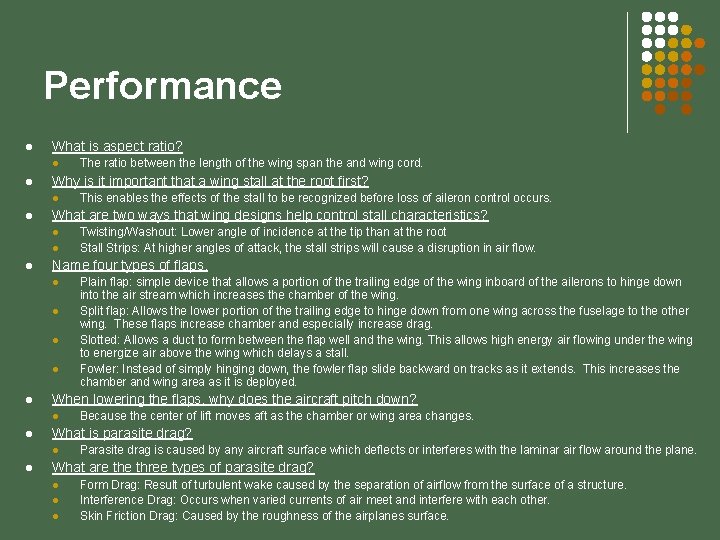
Performance l What is aspect ratio? l l Why is it important that a wing stall at the root first? l l l Because the center of lift moves aft as the chamber or wing area changes. What is parasite drag? l l Plain flap: simple device that allows a portion of the trailing edge of the wing inboard of the ailerons to hinge down into the air stream which increases the chamber of the wing. Split flap: Allows the lower portion of the trailing edge to hinge down from one wing across the fuselage to the other wing. These flaps increase chamber and especially increase drag. Slotted: Allows a duct to form between the flap well and the wing. This allows high energy air flowing under the wing to energize air above the wing which delays a stall. Fowler: Instead of simply hinging down, the fowler flap slide backward on tracks as it extends. This increases the chamber and wing area as it is deployed. When lowering the flaps, why does the aircraft pitch down? l l Twisting/Washout: Lower angle of incidence at the tip than at the root Stall Strips: At higher angles of attack, the stall strips will cause a disruption in air flow. Name four types of flaps. l l This enables the effects of the stall to be recognized before loss of aileron control occurs. What are two ways that wing designs help control stall characteristics? l l The ratio between the length of the wing span the and wing cord. Parasite drag is caused by any aircraft surface which deflects or interferes with the laminar air flow around the plane. What are three types of parasite drag? l l l Form Drag: Result of turbulent wake caused by the separation of airflow from the surface of a structure. Interference Drag: Occurs when varied currents of air meet and interfere with each other. Skin Friction Drag: Caused by the roughness of the airplanes surface.
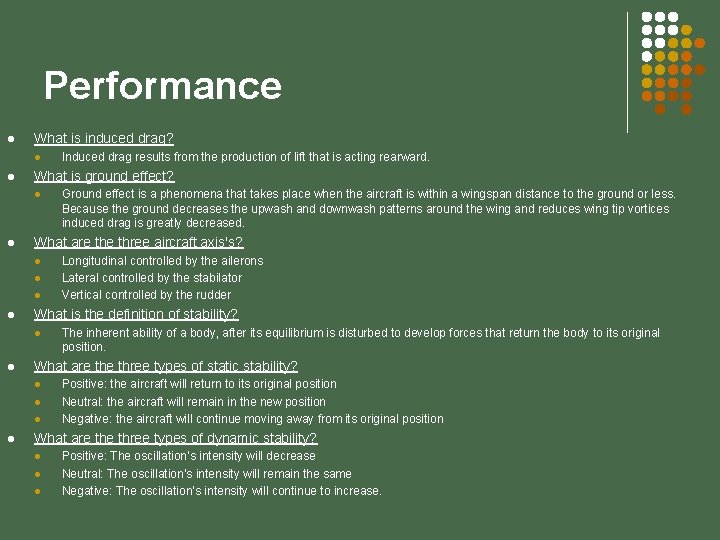
Performance l What is induced drag? l l What is ground effect? l l The inherent ability of a body, after its equilibrium is disturbed to develop forces that return the body to its original position. What are three types of static stability? l l Longitudinal controlled by the ailerons Lateral controlled by the stabilator Vertical controlled by the rudder What is the definition of stability? l l Ground effect is a phenomena that takes place when the aircraft is within a wingspan distance to the ground or less. Because the ground decreases the upwash and downwash patterns around the wing and reduces wing tip vortices induced drag is greatly decreased. What are three aircraft axis's? l l Induced drag results from the production of lift that is acting rearward. Positive: the aircraft will return to its original position Neutral: the aircraft will remain in the new position Negative: the aircraft will continue moving away from its original position What are three types of dynamic stability? l l l Positive: The oscillation’s intensity will decrease Neutral: The oscillation’s intensity will remain the same Negative: The oscillation’s intensity will continue to increase.
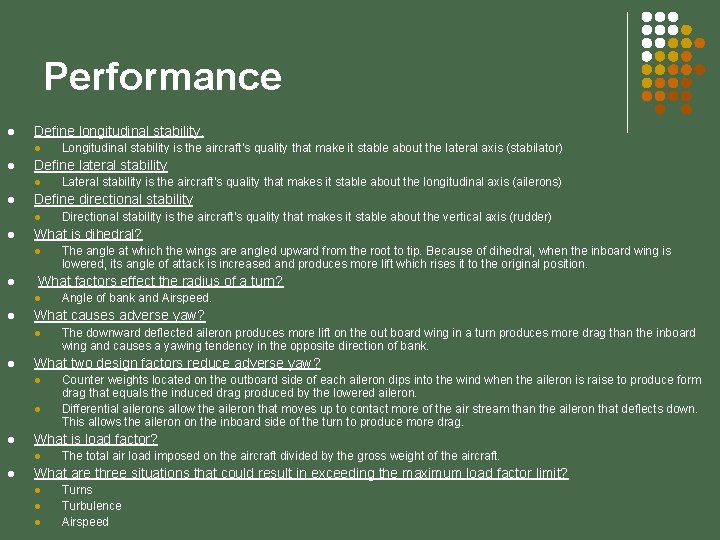
Performance l Define longitudinal stability. l l Define lateral stability l l l Counter weights located on the outboard side of each aileron dips into the wind when the aileron is raise to produce form drag that equals the induced drag produced by the lowered aileron. Differential ailerons allow the aileron that moves up to contact more of the air stream than the aileron that deflects down. This allows the aileron on the inboard side of the turn to produce more drag. What is load factor? l l The downward deflected aileron produces more lift on the out board wing in a turn produces more drag than the inboard wing and causes a yawing tendency in the opposite direction of bank. What two design factors reduce adverse yaw? l l Angle of bank and Airspeed. What causes adverse yaw? l l The angle at which the wings are angled upward from the root to tip. Because of dihedral, when the inboard wing is lowered, its angle of attack is increased and produces more lift which rises it to the original position. What factors effect the radius of a turn? l l Directional stability is the aircraft’s quality that makes it stable about the vertical axis (rudder) What is dihedral? l l Lateral stability is the aircraft’s quality that makes it stable about the longitudinal axis (ailerons) Define directional stability l l Longitudinal stability is the aircraft’s quality that make it stable about the lateral axis (stabilator) The total air load imposed on the aircraft divided by the gross weight of the aircraft. What are three situations that could result in exceeding the maximum load factor limit? l l l Turns Turbulence Airspeed
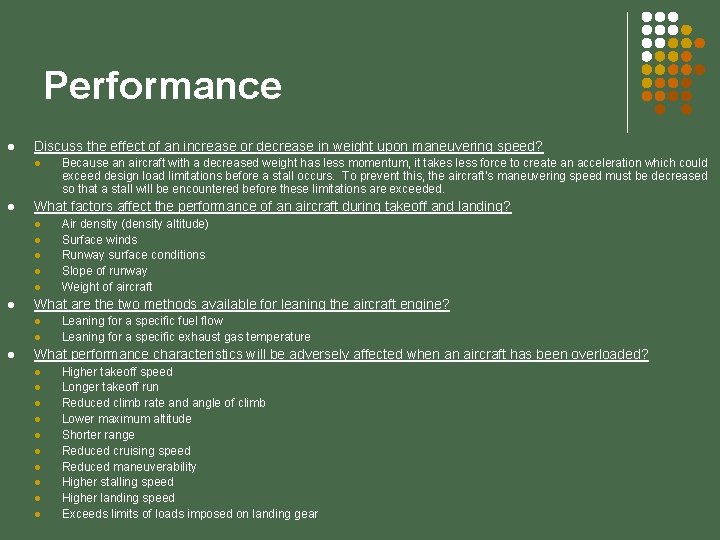
Performance l Discuss the effect of an increase or decrease in weight upon maneuvering speed? l l What factors affect the performance of an aircraft during takeoff and landing? l l l Air density (density altitude) Surface winds Runway surface conditions Slope of runway Weight of aircraft What are the two methods available for leaning the aircraft engine? l l l Because an aircraft with a decreased weight has less momentum, it takes less force to create an acceleration which could exceed design load limitations before a stall occurs. To prevent this, the aircraft’s maneuvering speed must be decreased so that a stall will be encountered before these limitations are exceeded. Leaning for a specific fuel flow Leaning for a specific exhaust gas temperature What performance characteristics will be adversely affected when an aircraft has been overloaded? l l l l l Higher takeoff speed Longer takeoff run Reduced climb rate and angle of climb Lower maximum altitude Shorter range Reduced cruising speed Reduced maneuverability Higher stalling speed Higher landing speed Exceeds limits of loads imposed on landing gear
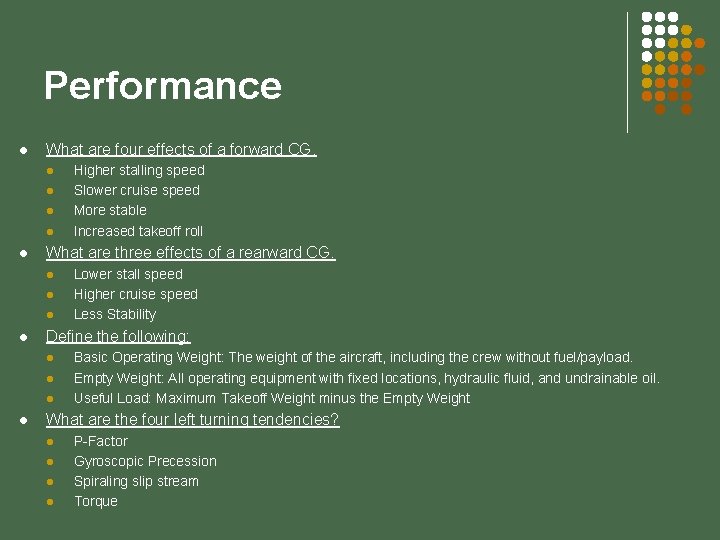
Performance l What are four effects of a forward CG. l l l What are three effects of a rearward CG. l l Lower stall speed Higher cruise speed Less Stability Define the following: l l Higher stalling speed Slower cruise speed More stable Increased takeoff roll Basic Operating Weight: The weight of the aircraft, including the crew without fuel/payload. Empty Weight: All operating equipment with fixed locations, hydraulic fluid, and undrainable oil. Useful Load: Maximum Takeoff Weight minus the Empty Weight What are the four left turning tendencies? l l P-Factor Gyroscopic Precession Spiraling slip stream Torque
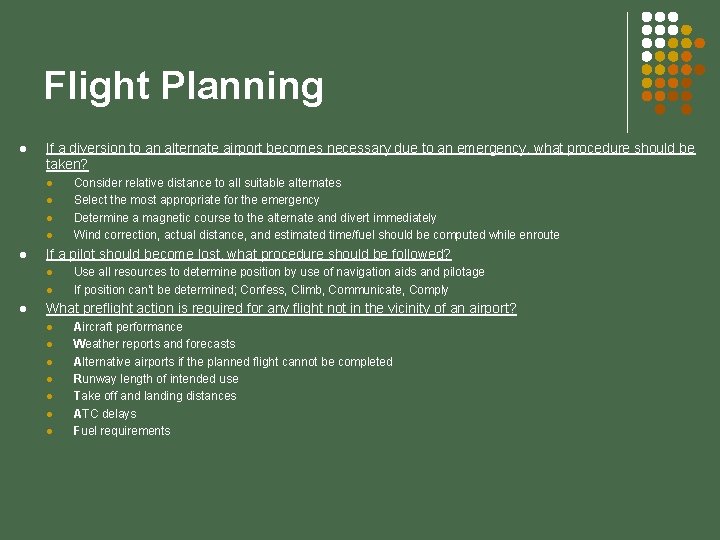
Flight Planning l If a diversion to an alternate airport becomes necessary due to an emergency, what procedure should be taken? l l l If a pilot should become lost, what procedure should be followed? l l l Consider relative distance to all suitable alternates Select the most appropriate for the emergency Determine a magnetic course to the alternate and divert immediately Wind correction, actual distance, and estimated time/fuel should be computed while enroute Use all resources to determine position by use of navigation aids and pilotage If position can’t be determined; Confess, Climb, Communicate, Comply What preflight action is required for any flight not in the vicinity of an airport? l l l l Aircraft performance Weather reports and forecasts Alternative airports if the planned flight cannot be completed Runway length of intended use Take off and landing distances ATC delays Fuel requirements
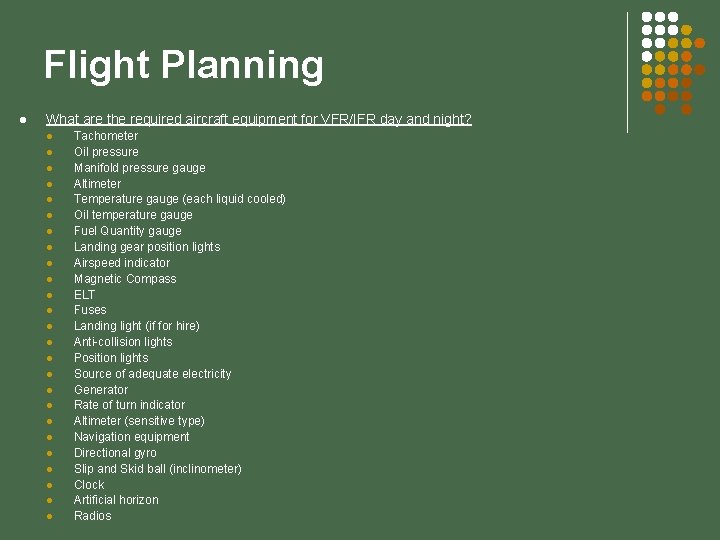
Flight Planning l What are the required aircraft equipment for VFR/IFR day and night? l l l l l l l Tachometer Oil pressure Manifold pressure gauge Altimeter Temperature gauge (each liquid cooled) Oil temperature gauge Fuel Quantity gauge Landing gear position lights Airspeed indicator Magnetic Compass ELT Fuses Landing light (if for hire) Anti-collision lights Position lights Source of adequate electricity Generator Rate of turn indicator Altimeter (sensitive type) Navigation equipment Directional gyro Slip and Skid ball (inclinometer) Clock Artificial horizon Radios
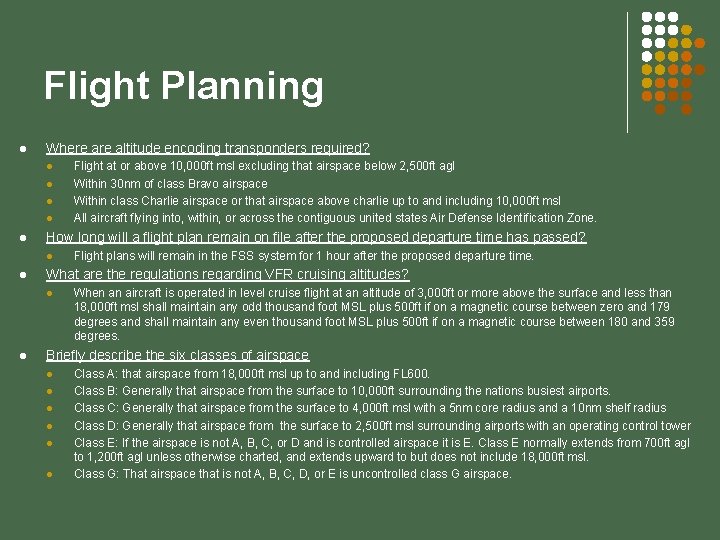
Flight Planning l Where altitude encoding transponders required? l l l How long will a flight plan remain on file after the proposed departure time has passed? l l Flight plans will remain in the FSS system for 1 hour after the proposed departure time. What are the regulations regarding VFR cruising altitudes? l l Flight at or above 10, 000 ft msl excluding that airspace below 2, 500 ft agl Within 30 nm of class Bravo airspace Within class Charlie airspace or that airspace above charlie up to and including 10, 000 ft msl All aircraft flying into, within, or across the contiguous united states Air Defense Identification Zone. When an aircraft is operated in level cruise flight at an altitude of 3, 000 ft or more above the surface and less than 18, 000 ft msl shall maintain any odd thousand foot MSL plus 500 ft if on a magnetic course between zero and 179 degrees and shall maintain any even thousand foot MSL plus 500 ft if on a magnetic course between 180 and 359 degrees. Briefly describe the six classes of airspace l l l Class A: that airspace from 18, 000 ft msl up to and including FL 600. Class B: Generally that airspace from the surface to 10, 000 ft surrounding the nations busiest airports. Class C: Generally that airspace from the surface to 4, 000 ft msl with a 5 nm core radius and a 10 nm shelf radius Class D: Generally that airspace from the surface to 2, 500 ft msl surrounding airports with an operating control tower Class E: If the airspace is not A, B, C, or D and is controlled airspace it is E. Class E normally extends from 700 ft agl to 1, 200 ft agl unless otherwise charted, and extends upward to but does not include 18, 000 ft msl. Class G: That airspace that is not A, B, C, D, or E is uncontrolled class G airspace.
Flight Planning l Define each of the following types of airspace l l l l Name three types of hydroplaning l l Prohibited: For security reasons all aircraft operations are prohibited from entering that airspace designated prohibited Restricted: Contains unusual hazards to aircraft, thus flights are restricted from entering that airspace designated as restricted unless they have prior approval. Military Operations Area: Designated to separate military training from IFR traffic. Permission is not required but pilots should exercise caution while operating with a MOA. Warning Area: Contains the same hazards as restricted airspace but does not require permission to enter. This airspace is generally found beyond the 3 -mile limit of international airspace. Alert Area: Airspace containing a high volume of pilot training or unusual aerial activity TRSA: Terminal Radar Service Area consists of airspace surrounding airports wherein ATC provides radar vectoring, sequencing and separation on a full time basis for all IFR and participating VFR aircraft. Federal Airway: Routes based on a centerline that extends from one navigational aid, fix, or intersection to another. These airways include class E airspace from 1, 200 ft agl to 17, 999 ft msl within 4 nm to either side of the center line, unless those fixes are more than 51 nm apart. In this case the airway is 4. 5° apart. Dynamic: Occurs when the aircraft’s tires contact standing water on the runway surface and cannot penetrate Viscous: Occurs when a very thin film of fluid prevents the aircraft from contacting the runway (smooth surfaces only) Reverted Rubber: Occurs when the brakes are locked for an extended period of time. The friction produces heat which melts the rubber and allows the tire to hydroplane on melted rubber and steam (if water is present) What are the six types of rotating beacons used to identify airports? l l l White and Green: lighted land airport Green along: lighted land airport White and yellow: lighted water airport Green, Yellow, and white: Lighted heliport White, Green: Military airport
Flight planning l Describe runway end identifier lights (REIL) l l What color are taxiway edge lights? l l Seven clicks within 5 seconds for high intensity Five clicks within 5 seconds for medium intensity Three clicks within 5 seconds for low intensity What are the requirements for use of supplemental oxygen? l l Green How are runway lights activated at night? l l Omnidirectional Blue What color are taxiway centerline lights? l l REILs are used to provide rapid and positive identification of the approach end of a particular runway. The system consists of a pair of synchronized flashing lights located on each side of the runway threshold. For flights at cabin pressure altitudes between 12, 500 ft msl and 14, 000 ft the minimum required flight crew members are required to use supplemental oxygen for all flight time exceeding 30 minutes For flights at cabin pressure altitudes above 14, 000 ft msl the minimum required flight crewmembers are required to use supplemental oxygen for all flight time For flights at cabin pressure altitudes above 15, 000 ft msl supplemental oxygen must be offered to passengers What are the requirements for use of supplemental oxygen aboard pressurized aircraft? l l Above FL 250 at least a 10 minute supply of oxygen must be available to each person on board for use in the even that pressurization is lost. Above FL 350 at least one pilot at the controls is wearing and using an oxygen mask that is secured and sealed that uses oxygen continuously or automatically whenever cabin pressure exceeds 14, 000 ft msl. Unless, the flight is conducted below FL 410 and both pilots at the controls each have a quick donning oxygen mask that can be placed on the face within 5 seconds and if one pilot leaves the controls for any reason, the remaining pilot must wear and use the oxygen mask.
Flight planning l When is immediate notification to the NTSB required? l l l l After an accident or incident has occurred, how soon must the NTSB be notified? l l Aircraft receives substantial damage Any person suffers death or serious injury Define serious injury? l l l 10 days after an accident When, after 7 days, if an overdue aircraft is still missing Define accident? l l Flight control malfunction Crewmember unable to perform normal duties Turbine engine failure of structural components In-flight fire Aircraft collision in-flight Property damage, other than aircraft, estimated to exceed $25, 000. 00 Overdue aircraft (believed to be involved in an accident) Requires hospitalization for more than 48 hours within 7 days from the date of injury Results in a fracture of any bone Causes severe hemorrhages, nerve, muscle or tendon damage Second or Third degree burns affecting more than 5% of the body surface Define structural accident? l Any damage that adversely affects structural strength, performance, or flight characteristics which requires major repair.
Federal Aviation Regulations l Define the term Civil Airworthiness? (Part 91. 7) l l What are the regulations concerning Alcohol or drugs? (91. 17) l l l l No person may operate any portable electronic device aboard any aircraft operated by the holder of an air carrier certificate or any flight operated under instrument flight rules. This section does not apply to; Voice recorders, Hearing aids, Pacemakers, Electric shavers, any other device the PIC determines is safe. What are the maximum operating air speeds governed by 91. 117? l l No person may act as a crewmember of a civil aircraft— Within 8 hours after consumption of any alcoholic beverage While under the influence of alcohol While using any drug that affects the person’s faculties in any way contrary to safety While having. 04 percent by body weight of alcohol in the blood No person may allow a person who appears to be intoxicated or who demonstrates by manner or physical indications that the individual is under the influence of drugs (except medical patients) to be carried in that aircraft. What are the regulations concerning portable electronic devices? (91. 21) l l The pilot in command of a civil aircraft is responsible for determining whether that aircraft is in condition for safe flight. The pilot in command shall discontinue the flight when unairworthy conditions exist. No person may operate an aircraft below 10, 000 ft MSL at more than 250 kias No person may operate an aircraft below 2, 500 MSL within 4 nm of the primary airport of class C or D airspace at an indicated airspeed of more than 200 kias. No person may operate an aircraft in the airspace underlying class B airspace at more than 200 kias What are the minimum safe altitudes for VFR and IFR? l l Anywhere: An altitude allowing, if a power unit fails, an emergency landing without undue hazard to persons/property Over Congested Areas: 1, 000 ft above the highest obstacle within a 2, 000 ft horizontal distance Other an Congested: 500 ft above the surface, except over open water or sparsely populated areas where the aircraft may not be operated closer than 500 ft to any person, vessel, vehicle, or structure. 2, 000 above the highest obstacle within 4 nm of the course in designated mountainous areas, and 1, 000 ft in all other areas.
Federal Aviation Regulations l What are the requirements for Altimeter Settings? (91. 121) l l What are three legal reasons to deviate from an ATC instruction or clearance? l l 48 hours to the manager of the ATC facility What does Steady Green, Flashing Green, Steady Red, Flashing White, and Alternating Red/Green mean to an aircraft on the surface? l l l l An amended clearance is received An emergency exists In response to traffic alert or collision avoidance IF a pilot is given priority handling in an emergency shall submit a report within what time frame if request? l l Below 18, 000 ft MSL to the current altimeter setting within 100 nm The elevation of the departure airport prior to takeoff in the absence of a reporting station At or above 18, 000 ft msl 29. 92 Hg Cleared for takeoff Cleared to taxi Stop Taxi clear of the runway in use Return to the starting point on the airport Exercise extreme caution What does Steady Green, Flashing Green, Steady Red, Flashing White, and Alternating Red/Green mean to an aircraft in flight? l l l Clear to land Return for landing (to be followed by a steady green) Give way to other aircraft and circle Airport unsafe—do not land Not Applicable Exercise extreme caution

Federal Aviation Regulations l What are the VFR weather minimums for class Bravo Airspace? l l l What are the VFR weather minimums for class Charlie Airspace? l l l l 1 sm visibility Clear of Clouds What are the VFR weather minimums for class Golf airspace during the day above 1, 200 ft but less than 10, 000 ft? l l l 5 sm visibility 1, 000 ft below, 1, 000 ft above, 1 sm horizontal What are the VFR weather minimums for class Golf airspace during the day at 1, 200 ft or less above the surface? l l 3 sm visibility 500 ft below, 1, 000 ft above, 2, 000 ft horizontal What are the VFR weather minimums for class Echo airspace while at or above 10, 000 ft msl? l l 3 sm visibility 500 ft below, 1, 000 ft above, 2, 000 ft horizontal What are the VFR weather minimums for class Echo airspace while less than 10, 000 ft msl? l l 3 sm visibility 500 ft below, 1, 000 ft above, 2, 000 ft horizontal What are the VFR weather minimums for class Delta Airspace? l l 3 sm visibility Clear of Clouds 1 sm visibility 500 ft below, 1000 ft above, 2, 000 ft horizontal What are the VFR weather minimums for class Golf airspace during the day or night above 10, 000 ft msl? l l 5 sm visibility 1, 000 ft below, 1, 000 ft above, 1 sm horizontal
Federal Aviation Regulations l Explain the requirements for Special VFR operations l l l Below 10, 000 ft msl within lateral boundaries designated for a controlled airport to the surface Requires a clearance Must operate with at least 1 sm visibility and clear of clouds If visibility is not reported the flight may continue if operated under part 91 and visibility is determined to be at least 1 sm by the pilot in command when in the cockpit looking down the runway. If operations are during sunset to sunrise the pilot and aircraft have to be certified for IFR flight. For an aircraft without an approved MEL, what must the pilot-in-command do to fly an aircraft with an inoperative instrument/system? l l l Be sure that it is not par of the VFR-day type certification instruments and equipment prescribed in the applicable airworthiness regulations under which the aircraft was certified In not part of the required equipment on the Kinds of Operations Equipment list as set by the manufacturer Not required by 91. 205 or any other rule that governs the specific kind of flight operation Not required to be operational by an airworthiness directive The inoperative instruments/equipment are removed/deactivated and placarded inoperative. A determination is made by the PIC that the aircraft condition does not constitute a hazard.
Aeromedical Factors l What are the four different types of hypoxia? l l l During night operations, when could hypoxia begin to affect a pilot? l l When cabin pressures decrease while ascending, the Eustachian tube opens and allows air pressure to equalize through the nasal passage. While descending this isn’t automatic and requires the pilot to manually equalize the pressure. If an upper respiratory infection or nasal allergic condition produces enough congestion around the Eustachian tube it may prevent pressure from equalizing. This “ear block” produces severe pain and possible loss of hearing that can last several hours to several days What is spatial disorientation? l l Lightheadedness Drowsiness Tingling feeling in the lower extremities What is a middle ear block? l l Hyperventilation is an increase in the volume of oxygen consumed by the lungs which can subconsciously occur a stressful situation is encountered during flight. This results is a significant decrease in carbon dioxide in the blood stream. What are some symptoms of hyperventilation? l l At cabin altitudes above 5, 000 ft msl, night vision could deteriorate due to hypoxia What is hyperventilation? l l Histotoxic: Chemicals in the blood stream or body tissues prevent the body from absorbing oxygen (alcohol) Hypemic: Blood fails to absorb oxygen because of a blocked hemoglobin (carbon monoxide) Stagnate: Blood absorbs oxygen but fails to circulate because of high g-loads. Hypoxic: Blood fails to absorb enough oxygen because of lack of partial pressure or lack of oxygen levels. (altitude) A loss of awareness of the position of the aircraft in relation to the earth What are 4 visual illusions that lead to spatial disorientation in flight? l l Autokinesis: Staring at a single light for an extended period of time may cause the light to “move. ” False Horizons: Sloping clouds, ground features, uneven terrain Landing Illusions: Bright lights or narrow runways may lead the pilot to believe he is higher than usual. Flicker Vertigo: Flickering lights that are viewed for an extended period of time may lead to convulsions, nausea, or unconsciousness
Aeromedical Factors l Describe the kinesthetic sense? l l What are the 5 illusions caused by vestibular disorientation? l l l l Open fresh air vents Use Supplement oxygen Prop scanning for best orientation What percentage of your body contains water? l l Continuous stimulation of the vestibular system may cause nausea and disorientation with head aches or vomiting What action can be taken to combat motion sickness? l l Coriolus Illusion: During a constant rate turn, rapid head movements will cause the fluid in the semicircular canals to move causing the sensation of rotating on various different planes. Graveyard Spiral: A loss of altitude during a turn may be interpreted as a wings-level descent. This will cause you to increase elevator pressure which tightens the rotation and increases the descent. A recovery to wings level may cause the feeling of rotating in the opposite direction and may result in reentry of the spiral in the opposite direction Leans: Abrupt recovery from a constant rate turn may cause the feeling of rotating in the opposite direction Somatogravic illusion: A rapid acceleration can produce the feeling of pitching up, this may prompt you to lower the nose and enter a dive. Inversion Illusion: An abrupt change from a climb to straight-and-level flight can create the feeling of tumbling backward. What is a common cause of motion sickness? l l This is the awareness of position relative to the earth obtained from nerves in your skin, muscles, and joints. 60 % males/50% females What does water support for the human body? l l Blood pressure Oxygen delivery Body Cooling Waste processing
Aeromedical Factors l When dehydration occurs, what faculties can be impaired? l l Alertness Situational Awareness Judgment What are three things that you can do to minimize dehydration? l l l Increase Cooling efficiency Pace physical activity Protect your body from heat absorption
- Slides: 56