
Commercial Law Weeks 9 and 10 Tort law





- Slides: 41
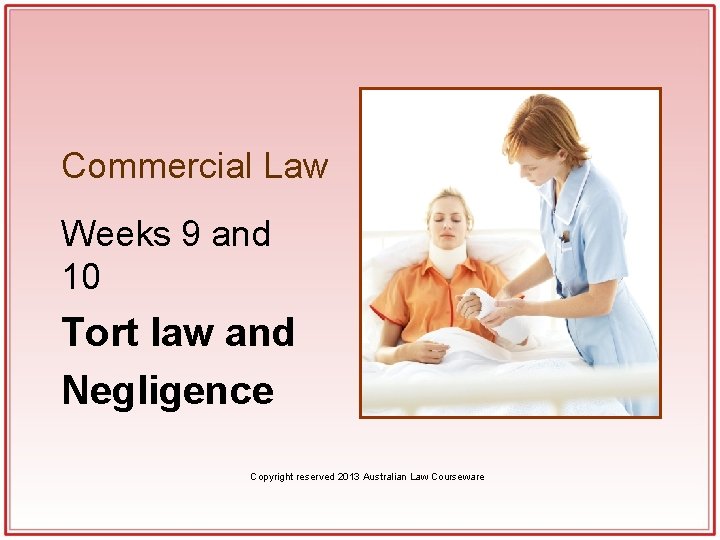
Commercial Law Weeks 9 and 10 Tort law and Negligence Copyright reserved 2013 Australian Law Courseware
About this lecture • Objectives: To distinguish liability in tort from liability in contract; to identify and describe the different torts recognised in Australian law; to explain the tort of Negligence and outline the elements of liability for Negligence.
What type of situation is governed by ‘tort law’?
1. Liability for wrongful conduct causing harm • The word Tort comes (via French) from ‘tortus’- Latin for twisted; crooked; wrong. • Tort law is concerned with wrongful conduct by one person that causes harm to another. • Tort law provides a private right of action for compensation; or for an order to stop continuing or threatened harm. • Both natural persons and corporations are liable for wrongful conduct causing harm. • Tort law encourages or discourages particular behaviour.
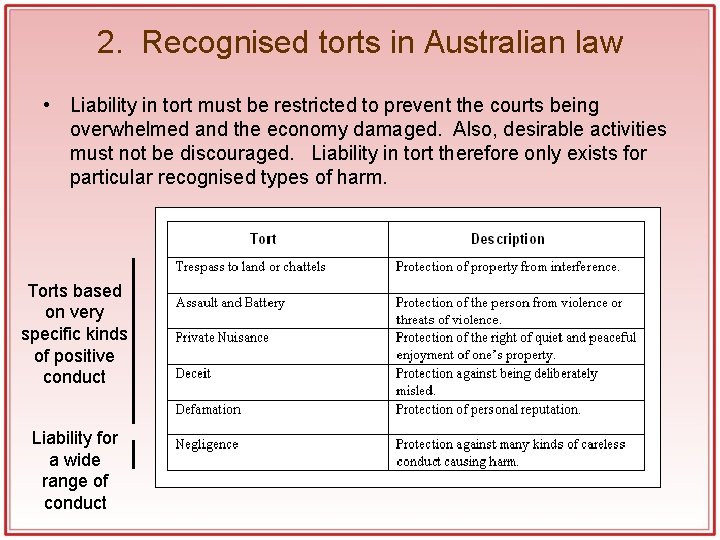
2. Recognised torts in Australian law • Liability in tort must be restricted to prevent the courts being overwhelmed and the economy damaged. Also, desirable activities must not be discouraged. Liability in tort therefore only exists for particular recognised types of harm. Torts based on very specific kinds of positive conduct Liability for a wide range of conduct
What types of conduct does the tort of Negligence cover?
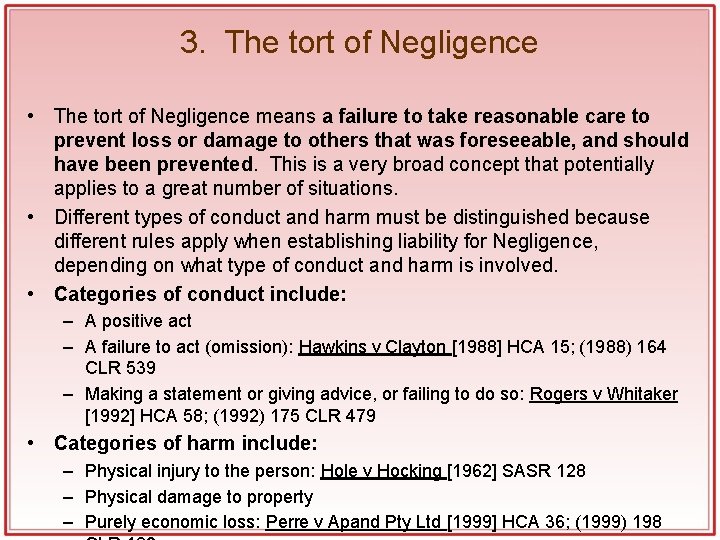
3. The tort of Negligence • The tort of Negligence means a failure to take reasonable care to prevent loss or damage to others that was foreseeable, and should have been prevented. This is a very broad concept that potentially applies to a great number of situations. • Different types of conduct and harm must be distinguished because different rules apply when establishing liability for Negligence, depending on what type of conduct and harm is involved. • Categories of conduct include: – A positive act – A failure to act (omission): Hawkins v Clayton [1988] HCA 15; (1988) 164 CLR 539 – Making a statement or giving advice, or failing to do so: Rogers v Whitaker [1992] HCA 58; (1992) 175 CLR 479 • Categories of harm include: – Physical injury to the person: Hole v Hocking [1962] SASR 128 – Physical damage to property – Purely economic loss: Perre v Apand Pty Ltd [1999] HCA 36; (1999) 198
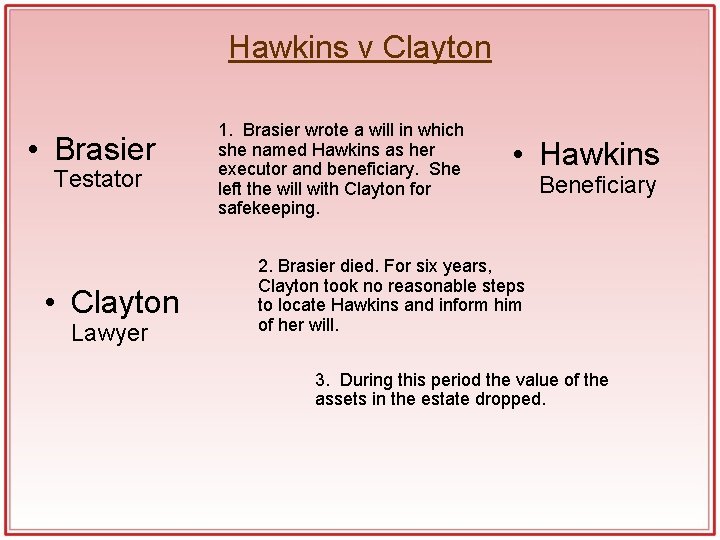
Hawkins v Clayton • Brasier Testator • Clayton Lawyer 1. Brasier wrote a will in which she named Hawkins as her executor and beneficiary. She left the will with Clayton for safekeeping. • Hawkins Beneficiary 2. Brasier died. For six years, Clayton took no reasonable steps to locate Hawkins and inform him of her will. 3. During this period the value of the assets in the estate dropped.
Rogers v Whitaker • Whitaker patient 1. Whitaker was blind in one eye from childhood. She had good sight in her other eye. • Rogers doctor 2. When Whitaker was 40, Rogers advised her that she could have an operation to improve her blind eye. He did not tell her of the risks associated with the operation. 3. Whitaker had the operation and ended up blind in both eyes.
Hole v Hocking • Hocking driver 1. Hocking’s poor driving caused an accident. Hole, his passenger, suffered a blow to his head. • Hole passenger 2. Hole had a medical condition that would have eventually resulted in a brain haemorrhage even without the blow. But the blow accelerated the onset of the haemorrhage and made it more severe.
Perre v Apand Pty Ltd • Perre potato farmer 1. Perre grew potatoes in SA and sold them in WA. • Apand grower of seed potatoes 2. Apand grew seed potatoes in a disease prone area of Vic and supplied them to Perre’s neighbour in SA. Disease broke out on the neighbour’s farm. • Neighbouring farmer 3. The WA government banned potatoes grown within 20 kms of a disease outbreak. Perre could not export and sell his crop in WA. Had Appand suffered harm even though his own potatoes were not infected with disease?
What are the essential elements of the tort of ‘Negligence’?
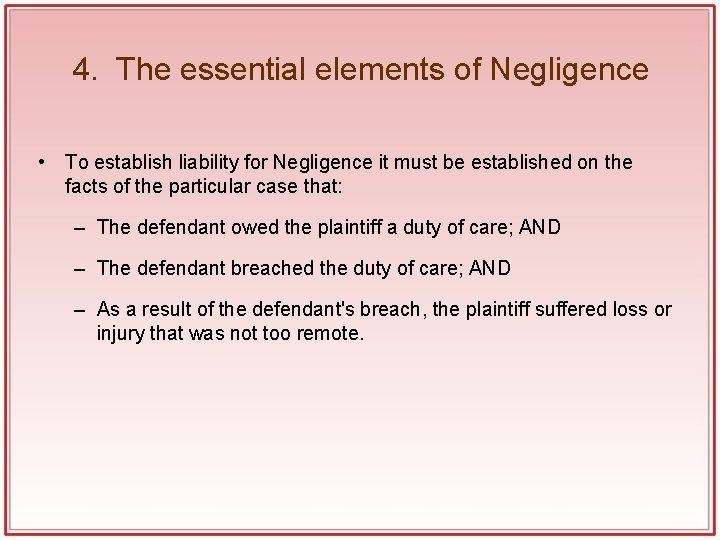
4. The essential elements of Negligence • To establish liability for Negligence it must be established on the facts of the particular case that: – The defendant owed the plaintiff a duty of care; AND – The defendant breached the duty of care; AND – As a result of the defendant's breach, the plaintiff suffered loss or injury that was not too remote.
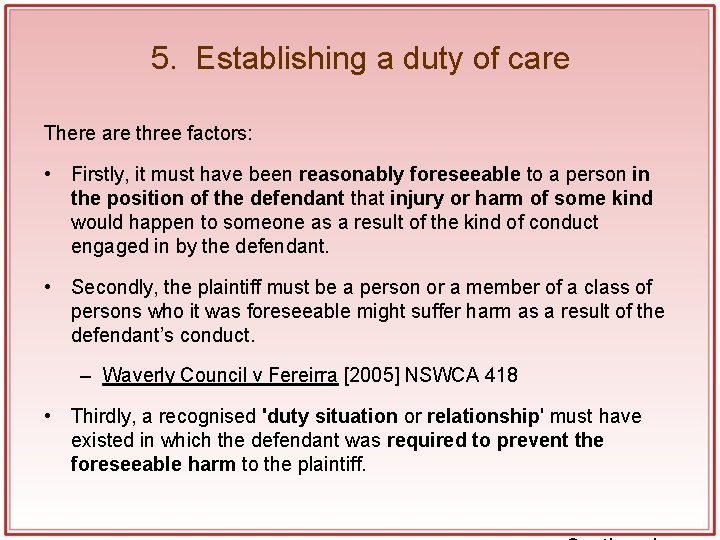
5. Establishing a duty of care There are three factors: • Firstly, it must have been reasonably foreseeable to a person in the position of the defendant that injury or harm of some kind would happen to someone as a result of the kind of conduct engaged in by the defendant. • Secondly, the plaintiff must be a person or a member of a class of persons who it was foreseeable might suffer harm as a result of the defendant’s conduct. – Waverly Council v Fereirra [2005] NSWCA 418 • Thirdly, a recognised 'duty situation or relationship' must have existed in which the defendant was required to prevent the foreseeable harm to the plaintiff.
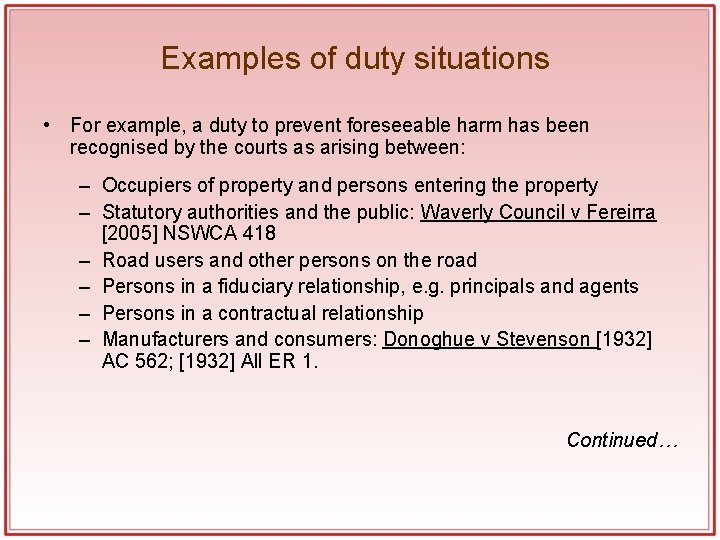
Examples of duty situations • For example, a duty to prevent foreseeable harm has been recognised by the courts as arising between: – Occupiers of property and persons entering the property – Statutory authorities and the public: Waverly Council v Fereirra [2005] NSWCA 418 – Road users and other persons on the road – Persons in a fiduciary relationship, e. g. principals and agents – Persons in a contractual relationship – Manufacturers and consumers: Donoghue v Stevenson [1932] AC 562; [1932] All ER 1. Continued…
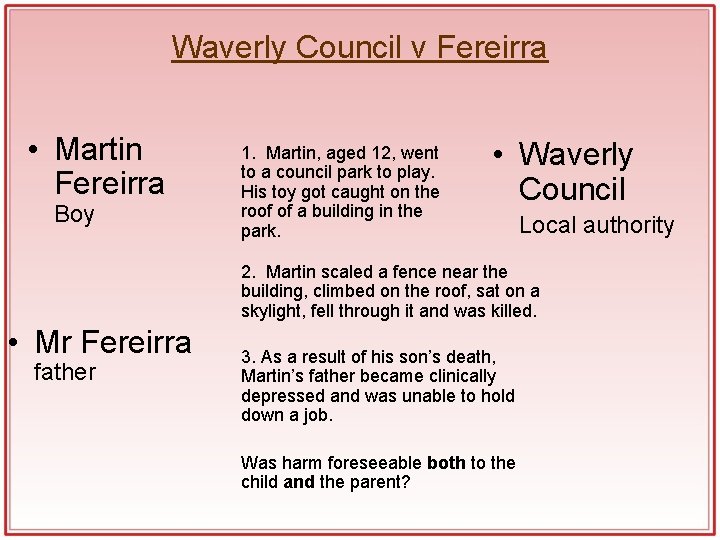
Waverly Council v Fereirra • Martin Fereirra Boy 1. Martin, aged 12, went to a council park to play. His toy got caught on the roof of a building in the park. • Waverly Council Local authority 2. Martin scaled a fence near the building, climbed on the roof, sat on a skylight, fell through it and was killed. • Mr Fereirra father 3. As a result of his son’s death, Martin’s father became clinically depressed and was unable to hold down a job. Was harm foreseeable both to the child and the parent?
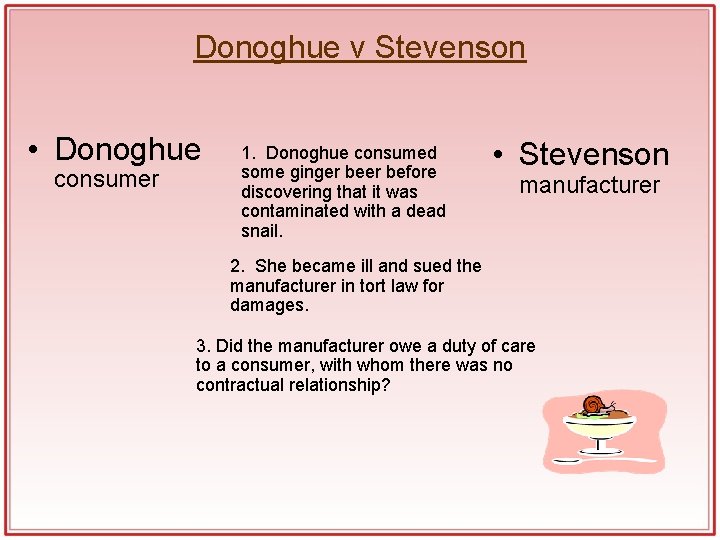
Donoghue v Stevenson • Donoghue consumer 1. Donoghue consumed some ginger before discovering that it was contaminated with a dead snail. • Stevenson manufacturer 2. She became ill and sued the manufacturer in tort law for damages. 3. Did the manufacturer owe a duty of care to a consumer, with whom there was no contractual relationship?
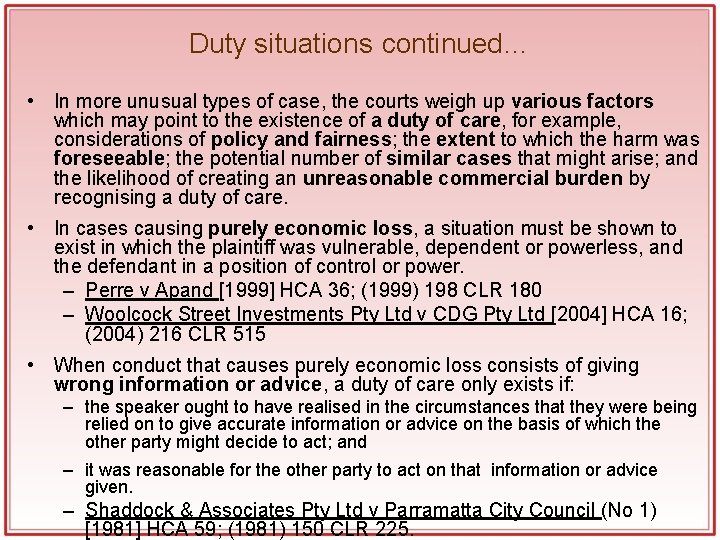
Duty situations continued… • In more unusual types of case, the courts weigh up various factors which may point to the existence of a duty of care, for example, considerations of policy and fairness; the extent to which the harm was foreseeable; the potential number of similar cases that might arise; and the likelihood of creating an unreasonable commercial burden by recognising a duty of care. • In cases causing purely economic loss, a situation must be shown to exist in which the plaintiff was vulnerable, dependent or powerless, and the defendant in a position of control or power. – Perre v Apand [1999] HCA 36; (1999) 198 CLR 180 – Woolcock Street Investments Pty Ltd v CDG Pty Ltd [2004] HCA 16; (2004) 216 CLR 515 • When conduct that causes purely economic loss consists of giving wrong information or advice, a duty of care only exists if: – the speaker ought to have realised in the circumstances that they were being relied on to give accurate information or advice on the basis of which the other party might decide to act; and – it was reasonable for the other party to act on that information or advice given. – Shaddock & Associates Pty Ltd v Parramatta City Council (No 1) [1981] HCA 59; (1981) 150 CLR 225.
Perre v Apand Pty Ltd • Apand grower • Perre potato farmer 1. Perre grew potatoes in SA and sold them in WA. of seed potatoes 2. Apand grew seed potatoes in a disease prone area of Vic and supplied them to Perre’s neighbour in SA. Disease broke out on the neighbour’s farm. • Neighbouring farmer 3. The WA government banned potatoes grown within 20 kms of a disease outbreak. Perre could not export and sell his crop. He lost money even though his potatoes were not infected with disease. Did Perre owe Apand a duty of care?
Woolcock Street Investments v CDG • The owner of some land built a new building on it without having the soil tested. Some years later, Woolcock bought the land building. • Woolcock • Buyer of building • A year later, the building settled and cracked. Woolcock sued the original consulting engineers. • CDG Did the consulting engineers owe a duty of care to future owners of the building who might suffer financial harm if the foundations were not adequate? Engineers
Shaddock v Parramatta City Council • Paramatta city council • Council employee 1. Shaddock wanted to buy and develop a piece of land. He telephoned a council employee to inquire if the land was affected by any road plans and was told no. • Shaddock developer 2. Shaddock asked for the advice in writing and was sent this. After he purchased the land he found the advice was wrong and the land was worth less than he had paid. 3. Did the council owe a duty of care to Shaddock in relation to purely economic harm caused by a negligent misstatement?
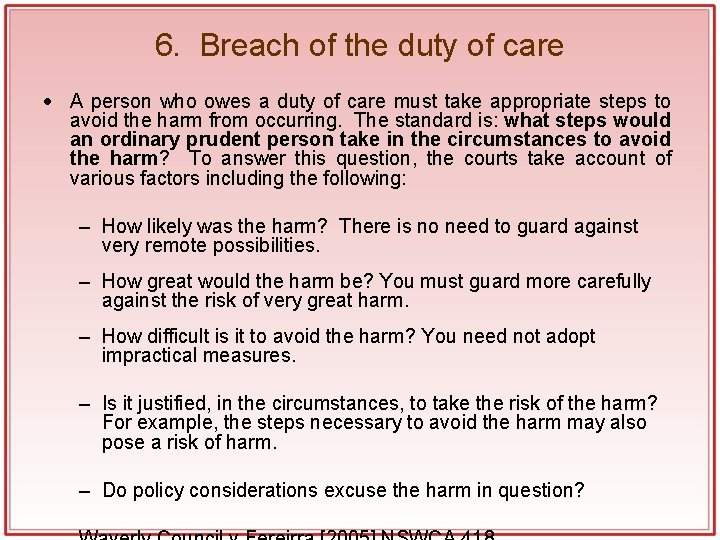
6. Breach of the duty of care A person who owes a duty of care must take appropriate steps to avoid the harm from occurring. The standard is: what steps would an ordinary prudent person take in the circumstances to avoid the harm? To answer this question, the courts take account of various factors including the following: – How likely was the harm? There is no need to guard against very remote possibilities. – How great would the harm be? You must guard more carefully against the risk of very great harm. – How difficult is it to avoid the harm? You need not adopt impractical measures. – Is it justified, in the circumstances, to take the risk of the harm? For example, the steps necessary to avoid the harm may also pose a risk of harm. – Do policy considerations excuse the harm in question?
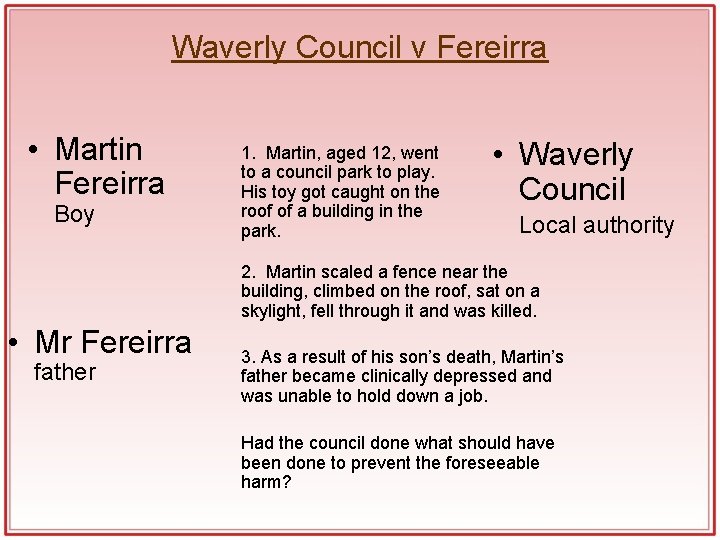
Waverly Council v Fereirra • Martin Fereirra Boy 1. Martin, aged 12, went to a council park to play. His toy got caught on the roof of a building in the park. • Waverly Council Local authority 2. Martin scaled a fence near the building, climbed on the roof, sat on a skylight, fell through it and was killed. • Mr Fereirra father 3. As a result of his son’s death, Martin’s father became clinically depressed and was unable to hold down a job. Had the council done what should have been done to prevent the foreseeable harm?
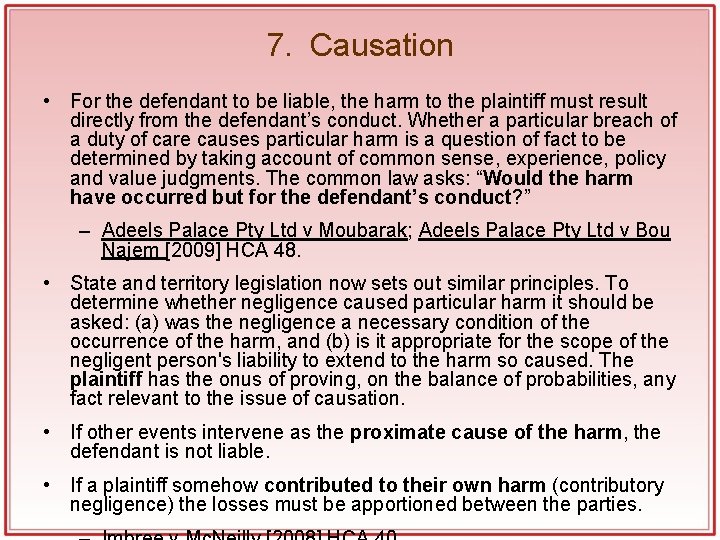
7. Causation • For the defendant to be liable, the harm to the plaintiff must result directly from the defendant’s conduct. Whether a particular breach of a duty of care causes particular harm is a question of fact to be determined by taking account of common sense, experience, policy and value judgments. The common law asks: “Would the harm have occurred but for the defendant’s conduct? ” – Adeels Palace Pty Ltd v Moubarak; Adeels Palace Pty Ltd v Bou Najem [2009] HCA 48. • State and territory legislation now sets out similar principles. To determine whether negligence caused particular harm it should be asked: (a) was the negligence a necessary condition of the occurrence of the harm, and (b) is it appropriate for the scope of the negligent person's liability to extend to the harm so caused. The plaintiff has the onus of proving, on the balance of probabilities, any fact relevant to the issue of causation. • If other events intervene as the proximate cause of the harm, the defendant is not liable. • If a plaintiff somehow contributed to their own harm (contributory negligence) the losses must be apportioned between the parties.
Adeels Palace Pty Ltd v Moubarak • Adeels restaurant 1. A brawl broke out between customers at Adeels restaurant and bar. Customer One customer was injured. He left the restaurant but returned later with a gun and shot Moubarak, another customer, in the stomach. 2. There were no security guards at the door to the restaurant. • Moubarak 3. Was the absence of security guards a breach of a duty of care owed to Moubarak, and was any such breach the cause of the harm he suffered?
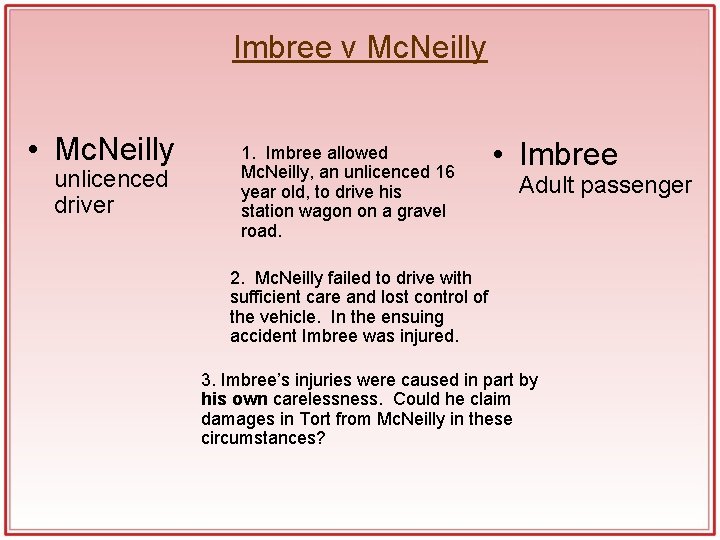
Imbree v Mc. Neilly • Mc. Neilly unlicenced driver 1. Imbree allowed Mc. Neilly, an unlicenced 16 year old, to drive his station wagon on a gravel road. • Imbree Adult passenger 2. Mc. Neilly failed to drive with sufficient care and lost control of the vehicle. In the ensuing accident Imbree was injured. 3. Imbree’s injuries were caused in part by his own carelessness. Could he claim damages in Tort from Mc. Neilly in these circumstances?
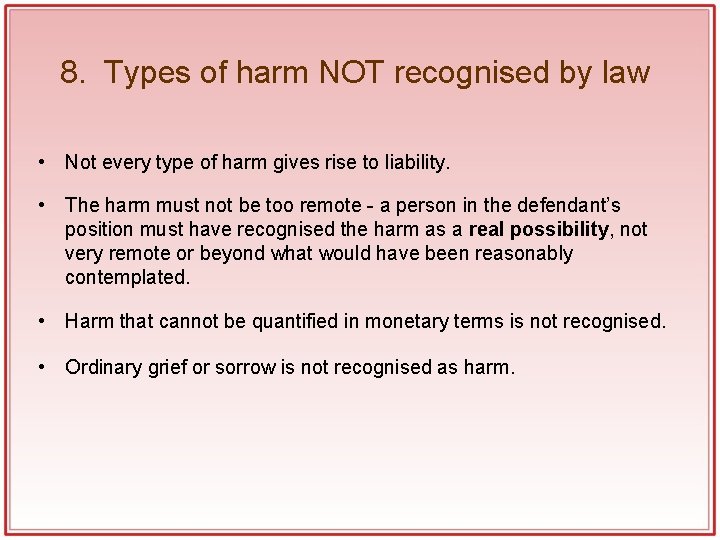
8. Types of harm NOT recognised by law • Not every type of harm gives rise to liability. • The harm must not be too remote - a person in the defendant’s position must have recognised the harm as a real possibility, not very remote or beyond what would have been reasonably contemplated. • Harm that cannot be quantified in monetary terms is not recognised. • Ordinary grief or sorrow is not recognised as harm.
9. Remedies available in tort law • Damages in tort compensate for harm suffered: The objective is to put the injured party in the position they would have been in but for the commission of the tort. However, legislation may put limits on the amount that can be claimed in specific circumstances. • Statutory compensation schemes: For example, workers compensation may provide an alternative source of compensation. • Injunctions: Injunctions are appropriate when the plaintiff wants the defendant to desist from conduct that threatens to cause damage.
Case-study Liability for Negligence
Case-study: The Crane • Hilift Pty Ltd (Hilift) owns an industrial crane. Hilift employs two crane operators, Elwyn and Osman, who each work 4 hour shifts. In May 2008 the owner/builder of a new apartment block hires Hilift’s crane and operators for two weeks to lift building materials to the upper floors of their building. At the end of the first shift on the 10 th May, Elwyn notifies the manager of Hilift that the crane is not performing properly and that it needs looking at. The manager contacts the company who does repairs and maintenance work on the crane, EFL Engineering, and asks for an engineer to be sent out immediately. EFL says that no-one is available for two hours. The manager of Hilift decides to allow Osman to begin his shift before the engineer arrives since to stop work will delay construction. Continued …
The Crane continued… • Osman is halfway through hoisting his first load when a cable in the crane snaps and the crane swings out of control, smashing into a lower floor of the building. Two construction workers in the building are injured. One has both legs crushed and they have to be amputated. The other worker will be hospitalised for a long time with serious injuries but will make a full recovery. The building is damaged by the accident and will cost $75, 000 to repair. The construction of the building is delayed by three months because of the accident, and for this period the expected income from tenants is lost. Continued …
The Crane continued… • Osman is deeply traumatized by these events and cannot bring himself to drive a crane again. After a period of six months without employment, during which he receives psychiatric treatment, Osman takes lower paid work as a general contruction worker. • A subsequent inspection of the crane finds that the fault in the cable would have been discovered if an engineer had inspected the crane after Elwyn’s shift had ended. To replace this cable would have taken six hours. • Advise Hilift as to whether and to what extent the company will be liable in tort for the harm that has occurred.
The issue • What are the significant facts of this case? • What is the issue that needs to be decided? “Is Hilift liable in tort to compensate the various persons who have suffered harm as a result of the accident? If so, to what extent will damages be payable?
Who has suffered harm? The owner of the building has suffered two types of harm: – physical harm to their property – financial harm because of the three month delay in completing the building and getting income from tenants. One contractor suffers severe physical injuries: (crushed legs) that will result in permanent disablement (amputation). These injuries will affect him for the rest of his life in various ways. The other contractor suffers physical injuries which require hospitalisation, but from which he will make a full recovery. The crane driver at the time of the accident suffers psychiatric shock which makes him unable to operate a crane, although he will be capable of lower-paid work.
Liability in Negligence • What are the elements of liability for the tort of Negligence? Are all the elements likely to be satisfied on the known facts – A duty of care. Does Hilift owe a duty of care to: • the owner of the building • the construction workers on the building site • their own crane operator? – Breach of the duty of care. If a duty of care was owed to these persons, is Hilift in breach of that duty? – The causal link between any breach and the harm. Is the harm suffered sufficiently closely connected to the breach of any duty of care?
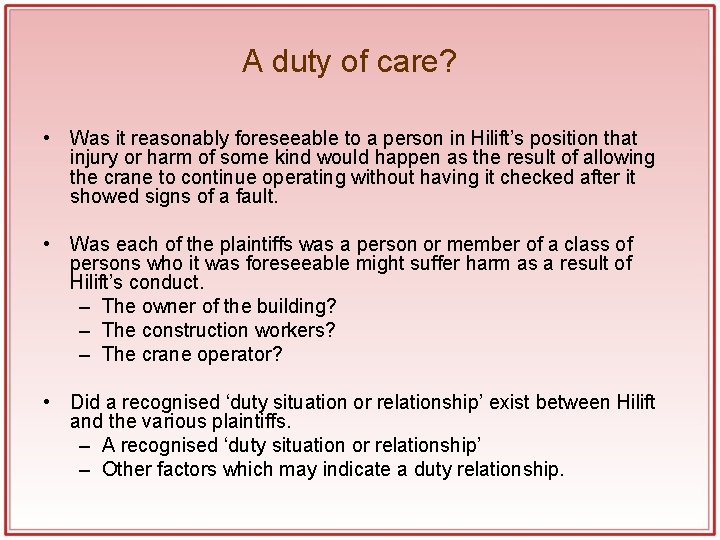
A duty of care? • Was it reasonably foreseeable to a person in Hilift’s position that injury or harm of some kind would happen as the result of allowing the crane to continue operating without having it checked after it showed signs of a fault. • Was each of the plaintiffs was a person or member of a class of persons who it was foreseeable might suffer harm as a result of Hilift’s conduct. – The owner of the building? – The construction workers? – The crane operator? • Did a recognised ‘duty situation or relationship’ exist between Hilift and the various plaintiffs. – A recognised ‘duty situation or relationship’ – Other factors which may indicate a duty relationship.
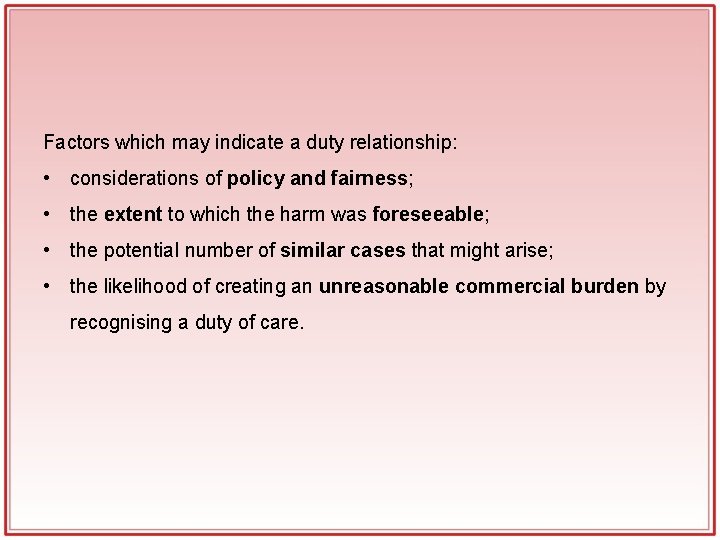
Factors which may indicate a duty relationship: • considerations of policy and fairness; • the extent to which the harm was foreseeable; • the potential number of similar cases that might arise; • the likelihood of creating an unreasonable commercial burden by recognising a duty of care.
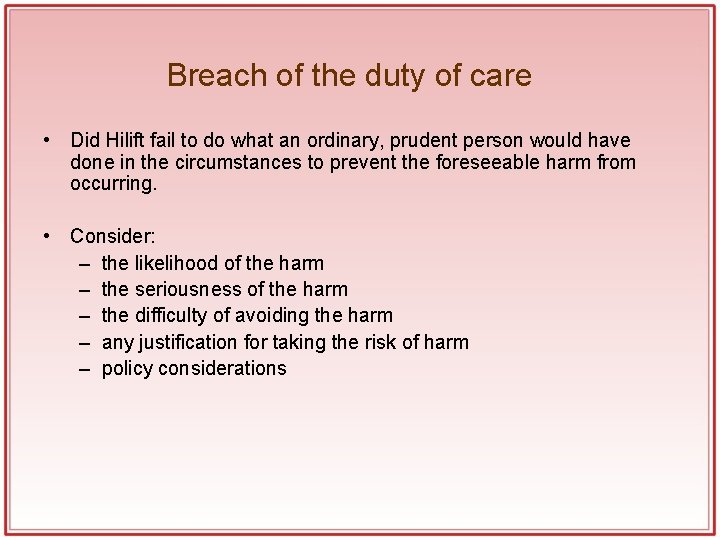
Breach of the duty of care • Did Hilift fail to do what an ordinary, prudent person would have done in the circumstances to prevent the foreseeable harm from occurring. • Consider: – the likelihood of the harm – the seriousness of the harm – the difficulty of avoiding the harm – any justification for taking the risk of harm – policy considerations
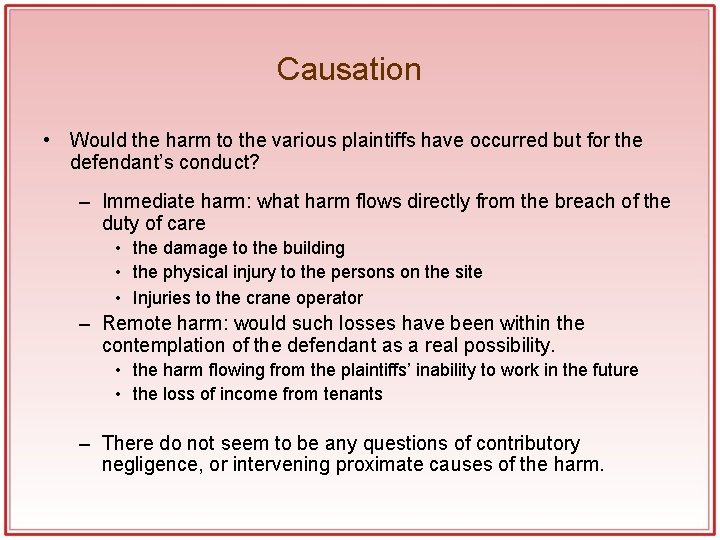
Causation • Would the harm to the various plaintiffs have occurred but for the defendant’s conduct? – Immediate harm: what harm flows directly from the breach of the duty of care • the damage to the building • the physical injury to the persons on the site • Injuries to the crane operator – Remote harm: would such losses have been within the contemplation of the defendant as a real possibility. • the harm flowing from the plaintiffs’ inability to work in the future • the loss of income from tenants – There do not seem to be any questions of contributory negligence, or intervening proximate causes of the harm.
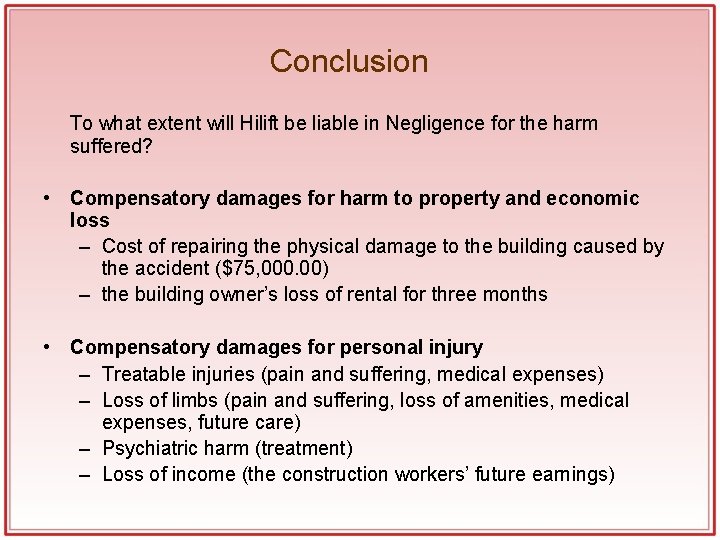
Conclusion To what extent will Hilift be liable in Negligence for the harm suffered? • Compensatory damages for harm to property and economic loss – Cost of repairing the physical damage to the building caused by the accident ($75, 000. 00) – the building owner’s loss of rental for three months • Compensatory damages for personal injury – Treatable injuries (pain and suffering, medical expenses) – Loss of limbs (pain and suffering, loss of amenities, medical expenses, future care) – Psychiatric harm (treatment) – Loss of income (the construction workers’ future earnings)
Notices • Do the tutorial ‘The scope of tort law’. • Read Chapters 12 and 13 of the First Principles of Business Law textbook. • Learn the cases in weeks 9 -10 lectures. Copyright reserved 2013 Australian Law Courseware