
Commercial Insurance Risk Management Presentation For Corporate Risk


- Slides: 25
Commercial Insurance & Risk Management Presentation For Corporate Risk Management (INS 4100) Carlson School of Management September 24 th , 2020 PUT AN EXPERT IN CORNER your
Today’s Presenter Gary R. Semmer, CIC CWCA Executive Vice President gsemmer@esserhayes. com (630) 544 -3788
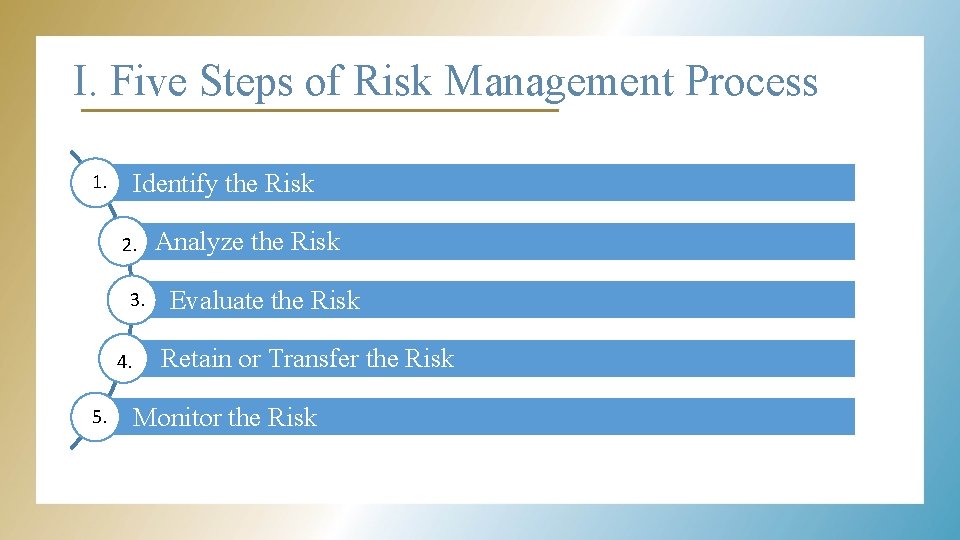
I. Five Steps of Risk Management Process Identify the Risk 1. 2. 3. 4. 5. Analyze the Risk Evaluate the Risk Retain or Transfer the Risk Monitor the Risk
1) Identify the Risk a) On-site Visits/Surveys of operations b) Financial Statement & Employee Handbook review c) Coverage Checklists based on client industry.
2) Analyze the Risk a) Loss/Claim Experience Review – frequency & severity. b) Safety Programs & Employee Handbook Review – to compare with industry “Best Practices”.
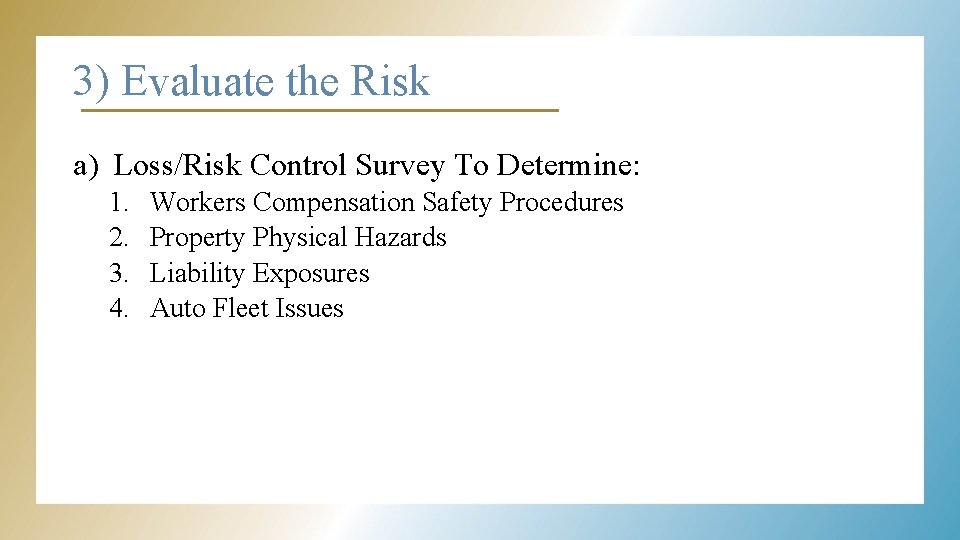
3) Evaluate the Risk a) Loss/Risk Control Survey To Determine: 1. 2. 3. 4. Workers Compensation Safety Procedures Property Physical Hazards Liability Exposures Auto Fleet Issues
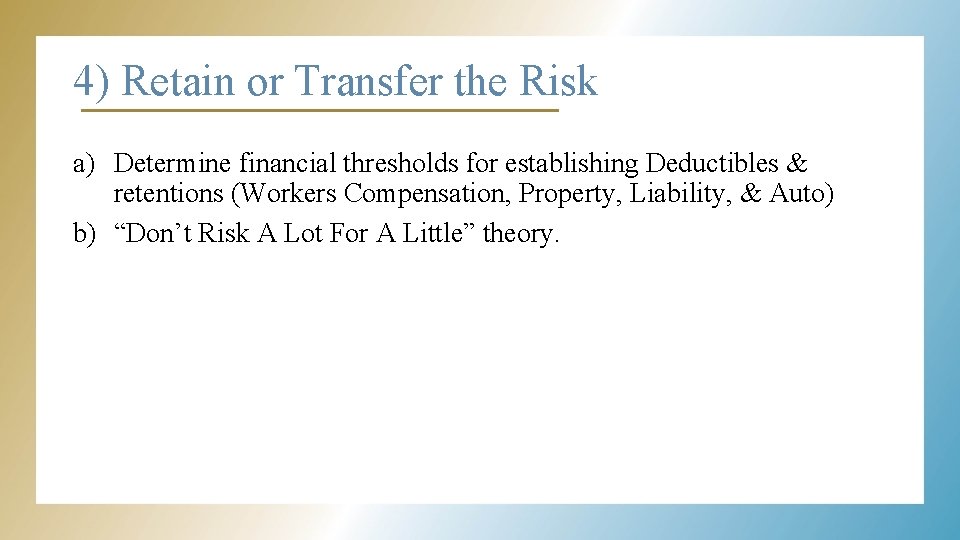
4) Retain or Transfer the Risk a) Determine financial thresholds for establishing Deductibles & retentions (Workers Compensation, Property, Liability, & Auto) b) “Don’t Risk A Lot For A Little” theory.
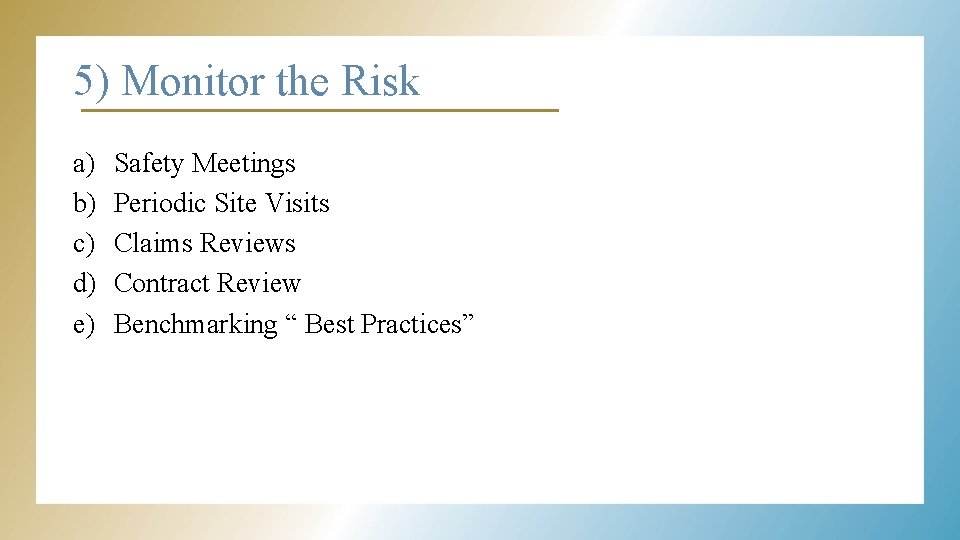
5) Monitor the Risk a) b) c) d) e) Safety Meetings Periodic Site Visits Claims Reviews Contract Review Benchmarking “ Best Practices”
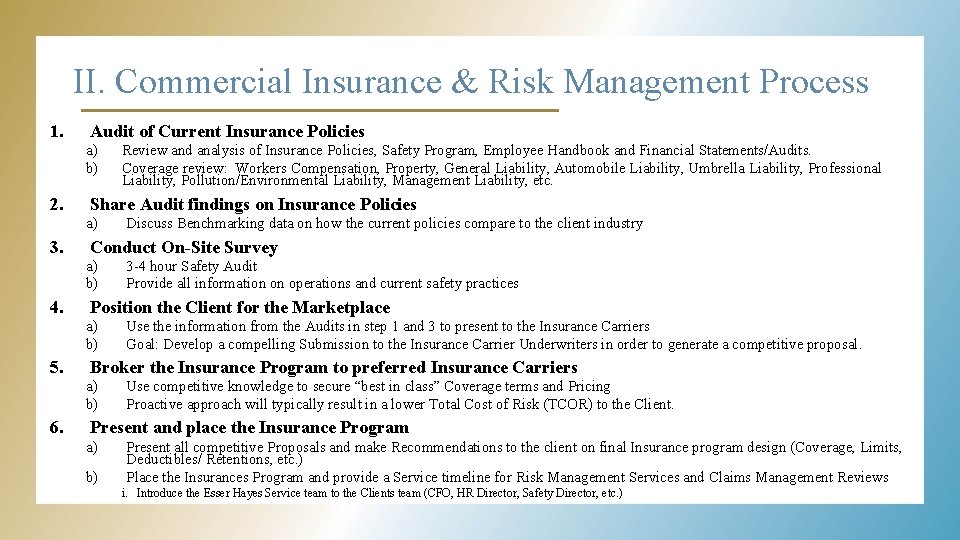
II. Commercial Insurance & Risk Management Process 1. Audit of Current Insurance Policies a) b) 2. Share Audit findings on Insurance Policies a) 3. Use the information from the Audits in step 1 and 3 to present to the Insurance Carriers Goal: Develop a compelling Submission to the Insurance Carrier Underwriters in order to generate a competitive proposal. Broker the Insurance Program to preferred Insurance Carriers a) b) 6. 3 -4 hour Safety Audit Provide all information on operations and current safety practices Position the Client for the Marketplace a) b) 5. Discuss Benchmarking data on how the current policies compare to the client industry Conduct On-Site Survey a) b) 4. Review and analysis of Insurance Policies, Safety Program, Employee Handbook and Financial Statements/Audits. Coverage review: Workers Compensation, Property, General Liability, Automobile Liability, Umbrella Liability, Professional Liability, Pollution/Environmental Liability, Management Liability, etc. Use competitive knowledge to secure “best in class” Coverage terms and Pricing Proactive approach will typically result in a lower Total Cost of Risk (TCOR) to the Client. Present and place the Insurance Program a) b) Present all competitive Proposals and make Recommendations to the client on final Insurance program design (Coverage, Limits, Deductibles/ Retentions, etc. ) Place the Insurances Program and provide a Service timeline for Risk Management Services and Claims Management Reviews i. Introduce the Esser Hayes Service team to the Clients team (CFO, HR Director, Safety Director, etc. )
Working with an Agent or Broker What is It? • Intermediary Services: • Risk assessment • Drafting coverage specifications • Marketing insurance coverage • Interpreting coverages • Advising clients about the insurance marketplace • Issuing insurance documents • Billing and processing invoices • Ordering and processing endorsements • Analyzing losses • Researching coverages and technical issues • Managing other vendors • Offering innovative ways to manage risk
Working with an Agent or Broker What is It? • Intermediary Relationship: • High value professionals • Requires utmost good faith and trust • A long-term relationship • A financial partner
Working with an Agent or Broker Steps to Implement • Evaluate the intermediary • Select the intermediary • Issue requests for insurance (RFP) • Hear presentations by intermediaries • Place coverages • Insurance policies issued • Intermediary performance evaluation Compensation • Commission – paid by insurers to agents • Service fees – paid by insured to broker or agent
Working with an Agent or Broker Advantages and Disadvantages • A good relationship is the key to advantages & disadvantages • Time and Cash Commitment • Time to gather and submit information • Information must be timely and accurate • Costs for intermediary compensation (commissions & fees) • Allocate time to do an annual performance review
QUESTIONS & ANSWERS
BILL OF HEALTH: Insurance Coverage for COVID-19 Related Business Losses Micah Skidmore © 2020 Haynes and Boone, LLP
CUSTOMER & VENDOR CONTRACTS • Indemnity Provisions • Insurance Requirements 16 © 2020 Haynes and Boone, LLP
INDEMNITY PROVISIONS • Release & Hold Harmless • Trigger for CGL Coverage • Workers’ Compensation Immunity • Notice & Selection of Counsel • Survival / Insurance 17 © 2020 Haynes and Boone, LLP
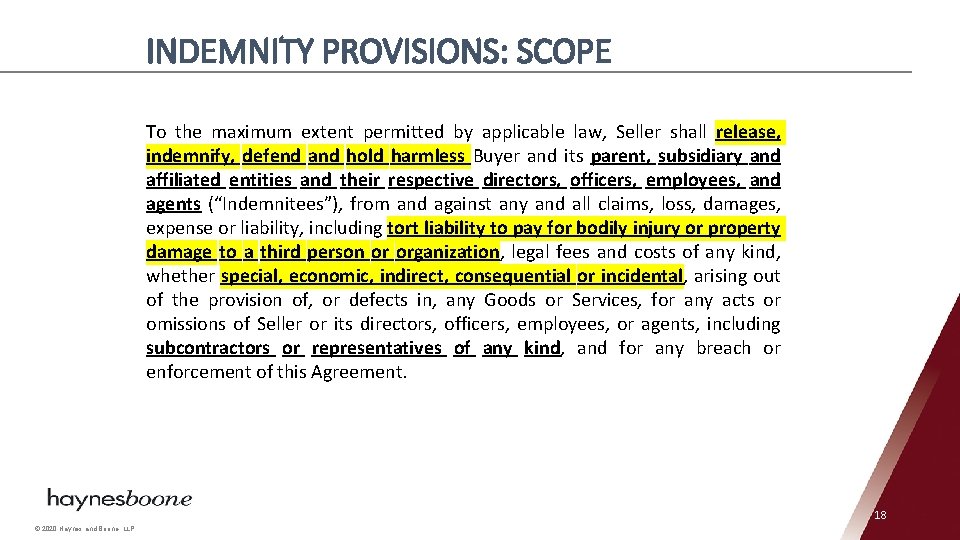
INDEMNITY PROVISIONS: SCOPE To the maximum extent permitted by applicable law, Seller shall release, indemnify, defend and hold harmless Buyer and its parent, subsidiary and affiliated entities and their respective directors, officers, employees, and agents (“Indemnitees”), from and against any and all claims, loss, damages, expense or liability, including tort liability to pay for bodily injury or property damage to a third person or organization, legal fees and costs of any kind, whether special, economic, indirect, consequential or incidental, arising out of the provision of, or defects in, any Goods or Services, for any acts or omissions of Seller or its directors, officers, employees, or agents, including subcontractors or representatives of any kind, and for any breach or enforcement of this Agreement. 18 © 2020 Haynes and Boone, LLP
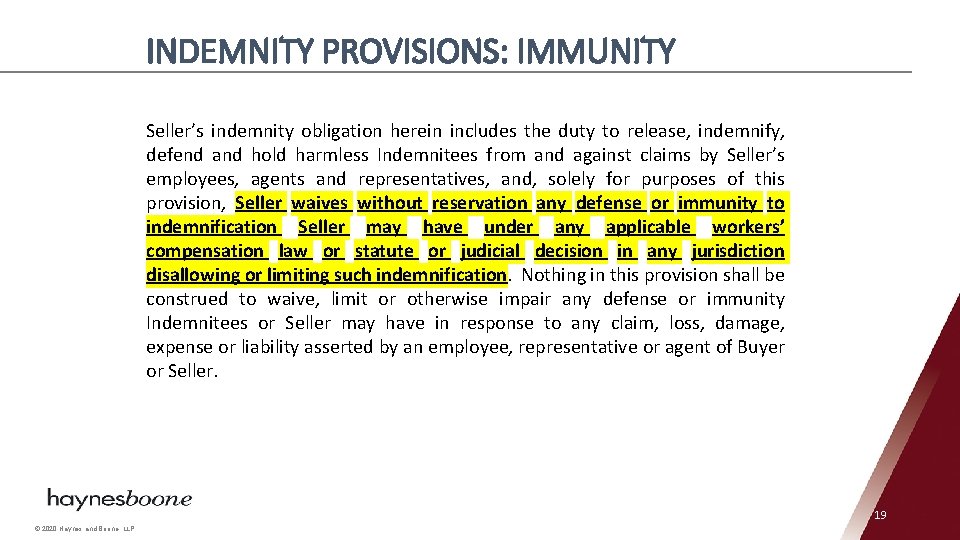
INDEMNITY PROVISIONS: IMMUNITY Seller’s indemnity obligation herein includes the duty to release, indemnify, defend and hold harmless Indemnitees from and against claims by Seller’s employees, agents and representatives, and, solely for purposes of this provision, Seller waives without reservation any defense or immunity to indemnification Seller may have under any applicable workers’ compensation law or statute or judicial decision in any jurisdiction disallowing or limiting such indemnification. Nothing in this provision shall be construed to waive, limit or otherwise impair any defense or immunity Indemnitees or Seller may have in response to any claim, loss, damage, expense or liability asserted by an employee, representative or agent of Buyer or Seller. 19 © 2020 Haynes and Boone, LLP
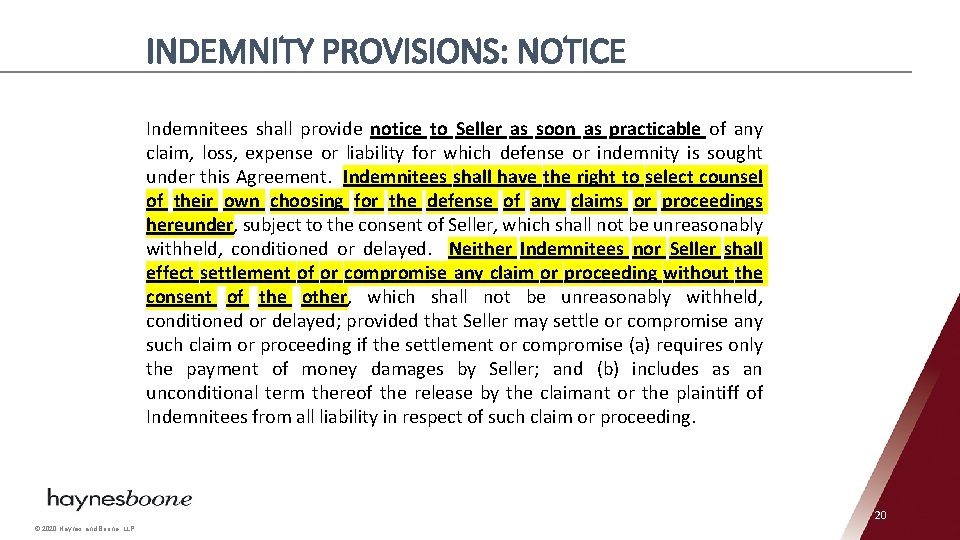
INDEMNITY PROVISIONS: NOTICE Indemnitees shall provide notice to Seller as soon as practicable of any claim, loss, expense or liability for which defense or indemnity is sought under this Agreement. Indemnitees shall have the right to select counsel of their own choosing for the defense of any claims or proceedings hereunder, subject to the consent of Seller, which shall not be unreasonably withheld, conditioned or delayed. Neither Indemnitees nor Seller shall effect settlement of or compromise any claim or proceeding without the consent of the other, which shall not be unreasonably withheld, conditioned or delayed; provided that Seller may settle or compromise any such claim or proceeding if the settlement or compromise (a) requires only the payment of money damages by Seller; and (b) includes as an unconditional term thereof the release by the claimant or the plaintiff of Indemnitees from all liability in respect of such claim or proceeding. 20 © 2020 Haynes and Boone, LLP
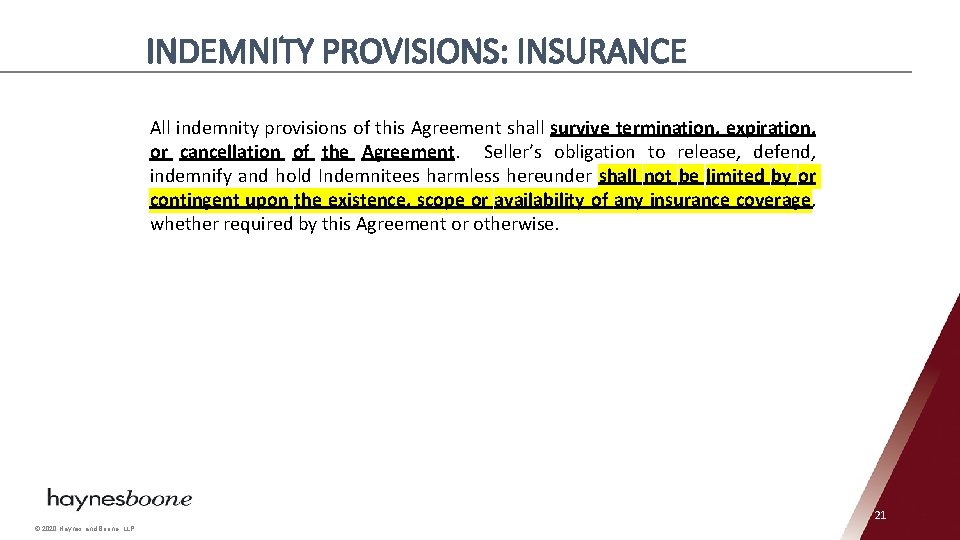
INDEMNITY PROVISIONS: INSURANCE All indemnity provisions of this Agreement shall survive termination, expiration, or cancellation of the Agreement. Seller’s obligation to release, defend, indemnify and hold Indemnitees harmless hereunder shall not be limited by or contingent upon the existence, scope or availability of any insurance coverage, whether required by this Agreement or otherwise. 21 © 2020 Haynes and Boone, LLP
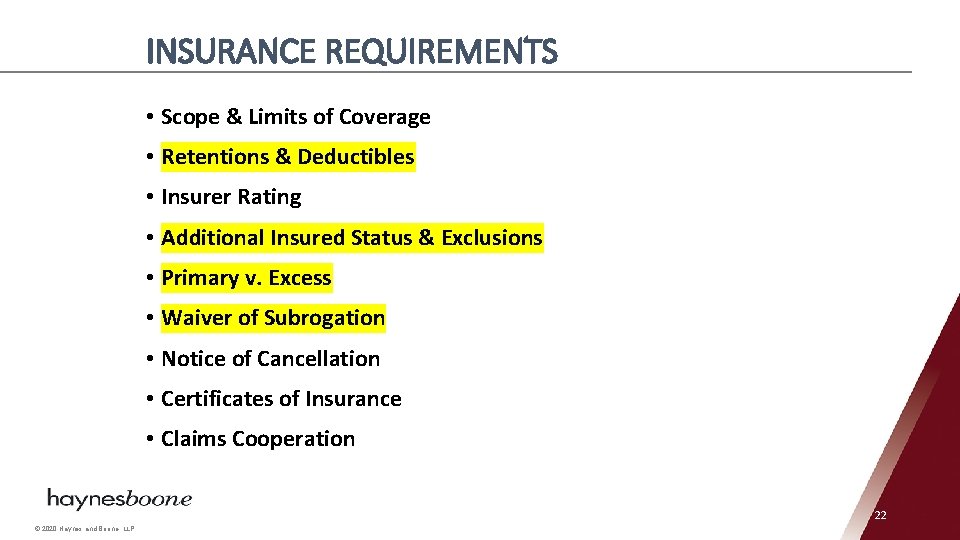
INSURANCE REQUIREMENTS • Scope & Limits of Coverage • Retentions & Deductibles • Insurer Rating • Additional Insured Status & Exclusions • Primary v. Excess • Waiver of Subrogation • Notice of Cancellation • Certificates of Insurance • Claims Cooperation 22 © 2020 Haynes and Boone, LLP
INSURANCE REQUIREMENTS Nor shall Seller self-insure, through the use of a captive or otherwise, any of the insurance coverages required by this Agreement, or non-subscribe to any state’s applicable worker’s compensation laws without the prior written consent of Buyer. Any deductible or self-insured retention (SIR) within the insurance policies required herein shall not exceed $25, 000, or such higher amount as is customary for the industry and approved in writing in advance by Buyer. Seller shall be responsible for payment of any and all deductibles, self-insured retentions or coinsurance penalties, if any, from insured claims under its policies of insurance. 23 © 2020 Haynes and Boone, LLP
INSURANCE REQUIREMENTS Indemnitees shall be named as additional insureds on those polic(ies) required under part (b) above using ISO CG 2010 11/85 edition or its equivalent providing ongoing operations and products and completed operations coverage. • Combination of ISO Forms CG 20 10 10 01 and CG 20 37 10 01 Where appropriate, specify terms regarding virus & pollution exclusions Where appropriate, specify that the additional insured obligation extends to all relevant policies, including primary, excess or umbrella 24 © 2020 Haynes and Boone, LLP
INSURANCE REQUIREMENTS All policies shall contain a waiver of subrogation in favor of Buyer and Buyer’s affiliated entities and each of their respective officers, directors, agents, servants, employees, except where prohibited by law. 25 © 2020 Haynes and Boone, LLP