
Commercial Banking in India Past Present and Future
Commercial Banking in India Past Present and Future outlook 1/11/2022 Dr. A. K. Vashisht 1
Agenda n n 1/11/2022 Banking Sector In India Major Challenges and Trends Ahead Dr. A. K. Vashisht 2
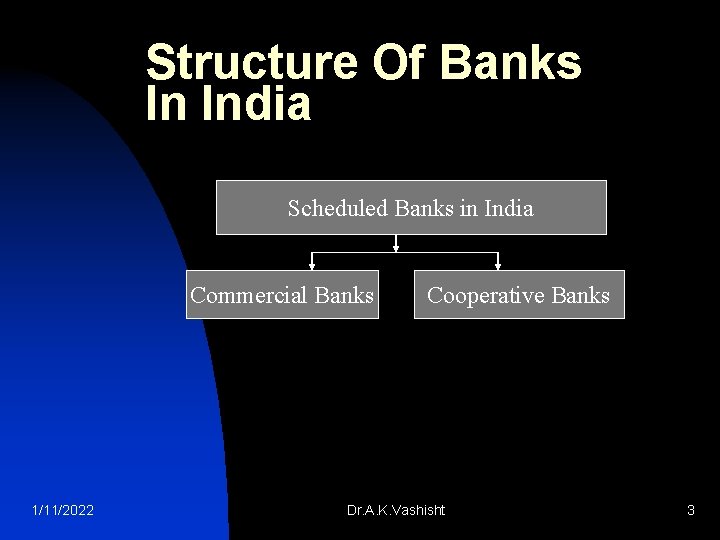
Structure Of Banks In India Scheduled Banks in India Commercial Banks 1/11/2022 Cooperative Banks Dr. A. K. Vashisht 3
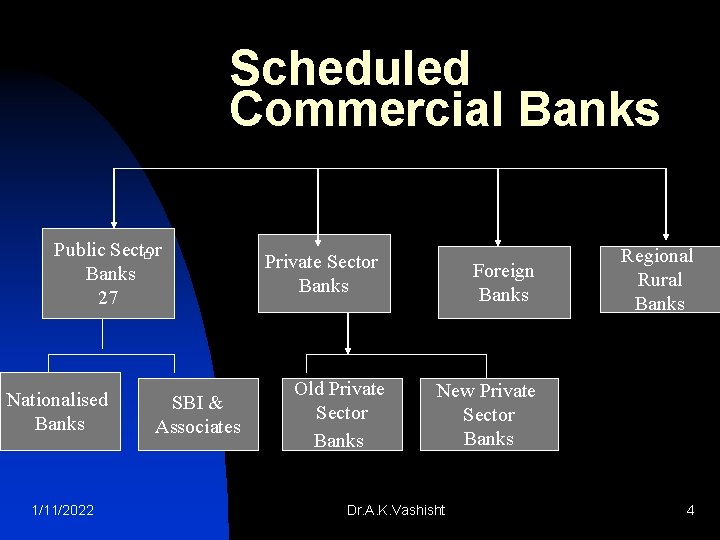
Scheduled Commercial Banks Public Sector Banks 27 Nationalised Banks 1/11/2022 SBI & Associates Private Sector Banks Old Private Sector Banks Foreign Banks Regional Rural Banks New Private Sector Banks Dr. A. K. Vashisht 4
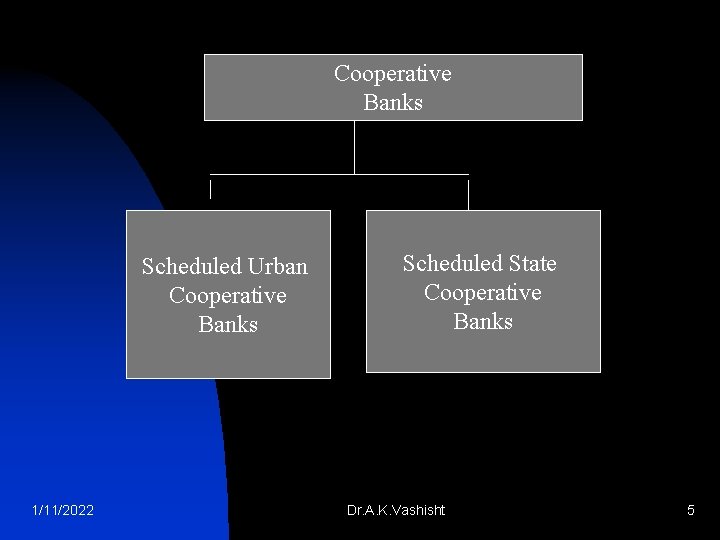
Cooperative Banks Scheduled Urban Cooperative Banks 1/11/2022 Scheduled State Cooperative Banks Dr. A. K. Vashisht 5
Indian Banking n n 1/11/2022 Banking in The Pre Independence Period Pre nationalisation Period(1947 69) Post Nationalization Period(1969 91) Post –Liberalization Period(1991 till date) Dr. A. K. Vashisht 6
Banking in The Pre-Independence Period n n n 1/11/2022 Evidences of banking in Vedic period, 2000 B. C. to 1400 B. C. . References to debt in Vedic literature. Banking in the Smiriti period performed most of the function of a modern bank, accepted deposits, granted loans, acted as customers’ bailee, granted loans to the kings, acted as bankers to the State and managed currency of the country Dr. A. K. Vashisht 7
Banking in The Pre-Independence Period ( Continued) n n n 1/11/2022 Caste engaged in banking profession was mainly Vaishyas. During the Budhist period Brahmins and Kshetriyas also entered into the banking profession. During the Budhist period there ample evidences of Sreshtis or bankers in all important trade centers. Dr. A. K. Vashisht 8
Banking in The Pre-Independence Period ( Continued) n n n 1/11/2022 People engaged in the profession of banking were known as Sreshtis or Sahukars or Mahajans. Usury was practiced but was held in contempt. Kautilya’s Arthashastra laid down 15 and 60 percent as the maximum legal rates of interest on secured and unsecured loans respectively. Dr. A. K. Vashisht 9
Banking in The Pre-Independence Period ( Continued) n n 1/11/2022 Hundis and indigenous bills of exchange came into use from 12 th century. Ain I Akbari states that under the early Muslims and Mogul rulers in India indigenous bankers played a prominent part in lending money, financing internal and foreign trade. Dr. A. K. Vashisht 10
Banking in The Pre-Independence Period ( Continued) n n 1/11/2022 East India Company did not establish banking on wesrern lines for a considerable period on the ground that agency houses and indigenous bankerswere suited to the banking requirement of the country. Some of the indigenous bankers were quite powerful, e. g. “Jagat Seths of U. P. Dr. A. K. Vashisht 11
Banking in The Pre-Independence Period ( Continued) n n n 1/11/2022 First joint stock bank Hindustan Bank was set up in 1770. Presidency Banks were set up in Calcutta, Bombay and Madras in 1806, 1840 and 1843 respectively. In 1920 these banks were amalgamated anew bank “ Imperial Bank of India “ was formed. Dr. A. K. Vashisht 12
Banking in The Pre-Independence Period ( Continued) n n n 1/11/2022 With the beginning of swadeshi movement in 1905 many banks were established by Indians. The period between 1913 17 was a period of banking crisis. Many small banks started during the swadeshi movement failed. Reserve Bank of India came into being in 1935. Dr. A. K. Vashisht 13
Banking in the Post independence Period(1947 -69) n n n 1/11/2022 Banking Regulation Act was passed in 1949. In 1955 Imperial Bank of India was nationalized and renamed as State Bank of India. Social control over banks was introduced in 1967. Dr. A. K. Vashisht 14
Post Nationalization Period(196991) n n 1/11/2022 14 major banks were nationalized in 1969. 6 more banks were nationalized in 1980 Dr. A. K. Vashisht 15
Banking in the Post nationalization Period(1969 -91) n 1/11/2022 The objective of nationalization of banks were, expansion of bank credit to priority sectors, encouraging new class of entrepreneurs, provision reasonable terms of service to the bank staff and giving professional bent to bank management. Dr. A. K. Vashisht 16
Banking in the Post nationalization Period(1969 -91) n 1/11/2022 Regional Rural Banks were set up in 1975 on the recommendations of shri M. Narsmham. These banks aimed at combining the local feel and familiarity possessed by the cooperative banks and degree of business acumen possessed by the commercial banks. Dr. A. K. Vashisht 17
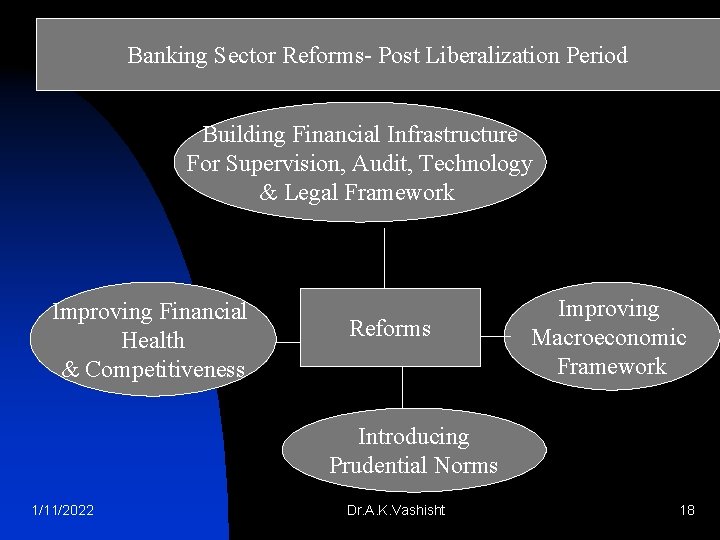
Banking Sector Reforms- Post Liberalization Period Building Financial Infrastructure For Supervision, Audit, Technology & Legal Framework Improving Financial Health & Competitiveness Reforms Improving Macroeconomic Framework Introducing Prudential Norms 1/11/2022 Dr. A. K. Vashisht 18
Major Reforms in the Banking Sector of India n n Deregulation of Interest Rates interest rates on deposits and lending have been deregulated with banks enjoying greater freedom to determine their rates. Adoption of prudential norms in terms of capital adequacy, asset classification, income recognition, provisioning, exposure limits, and investment fluctuation reserve, etc. have been adopted. 1/11/2022 Dr. A. K. Vashisht 19
n n Reduction in pre emptions reserve requirements like Statutory Liquidity Ratio and Cash Reserve Ratio have been lowered so as to release more resources, which can be lent, and which the banks can deploy profitably. Reduction of government equity in banks has been reduced, and strong banks have been allowed to access the capital market for raising additional capital. 1/11/2022 Dr. A. K. Vashisht 20
n n Provision of greater operational freedom banks now enjoy greater freedom in terms of opening and swapping of branches, and banks with a good track record of profitability have been given greater flexibility in recruitment. New private sector banks have been set up, and foreign banks have been permitted to expand their operations in India even through subsidiaries. Banks have also been allowed to set up offshore banking units in special economic zones. 1/11/2022 Dr. A. K. Vashisht 21
n n New areas have been opened up for bank financing: Insurance, credit cards, infrastructure financing, leasing, gold banking, besides investment banking, asset management, factoring, etc. Introduction of new instruments like interest rate swaps, forward rate agreements, cross currency forward contracts, forward cover to hedge inflows under foreign direct investment, and liquidity adjustment facility for meeting day to day liquidity mismatch' have been introduced for greater flexibility and better risk management. 1/11/2022 Dr. A. K. Vashisht 22
n n Setting up new institutions several new institutions have been set up including the National Securities Depositories Ltd. , Central Depositories Services Ltd. , Clearing Corporation of India Ltd. , and Credit Information Bureau India Ltd. Liberalization in overseas investment limits for investment in overseas markets by banks, Mutual Funds (MF) and companies have been liberalized. 1/11/2022 Dr. A. K. Vashisht 23
n n Introduction of universal banking with banks permitted to diversify into long term finance and DFls into working capital; guidelines have been put in place for the evolution of universal banks in an orderly fashion. Technology infrastructure for the payment and settlement system in the country has been strengthened with Electronic Funds Transfer, Centralized Funds Management System, Structured Financial Messaging Solution, Negotiated Dealing System and move towards Real Time Gross Settlement. 1/11/2022 Dr. A. K. Vashisht 24
n Adoption of global standards Prudential norms for capital adequacy, asset classification, income recognition and provisioning are now close to global standards. RBI has introduced risk based supervision of banks (against the traditional transaction based approach). Best international practices in accounting systems, corporate governance, payment and settlement systems, etc. are being adopted. 1/11/2022 Dr. A. K. Vashisht 25
n Credit delivery mechanism has been reinforced to increase the flow of credit to priority sectors through focus on micro credit and self help groups. The definition of the priority sector has been widened to include food processing and cold storage, software up to Rs. 1 crores, housing above Rs. 10 lakhs, selected lending through NBFCs (Non Banking Finance Companies), etc. 1/11/2022 Dr. A. K. Vashisht 26
n RBI guidelines have been issued for putting in place risk management systems in banks. Risk Management Committees in banks address credit risk, market risk and operational risk. Banks have specialized committees to measure and monitor various risks and have been upgrading their risk management skills and systems. 1/11/2022 Dr. A. K. Vashisht 27
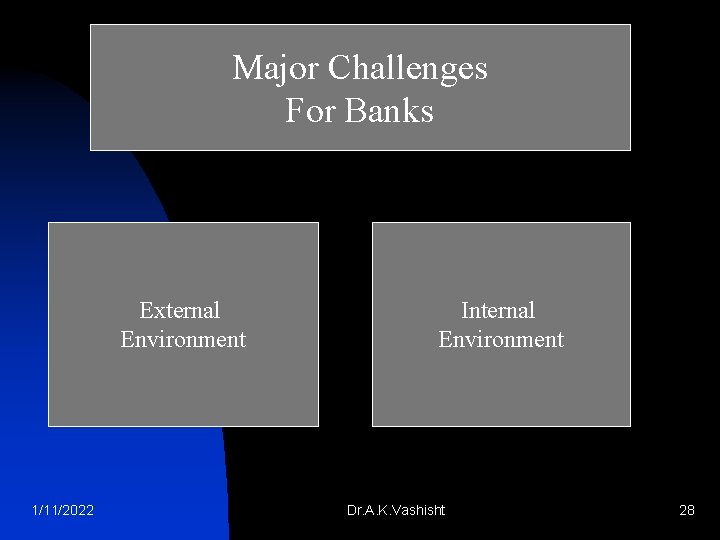
Major Challenges For Banks External Environment 1/11/2022 Internal Environment Dr. A. K. Vashisht 28

External Environment 1/11/2022 Dr. A. K. Vashisht 29
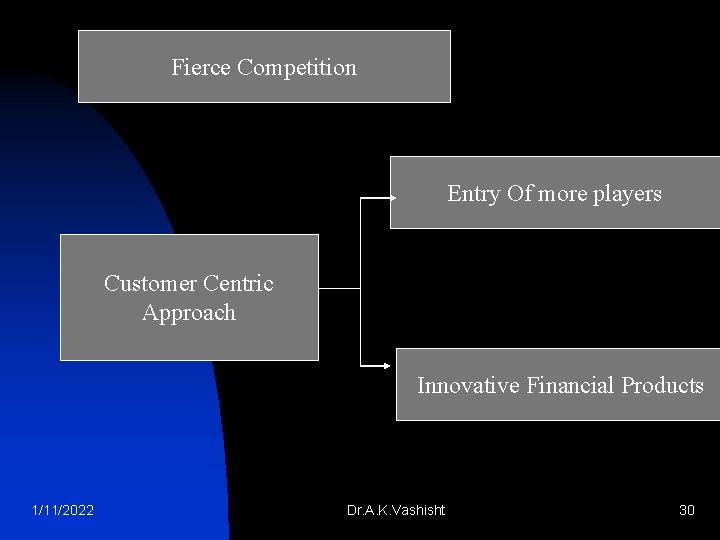
Fierce Competition Entry Of more players Customer Centric Approach Innovative Financial Products 1/11/2022 Dr. A. K. Vashisht 30
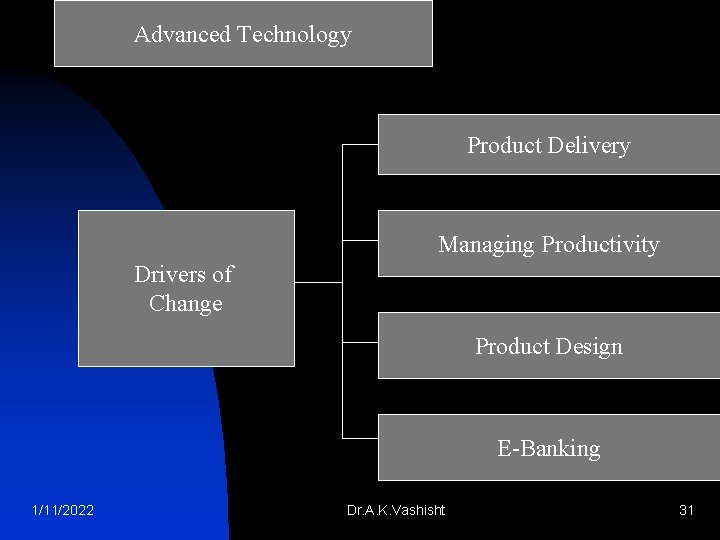
Advanced Technology Product Delivery Managing Productivity Drivers of Change Product Design E-Banking 1/11/2022 Dr. A. K. Vashisht 31
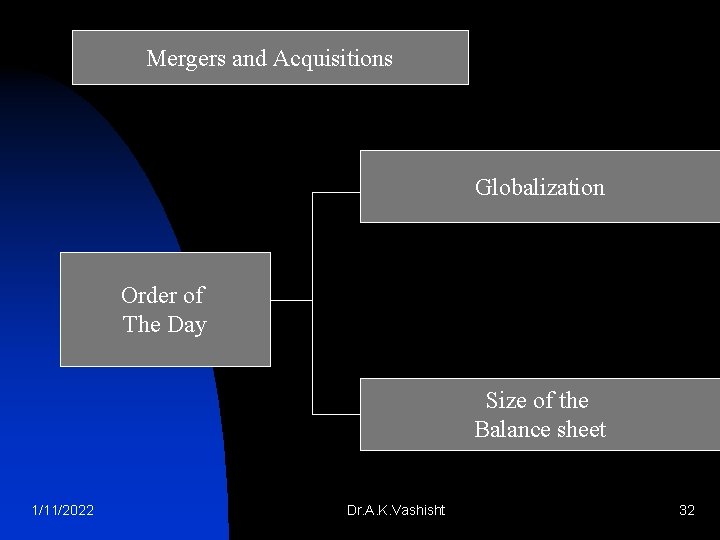
Mergers and Acquisitions Globalization Order of The Day Size of the Balance sheet 1/11/2022 Dr. A. K. Vashisht 32
Globalization consists of all those actions, approaches and policies, which results into connectivity among people across borders. Globalization leads to economic integration of countries. economic integration occurs through three channels, viz. movement of people, goods, services, capital and financial services. 1/11/2022 Dr. A. K. Vashisht 33
Globalization in the Context of the Banking Sector n n n globalization is expected to result in flows of capital from developed to developing countries For almost all the years from 1999, the current account balance of advanced economies has been negative and it was estimated to reach US $ 225 billion in the year 2004 from a positive of US $ 41 billion in 1998 The developing countries, which had a current account deficit of US $ 83 billion in 1998, were estimated to have a surplus balance of a projected US $ 28 billion in 2004 1/11/2022 Dr. A. K. Vashisht 34
Distribution Channels n n 1/11/2022 Transactions through other channels ATM, Phone Banking Virtual Banking Dr. A. K. Vashisht 35
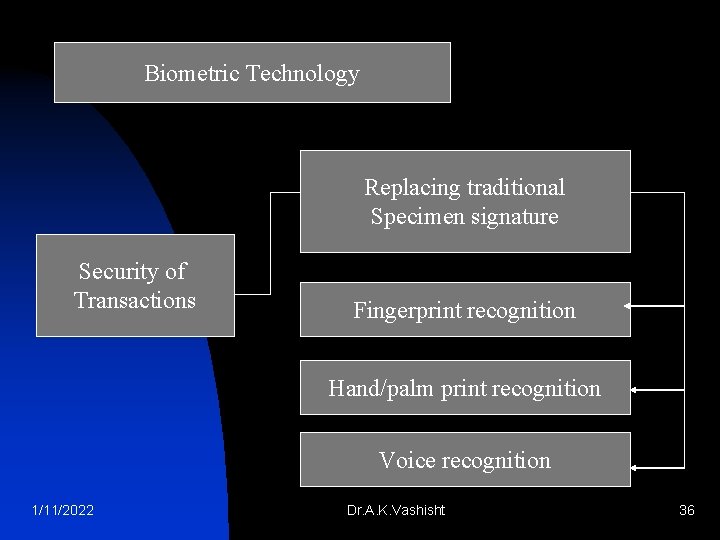
Biometric Technology Replacing traditional Specimen signature Security of Transactions Fingerprint recognition Hand/palm print recognition Voice recognition 1/11/2022 Dr. A. K. Vashisht 36
Payment and settlement systems n n n 1/11/2022 MICR ECS RTGS Dr. A. K. Vashisht 37
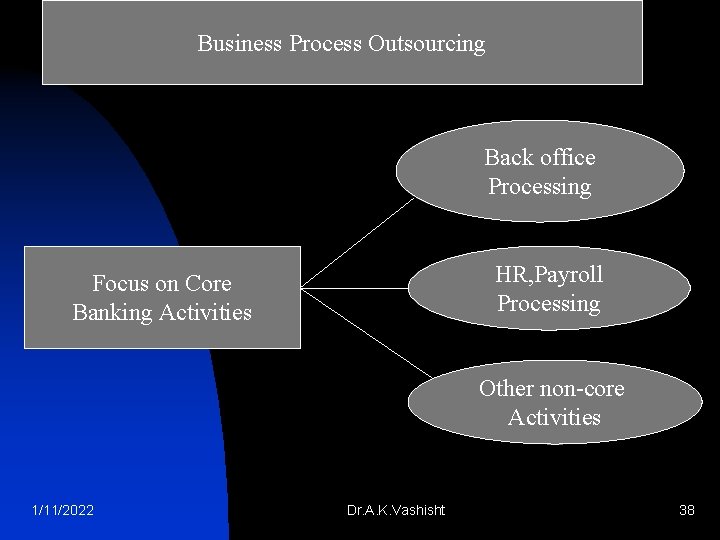
Business Process Outsourcing Back office Processing HR, Payroll Processing Focus on Core Banking Activities Other non-core Activities 1/11/2022 Dr. A. K. Vashisht 38
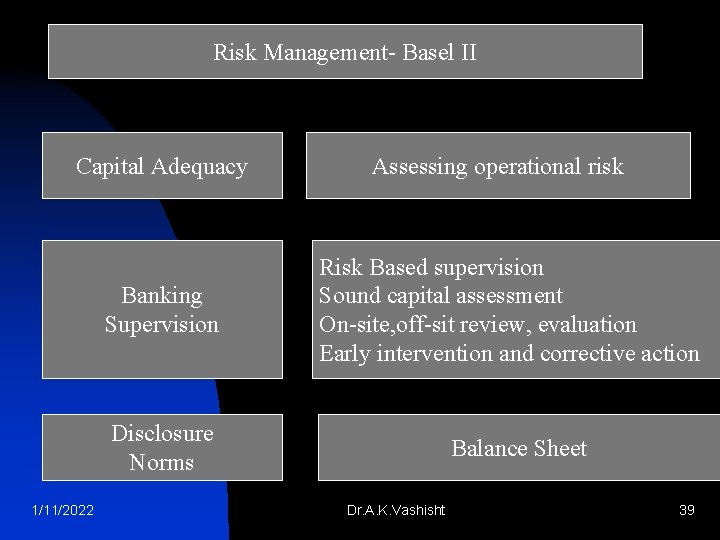
Risk Management- Basel II Capital Adequacy Banking Supervision Assessing operational risk Risk Based supervision Sound capital assessment On-site, off-sit review, evaluation Early intervention and corrective action Disclosure Norms 1/11/2022 Balance Sheet Dr. A. K. Vashisht 39
IT Security n n 1/11/2022 Gains tremendous significance Security framework and IT security Dr. A. K. Vashisht 40

Internal Functioning 1/11/2022 Dr. A. K. Vashisht 41
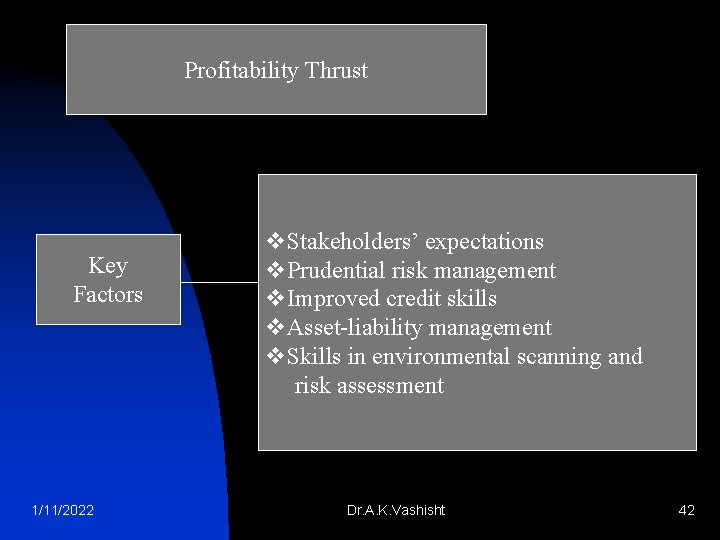
Profitability Thrust Key Factors 1/11/2022 v. Stakeholders’ expectations v. Prudential risk management v. Improved credit skills v. Asset-liability management v. Skills in environmental scanning and risk assessment Dr. A. K. Vashisht 42
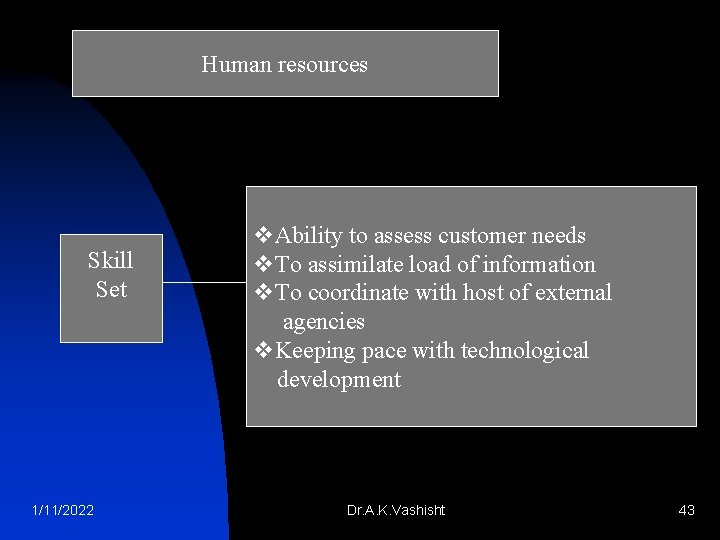
Human resources Skill Set 1/11/2022 v. Ability to assess customer needs v. To assimilate load of information v. To coordinate with host of external agencies v. Keeping pace with technological development Dr. A. K. Vashisht 43
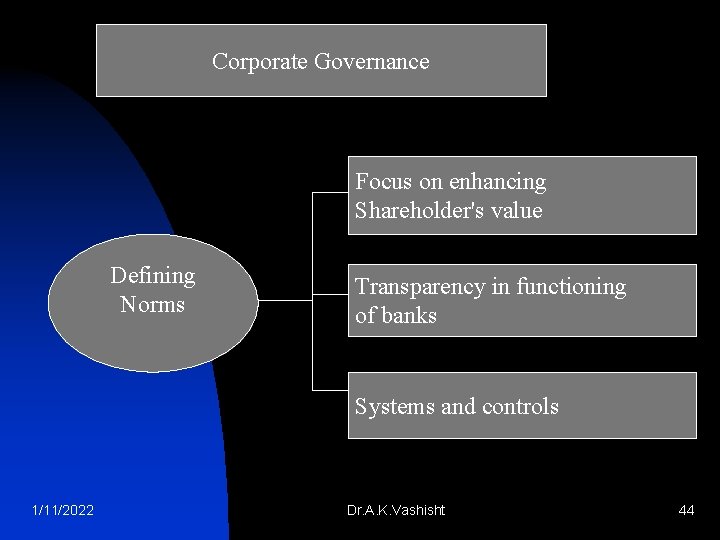
Corporate Governance Focus on enhancing Shareholder's value Defining Norms Transparency in functioning of banks Systems and controls 1/11/2022 Dr. A. K. Vashisht 44
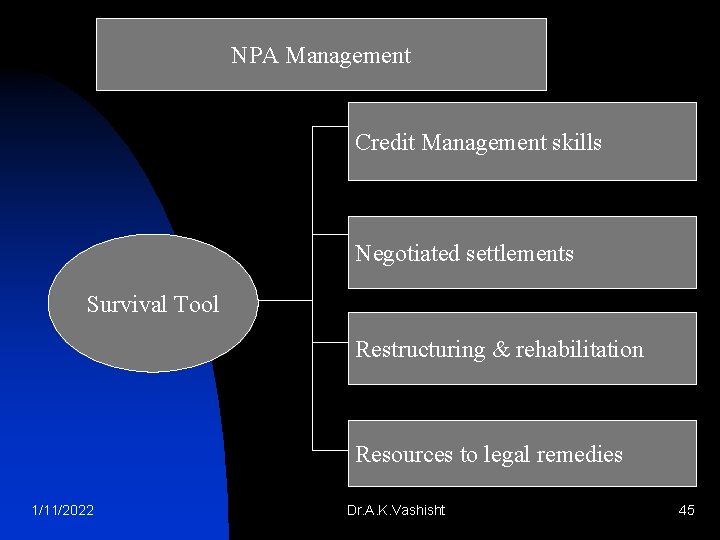
NPA Management Credit Management skills Negotiated settlements Survival Tool Restructuring & rehabilitation Resources to legal remedies 1/11/2022 Dr. A. K. Vashisht 45
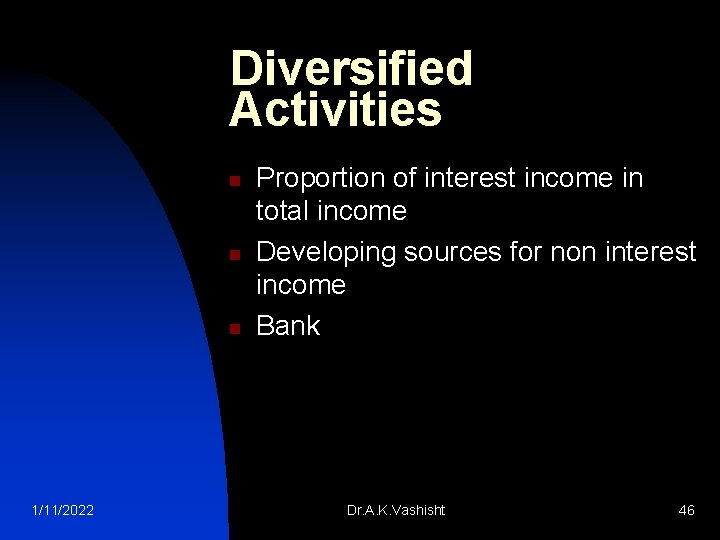
Diversified Activities n n n 1/11/2022 Proportion of interest income in total income Developing sources for non interest income Bank Dr. A. K. Vashisht 46
LANDMARK YEAR FOR INDIAN ECONOMY 1991 n n Ø Ø 1/11/2022 Serious Balance of Payment problem Double digit inflation Stagnant industrial production Huge fiscal deficit etc. By June 1991 on verge of default availed IMF Loan Condition Economic Reforms Dr. A. K. Vashisht 47
RBI – Committee on Financial System Recommendations n introduction of prudential norms n reduction in Cash Reserve Ratio n reduction in Statutory Liquidity Requirement n deregulation of interest rates etc. 1/11/2022 Dr. A. K. Vashisht 48
POST BANKING REFORMS Momentous Changes: n intense Competition for business n involving both the assets and liabilities n increasing volatility in interest rates n increasing volatility in foreign exchange rates etc. 1/11/2022 Dr. A. K. Vashisht 49
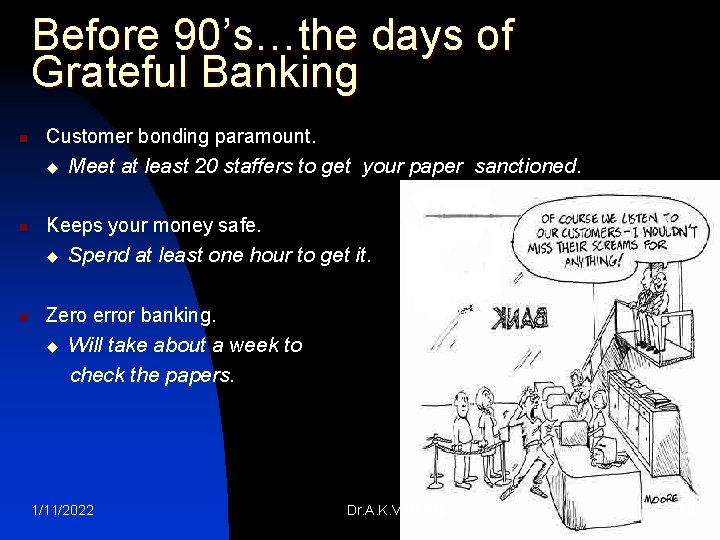
Before 90’s…the days of Grateful Banking n Customer bonding paramount. u n Keeps your money safe. u n Meet at least 20 staffers to get your paper sanctioned. Spend at least one hour to get it. Zero error banking. u Will take about a week to check the papers. 1/11/2022 Dr. A. K. Vashisht 50
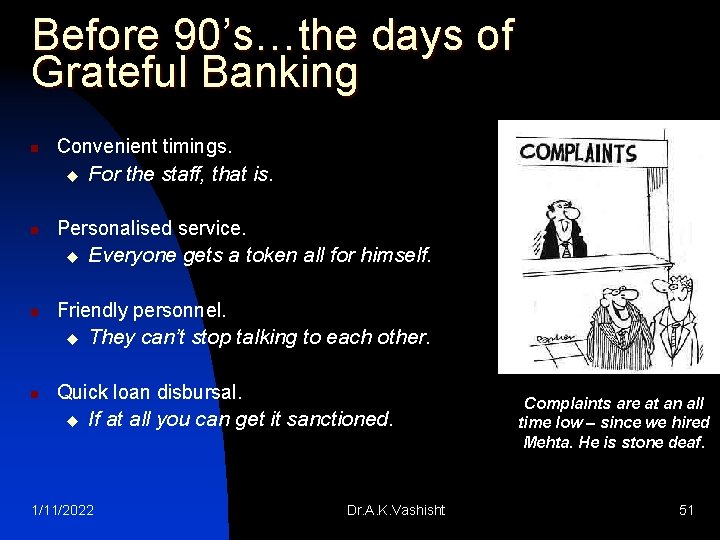
Before 90’s…the days of Grateful Banking n Convenient timings. u n Personalised service. u n Everyone gets a token all for himself. Friendly personnel. u n For the staff, that is. They can’t stop talking to each other. Quick loan disbursal. u If at all you can get it sanctioned. 1/11/2022 Dr. A. K. Vashisht Complaints are at an all time low – since we hired Mehta. He is stone deaf. 51
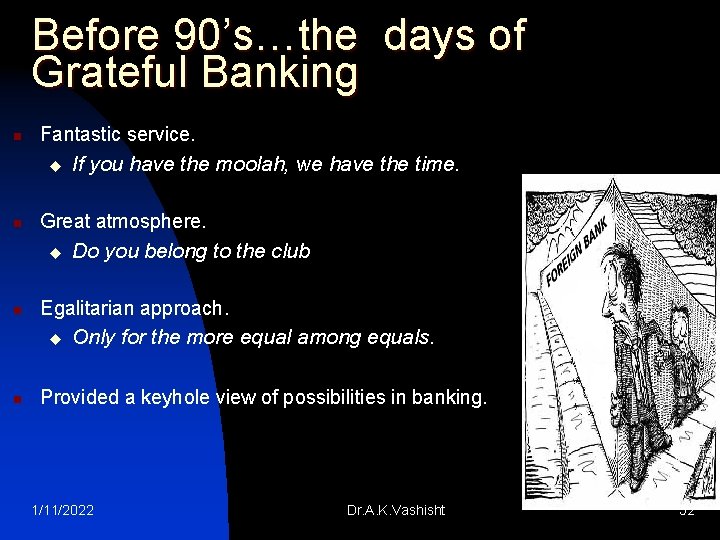
Before 90’s…the days of Grateful Banking n Fantastic service. u n Great atmosphere. u n Do you belong to the club Egalitarian approach. u n If you have the moolah, we have the time. Only for the more equal among equals. Provided a keyhole view of possibilities in banking. 1/11/2022 Dr. A. K. Vashisht 52
Before 90’s…the days of Grateful Banking n Convenient timings. u n Personalised service. u n Everyone gets a token all for himself. Friendly personnel. u n For the staff, that is. They can’t stop talking to each other. Quick loan disbursal. u If at all you can get it sanctioned. 1/11/2022 Dr. A. K. Vashisht Complaints are at an all time low – since we hired Mehta. He is stone deaf. 53
After 90’s. . finally something to be truly grateful for n Affordability. u n Customer service. u n Class for the masses. More free time for yourself. Convenience. u 1/11/2022 Take your money when you want it. Dr. A. K. Vashisht 54
After 90’s. . finally something to be truly grateful for n Multiple channels. u n New range of products. u n Variants catering to different needs. Asset products. u 1/11/2022 You choose - come to the bank or the bank will come to you. Take money from me easily, for a change. Dr. A. K. Vashisht 55
Are Banks truly marketing-savvy and customer - centric? 1/11/2022 Dr. A. K. Vashisht 56

n Myth 1 – The larger the range of products, the more customer centric I am. Mythbuster – The range of products has emerged from being competition-centric. 1/11/2022 Dr. A. K. Vashisht 57
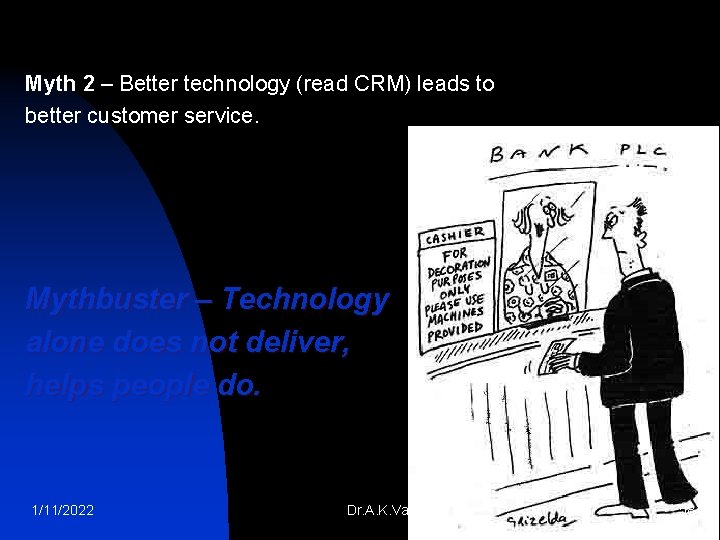
Myth 2 – Better technology (read CRM) leads to better customer service. Mythbuster – Technology alone does not deliver, helps people do. 1/11/2022 Dr. A. K. Vashisht 58

Myth 3 – Launch a product and the customer will start using instantly. Give a customer a card and he will learn how to play with it immediately Mythbuster – Customers need To be educated too… 1/11/2022 Dr. A. K. Vashisht 59
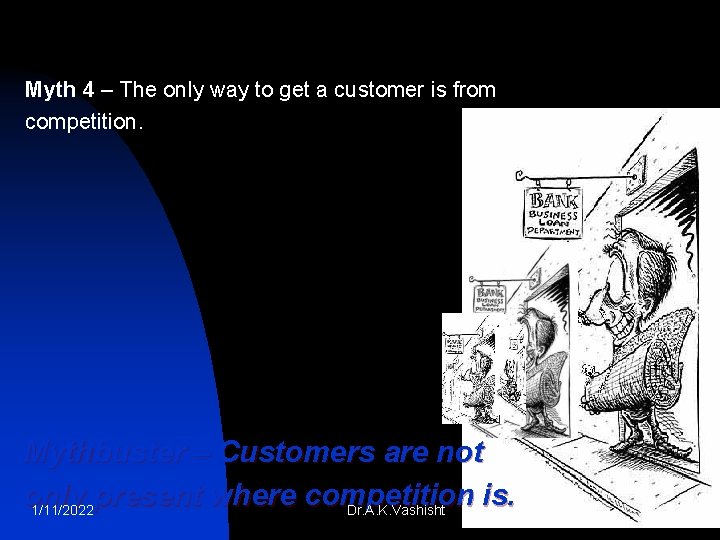
Myth 4 – The only way to get a customer is from competition. Mythbuster – Customers are not only present where competition is. 1/11/2022 Dr. A. K. Vashisht 60

Myth 5 – Just advertise and You will sell. Mythbuster – Advertising will only sell, Not retain customers. 1/11/2022 Dr. A. K. Vashisht 61

Myth 6 – No difference between marketing & selling Mythbuster – “Selling focuses on the needs of the seller; marketing on the needs of the buyer. 1/11/2022 Dr. A. K. Vashisht 62
Myth 7 – In the absence of relationships ‘trust’ builds financial brands Mythbuster – Trust is not a differentiator at all… it is the very minimum that the customer expects!! 1/11/2022 Dr. A. K. Vashisht 63
So what will the differentiators be : • Technology ? • Brand ? 1/11/2022 Dr. A. K. Vashisht 64
The real differentiator of customer – centricity in a commoditised world of financial products - Customer Service ! 1/11/2022 Dr. A. K. Vashisht 65
Challenge before Financial services sector 1/11/2022 Designing of appropriate organizational structure n Training of employees n Retention of employees n Facing international competition in view if WTO n Product innovation n Keeping pace with technological developments n Security issues n Ethical Issues Dr. A. K. Vashisht 66

Thank you 1/11/2022 Dr. A. K. Vashisht 67
- Slides: 67