
Commas Semicolons and Colons Writing Centre Website Write
Commas, Semicolons, and Colons Writing Centre Website Write. Answers Theresa Bell Writing centre coordinator, Royal Roads University © Royal Roads University
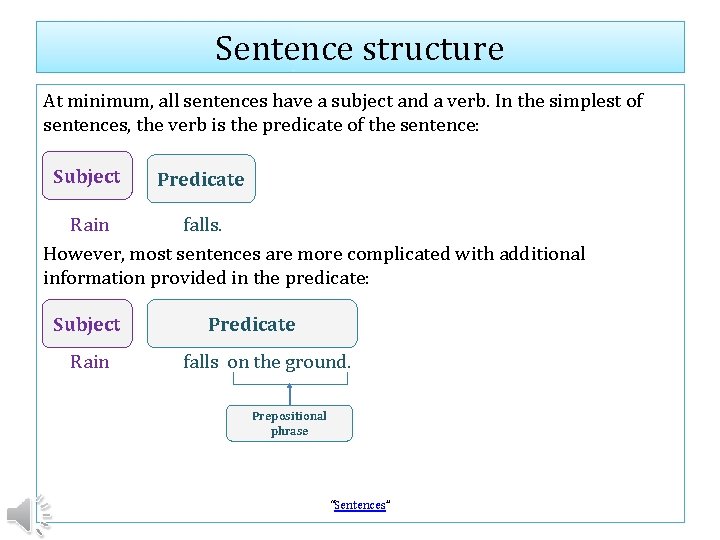
Sentence structure At minimum, all sentences have a subject and a verb. In the simplest of sentences, the verb is the predicate of the sentence: Subject Predicate Rain falls. However, most sentences are more complicated with additional information provided in the predicate: Subject Rain Predicate falls on the ground. Prepositional phrase “Sentences”
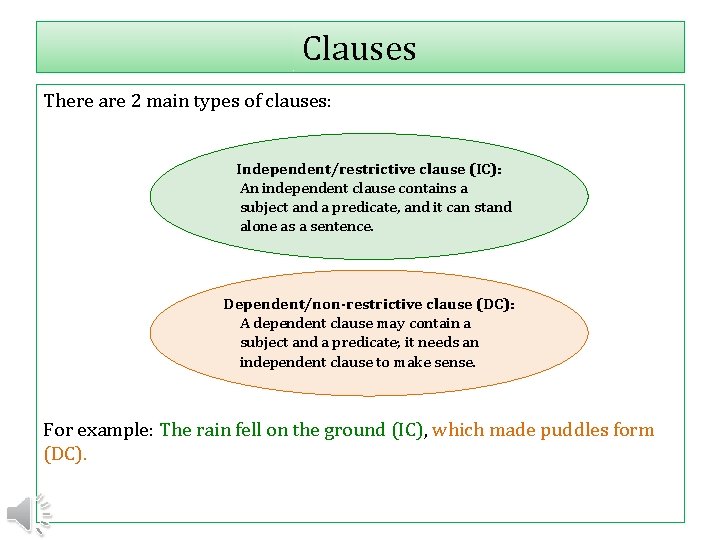
Clauses There are 2 main types of clauses: Independent/restrictive clause (IC): An independent clause contains a subject and a predicate, and it can stand alone as a sentence. Dependent/non-restrictive clause (DC): A dependent clause may contain a subject and a predicate; it needs an independent clause to make sense. For example: The rain fell on the ground (IC), which made puddles form (DC).
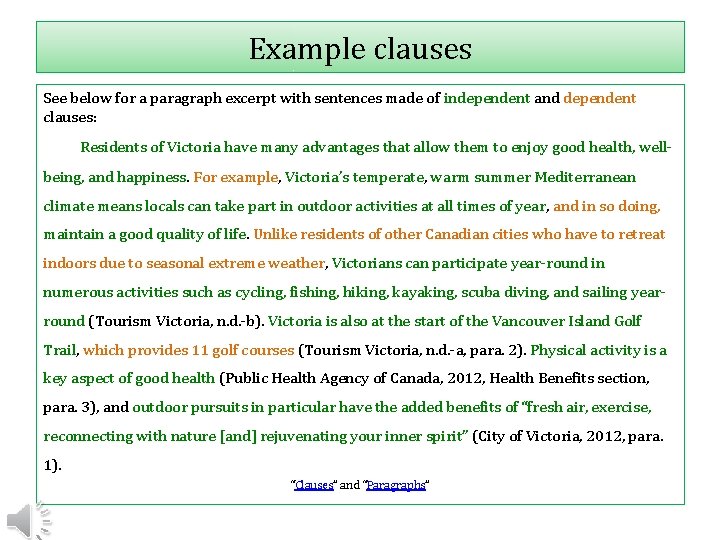
Example clauses See below for a paragraph excerpt with sentences made of independent and dependent clauses: Residents of Victoria have many advantages that allow them to enjoy good health, wellbeing, and happiness. For example, Victoria’s temperate, warm summer Mediterranean climate means locals can take part in outdoor activities at all times of year, and in so doing, maintain a good quality of life. Unlike residents of other Canadian cities who have to retreat indoors due to seasonal extreme weather, Victorians can participate year-round in numerous activities such as cycling, fishing, hiking, kayaking, scuba diving, and sailing yearround (Tourism Victoria, n. d. -b). Victoria is also at the start of the Vancouver Island Golf Trail, which provides 11 golf courses (Tourism Victoria, n. d. -a, para. 2). Physical activity is a key aspect of good health (Public Health Agency of Canada, 2012, Health Benefits section, para. 3), and outdoor pursuits in particular have the added benefits of “fresh air, exercise, reconnecting with nature [and] rejuvenating your inner spirit” (City of Victoria, 2012, para. 1). “Clauses” and “Paragraphs”
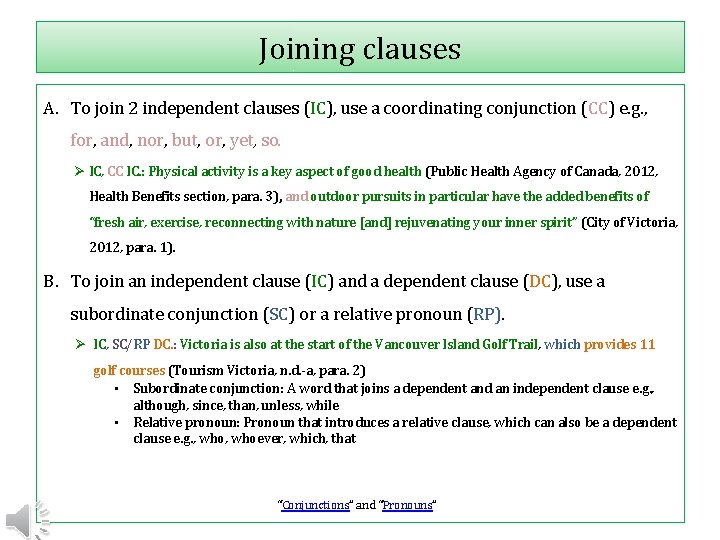
Joining clauses A. To join 2 independent clauses (IC), use a coordinating conjunction (CC) e. g. , for, and, nor, but, or, yet, so. Ø IC, CC IC. : Physical activity is a key aspect of good health (Public Health Agency of Canada, 2012, Health Benefits section, para. 3), and outdoor pursuits in particular have the added benefits of “fresh air, exercise, reconnecting with nature [and] rejuvenating your inner spirit” (City of Victoria, 2012, para. 1). B. To join an independent clause (IC) and a dependent clause (DC), use a subordinate conjunction (SC) or a relative pronoun (RP). Ø IC, SC/RP DC. : Victoria is also at the start of the Vancouver Island Golf Trail, which provides 11 golf courses (Tourism Victoria, n. d. -a, para. 2) • Subordinate conjunction: A word that joins a dependent and an independent clause e. g. , although, since, than, unless, while • Relative pronoun: Pronoun that introduces a relative clause, which can also be a dependent clause e. g. , whoever, which, that “Conjunctions” and “Pronouns”
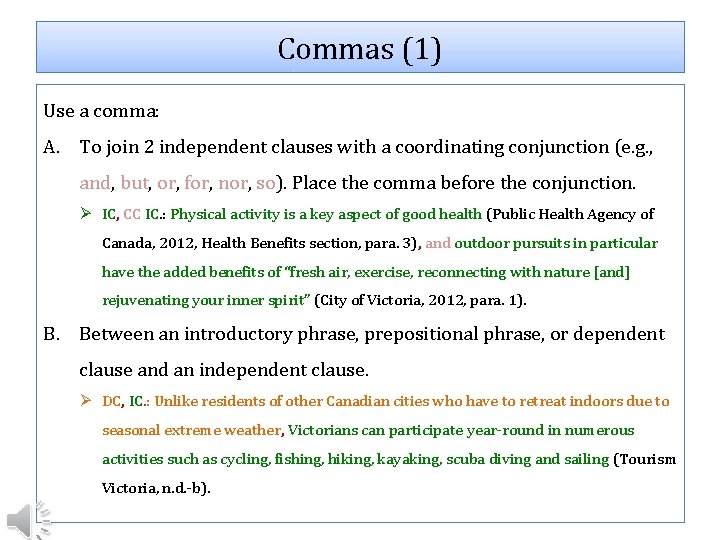
Commas (1) Use a comma: A. To join 2 independent clauses with a coordinating conjunction (e. g. , and, but, or, for, nor, so). Place the comma before the conjunction. Ø IC, CC IC. : Physical activity is a key aspect of good health (Public Health Agency of Canada, 2012, Health Benefits section, para. 3), and outdoor pursuits in particular have the added benefits of “fresh air, exercise, reconnecting with nature [and] rejuvenating your inner spirit” (City of Victoria, 2012, para. 1). B. Between an introductory phrase, prepositional phrase, or dependent clause and an independent clause. Ø DC, IC. : Unlike residents of other Canadian cities who have to retreat indoors due to seasonal extreme weather, Victorians can participate year-round in numerous activities such as cycling, fishing, hiking, kayaking, scuba diving and sailing (Tourism Victoria, n. d. -b).
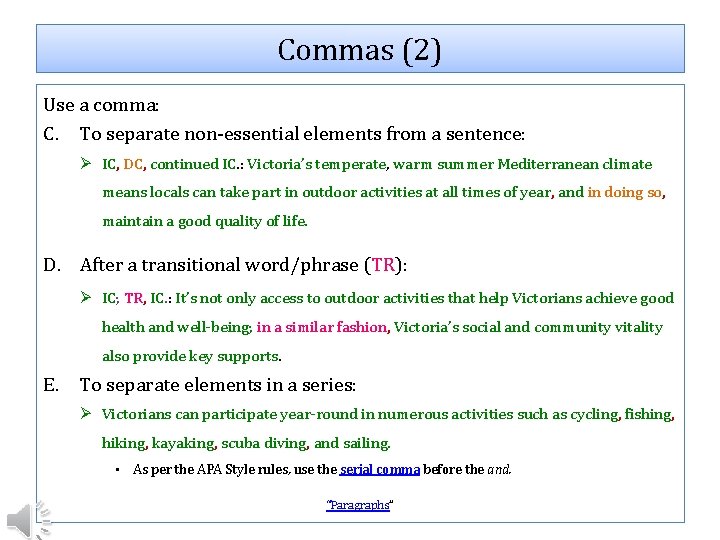
Commas (2) Use a comma: C. To separate non-essential elements from a sentence: Ø IC, DC, continued IC. : Victoria’s temperate, warm summer Mediterranean climate means locals can take part in outdoor activities at all times of year, and in doing so, maintain a good quality of life. D. After a transitional word/phrase (TR): Ø IC; TR, IC. : It’s not only access to outdoor activities that help Victorians achieve good health and well-being; in a similar fashion, Victoria’s social and community vitality also provide key supports. E. To separate elements in a series: Ø Victorians can participate year-round in numerous activities such as cycling, fishing, hiking, kayaking, scuba diving, and sailing. • As per the APA Style rules, use the serial comma before the and. “Paragraphs”
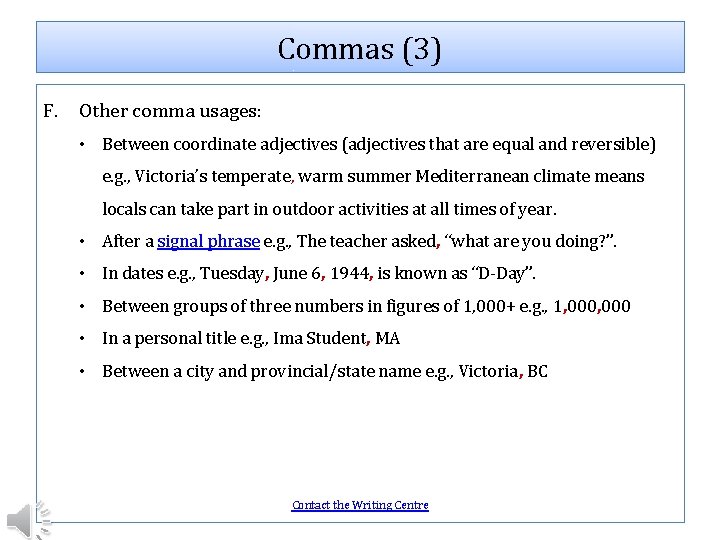
Commas (3) F. Other comma usages: • Between coordinate adjectives (adjectives that are equal and reversible) e. g. , Victoria’s temperate, warm summer Mediterranean climate means locals can take part in outdoor activities at all times of year. • After a signal phrase e. g. , The teacher asked, “what are you doing? ”. • In dates e. g. , Tuesday, June 6, 1944, is known as “D-Day”. • Between groups of three numbers in figures of 1, 000+ e. g. , 1, 000 • In a personal title e. g. , Ima Student, MA • Between a city and provincial/state name e. g. , Victoria, BC Contact the Writing Centre
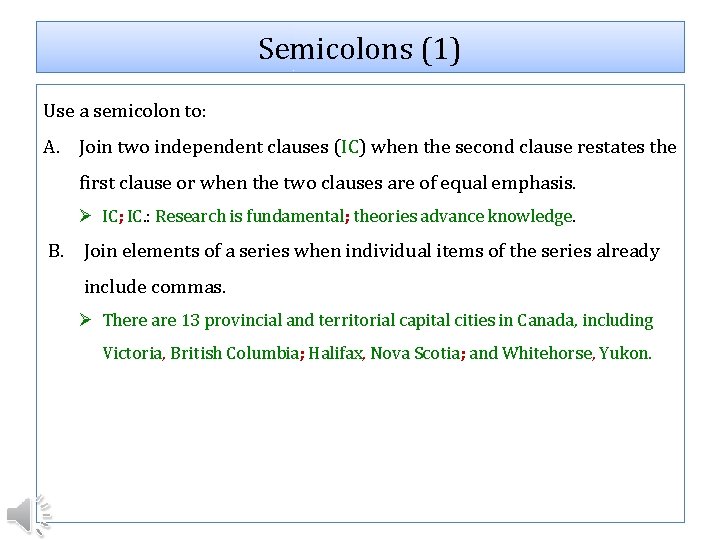
Semicolons (1) Use a semicolon to: A. Join two independent clauses (IC) when the second clause restates the first clause or when the two clauses are of equal emphasis. Ø IC; IC. : Research is fundamental; theories advance knowledge. B. Join elements of a series when individual items of the series already include commas. Ø There are 13 provincial and territorial capital cities in Canada, including Victoria, British Columbia; Halifax, Nova Scotia; and Whitehorse, Yukon.
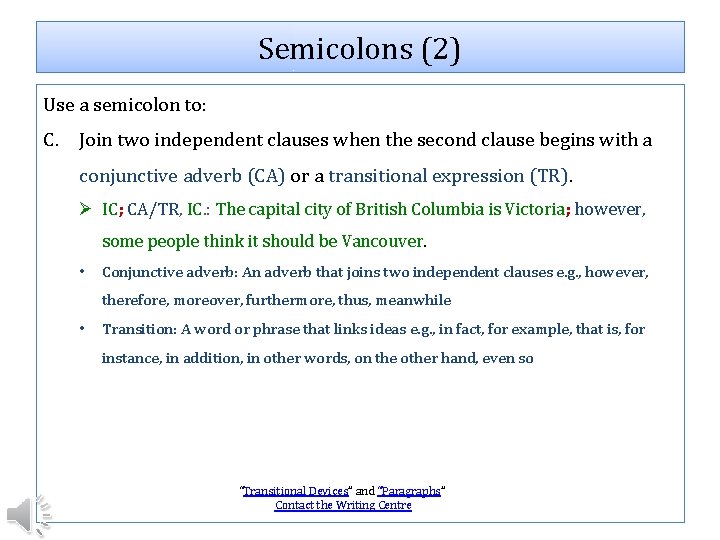
Semicolons (2) Use a semicolon to: C. Join two independent clauses when the second clause begins with a conjunctive adverb (CA) or a transitional expression (TR). Ø IC; CA/TR, IC. : The capital city of British Columbia is Victoria; however, some people think it should be Vancouver. • Conjunctive adverb: An adverb that joins two independent clauses e. g. , however, therefore, moreover, furthermore, thus, meanwhile • Transition: A word or phrase that links ideas e. g. , in fact, for example, that is, for instance, in addition, in other words, on the other hand, even so “Transitional Devices” and “Paragraphs” Contact the Writing Centre
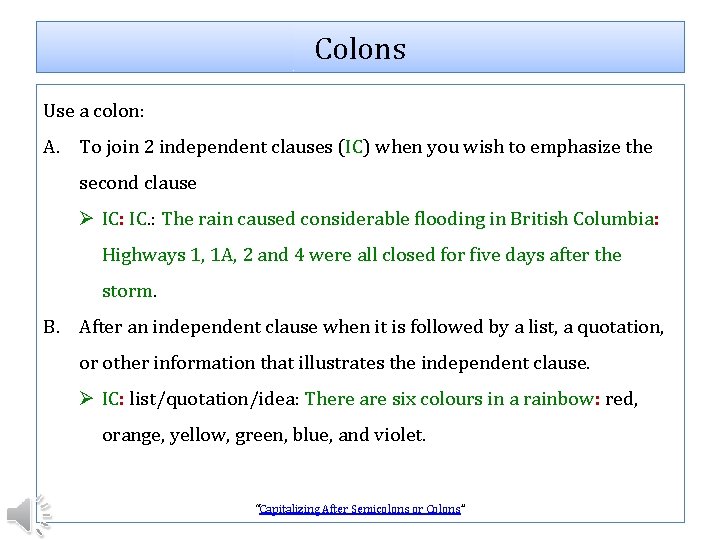
Colons Use a colon: A. To join 2 independent clauses (IC) when you wish to emphasize the second clause Ø IC: IC. : The rain caused considerable flooding in British Columbia: Highways 1, 1 A, 2 and 4 were all closed for five days after the storm. B. After an independent clause when it is followed by a list, a quotation, or other information that illustrates the independent clause. Ø IC: list/quotation/idea: There are six colours in a rainbow: red, orange, yellow, green, blue, and violet. “Capitalizing After Semicolons or Colons”
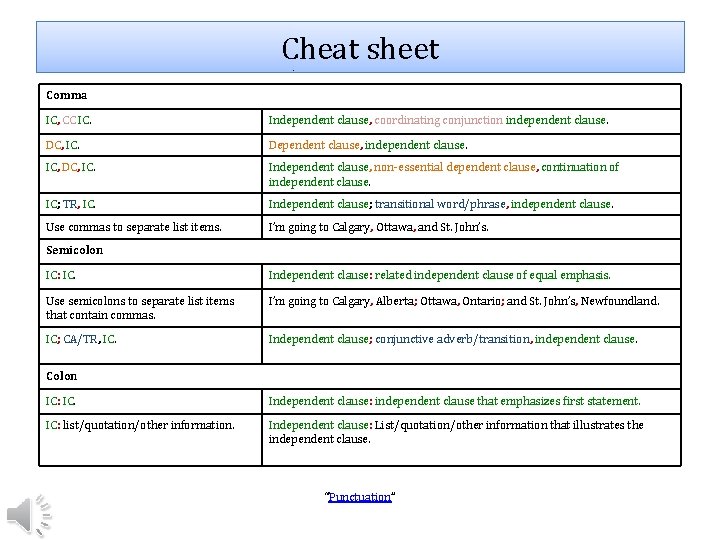
Cheat sheet Punctuation cheat sheet Comma IC, CC IC. Independent clause, coordinating conjunction independent clause. DC, IC. Dependent clause, independent clause. IC, DC, IC. Independent clause, non-essential dependent clause, continuation of independent clause. IC; TR, IC. Independent clause; transitional word/phrase, independent clause. Use commas to separate list items. I’m going to Calgary, Ottawa, and St. John’s. Semicolon IC: IC. Independent clause: related independent clause of equal emphasis. Use semicolons to separate list items that contain commas. I’m going to Calgary, Alberta; Ottawa, Ontario; and St. John’s, Newfoundland. IC; CA/TR, IC. Independent clause; conjunctive adverb/transition, independent clause. Colon IC: IC. Independent clause: independent clause that emphasizes first statement. IC: list/quotation/other information. Independent clause: List/quotation/other information that illustrates the independent clause. “Punctuation”
Questions? http: //library. royalroads. ca/writing-centre http: //writeanswers. royalroads. ca (250) 391 -2600, ext. 4353 Toll free in North America: 1 -800 -788 -8028
- Slides: 13