
Commanding the Confined Space Rescue ICS Incident Priorities

- Slides: 36
Commanding the Confined Space Rescue
ICS Incident Priorities • • • Life safety Responder safety is number one priority General public Be part of the solution, not the problem 60% of fatalities are would be rescuers
ICS Incident Priorities • Risk / Benefit analysis – What do I have to lose? – What do I have to gain? – Analysis: process used to determine strategic goals of an incident.
ICS Incident Priorities • Development of strategic goals is determined after an assessment of the situation. • The survivability of the victim will determine if a rescue is possible or if this will be a body recovery.
ICS Incident Priorities • Offensive ( rescue) – Are viable lives at risk – Manageable number – Hazards are known and controllable – Resources are available – Incident stabilization prompt and probable
ICS Incident Priorities • Defensive ( body recovery ) – No life probability of victim – Complex rescue incident – Hazardous conditions still exist – Resources unavailable – Stabilization unlikely
Incident Stabilization • Ability of each CSR team is based on training and equipment. • CSR team needs to pre-plan spaces to determine equipment and training needs. • Tactical objectives are based on strategic goals of the incident.
Scene Management • Establish Command • Reconnaissance • Gain Control
Establish Command • Any team member can be command – usually highest trained – can be passed as more people arrive – need to know the ICS – trained in CSR
Responsibilities of IC • • • Make initial assessment and evaluation Establish goals and objectives Determine additional resources Deploy personnel and units Establish a command post
Reconnaissance • Once preliminary information indicates that PPE on hand is adequate – Obtain air monitoring samples – Assess hazards – Patients – Characteristics of space • Rapidly communicate information to IC
Gain Control • Perimeter Control – May need police – Barrier tape, ropes, barricades • Includes – Civilian volunteer rescuers – Controlling traffic – Limiting access to the rescue area to assigned personnel
Gain Control • Hazard Mitigation – Avoid the hazard – Remove the hazard – Control the hazard – Use personal protective equipment
Gain Control • Hazard Mitigation – Risk / benefit analysis – Length of time to implement – survival time of patient • Factors involved – Equipment available – Personnel - training, skills, knowledge and numbers
Scene Management • • • IC needs to: Analyze the problem Plan solutions Implement the plan Evaluate progress
Strategic Factors for CSR • • Confined Space Characteristics Hazards Present Rescue Opportunities Resources
Confined Space Characteristics • • • Type Function Configuration Construction Size Entry Points ( size, number, location )
Hazards Present • • • Atmospheric Energy Sources Entrapment Fall Fire / Explosion Hazardous Material
Rescue Opportunities • • • Not Injured Minor Injury Controllable Hazards Personal Protection for Patient Rescue Problem within Capabilities of the Department • Distance
Resources • Sufficient Personnel ( numbers, experience, training ) • Appropriate equipment, Apparatus, Material • Time to Implement Option Chosen • Availability • Interagency Coordination
Functional Components of IMS Assigned by IC • Operations / Group Supervisor / Team Leader • Overseas and controls all tasks and functions. • Directs all tactical objectives according to goals set by command. • Ensures entry control
Functional Components of IMS Assigned by IC • Safety – Monitors all safety factors – Advises command – Ensures correct selection and use of PPE – Monitors entry team air time – Has authority to stop unsafe operations and override command
Functional Components of IMS Assigned by IC • Entry: Rescue / Recovery – Enters space to provide recon – Provides for removal of patients – Directs communication with Operations and Safety
Functional Components of IMS Assigned by IC • Hazard Control – Provides proper ventilation of space – Provides monitoring of space – Provides lockout of all sources of energy and engulfment hazards – Advises Operations of above
Functional Components of IMS Assigned by IC • Air Supply – Provides appropriate air supply support for all entrants – determines amount of air needed amount – Ensures adequate amount of on-scene air supply – Advises Operations
Functional Components of IMS Assigned by IC • Rigging – Determines type rescue equipment needed – Sets up and manages rescue systems – Performs duties of attendant – Ensures safety of entrants – Advises Operations
Functional Components of IMS Assigned by IC • Medical – Provides medical surveillance of entrants – Provides rehabilitation – Provides medical care to patients after removal
Functional Components of IMS Assigned by IC • Additional Functions – Research • Provides technical research on hazards. – Decontamination • Provides decon to entrants and patients • Manages decon line
Functional Components of IMS Assigned by IC • Rapid Intervention Team ( RIT ) – Provides safety backup for entry – Dressed in same PPE as entry, staged to go – Cannot be assigned to another task – Provides at least one for one coverage
Application
Application • First Arriving Company: Initial Actions – Establish Command – Reconnaissance – Gain control
Application Phase I: Pre-Entry • • Size-up Rescue / Recovery Pre-Plan Command Post Hazard control Monitoring Ventilation
Application Phase I: Pre-Entry Cont. • • • Lockout / Tagout Technical Team Required Decon Rehab Accountability
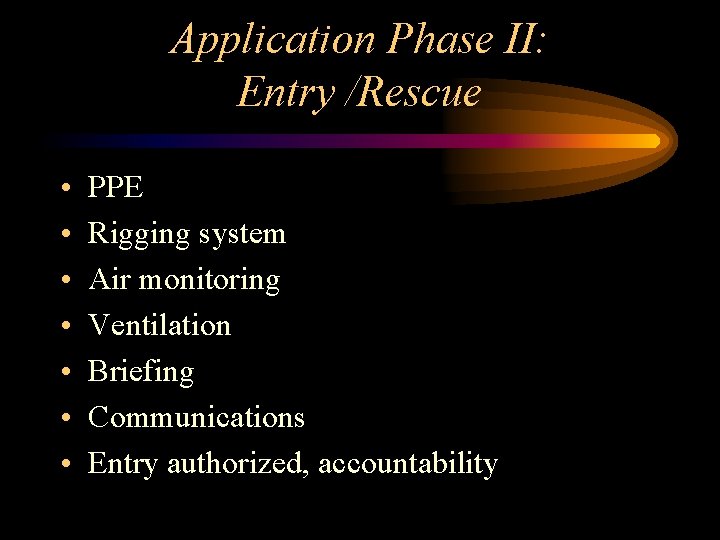
Application Phase II: Entry /Rescue • • PPE Rigging system Air monitoring Ventilation Briefing Communications Entry authorized, accountability
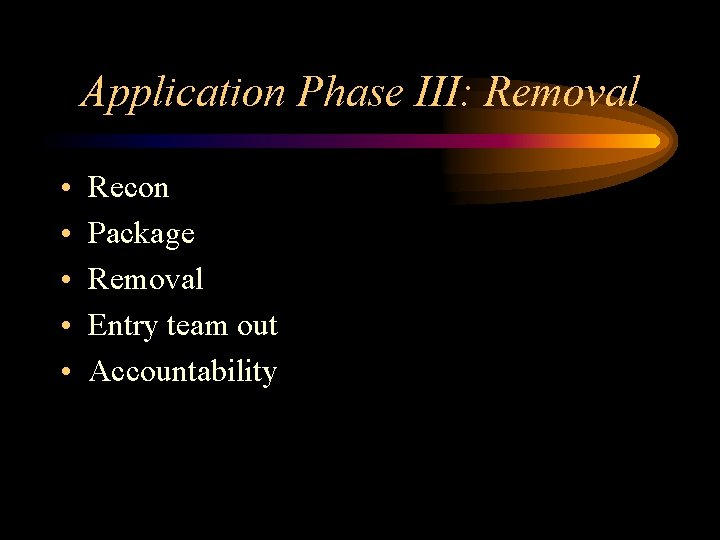
Application Phase III: Removal • • • Recon Package Removal Entry team out Accountability
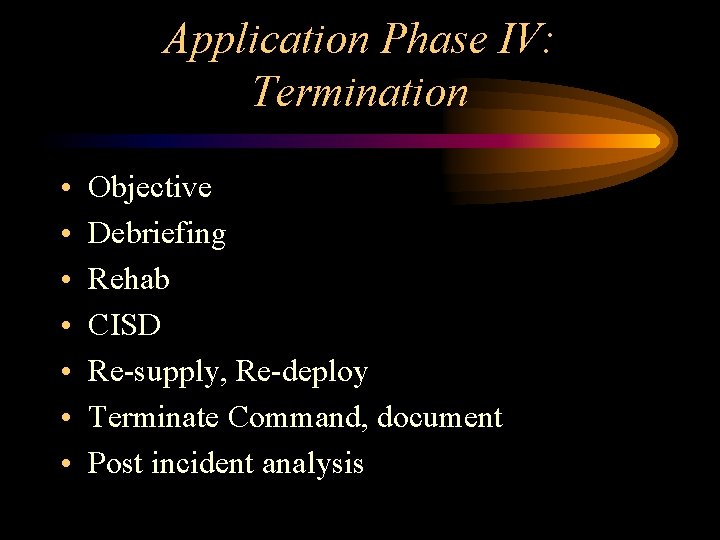
Application Phase IV: Termination • • Objective Debriefing Rehab CISD Re-supply, Re-deploy Terminate Command, document Post incident analysis