
COMMAND SUPPORT PROGRAMS HEARING CONSERVATION US Army Hearing

- Slides: 31
COMMAND SUPPORT PROGRAMS HEARING CONSERVATION US Army Hearing Conservation Program
COMMAND SUPPORT PROGRAMS HEARING CONSERVATION Did You Know…. . . ? • Noise-induced hearing loss is the number one occupational disability. • It is generally painless. • It is progressive over time. • It is permanent. • IT IS PREVENTABLE!!!
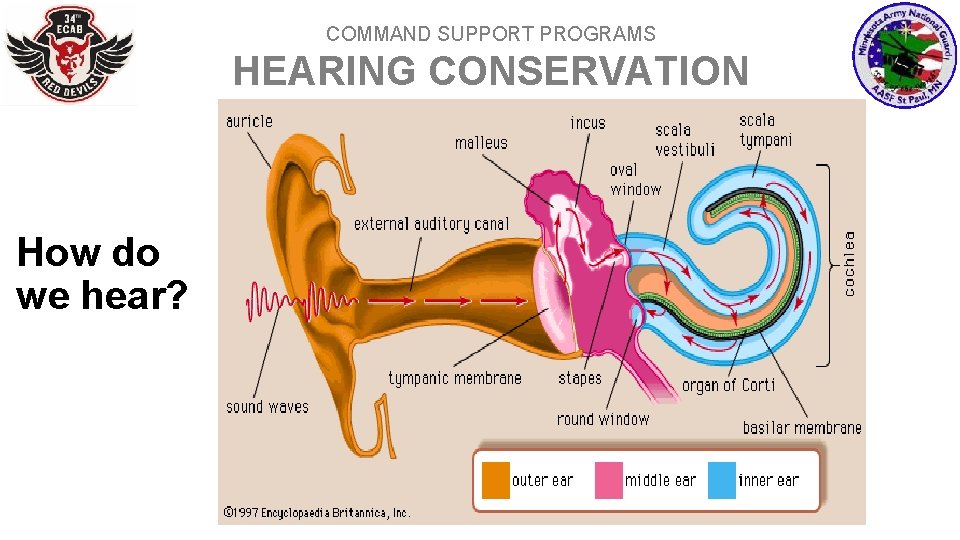
COMMAND SUPPORT PROGRAMS HEARING CONSERVATION How do we hear?
COMMAND SUPPORT PROGRAMS HEARING CONSERVATION Sound Receptors
COMMAND SUPPORT PROGRAMS HEARING CONSERVATION Damaged Hair Cells
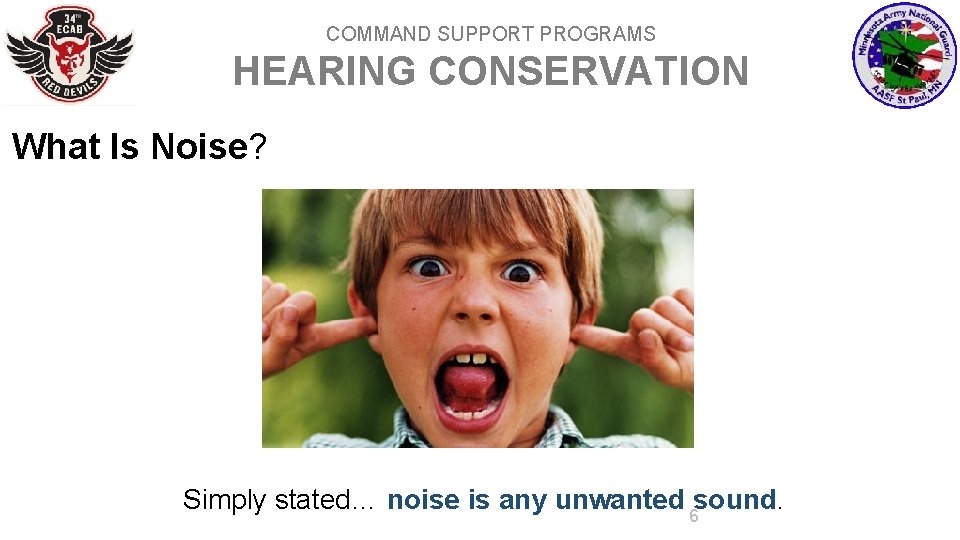
COMMAND SUPPORT PROGRAMS HEARING CONSERVATION What Is Noise? Simply stated… noise is any unwanted 6 sound.
COMMAND SUPPORT PROGRAMS HEARING CONSERVATION Ways To Characterize Noise • FREQUENCY - perceived as pitch • INTENSITY - perceived as loudness • NATURE - steady-state vs. impulse/impact • DURATION - length of time exposed 7
COMMAND SUPPORT PROGRAMS HEARING CONSERVATION Noise Induced Hearing Loss • Initially, exposure to noise causes a loss of sensitivity to high frequency (high pitch) sound. • Continued exposure results in damage to mid frequency region as well. • One can experience progressive high frequency hearing loss and not be aware of it until it becomes severe (doesn’t affect loudness perception).
COMMAND SUPPORT PROGRAMS HEARING CONSERVATION How Can It Happen? • Acoustic Trauma – One time exposure to loud noise • Daily exposure to moderately loud noise
COMMAND SUPPORT PROGRAMS HEARING CONSERVATION When is Something Too Loud? • Use the 3 -foot rule: If you have to raise your voice to be heard by someone standing within 3 foot (arm’s length) then the level is most likely above the hazardous noise level. • Objectively measure loudness with proper equipment.
COMMAND SUPPORT PROGRAMS HEARING CONSERVATION When is NOISE Scientifically Defined to be a HAZARD? • Duration of exposure, intensity (volume) of sound, repeated exposure, individual susceptibility. • 85 d. BA for steady-state noise sources. • 140 d. BP for impulse/impact noise sources.
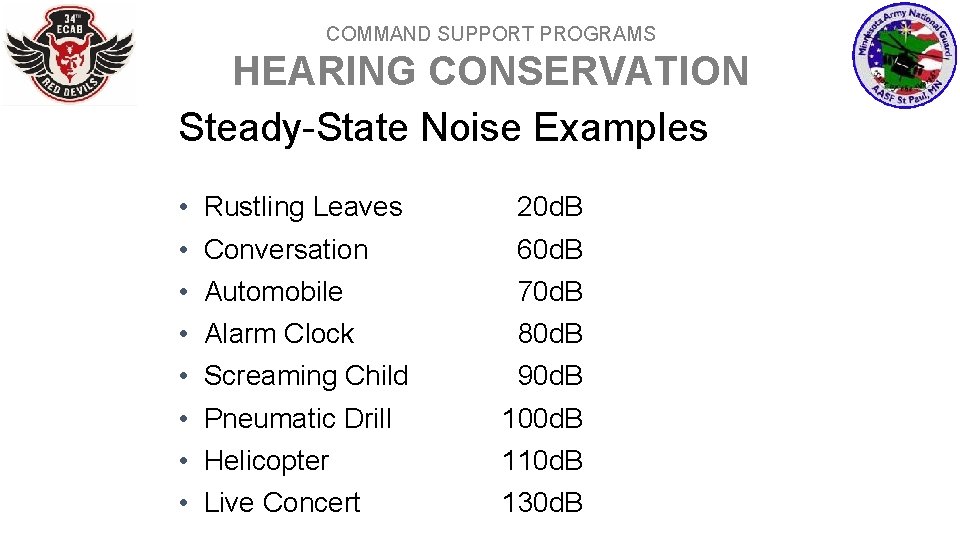
COMMAND SUPPORT PROGRAMS HEARING CONSERVATION Steady-State Noise Examples • • Rustling Leaves 20 d. B Conversation 60 d. B Automobile 70 d. B Alarm Clock 80 d. B Screaming Child 90 d. B Pneumatic Drill 100 d. B Helicopter 110 d. B Live Concert 130 d. B
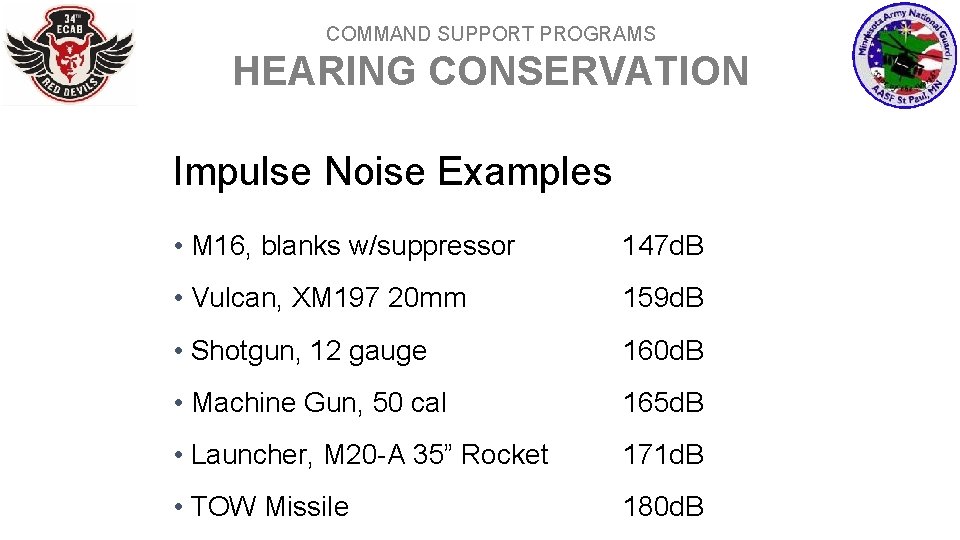
COMMAND SUPPORT PROGRAMS HEARING CONSERVATION Impulse Noise Examples • M 16, blanks w/suppressor 147 d. B • Vulcan, XM 197 20 mm 159 d. B • Shotgun, 12 gauge 160 d. B • Machine Gun, 50 cal 165 d. B • Launcher, M 20 -A 35” Rocket 171 d. B • TOW Missile 180 d. B
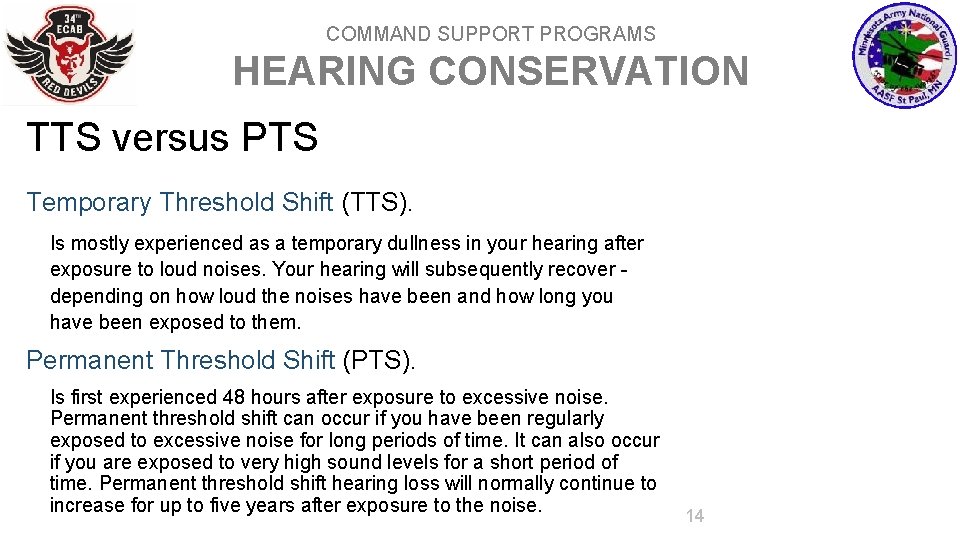
COMMAND SUPPORT PROGRAMS HEARING CONSERVATION TTS versus PTS Temporary Threshold Shift (TTS). Is mostly experienced as a temporary dullness in your hearing after exposure to loud noises. Your hearing will subsequently recover depending on how loud the noises have been and how long you have been exposed to them. Permanent Threshold Shift (PTS). Is first experienced 48 hours after exposure to excessive noise. Permanent threshold shift can occur if you have been regularly exposed to excessive noise for long periods of time. It can also occur if you are exposed to very high sound levels for a short period of time. Permanent threshold shift hearing loss will normally continue to increase for up to five years after exposure to the noise. 14
COMMAND SUPPORT PROGRAMS HEARING CONSERVATION Permanent Effects of Noise Induced Hearing Loss • Difficulty understanding conversation, particularly with background noise. • High frequency hearing loss affects ability to hear consonants. • Quality of environmental sound is diminished. • “Ringing in Ears” − tinnitus 15
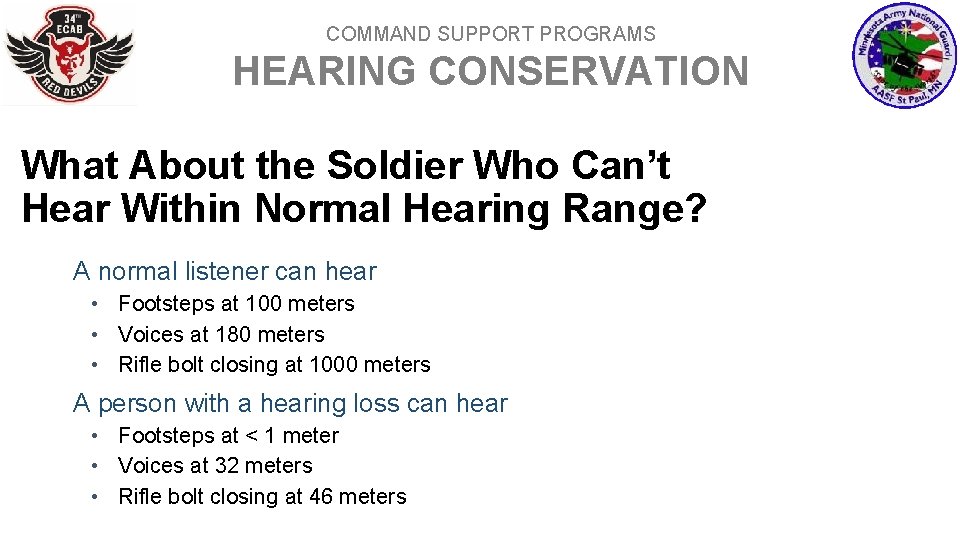
COMMAND SUPPORT PROGRAMS HEARING CONSERVATION What About the Soldier Who Can’t Hear Within Normal Hearing Range? A normal listener can hear • Footsteps at 100 meters • Voices at 180 meters • Rifle bolt closing at 1000 meters A person with a hearing loss can hear • Footsteps at < 1 meter • Voices at 32 meters • Rifle bolt closing at 46 meters
COMMAND SUPPORT PROGRAMS HEARING CONSERVATION If you are exposing yourself to hazardous noise levels unprotected… it’s not a matter of whether you will develop hearing loss but when you will develop hearing loss… the odds are VERY RARELY beaten. 17
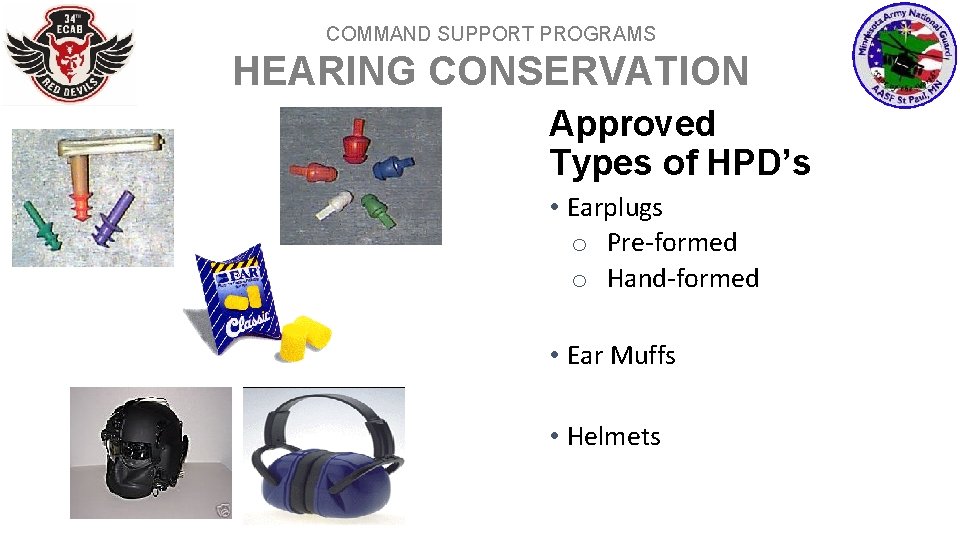
COMMAND SUPPORT PROGRAMS HEARING CONSERVATION Approved Types of HPD’s • Earplugs o Pre-formed o Hand-formed • Ear Muffs • Helmets
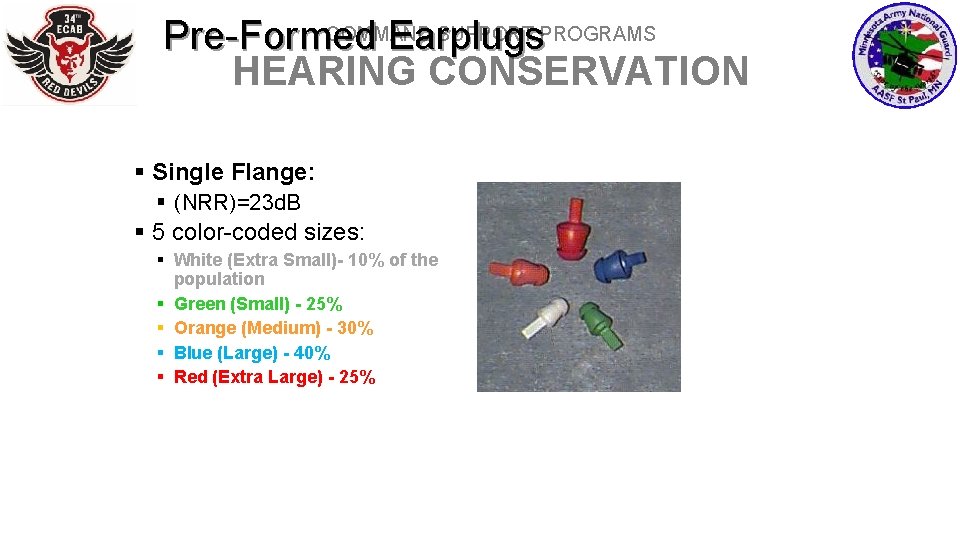
COMMAND SUPPORT PROGRAMS Pre-Formed Earplugs HEARING CONSERVATION § Single Flange: § (NRR)=23 d. B § 5 color-coded sizes: § White (Extra Small)- 10% of the population § Green (Small) - 25% § Orange (Medium) - 30% § Blue (Large) - 40% § Red (Extra Large) - 25%
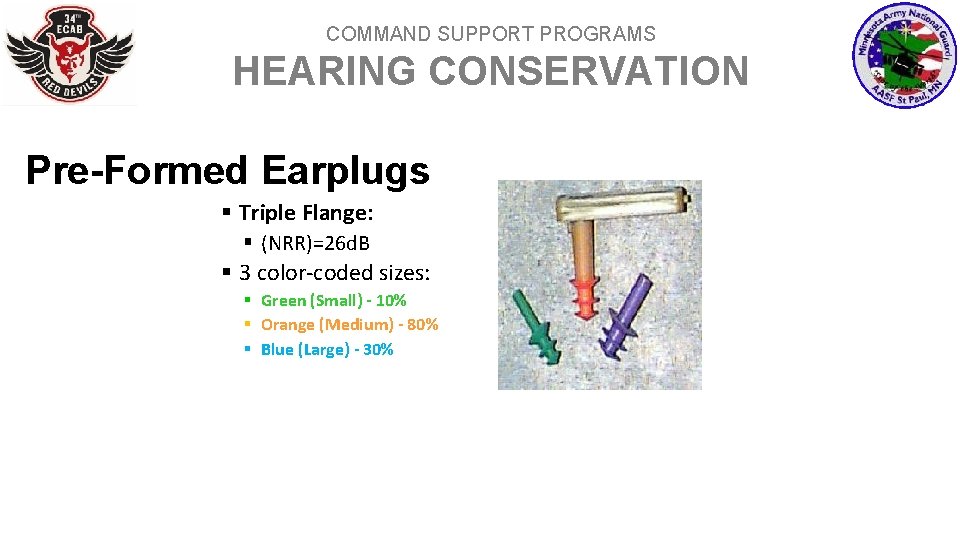
COMMAND SUPPORT PROGRAMS HEARING CONSERVATION Pre-Formed Earplugs § Triple Flange: § (NRR)=26 d. B § 3 color-coded sizes: § Green (Small) - 10% § Orange (Medium) - 80% § Blue (Large) - 30%
COMMAND SUPPORT PROGRAMS HEARING CONSERVATION Characteristics Of A Good Pre-formed Earplug Fit • Voices sound muffled. • “Vacuum” effect. • Comfortable. • Single flange tab facing toward back of ear. • Largest flange of triple flange is flush against ear canal opening.
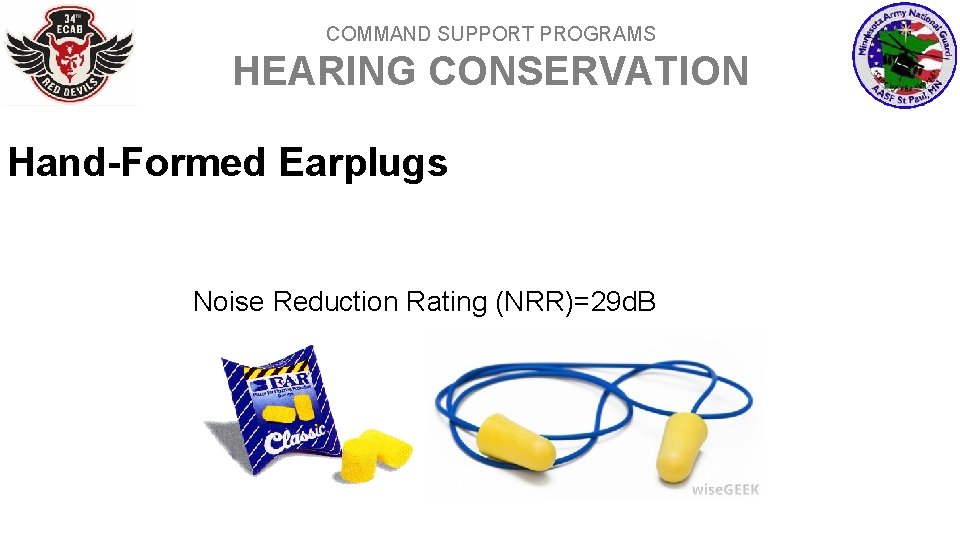
COMMAND SUPPORT PROGRAMS HEARING CONSERVATION Hand-Formed Earplugs Noise Reduction Rating (NRR)=29 d. B
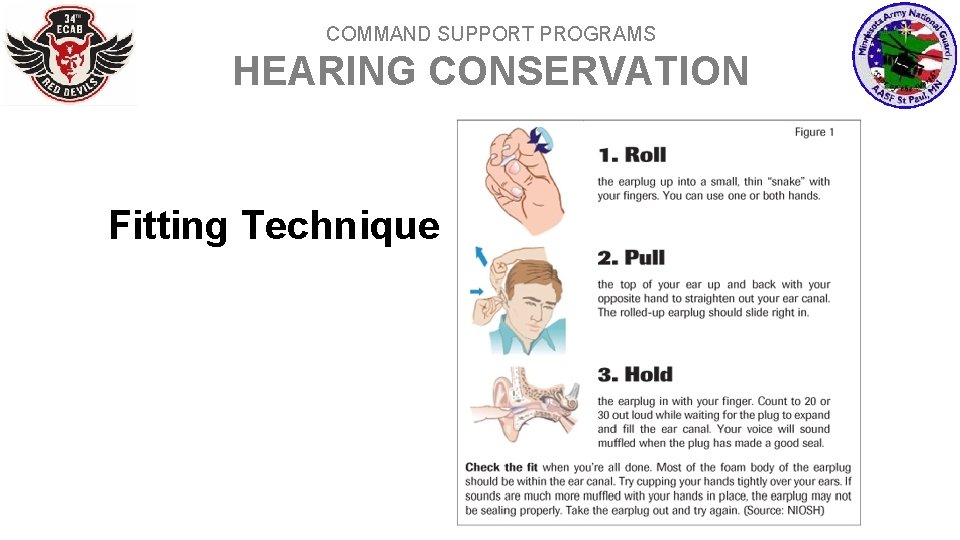
COMMAND SUPPORT PROGRAMS HEARING CONSERVATION Fitting Technique
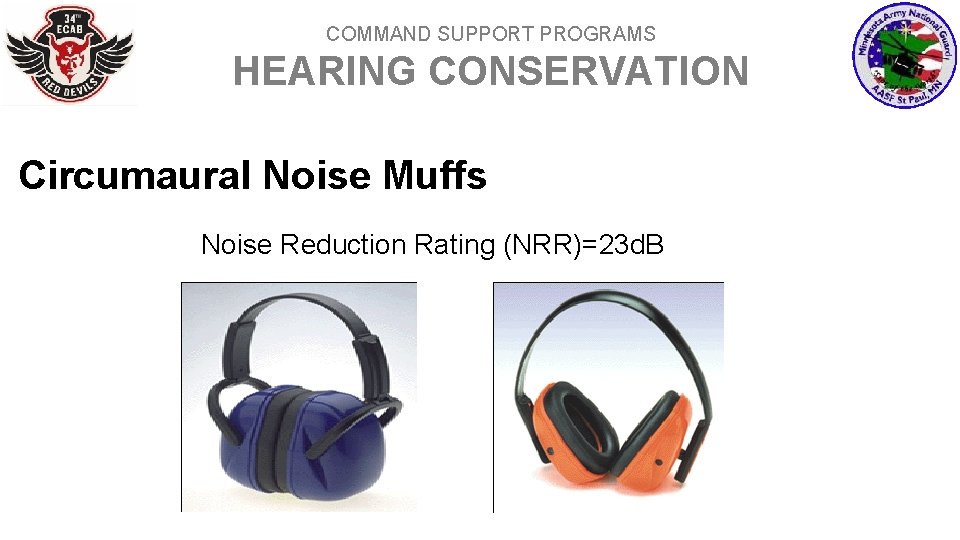
COMMAND SUPPORT PROGRAMS HEARING CONSERVATION Circumaural Noise Muffs Noise Reduction Rating (NRR)=23 d. B
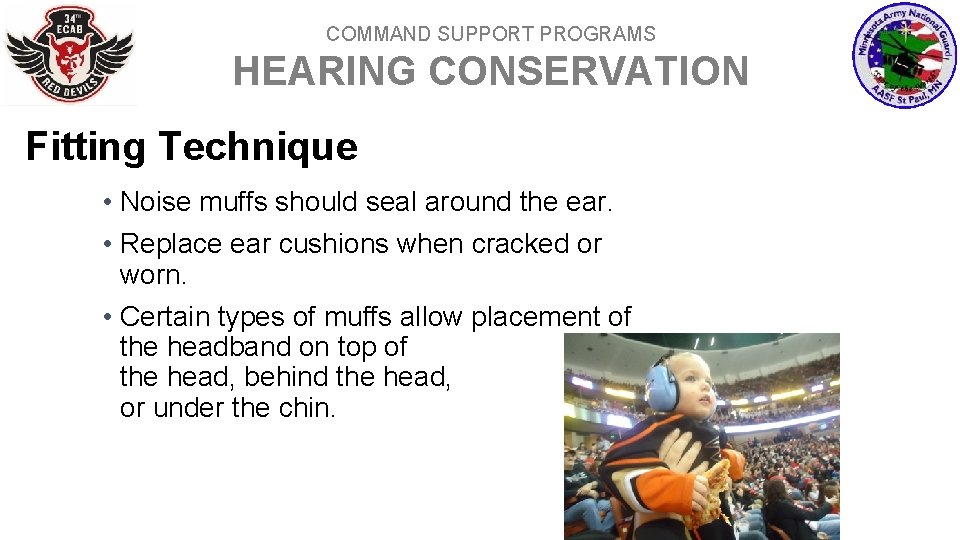
COMMAND SUPPORT PROGRAMS HEARING CONSERVATION Fitting Technique • Noise muffs should seal around the ear. • Replace ear cushions when cracked or worn. • Certain types of muffs allow placement of the headband on top of the head, behind the head, or under the chin.
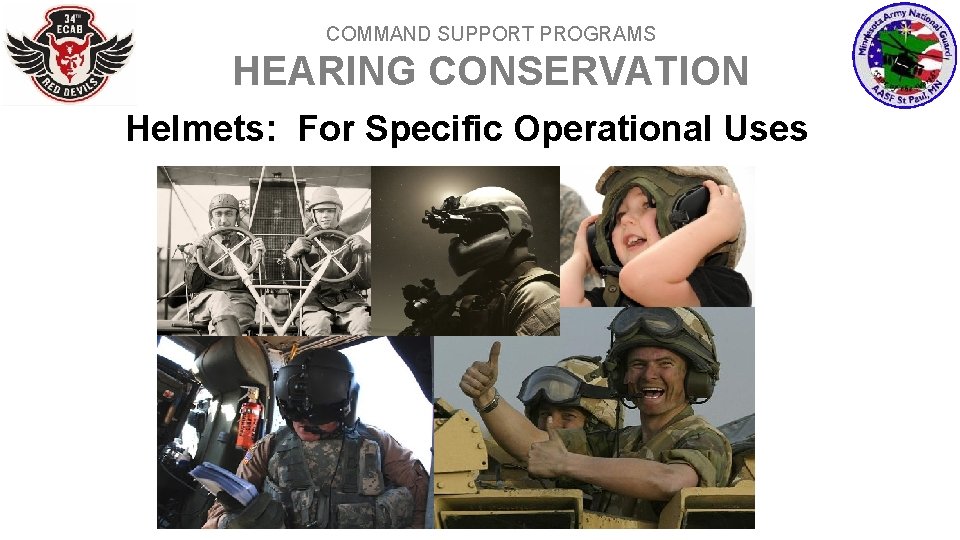
COMMAND SUPPORT PROGRAMS HEARING CONSERVATION Helmets: For Specific Operational Uses 26
COMMAND SUPPORT PROGRAMS HEARING CONSERVATION Care and Maintenance of all Hearing Protective Devices • Keep clean with mild soap and water and dry before using. • Replace when material hardens/cracks or does not clean. • Check for cracks on earphone seals, headband tension and replace as needed.
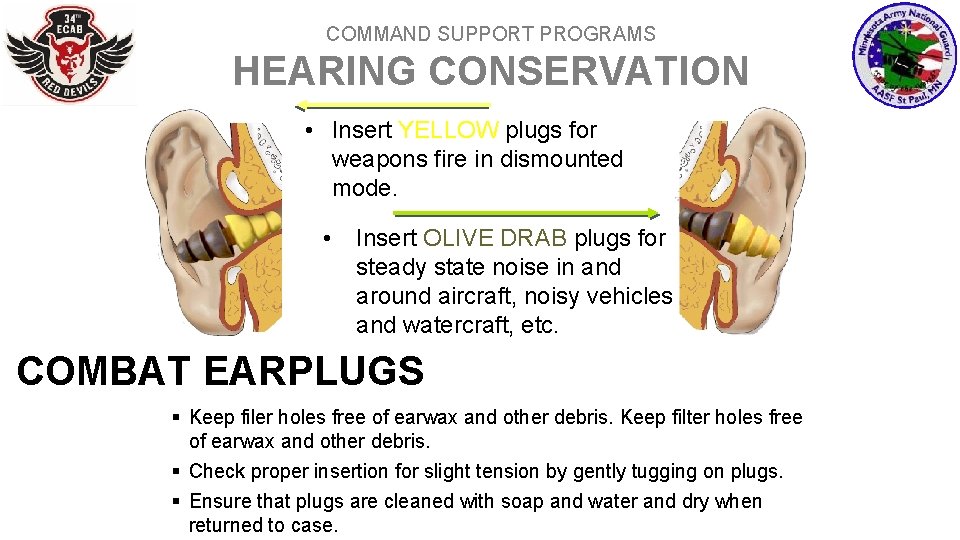
COMMAND SUPPORT PROGRAMS HEARING CONSERVATION • Insert YELLOW plugs for weapons fire in dismounted mode. • Insert OLIVE DRAB plugs for steady state noise in and around aircraft, noisy vehicles and watercraft, etc. COMBAT EARPLUGS § Keep filer holes free of earwax and other debris. Keep filter holes free of earwax and other debris. § Check proper insertion for slight tension by gently tugging on plugs. § Ensure that plugs are cleaned with soap and water and dry when returned to case.
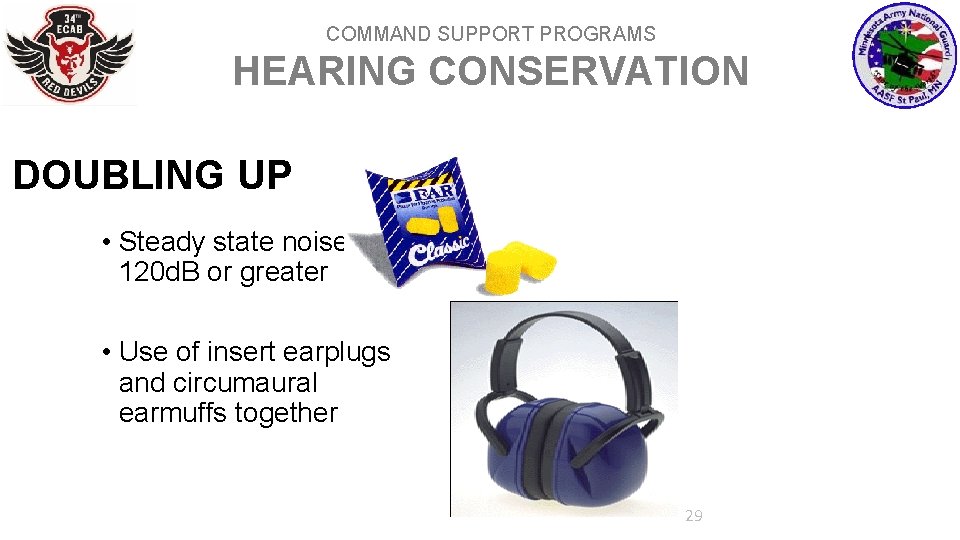
COMMAND SUPPORT PROGRAMS HEARING CONSERVATION DOUBLING UP • Steady state noises 120 d. B or greater • Use of insert earplugs and circumaural earmuffs together 29
COMMAND SUPPORT PROGRAMS HEARING CONSERVATION Administrative Controls Limit exposure time by implementing shift work schedules 30
COMMAND SUPPORT PROGRAMS HEARING CONSERVATION In Summary HEARING LOSS HAPPENS • Noise induced hearing loss is 100% preventable. • Your hearing health starts with YOU while at work or home. • If YOU don’t protect it, YOU will lose it