
Comma RulesGrammar Bell Work Introducer Use a comma
Comma Rules/Grammar Bell Work
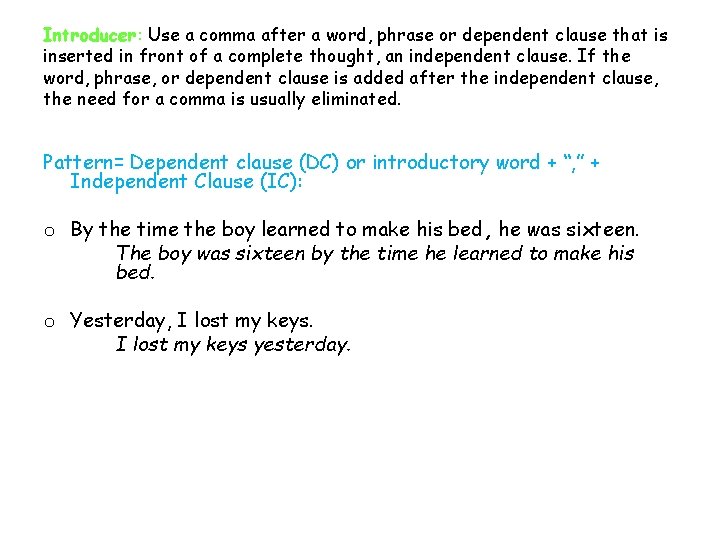
Introducer: Use a comma after a word, phrase or dependent clause that is inserted in front of a complete thought, an independent clause. If the word, phrase, or dependent clause is added after the independent clause, the need for a comma is usually eliminated. Pattern= Dependent clause (DC) or introductory word + “, ” + Independent Clause (IC): o By the time the boy learned to make his bed, he was sixteen. The boy was sixteen by the time he learned to make his bed. o Yesterday, I lost my keys yesterday.
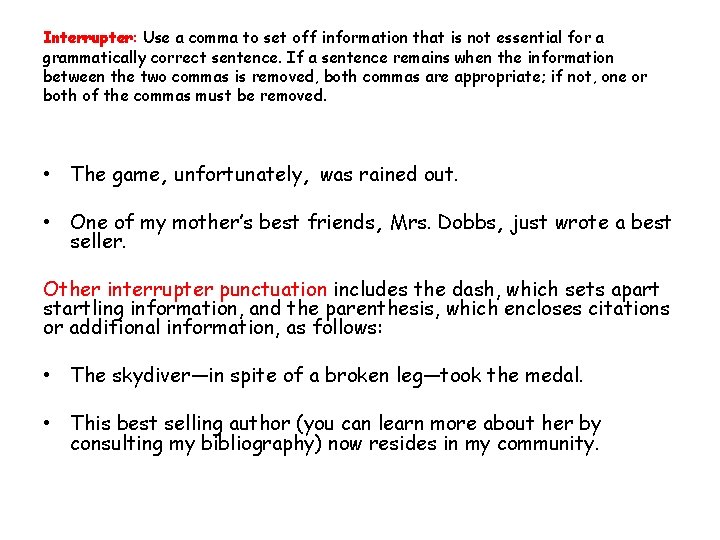
Interrupter: Use a comma to set off information that is not essential for a grammatically correct sentence. If a sentence remains when the information between the two commas is removed, both commas are appropriate; if not, one or both of the commas must be removed. • The game, unfortunately, was rained out. • One of my mother’s best friends, Mrs. Dobbs, just wrote a best seller. Other interrupter punctuation includes the dash, which sets apart startling information, and the parenthesis, which encloses citations or additional information, as follows: • The skydiver—in spite of a broken leg—took the medal. • This best selling author (you can learn more about her by consulting my bibliography) now resides in my community.
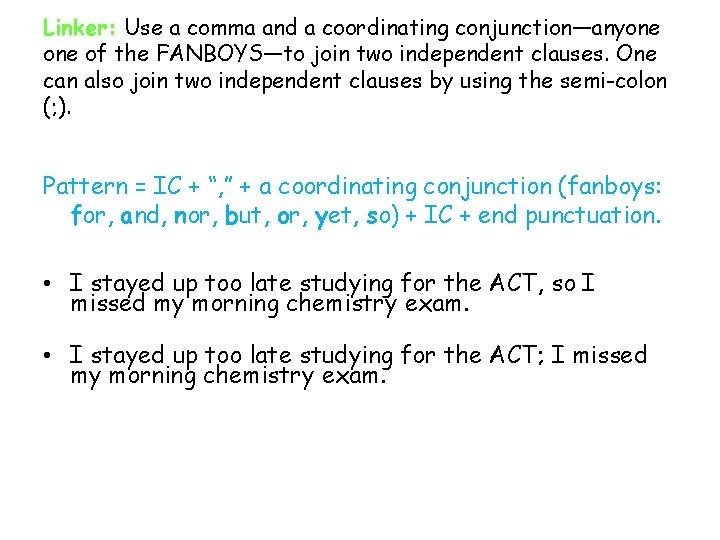
Linker: Use a comma and a coordinating conjunction—anyone of the FANBOYS—to join two independent clauses. One can also join two independent clauses by using the semi-colon (; ). Pattern = IC + “, ” + a coordinating conjunction (fanboys: for, and, nor, but, or, yet, so) + IC + end punctuation. • I stayed up too late studying for the ACT, so I missed my morning chemistry exam. • I stayed up too late studying for the ACT; I missed my morning chemistry exam.
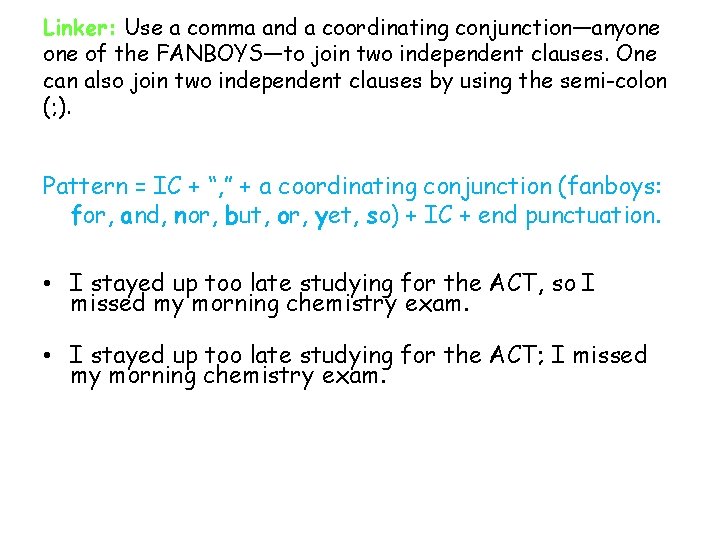
Linker: Use a comma and a coordinating conjunction—anyone of the FANBOYS—to join two independent clauses. One can also join two independent clauses by using the semi-colon (; ). Pattern = IC + “, ” + a coordinating conjunction (fanboys: for, and, nor, but, or, yet, so) + IC + end punctuation. • I stayed up too late studying for the ACT, so I missed my morning chemistry exam. • I stayed up too late studying for the ACT; I missed my morning chemistry exam.
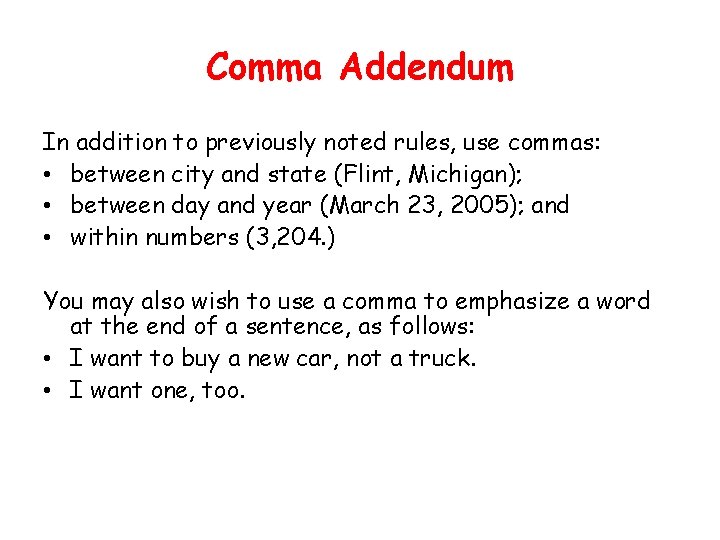
Comma Addendum In addition to previously noted rules, use commas: • between city and state (Flint, Michigan); • between day and year (March 23, 2005); and • within numbers (3, 204. ) You may also wish to use a comma to emphasize a word at the end of a sentence, as follows: • I want to buy a new car, not a truck. • I want one, too.
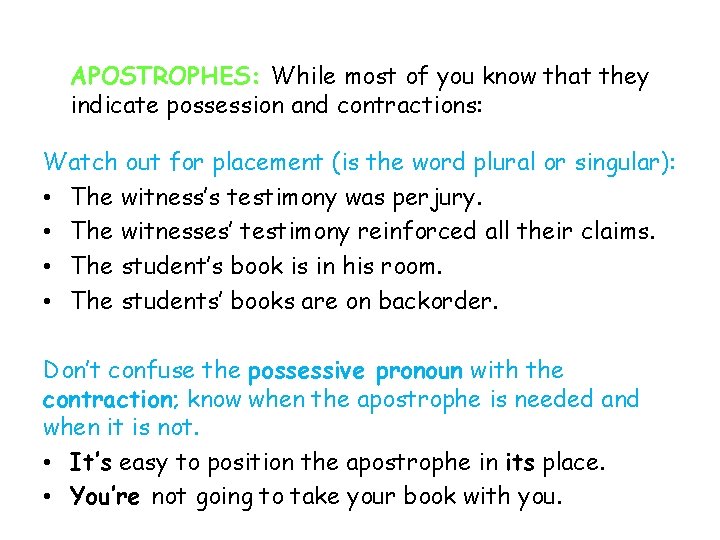
APOSTROPHES: While most of you know that they indicate possession and contractions: Watch out for placement (is the word plural or singular): • The witness’s testimony was perjury. • The witnesses’ testimony reinforced all their claims. • The student’s book is in his room. • The students’ books are on backorder. Don’t confuse the possessive pronoun with the contraction; know when the apostrophe is needed and when it is not. • It’s easy to position the apostrophe in its place. • You’re not going to take your book with you.
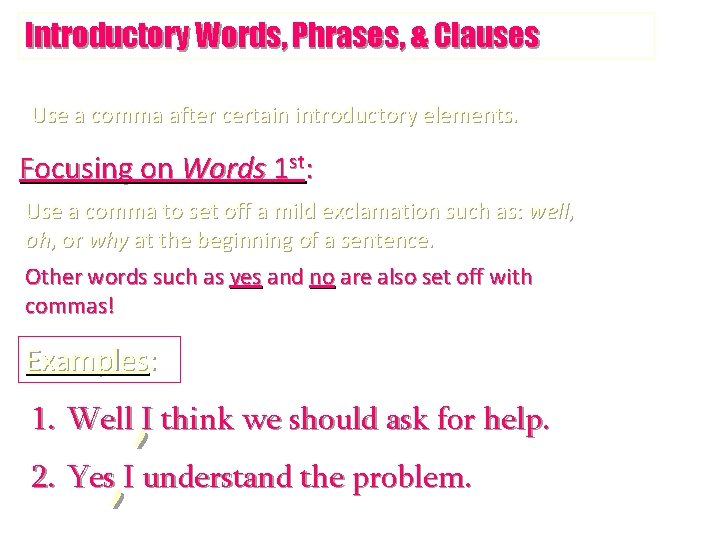
Introductory Words, Phrases, & Clauses Use a comma after certain introductory elements. Focusing on Words 1 st: Use a comma to set off a mild exclamation such as: well, oh, or why at the beginning of a sentence. Other words such as yes and no are also set off with commas! Examples: , 1. Well I think we should ask for help. , 2. Yes I understand the problem.
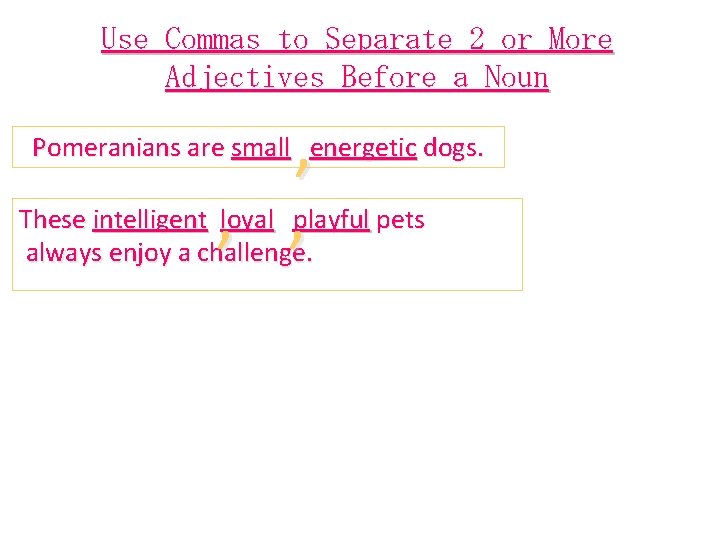
Use Commas to Separate 2 or More Adjectives Before a Noun , , , Pomeranians are small energetic dogs. These intelligent loyal playful pets always enjoy a challenge.
- Slides: 9