
COMFORT Communication narrative Orientation and opportunity Mindful presence


- Slides: 17
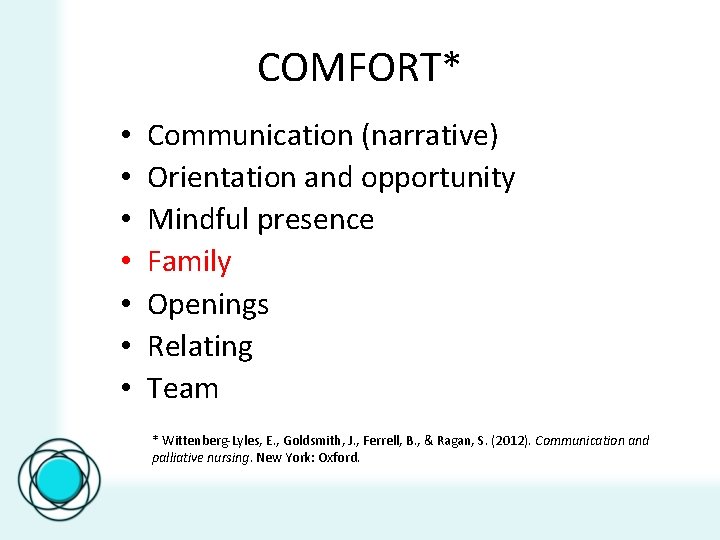
COMFORT* • • Communication (narrative) Orientation and opportunity Mindful presence Family Openings Relating Team * Wittenberg-Lyles, E. , Goldsmith, J. , Ferrell, B. , & Ragan, S. (2012). Communication and palliative nursing. New York: Oxford.
Objectives • Describe a typology of family caregivers from a communication perspective • Identify two communication skills that could be used with family caregivers
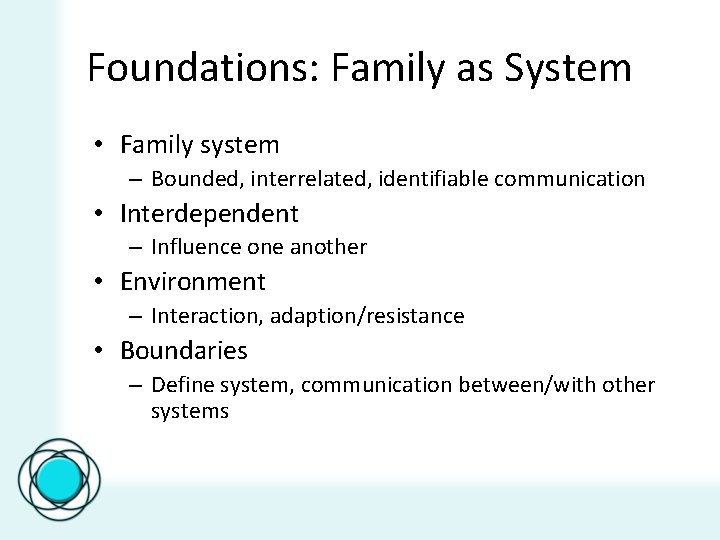
Foundations: Family as System • Family system – Bounded, interrelated, identifiable communication • Interdependent – Influence one another • Environment – Interaction, adaption/resistance • Boundaries – Define system, communication between/with other systems
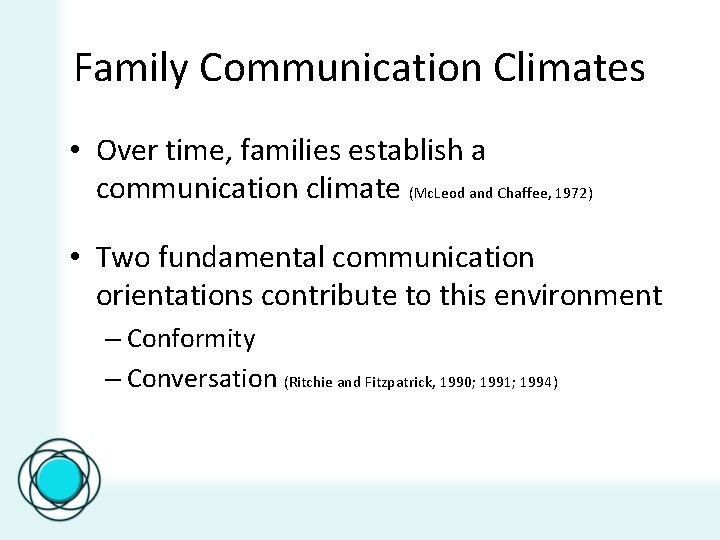
Family Communication Climates • Over time, families establish a communication climate (Mc. Leod and Chaffee, 1972) • Two fundamental communication orientations contribute to this environment – Conformity – Conversation (Ritchie and Fitzpatrick, 1990; 1991; 1994)
Conversation Orientation • Degree to which all family: – Are encouraged to participate freely – Are encouraged to participate frequently – Are encouraged to participate without time limits – Are encouraged to participate without topic limits
Conformity Orientation • Degree to which all family – Stresses homogeneity of attitudes – Stresses homogeneity of beliefs – Stresses homogeneity of values – Stresses fixed family roles
Caregiver Type: Manager High family conformity/High family conversation • Caregiver dominates care planning • Caregiver as self-appointed Family Spokesperson • Caregiver controls decision-making • Context of illness exaggerates: – Limited communication within/by family – Lack of diversity in perspectives about illness – Obligation to conform in family
Things to look for* • Direct blocked communication – Hang up phone – Refuse to answer – Agree not to talk about illness • Indirect blocked communication – Not responsive – Appear uncomfortable – Self-censored speech *Kenen, R. , Ardern-Jones, A. , & Eeles, 2004
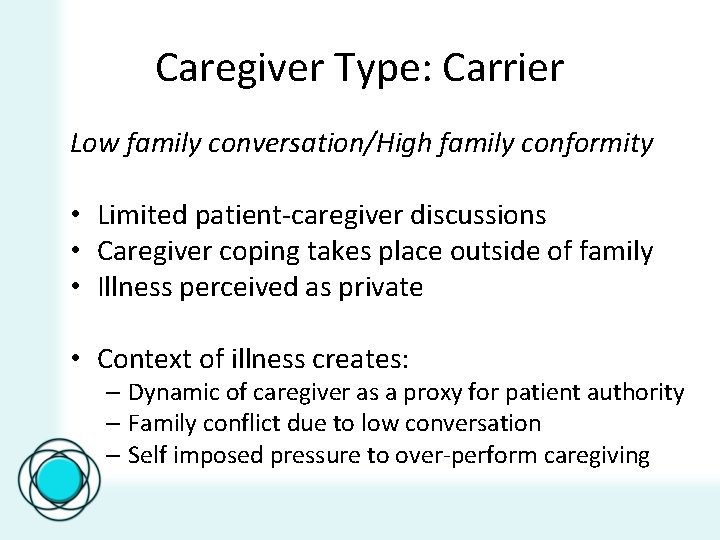
Caregiver Type: Carrier Low family conversation/High family conformity • Limited patient-caregiver discussions • Caregiver coping takes place outside of family • Illness perceived as private • Context of illness creates: – Dynamic of caregiver as a proxy for patient authority – Family conflict due to low conversation – Self imposed pressure to over-perform caregiving
Understand family coping style • Could you give an example of a difficulty your family has faced when you were growing up? • What helped your family get through this? • What was tried that did not help?
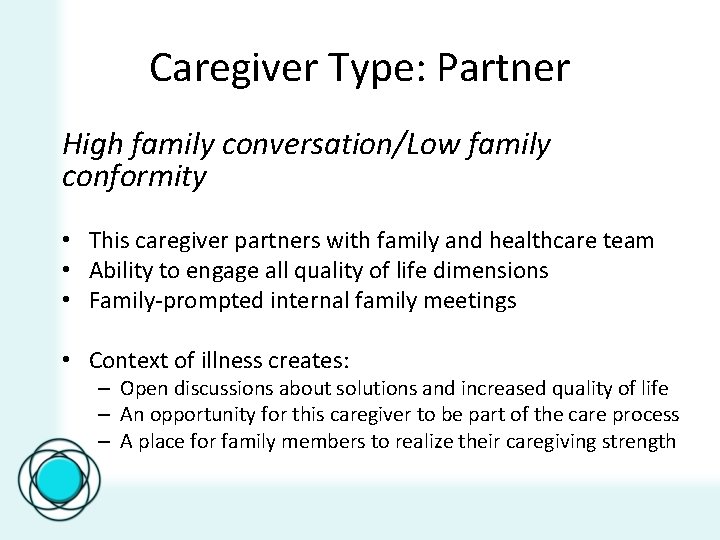
Caregiver Type: Partner High family conversation/Low family conformity • This caregiver partners with family and healthcare team • Ability to engage all quality of life dimensions • Family-prompted internal family meetings • Context of illness creates: – Open discussions about solutions and increased quality of life – An opportunity for this caregiver to be part of the care process – A place for family members to realize their caregiving strength
Assess family stressors • What else is going on in your family’s life? • What has helped you in dealing with these stressors? • What has not been helpful?
Caregiver Type: Loner Low family conversation/Low family conformity • A focus on one dimension of quality of life • Experiences caregiving as one acute crisis after the next • Can feel like a constant outsider to team and family • Context of illness creates: – Further isolation for patient, caregiver, and family – Unrelenting caregiver burden – Conflicts for healthcare team and system
Assessing family relationships • Tell me about your family. • Who is close to whom?
Team-based Family Care • Managers – Moderate family communication • Carriers – Encourage self-care – Mediate patient-caregiver communication • Partners – Establish clear routine – Educate about home care/pain meds • Loners – Provide assistance in information seeking – Spiritual care/counseling