
COMETS METEORITES Outline 1 Origin and Structure of

- Slides: 50
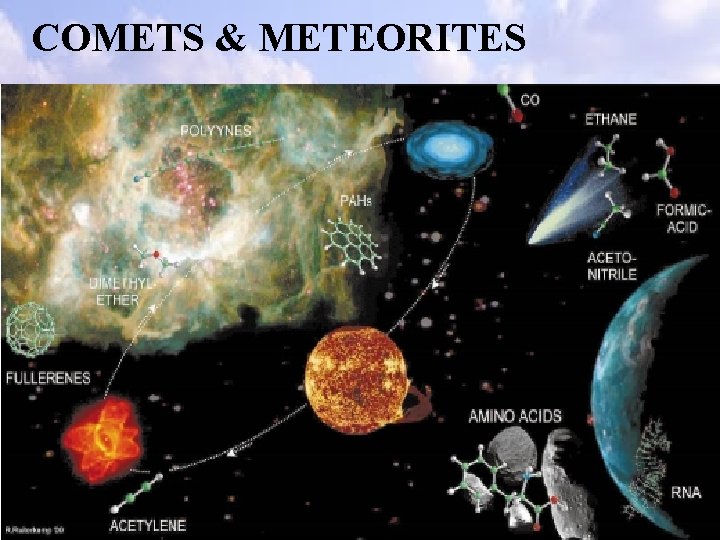
COMETS & METEORITES
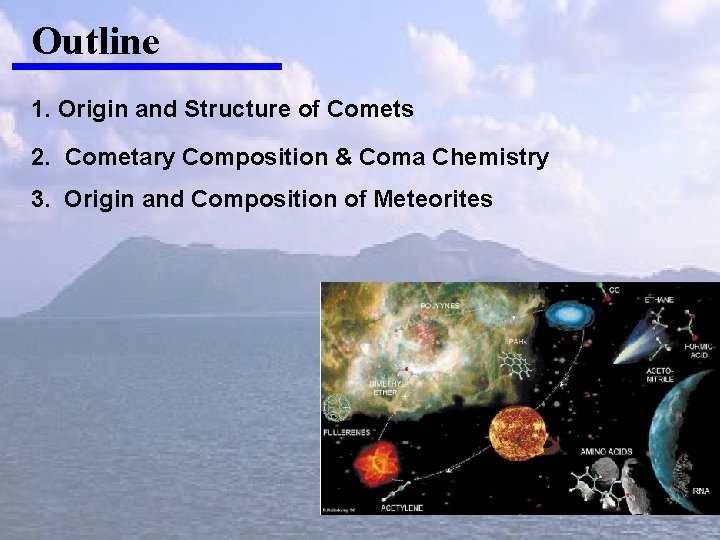
Outline 1. Origin and Structure of Comets 2. Cometary Composition & Coma Chemistry 3. Origin and Composition of Meteorites
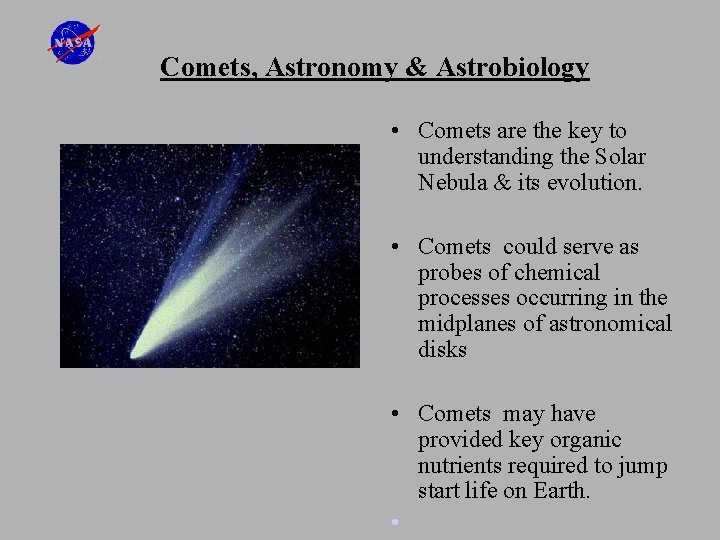
Comets, Astronomy & Astrobiology • Comets are the key to understanding the Solar Nebula & its evolution. • Comets could serve as probes of chemical processes occurring in the midplanes of astronomical disks • Comets may have provided key organic nutrients required to jump start life on Earth. •
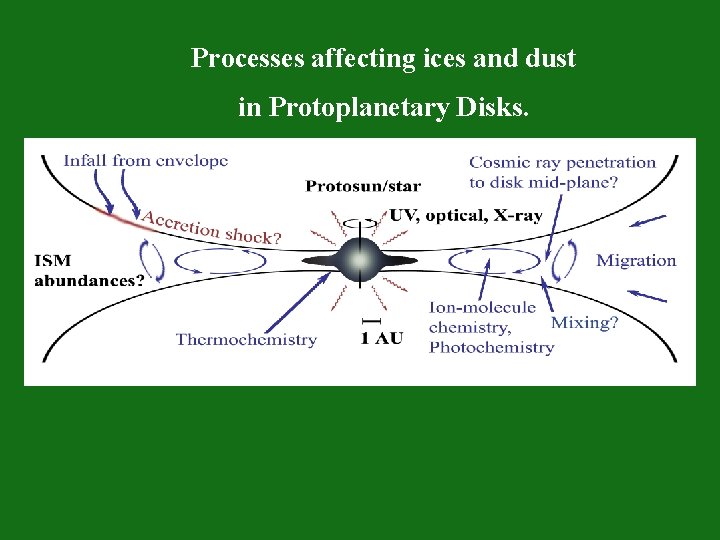
Processes affecting ices and dust in Protoplanetary Disks.
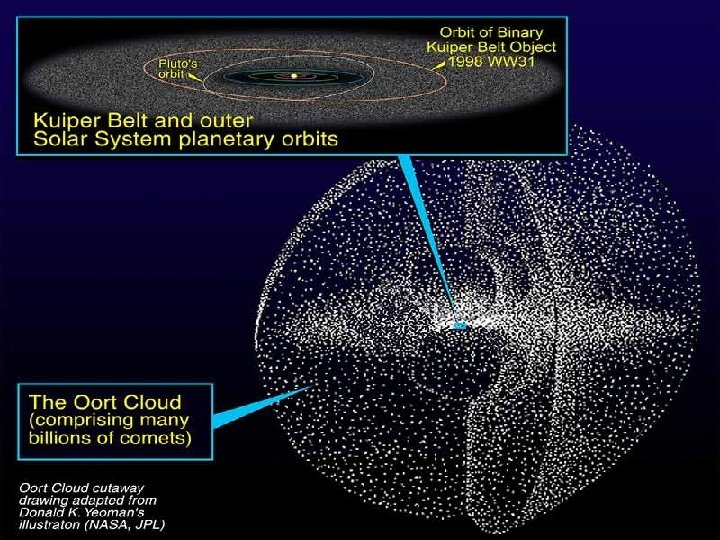
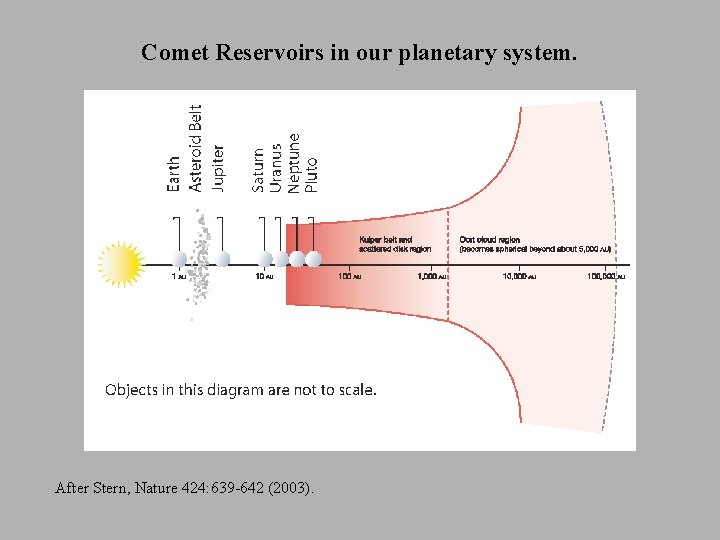
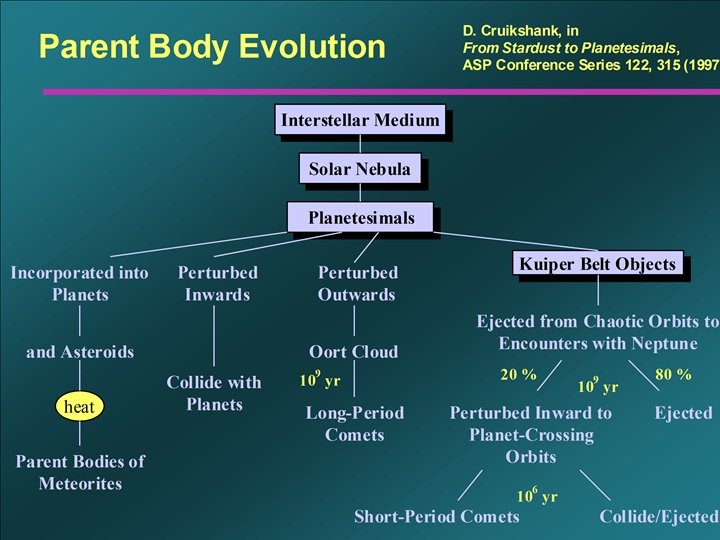
Comet Reservoirs in our planetary system. After Stern, Nature 424: 639 -642 (2003).
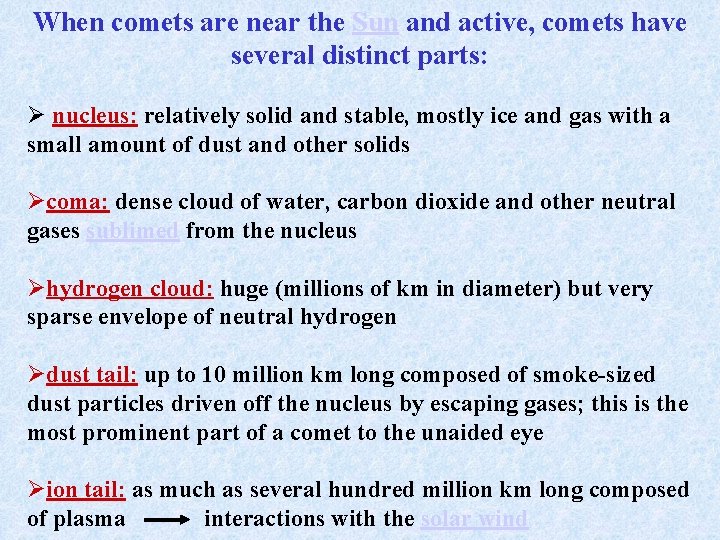
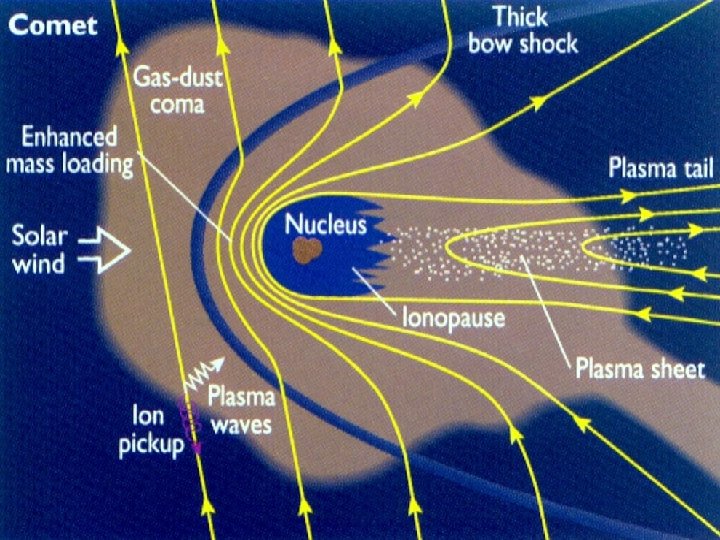
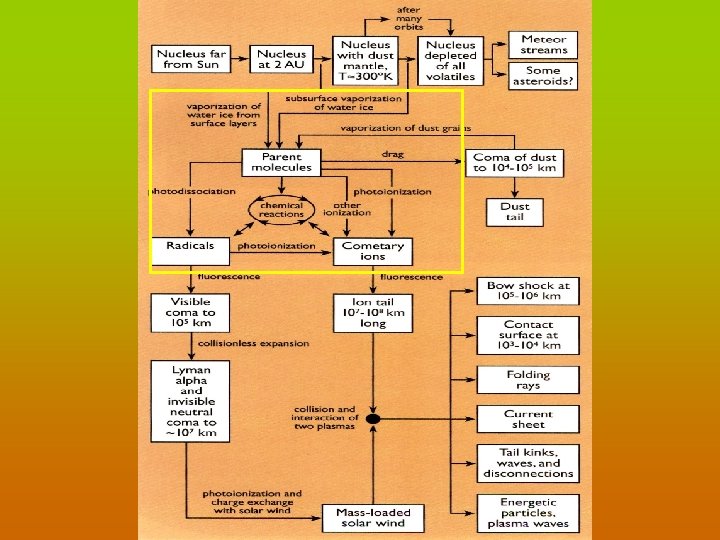
When comets are near the Sun and active, comets have several distinct parts: Ø nucleus: relatively solid and stable, mostly ice and gas with a small amount of dust and other solids Øcoma: dense cloud of water, carbon dioxide and other neutral gases sublimed from the nucleus Øhydrogen cloud: huge (millions of km in diameter) but very sparse envelope of neutral hydrogen Ødust tail: up to 10 million km long composed of smoke-sized dust particles driven off the nucleus by escaping gases; this is the most prominent part of a comet to the unaided eye Øion tail: as much as several hundred million km long composed of plasma interactions with the solar wind
Major Comet Structures HI CLOUD ION TAIL NUCLEUS COMA
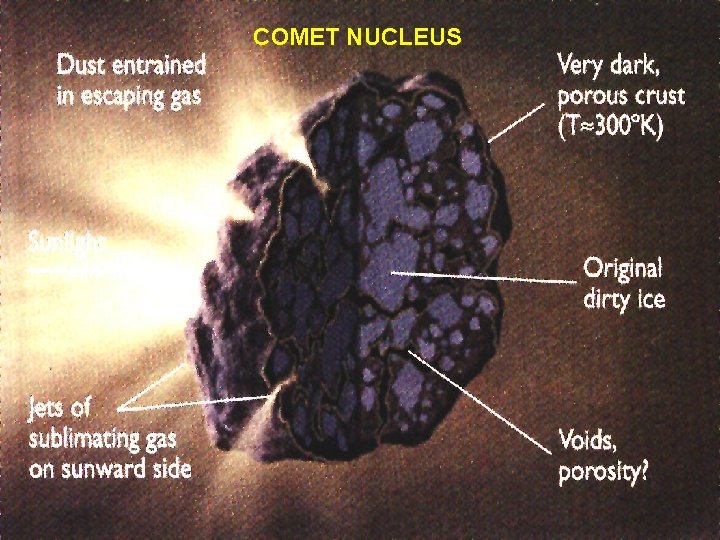
COMET NUCLEUS
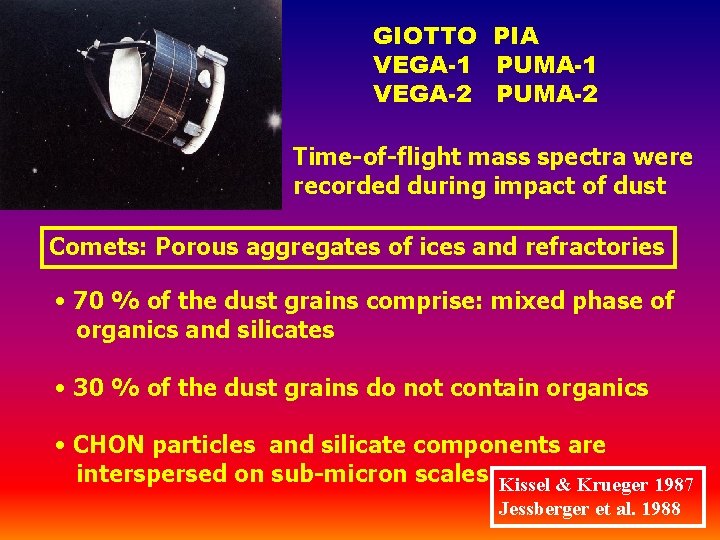
GIOTTO PIA VEGA-1 PUMA-1 VEGA-2 PUMA-2 Time-of-flight mass spectra were recorded during impact of dust Comets: Porous aggregates of ices and refractories • 70 % of the dust grains comprise: mixed phase of organics and silicates • 30 % of the dust grains do not contain organics • CHON particles and silicate components are interspersed on sub-micron scales Kissel & Krueger 1987 Jessberger et al. 1988
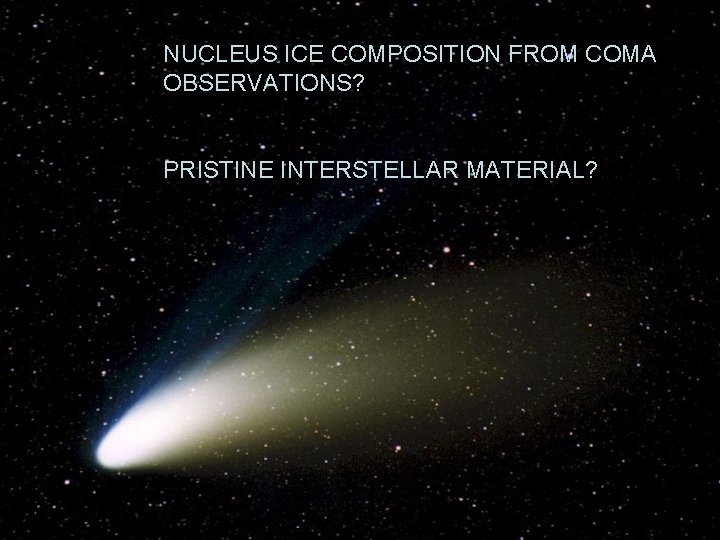
NUCLEUS ICE COMPOSITION FROM COMA OBSERVATIONS? PRISTINE INTERSTELLAR MATERIAL?
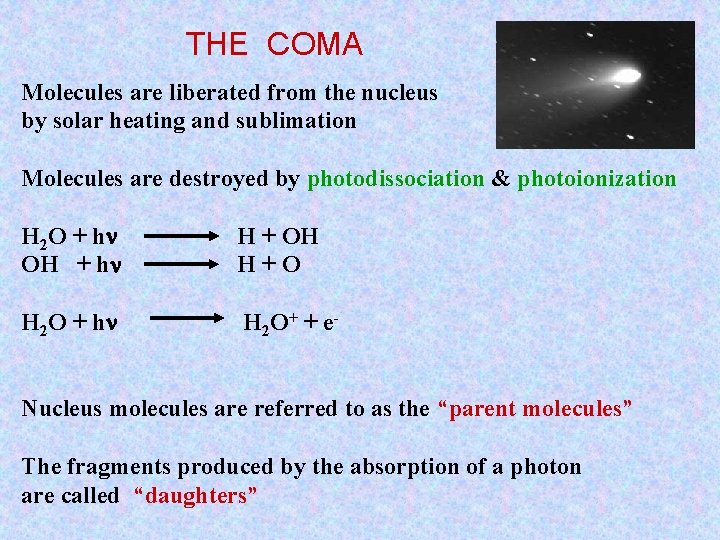
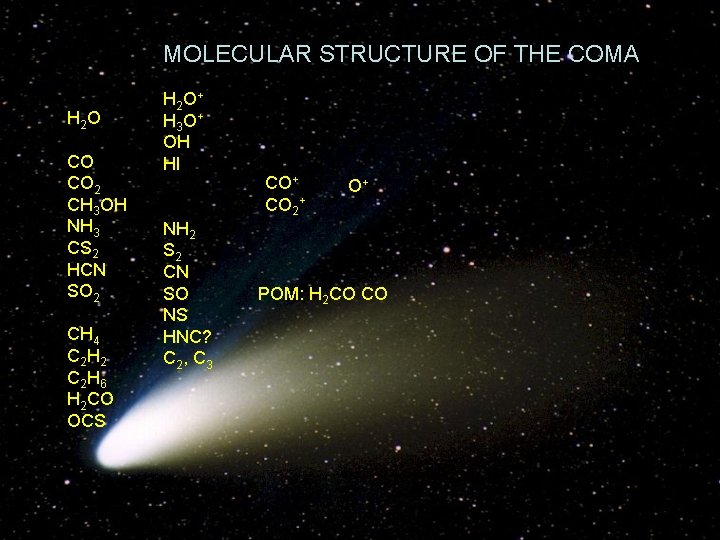
THE COMA Molecules are liberated from the nucleus by solar heating and sublimation Molecules are destroyed by photodissociation & photoionization H 2 O + hn OH + hn H + OH H+O H 2 O + hn H 2 O+ + e- Nucleus molecules are referred to as the “parent molecules” The fragments produced by the absorption of a photon are called “daughters”
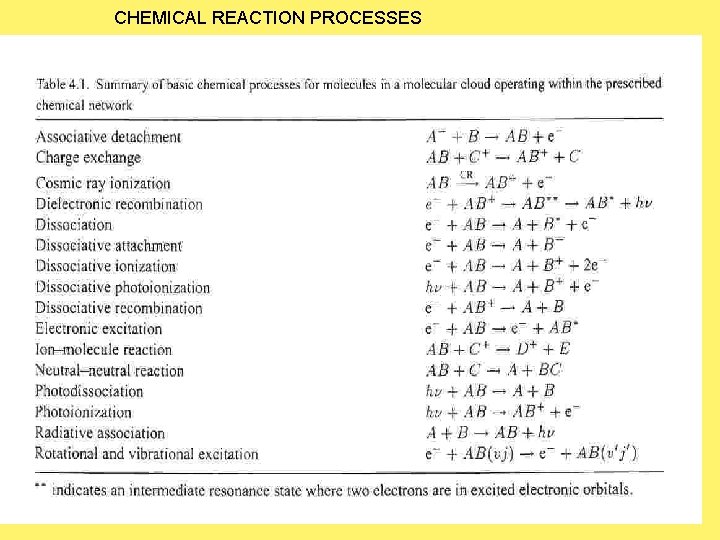
CHEMICAL REACTION PROCESSES
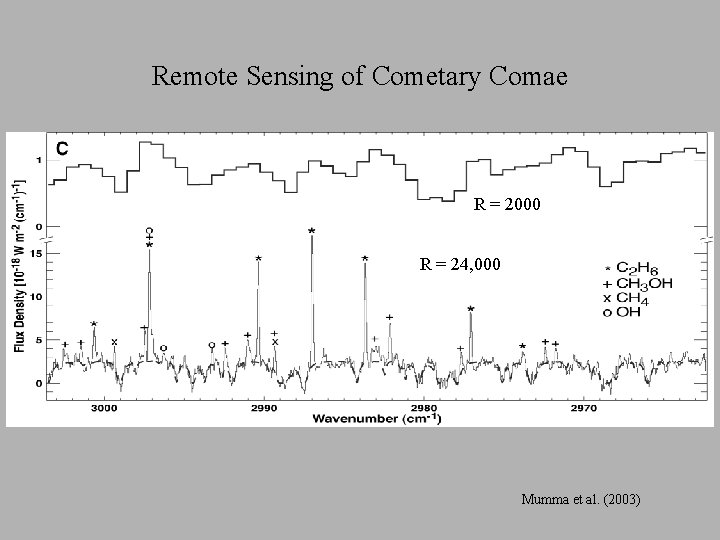
Remote Sensing of Cometary Comae R = 2000 R = 24, 000 Mumma et al. (2003)
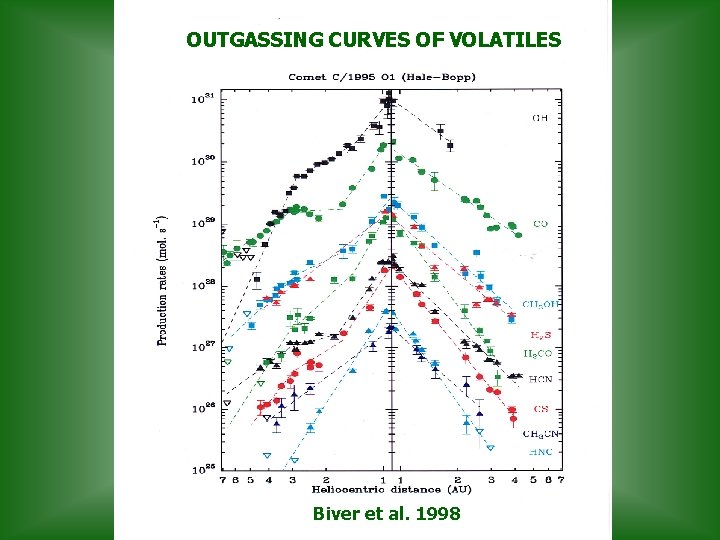
OUTGASSING CURVES OF VOLATILES Biver et al. 1998
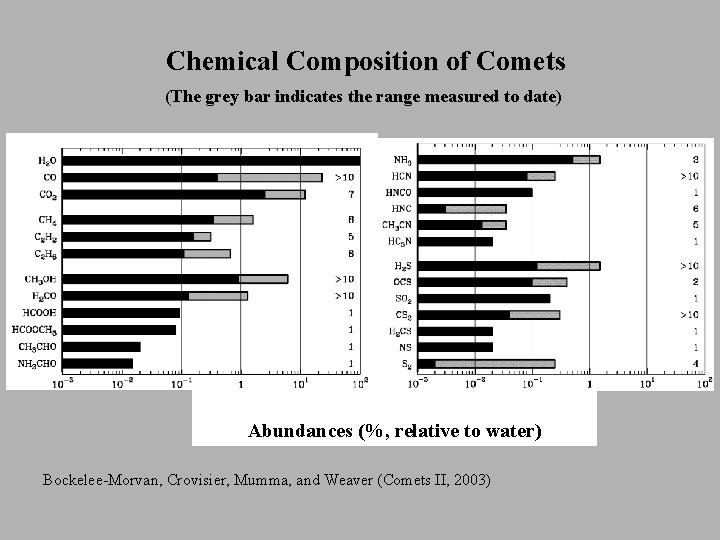
Chemical Composition of Comets (The grey bar indicates the range measured to date) Abundances (%, relative to water) Bockelee-Morvan, Crovisier, Mumma, and Weaver (Comets II, 2003)
MOLECULAR STRUCTURE OF THE COMA H 2 O CO CO 2 CH 3 OH NH 3 CS 2 HCN SO 2 CH 4 C 2 H 2 C 2 H 6 H 2 CO OCS H 2 O + H 3 O + OH HI NH 2 S 2 CN SO NS HNC? C 2 , C 3 CO+ CO 2+ O+ POM: H 2 CO CO
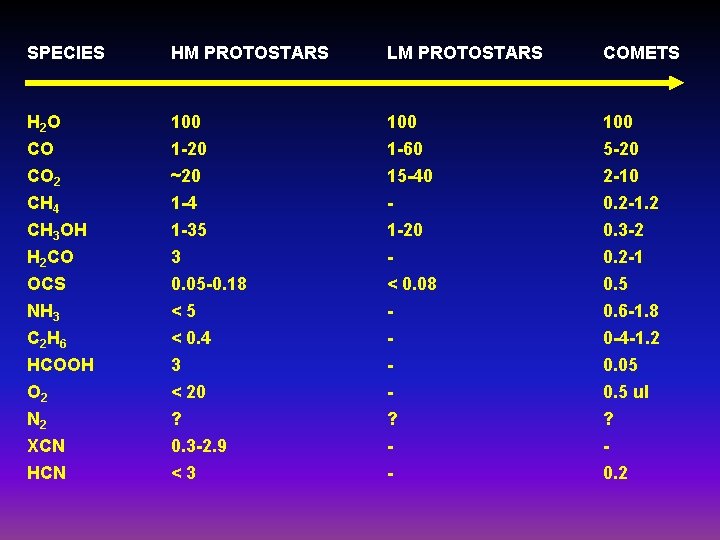
SPECIES HM PROTOSTARS LM PROTOSTARS COMETS H 2 O CO 100 1 -20 100 1 -60 100 5 -20 CO 2 CH 4 CH 3 OH H 2 CO OCS NH 3 C 2 H 6 HCOOH O 2 N 2 XCN HCN ~20 1 -4 1 -35 3 0. 05 -0. 18 <5 < 0. 4 3 < 20 ? 0. 3 -2. 9 <3 15 -40 1 -20 < 0. 08 ? - 2 -10 0. 2 -1. 2 0. 3 -2 0. 2 -1 0. 5 0. 6 -1. 8 0 -4 -1. 2 0. 05 0. 5 ul ? 0. 2
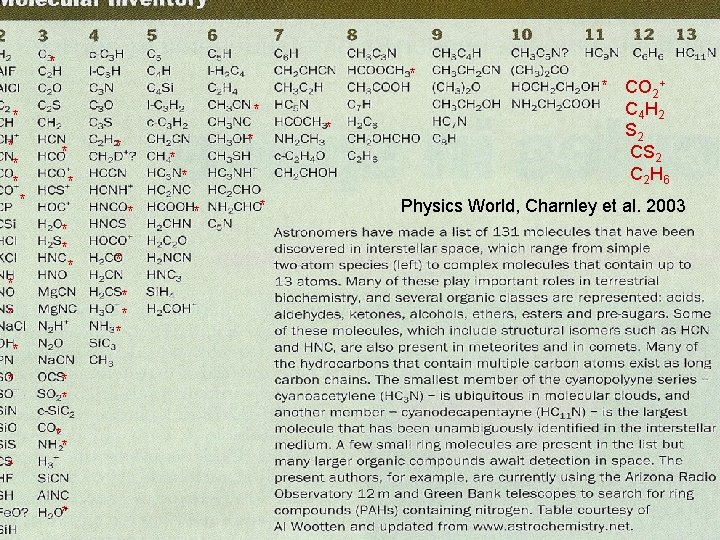
* * * * * * * * * CO 2+ C 4 H 2 S 2 C 2 H 6 Physics World, Charnley et al. 2003 *
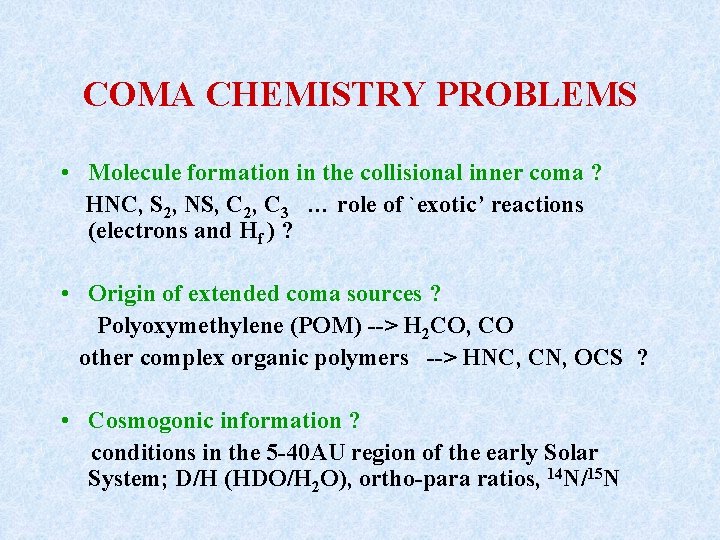
COMA CHEMISTRY PROBLEMS • Molecule formation in the collisional inner coma ? HNC, S 2, NS, C 2, C 3 … role of `exotic’ reactions (electrons and Hf ) ? • Origin of extended coma sources ? Polyoxymethylene (POM) --> H 2 CO, CO other complex organic polymers --> HNC, CN, OCS ? • Cosmogonic information ? conditions in the 5 -40 AU region of the early Solar System; D/H (HDO/H 2 O), ortho-para ratios, 14 N/15 N
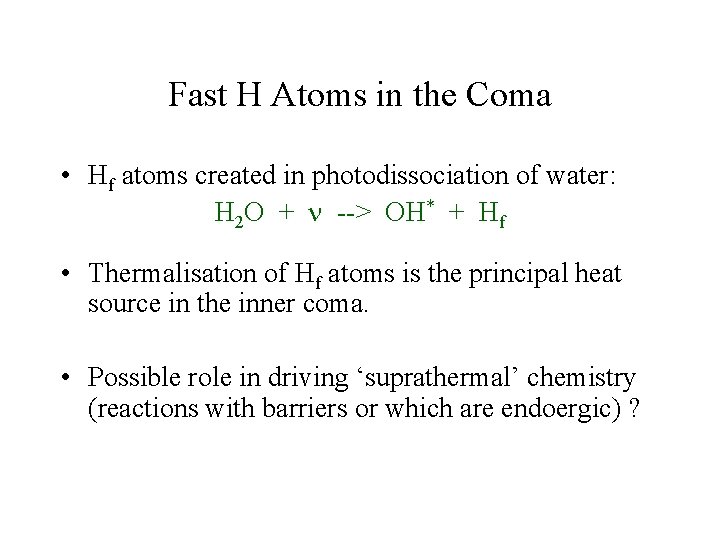
Fast H Atoms in the Coma • Hf atoms created in photodissociation of water: H 2 O + --> OH* + Hf • Thermalisation of Hf atoms is the principal heat source in the inner coma. • Possible role in driving ‘suprathermal’ chemistry (reactions with barriers or which are endoergic) ?
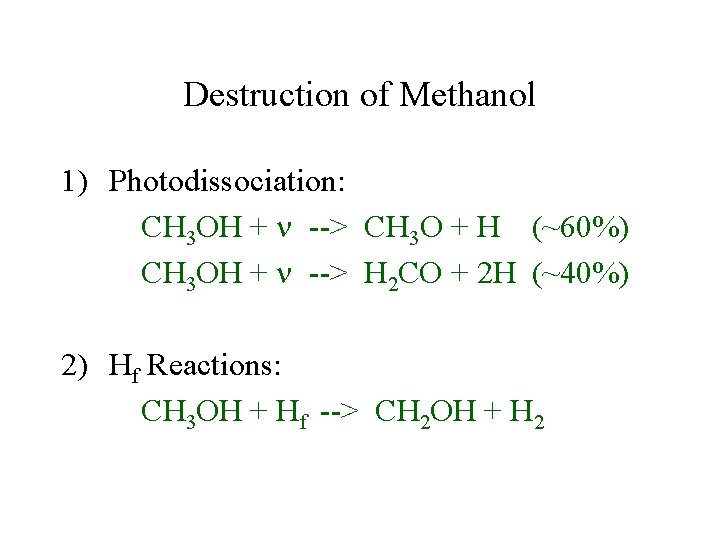
Destruction of Methanol 1) Photodissociation: CH 3 OH + --> CH 3 O + H (~60%) CH 3 OH + --> H 2 CO + 2 H (~40%) 2) Hf Reactions: CH 3 OH + Hf --> CH 2 OH + H 2
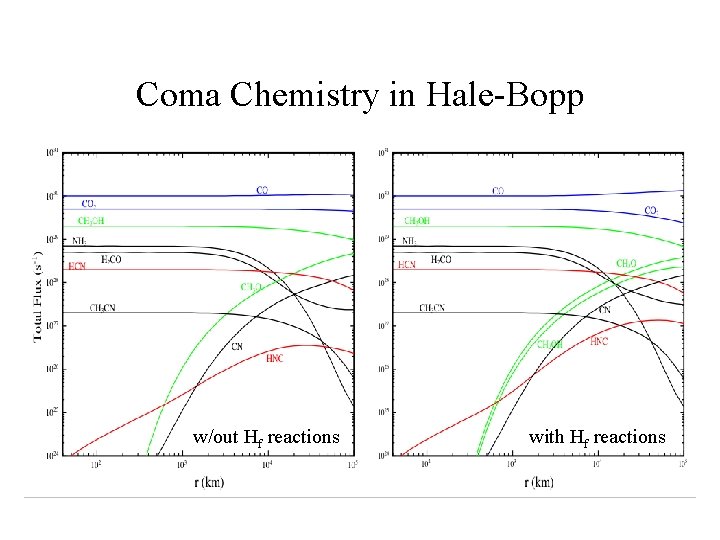
Coma Chemistry in Hale-Bopp w/out Hf reactions with Hf reactions
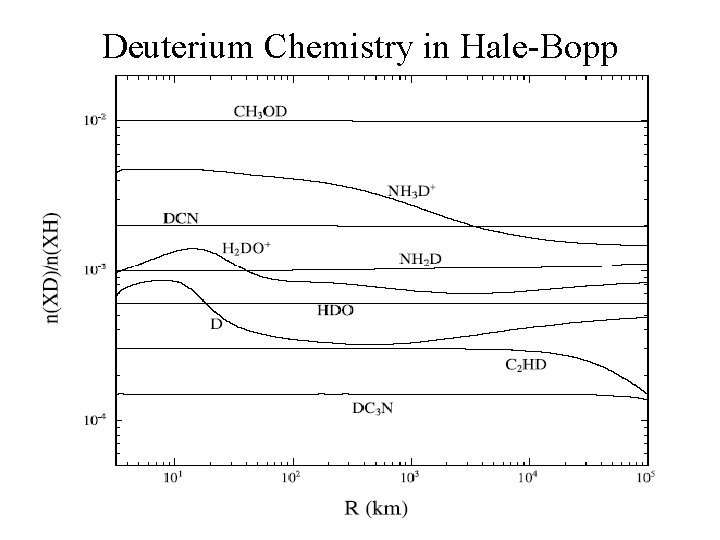
Deuterium Chemistry in Hale-Bopp
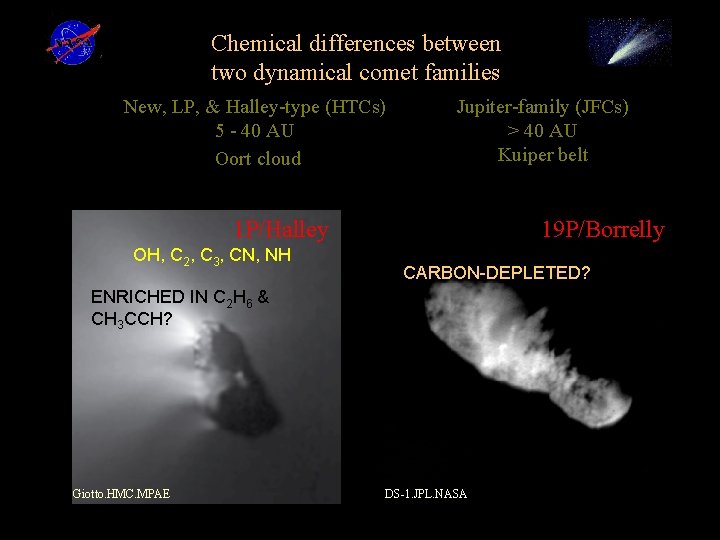
Chemical differences between two dynamical comet families Type: New, LP, & Halley-type (HTCs) Formed: 5 - 40 AU Reservoir: Oort cloud Orbit: Jupiter-family (JFCs) > 40 AU Kuiper belt 1 P/Halley OH, C 2, C 3, CN, NH 19 P/Borrelly CARBON-DEPLETED? ENRICHED IN C 2 H 6 & CH 3 CCH? Giotto. HMC. MPAE DS-1. JPL. NASA mumma_JWST_051203. 27 mumma. 061203. 27
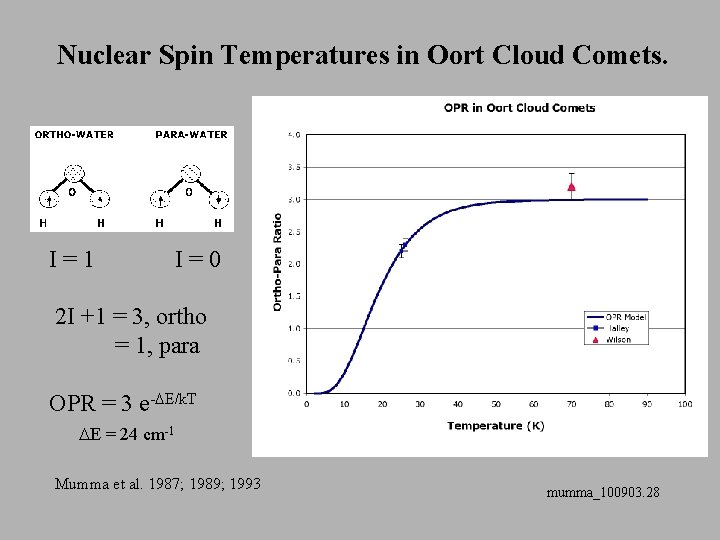
Nuclear Spin Temperatures in Oort Cloud Comets. I=1 I=0 2 I +1 = 3, ortho = 1, para OPR = 3 e-DE/k. T DE = 24 cm-1 Mumma et al. 1987; 1989; 1993 mumma_100903. 28
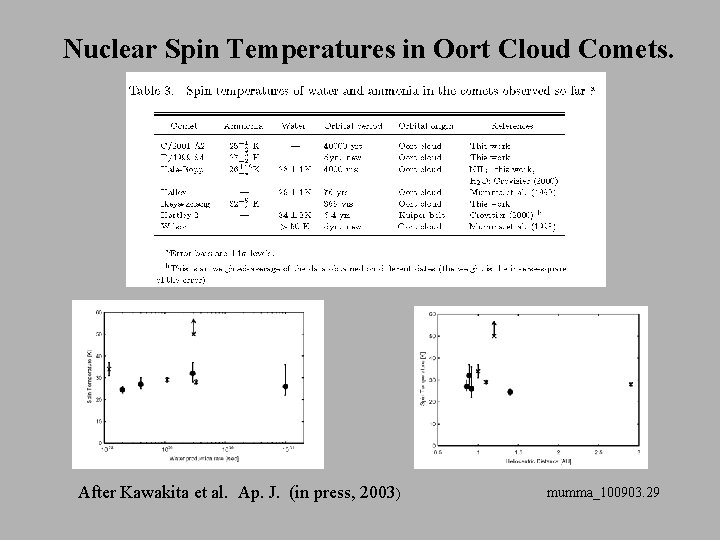
Nuclear Spin Temperatures in Oort Cloud Comets. After Kawakita et al. Ap. J. (in press, 2003) mumma_100903. 29
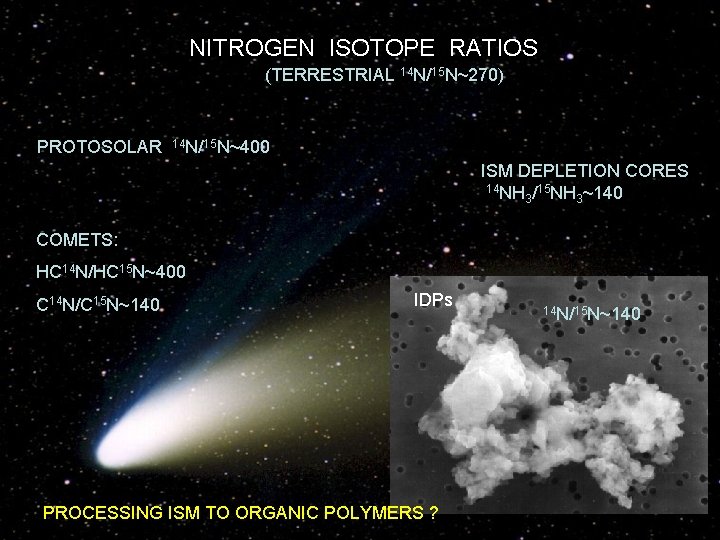
NITROGEN ISOTOPE RATIOS (TERRESTRIAL 14 N/15 N~270) PROTOSOLAR 14 N/15 N~400 ISM DEPLETION CORES 14 NH /15 NH ~140 3 3 COMETS: HC 14 N/HC 15 N~400 C 14 N/C 15 N~140 IDPs PROCESSING ISM TO ORGANIC POLYMERS ? 14 N/15 N~140
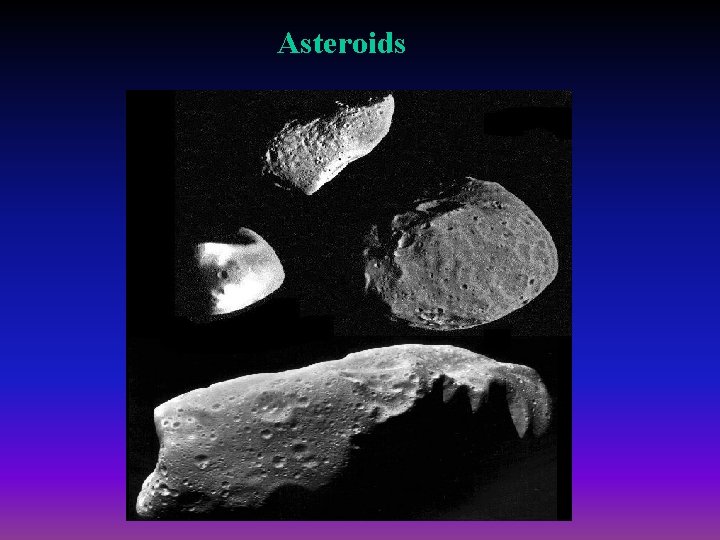
Asteroids
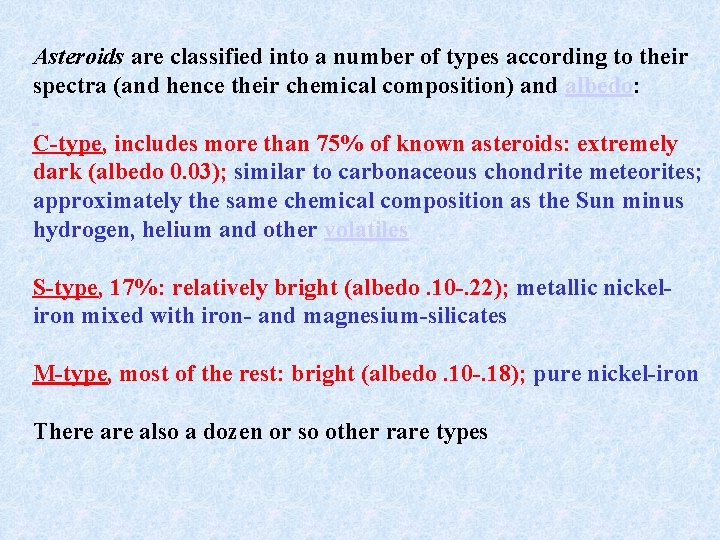
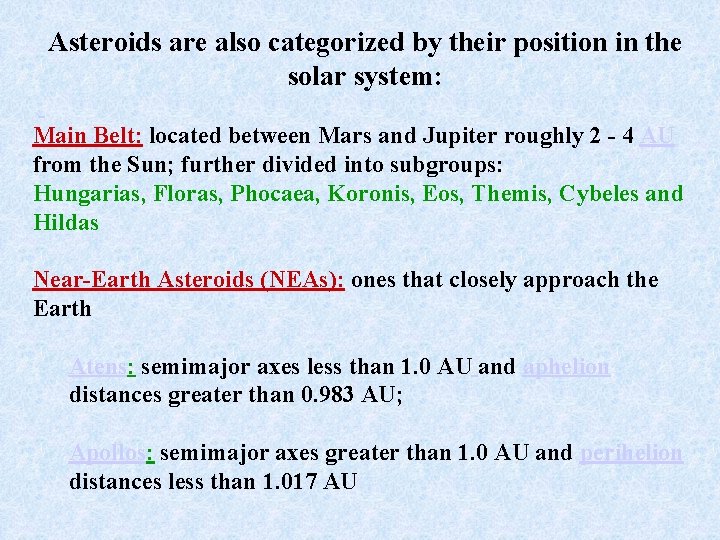
Asteroids are classified into a number of types according to their spectra (and hence their chemical composition) and albedo: C-type, includes more than 75% of known asteroids: extremely dark (albedo 0. 03); similar to carbonaceous chondrite meteorites; approximately the same chemical composition as the Sun minus hydrogen, helium and other volatiles S-type, 17%: relatively bright (albedo. 10 -. 22); metallic nickeliron mixed with iron- and magnesium-silicates M-type, most of the rest: bright (albedo. 10 -. 18); pure nickel-iron There also a dozen or so other rare types
Asteroids are also categorized by their position in the solar system: Main Belt: located between Mars and Jupiter roughly 2 - 4 AU from the Sun; further divided into subgroups: Hungarias, Floras, Phocaea, Koronis, Eos, Themis, Cybeles and Hildas Near-Earth Asteroids (NEAs): ones that closely approach the Earth Atens: semimajor axes less than 1. 0 AU and aphelion distances greater than 0. 983 AU; Apollos: semimajor axes greater than 1. 0 AU and perihelion distances less than 1. 017 AU
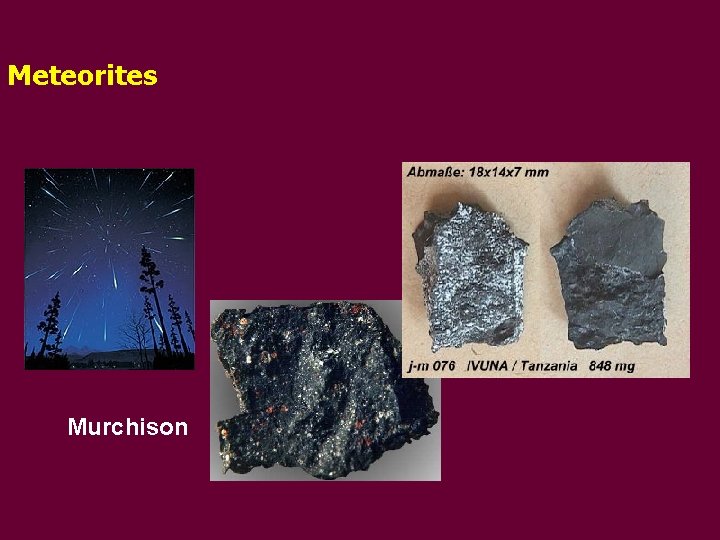
Meteorites Murchison
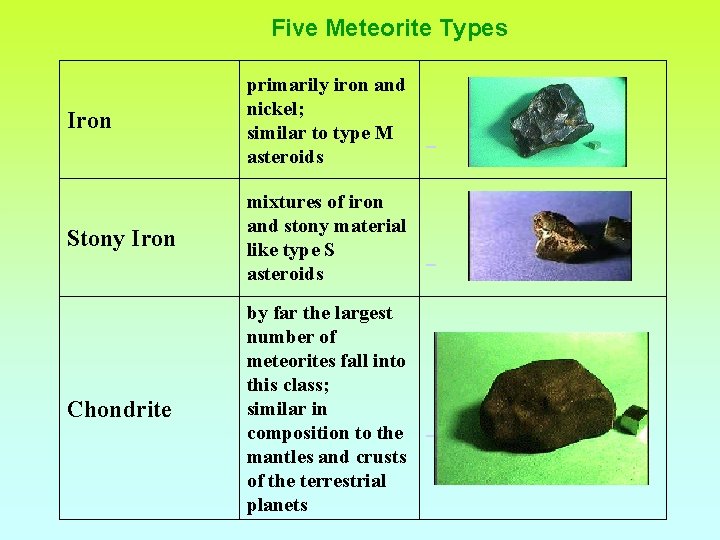
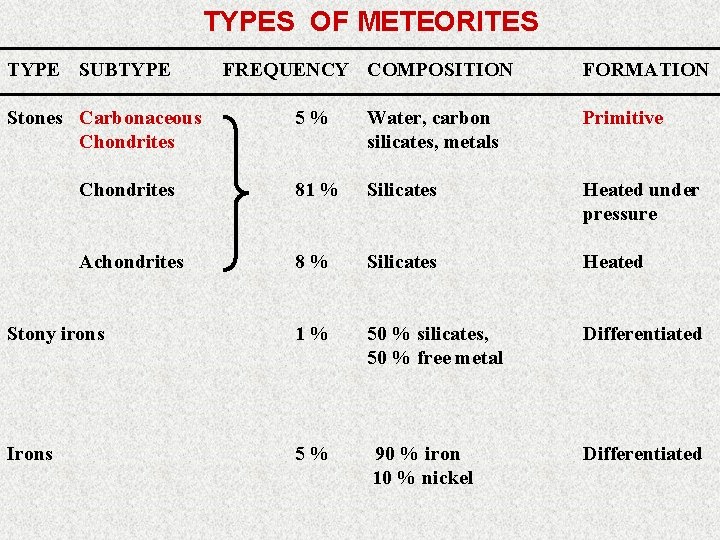
Five Meteorite Types Iron primarily iron and nickel; similar to type M asteroids Stony Iron mixtures of iron and stony material like type S asteroids Chondrite by far the largest number of meteorites fall into this class; similar in composition to the mantles and crusts of the terrestrial planets
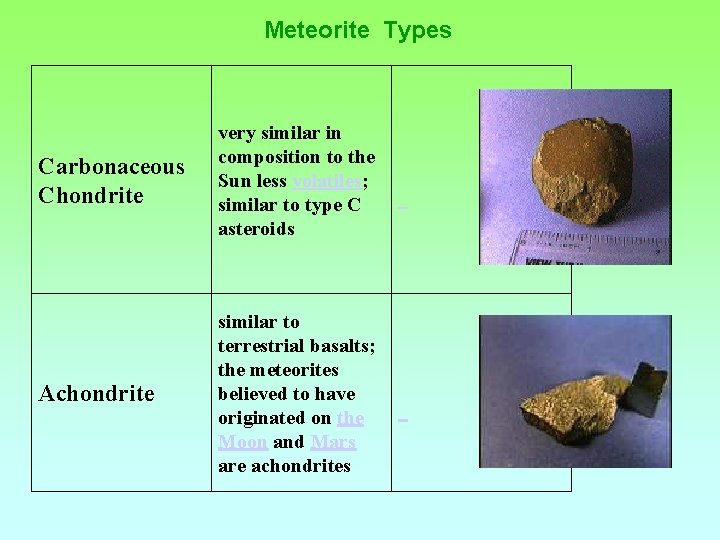
Meteorite Types Carbonaceous Chondrite very similar in composition to the Sun less volatiles; similar to type C asteroids Achondrite similar to terrestrial basalts; the meteorites believed to have originated on the Moon and Mars are achondrites
TYPES OF METEORITES TYPE SUBTYPE Stones Carbonaceous Chondrites FREQUENCY COMPOSITION FORMATION 5% Water, carbon silicates, metals Primitive Chondrites 81 % Silicates Heated under pressure Achondrites 8% Silicates Heated Stony irons 1% 50 % silicates, 50 % free metal Differentiated Irons 5% 90 % iron 10 % nickel Differentiated
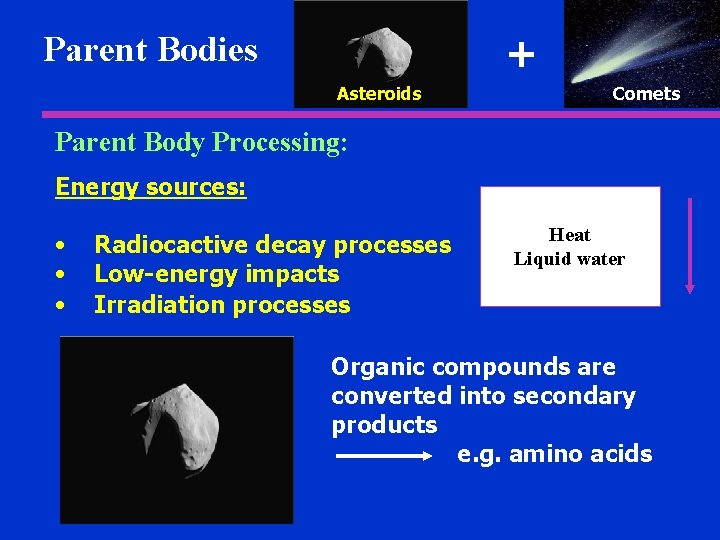
+ Parent Bodies Asteroids Comets Parent Body Processing: Energy sources: • • • Radiocactive decay processes Low-energy impacts Irradiation processes Heat Liquid water Organic compounds are converted into secondary products e. g. amino acids
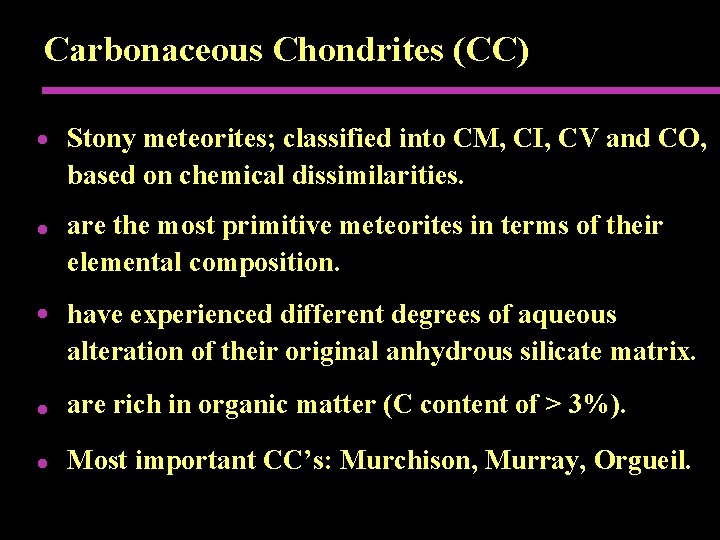
Carbonaceous Chondrites (CC) • Stony meteorites; classified into CM, CI, CV and CO, based on chemical dissimilarities. • are the most primitive meteorites in terms of their elemental composition. • have experienced different degrees of aqueous alteration of their original anhydrous silicate matrix. • are rich in organic matter (C content of > 3%). • Most important CC’s: Murchison, Murray, Orgueil.
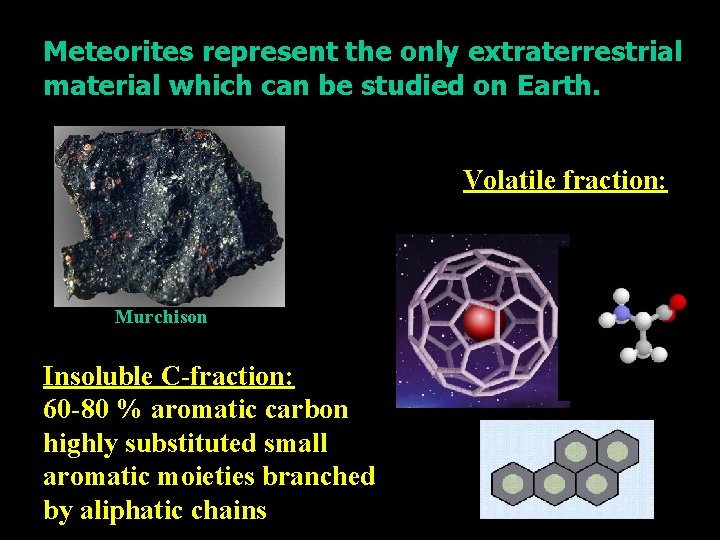
Meteorites represent the only extraterrestrial material which can be studied on Earth. Volatile fraction: Murchison Insoluble C-fraction: 60 -80 % aromatic carbon highly substituted small aromatic moieties branched by aliphatic chains
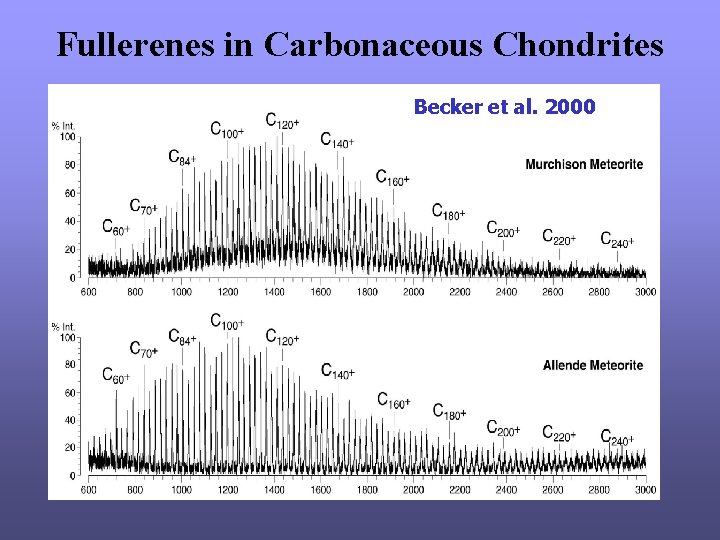
Fullerenes in Carbonaceous Chondrites Becker et al. 2000
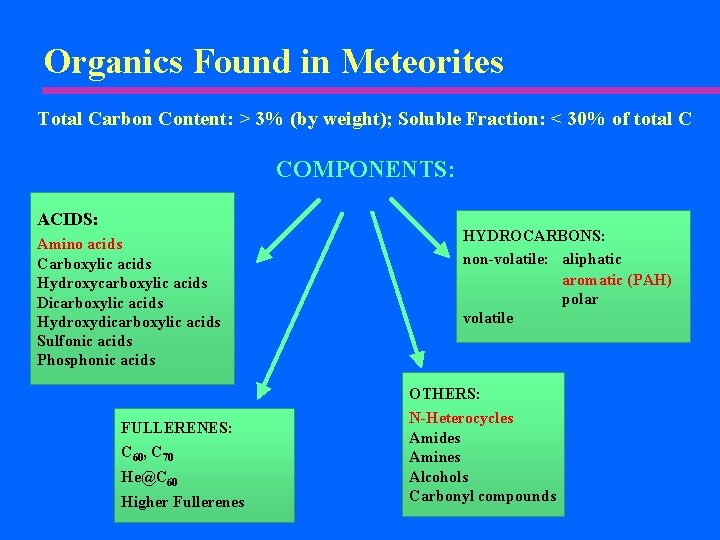
Organics Found in Meteorites Total Carbon Content: > 3% (by weight); Soluble Fraction: < 30% of total C COMPONENTS: ACIDS: Amino acids Carboxylic acids Hydroxycarboxylic acids Dicarboxylic acids Hydroxydicarboxylic acids Sulfonic acids Phosphonic acids FULLERENES: C 60, C 70 He@C 60 Higher Fullerenes HYDROCARBONS: non-volatile: aliphatic aromatic (PAH) polar volatile OTHERS: N-Heterocycles Amides Amines Alcohols Carbonyl compounds
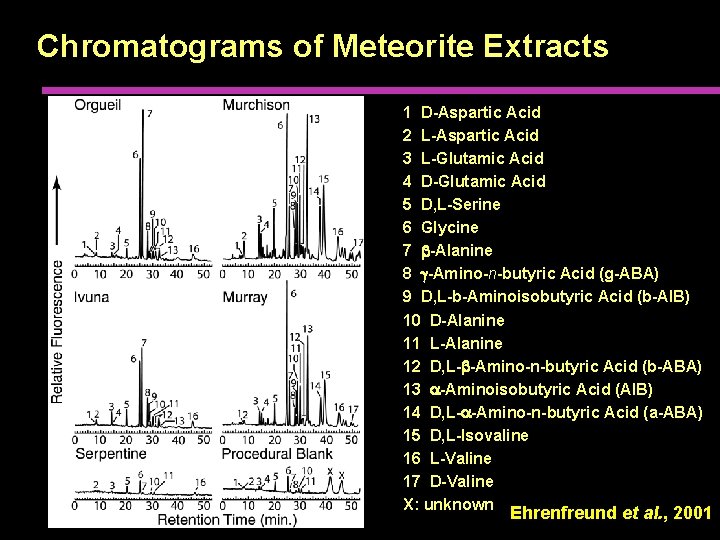
Chromatograms of Meteorite Extracts 1 D-Aspartic Acid 2 L-Aspartic Acid 3 L-Glutamic Acid 4 D-Glutamic Acid 5 D, L-Serine 6 Glycine 7 b-Alanine 8 g-Amino-n-butyric Acid (g-ABA) 9 D, L-b-Aminoisobutyric Acid (b-AIB) 10 D-Alanine 11 L-Alanine 12 D, L-b-Amino-n-butyric Acid (b-ABA) 13 a-Aminoisobutyric Acid (AIB) 14 D, L-a-Amino-n-butyric Acid (a-ABA) 15 D, L-Isovaline 16 L-Valine 17 D-Valine X: unknown Ehrenfreund et al. , 2001
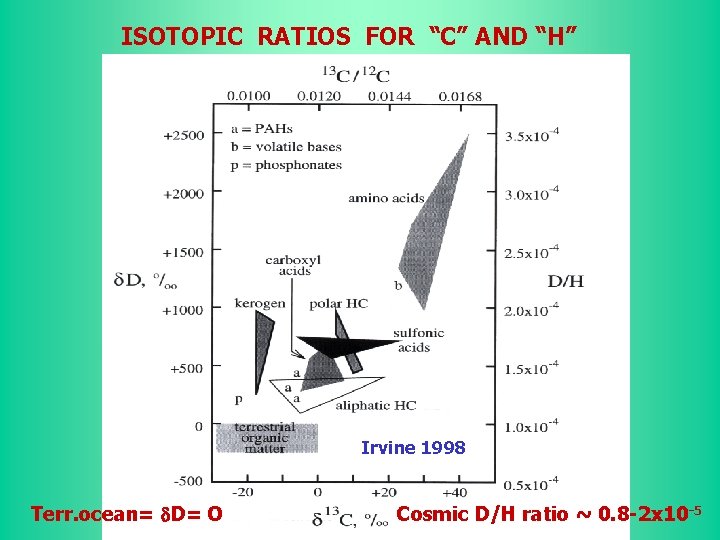
ISOTOPIC RATIOS FOR “C” AND “H” Irvine 1998 Terr. ocean= d. D= O Cosmic D/H ratio ~ 0. 8 -2 x 10 -5
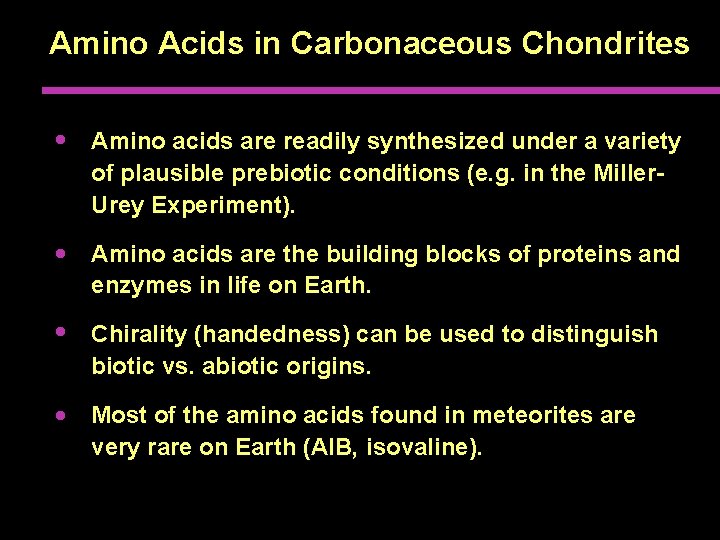
Amino Acids in Carbonaceous Chondrites • Amino acids are readily synthesized under a variety of plausible prebiotic conditions (e. g. in the Miller. Urey Experiment). • Amino acids are the building blocks of proteins and enzymes in life on Earth. • Chirality (handedness) can be used to distinguish biotic vs. abiotic origins. • Most of the amino acids found in meteorites are very rare on Earth (AIB, isovaline).
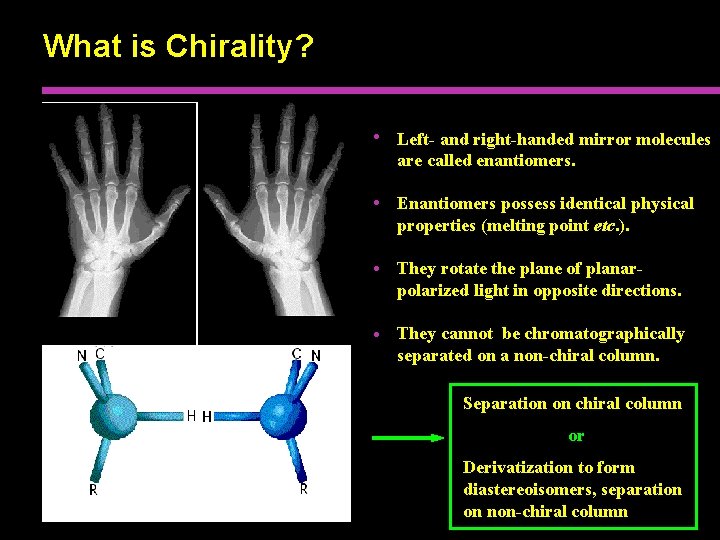
What is Chirality? • Left- and right-handed mirror molecules are called enantiomers. • Enantiomers possess identical physical properties (melting point etc. ). • They rotate the plane of planarpolarized light in opposite directions. • They cannot be chromatographically separated on a non-chiral column. Separation on chiral column or Derivatization to form diastereoisomers, separation on non-chiral column
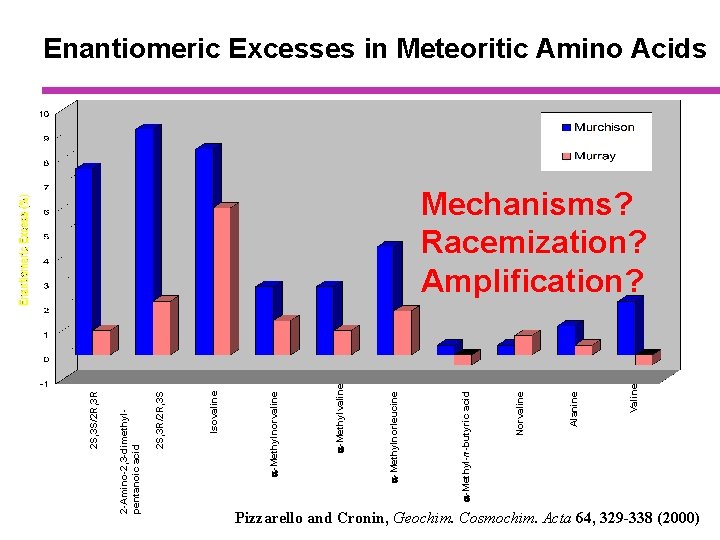
Valine Alanine Norvaline a-Methyl-n-butyric acid a-Methylnorleucine a-Methylvaline a-Methylnorvaline Isovaline 2 S, 3 R/2 R, 3 S 2 -Amino-2, 3 -dimethylpentanoic acid 2 S, 3 S/2 R, 3 R Enantiomeric Excesses in Meteoritic Amino Acids Mechanisms? Racemization? Amplification? Pizzarello and Cronin, Geochim. Cosmochim. Acta 64, 329 -338 (2000)
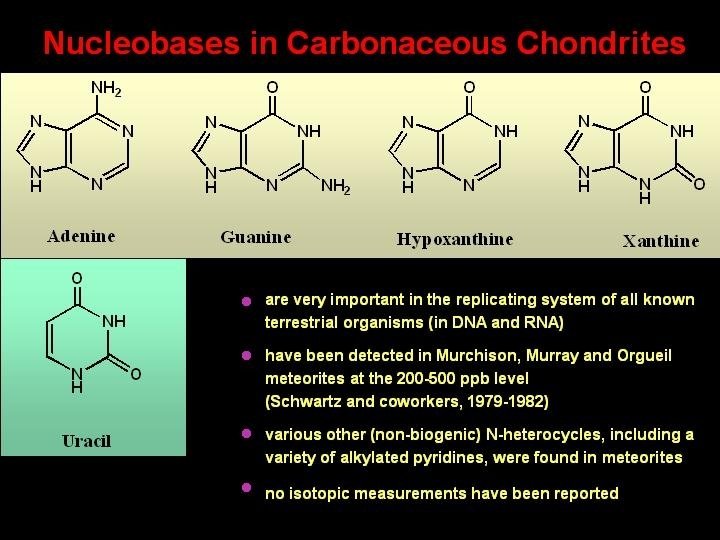
Nucleobases in Carbonaceous Chondrites are very important in the replicating system of all known terrestrial organisms (in DNA and RNA) have been detected in Murchison, Murray and Orgueil meteorites at the 200 -500 ppb level (Schwartz and coworkers, 1979 -1982) various other (non-biogenic) N-heterocycles, including a variety of alkylated pyridines, were found in meteorites no isotopic measurements have been reported
Summary - Comets preserve record of the early Solar System - Coma chemistry constrains nucleus composition - Comets are a mixture of pristine ISM & nebular materials - Meteorites are highly processed nebular material - Meteorites are very rich in organics