
COMETa 2020 5 th INTERNATIONAL SCIENTIFIC CONFERENCE Conference

- Slides: 12
COMETa 2020 5 th INTERNATIONAL SCIENTIFIC CONFERENCE ”Conference on Mechanical Engineering Technologies and Application” East Sarajevo, B&H, RS November, 26 th - 28 th, 2020 Numerical Analysis of Aerodynamic Performances of Single vs. Double Wing (Biplane) Configuration Jelena Svorcan 1, Milica Milić1, 2, Vladimir Vasić2 1 UB-FME, Belgrade, Serbia 2 EDe. Pro, Belgrade, Serbia
Contents • Introduction • Geometric Models • Numerical Analysis • Results and Discussion • Conclusions
Introduction • Light, utility and commercial aircrafts can be extremely useful and popular for shorter distances • In order to reduce the total cost, new (and old) aerodynamic concepts are constantly being investigated (reviewed) • The idea of biplane wings dates back to the beginning of XX century • Biplane is compact and enables smaller stalling speeds • However, due to the complex aerodynamic environment further analyses are always necessary • Paper presents the numerical investigation and comparison of several biplane configurations
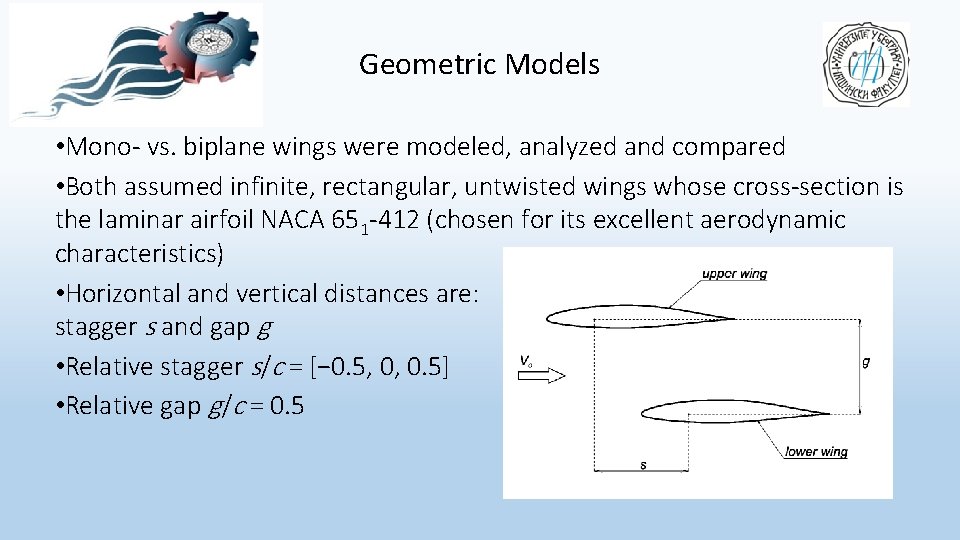
Geometric Models • Mono- vs. biplane wings were modeled, analyzed and compared • Both assumed infinite, rectangular, untwisted wings whose cross-section is the laminar airfoil NACA 651 -412 (chosen for its excellent aerodynamic characteristics) • Horizontal and vertical distances are: stagger s and gap g • Relative stagger s/c = [− 0. 5, 0, 0. 5] • Relative gap g /c = 0. 5
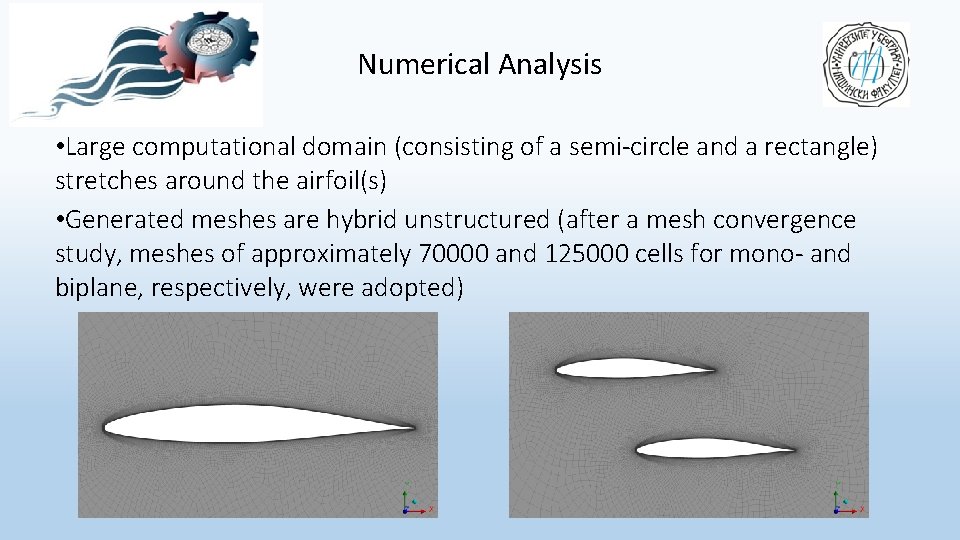
Numerical Analysis • Large computational domain (consisting of a semi-circle and a rectangle) stretches around the airfoil(s) • Generated meshes are hybrid unstructured (after a mesh convergence study, meshes of approximately 70000 and 125000 cells for mono- and biplane, respectively, were adopted)
Numerical Analysis • Flow computations were realized in engineering software package ANSYS Fluent by finite volume method • Flow was considered to be steady, planar, incompressible and viscous • RANS equations were closed by the 4 -equation transitional shear stress transport (SST) model • BC: velocity inlet + pressure outlet, no-slip walls • Pressure-based solver with SIMPLEC coupling scheme, 2 nd order schemes • Computations were performed until reaching the converged values of aerodynamic coefficients, usually 5000 -20000 iterations
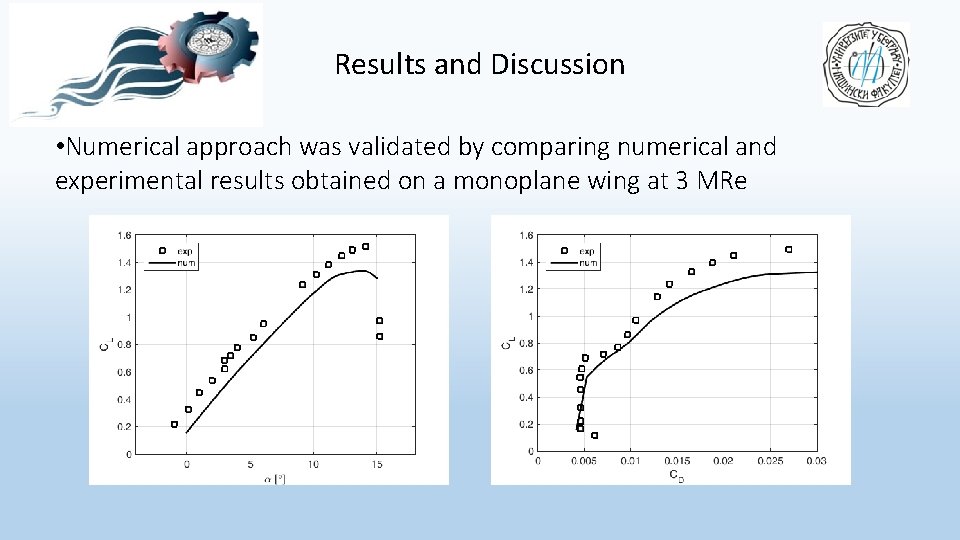
Results and Discussion • Numerical approach was validated by comparing numerical and experimental results obtained on a monoplane wing at 3 MRe
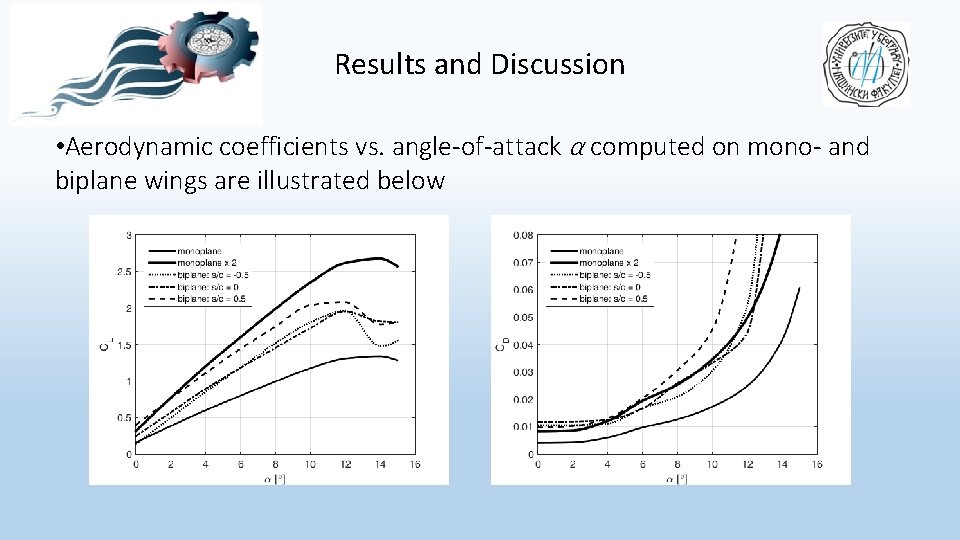
Results and Discussion • Aerodynamic coefficients vs. angle-of-attack α computed on mono- and biplane wings are illustrated below
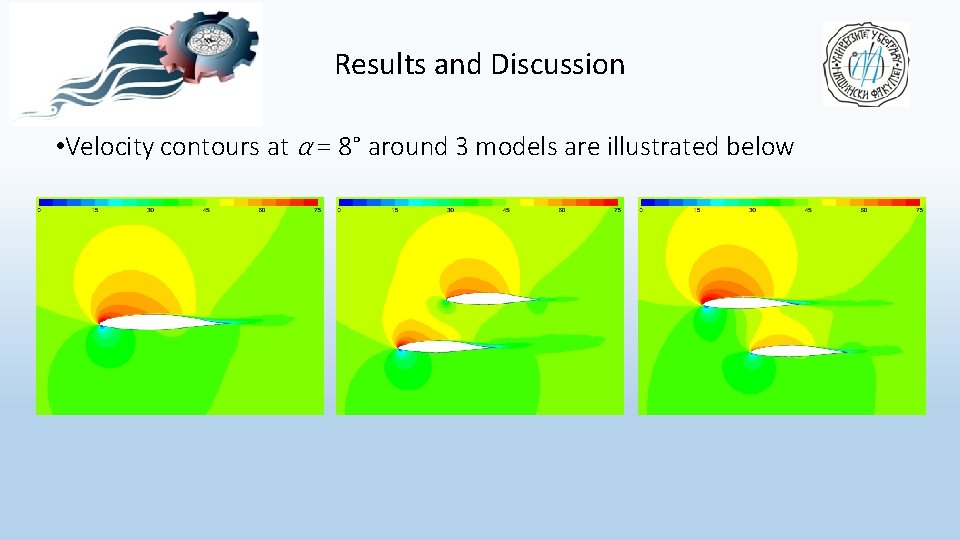
Results and Discussion • Velocity contours at α = 8° around 3 models are illustrated below
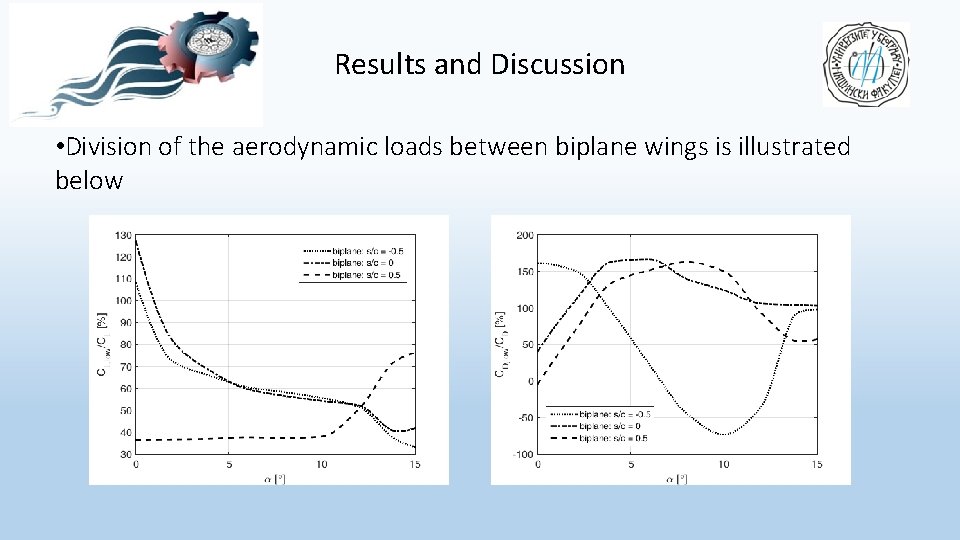
Results and Discussion • Division of the aerodynamic loads between biplane wings is illustrated below
Conclusions • Overall, no biplane configuration can outperform the monoplane wing of equivalent wetted surface with respect to global aerodynamic coefficients • However, the benefits of biplanes are load distribution and compact design • The biplane with s/c = 0. 5 (highest stagger) achieves the highest lift coefficient but at the smallest critical angle • From the drag perspective, biplane with s/c = 0. 5 performs better at lower α, while biplane with s/c = − 0. 5 is more appropriate at medium α • Both positive and negative stagger increases lift-to-drag ratio of biplane wings
Thank You for Your Attention! Contact: jsvorcan@mas. bg. ac. rs