
COMBUSTION PHENOMENON IN COMPRESSION IGNITION ENGINES PARTICULARS SI
COMBUSTION PHENOMENON IN COMPRESSION IGNITION ENGINES
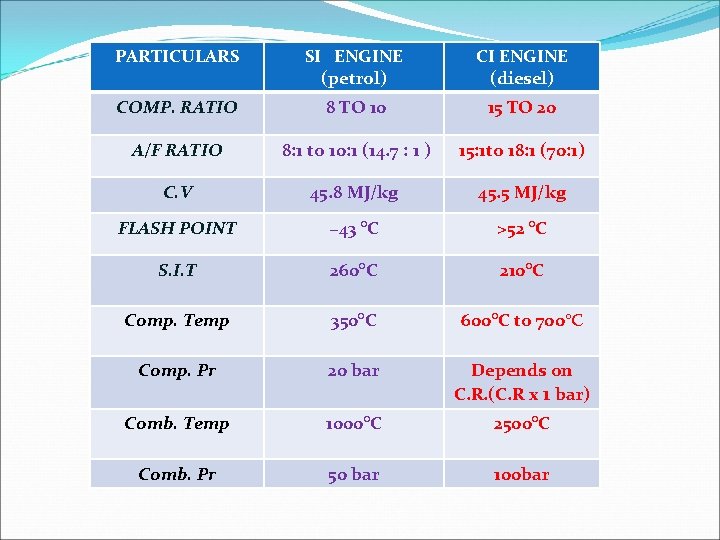
PARTICULARS SI ENGINE (petrol) CI ENGINE (diesel) COMP. RATIO 8 TO 10 15 TO 20 A/F RATIO 8: 1 to 10: 1 (14. 7 : 1 ) 15: 1 to 18: 1 (70: 1) C. V 45. 8 MJ/kg 45. 5 MJ/kg FLASH POINT − 43 °C >52 °C S. I. T 260°C 210°C Comp. Temp 350°C 600°C to 700°C Comp. Pr 20 bar Depends on C. R. (C. R x 1 bar) Comb. Temp 1000°C 2500°C Comb. Pr 50 bar 100 bar
Combustion in CI Engines STAGES OF COMBUSTION IN CI ENGINES
Combustion in CI Engines • Combustion in CI engines differ from SI engine due to the basic fact that CI engine combustion is unassisted combustion occurring on its’ own. • In CI engine the fuel is injected into combustion space after the compression of air is completed. • Due to excessively high temperature and pressure of air the fuel when injected in atomised form gets burnt on its’ own and burning of fuel is continued till the fuel is injected. • Theoretically this injection of fuel and its’ burning should occur simultaneously up to the cut off point, but this does not occur in actual CI engine. Different significant phases of combustion are explained as under.
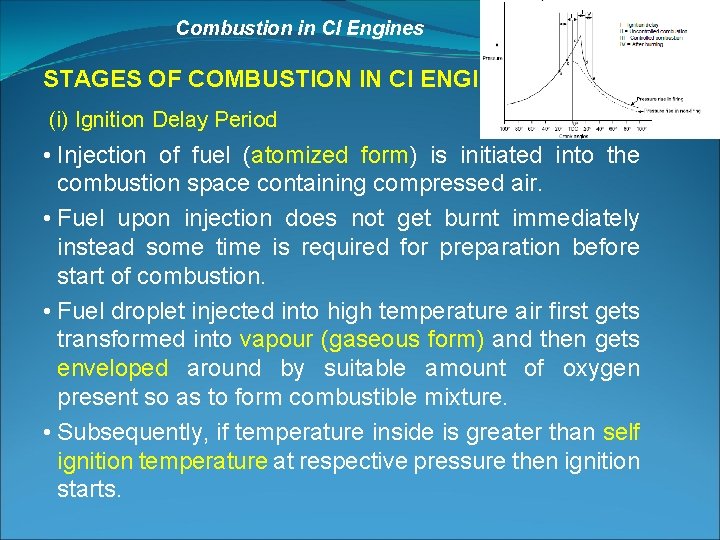
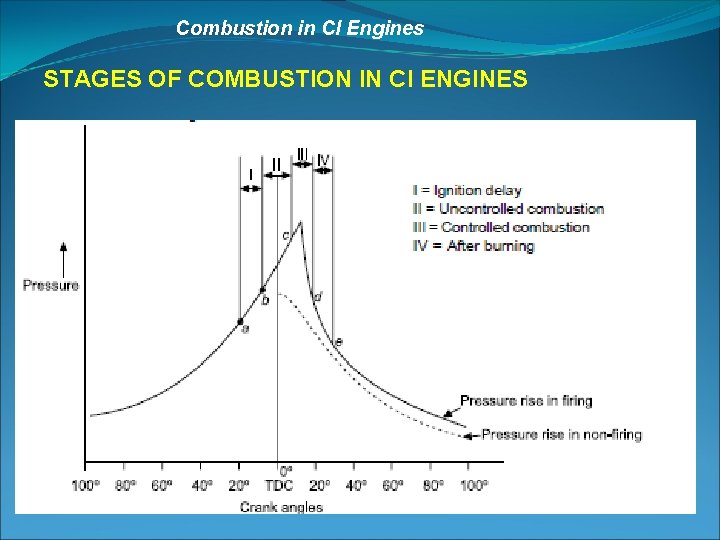
Combustion in CI Engines STAGES OF COMBUSTION IN CI ENGINES (i) Ignition Delay Period • Injection of fuel (atomized form) is initiated into the combustion space containing compressed air. • Fuel upon injection does not get burnt immediately instead some time is required for preparation before start of combustion. • Fuel droplet injected into high temperature air first gets transformed into vapour (gaseous form) and then gets enveloped around by suitable amount of oxygen present so as to form combustible mixture. • Subsequently, if temperature inside is greater than self ignition temperature at respective pressure then ignition starts.
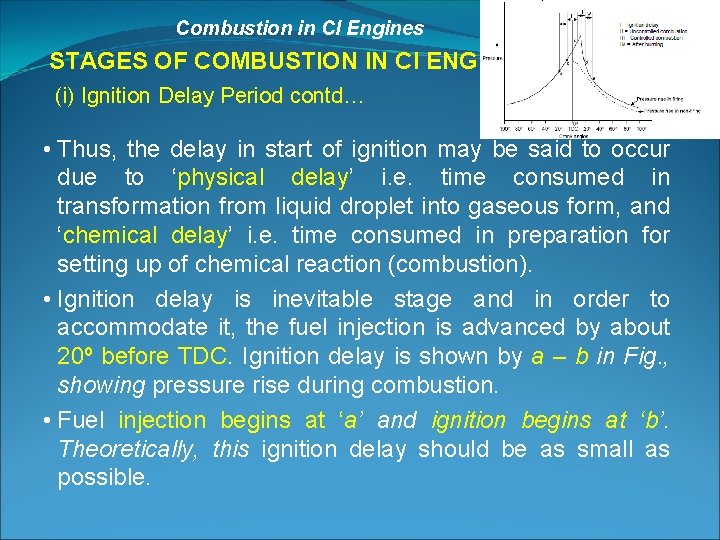
Combustion in CI Engines STAGES OF COMBUSTION IN CI ENGINES (i) Ignition Delay Period contd… • Thus, the delay in start of ignition may be said to occur due to ‘physical delay’ i. e. time consumed in transformation from liquid droplet into gaseous form, and ‘chemical delay’ i. e. time consumed in preparation for setting up of chemical reaction (combustion). • Ignition delay is inevitable stage and in order to accommodate it, the fuel injection is advanced by about 20º before TDC. Ignition delay is shown by a – b in Fig. , showing pressure rise during combustion. • Fuel injection begins at ‘a’ and ignition begins at ‘b’. Theoretically, this ignition delay should be as small as possible.

Combustion in CI Engines STAGES OF COMBUSTION IN CI ENGINES (ii) Uncontrolled Combustion • During the ignition delay period the injection of fuel is continued as it has begun at point ‘a’ and shall continue upto the point of cut off. • During this period, the continuous fuel injection results in accumulation of fuel in combustion space. • The moment when ignition just begins means, if the sustainable flame front is established then this accumulated fuel also gets burnt rapidly. • This burning of accumulated fuel occurs in such a manner that combustion process becomes uncontrolled resulting into steep pressure rise as shown from ‘b’ to ‘c’.
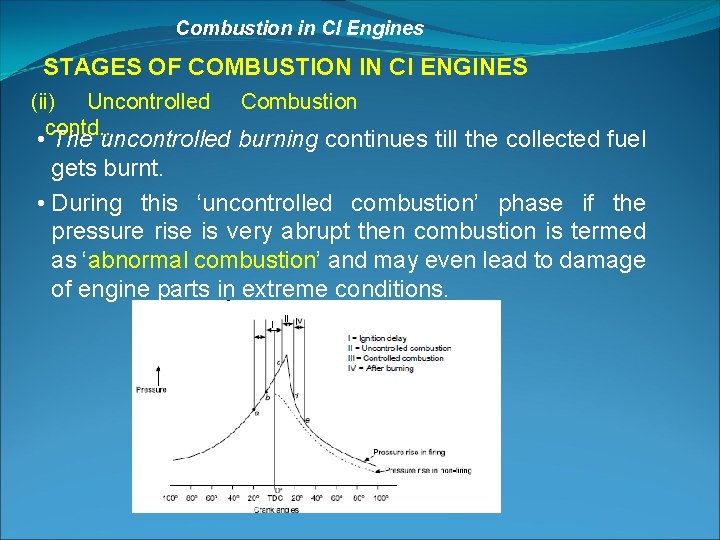
Combustion in CI Engines STAGES OF COMBUSTION IN CI ENGINES (ii) Uncontrolled contd. . Combustion • The uncontrolled burning continues till the collected fuel gets burnt. • During this ‘uncontrolled combustion’ phase if the pressure rise is very abrupt then combustion is termed as ‘abnormal combustion’ and may even lead to damage of engine parts in extreme conditions.
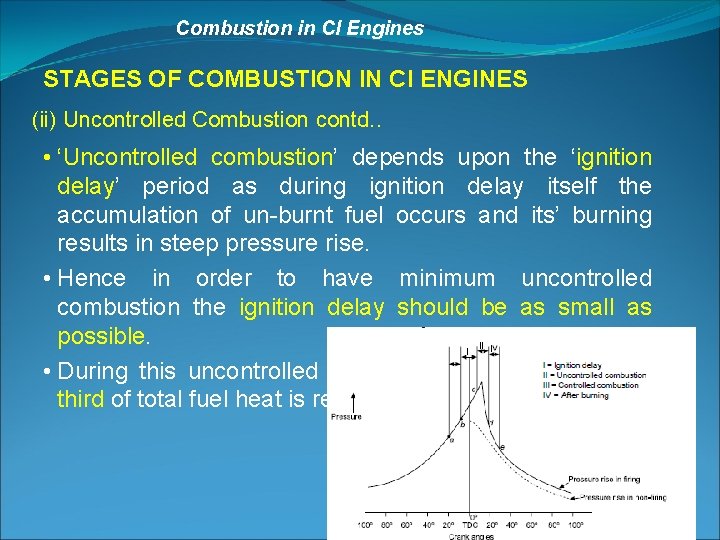
Combustion in CI Engines STAGES OF COMBUSTION IN CI ENGINES (ii) Uncontrolled Combustion contd. . • ‘Uncontrolled combustion’ depends upon the ‘ignition delay’ period as during ignition delay itself the accumulation of un burnt fuel occurs and its’ burning results in steep pressure rise. • Hence in order to have minimum uncontrolled combustion the ignition delay should be as small as possible. • During this uncontrolled combustion phase about one third of total fuel heat is released.
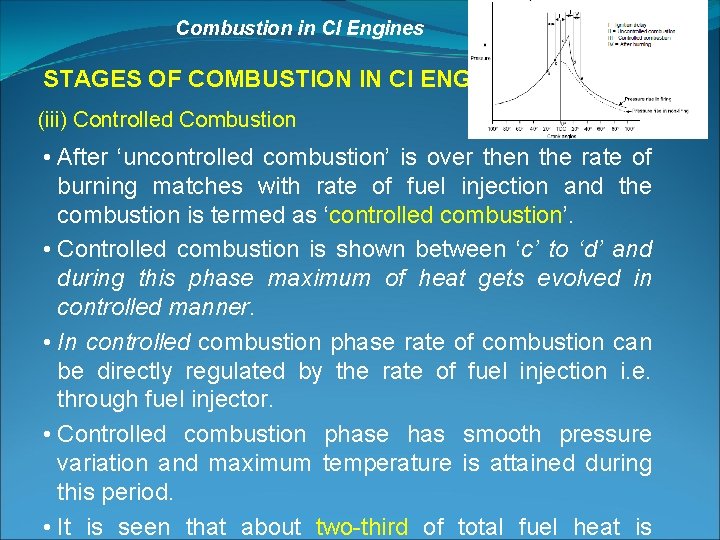
Combustion in CI Engines STAGES OF COMBUSTION IN CI ENGINES (iii) Controlled Combustion • After ‘uncontrolled combustion’ is over then the rate of burning matches with rate of fuel injection and the combustion is termed as ‘controlled combustion’. • Controlled combustion is shown between ‘c’ to ‘d’ and during this phase maximum of heat gets evolved in controlled manner. • In controlled combustion phase rate of combustion can be directly regulated by the rate of fuel injection i. e. through fuel injector. • Controlled combustion phase has smooth pressure variation and maximum temperature is attained during this period. • It is seen that about two third of total fuel heat is
Combustion in CI Engines STAGES OF COMBUSTION IN CI ENGINES (iv) After Burning • After controlled combustion, the residual if any gets burnt and the combustion is termed as ‘after burning’. • This after burning may be there due to fuel particles residing in remote position in combustion space where flame front could not reach. • ‘After burning’ is spread over 60 – 70º of crank angle rotation and occurs even during expansion stroke.
Combustion in CI Engines ***FACTORS AFFECTING DELAY PERIOD IN CI • ENGINES**** Compression Ratio Increase in CR increases the temperature of air. Autoignition temperature decreases with increased density. Both these reduce the delay period(DP). • Engine Power Output With an Increase in engine power, the operating temperature increases. A/F ratio decreases and DP decreases • Engine Speed DP decreases with increasing engine speed, as the temperature and pressure of compressed air rises at high engine speeds. • Injection Timing The temperature and pressure of air at the beginning of injection are lower for higher injection advance. The DP
Combustion in CI Engines ***FACTORS AFFECTING DELAY PERIOD IN CI • ENGINES**** Atomization of fuel Higher fuel injection pressures increase the degree of atomization. The fineness of atomization reduces the DP due to higher A/V ratio of the spray droplets. • Injection Pressure Increase injection pressure reduces the auto ignition temperature and hence decreases DP. • Fuel Properties Low SIT reduces DP. Other fuel properties which affect DP are volatility, surface tension, latent heat and viscosity. • Intake Temperature High intake temperature increase the air temperature after compression , which reduces DP.
***FACTORS AFFECTING DELAY PERIOD IN CI • ENGINES**** Engine Size • • Large engines operate at lower speeds, thus increasing the DP in terms of crank angle. Cetane No. Fuels with high cetane no. Have lower DP. F/A ratio With increasing F/A ratio, operating temperature increases and thus DP decreases. Combustion Chamber Shape Engines with pre combustion chambers will have low DP. Injection Duration Increase in injection duration, results in higher quantity of fuel injected which reduces DP.
Abnormal Combustion • Thus, it is seen that the complete combustion in CI engines may be comprising of four distinct phases i. e. ‘ignition delay’ followed by ‘uncontrolled combustion, ’ ‘controlled combustion’ and ‘after burning’. • Combustion generally becomes abnormal combustion in CI engines when the ignition delay is too large resulting into large uncontrolled combustion and zig zag pressure rise. • Abnormal combustion in CI engines may also be termed as ‘knocking’ in engines and can be felt by excessive vibrations, excessive noise, excessive heat release, pitting of cylinder head and piston head etc. • In order to control the knocking some additives are put in CI engine fuel so as to reduce its’ self ignition
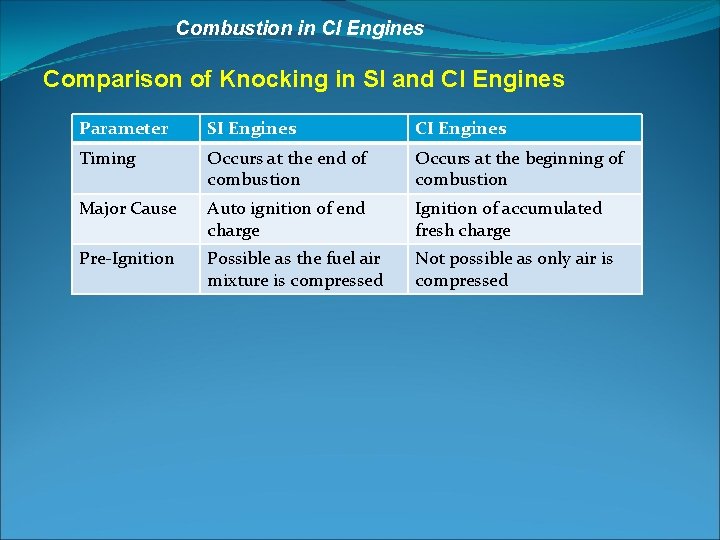
Combustion in CI Engines Comparison of Knocking in SI and CI Engines Parameter SI Engines CI Engines Timing Occurs at the end of combustion Occurs at the beginning of combustion Major Cause Auto ignition of end charge Ignition of accumulated fresh charge Pre-Ignition Possible as the fuel air mixture is compressed Not possible as only air is compressed
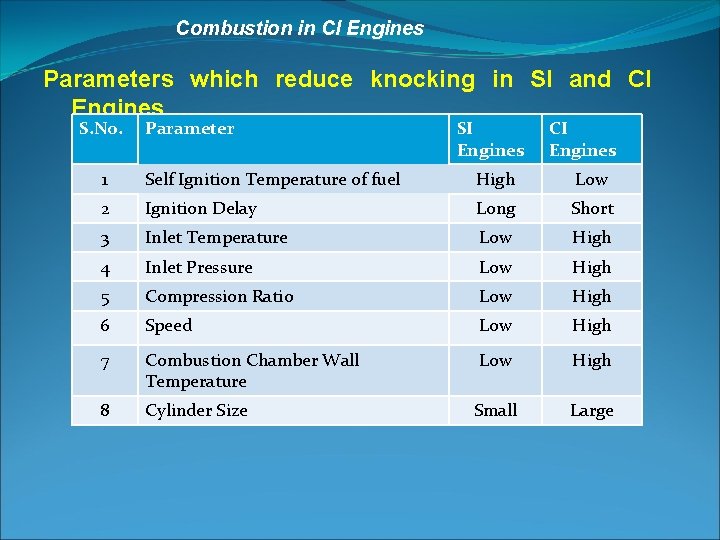
Combustion in CI Engines Parameters which reduce knocking in SI and CI Engines S. No. Parameter SI Engines CI Engines 1 Self Ignition Temperature of fuel High Low 2 Ignition Delay Long Short 3 Inlet Temperature Low High 4 Inlet Pressure Low High 5 Compression Ratio Low High 6 Speed Low High 7 Combustion Chamber Wall Temperature Low High 8 Cylinder Size Small Large
Combustion in CI Engines COMBUSTION CHAMBER FOR Cl ENGINES Combustion Chamber Characteristics • • • The proper design of a combustion chamber is very important. In a Cl engine the fuel is injected during a period of some 20 to 35 degrees of crank angle. In this short period of time an efficient preparation of the fuel air charge is required, which means: • An even distribution of the injected fuel throughout the combustion space, for which it requires a directed flow or swirl of the air. • A thorough mixing of the fuel with the air to ensure complete combustion with the minimum excess air, for which it requires an air swirl or squish of high intensity.
Combustion in CI Engines COMBUSTION CHAMBER FOR Cl ENGINES Combustion Chamber Characteristics An efficient smooth combustion depends upon: • A sufficiently high temperature to initiate ignition; it is controlled by the selection of the proper compression ratio. • A small delay period or ignition lag. • A moderate of pressure rise during the second stage of combustion. • A controlled, even burning during the third stage; it is governed by the rate of injection. • A minimum of afterburning. • Minimum heat losses to the walls. These losses can be controlled by reducing the surface to volume ratio. The main characteristics of an injection system that link it with a given combustion chamber are atomization, penetration, fuel distribution, and the shape of the fuel spray.
Combustion in CI Engines Classification of Cl Engine Combustion Chambers (a) direct injection (DI) engines, which have a single open combustion chamber into which fuel is injected directly; (b) indirect injection (IDI) engines, where the chamber is divided into two regions and the fuel is injected into the pre chamber which is situated above the piston crown and is connected to the main chamber via a nozzle or one or more orifices.
Combustion in CI Engines DIRECT INJECTION (Dl) ENGINES OR OPEN COMBUSTION CHAMBER ENGINES An open chamber has the entire compression volume in which the combustion takes place in one chamber formed between the piston and the cylinder head. The shape of the combustion chamber may create swirl or turbulence to assist fuel and air. • Swirl denotes a rotary motion of the gases in the chamber more or less about the chamber axis. • Turbulence denotes a haphazard motion of the gases. In this combustion chamber, the mixing of fuel and air depends entirely on the spray charac teristicsand on air motion, and it is not essentially affected by the combustion process. In this type of engine, the spray characteristics must be carefully arranged to obtain rapid mixing. Fuel is injected at high injection pressure and mixing is usually assissted by a swirl, induced by directing the inlet air tangentially, or by a squish which is the air motion caused by a small clearance space over part of the piston.
Combustion in CI Engines DIRECT INJECTION (Dl) ENGINES OR OPEN COMBUSTION CHAMBER ENGINES The open chamber design can be classified as follows: • Semiquiescent or low swirl open chamber • Medium swirl open chamber • High swirl open chamber (‘M’ type).
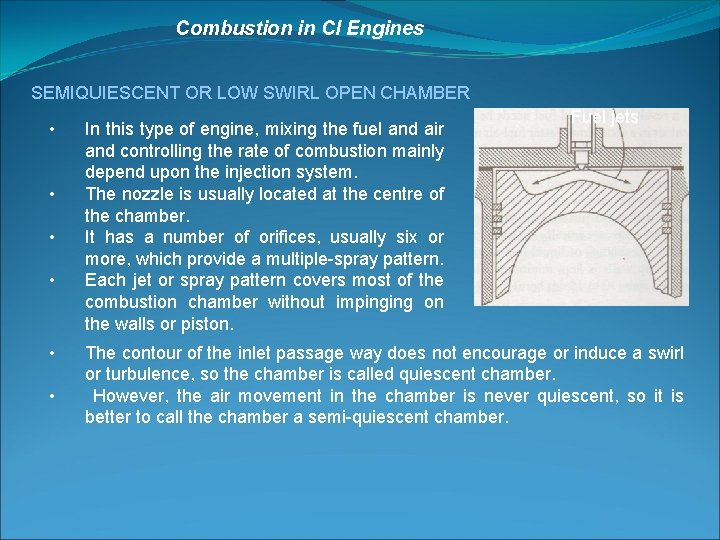
Combustion in CI Engines SEMIQUIESCENT OR LOW SWIRL OPEN CHAMBER • • • In this type of engine, mixing the fuel and air and controlling the rate of combustion mainly depend upon the injection system. The nozzle is usually located at the centre of the chamber. It has a number of orifices, usually six or more, which provide a multiple spray pattern. Each jet or spray pattern covers most of the combustion chamber without impinging on the walls or piston. Fuel jets The contour of the inlet passage way does not encourage or induce a swirl or turbulence, so the chamber is called quiescent chamber. However, the air movement in the chamber is never quiescent, so it is better to call the chamber a semi quiescent chamber.
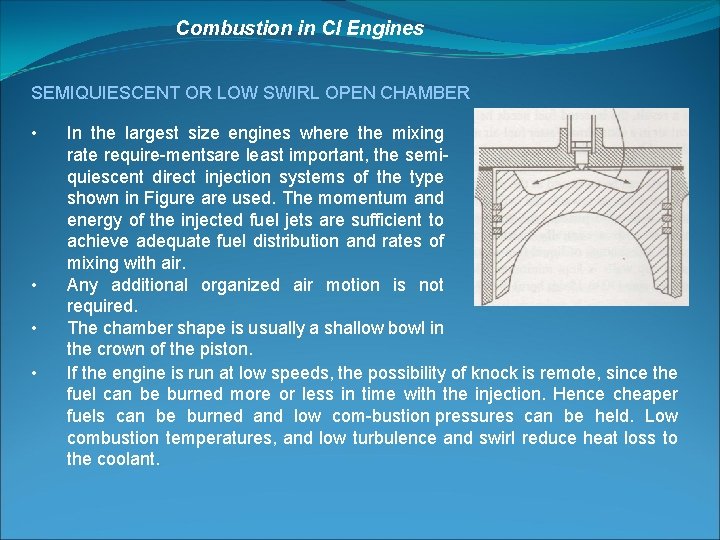
Combustion in CI Engines SEMIQUIESCENT OR LOW SWIRL OPEN CHAMBER • • In the largest size engines where the mixing rate require mentsare least important, the semi quiescent direct injection systems of the type shown in Figure are used. The momentum and energy of the injected fuel jets are sufficient to achieve adequate fuel distribution and rates of mixing with air. Any additional organized air motion is not required. The chamber shape is usually a shallow bowl in the crown of the piston. If the engine is run at low speeds, the possibility of knock is remote, since the fuel can be burned more or less in time with the injection. Hence cheaper fuels can be burned and low com bustion pressures can be held. Low combustion temperatures, and low turbulence and swirl reduce heat loss to the coolant.
Combustion in CI Engines The advantages of the open chamber design with a slow speed engine are as follows: 1. The specific fuel consumption is less, because of the following reasons: The fuel is burned close to TDC because the time in degree crank angle is long. It is an approach towards achieving the Otto cycle efficiency. The air/fuel ratio is high, therefore, combustion should be relatively complete with an approach towards the air standard efficiency. Percentage heat loss is reduced. It is an approach towards adiabatic combustion. Following are the possible reasons: Either low swirl or low turbulence Low surface to volume ratio of an undivided chamber Low overall combustion temperatures. 2. Starting is relatively easier. It is because of low heat losses. 3. Less heat is rejected to the coolant and to the exhaust gases. It requires smaller radiator and pumps. The life of the exhaust valve is increased. For small for high f systems h divided 4. The engine is quiet and provides relative freedom from combustion noise. 5. The residual fuels can be burned. It favours the operation of two stroke engines.
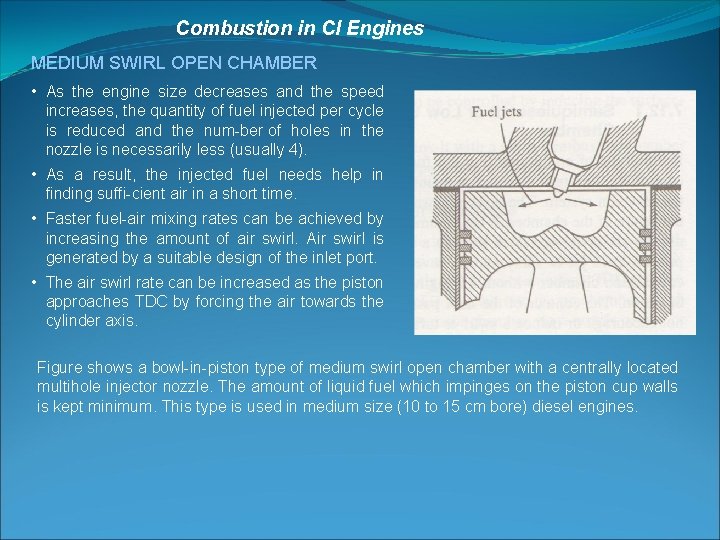
Combustion in CI Engines MEDIUM SWIRL OPEN CHAMBER • As the engine size decreases and the speed increases, the quantity of fuel injected per cycle is reduced and the num ber of holes in the nozzle is necessarily less (usually 4). • As a result, the injected fuel needs help in finding suffi cient air in a short time. • Faster fuel air mixing rates can be achieved by increasing the amount of air swirl. Air swirl is generated by a suitable design of the inlet port. • The air swirl rate can be increased as the piston approaches TDC by forcing the air towards the cylinder axis. Figure shows a bowl in piston type of medium swirl open chamber with a centrally located multihole injector nozzle. The amount of liquid fuel which impinges on the piston cup walls is kept minimum. This type is used in medium size (10 to 15 cm bore) diesel engines.
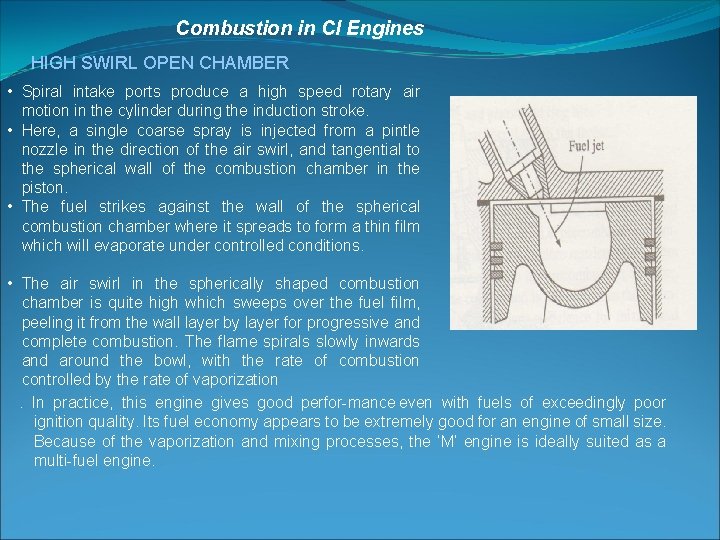
Combustion in CI Engines HIGH SWIRL OPEN CHAMBER • Spiral intake ports produce a high speed rotary air motion in the cylinder during the induction stroke. • Here, a single coarse spray is injected from a pintle nozzle in the direction of the air swirl, and tangential to the spherical wall of the combustion chamber in the piston. • The fuel strikes against the wall of the spherical combustion chamber where it spreads to form a thin film which will evaporate under controlled conditions. • The air swirl in the spherically shaped combustion chamber is quite high which sweeps over the fuel film, peeling it from the wall layer by layer for progressive and complete combustion. The flame spirals slowly inwards and around the bowl, with the rate of combustion controlled by the rate of vaporization. In practice, this engine gives good perfor mance even with fuels of exceedingly poor ignition quality. Its fuel economy appears to be extremely good for an engine of small size. Because of the vaporization and mixing processes, the ‘M’ engine is ideally suited as a multi fuel engine.
Combustion in CI Engines INDIRECT INJECTION (IDI) ENGINES OR DIVIDED COMBUSTION CHAMBER ENGINES For small high speed diesel engines such as those used in automobiles, the inlet generated air swirl for high fuel air mixing rate is not sufficient. Indirect injection (IDI) or divided chamber engine systems have been used to generate vigorous charge motion during the compression stroke. The divided combustion chamber can be classified as: a) Swirl or turbulent chamber b) Precombustion chamber c) Air and energy cells.
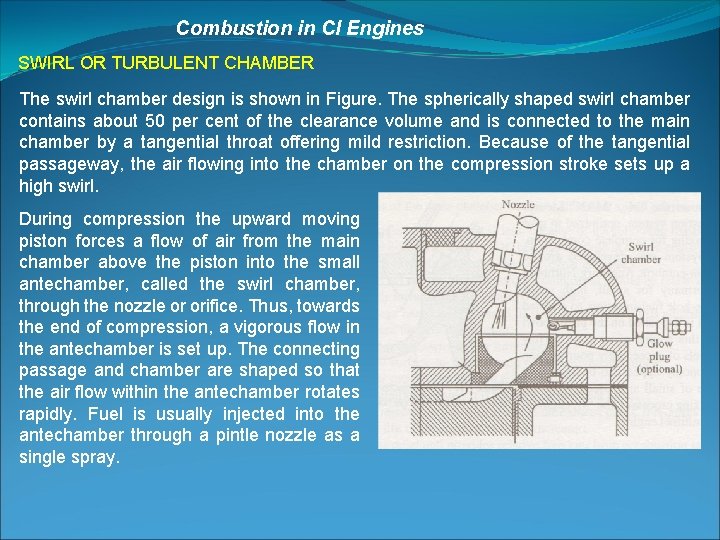
Combustion in CI Engines SWIRL OR TURBULENT CHAMBER The swirl chamber design is shown in Figure. The spherically shaped swirl chamber contains about 50 per cent of the clearance volume and is connected to the main chamber by a tangential throat offering mild restriction. Because of the tangential passageway, the air flowing into the chamber on the compression stroke sets up a high swirl. During compression the upward moving piston forces a flow of air from the main chamber above the piston into the small antechamber, called the swirl chamber, through the nozzle or orifice. Thus, towards the end of compression, a vigorous flow in the antechamber is set up. The connecting passage and chamber are shaped so that the air flow within the antechamber rotates rapidly. Fuel is usually injected into the antechamber through a pintle nozzle as a single spray.
Combustion in CI Engines SWIRL OR TURBULENT CHAMBER In some cases sufficient air may be present in the antechamber to bum completely all but the over load quantities of the fuel injected. The pressure built up in the antechamber by the expanding burning gases forces the burning and the unburned fuel and air mixtures back into the main chamber, where the jet issuing from the nozzle entrains and mixes with the main chamber air, imparting high turbulence and therefore further assisting combustion. The glow plug shown on the right of the antechamber in Figure is a cold starting aid. Since the antechamber is small, deep penetration of the spray is not required. Since the swirl is high, a single hole nozzle is sufficient, although a well atomized fuel spray is desirable. A pintle type nozzle offers these qualities.
Combustion in CI Engines The advantages of the indirect injection swirl chamber over the open chamber are as follows: • Higher speed, brake mean effective pressure and power with less smoke are feasible. It is because of: • Higher volumetric efficiency—since the nozzle is at the side, there is more room for the larger intake and exhaust valves. • Shorter delay period—since the antechamber is compact and the air swirl in the cham ber is very high. • Less mechanical stress and noise. It is because of the lower rate of pressure rise and the lower maximum pressure in the main chamber due to the throttling effect of thro • Less maintenance—since the pintle nozzle is self cleaning and the mechanical stress is less. • Wider range of fuels can be used. It can serve as a multi fuel engine with minimal changes. • Smoother and quieter idling—since matching of small air supply with the small fuel supply is possible. Cleaner exhaust resulting in less air pollution.
Combustion in CI Engines The disadvantages of the IDI swirl chamber over the open chamber are as follows: Higher specific fuel consumption resulting in poorer fuel economy. It is because of greater heat losses and pressure losses through the throat which result in lower thermal efficiency and higher pumping losses. The flow of combustion gases through the throat leads to thermal cracks in the cylinder head and creates sealing problems. Cylinder construction is more expensive. More thermal energy is lost to the exhaust gases. It may decrease the life of the exhaust valve which will run hotter and increase cracking and sealing problems of the exhaust manifold.
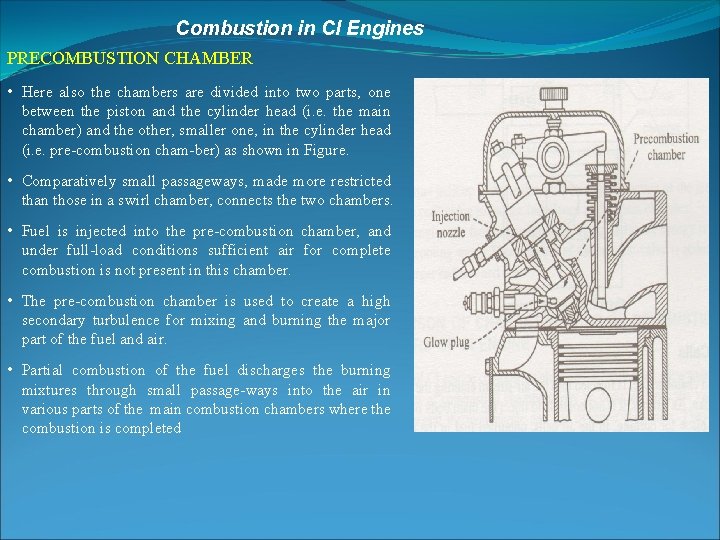
Combustion in CI Engines PRECOMBUSTION CHAMBER • Here also the chambers are divided into two parts, one between the piston and the cylinder head (i. e. the main chamber) and the other, smaller one, in the cylinder head (i. e. pre combustion cham ber) as shown in Figure. • Comparatively small passageways, made more restricted than those in a swirl chamber, connects the two chambers. • Fuel is injected into the pre combustion chamber, and under full load conditions sufficient air for complete combustion is not present in this chamber. • The pre combustion chamber is used to create a high secondary turbulence for mixing and burning the major part of the fuel and air. • Partial combustion of the fuel discharges the burning mixtures through small passage ways into the air in various parts of the main combustion chambers where the combustion is completed
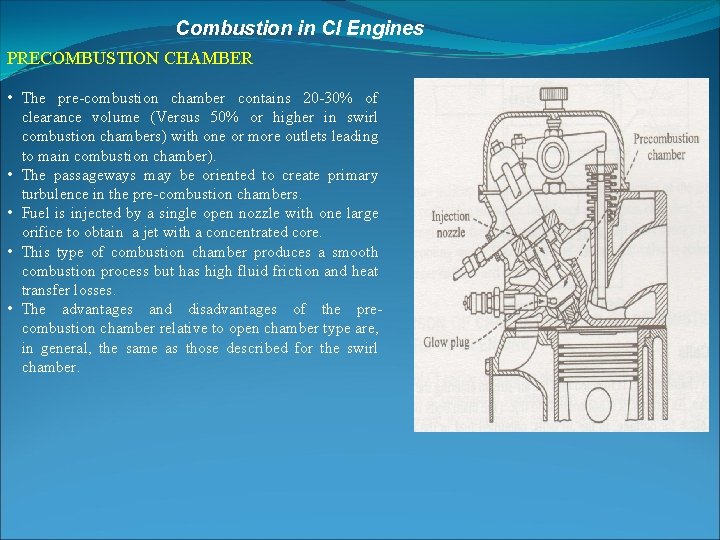
Combustion in CI Engines PRECOMBUSTION CHAMBER • The pre combustion chamber contains 20 30% of clearance volume (Versus 50% or higher in swirl combustion chambers) with one or more outlets leading to main combustion chamber). • The passageways may be oriented to create primary turbulence in the pre combustion chambers. • Fuel is injected by a single open nozzle with one large orifice to obtain a jet with a concentrated core. • This type of combustion chamber produces a smooth combustion process but has high fluid friction and heat transfer losses. • The advantages and disadvantages of the pre combustion chamber relative to open chamber type are, in general, the same as those described for the swirl chamber.
- Slides: 34