
Combustion Part 2 Deflagration and Explosion A Kotchourko
Combustion – Part 2 Deflagration and Explosion A. Kotchourko Karlsruhe Institute of Technology, Germany 4 th International Conference on Hydrogen Safety, San Francisco, USA, 12 - 14 September, 2011 1
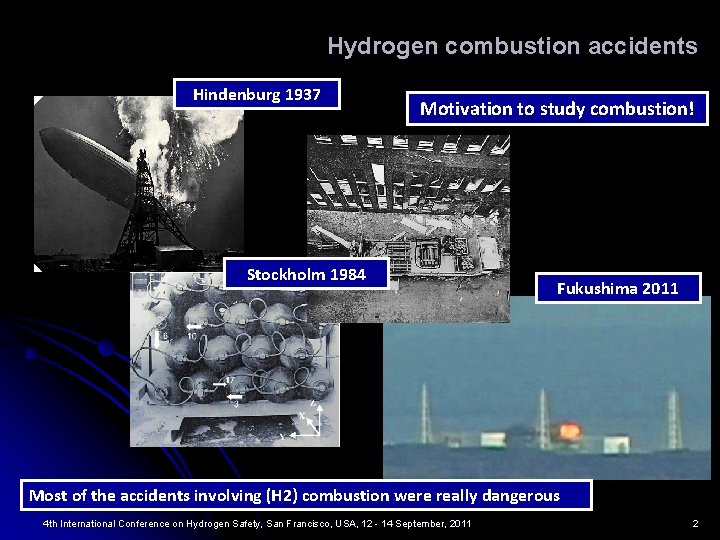
Hydrogen combustion accidents Hindenburg 1937 Motivation to study combustion! Stockholm 1984 Fukushima 2011 Most of the accidents involving (H 2) combustion were really dangerous 4 th International Conference on Hydrogen Safety, San Francisco, USA, 12 - 14 September, 2011 2
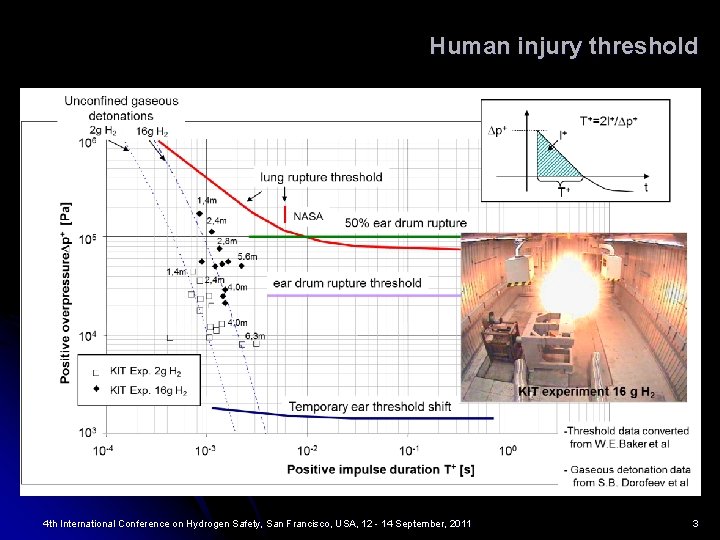
Human injury threshold 4 th International Conference on Hydrogen Safety, San Francisco, USA, 12 - 14 September, 2011 3
Industrial accident initial conditions § § Various H 2 -air mixture compositions (4% - 75%) Various geometry environment § § Various congestion § § Open geometry (external explosions): outside buildings, little influence of partial confinement and obstacles (in containment such as dome area) Partially confined: limitation in space, geometrical limitations (semiopen configurations; near wall, roof; etc) Confined explosions (internal explosions) inside rooms, compartments, pipes, etc High: high space blockage by pipework, cabling, repeating obstacles, etc Medium: intermediate level of space obstruction Low: open space with little blockage of the flame propagation path Ignition source 4 th International Conference on Hydrogen Safety, San Francisco, USA, 12 - 14 September, 2011 4
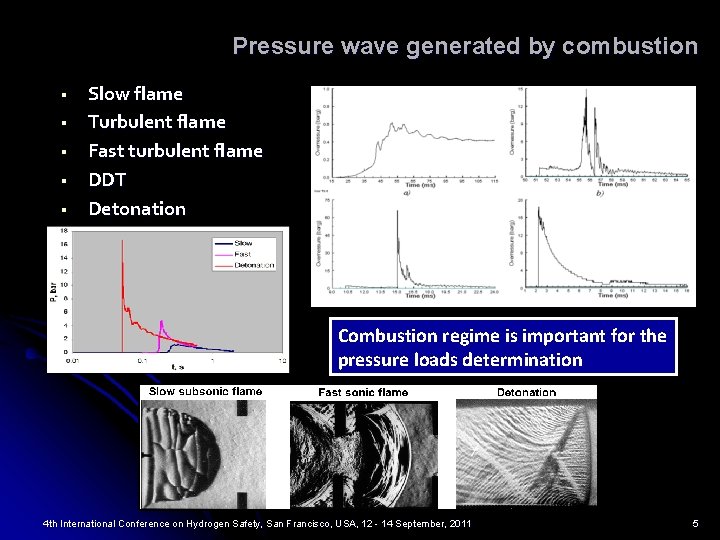
Pressure wave generated by combustion § § § Slow flame Turbulent flame Fast turbulent flame DDT Detonation Combustion regime is important for the pressure loads determination 4 th International Conference on Hydrogen Safety, San Francisco, USA, 12 - 14 September, 2011 5
Practical needs - - Safety engineer needs to know which combustion regime is to be expected Numerous scientific studies on FA and DDT still do not provide complete understanding of these complicated events, which usually exhibit probabilistic nature and complicate their confident prediction both in the experiments and in detailed CFD simulations Complexity of the modeling for turbulent combustion - Simplified outdated models as EBU, EDM, etc Widely using now in engineering simulations BVM - - A number of different correlations Poor accounting of flame instabilities Complexity of adequate modeling of turbulence (RANS vs. LES) PDF approach requires better theory 4 th International Conference on Hydrogen Safety, San Francisco, USA, 12 - 14 September, 2011 6
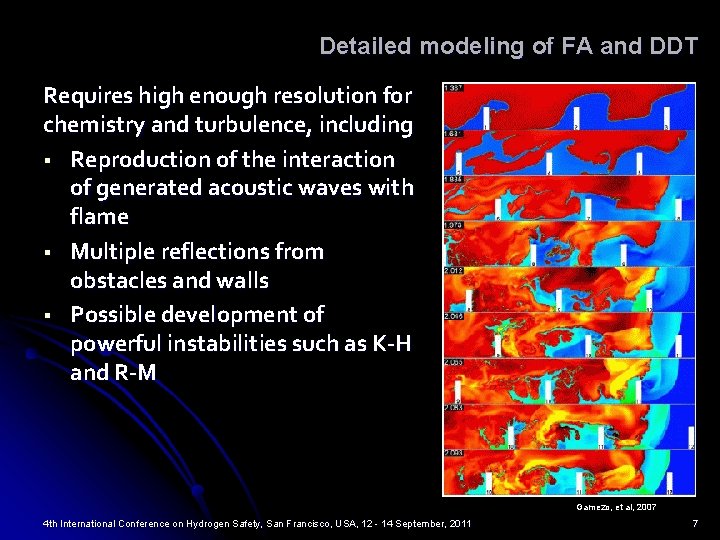
Detailed modeling of FA and DDT Requires high enough resolution for chemistry and turbulence, including § Reproduction of the interaction of generated acoustic waves with flame § Multiple reflections from obstacles and walls § Possible development of powerful instabilities such as K-H and R-M Gamezo, et al, 2007 4 th International Conference on Hydrogen Safety, San Francisco, USA, 12 - 14 September, 2011 7
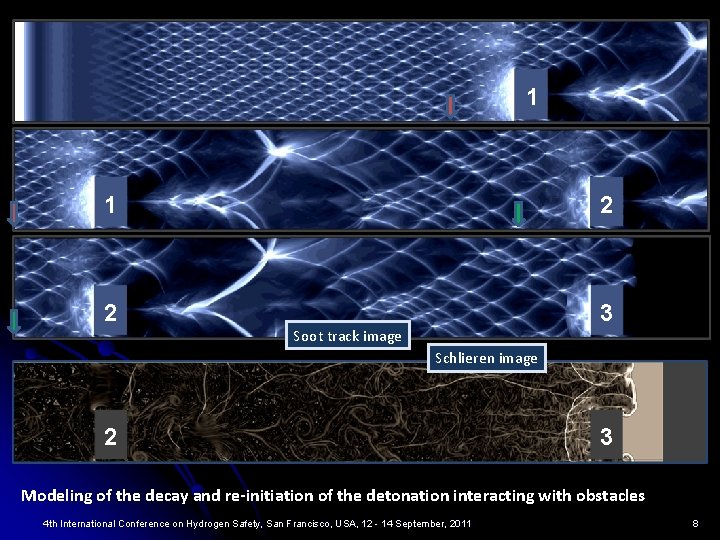
1 1 2 2 3 Soot track image Schlieren image 2 3 Modeling of the decay and re-initiation of the detonation interacting with obstacles 4 th International Conference on Hydrogen Safety, San Francisco, USA, 12 - 14 September, 2011 8
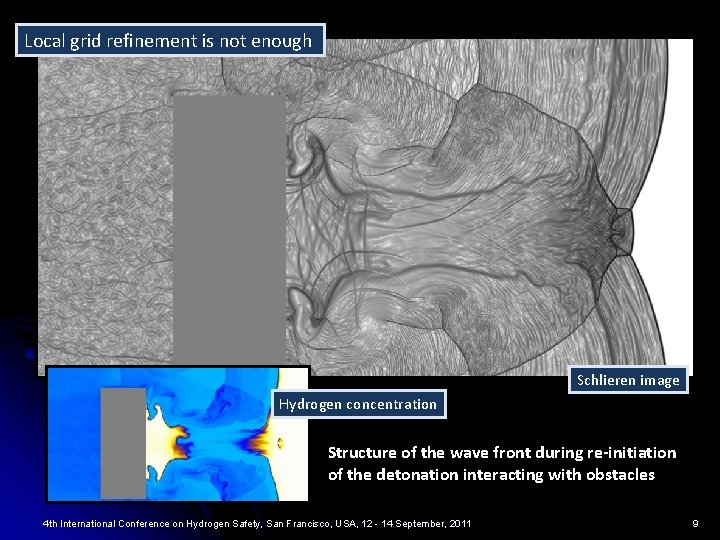
Local grid refinement is not enough Schlieren image Hydrogen concentration Structure of the wave front during re-initiation of the detonation interacting with obstacles 4 th International Conference on Hydrogen Safety, San Francisco, USA, 12 - 14 September, 2011 9
- - The principles of combustion and detonation processes can be basically considered as known, however distinct prediction of the flame propagation regime is still challenging task The technical recipes often used, can be subjective or even not fully consistent, such as e. g. , - - LFL and UFL for combustion possibility Concentration limits for explosion possibility Evaluation of the combustion speed in comparison with sound speed as criterion for transition to detonation Methodology which is considered below is based on the evaluation of the possibility for FA and DDT depending on engineering characteristics of the system, such as geometrical properties and composition of the mixture 4 th International Conference on Hydrogen Safety, San Francisco, USA, 12 - 14 September, 2011 10
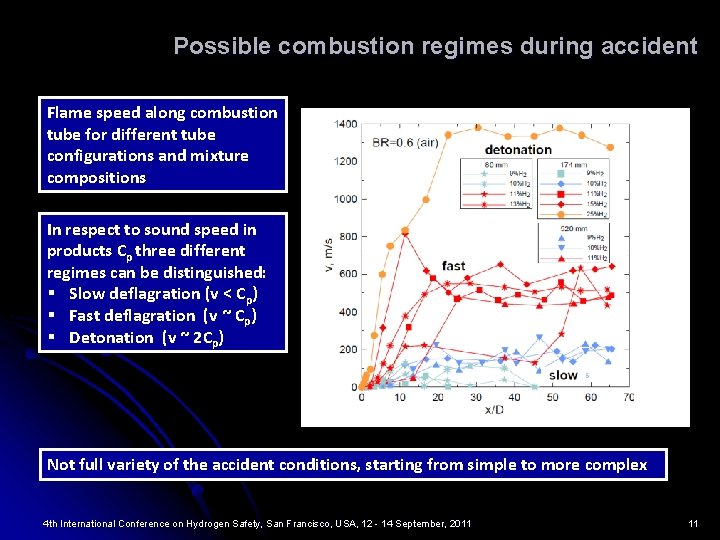
Possible combustion regimes during accident Flame speed along combustion tube for different tube configurations and mixture compositions In respect to sound speed in products Cp three different regimes can be distinguished: § Slow deflagration (v < Cp) § Fast deflagration (v ~ Cp) § Detonation (v ~ 2 Cp) Not full variety of the accident conditions, starting from simple to more complex 4 th International Conference on Hydrogen Safety, San Francisco, USA, 12 - 14 September, 2011 11
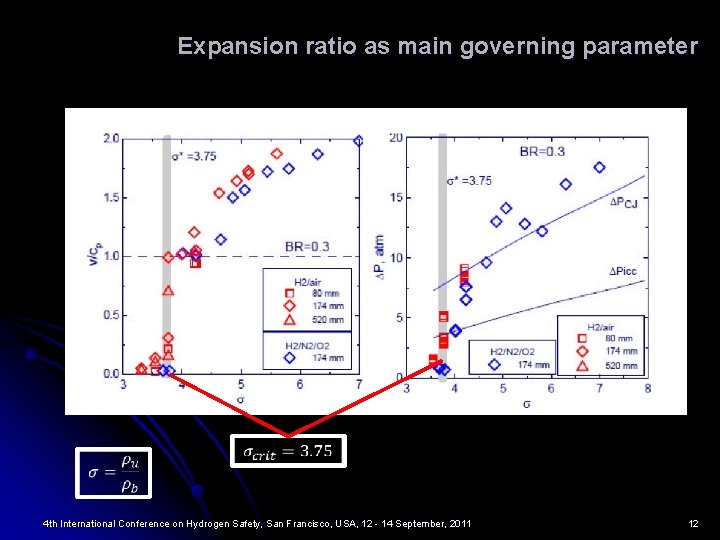
Expansion ratio as main governing parameter 4 th International Conference on Hydrogen Safety, San Francisco, USA, 12 - 14 September, 2011 12
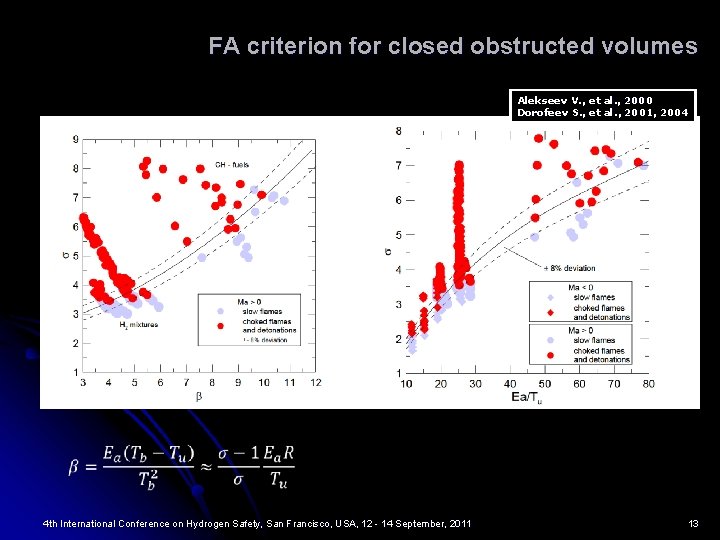
FA criterion for closed obstructed volumes Alekseev V. , et al. , 2000 Dorofeev S. , et al. , 2001, 2004 4 th International Conference on Hydrogen Safety, San Francisco, USA, 12 - 14 September, 2011 13
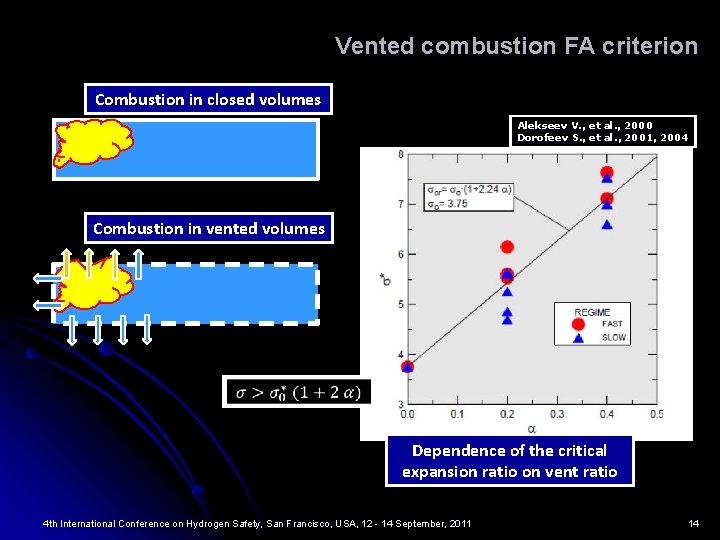
Vented combustion FA criterion Combustion in closed volumes Alekseev V. , et al. , 2000 Dorofeev S. , et al. , 2001, 2004 Combustion in vented volumes Dependence of the critical expansion ratio on vent ratio 4 th International Conference on Hydrogen Safety, San Francisco, USA, 12 - 14 September, 2011 14
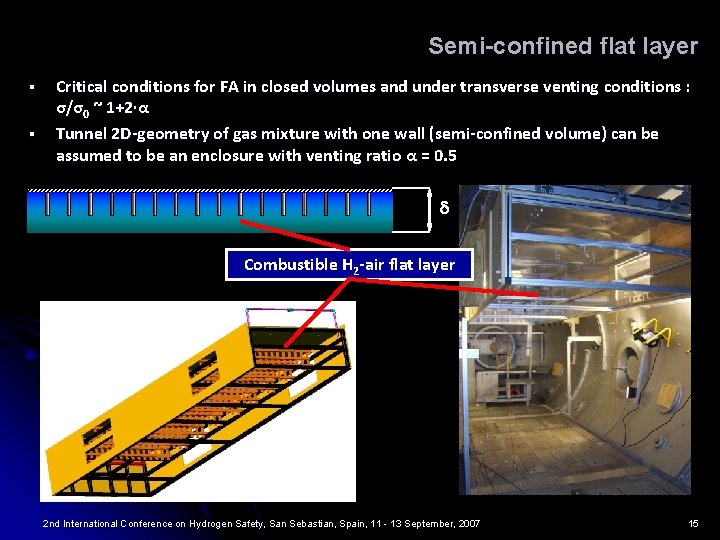
Semi-confined flat layer § § Critical conditions for FA in closed volumes and under transverse venting conditions : σ/σ0 ~ 1+2·α Tunnel 2 D-geometry of gas mixture with one wall (semi-confined volume) can be assumed to be an enclosure with venting ratio α = 0. 5 d Combustible H 2 -air flat layer 2 nd International Conference on Hydrogen Safety, San Sebastian, Spain, 11 - 13 September, 2007 15
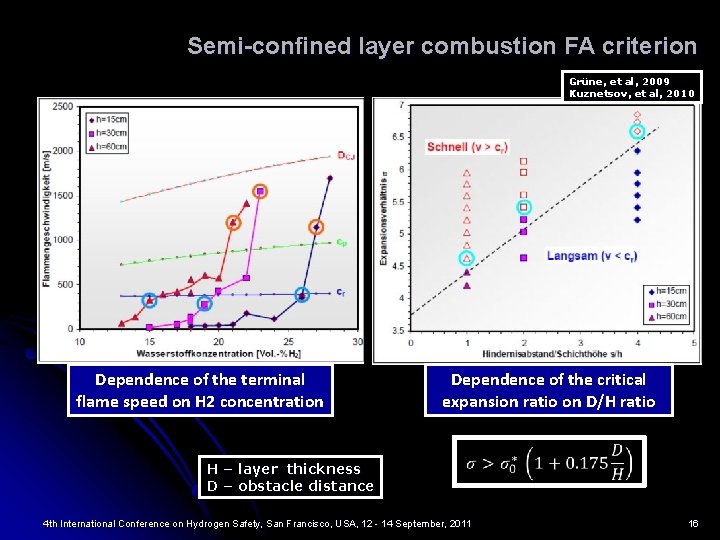
Semi-confined layer combustion FA criterion Grüne, et al, 2009 Kuznetsov, et al, 2010 Dependence of the terminal flame speed on H 2 concentration Dependence of the critical expansion ratio on D/H ratio H – layer thickness D – obstacle distance 4 th International Conference on Hydrogen Safety, San Francisco, USA, 12 - 14 September, 2011 16
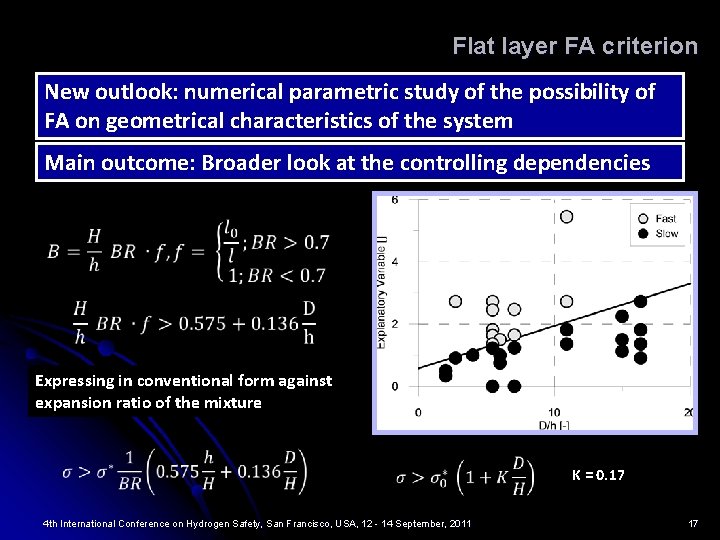
Flat layer FA criterion New outlook: numerical parametric study of the possibility of FA on geometrical characteristics of the system Main outcome: Broader look at the controlling dependencies Expressing in conventional form against expansion ratio of the mixture K = 0. 17 4 th International Conference on Hydrogen Safety, San Francisco, USA, 12 - 14 September, 2011 17
Summary - - The studies targeted to formulation of the principles (criteria) permitting reliably (or at least conservatively) predict possible combustion regimes have to be highly appreciated An acceptance and approval of the standards based on such criteria has to be considered as significant improvement in safety regulations 4 th International Conference on Hydrogen Safety, San Francisco, USA, 12 - 14 September, 2011 18
- Slides: 18