
Combustion Driven Compaction of Nanostructured Sm CoFe Exchange
Combustion Driven Compaction of Nanostructured Sm. Co/Fe • Exchange spring magnetic materials can potentially increase the energy-products of permanent magnets • Powder consolidation has the ability to form composite magnets with arbitrary 3 D shapes and sizes, less $ for expensive hard phase, possibility of mechanical fiber reinforcements
Approach • Obtain high coercivity by ballmilling hard phase • Increase magnetization of the ballmilled hard phase by mixing with soft -phase • Obtain exchange coupling between the hard and the soft phase by compaction
Challenges for compacted nanocomposites • Preserve original phases during compaction • Achieve strong coupling across interfaces Here compare results for consolidation by three different methods: Hot Isostatic Pressing (HIP), Plasma Pressure Compaction (P 2 C), and Combustion Driven Compaction (CDC)
Powder Precursors • Sm 2 Co 17 (= Sm(Co 0. 67 Fe 0. 234 Cu 0. 07 Zr 0. 024)7. 5)* or Sm. Co 5 for the hard phase [d ~ 1 mm] [*Courtesy of C. Chen, Electron Energy Corporation] • High crystallinity acicular-Fe nanoparticles for soft phase [length ~ 200 nm, d ~ 20 nm] [Courtesy of J. Nakano, Toda Corporation] • Sm. Co and Fe powder precursors were mixed together by gentle milling

Acicular Fe Nanoparticles • TEM of commercial acicular-Fe particles with an average length of 200 nm and average diameter of 20 nm • Hydrogen reduction at 400 °C used to remove surface Fe 3 O 4

Consolidation Methods Hot Isostatic Pressing (HIP) Plasma Pressure Compaction (P 2 C) r Compaction done at Wright. Patterson AFB 550°C, 21. 6 MPa, 5 min Compaction done at Materials Modification, Inc. , 600°C, 45 MPa, 5 min
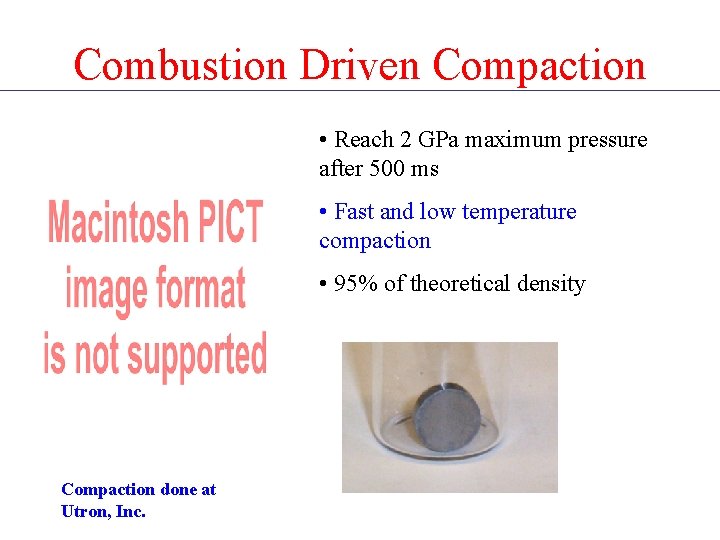
Combustion Driven Compaction • Reach 2 GPa maximum pressure after 500 ms • Fast and low temperature compaction • 95% of theoretical density Compaction done at Utron, Inc.
Different Compaction Methods • Plasma Pressure Compaction (P 2 C): 73 MPa; 5 mins; 600 o. C • Hot Isostatic Pressing (HIP): 435 k. Pa; 5 mins; 550 o. C • Combustion Driven Compaction (CDC): 2 GPa; 500 ms; “room temperature” CDC: Retains HC but here loses M because not aligned
X-ray Diffraction and CDC • Average Grain size estimates based on Scherrer analysis Powder : 190 nm Pellet : 138 nm 2 • No Sm. Co phase decomposition occurred during CDC (unlike with HIP and P 2 C) • Reduced grain-size after compaction
Different Compaction Methods • Plasma Pressure Compaction (P 2 C): 73 MPa; 5 mins; 600 o. C • Hot Isostatic Pressing (HIP): 435 k. Pa; 5 mins; 550 o. C • Combustion Driven Compaction (CDC): 2 GPa; 500 ms; “room temperature” CDC: Retains HC but here loses M because not aligned
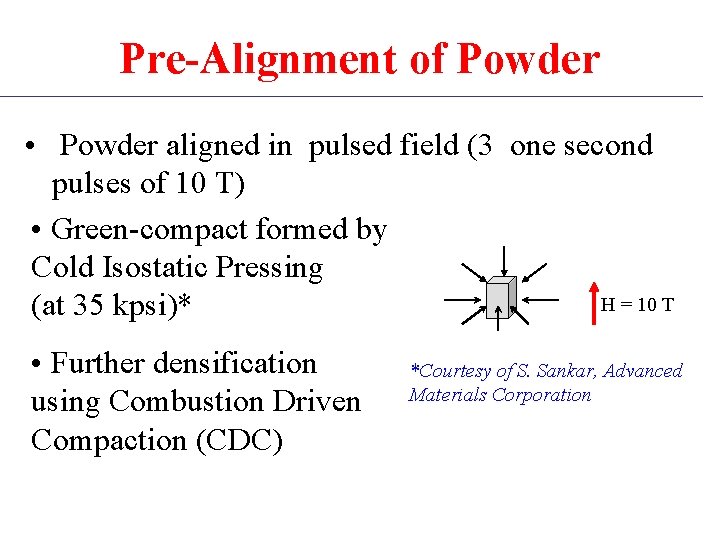
Pre-Alignment of Powder • Powder aligned in pulsed field (3 one second pulses of 10 T) • Green-compact formed by Cold Isostatic Pressing H = 10 T (at 35 kpsi)* • Further densification using Combustion Driven Compaction (CDC) *Courtesy of S. Sankar, Advanced Materials Corporation
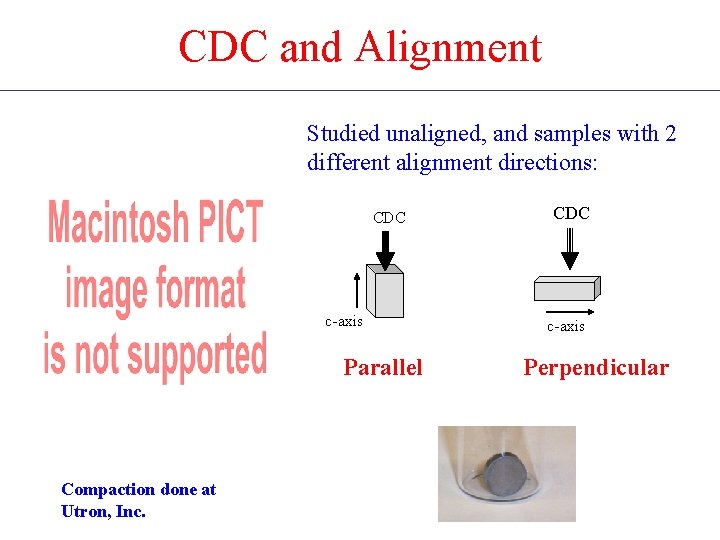
CDC and Alignment Studied unaligned, and samples with 2 different alignment directions: CDC c-axis Parallel Compaction done at Utron, Inc. CDC c-axis Perpendicular
CDC: via green-compact • Compacted parallel to c -axis (BH)max = 1. 2 x 10⁵ J/m 3 (15. 5 MGOe) • Compacted perpendicular to c-axis (BH)max = 2. 5 x 10⁵ J/m 3 (31. 3 MGOe) • Density ~ 95% in both cases
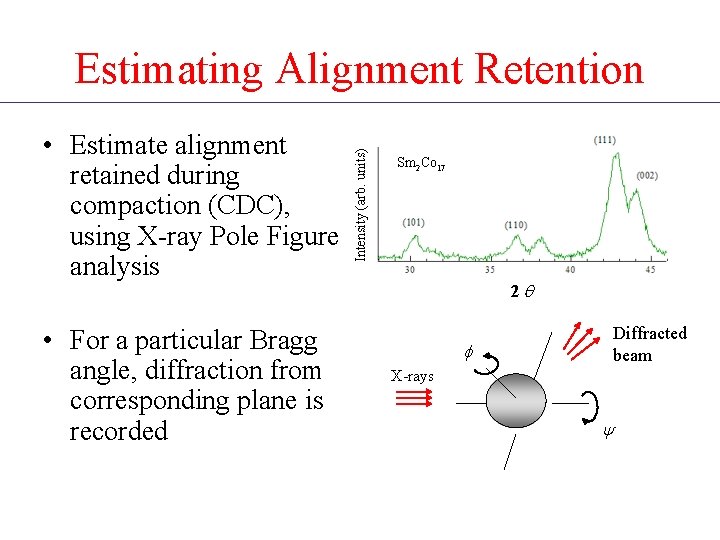
• Estimate alignment retained during compaction (CDC), using X-ray Pole Figure analysis • For a particular Bragg angle, diffraction from corresponding plane is recorded Intensity (arb. units) Estimating Alignment Retention Sm 2 Co 17 2 q f Diffracted beam X-rays y
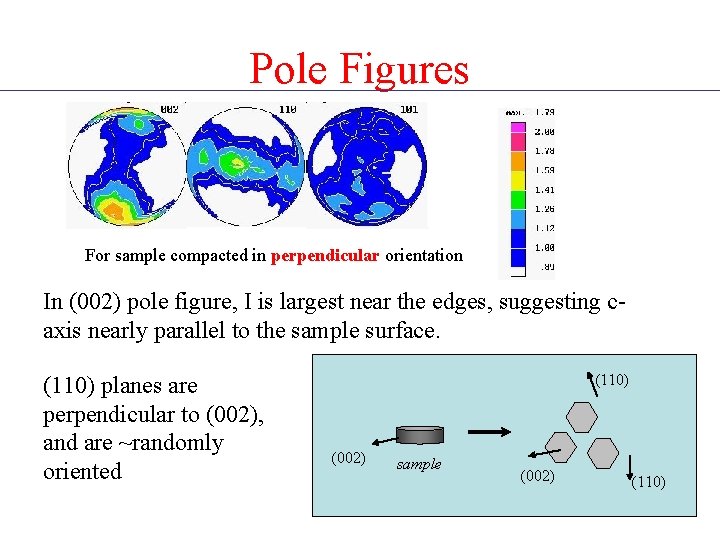
Pole Figures For sample compacted in perpendicular orientation In (002) pole figure, I is largest near the edges, suggesting caxis nearly parallel to the sample surface. (110) planes are perpendicular to (002), and are ~randomly oriented (110) (002) sample (002) (110)

Return to Home Page
- Slides: 16