
Combustion Control based on Flame Ionization Application in
Combustion Control based on Flame Ionization Application in Condensing Heating Appliances by: Martin Kiefer 07 June 2012 Venue: EF 5. B: WOC 5 Gas Quality Changes, Impact & Remedies
Overview § § § Company Profile Background and Motivation Application and System Integration Model Based Development Experimental Investigations Summary and Conclusions 2
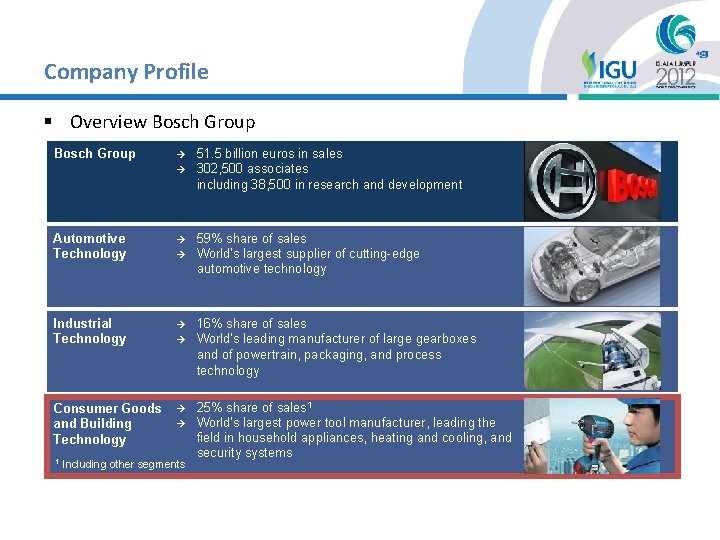
Company Profile § Overview Bosch Group è è Automotive Technology è Industrial Technology è Consumer Goods and Building Technology è 1 è è è Including other segments 51. 5 billion euros in sales 302, 500 associates including 38, 500 in research and development 59% share of sales World's largest supplier of cutting-edge automotive technology 16% share of sales World's leading manufacturer of large gearboxes and of powertrain, packaging, and process technology 25% share of sales 1 World's largest power tool manufacturer, leading the field in household appliances, heating and cooling, and security systems
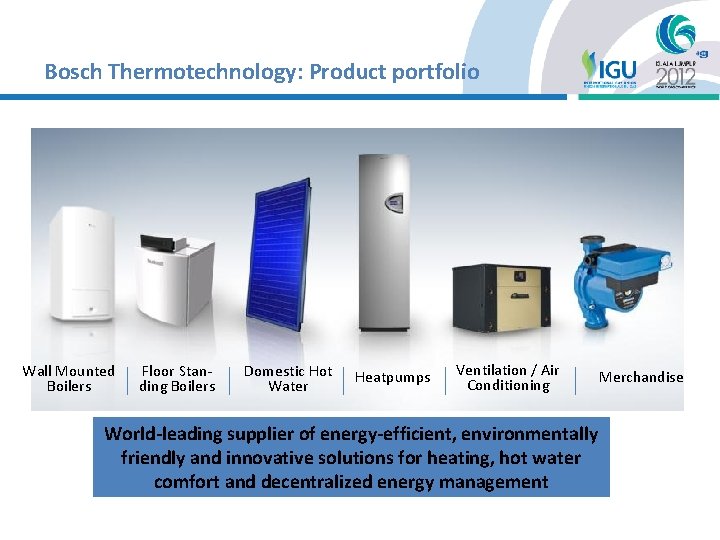
Bosch Thermotechnology: Product portfolio Wall Mounted Boilers Floor Standing Boilers Domestic Hot Water Heatpumps Ventilation / Air Conditioning World-leading supplier of energy-efficient, environmentally friendly and innovative solutions for heating, hot water comfort and decentralized energy management Merchandise
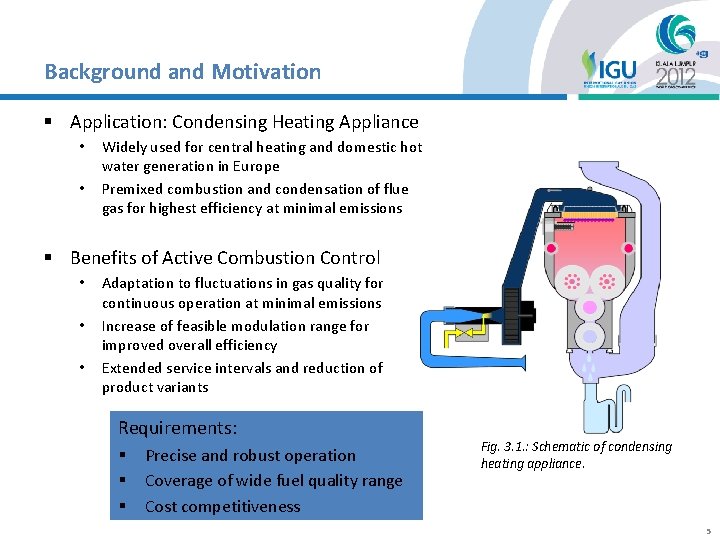
Background and Motivation § Application: Condensing Heating Appliance • • Widely used for central heating and domestic hot water generation in Europe Premixed combustion and condensation of flue gas for highest efficiency at minimal emissions § Benefits of Active Combustion Control • • • Adaptation to fluctuations in gas quality for continuous operation at minimal emissions Increase of feasible modulation range for improved overall efficiency Extended service intervals and reduction of product variants Requirements: § § § Precise and robust operation Coverage of wide fuel quality range Cost competitiveness Fig. 3. 1. : Schematic of condensing heating appliance. 5
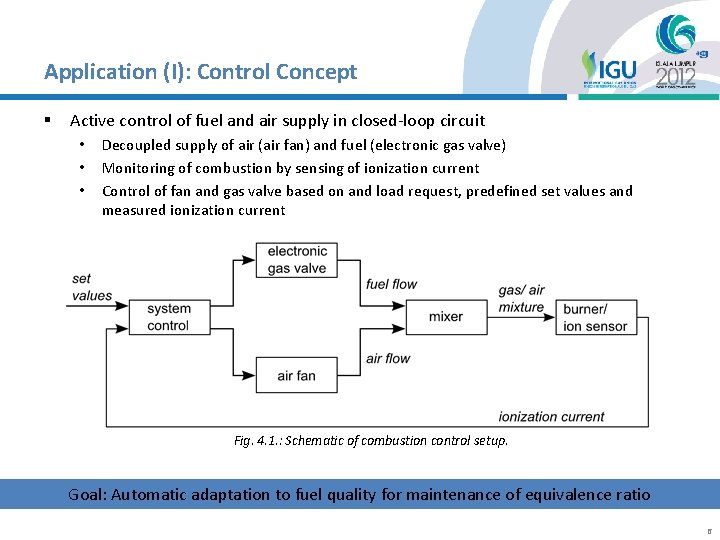
Application (I): Control Concept § Active control of fuel and air supply in closed-loop circuit • • • Decoupled supply of air (air fan) and fuel (electronic gas valve) Monitoring of combustion by sensing of ionization current Control of fan and gas valve based on and load request, predefined set values and measured ionization current Fig. 4. 1. : Schematic of combustion control setup. Goal: Automatic adaptation to fuel quality for maintenance of equivalence ratio 6
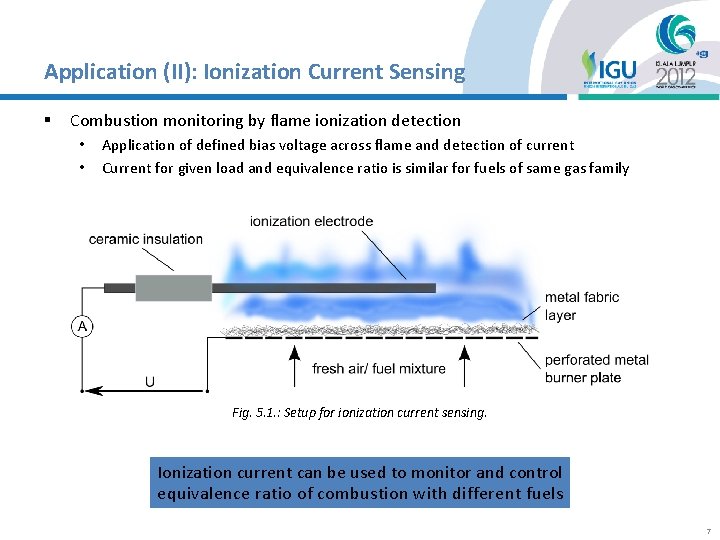
Application (II): Ionization Current Sensing § Combustion monitoring by flame ionization detection • • Application of defined bias voltage across flame and detection of current Current for given load and equivalence ratio is similar for fuels of same gas family Fig. 5. 1. : Setup for ionization current sensing. Ionization current can be used to monitor and control equivalence ratio of combustion with different fuels 7
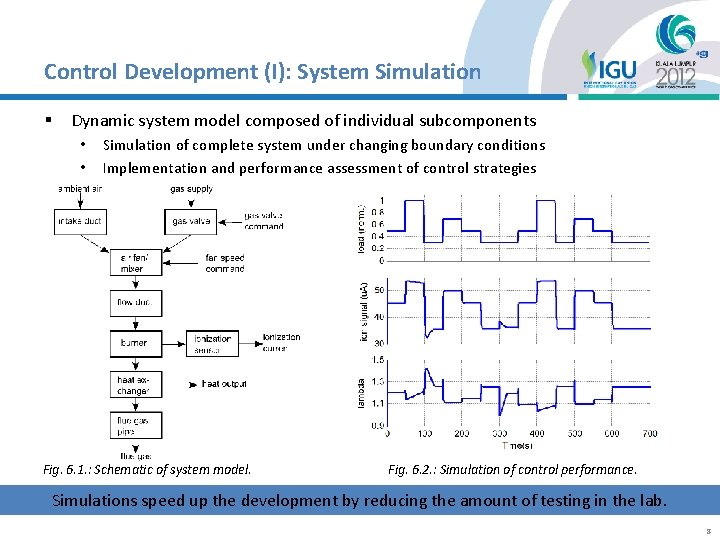
Control Development (I): System Simulation § Dynamic system model composed of individual subcomponents • • Simulation of complete system under changing boundary conditions Implementation and performance assessment of control strategies Fig. 6. 1. : Schematic of system model. Fig. 6. 2. : Simulation of control performance. Simulations speed up the development by reducing the amount of testing in the lab. 8
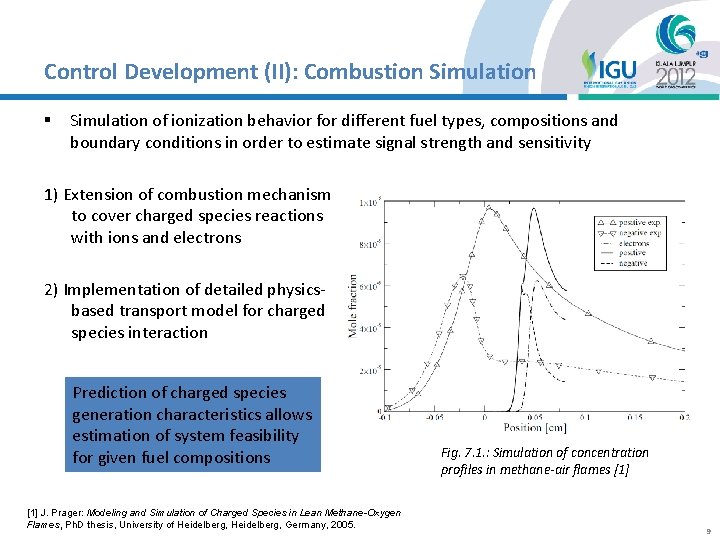
Control Development (II): Combustion Simulation § Simulation of ionization behavior for different fuel types, compositions and boundary conditions in order to estimate signal strength and sensitivity 1) Extension of combustion mechanism to cover charged species reactions with ions and electrons 2) Implementation of detailed physicsbased transport model for charged species interaction Prediction of charged species generation characteristics allows estimation of system feasibility for given fuel compositions [1] J. Prager: Modeling and Simulation of Charged Species in Lean Methane-Oxygen Flames, Ph. D thesis, University of Heidelberg, Germany, 2005. Fig. 7. 1. : Simulation of concentration profiles in methane-air flames [1] 9
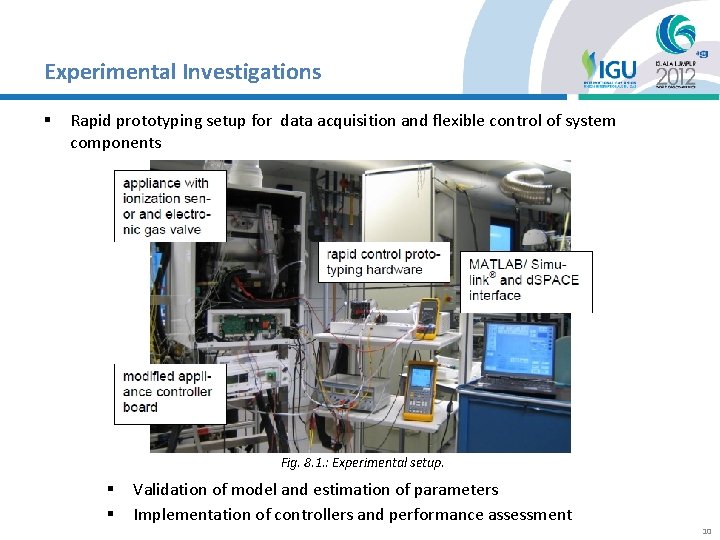
Experimental Investigations § Rapid prototyping setup for data acquisition and flexible control of system components Fig. 8. 1. : Experimental setup. § § Validation of model and estimation of parameters Implementation of controllers and performance assessment 10
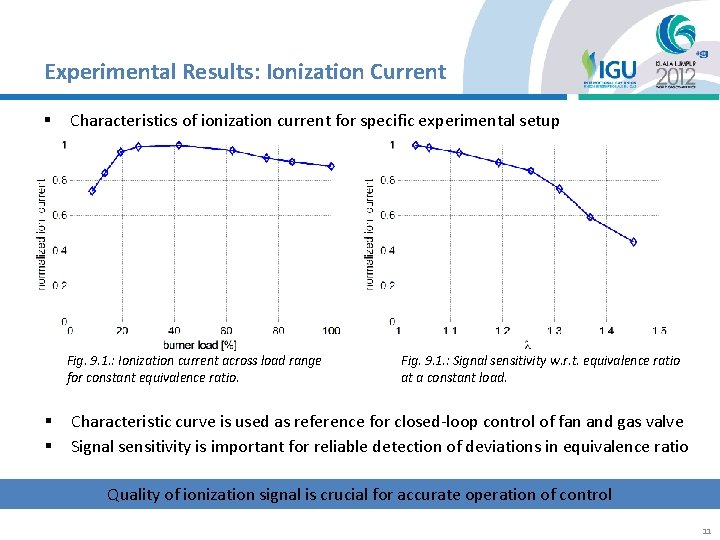
Experimental Results: Ionization Current § Characteristics of ionization current for specific experimental setup Fig. 9. 1. : Ionization current across load range for constant equivalence ratio. § § Fig. 9. 1. : Signal sensitivity w. r. t. equivalence ratio at a constant load. Characteristic curve is used as reference for closed-loop control of fan and gas valve Signal sensitivity is important for reliable detection of deviations in equivalence ratio Quality of ionization signal is crucial for accurate operation of control 11
Summary and Conclusions § Results • Reliable control of combustion for different fuel types across wide modulation range has been shown • Active control allows reduction of emissions and increase of overall appliance efficiency for various fuel types • Cost-competitive technology in terms of required components § Major challenges • Understanding and optimization of ionization signal generation • Modeling and simulation of ionization characteristics • Implementation of robust control algorithms for safe and reliable operation 12
- Slides: 12