
Combining theory of didactical situations and semiotic theory
Combining theory of didactical situations and semiotic theory — to investigate students’ enterprise of representing a relationship in algebraic notation MEC Annual Symposium LOUGHBOROUGH UNIVERSITY — 25 MAY 2017 Heidi Strømskag Norwegian University of Science and Technology
TDS: THEORY OF DIDACTICAL SITUATIONS IN MATHEMATICS § Systemic framework Particularity of – investigating mathematics teaching and learning the knowledge – supporting didactical design in mathematics taught § Applicability - Intention § Methodology Didactical engineering Ordinary teaching situations Brousseau, G. (1997). The theory of didactical situations in mathematics: Didactique des mathématiques, 1970 -1990. Dordrecht: Kluwer.
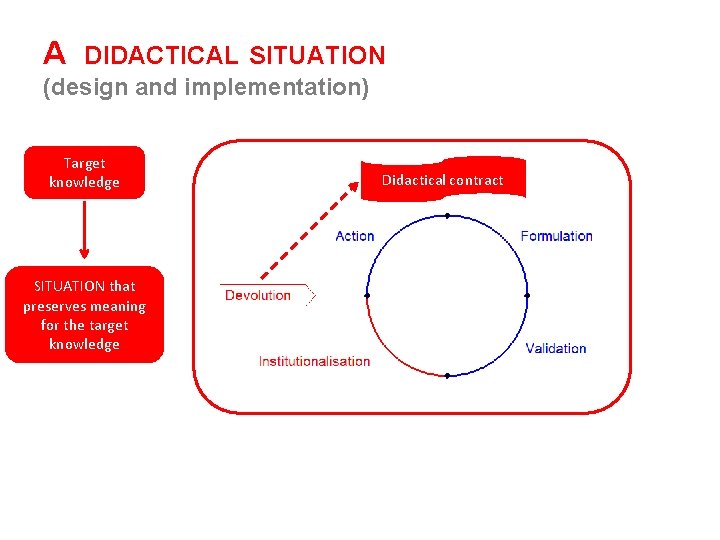
A DIDACTICAL SITUATION (design and implementation) Target knowledge SITUATION that preserves meaning for the target knowledge Didactical contract
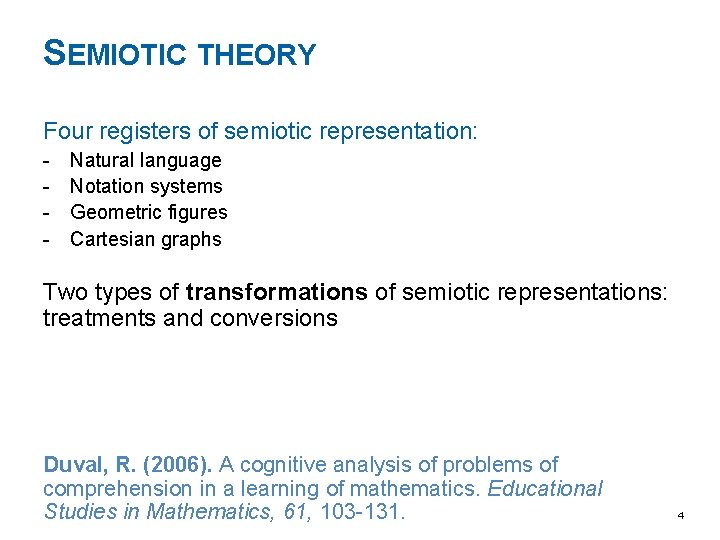
SEMIOTIC THEORY Four registers of semiotic representation: - Natural language Notation systems Geometric figures Cartesian graphs Two types of transformations of semiotic representations: treatments and conversions Duval, R. (2006). A cognitive analysis of problems of comprehension in a learning of mathematics. Educational Studies in Mathematics, 61, 103 -131. 4
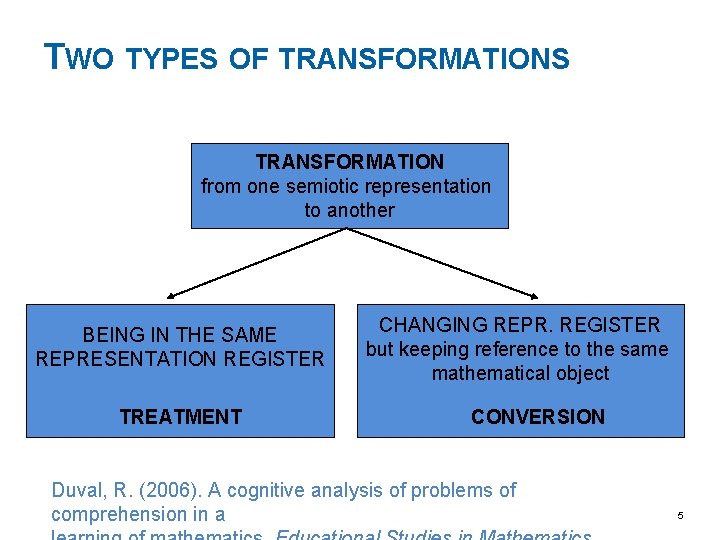
TWO TYPES OF TRANSFORMATIONS TRANSFORMATION from one semiotic representation to another BEING IN THE SAME REPRESENTATION REGISTER TREATMENT CHANGING REPR. REGISTER but keeping reference to the same mathematical object CONVERSION Duval, R. (2006). A cognitive analysis of problems of comprehension in a 5
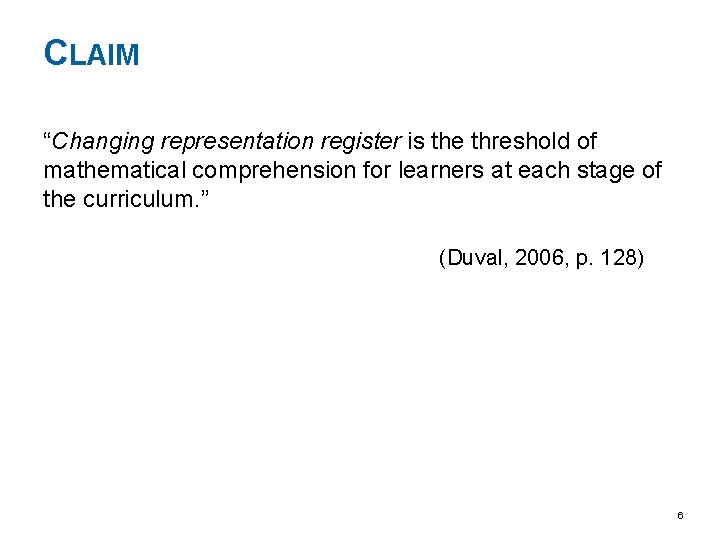
CLAIM “Changing representation register is the threshold of mathematical comprehension for learners at each stage of the curriculum. ” (Duval, 2006, p. 128) 6
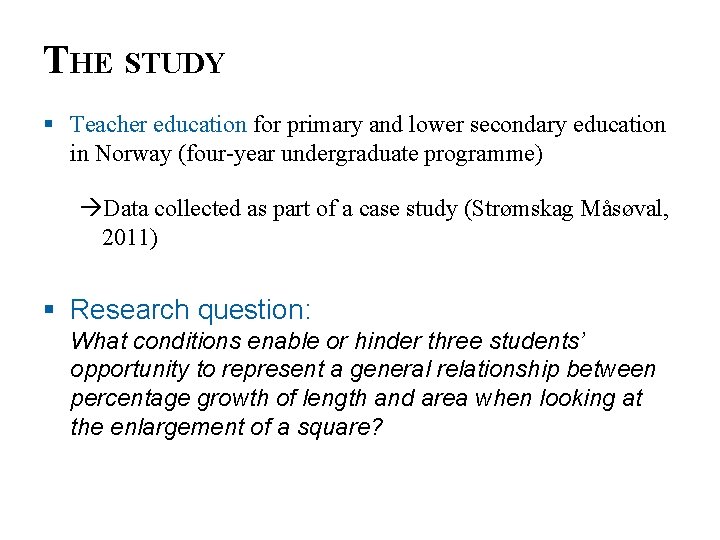
THE STUDY § Teacher education for primary and lower secondary education in Norway (four-year undergraduate programme) Data collected as part of a case study (Strømskag Måsøval, 2011) § Research question: What conditions enable or hinder three students’ opportunity to represent a general relationship between percentage growth of length and area when looking at the enlargement of a square?
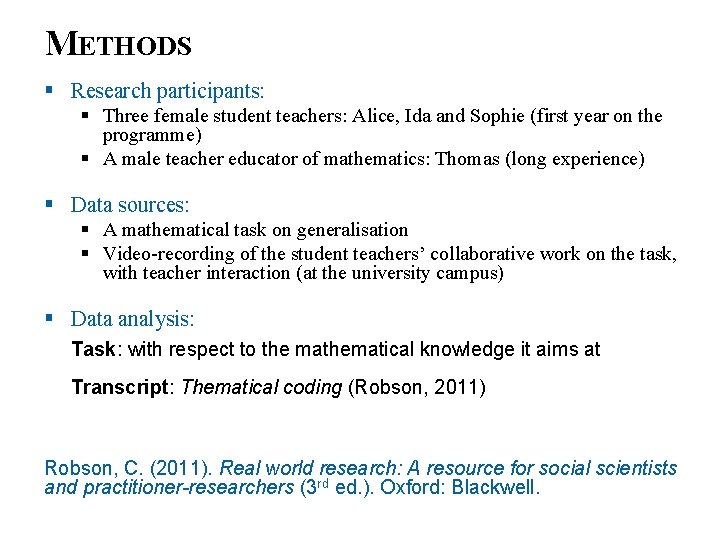
METHODS § Research participants: § Three female student teachers: Alice, Ida and Sophie (first year on the programme) § A male teacher educator of mathematics: Thomas (long experience) § Data sources: § A mathematical task on generalisation § Video-recording of the student teachers’ collaborative work on the task, with teacher interaction (at the university campus) § Data analysis: Task: with respect to the mathematical knowledge it aims at Transcript: Thematical coding (Robson, 2011) Robson, C. (2011). Real world research: A resource for social scientists and practitioner-researchers (3 rd ed. ). Oxford: Blackwell.
REASONS FOR CHOICE OF THE EPISODE § it provides an example of an evolution of the milieu which enabled the students to develop the knowledge aimed at § it shows the utility and complexity of changing representation register when solving a generalization task
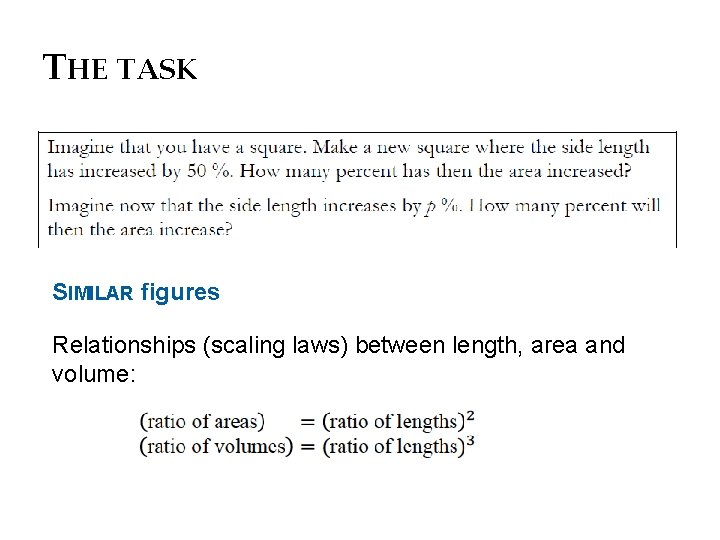
THE TASK SIMILAR figures Relationships (scaling laws) between length, area and volume:
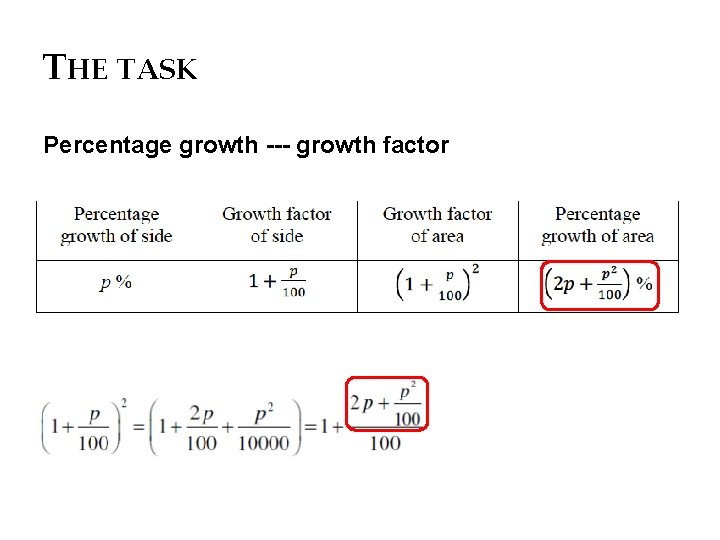
THE TASK Percentage growth --- growth factor
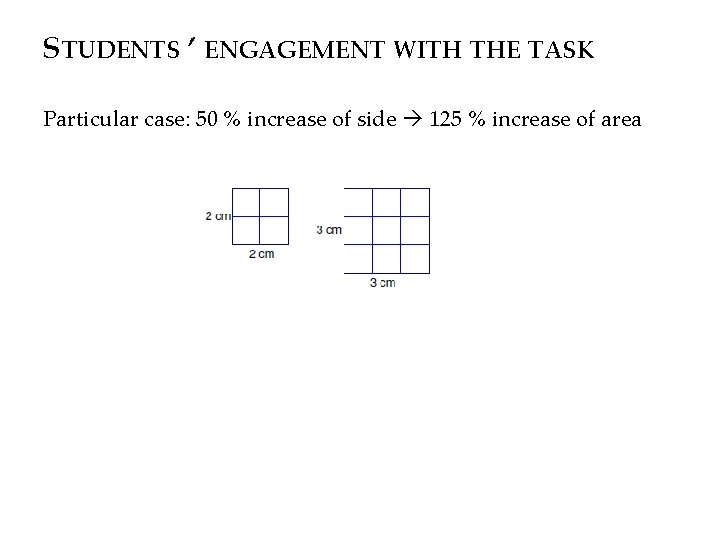
STUDENTS ’ ENGAGEMENT WITH THE TASK Particular case: 50 % increase of side 125 % increase of area
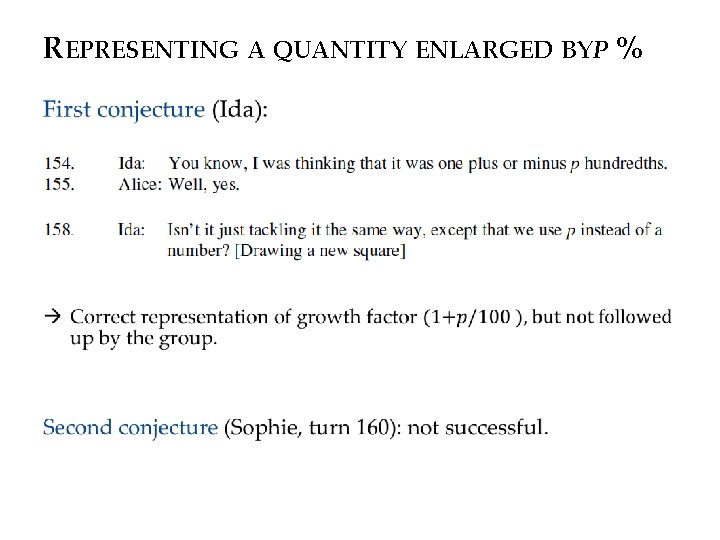
REPRESENTING A QUANTITY ENLARGED BYP % •
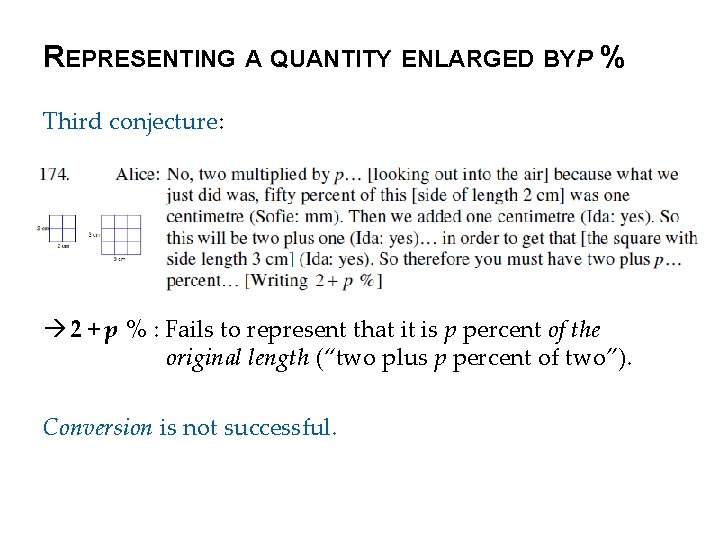
REPRESENTING A QUANTITY ENLARGED BYP % Third conjecture: 2 + p % : Fails to represent that it is p percent of the original length (“two plus p percent of two”). Conversion is not successful.
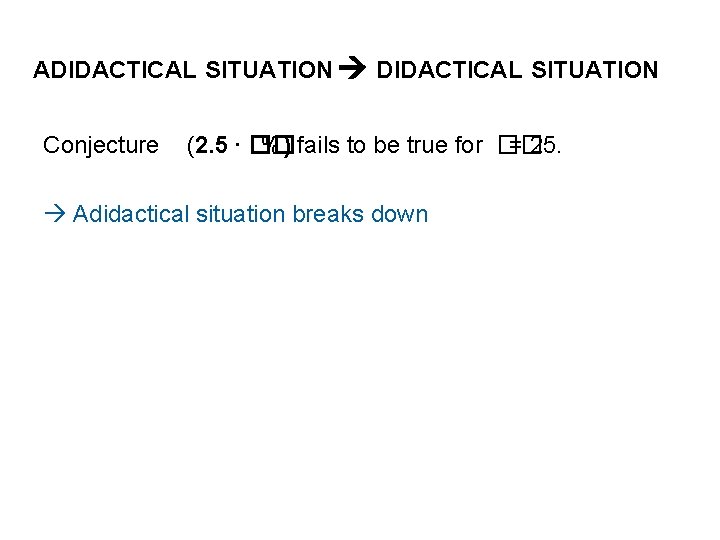
ADIDACTICAL SITUATION Conjecture (2. 5 ∙ �� %) fails to be true for �� = 25. Adidactical situation breaks down
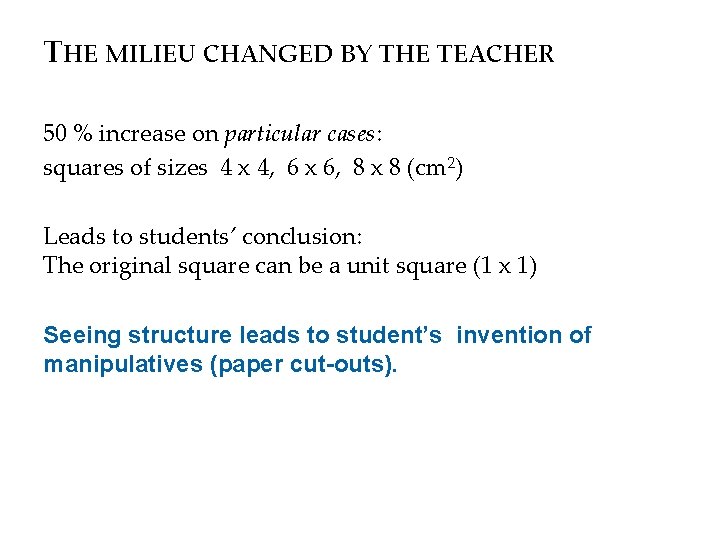
THE MILIEU CHANGED BY THE TEACHER 50 % increase on particular cases: squares of sizes 4 x 4, 6 x 6, 8 x 8 (cm 2) Leads to students’ conclusion: The original square can be a unit square (1 x 1) Seeing structure leads to student’s invention of manipulatives (paper cut-outs).
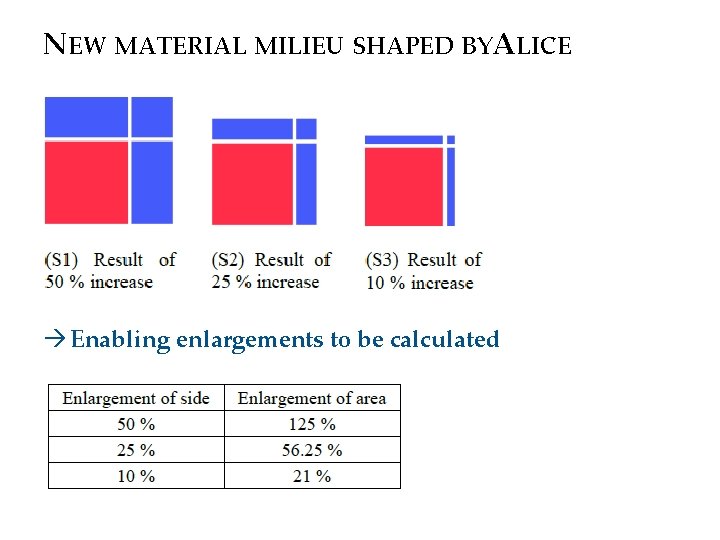
NEW MATERIAL MILIEU SHAPED BYALICE Enabling enlargements to be calculated
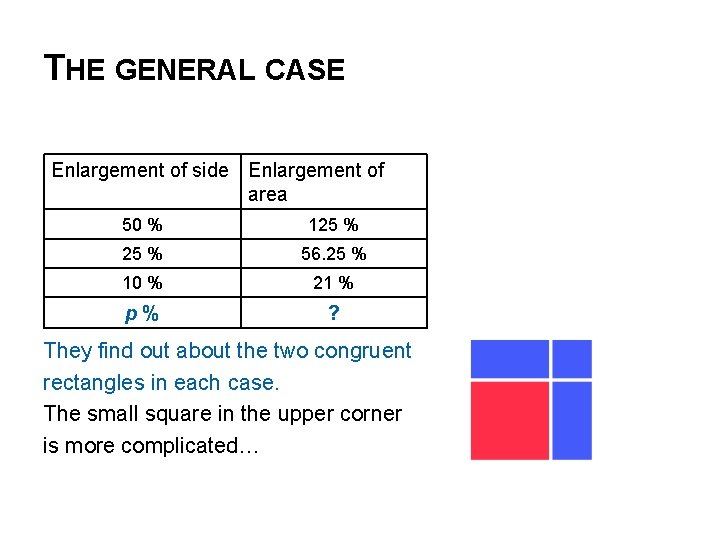
THE GENERAL CASE Enlargement of side Enlargement of area 50 % 125 % 56. 25 % 10 % 21 % p% ? They find out about the two congruent rectangles in each case. The small square in the upper corner is more complicated…
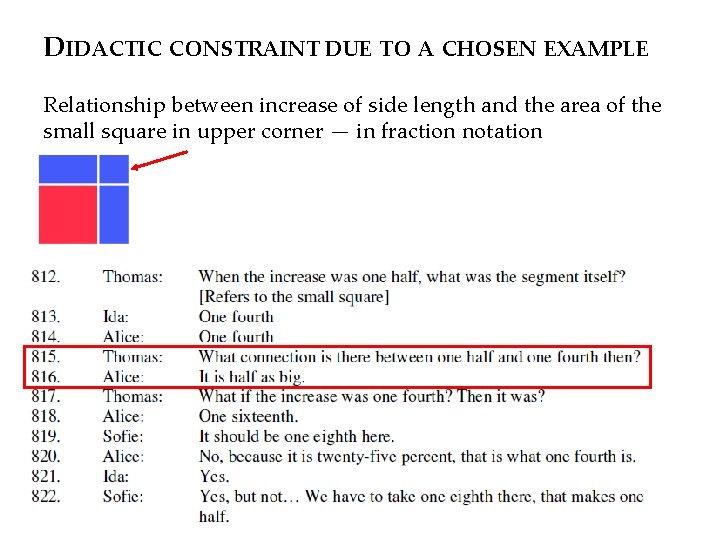
DIDACTIC CONSTRAINT DUE TO A CHOSEN EXAMPLE Relationship between increase of side length and the area of the small square in upper corner — in fraction notation
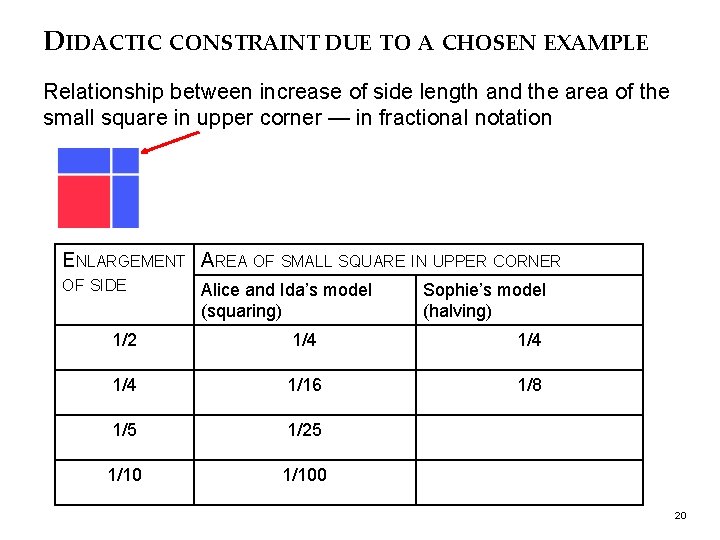
DIDACTIC CONSTRAINT DUE TO A CHOSEN EXAMPLE Relationship between increase of side length and the area of the small square in upper corner — in fractional notation ENLARGEMENT AREA OF SMALL SQUARE IN UPPER CORNER OF SIDE Alice and Ida’s model (squaring) Sophie’s model (halving) 1/2 1/4 1/4 1/16 1/8 1/5 1/25 1/100 20
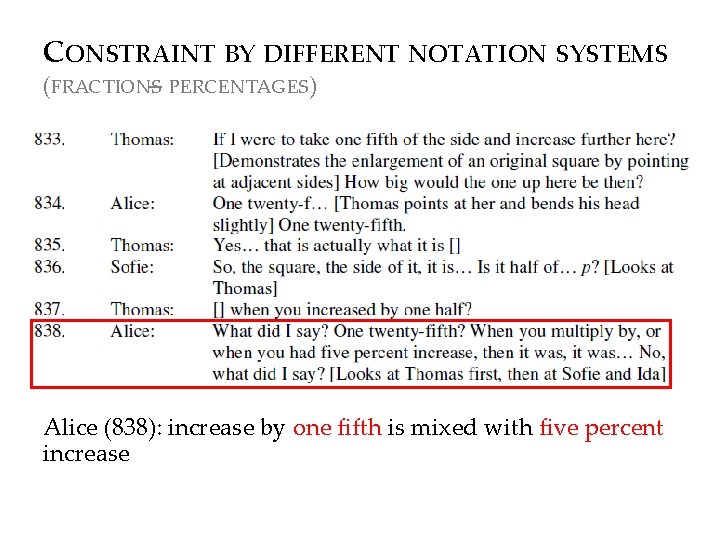
CONSTRAINT BY DIFFERENT NOTATION SYSTEMS (FRACTIONS – PERCENTAGES) Alice (838): increase by one fifth is mixed with five percent increase
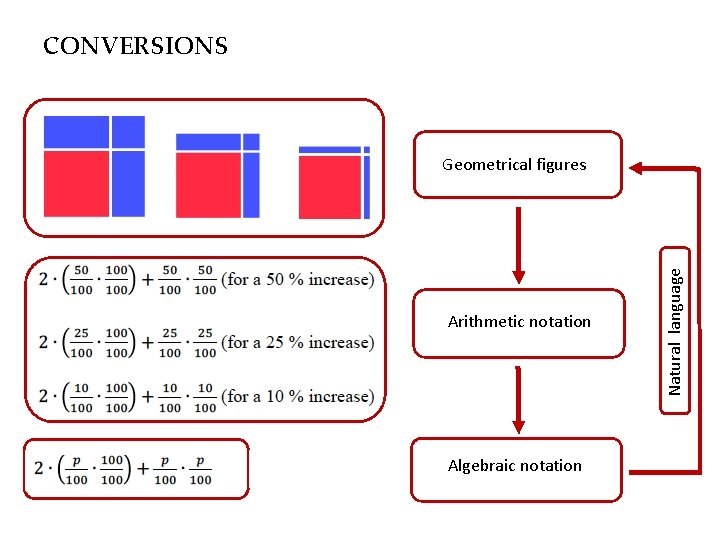
CONVERSIONS Arithmetic notation Algebraic notation Natural language Geometrical figures
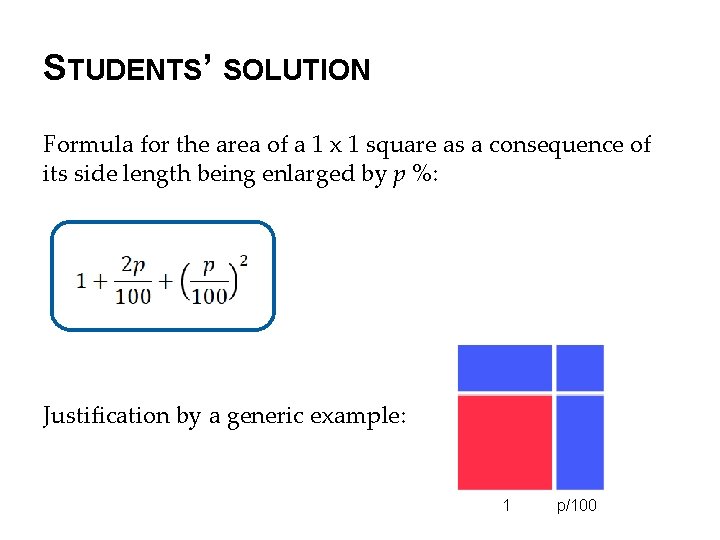
STUDENTS’ SOLUTION Formula for the area of a 1 x 1 square as a consequence of its side length being enlarged by p %: Justification by a generic example: 1 p/100
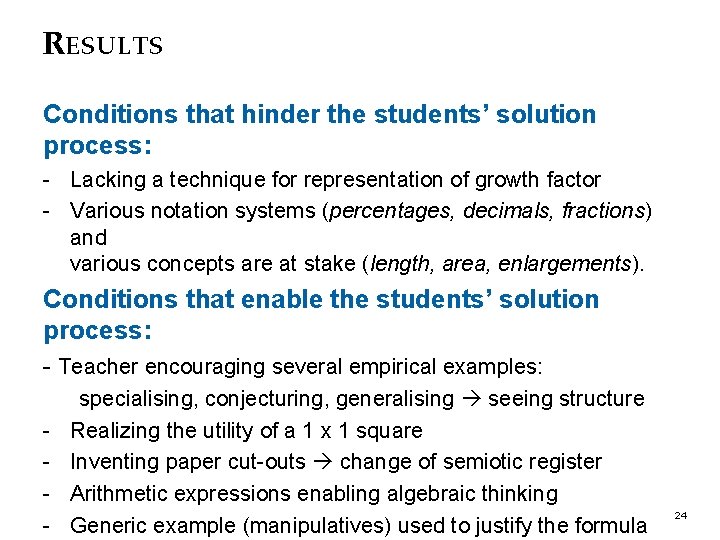
RESULTS Conditions that hinder the students’ solution process: - Lacking a technique for representation of growth factor - Various notation systems (percentages, decimals, fractions) and various concepts are at stake (length, area, enlargements). Conditions that enable the students’ solution process: - Teacher encouraging several empirical examples: - specialising, conjecturing, generalising seeing structure Realizing the utility of a 1 x 1 square Inventing paper cut-outs change of semiotic register Arithmetic expressions enabling algebraic thinking Generic example (manipulatives) used to justify the formula 24
RELEVANCE Fine-grained analysis of transcripts of classroom communication a detailed analysis of the functioning of knowledge and exploration of didactic variables that can lead to its modification - What figures to be used? What numbers to be used? What should the material milieu look like? What semiotic representations to be used intended conversions?
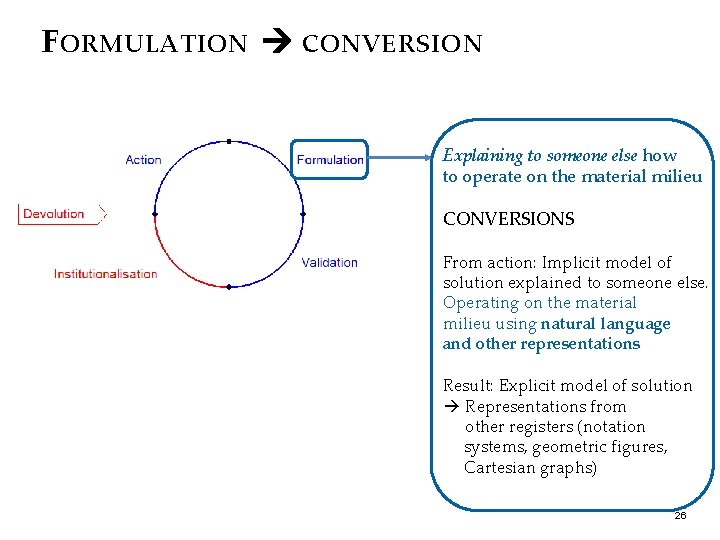
FORMULATION CONVERSION Explaining to someone else how to operate on the material milieu CONVERSIONS From action: Implicit model of solution explained to someone else. Operating on the material milieu using natural language and other representations Result: Explicit model of solution Representations from other registers (notation systems, geometric figures, Cartesian graphs) 26
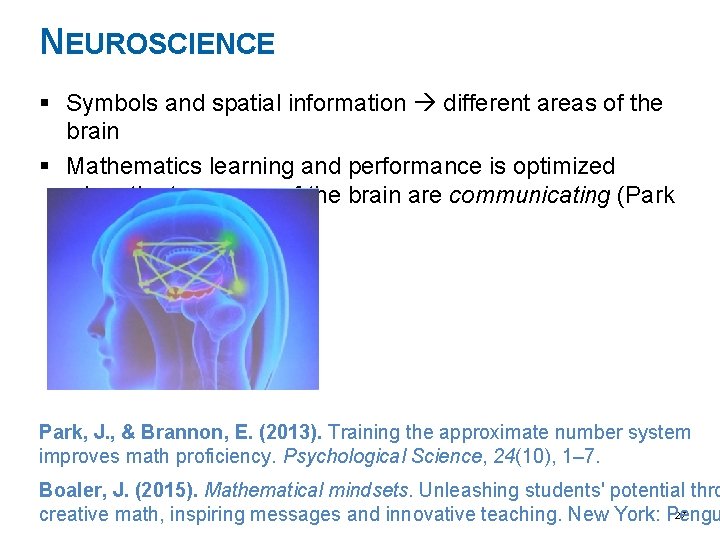
NEUROSCIENCE § Symbols and spatial information different areas of the brain § Mathematics learning and performance is optimized when the two areas of the brain are communicating (Park & Brannon, 2013) Park, J. , & Brannon, E. (2013). Training the approximate number system improves math proficiency. Psychological Science, 24(10), 1– 7. Boaler, J. (2015). Mathematical mindsets. Unleashing students' potential thro 27 creative math, inspiring messages and innovative teaching. New York: Pengu
Thank you for your attention!
- Slides: 28