
Combining Perceptions and Prescriptions in Requirements Engineering Process
Combining Perceptions and Prescriptions in Requirements Engineering Process Assessment Presented By: Hector M Lugo-Cordero, MS EEL 6883 1
Authors • Nannette P. Napier – Ph. D in Computer Information Systems at Georgia State University – Interest in Action Research for Software Development • Lars Mathiassen – Ph. D in Informatics at Oslo Univerity, Norway – Senior IEEE member • Roy D. Johson – 2 post docs in management of information systems 2
Agenda • • What is Requirements Engineering Challenges Goals Background 3
What is Requirements Engineering? • Also known as Systematic requirements analysis – Gathering – Capture or – Specification • According to Laplante (2007) – “a subdiscipline of systems engineering and software engineering that is concerned with determining the goals, functions, and constraints of hardware and software systems. ” • Covers of aspects in development life cycle of requirements in – Discovery – Documentation – Maintenance 4
Type of assessments • Inductive or problem-based – Consider stakeholder perception as important knowledge – Centers improvements on specific strengths and weaknesses of existing processes • Prescriptive or model-based – Centers improvements on best practices on industry 5
Methods of Assessment • Analyzing the RE-related data from generic software process assessments • Applying an RE-specific version of the SW-CMM • Measuring adherence to the best practices based on a dedicated RE maturity model • Scores (Requirements Engineering Good Practice Guide (REGPG) – Initial (level 1) – Repeatable (level 2) – Defined (level 3) 6
Challenges • Assessment – Specificity (uncover improvement problems) – Comparability (against best practices) – Accuracy (representation of characteristics) • How can stakeholder perceptions and process prescriptions be combined during assessment to effectively balance specificity, comparability, and accuracy challenges in RE process improvement? 7
How stakeholder perception can help out • Can provide information on traditions that shape practices within a certain company • Can help prioritize the actions in the company • Can increase commitment of subsequent changes 8
Proposed Method • Combining prescription with perception • Prescription – Can make comparison among companies – Support structured and easy-to-adopt assessment – Immediate recommendations for improvement • Perception – Understand characteristics and priorities of company – Recommendations to company context – Increase buy in and facilitate successful implementation 9
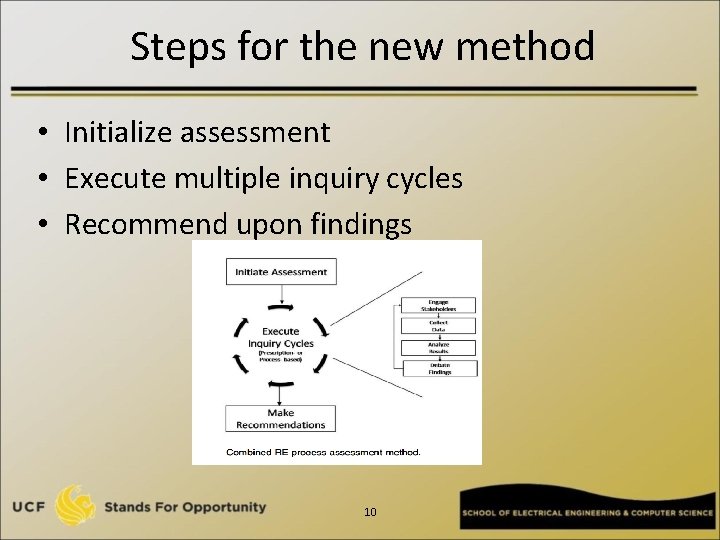
Steps for the new method • Initialize assessment • Execute multiple inquiry cycles • Recommend upon findings 10
Concerns (Step 1) • Establish commitments • Select strategy • Develop assessment plan – agree on overall inquiry cycles 11
Concerns (Step 2) • Engage stakeholders • Collect data – Documents – Observations – Interviews – Workshops • Analyze data • Debate findings 12
Concerns (Step 3) • Appreciate context • Prioritize recommendations • Develop improvement plan – Provide evidence of improvement – Areas to be improved – Establish teams 13
Industrial Case Study • Collaboration of Tele. Soft and Center for Process Innovation at Georgia State University • Investigate real world context • Evaluate impact • Perceive benefit 14
Approaches of action research • Process model – Iterative – Reflective – Linear • Structure – Rigorous – Fluid • Typical involvement – Collaborative – Facilitative – Experimental • Primary goals – Organizational development – System design – Scientific knowledge – Training 15
Learning Cycle • • • Diagnostic Planning Executing Evaluating Specifying learning 16
Team composition • Steering Committee (SC) • Problem Solving Team (PST) • Research Team 17
Pre-Assessment • Software development perceptions – Requirement document, activities, open-ended • Internal customer perception – Interviews – Workshops for validating • REGPG – requirements documents, requirements elicitation, requirements analysis and negotiation, describing requirements, system modeling, requirements validation, requirements management, and requirements engineering for critical systems • External customer perception – Interviews 18
Post-Assessment • Participant perceptions (with Software Process Improvement) – SPI Impact, Organization, and Perceptions • Software Development Questionnaire – Overall initiative, software policies, modified process, and templates – Open-ended questions (for additional details) • REGPG – Compared with previous REGPG 19
Recommendations Obtained • Continue having the PST to meet for monitoring improvement • Improve project management capability at Tel. Soft 20
Conclusions • RE assessment combined method is good for improving the quality of a company • However it is time consuming • Not appropriate for small companies – It may not be needed since good communication is achievable – Adjustments can be easily be made – Everybody is aware of each other work • The industrial case gave strength to the method accuracy 21
References • Combining Perceptions and Prescriptions in Requirements Engineering Process Assessment: An Industrial Case Study (IEEE Transactions on Software Engineering, vol. 35, issue 5, pp. 593 -606, Sept. -Oct. 2009) • http: //www. wikipedia. org 22
Questions 23
- Slides: 23