
COMBINING HETEROGENEOUS MODELS FOR MEASURING RELATIONAL SIMILARITY Alisa
COMBINING HETEROGENEOUS MODELS FOR MEASURING RELATIONAL SIMILARITY Alisa Zhila, Instituto Politecnico Nacional, Mexico Scott Wen-tau Yih, Chris Meek, Geoffrey Zweig, Microsoft Research, Redmond Tomas Mikolov, BRNO University of Technology, Czech Republic (currently at Google) NAACL-HLT 2013
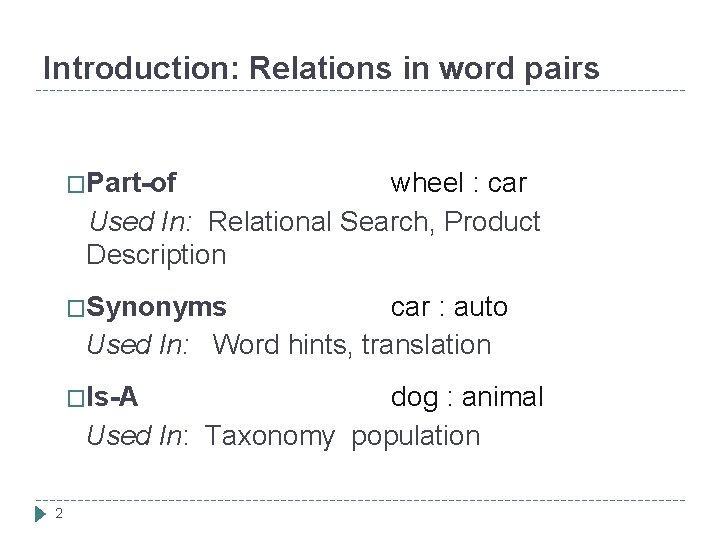
Introduction: Relations in word pairs �Part-of wheel : car Used In: Relational Search, Product Description �Synonyms car : auto Used In: Word hints, translation �Is-A dog : animal Used In: Taxonomy population 2
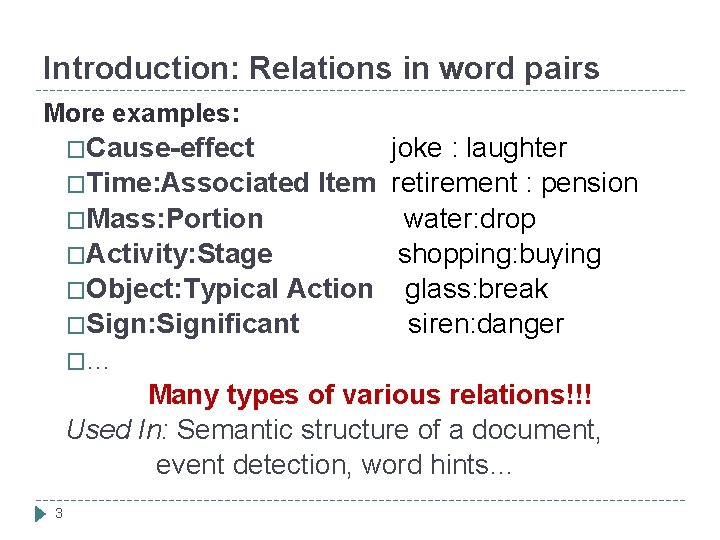
Introduction: Relations in word pairs More examples: �Cause-effect joke : laughter �Time: Associated Item retirement : pension �Mass: Portion water: drop �Activity: Stage shopping: buying �Object: Typical Action glass: break �Sign: Significant siren: danger �… Many types of various relations!!! Used In: Semantic structure of a document, event detection, word hints… 3
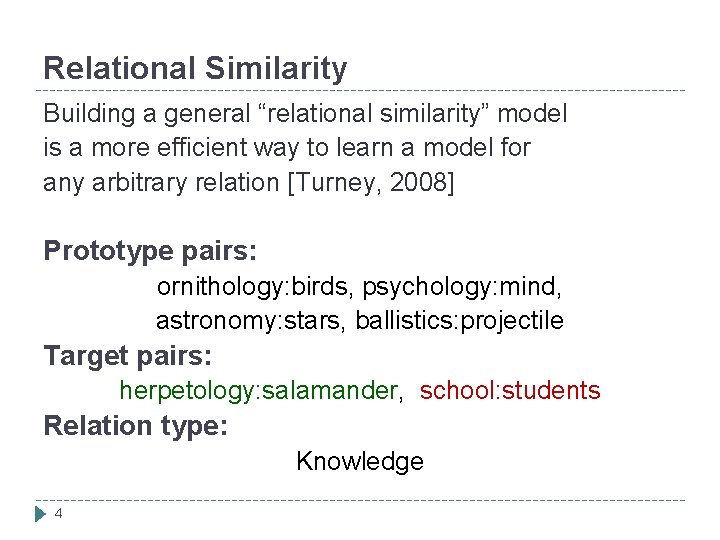
Relational Similarity Building a general “relational similarity” model is a more efficient way to learn a model for any arbitrary relation [Turney, 2008] Prototype pairs: ornithology: birds, psychology: mind, astronomy: stars, ballistics: projectile Target pairs: herpetology: salamander, school: students Relation type: Knowledge 4
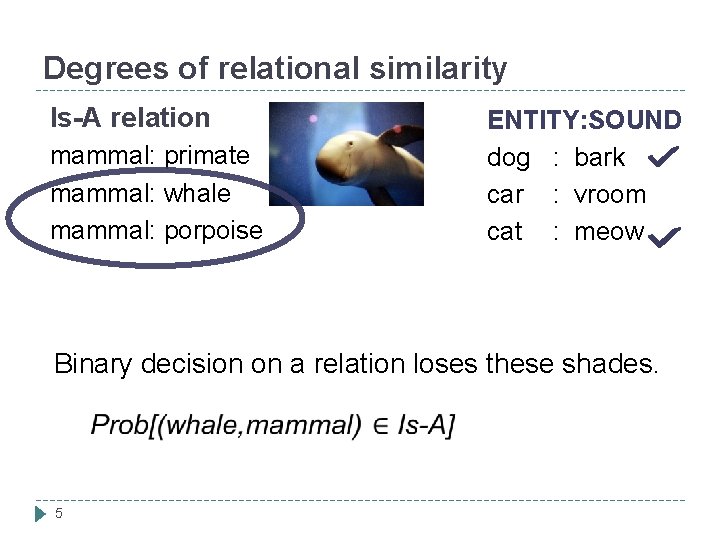
Degrees of relational similarity Is-A relation ENTITY: SOUND dog : bark car : vroom cat : meow mammal: primate mammal: whale mammal: porpoise Binary decision on a relation loses these shades. 5
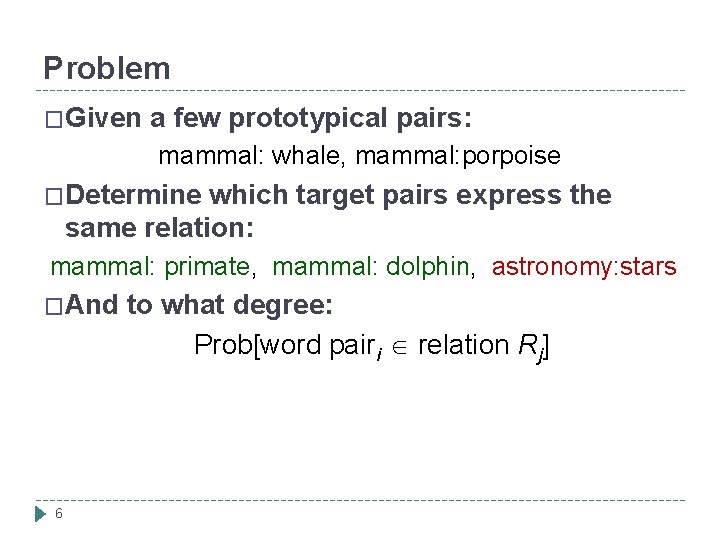
Problem �Given a few prototypical pairs: mammal: whale, mammal: porpoise �Determine which target pairs express the same relation: mammal: primate, mammal: dolphin, astronomy: stars �And to what degree: Prob[word pairi relation Rj] 6
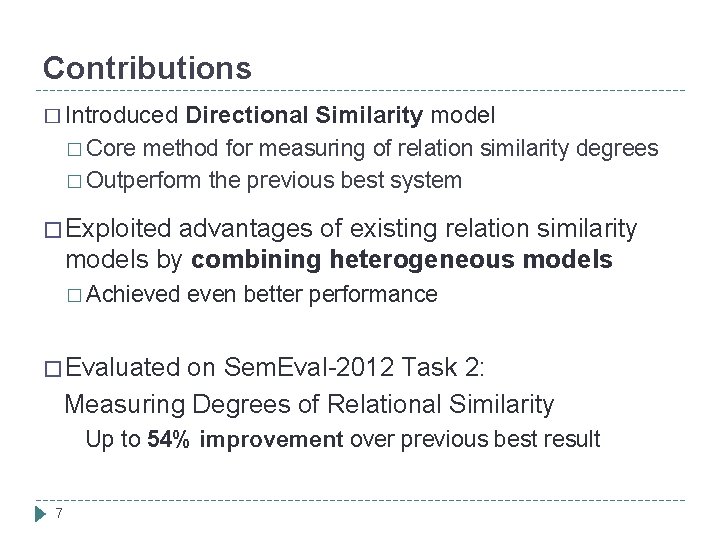
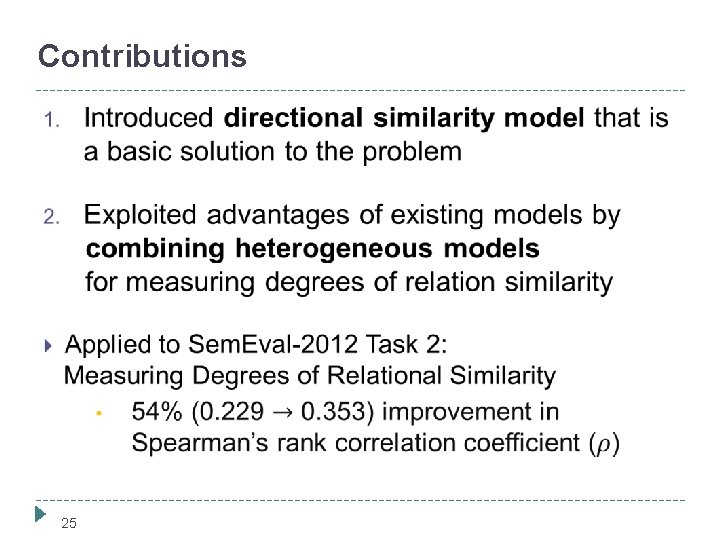
Contributions � Introduced Directional Similarity model � Core method for measuring of relation similarity degrees � Outperform the previous best system � Exploited advantages of existing relation similarity models by combining heterogeneous models � Achieved even better performance � Evaluated on Sem. Eval-2012 Task 2: Measuring Degrees of Relational Similarity Up to 54% improvement over previous best result 7
Outline � Introduction � Heterogeneous Relational Similarity Models � General Relational Similarity Models � Relation-Specific Models � Combining Heterogeneous Models � Experiment and Results � Conclusions and Future Work 8
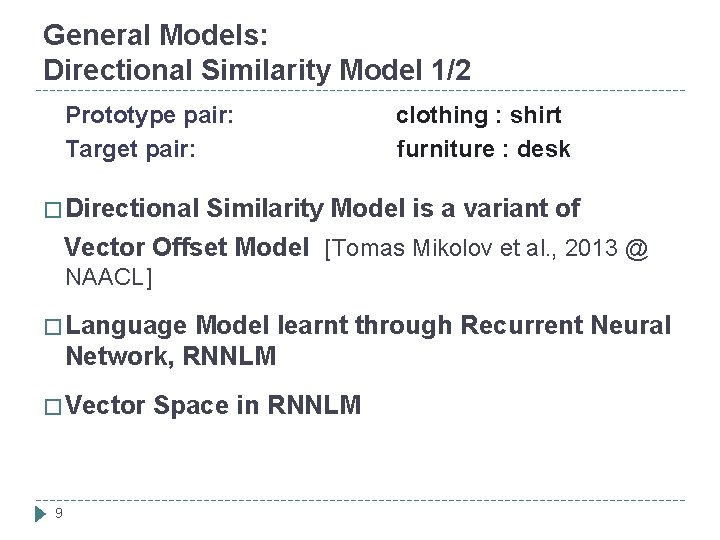
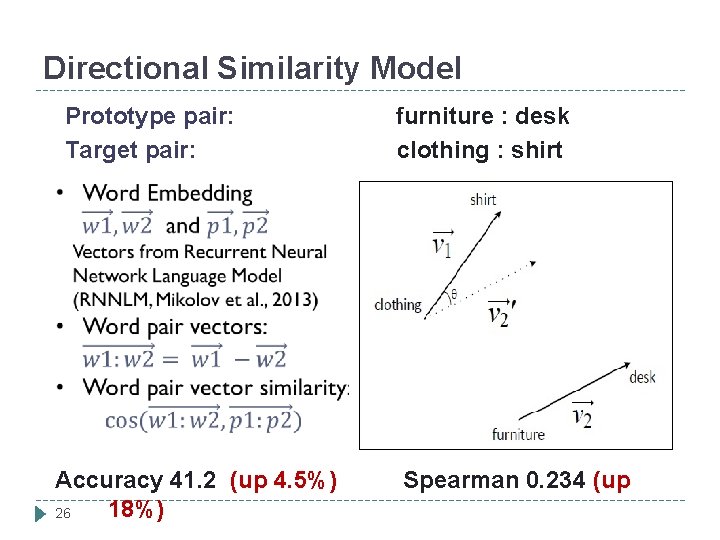
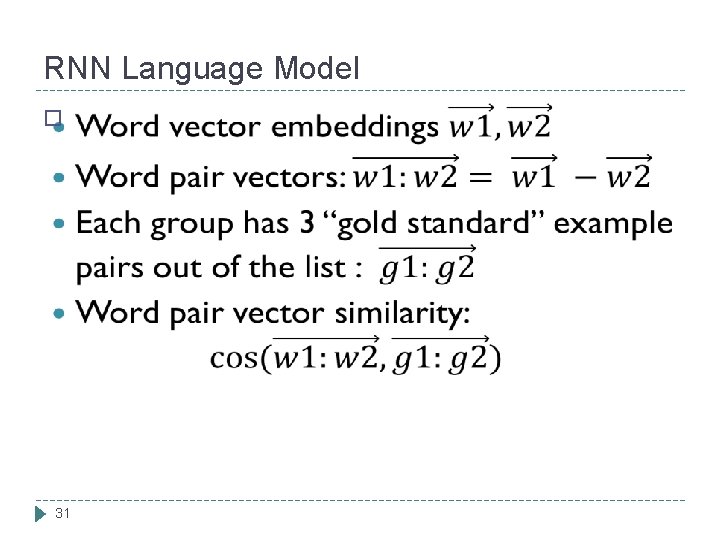
General Models: Directional Similarity Model 1/2 Prototype pair: clothing : shirt Target pair: furniture : desk � Directional Similarity Model is a variant of Vector Offset Model [Tomas Mikolov et al. , 2013 @ NAACL] � Language Model learnt through Recurrent Neural Network, RNNLM � Vector Space in RNNLM 9
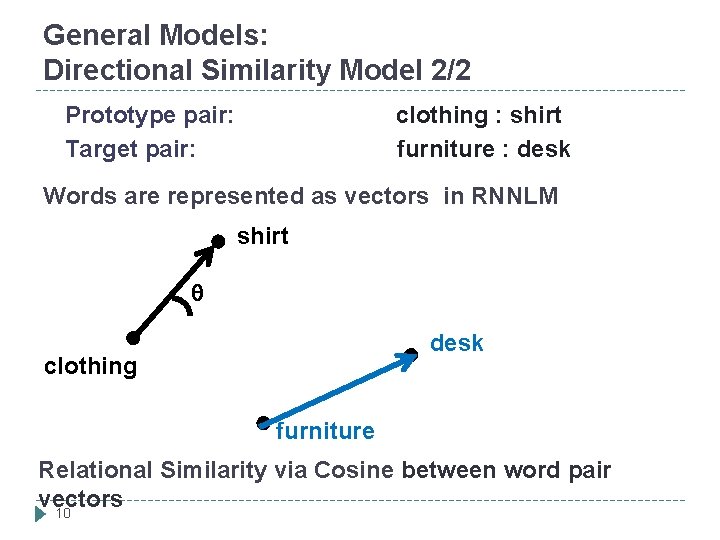
General Models: Directional Similarity Model 2/2 Prototype pair: clothing : shirt Target pair: furniture : desk Words are represented as vectors in RNNLM shirt desk clothing furniture Relational Similarity via Cosine between word pair vectors 10
![General Models: Lexical Pattern Model [E. g. Rink and Harabagiu, 2012] � Extract lexical](http://slidetodoc.com/presentation_image_h/af65adc21b1f1bae5a4e0d17dbfc72bf/image-11.jpg "General Models: Lexical Pattern Model [E. g. Rink and Harabagiu, 2012] � Extract lexical")
General Models: Lexical Pattern Model [E. g. Rink and Harabagiu, 2012] � Extract lexical patterns: Word pairs (mammal : whale), (library : books) Corpora: Wikipedia, Giga. Word Lexical patterns: word sequences encountered between given words of a word pair “mammals such as whales”, “library comprised of books” � Hundreds of thousands of lexical patterns collected � Features: log(pattern occurrence count) � Train a log-linear classifier: � 11 Positive and negative examples for a relation
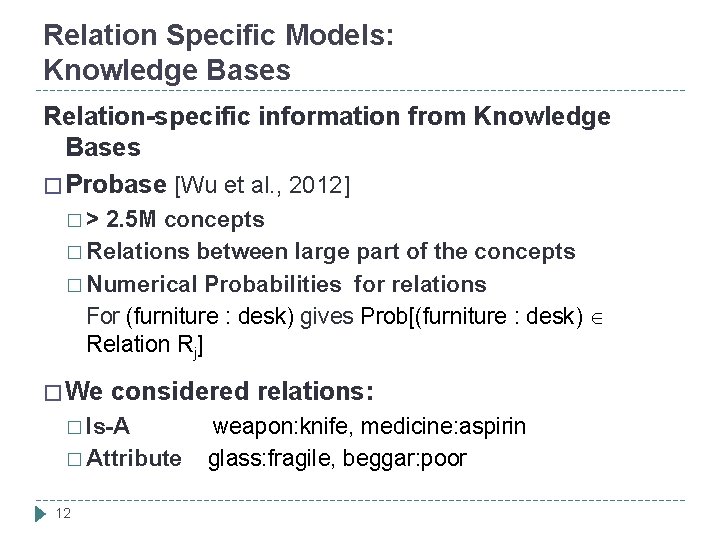
Relation Specific Models: Knowledge Bases Relation-specific information from Knowledge Bases � Probase [Wu et al. , 2012] � > 2. 5 M concepts � Relations between large part of the concepts � Numerical Probabilities for relations For (furniture : desk) gives Prob[(furniture : desk) Relation Rj] � We considered relations: � Is-A weapon: knife, medicine: aspirin � Attribute glass: fragile, beggar: poor 12
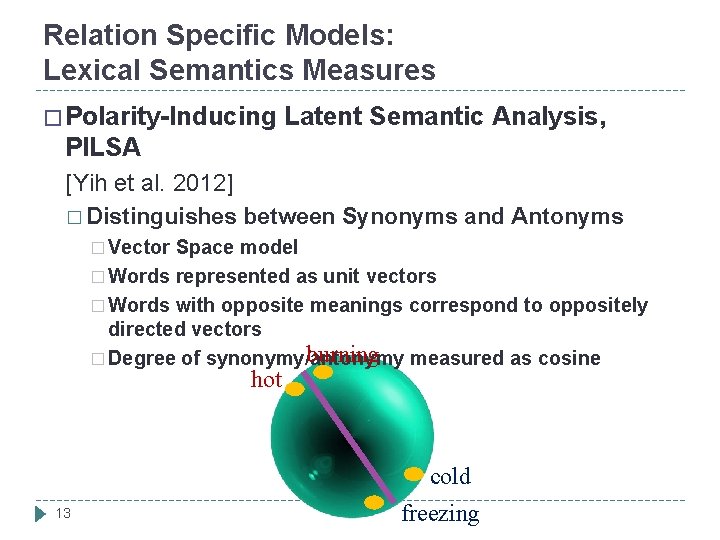
Relation Specific Models: Lexical Semantics Measures � Polarity-Inducing Latent Semantic Analysis, PILSA [Yih et al. 2012] � Distinguishes between Synonyms and Antonyms � Vector Space model � Words represented as unit vectors � Words with opposite meanings correspond to oppositely directed vectors burning � Degree of synonymy/antonymy measured as cosine hot cold 13 freezing
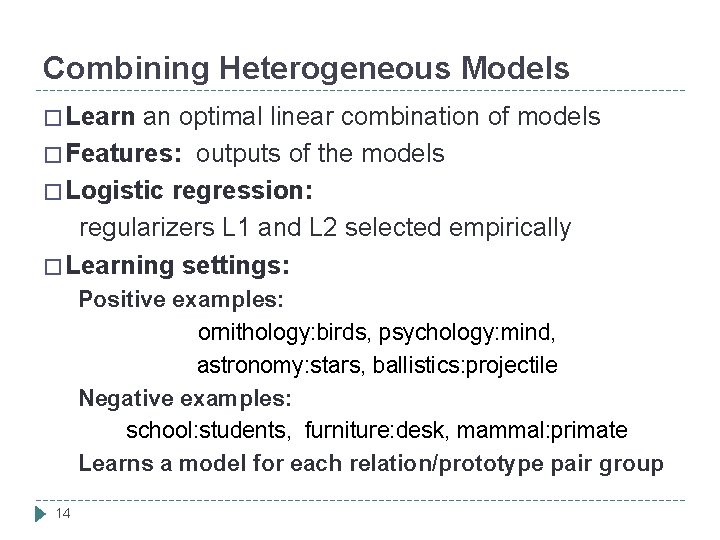
Combining Heterogeneous Models � Learn an optimal linear combination of models � Features: outputs of the models � Logistic regression: regularizers L 1 and L 2 selected empirically � Learning settings: Positive examples: ornithology: birds, psychology: mind, astronomy: stars, ballistics: projectile Negative examples: school: students, furniture: desk, mammal: primate Learns a model for each relation/prototype pair group 14
Outline � Introduction � Heterogeneous Relational Similarity Models � Experiment and Results � Task & Dataset � Results � Analysis of combined models � Conclusions and Future Work 15
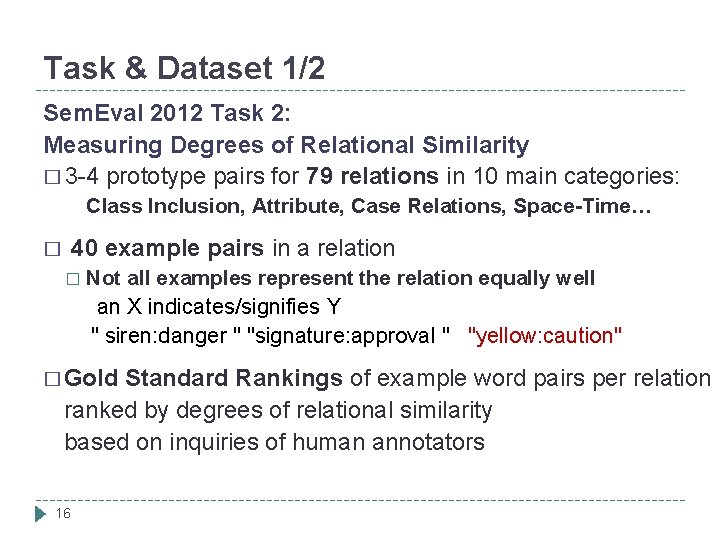
Task & Dataset 1/2 Sem. Eval 2012 Task 2: Measuring Degrees of Relational Similarity � 3 -4 prototype pairs for 79 relations in 10 main categories: Class Inclusion, Attribute, Case Relations, Space-Time… � 40 example pairs in a relation � Not all examples represent the relation equally well an X indicates/signifies Y " siren: danger " "signature: approval " "yellow: caution" � Gold Standard Rankings of example word pairs per relation ranked by degrees of relational similarity based on inquiries of human annotators 16
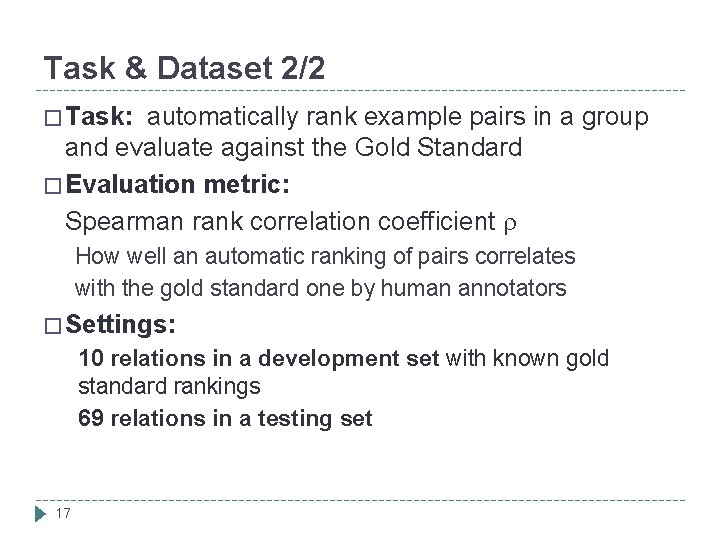
Task & Dataset 2/2 � Task: automatically rank example pairs in a group and evaluate against the Gold Standard � Evaluation metric: Spearman rank correlation coefficient How well an automatic ranking of pairs correlates with the gold standard one by human annotators � Settings: 10 relations in a development set with known gold standard rankings 69 relations in a testing set 17
![Approaches to Measuring Relational Similarity Degree � Duluth systems [Pedersen, 2012] � Word vectors](http://slidetodoc.com/presentation_image_h/af65adc21b1f1bae5a4e0d17dbfc72bf/image-18.jpg "Approaches to Measuring Relational Similarity Degree � Duluth systems [Pedersen, 2012] � Word vectors")
Approaches to Measuring Relational Similarity Degree � Duluth systems [Pedersen, 2012] � Word vectors based on Word. Net + cosine similarity �BUAP system [Tovar et al. , 2012] � Word pair represented in a vector space + Cosine between target pair and a prototypical example �UTD systems [Rink and Harabagiu, 2012] � Lexical patterns between words in a word pair + Naïve Bayes Classifier or SVM classifier Some systems were able to outperform the random baseline, yet there was still much room for improvement 18
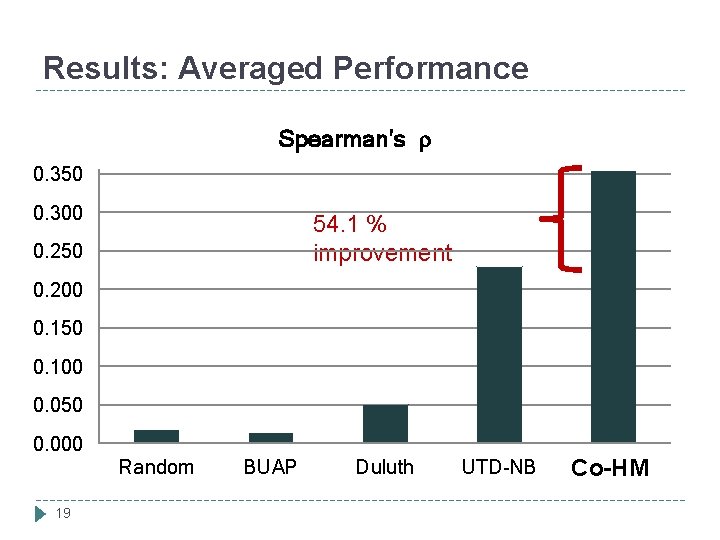
Results: Averaged Performance Spearman's 0. 350 0. 300 54. 1 % improvement 0. 250 0. 200 0. 150 0. 100 0. 050 0. 000 Random 19 BUAP Duluth UTD-NB Comb Co-HM
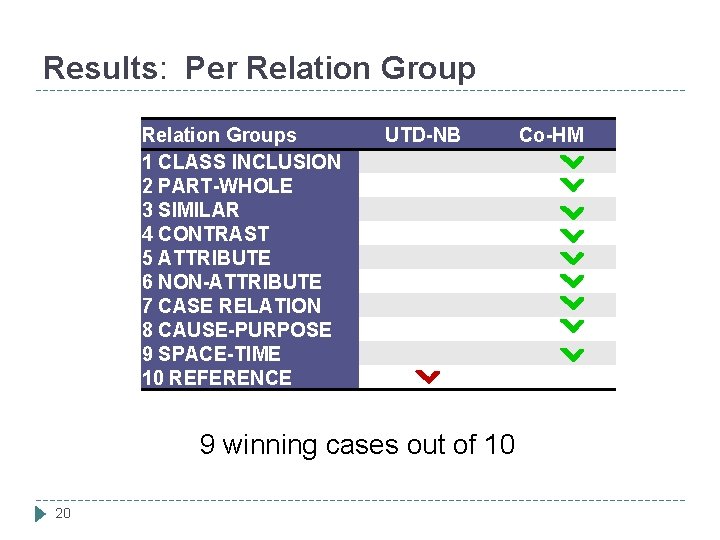
Results: Per Relation Groups 1 CLASS INCLUSION 2 PART-WHOLE 3 SIMILAR 4 CONTRAST 5 ATTRIBUTE 6 NON-ATTRIBUTE 7 CASE RELATION 8 CAUSE-PURPOSE 9 SPACE-TIME 10 REFERENCE UTD-NB Co-HM 9 winning cases out of 10 20
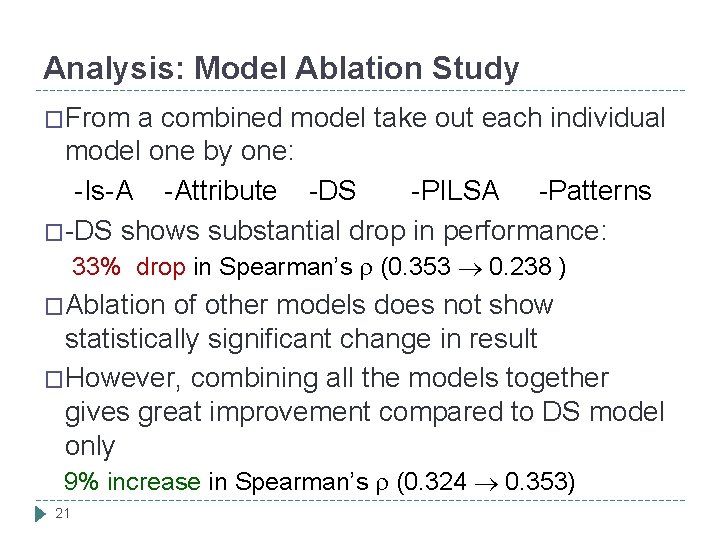
Analysis: Model Ablation Study �From a combined model take out each individual model one by one: -Is-A -Attribute -DS -PILSA -Patterns �-DS shows substantial drop in performance: 33% drop in Spearman’s (0. 353 0. 238 ) �Ablation of other models does not show statistically significant change in result �However, combining all the models together gives great improvement compared to DS model only 9% increase in Spearman’s (0. 324 0. 353) 21
Outline � Introduction � Heterogeneous Relational Similarity Models � Experiment and Results � Conclusions and Future Work 22
Conclusions & Future Work �State-of-the-art results � Introduced Directional Similarity model � A general model for measuring relational similarity for arbitrary relations � Introduced combination of heterogeneous – general and relation-specific – models for even better relational similarity measuring In the future: � How to choose individual models for specific relations? � User study for relation similarity ceiling � Compare various VSM (RNNLM vs. others) 23 Thank you!
Additional slides (mostly old slides from the internship presentation) 24
Contributions 25
Directional Similarity Model Prototype pair: furniture : desk Target pair: clothing : shirt Accuracy 41. 2 (up 4. 5%) Spearman 0. 234 (up 18%) 26
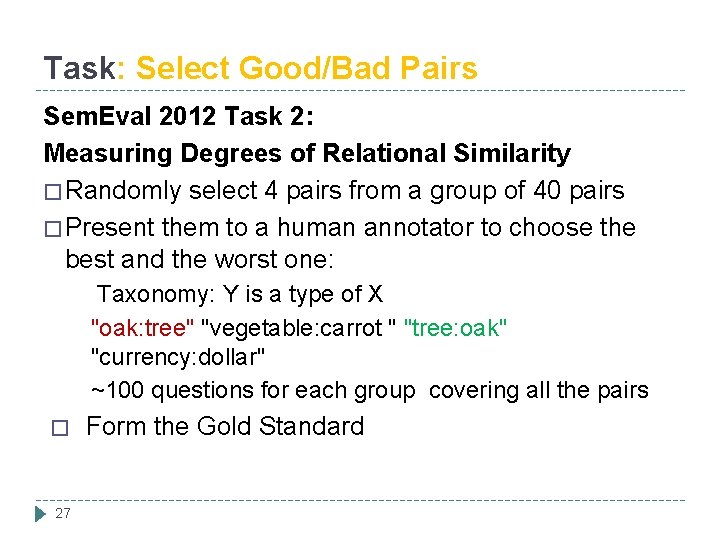
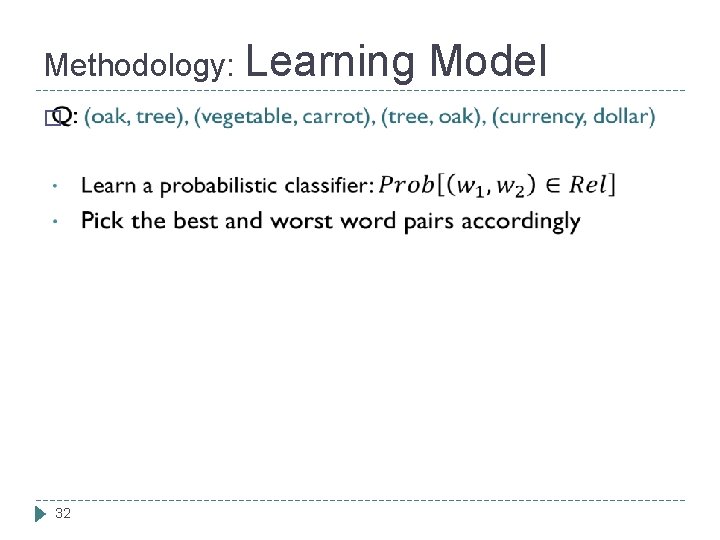
Task: Select Good/Bad Pairs Sem. Eval 2012 Task 2: Measuring Degrees of Relational Similarity � Randomly select 4 pairs from a group of 40 pairs � Present them to a human annotator to choose the best and the worst one: Taxonomy: Y is a type of X "oak: tree" "vegetable: carrot " "tree: oak" "currency: dollar" ~100 questions for each group covering all the pairs � 27 Form the Gold Standard
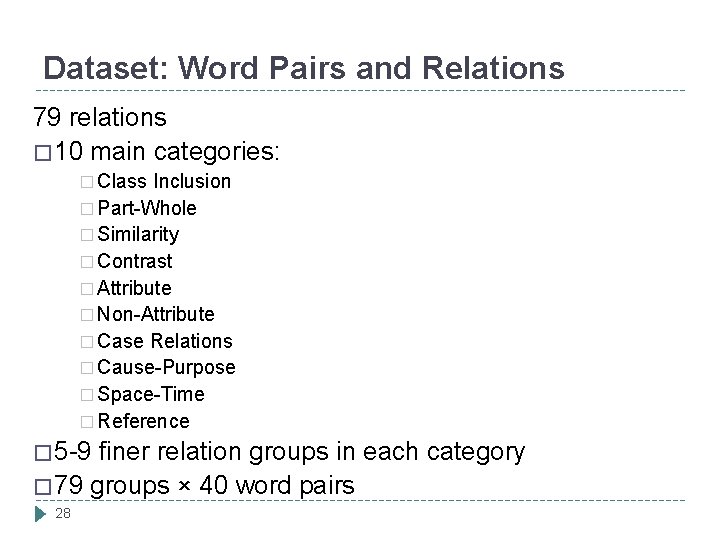
Dataset: Word Pairs and Relations 79 relations � 10 main categories: � Class Inclusion � Part-Whole � Similarity � Contrast � Attribute � Non-Attribute � Case Relations � Cause-Purpose � Space-Time � Reference � 5 -9 finer relation groups in each category � 79 groups × 40 word pairs 28
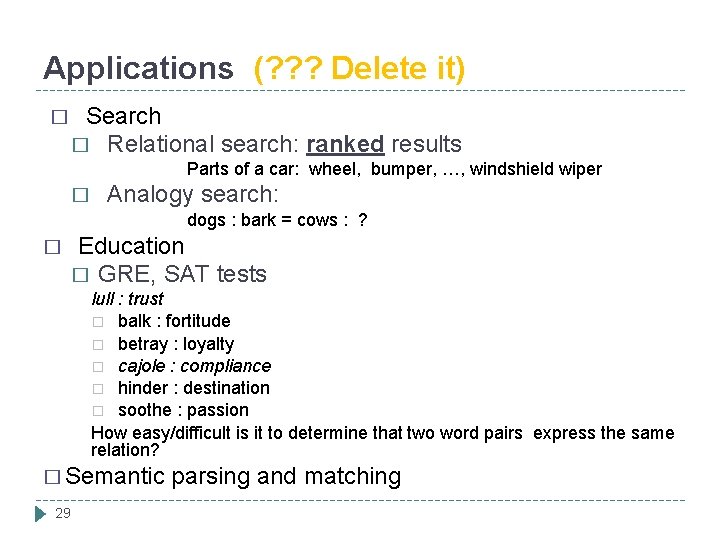
Applications (? ? ? Delete it) � Search � Relational search: ranked results Parts of a car: wheel, bumper, …, windshield wiper � Analogy search: dogs : bark = cows : ? � Education � GRE, SAT tests lull : trust � balk : fortitude � betray : loyalty � cajole : compliance � hinder : destination � soothe : passion How easy/difficult is it to determine that two word pairs express the same relation? � Semantic parsing and matching 29
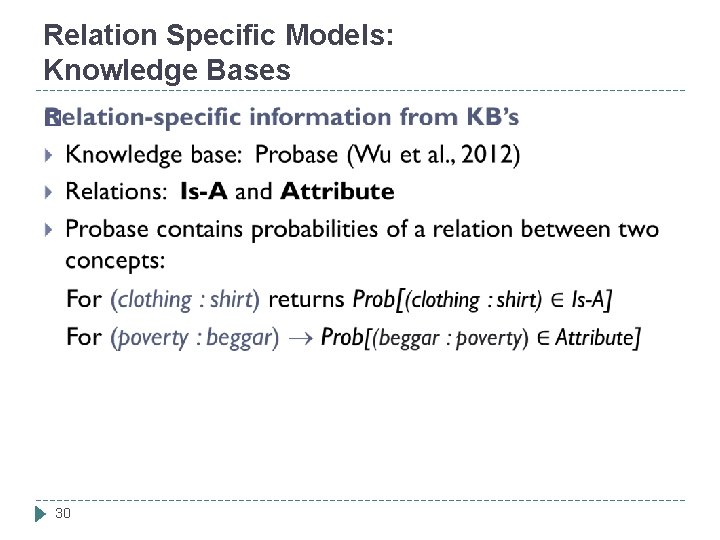
Relation Specific Models: Knowledge Bases � 30
RNN Language Model � 31
Methodology: Learning Model � 32
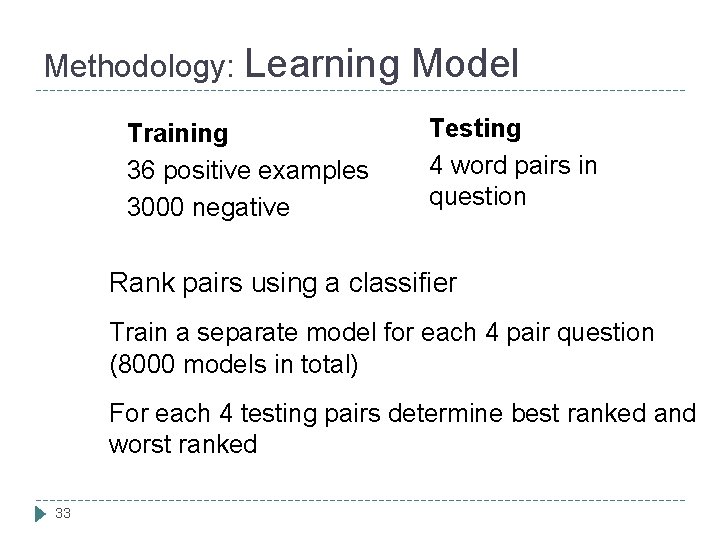
Methodology: Learning Model Training 36 positive examples 3000 negative Testing 4 word pairs in question Rank pairs using a classifier Train a separate model for each 4 pair question (8000 models in total) For each 4 testing pairs determine best ranked and worst ranked 33
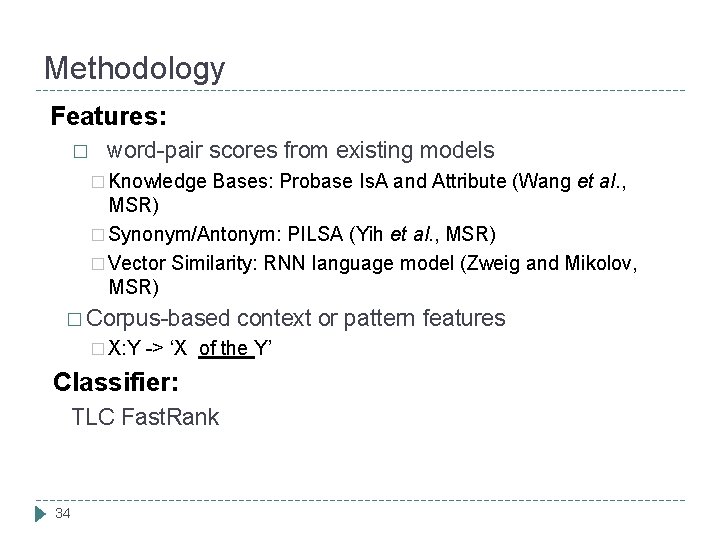
Methodology Features: � word-pair scores from existing models � Knowledge Bases: Probase Is. A and Attribute (Wang et al. , MSR) � Synonym/Antonym: PILSA (Yih et al. , MSR) � Vector Similarity: RNN language model (Zweig and Mikolov, MSR) � Corpus-based context or pattern features � X: Y -> ‘X of the Y’ Classifier: TLC Fast. Rank 34
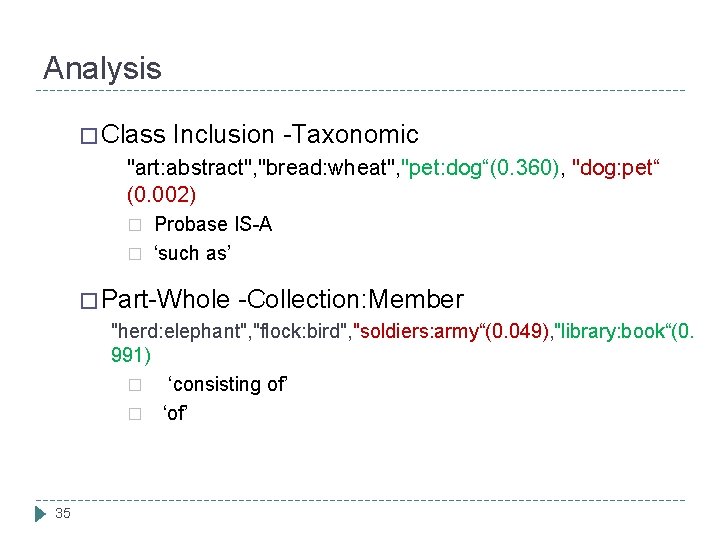
Analysis � Class Inclusion -Taxonomic "art: abstract", "bread: wheat", "pet: dog“(0. 360), "dog: pet“ (0. 002) � � Probase IS-A ‘such as’ � Part-Whole -Collection: Member "herd: elephant", "flock: bird", "soldiers: army“(0. 049), "library: book“(0. 991) � ‘consisting of’ � ‘of’ 35
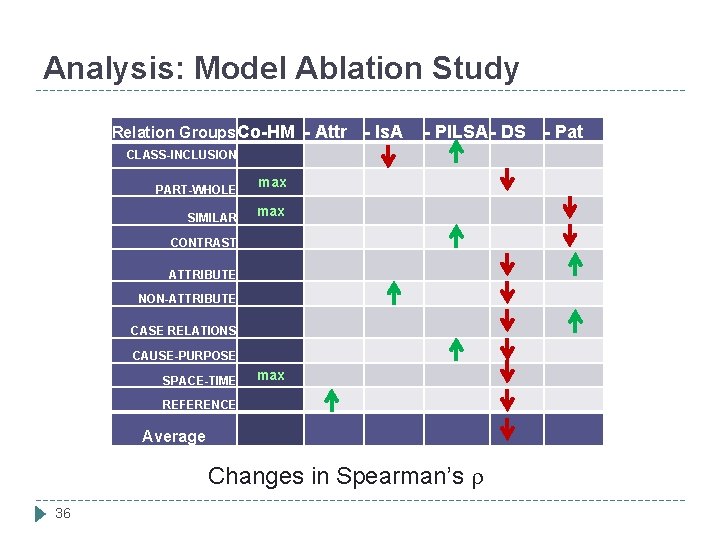
Analysis: Model Ablation Study Relation Groups Co-HM - Attr - Is. A - PILSA - DS - Pat CLASS-INCLUSION PART-WHOLE max SIMILAR max CONTRAST ATTRIBUTE NON-ATTRIBUTE CASE RELATIONS CAUSE-PURPOSE SPACE-TIME max REFERENCE Average Changes in Spearman’s 36
Analysis – Room for Improvement � SPACE-TIME – Time: Associated Item Example: ‘retirement: pension’ � ‘education and’ � ‘and a big’ � No distinctive context patterns � No leading feature 37
Building a general “relational similarity” model is a more efficient way to learn many, specific individual relation models [Turney, 2008] 38
- Slides: 38