
COMBINING CIRCUIT AND PACKET BASED SERVICES IN CONVERGING
COMBINING CIRCUIT AND PACKET BASED SERVICES IN CONVERGING NETWORKS Sauli Österman sauli. osterman@teliasonera. com
About • Written at Telia. Sonera Finland, in the Mobile System Planning department. • Supervised by Prof. Raimo Kantola • Instructed by M. Sc. Ville Helenius
Outline • • Background & Objective 3 GPP release 6 network IP Multimedia subsystem Circuit Switched IMS Combinational Services • Conferencing service utilising CSICS • Conclusion
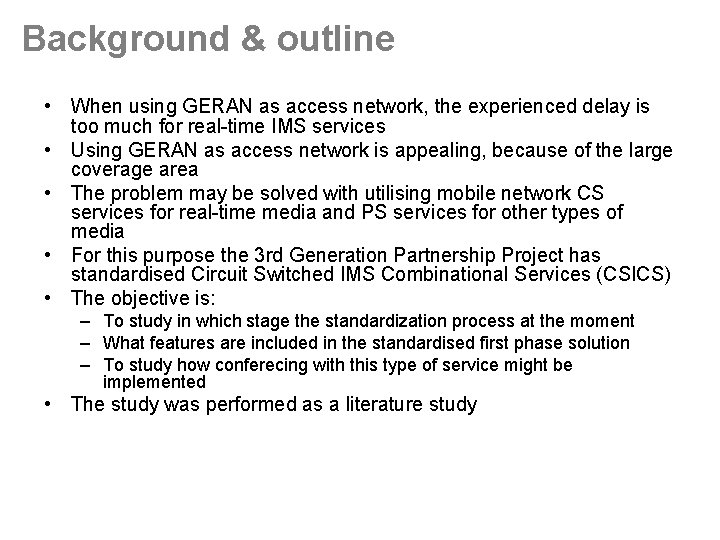
Background & outline • When using GERAN as access network, the experienced delay is too much for real-time IMS services • Using GERAN as access network is appealing, because of the large coverage area • The problem may be solved with utilising mobile network CS services for real-time media and PS services for other types of media • For this purpose the 3 rd Generation Partnership Project has standardised Circuit Switched IMS Combinational Services (CSICS) • The objective is: – To study in which stage the standardization process at the moment – What features are included in the standardised first phase solution – To study how conferecing with this type of service might be implemented • The study was performed as a literature study
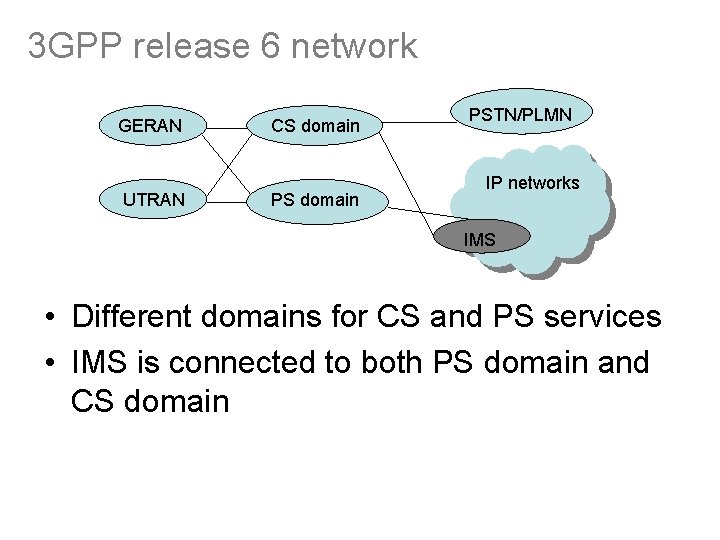
3 GPP release 6 network GERAN UTRAN CS domain PSTN/PLMN IP networks IMS • Different domains for CS and PS services • IMS is connected to both PS domain and CS domain
IP multimedia subsystem • 3 GPP specified access network independent service creation environment • Two main signalling protocols: – SIP for call control – Diameter for database queries • The signalling is always routed trough the controlling nodes, but the user data is routed via shortest path
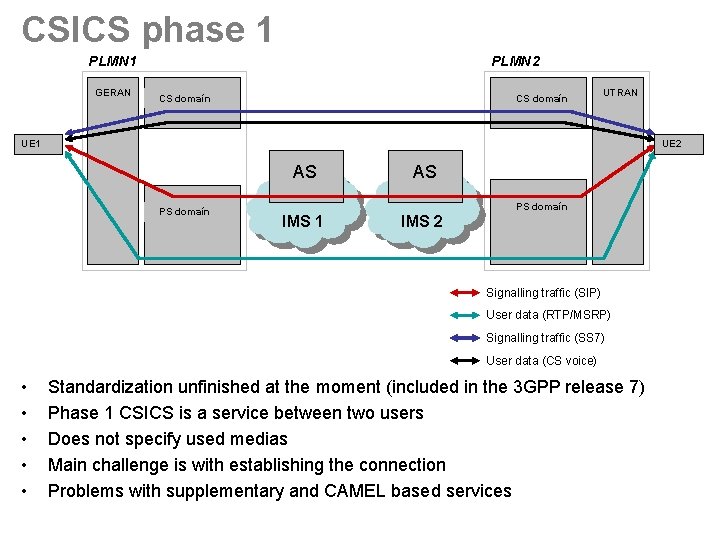
CSICS phase 1 PLMN 1 GERAN PLMN 2 CS domaín UTRAN UE 1 UE 2 AS PS domaín IMS 1 IMS 2 Signalling traffic (SIP) User data (RTP/MSRP) Signalling traffic (SS 7) User data (CS voice) • • • Standardization unfinished at the moment (included in the 3 GPP release 7) Phase 1 CSICS is a service between two users Does not specify used medias Main challenge is with establishing the connection Problems with supplementary and CAMEL based services
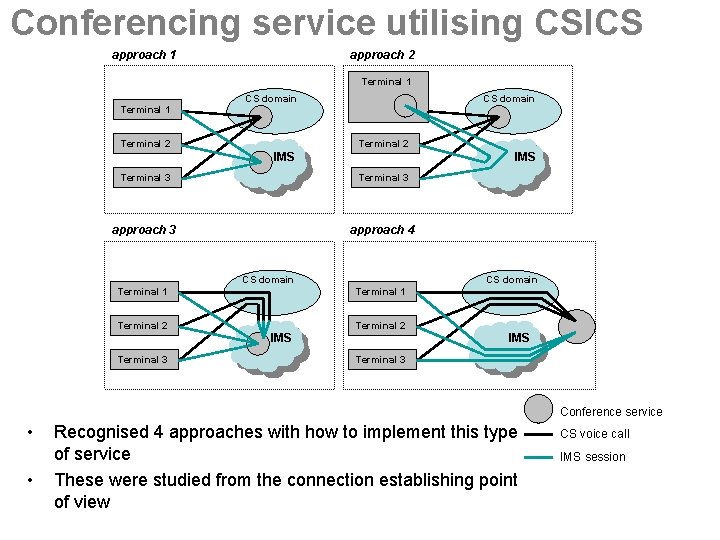
Conferencing service utilising CSICS approach 1 approach 2 Terminal 1 CS domain Terminal 1 Terminal 2 IMS Terminal 3 approach 4 CS domain Terminal 1 Terminal 2 IMS Terminal 3 Conference service • • Recognised 4 approaches with how to implement this type of service These were studied from the connection establishing point of view CS voice call IMS session
Conclusion • Service offers support for real-time services, even when GERAN is only available access network • The best approaches for implementing the CSICS conferencing service were concluded to be approaches 3 or 4 • CSICS requires a lot from terminal. The success depends heavily on the amount of the capable terminals • Synchronization of two separate media streams may cause problems to some applications • Subjects fo further study: – Final CSICS phase 1 functionality (when standardization is finished) – CSICS phase 2 (when more information is published) – Other types of services with which the mobile operator may differ from the service providers in the internet
- Slides: 9