
Combiner Charge Cont Battery Bank Solar Powered Oyster
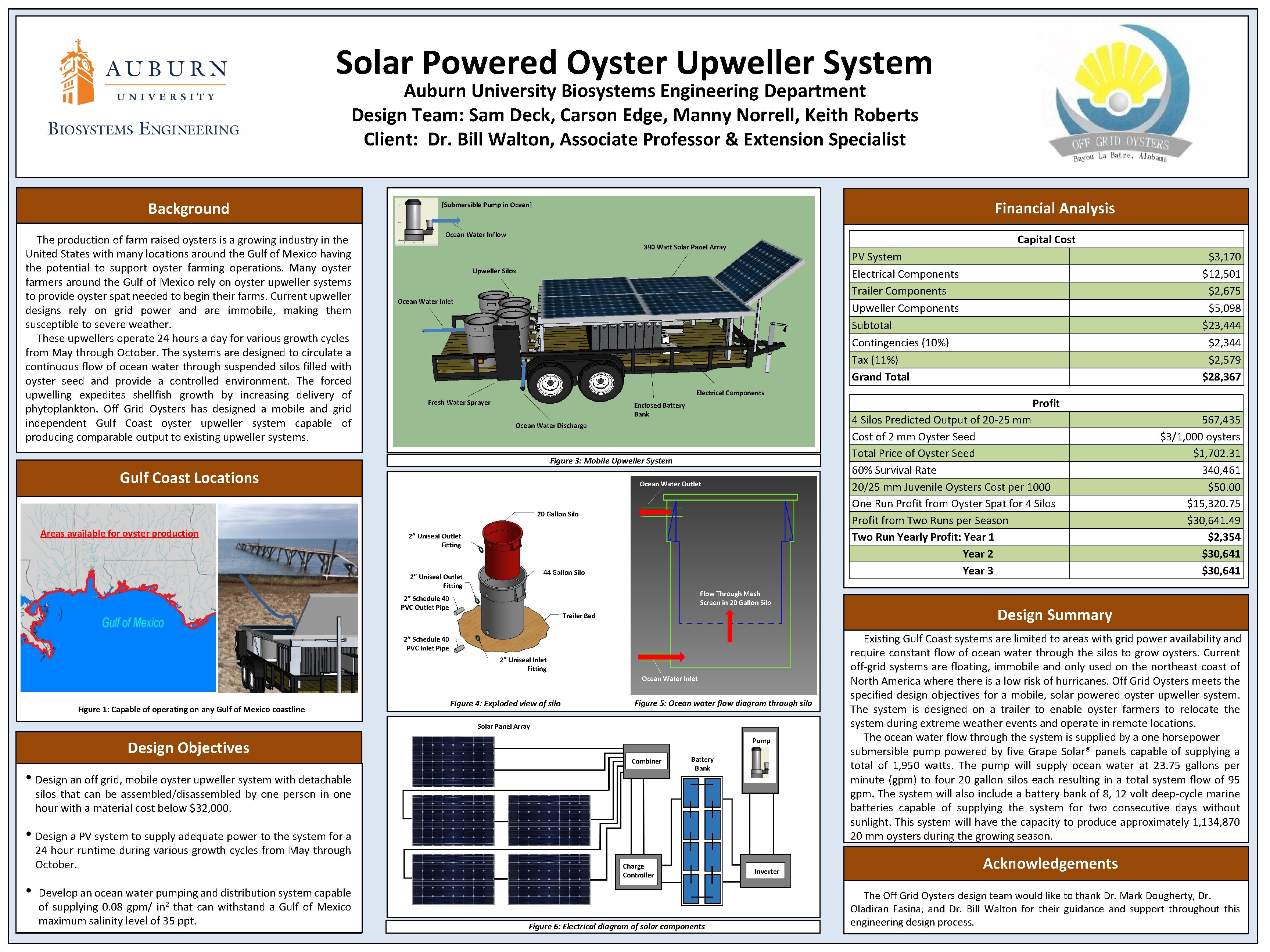
Combiner Charge Cont. Battery Bank Solar Powered Oyster Upweller System Inverter Auburn University Biosystems Engineering Department Design Team: Sam Deck, Carson Edge, Manny Norrell, Keith Roberts Client: Dr. Bill Walton, Associate Professor & Extension Specialist Background The production of farm raised oysters is a growing industry in the United States with many locations around the Gulf of Mexico having the potential to support oyster farming operations. Many oyster farmers around the Gulf of Mexico rely on oyster upweller systems to provide oyster spat needed to begin their farms. Current upweller designs rely on grid power and are immobile, making them susceptible to severe weather. These upwellers operate 24 hours a day for various growth cycles from May through October. The systems are designed to circulate a continuous flow of ocean water through suspended silos filled with oyster seed and provide a controlled environment. The forced upwelling expedites shellfish growth by increasing delivery of phytoplankton. Off Grid Oysters has designed a mobile and grid independent Gulf Coast oyster upweller system capable of producing comparable output to existing upweller systems. Financial Analysis [Submersible Pump in Ocean] Ocean Water Inflow Capital Cost 390 Watt Solar Panel Array PV System Electrical Components Trailer Components Upweller Components Subtotal Contingencies (10%) Tax (11%) Grand Total Upweller Silos Ocean Water Inlet Electrical Components Fresh Water Sprayer Enclosed Battery Bank Figure 3: Mobile Upweller System Ocean Water Outlet 20 Gallon Silo Areas available for oyster production 2” Uniseal Outlet Fitting 44 Gallon Silo 2” Uniseal Outlet Fitting Flow Through Mesh Screen in 20 Gallon Silo 2” Schedule 40 PVC Outlet Pipe Trailer Bed 2” Schedule 40 PVC Inlet Pipe 2” Uniseal Inlet Fitting Ocean Water Inlet Figure 1: Capable of operating on any Gulf of Mexico coastline Figure 4: Exploded view of silo Figure 5: Ocean water flow diagram through silo Solar Panel Array Design Objectives Pump Combiner • Design an off grid, mobile oyster upweller system with detachable Battery Bank silos that can be assembled/disassembled by one person in one hour with a material cost below $32, 000. • Design a PV system to supply adequate power to the system for a 24 hour runtime during various growth cycles from May through October. • Develop an ocean water pumping and distribution system capable of supplying 0. 08 gpm/ in 2 that can withstand a Gulf of Mexico maximum salinity level of 35 ppt. Charge Controller Figure 6: Electrical diagram of solar components Profit 4 Silos Predicted Output of 20 -25 mm Cost of 2 mm Oyster Seed Total Price of Oyster Seed 60% Survival Rate 20/25 mm Juvenile Oysters Cost per 1000 One Run Profit from Oyster Spat for 4 Silos Profit from Two Runs per Season Two Run Yearly Profit: Year 1 Year 2 Year 3 Ocean Water Discharge Gulf Coast Locations $3, 170 $12, 501 $2, 675 $5, 098 $23, 444 $2, 344 $2, 579 $28, 367 Inverter 567, 435 $3/1, 000 oysters $1, 702. 31 340, 461 $50. 00 $15, 320. 75 $30, 641. 49 $2, 354 $30, 641 Design Summary Existing Gulf Coast systems are limited to areas with grid power availability and require constant flow of ocean water through the silos to grow oysters. Current off-grid systems are floating, immobile and only used on the northeast coast of North America where there is a low risk of hurricanes. Off Grid Oysters meets the specified design objectives for a mobile, solar powered oyster upweller system. The system is designed on a trailer to enable oyster farmers to relocate the system during extreme weather events and operate in remote locations. The ocean water flow through the system is supplied by a one horsepower submersible pump powered by five Grape Solar® panels capable of supplying a total of 1, 950 watts. The pump will supply ocean water at 23. 75 gallons per minute (gpm) to four 20 gallon silos each resulting in a total system flow of 95 gpm. The system will also include a battery bank of 8, 12 volt deep-cycle marine batteries capable of supplying the system for two consecutive days without sunlight. This system will have the capacity to produce approximately 1, 134, 870 20 mm oysters during the growing season. Acknowledgements The Off Grid Oysters design team would like to thank Dr. Mark Dougherty, Dr. Oladiran Fasina, and Dr. Bill Walton for their guidance and support throughout this engineering design process.
- Slides: 1