
Combined science Physics Key stage 4 Particle Models
Combined science - Physics - Key stage 4 Particle Models - worksheets Mr Charman 1

Energy transfers - Downloadable worksheet 1. In lesson questions 2. Exam questions
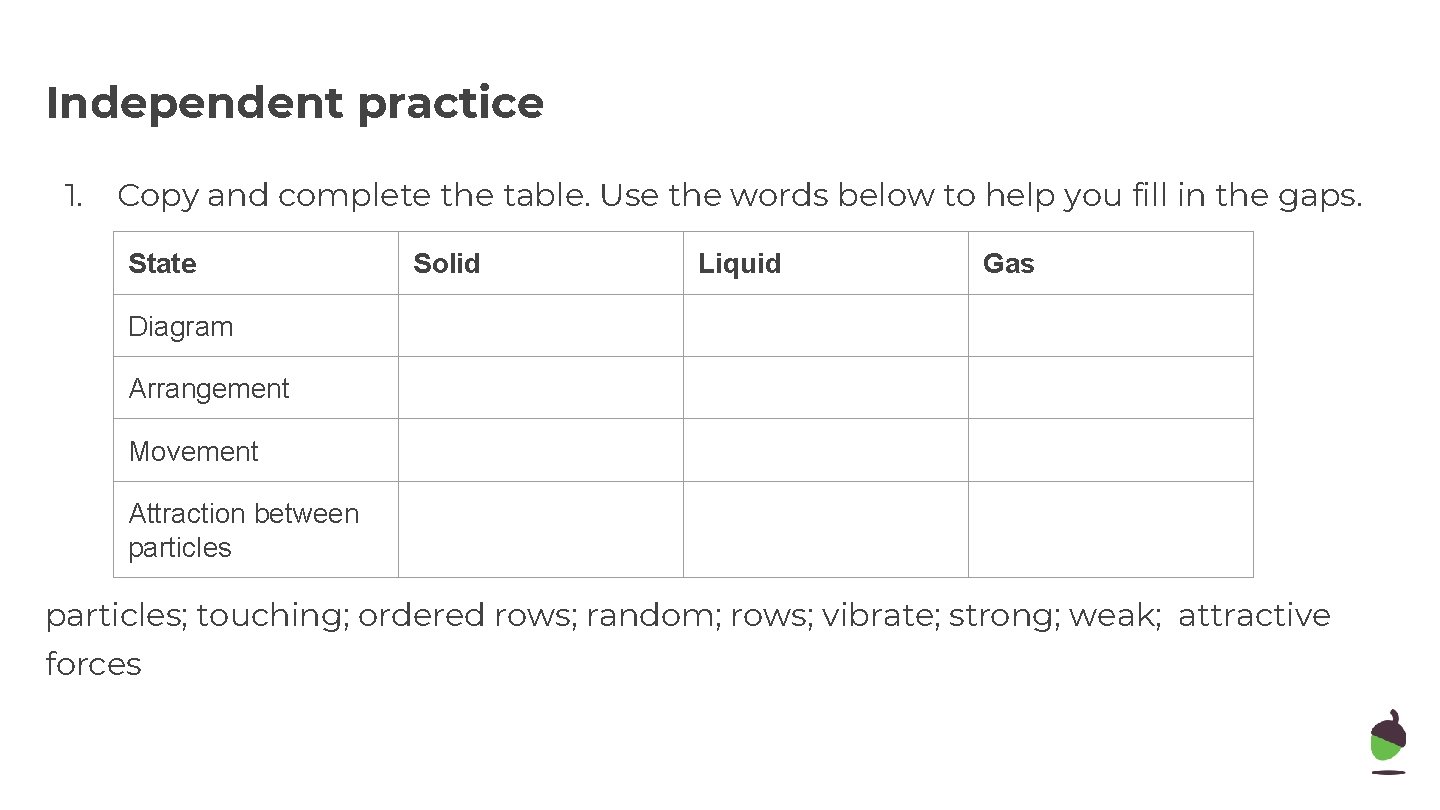
Independent practice 1. Copy and complete the table. Use the words below to help you fill in the gaps. State Solid Liquid Gas Diagram Arrangement Movement Attraction between particles; touching; ordered rows; random; rows; vibrate; strong; weak; attractive forces

Review State Solid Liquid Gas Arrangement Ordered structure in rows, all particles touching Random structure, particles not touching Movement Fixed positions, can vibrate Can move freely over each other Fast moving, random Attraction between particles Very strong forces of attraction Weaker forces of attraction weakest forces of attraction Diagram
Independent practice Solids: ● have a fixed shape ● Difficult to compress Gases ● Will spread and fill the entire container ● Easy to compress Use your knowledge to explain the above properties. You should consider: 5 ● The spacing between the particles ● The movement of individual particles ● The forces between particles
Review Solids: ● have a fixed shape – Strong forces of attraction mean particles are not free to moves around so shape is fixed. ● Difficult to compress – Particles have no gaps between one another r so there is no room for particles to move closer. 6
Review Gases ● Will spread and fill the entire container – Very weak intermolecular forces of attraction so particles move randomly and spread out. ● Easy to compress – Particles are far apart, so there is space for the particles to move closer 7
A question from Exampro Exam questions Q 1 Solid, liquid and gas are three different states of matter. Describe the difference between the solid and gas states, in terms of the arrangement and movement of their particles. 8
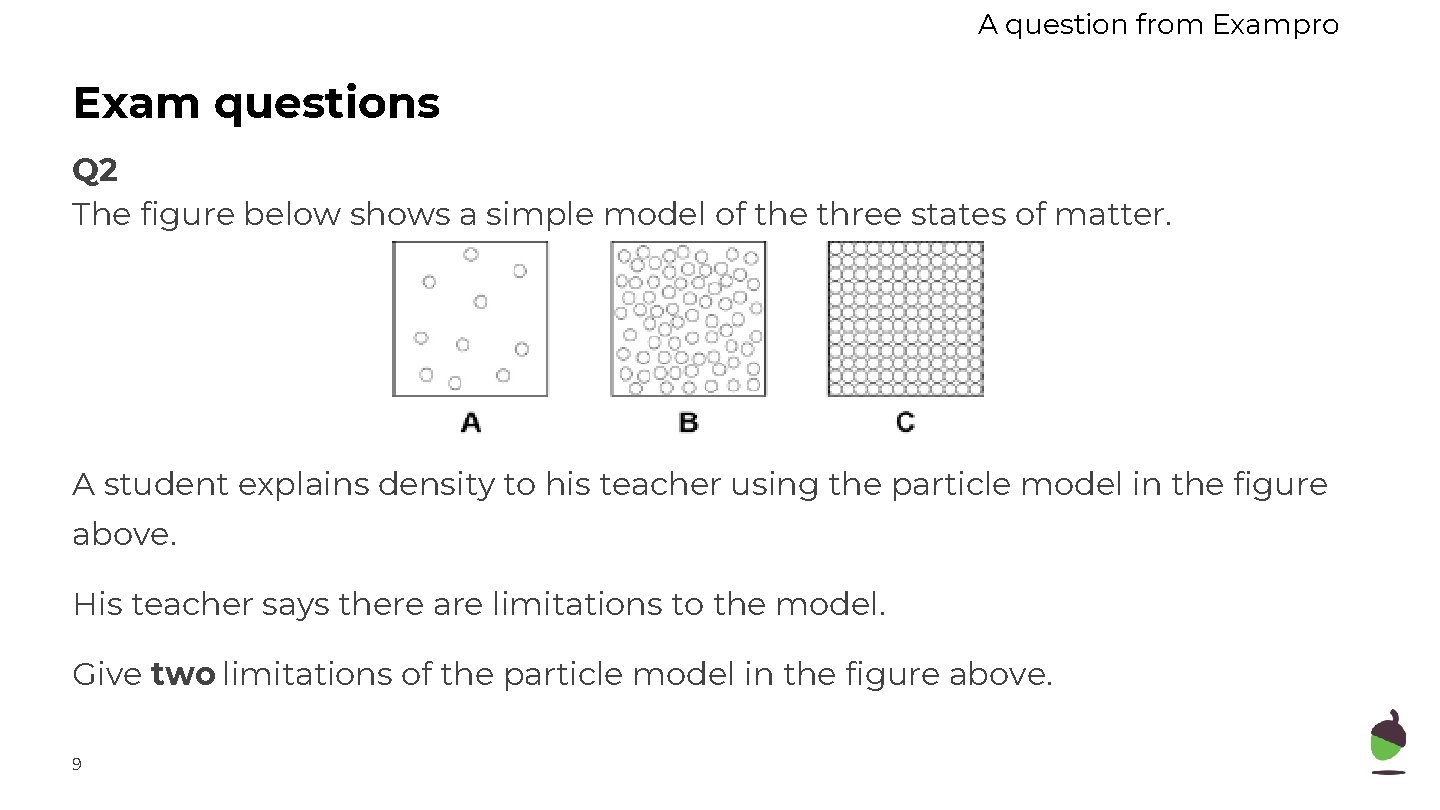
A question from Exampro Exam questions Q 2 The figure below shows a simple model of the three states of matter. A student explains density to his teacher using the particle model in the figure above. His teacher says there are limitations to the model. Give two limitations of the particle model in the figure above. 9
A question from Exampro Exam questions - Review Q 1 solid ● particles vibrate about fixed positions (1) ● closely packed (1) accept regular gas ● particles move randomly (1) accept particles move faster accept freely for randomly ● far apart (1) 1 10
A question from Exampro Exam questions - Review Q 2 Any two from: • • • no forces shown between spheres atoms / molecules / ions are not solid spheres not all the same size. 2 11
- Slides: 11