
Combined science Physics Key stage 4 Energy Specific
Combined science - Physics - Key stage 4 - Energy Specific heat capacity - required practical - worksheet Dr Fishwick 1

In lesson questions 2

1. Sketch this graph and identify which sections are related to the heat capacity of the material. 2. Explain why it is not possible to identify directly the specific heat capacity from this graph. ○ (hint - think about which quantity is missing) Temperature / o. C Pause the video to complete your task Resume once you’re finished Energy transferred / J
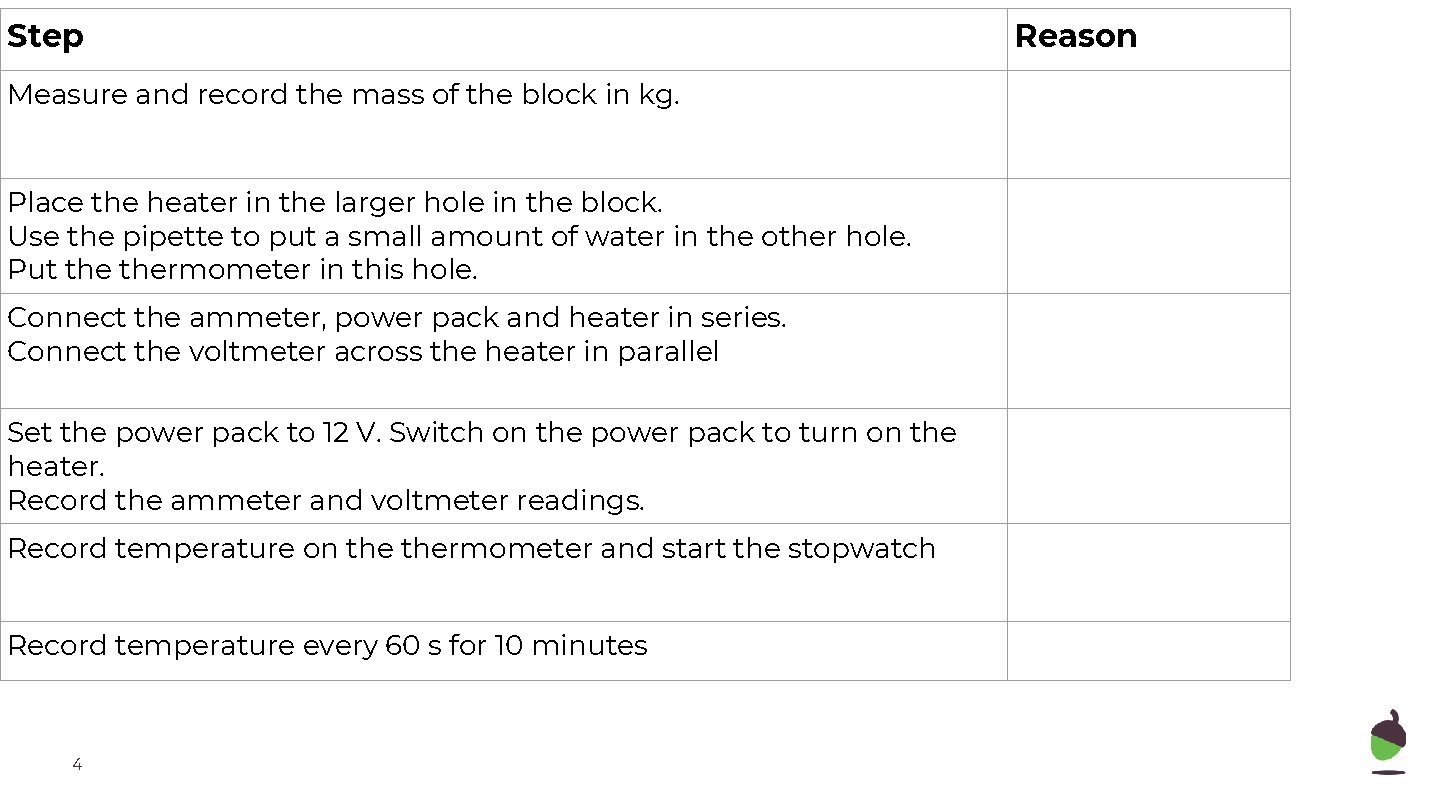
Step Reason Measure and record the mass of the block in kg. To be used to calculate specific heat capacity Place the heater in the larger hole in the block. Use the pipette to put a small amount of water in the other hole. Put thermometer in this hole. To allow for temperature to be measured Connect the ammeter, power pack and heater in series. Connect the voltmeter across the heater in parallel Set the power pack to 12 V. Switch on the power pack to turn on the heater. Record the ammeter and voltmeter readings. Record temperature on thermometer and start the stopwatch Record temperature every 60 s for 10 minutes 4
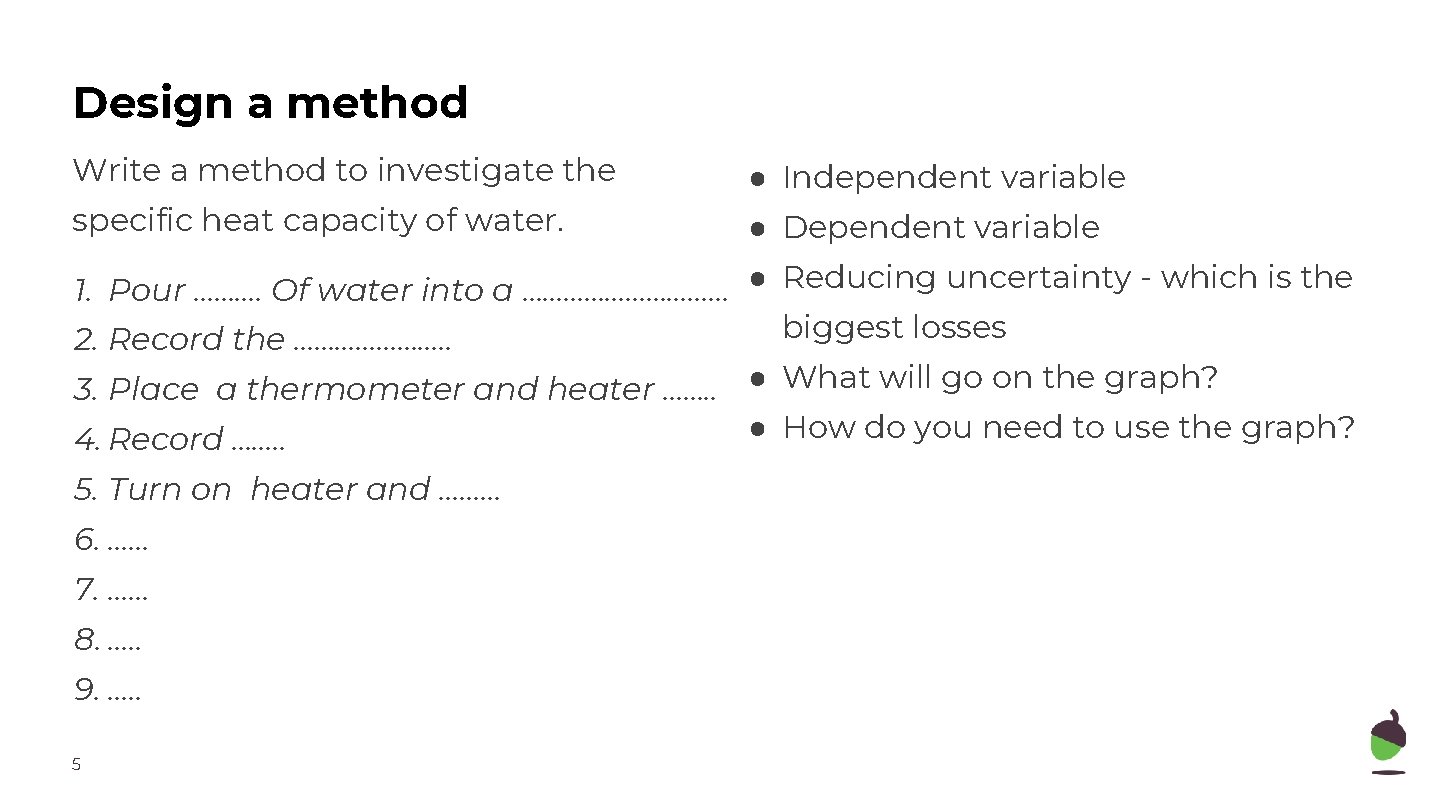
Design a method Write a method to investigate the specific heat capacity of water. ● Independent variable ● Dependent variable 1. Pour ………. Of water into a …………… ● Reducing uncertainty - which is the biggest losses 2. Record the …………………. . 3. Place a thermometer and heater ……. . ● What will go on the graph? ● How do you need to use the graph? 4. Record ……. . 5. Turn on heater and ……… 6. …… 7. …… 8. …. . 9. …. . 5
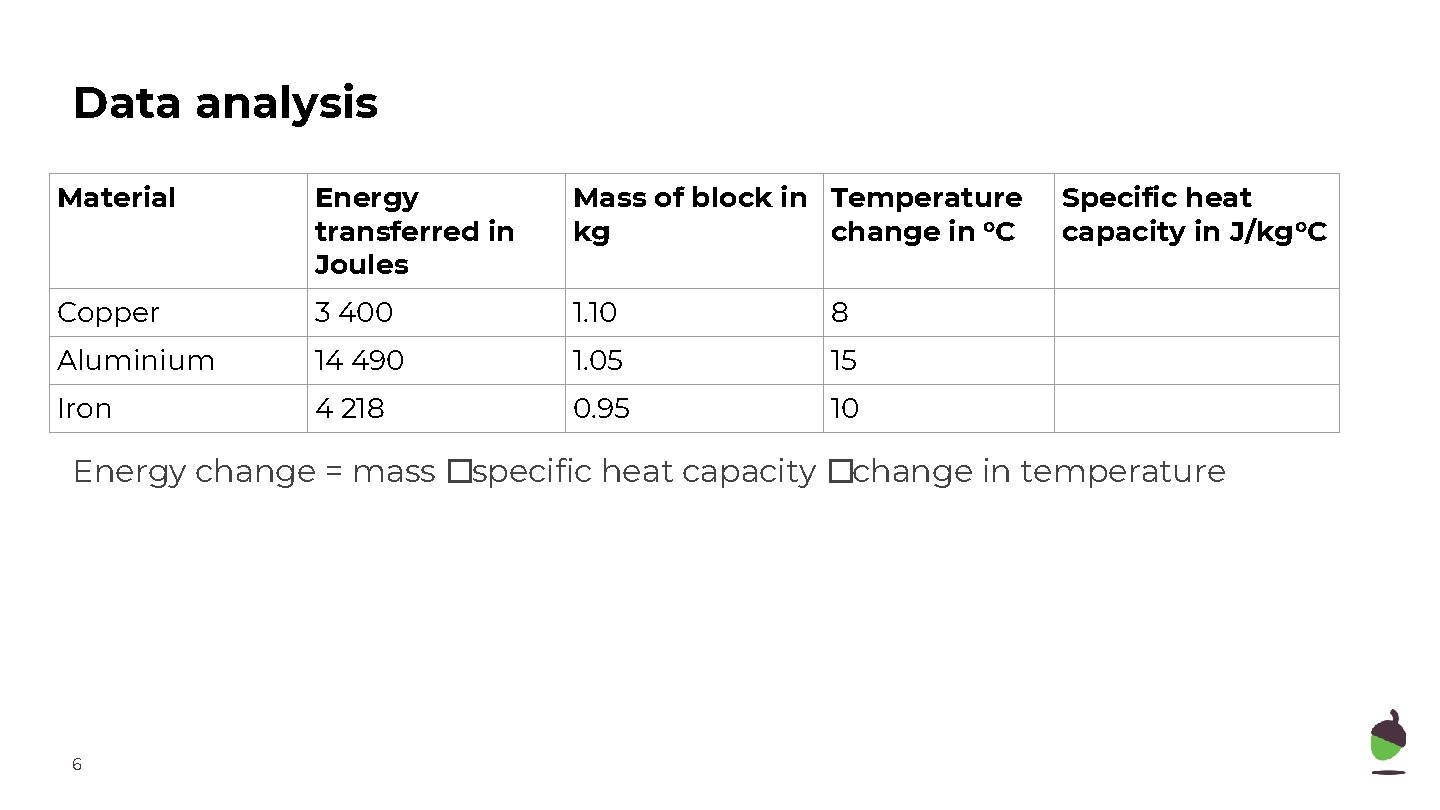
Data analysis Material Energy transferred in Joules Mass of block in Temperature kg change in o. C Copper 3 400 1. 10 8 Aluminium 14 490 1. 05 15 Iron 4 218 0. 95 10 Specific heat capacity in J/kg o. C Energy change = mass �specific heat capacity �change in temperature 6
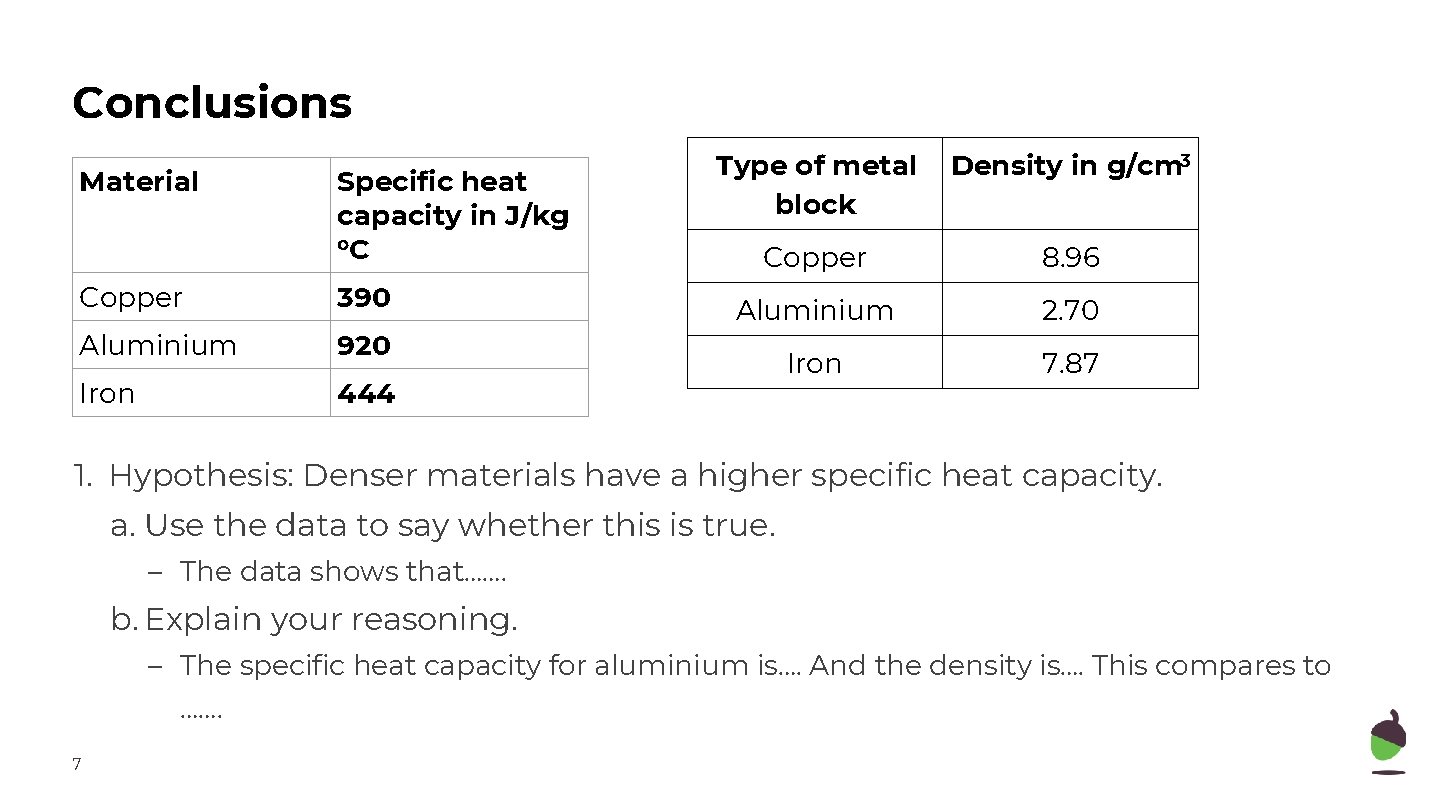
Conclusions Material Specific heat capacity in J/kg o. C Copper 390 Aluminium 920 Iron 444 Type of metal block Density in g/cm 3 Copper 8. 96 Aluminium 2. 70 Iron 7. 87 1. Hypothesis: Denser materials have a higher specific heat capacity. a. Use the data to say whether this is true. – The data shows that……. b. Explain your reasoning. – The specific heat capacity for aluminium is…. And the density is…. This compares to ……. 7

Answers 8
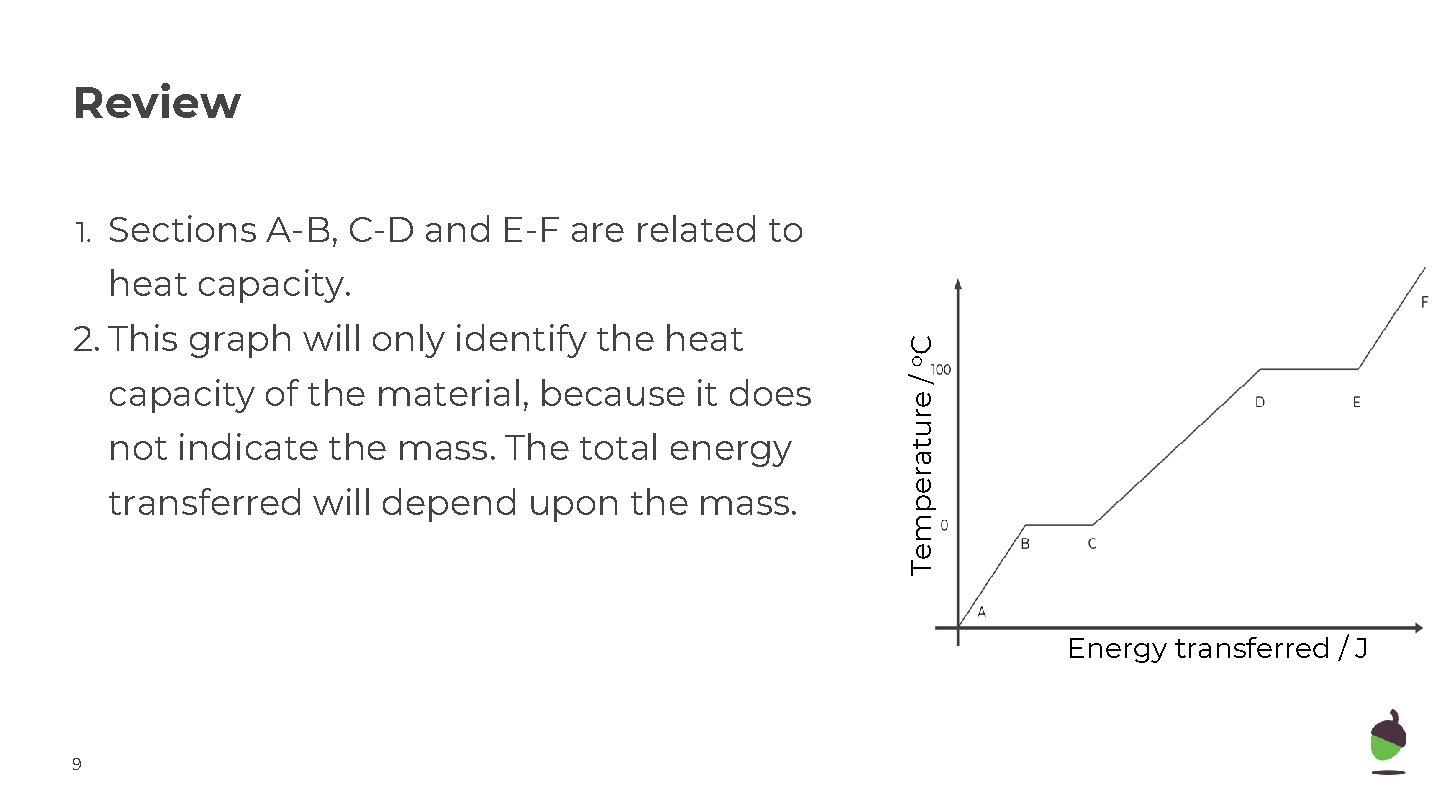
Review 1. Sections A-B, C-D and E-F are related to 2. This graph will only identify the heat capacity of the material, because it does not indicate the mass. The total energy transferred will depend upon the mass. Temperature / o. C heat capacity. Energy transferred / J 9
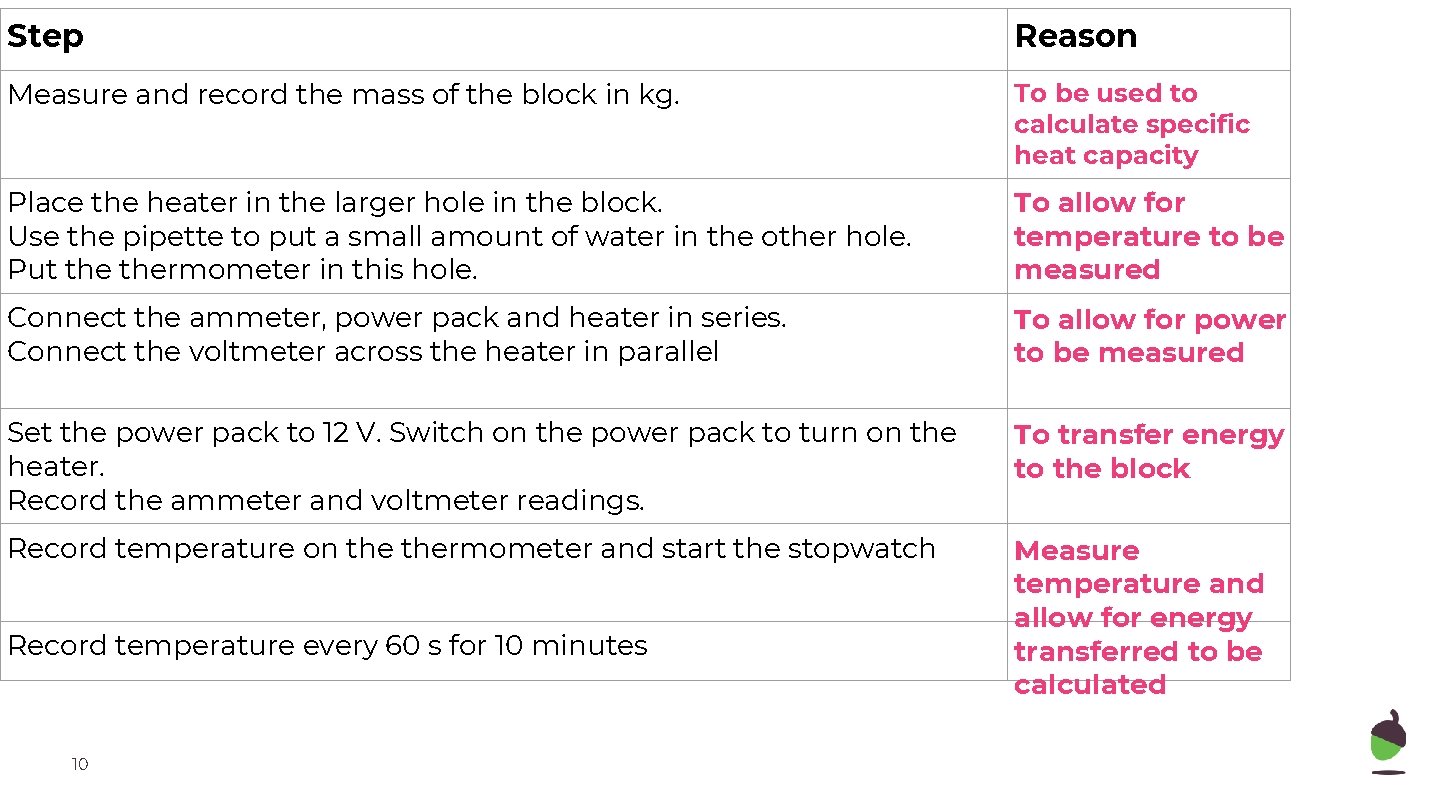
Step Reason Measure and record the mass of the block in kg. To be used to calculate specific heat capacity Place the heater in the larger hole in the block. Use the pipette to put a small amount of water in the other hole. Put thermometer in this hole. To allow for temperature to be measured Connect the ammeter, power pack and heater in series. Connect the voltmeter across the heater in parallel To allow for power to be measured Set the power pack to 12 V. Switch on the power pack to turn on the heater. Record the ammeter and voltmeter readings. To transfer energy to the block Record temperature on thermometer and start the stopwatch Measure temperature and allow for energy transferred to be calculated Record temperature every 60 s for 10 minutes 10
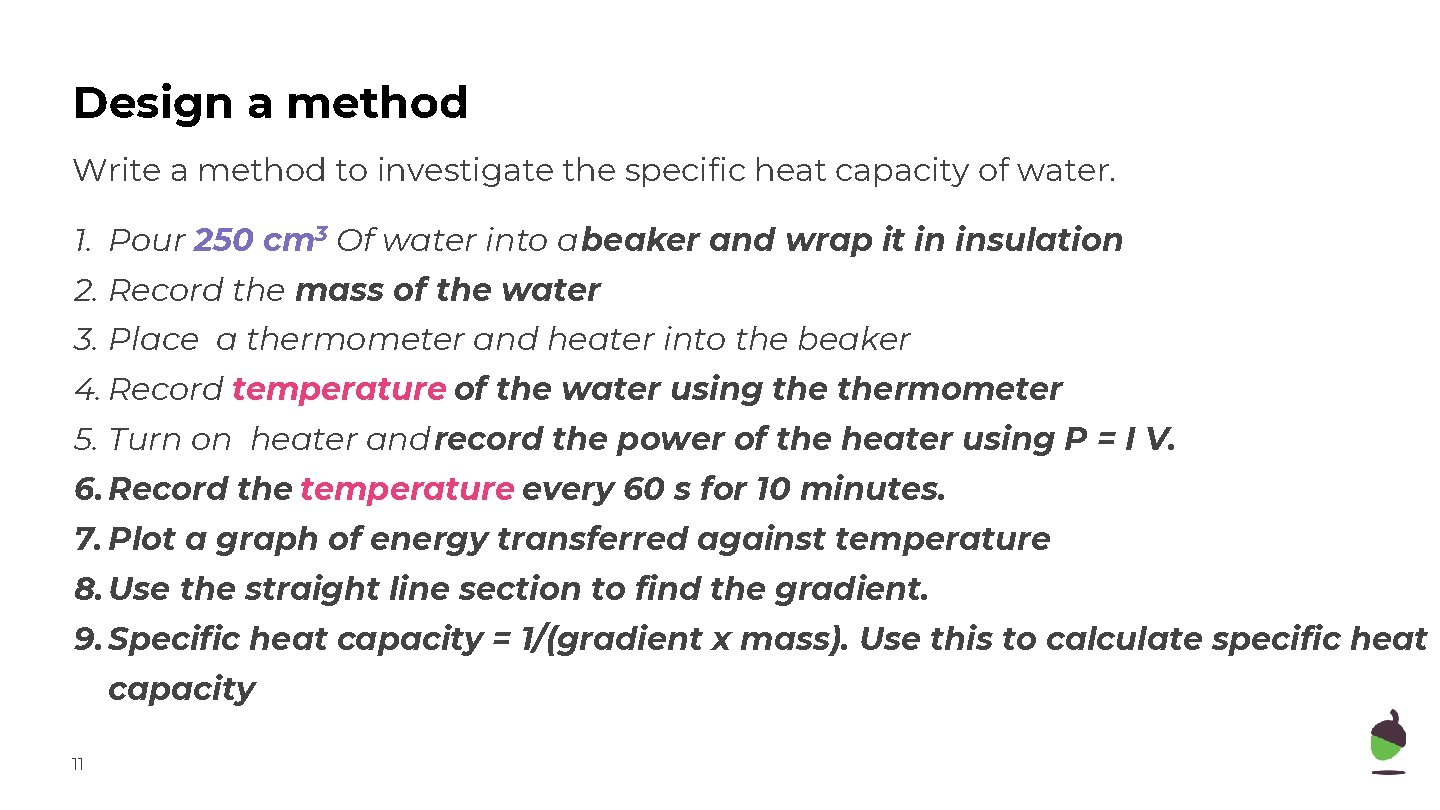
Design a method Write a method to investigate the specific heat capacity of water. 1. Pour 250 cm 3 Of water into a beaker and wrap it in insulation 2. Record the mass of the water 3. Place a thermometer and heater into the beaker 4. Record temperature of the water using thermometer 5. Turn on heater and record the power of the heater using P = I V. 6. Record the temperature every 60 s for 10 minutes. 7. Plot a graph of energy transferred against temperature 8. Use the straight line section to find the gradient. 9. Specific heat capacity = 1/(gradient x mass). Use this to calculate specific heat capacity 11
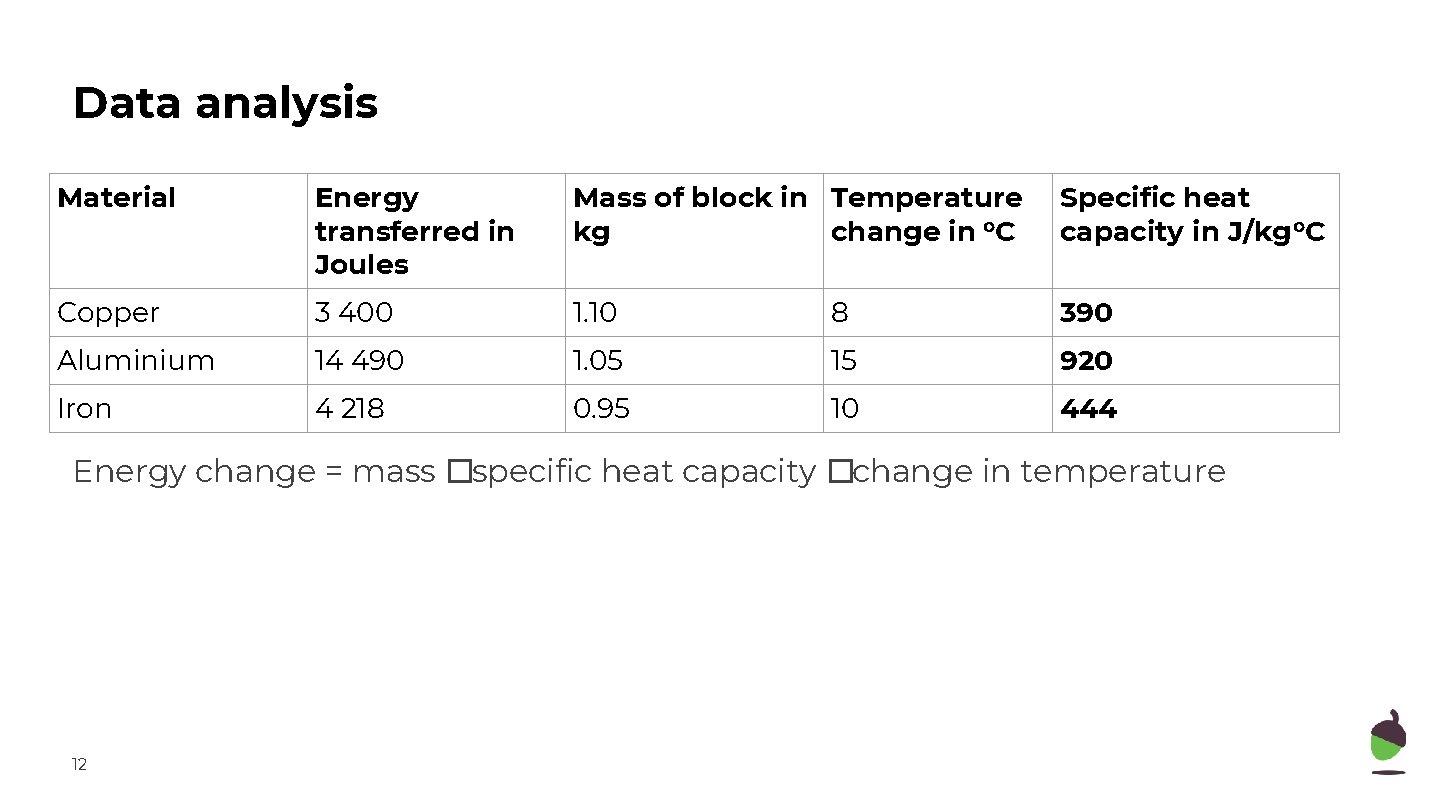
Data analysis Material Energy transferred in Joules Mass of block in Temperature kg change in o. C Specific heat capacity in J/kg o. C Copper 3 400 1. 10 8 390 Aluminium 14 490 1. 05 15 920 Iron 4 218 0. 95 10 444 Energy change = mass �specific heat capacity �change in temperature 12
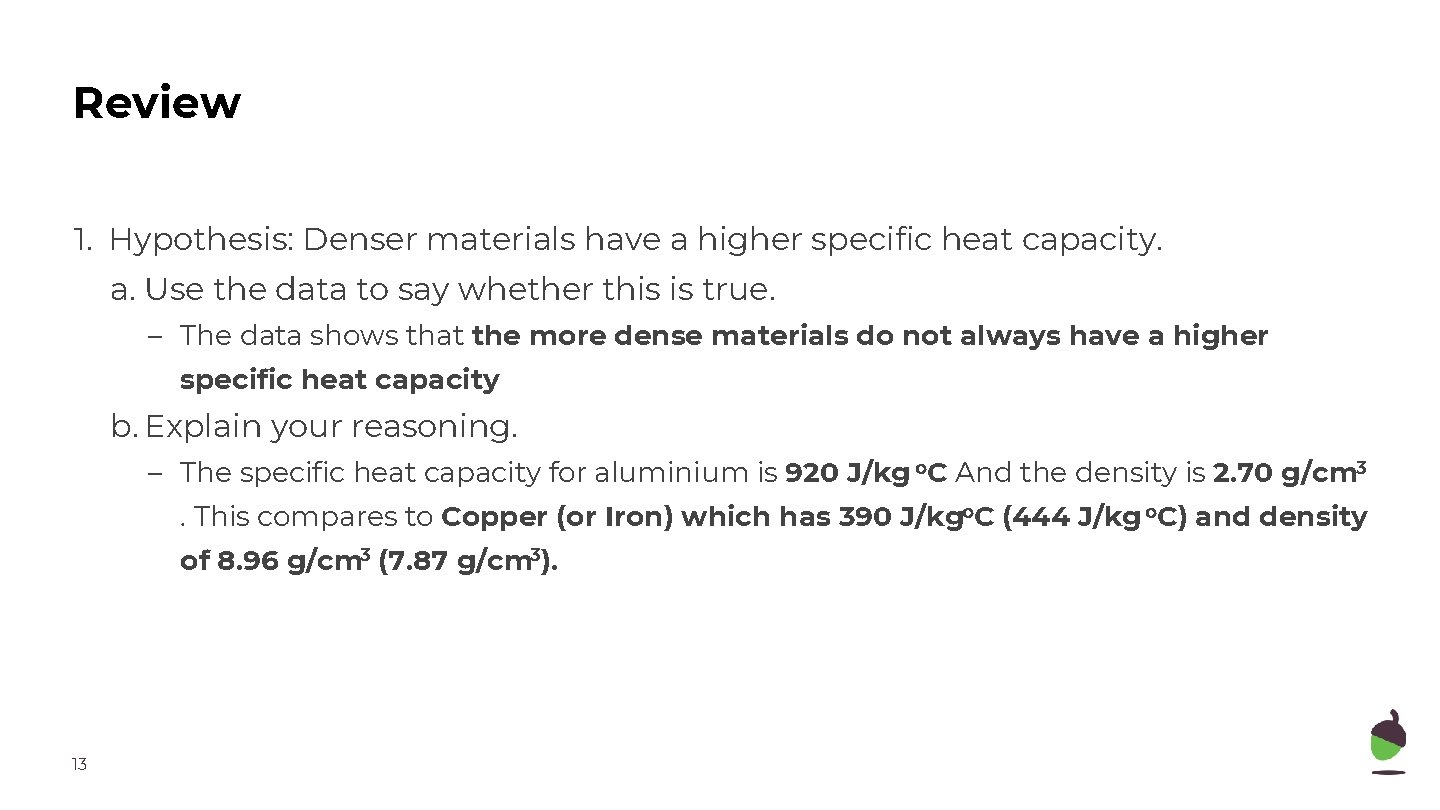
Review 1. Hypothesis: Denser materials have a higher specific heat capacity. a. Use the data to say whether this is true. – The data shows that the more dense materials do not always have a higher specific heat capacity b. Explain your reasoning. – The specific heat capacity for aluminium is 920 J/kg o. C And the density is 2. 70 g/cm 3. This compares to Copper (or Iron) which has 390 J/kgo. C (444 J/kg o. C) and density of 8. 96 g/cm 3 (7. 87 g/cm 3). 13
- Slides: 13