
Combined science Physics Key stage 4 Atomic Structure
Combined science - Physics - Key stage 4 - Atomic Structure Isotopes and Ionisation Mr van Hoek 1
How much can you recall? Describe the nuclear model of the structure of an atom. In your answer you should: ● Give details of the individual particles that make up an atom. ● Include the relative masses and relative charges of these particles. Do not include a diagram in your answer. 2
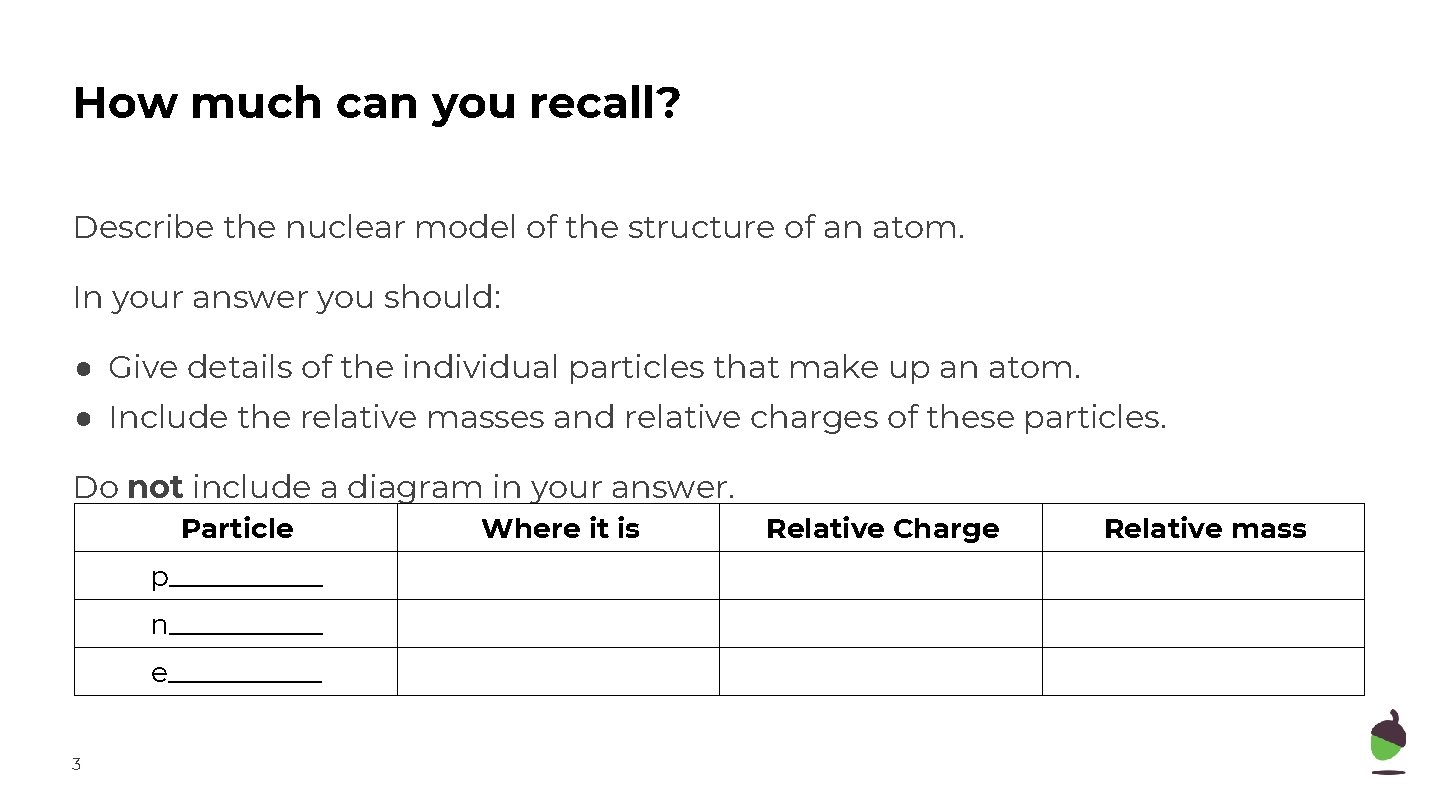
How much can you recall? Describe the nuclear model of the structure of an atom. In your answer you should: ● Give details of the individual particles that make up an atom. ● Include the relative masses and relative charges of these particles. Do not include a diagram in your answer. Particle p______ n______ e______ 3 Where it is Relative Charge Relative mass
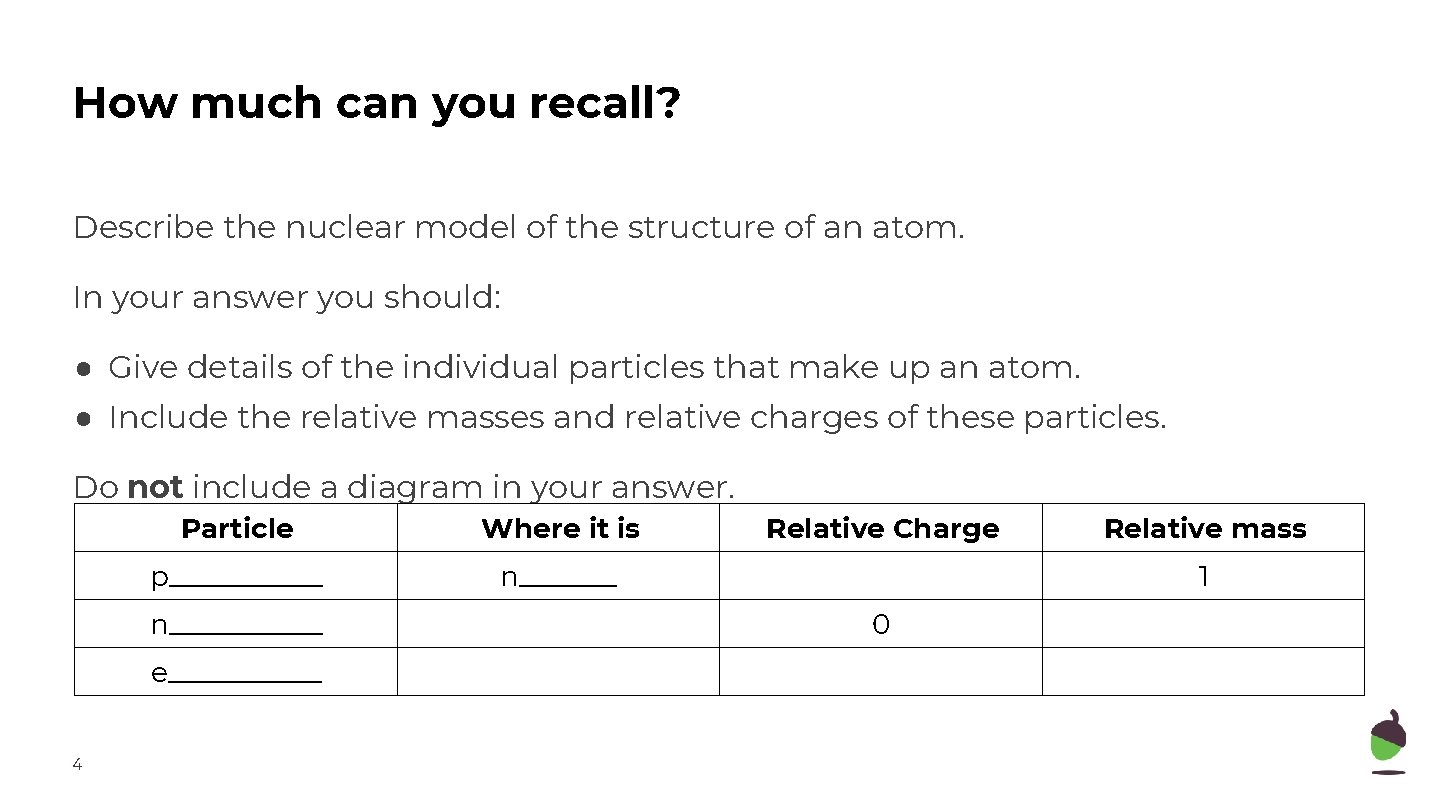
How much can you recall? Describe the nuclear model of the structure of an atom. In your answer you should: ● Give details of the individual particles that make up an atom. ● Include the relative masses and relative charges of these particles. Do not include a diagram in your answer. Particle Where it is p______ n___________ e______ 4 Relative Charge Relative mass 1 0

How much can you recall? Describe the nuclear model of the structure of an atom. In your answer you should: ● Give details of the individual particles that make up an atom. ● Include the relative masses and relative charges of these particles. Do not include a diagram in your answer. Particle Where it is p______ n___________ e______ 5 Relative Charge Relative mass 1 0
Independent task - part 1 of 2 1. What is the definition of an isotope? 1. How can you determine the number of neutrons in an isotope? 1. What does the number of protons determine about an atom? 6

Independent task - part 2 of 2 4. Uranium has two natural isotopes, uranium-235 and uranium-238. Use the correct answer from the words below to complete the sentence. electrons neutrons protons The nucleus of a uranium-238 atom has three more _______ than the nucleus of a uranium-235 atom. 5. How many protons are there in the nucleus of a lead-206 atom? 4. How many neutrons are there in the nucleus of a lead-206 atom? 7

Complete the sentences about atoms. In an atom, the number of electrons is equal to the number of _________. All atoms of an element have the same number of _____________. Isotopes of the same element have different numbers of ___________. Exam Question taken from Exam. Pro 8
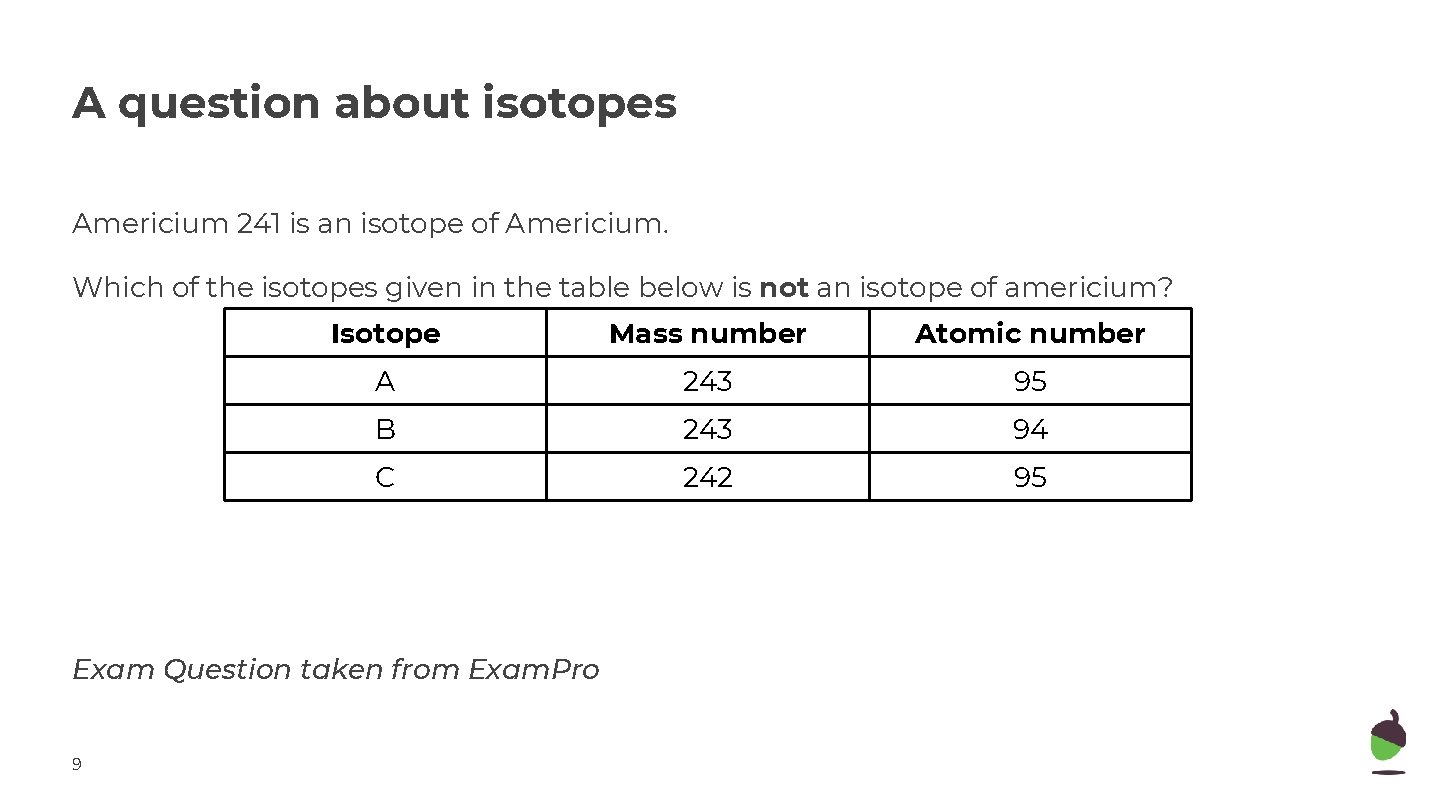
A question about isotopes Americium 241 is an isotope of Americium. Which of the isotopes given in the table below is not an isotope of americium? Isotope Mass number Atomic number A 243 95 B 243 94 C 242 95 Exam Question taken from Exam. Pro 9
Exam question about ionisation What happens to the structure of an atom when the atom is ionised? Exam Question taken from Exam. Pro 10
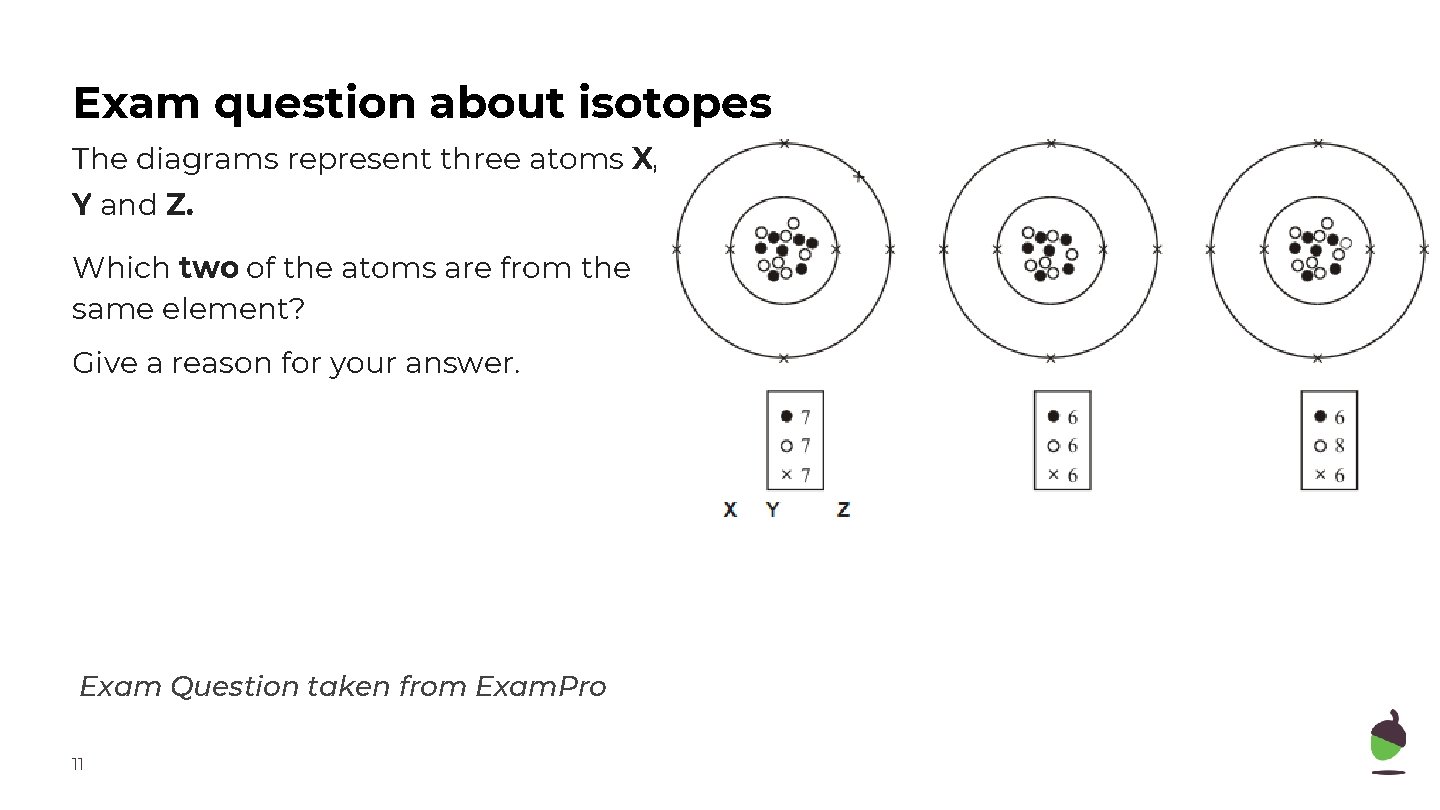
Exam question about isotopes The diagrams represent three atoms X, Y and Z. Which two of the atoms are from the same element? Give a reason for your answer. Exam Question taken from Exam. Pro 11
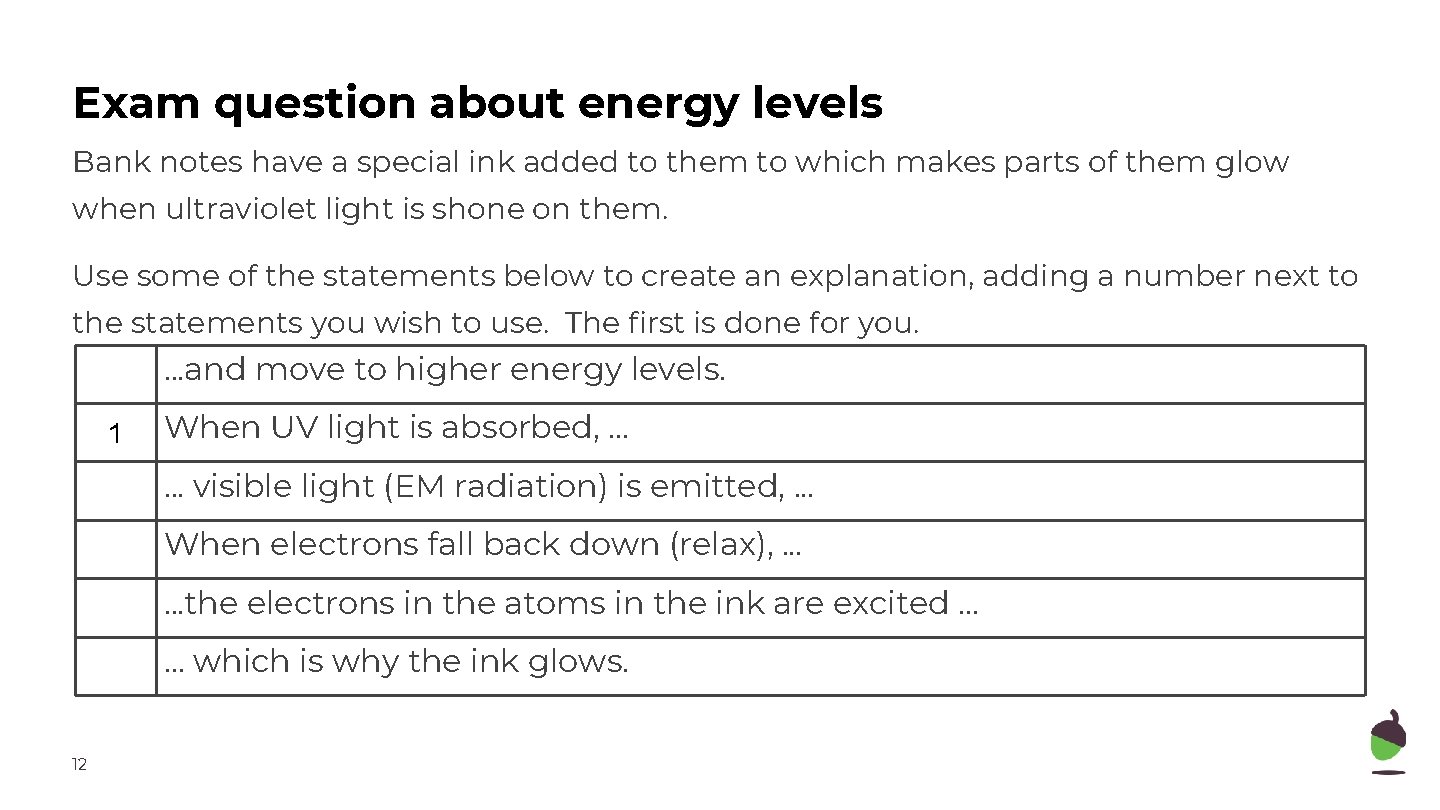
Exam question about energy levels Bank notes have a special ink added to them to which makes parts of them glow when ultraviolet light is shone on them. Use some of the statements below to create an explanation, adding a number next to the statements you wish to use. The first is done for you. . and move to higher energy levels. 1 When UV light is absorbed, . . . visible light (EM radiation) is emitted, . . . When electrons fall back down (relax), . . . the electrons in the atoms in the ink are excited. . . … which is why the ink glows. 12
Independent task Within the nuclear industry, workers must be protected from ionising radiation. Ionising radiation cause ionisation to occur within the chemicals of cells, and this increases risks to workers’ health. Explain what is meant by ionisation. Describe how the process of ionisation occurs. 13
- Slides: 13