
Combined Science Chemistry Key Stage 4 Energy Changes
Combined Science - Chemistry - Key Stage 4 Energy Changes Required Practical Temperature Change Part 2 Mrs. Begum 1
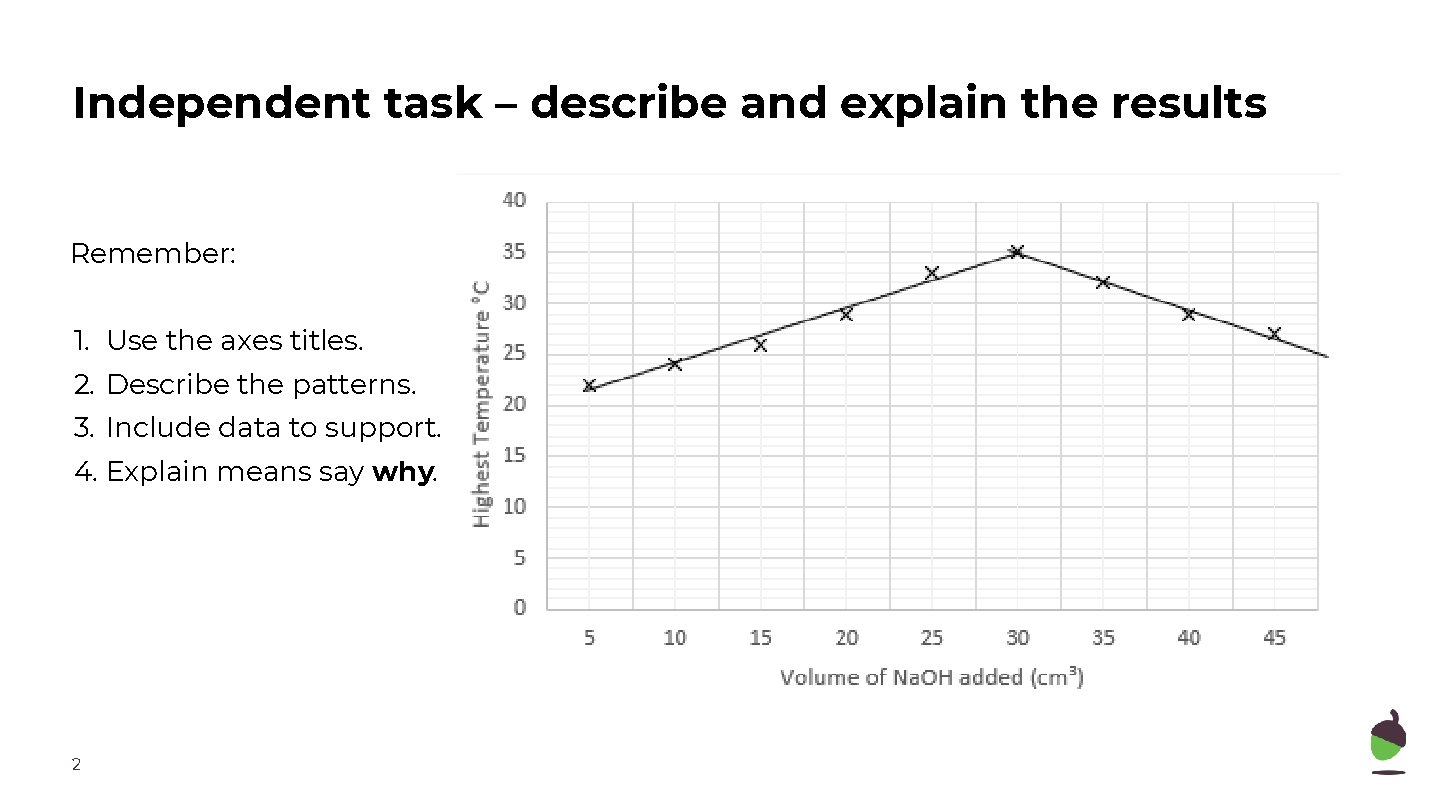
Independent task – describe and explain the results Remember: 1. Use the axes titles. 2. Describe the patterns. 3. Include data to support. 4. Explain means say why. 2
Independent task answers As the volume of Na. OH added increases, the more the temperature of the solution increases. For example, when 5 cm 3 of Na. OH was added, the temperature was 26 o. C, but when 15 cm 3 was added, the temperature rose to 32 o. C. After 35 cm 3 has been added, the temperature decreases. This is because, when Na. OH is added to the solution, an exothermic reaction occurs and the temperature increases. However, after 35 cm 3, the reaction is complete, so the temperature can not increase any further. As more Na. OH is being added the temperature decreases. 3
Independent task – exam style question A student carried out an investigation into the energy changes involved when magnesium and hydrochloric acid react. 10 cm³ acid was placed into a beaker and a 2 cm strip of magnesium added. The temperature at the start and end were recorded using a thermometer. a) Suggest 2 ways of improving the equipment used. Explain why each is an improvement. b)Suggest one way of improving the method. c) Explain what is meant by the term ‘repeatable’. 4
Independent task answers a) Use a polystyrene cup or insulate the beaker, so that energy loss to the surroundings is reduced. Add a lid to the beaker, so that energy loss to the surroundings is reduced. Use a digital thermometer or temperature probe, so that the temperature readings are more accurate or have greater resolution. a) Repeat the experiment and calculate a mean. b)When the experiment has been repeated several times and the repeated readings are the same or very similar. 5
- Slides: 5