
Combined Multiuser Reception and Channel Decoding for TDMA
Combined Multiuser Reception and Channel Decoding for TDMA Cellular Systems 48 th Annual Vehicular Technology Conference Ottawa, Canada May 21, 1998 VIRGINIA POLYTECHNIC INSTITUTE & STATE UNIVERSITY MPRG MOBILE & PORTABLE RADIO RESEARCH GROUP Matthew Valenti and Brian D. Woerner Mobile and Portable Radio Research Group Virginia Tech Blacksburg, Virginia
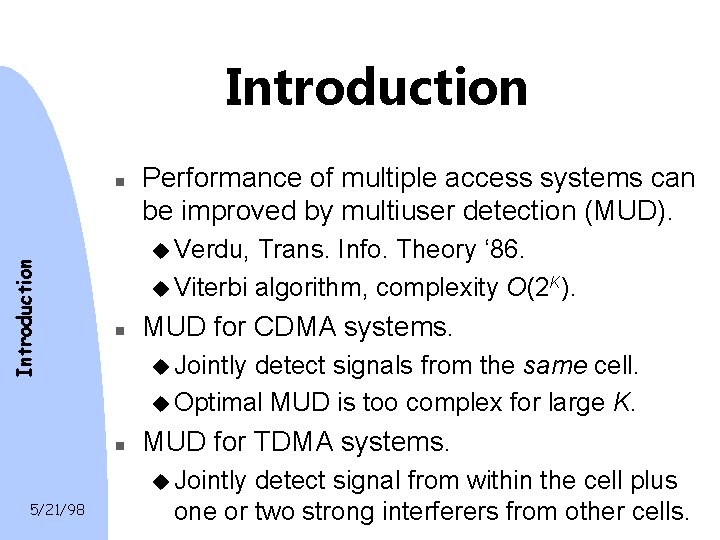
Introduction n Performance of multiple access systems can be improved by multiuser detection (MUD). u Verdu, Trans. Info. Theory ‘ 86. u Viterbi algorithm, complexity O(2 K). n MUD for CDMA systems. u Jointly detect signals from the same cell. u Optimal MUD is too complex for large K. n MUD for TDMA systems. u Jointly 5/21/98 detect signal from within the cell plus one or two strong interferers from other cells.
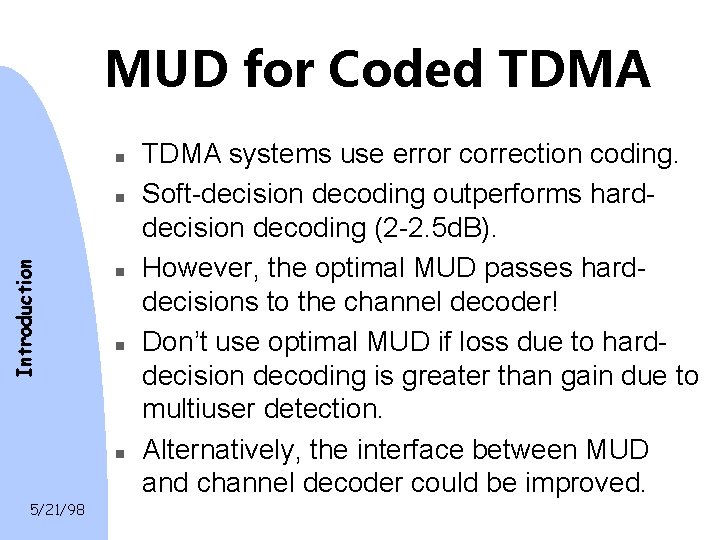
MUD for Coded TDMA n Introduction n n 5/21/98 TDMA systems use error correction coding. Soft-decision decoding outperforms harddecision decoding (2 -2. 5 d. B). However, the optimal MUD passes harddecisions to the channel decoder! Don’t use optimal MUD if loss due to harddecision decoding is greater than gain due to multiuser detection. Alternatively, the interface between MUD and channel decoder could be improved.
Outline of Talk n System Model. asynchronous. u Generalized for both TDMA and CDMA. Introduction u bit n n MUD for TDMA. Proposed Receiver Architecture. u Turbo n Simulation results u RSC 5/21/98 processing. coded system. u 1 strong interferer. u SOVA decoders.
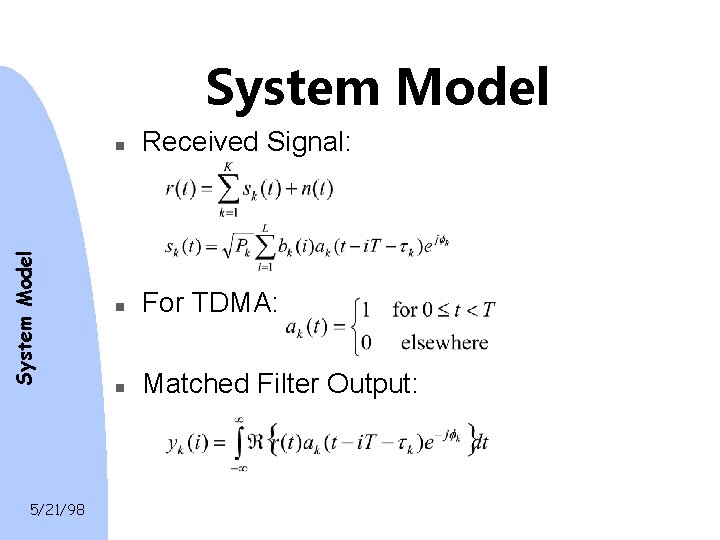
System Model 5/21/98 n Received Signal: n For TDMA: n Matched Filter Output:
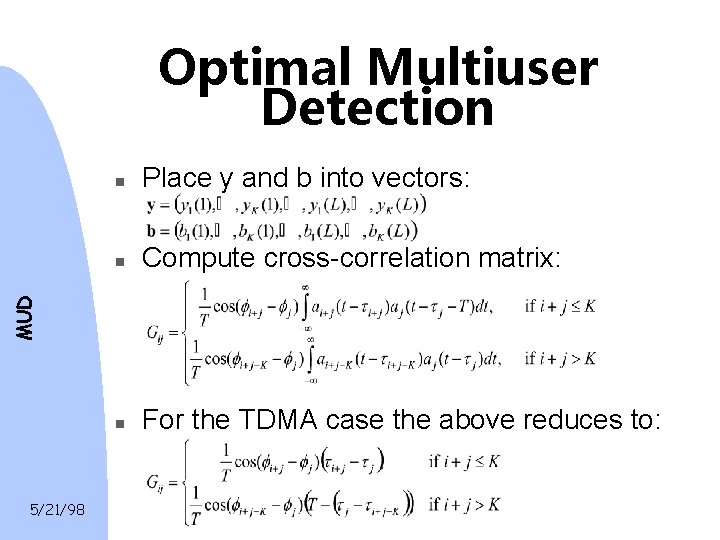
Optimal Multiuser Detection Place y and b into vectors: n Compute cross-correlation matrix: n For the TDMA case the above reduces to: MUD n 5/21/98
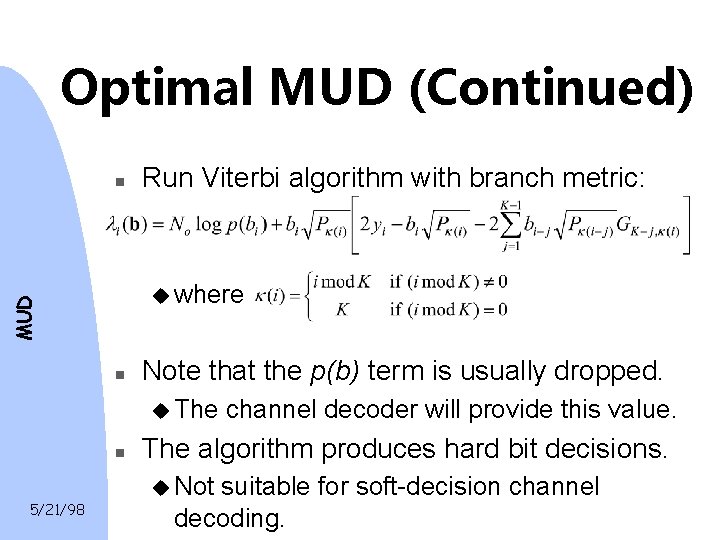
Optimal MUD (Continued) n Run Viterbi algorithm with branch metric: MUD u where n Note that the p(b) term is usually dropped. u The n 5/21/98 channel decoder will provide this value. The algorithm produces hard bit decisions. u Not suitable for soft-decision channel decoding.
Soft-Output MUD n n Several algorithms can be used to produce soft-output. Trellis-based. MUD u MAP algorithm F Log-MAP, Robertson et al, ICC ‘ 95 F OSOME, Hafeez & Stark, VTC ‘ 97 u SOVA algorithm F Hagenauer n 5/21/98 & Hoeher, Globecom ‘ 89 Non-trellis-based. u Suboptimal, reduced complexity.
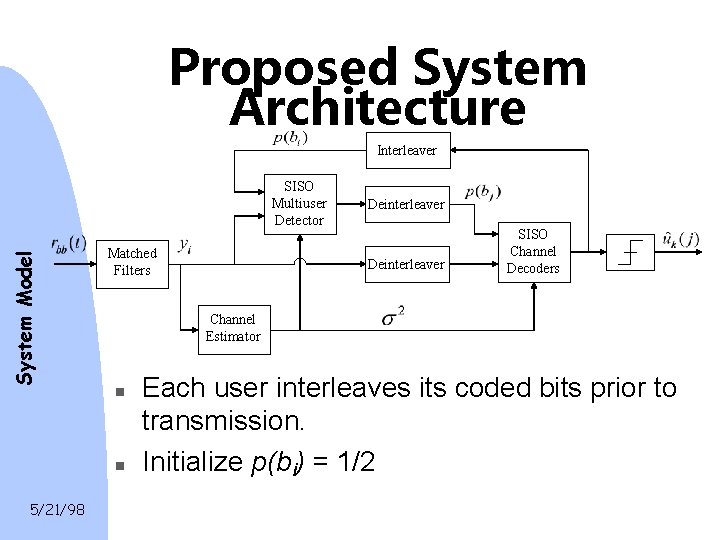
Proposed System Architecture Interleaver System Model SISO Multiuser Detector Matched Filters Deinterleaver SISO Channel Decoders Channel Estimator n n 5/21/98 Deinterleaver Each user interleaves its coded bits prior to transmission. Initialize p(bi) = 1/2
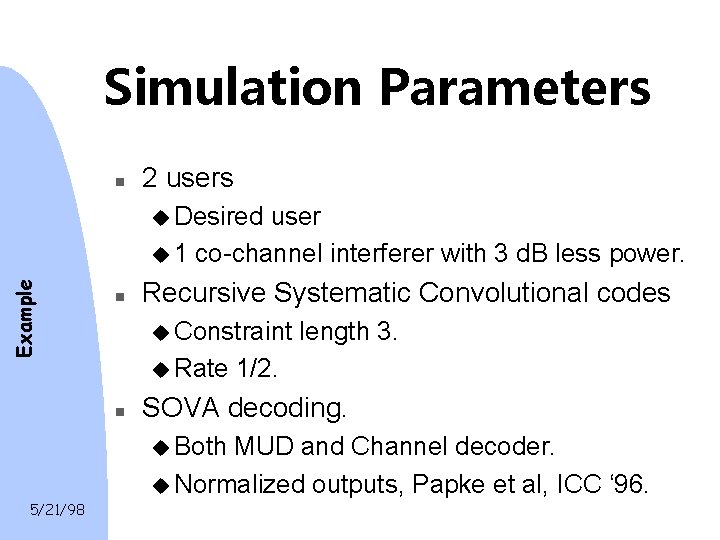
Simulation Parameters n 2 users user u 1 co-channel interferer with 3 d. B less power. Example u Desired n Recursive Systematic Convolutional codes u Constraint u Rate n length 3. 1/2. SOVA decoding. u Both MUD and Channel decoder. u Normalized outputs, Papke et al, ICC ‘ 96. 5/21/98
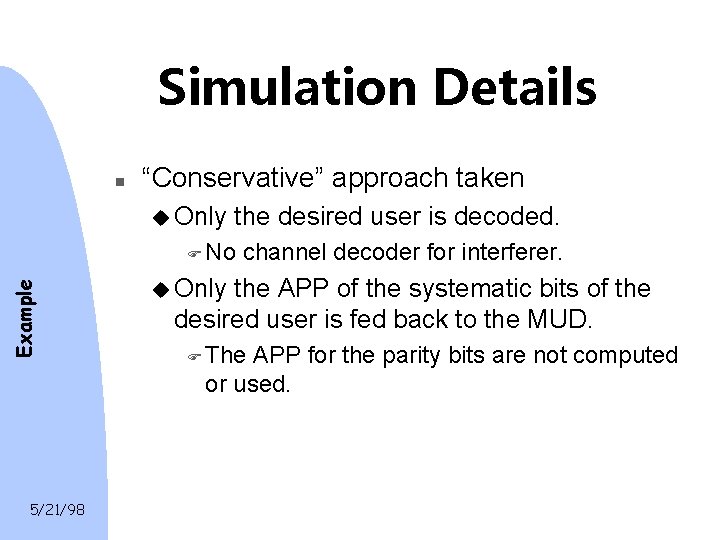
Simulation Details n “Conservative” approach taken u Only the desired user is decoded. Example F No 5/21/98 channel decoder for interferer. u Only the APP of the systematic bits of the desired user is fed back to the MUD. F The APP for the parity bits are not computed or used.
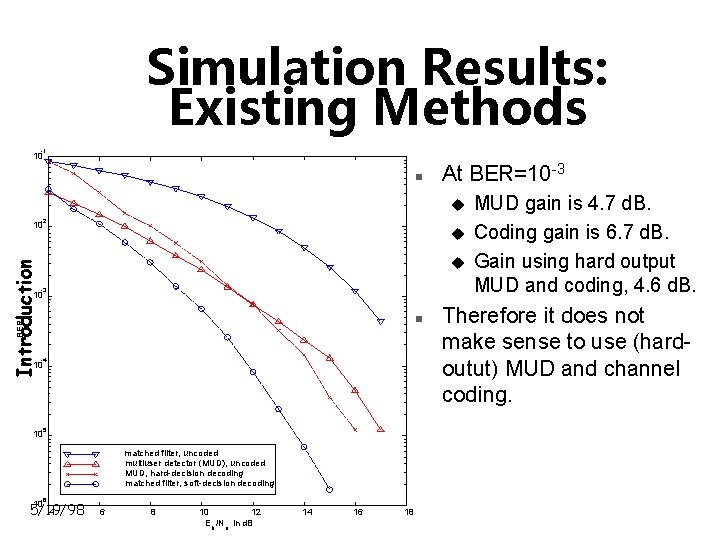
Simulation Results: Existing Methods -1 10 n At BER=10 -3 u -2 BER Introduction 10 u u -3 10 n -4 10 -5 10 matched filter, uncoded multiuser detector (MUD), uncoded MUD, hard-decision decoding matched filter, soft-decision decoding -6 10 5/19/98 4 6 8 10 12 E b /No in d. B 14 16 18 MUD gain is 4. 7 d. B. Coding gain is 6. 7 d. B. Gain using hard output MUD and coding, 4. 6 d. B. Therefore it does not make sense to use (hardoutut) MUD and channel coding.
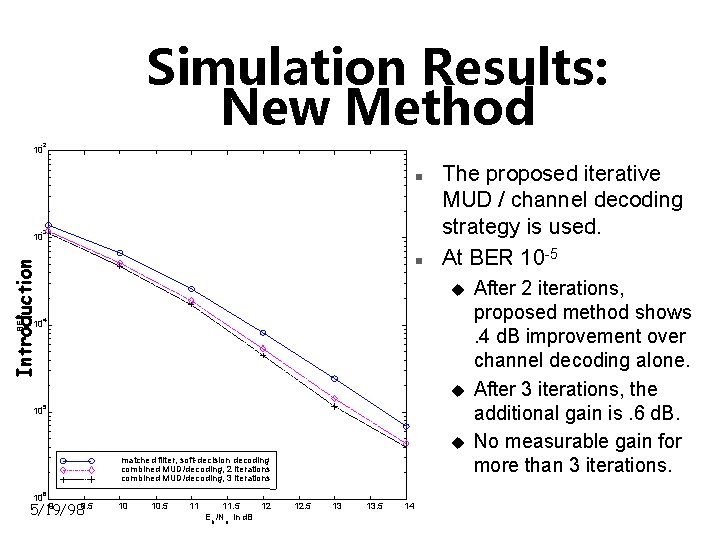
Simulation Results: New Method -2 10 n -3 BER Introduction 10 n The proposed iterative MUD / channel decoding strategy is used. At BER 10 -5 u -4 10 u -5 10 u matched filter, soft-decision decoding combined MUD/decoding, 2 iterations combined MUD/decoding, 3 iterations -6 10 9 9. 5 5/19/98 10 10. 5 11 11. 5 12 E b /No in d. B 12. 5 13 13. 5 14 After 2 iterations, proposed method shows. 4 d. B improvement over channel decoding alone. After 3 iterations, the additional gain is. 6 d. B. No measurable gain for more than 3 iterations.
Conclusion n Optimal MUD can be used for TDMA. if channel coding is used then the interface between MUD and decoder is critical. Conclusion u However, n A strategy for iterative MUD/channel decoding is proposed. u Based n on the concept of turbo processing. Proposed strategy was illustrated by simulation example. u Modest 5/21/98 gain by using proposed strategy over channel coding alone.
Future Work n More aggressive use of soft-information. Conclusion u Use parity information for RSC codes, or use conventional convolutional coding. u Decode the interfering user. n u Decode each user at the closest base station. u Send the results to all the other base stations. n n 5/21/98 Share information among base stations. Use MAP algorithm instead of SOVA. Fading, channel estimation, and equalization.
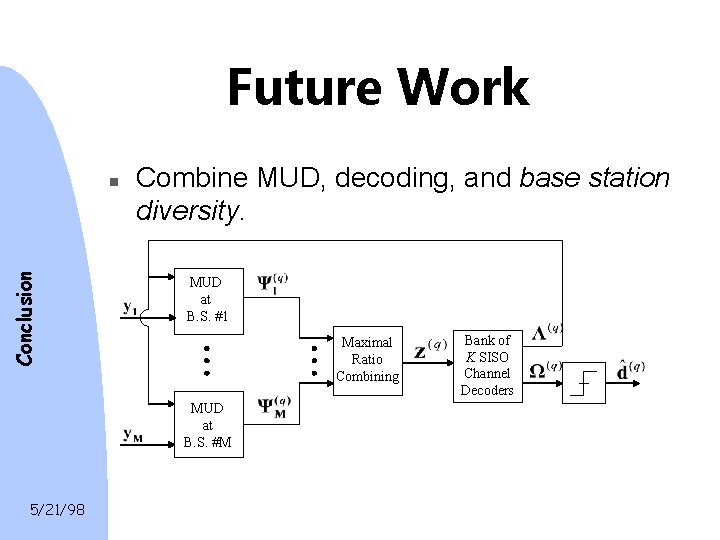
Future Work Conclusion n Combine MUD, decoding, and base station diversity. MUD at B. S. #1 Maximal Ratio Combining MUD at B. S. #M 5/21/98 Bank of K SISO Channel Decoders
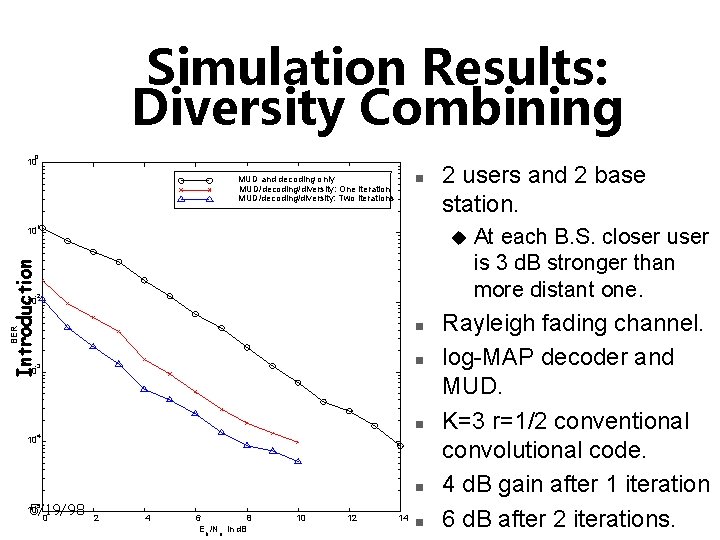
Simulation Results: Diversity Combining 0 10 n MUD and decoding only MUD/decoding/diversity: One iteration MUD/decoding/diversity: Two iterations -1 10 Introduction u -2 10 BER n n -3 10 n -4 10 n 10 5/19/98 0 2 users and 2 base station. -5 2 4 6 8 E b /No in d. B 10 12 14 n At each B. S. closer user is 3 d. B stronger than more distant one. Rayleigh fading channel. log-MAP decoder and MUD. K=3 r=1/2 conventional convolutional code. 4 d. B gain after 1 iteration 6 d. B after 2 iterations.
- Slides: 17