
Combined Heat and Power CHP Modeling in the
Combined Heat and Power (CHP) Modeling in the REopt Lite Web Tool CID Number GO 28308 National Renewable Energy Laboratory, Colorado School of Mines, and Clean Energy Group Fiscal Year 2019 -2021 Kate Anderson, National Renewable Energy Laboratory (NREL) Patti Garland, DOE Advanced Manufacturing Office U. S. DOE Advanced Manufacturing Office Virtual Program Review June 2 -3, 2020 This presentation does not contain any proprietary, confidential, or otherwise restricted information.
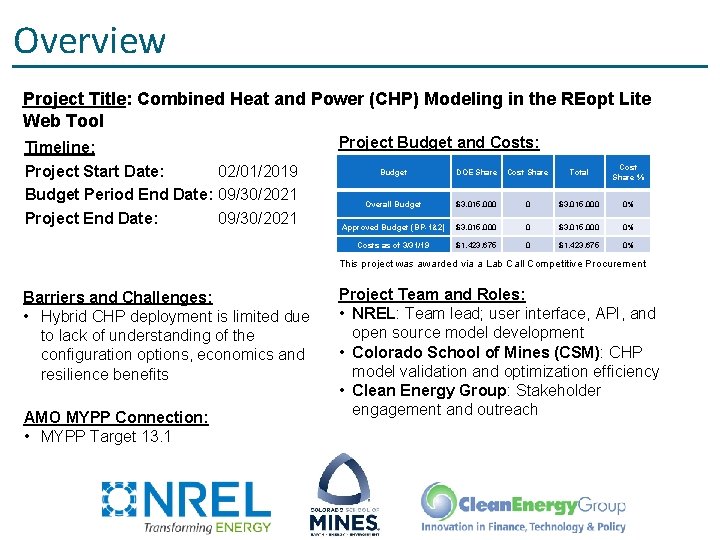
Overview Project Title: Combined Heat and Power (CHP) Modeling in the REopt Lite Web Tool Timeline: Project Start Date: 02/01/2019 Budget Period End Date: 09/30/2021 Project Budget and Costs: Budget DOE Share Cost Share Total Cost Share % Overall Budget $3, 015, 000 0% Approved Budget (BP-1&2) $3, 015, 000 0% Costs as of 3/31/19 $1, 423, 675 0% This project was awarded via a Lab Call Competitive Procurement Barriers and Challenges: • Hybrid CHP deployment is limited due to lack of understanding of the configuration options, economics and resilience benefits AMO MYPP Connection: • MYPP Target 13. 1 Project Team and Roles: • NREL: Team lead; user interface, API, and open source model development • Colorado School of Mines (CSM): CHP model validation and optimization efficiency • Clean Energy Group: Stakeholder engagement and outreach
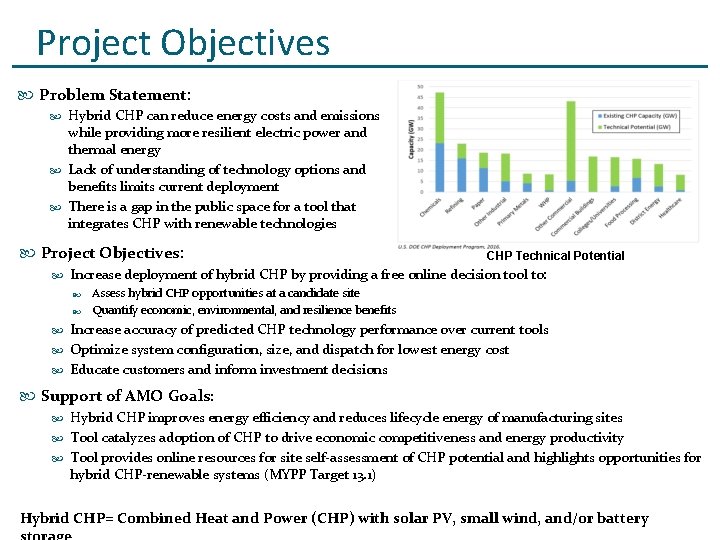
Project Objectives Problem Statement: Hybrid CHP can reduce energy costs and emissions while providing more resilient electric power and thermal energy Lack of understanding of technology options and benefits limits current deployment There is a gap in the public space for a tool that integrates CHP with renewable technologies Project Objectives: CHP Technical Potential Increase deployment of hybrid CHP by providing a free online decision tool to: Assess hybrid CHP opportunities at a candidate site Quantify economic, environmental, and resilience benefits Increase accuracy of predicted CHP technology performance over current tools Optimize system configuration, size, and dispatch for lowest energy cost Educate customers and inform investment decisions Support of AMO Goals: Hybrid CHP improves energy efficiency and reduces lifecycle energy of manufacturing sites Tool catalyzes adoption of CHP to drive economic competitiveness and energy productivity Tool provides online resources for site self-assessment of CHP potential and highlights opportunities for hybrid CHP-renewable systems (MYPP Target 13. 1) Hybrid CHP= Combined Heat and Power (CHP) with solar PV, small wind, and/or battery
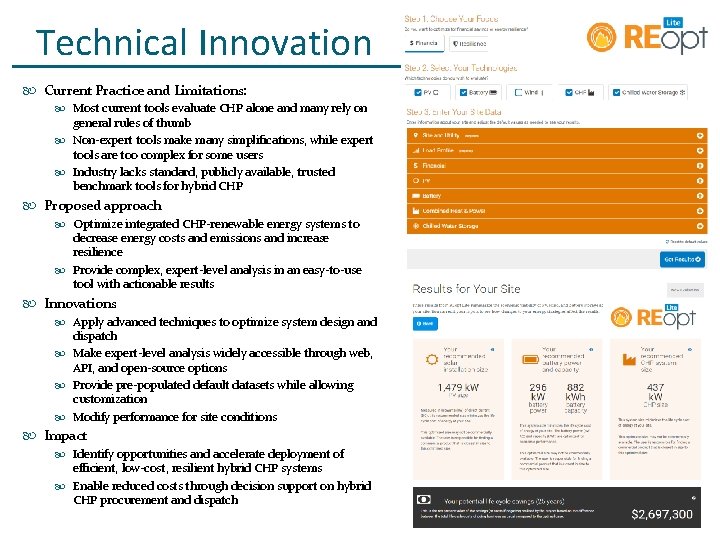
Technical Innovation Current Practice and Limitations: Most current tools evaluate CHP alone and many rely on general rules of thumb Non-expert tools make many simplifications, while expert tools are too complex for some users Industry lacks standard, publicly available, trusted benchmark tools for hybrid CHP Proposed approach Optimize integrated CHP-renewable energy systems to decrease energy costs and emissions and increase resilience Provide complex, expert-level analysis in an easy-to-use tool with actionable results Innovations Apply advanced techniques to optimize system design and dispatch Make expert-level analysis widely accessible through web, API, and open-source options Provide pre-populated default datasets while allowing customization Modify performance for site conditions Impact Identify opportunities and accelerate deployment of efficient, low-cost, resilient hybrid CHP systems Enable reduced costs through decision support on hybrid CHP procurement and dispatch
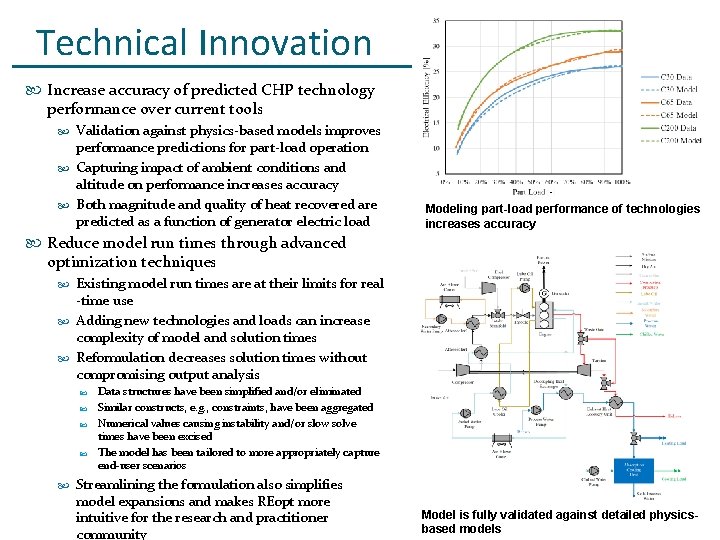
Technical Innovation Increase accuracy of predicted CHP technology performance over current tools Validation against physics-based models improves performance predictions for part-load operation Capturing impact of ambient conditions and altitude on performance increases accuracy Both magnitude and quality of heat recovered are predicted as a function of generator electric load Modeling part-load performance of technologies increases accuracy Reduce model run times through advanced optimization techniques Existing model run times are at their limits for real -time use Adding new technologies and loads can increase complexity of model and solution times Reformulation decreases solution times without compromising output analysis Data structures have been simplified and/or eliminated Similar constructs, e. g. , constraints, have been aggregated Numerical values causing instability and/or slow solve times have been excised The model has been tailored to more appropriately capture end-user scenarios Streamlining the formulation also simplifies model expansions and makes REopt more intuitive for the research and practitioner community Model is fully validated against detailed physicsbased models
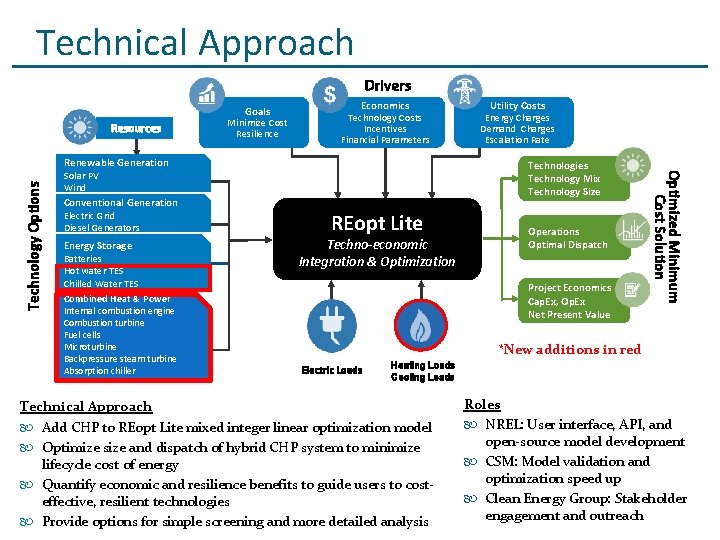
Technical Approach Drivers Renewable Generation Solar PV Wind Conventional Generation Electric Grid Diesel Generators Energy Storage Batteries Hot water TES Chilled Water TES Combined Heat & Power Internal combustion engine Combustion turbine Fuel cells Microturbine Backpressure steam turbine Absorption chiller Economics Technology Costs Incentives Financial Parameters Utility Costs Energy Charges Demand Charges Escalation Rate Technologies Technology Mix Technology Size REopt Lite Techno-economic Integration & Optimization Operations Optimal Dispatch Project Economics Cap. Ex, Op. Ex Net Present Value Optimized Minimum Cost Solution Technology Options Resources Goals Minimize Cost Resilience *New additions in red Electric Loads Heating Loads Cooling Loads Technical Approach Add CHP to REopt Lite mixed integer linear optimization model Optimize size and dispatch of hybrid CHP system to minimize lifecycle cost of energy Quantify economic and resilience benefits to guide users to costeffective, resilient technologies Provide options for simple screening and more detailed analysis Roles NREL: User interface, API, and open-source model development CSM: Model validation and optimization speed up Clean Energy Group: Stakeholder engagement and outreach
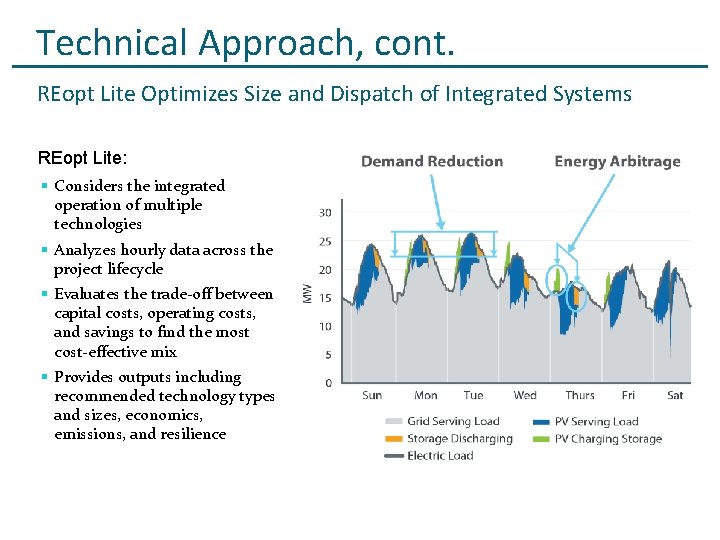
Technical Approach, cont. REopt Lite Optimizes Size and Dispatch of Integrated Systems REopt Lite: § Considers the integrated operation of multiple technologies § Analyzes hourly data across the project lifecycle § Evaluates the trade-off between capital costs, operating costs, and savings to find the most cost-effective mix § Provides outputs including recommended technology types and sizes, economics, emissions, and resilience
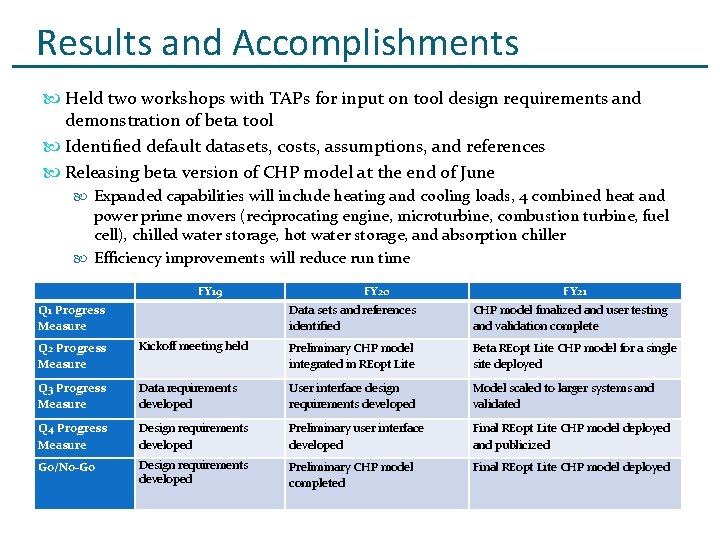
Results and Accomplishments Held two workshops with TAPs for input on tool design requirements and demonstration of beta tool Identified default datasets, costs, assumptions, and references Releasing beta version of CHP model at the end of June Expanded capabilities will include heating and cooling loads, 4 combined heat and power prime movers (reciprocating engine, microturbine, combustion turbine, fuel cell), chilled water storage, hot water storage, and absorption chiller Efficiency improvements will reduce run time FY 19 Q 1 Progress Measure FY 20 FY 21 Data sets and references identified CHP model finalized and user testing and validation complete Q 2 Progress Measure Kickoff meeting held Preliminary CHP model integrated in REopt Lite Beta REopt Lite CHP model for a single site deployed Q 3 Progress Measure Data requirements developed User interface design requirements developed Model scaled to larger systems and validated Q 4 Progress Measure Design requirements developed Preliminary user interface developed Final REopt Lite CHP model deployed and publicized Go/No-Go Design requirements developed Preliminary CHP model completed Final REopt Lite CHP model deployed
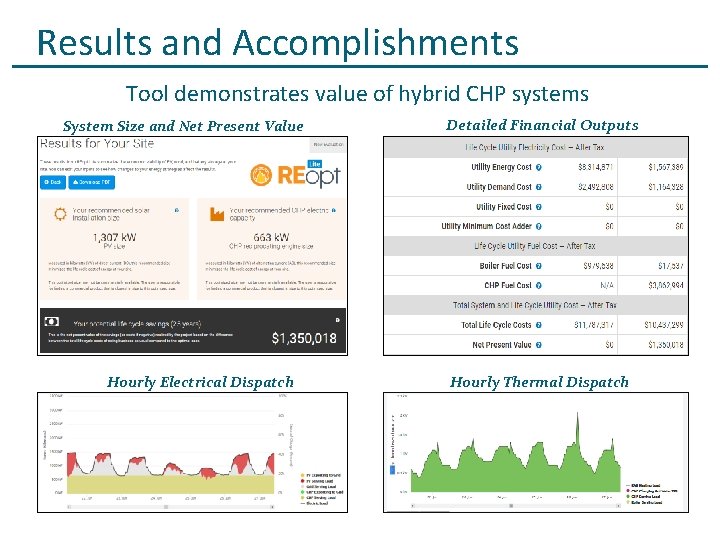
Results and Accomplishments Tool demonstrates value of hybrid CHP systems System Size and Net Present Value Hourly Electrical Dispatch Detailed Financial Outputs Hourly Thermal Dispatch
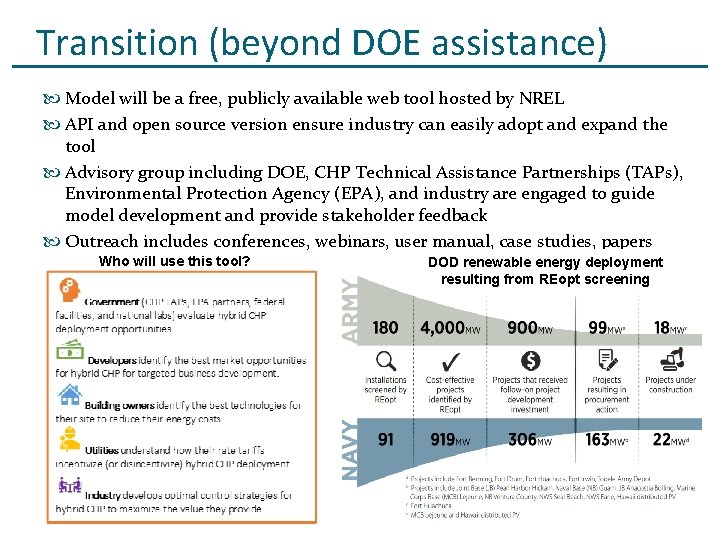
Transition (beyond DOE assistance) Model will be a free, publicly available web tool hosted by NREL API and open source version ensure industry can easily adopt and expand the tool Advisory group including DOE, CHP Technical Assistance Partnerships (TAPs), Environmental Protection Agency (EPA), and industry are engaged to guide model development and provide stakeholder feedback Outreach includes conferences, webinars, user manual, case studies, papers Who will use this tool? DOD renewable energy deployment resulting from REopt screening
- Slides: 10