
Combined Hamartoma of the Retina and RPE Involving
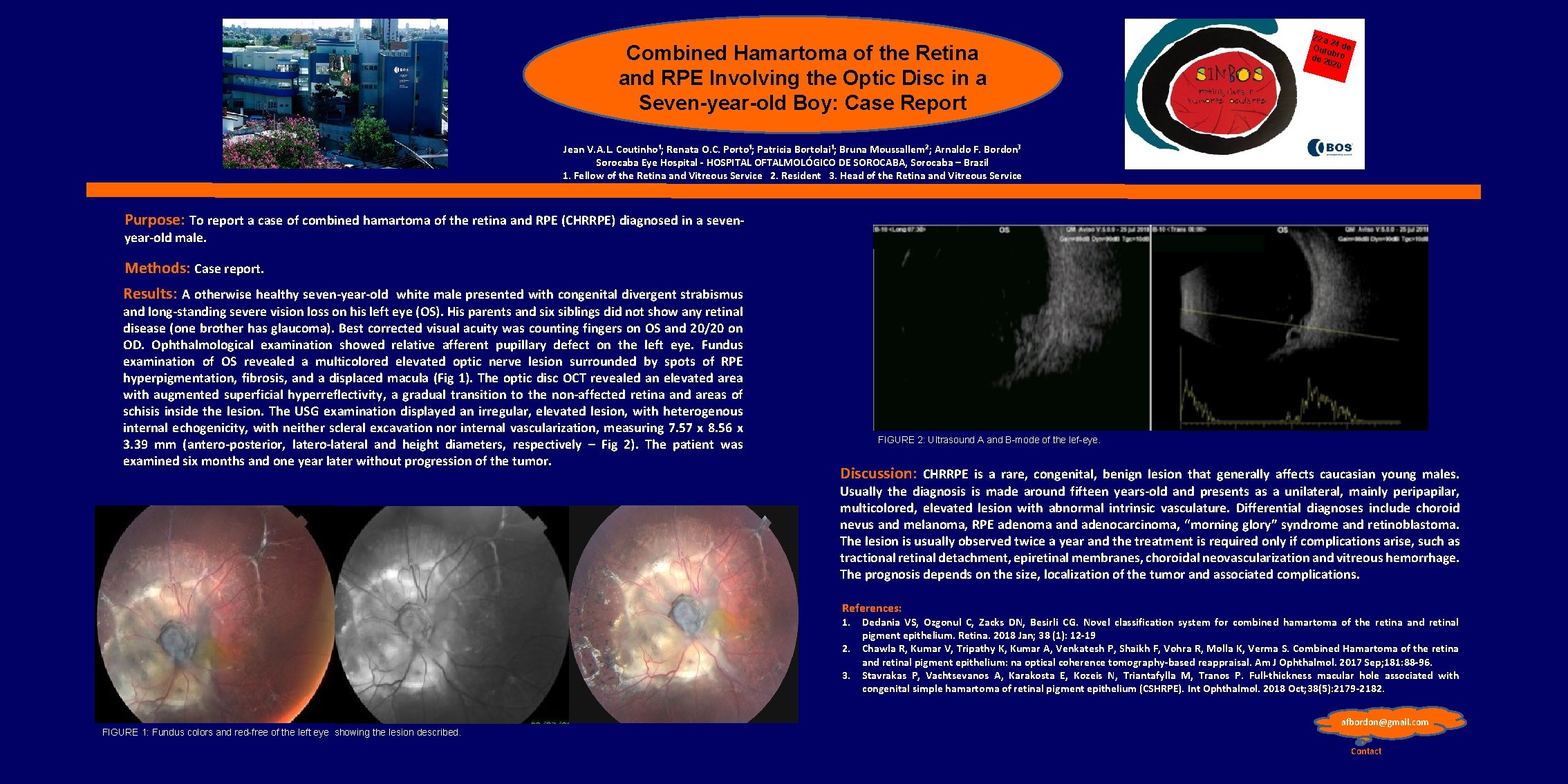
Combined Hamartoma of the Retina and RPE Involving the Optic Disc in a Seven-year-old Boy: Case Report 22 a 24 Outu de b de 2 ro 020 Jean V. A. L. Coutinho¹; Renata O. C. Porto¹; Patricia Bortolai¹; Bruna Moussallem²; Arnaldo F. Bordon³ Sorocaba Eye Hospital - HOSPITAL OFTALMOLÓGICO DE SOROCABA, Sorocaba – Brazil 1. Fellow of the Retina and Vitreous Service 2. Resident 3. Head of the Retina and Vitreous Service Purpose: To report a case of combined hamartoma of the retina and RPE (CHRRPE) diagnosed in a sevenyear-old male. Methods: Case report. Results: A otherwise healthy seven-year-old white male presented with congenital divergent strabismus and long-standing severe vision loss on his left eye (OS). His parents and six siblings did not show any retinal disease (one brother has glaucoma). Best corrected visual acuity was counting fingers on OS and 20/20 on OD. Ophthalmological examination showed relative afferent pupillary defect on the left eye. Fundus examination of OS revealed a multicolored elevated optic nerve lesion surrounded by spots of RPE hyperpigmentation, fibrosis, and a displaced macula (Fig 1). The optic disc OCT revealed an elevated area with augmented superficial hyperreflectivity, a gradual transition to the non-affected retina and areas of schisis inside the lesion. The USG examination displayed an irregular, elevated lesion, with heterogenous internal echogenicity, with neither scleral excavation nor internal vascularization, measuring 7. 57 x 8. 56 x 3. 39 mm (antero-posterior, latero-lateral and height diameters, respectively – Fig 2). The patient was examined six months and one year later without progression of the tumor. FIGURE 2: Ultrasound A and B-mode of the lef-eye. Discussion: CHRRPE is a rare, congenital, benign lesion that generally affects caucasian young males. Usually the diagnosis is made around fifteen years-old and presents as a unilateral, mainly peripapilar, multicolored, elevated lesion with abnormal intrinsic vasculature. Differential diagnoses include choroid nevus and melanoma, RPE adenoma and adenocarcinoma, “morning glory” syndrome and retinoblastoma. The lesion is usually observed twice a year and the treatment is required only if complications arise, such as tractional retinal detachment, epiretinal membranes, choroidal neovascularization and vitreous hemorrhage. The prognosis depends on the size, localization of the tumor and associated complications. References: 1. Dedania VS, Ozgonul C, Zacks DN, Besirli CG. Novel classification system for combined hamartoma of the retina and retinal pigment epithelium. Retina. 2018 Jan; 38 (1): 12 -19 2. Chawla R, Kumar V, Tripathy K, Kumar A, Venkatesh P, Shaikh F, Vohra R, Molla K, Verma S. Combined Hamartoma of the retina and retinal pigment epithelium: na optical coherence tomography-based reappraisal. Am J Ophthalmol. 2017 Sep; 181: 88 -96. 3. Stavrakas P, Vachtsevanos A, Karakosta E, Kozeis N, Triantafylla M, Tranos P. Full-thickness macular hole associated with congenital simple hamartoma of retinal pigment epithelium (CSHRPE). Int Ophthalmol. 2018 Oct; 38(5): 2179 -2182. FIGURE 1: Fundus colors and red-free of the left eye showing the lesion described. afbordon@gmail. com Contact
- Slides: 1