
Combinatorics and In Breeding Goal To provide a
Combinatorics and In. Breeding
Goal • To provide a rough model which gives a lower bound of organisms needed to prevent inbreeding • Show that an exponential decay of a population can be balanced out with a linear factorial increase in population
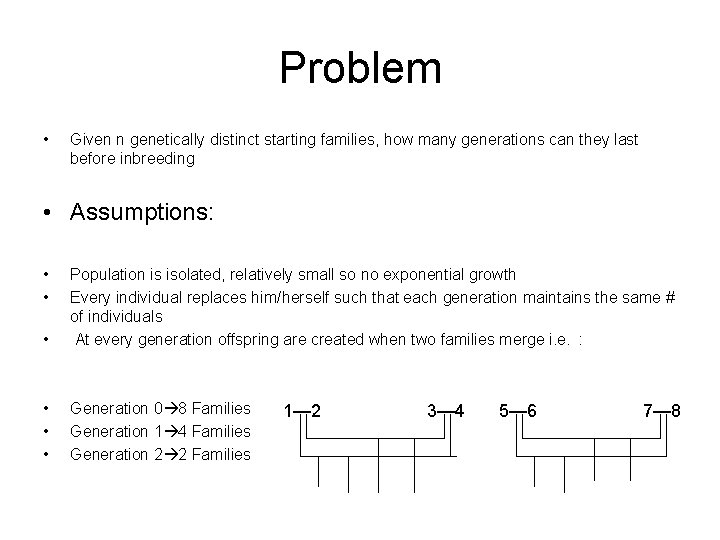
Problem • Given n genetically distinct starting families, how many generations can they last before inbreeding • Assumptions: • • • Population is isolated, relatively small so no exponential growth Every individual replaces him/herself such that each generation maintains the same # of individuals At every generation offspring are created when two families merge i. e. : • • • Generation 0 8 Families Generation 1 4 Families Generation 2 2 Families 1— 2 3— 4 5— 6 7— 8
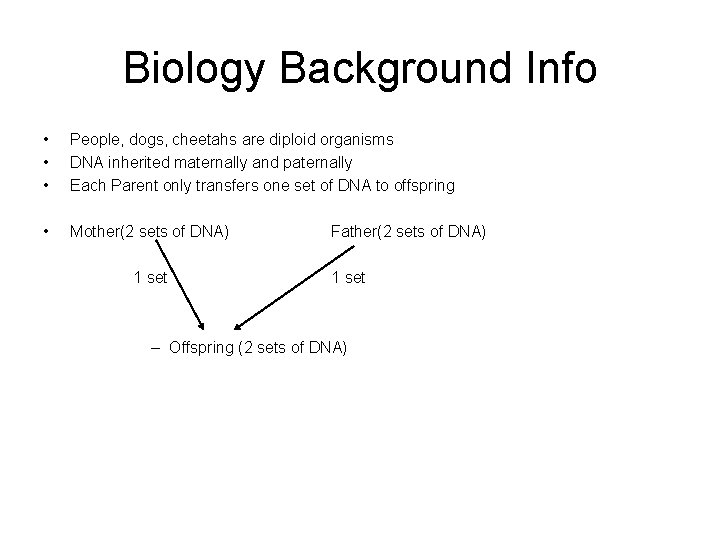
Biology Background Info • • • People, dogs, cheetahs are diploid organisms DNA inherited maternally and paternally Each Parent only transfers one set of DNA to offspring • Mother(2 sets of DNA) 1 set Father(2 sets of DNA) 1 set – Offspring (2 sets of DNA)
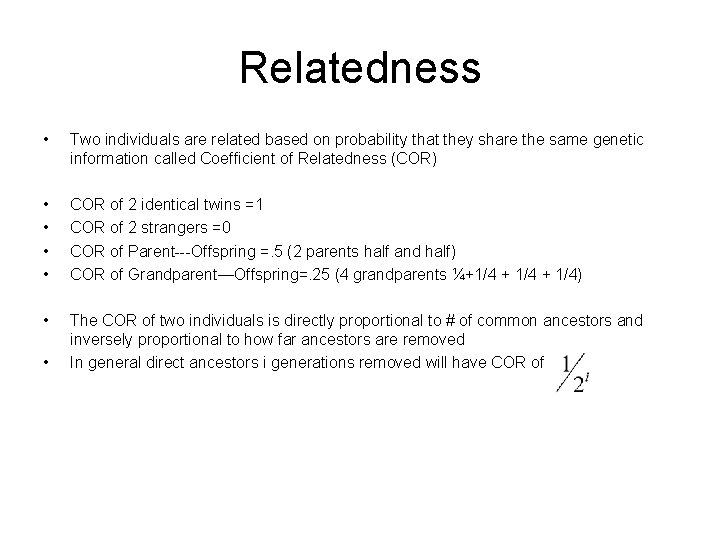
Relatedness • Two individuals are related based on probability that they share the same genetic information called Coefficient of Relatedness (COR) • • COR of 2 identical twins =1 COR of 2 strangers =0 COR of Parent---Offspring =. 5 (2 parents half and half) COR of Grandparent—Offspring=. 25 (4 grandparents ¼+1/4 + 1/4) • The COR of two individuals is directly proportional to # of common ancestors and inversely proportional to how far ancestors are removed In general direct ancestors i generations removed will have COR of •

Relatedness • Full siblings COR=. 5=1/2 (Probability they share from father) + (Probability they share from mother) • Cousins with 2 grandparents in common COR=. 125=1/8 (Probability from sharing with 1 G. Parent)+(Probability from sharing with 2 nd G. Parent) • In the case of half siblings with 1 parent in common COR=. 25 (1/2 x 1/2)
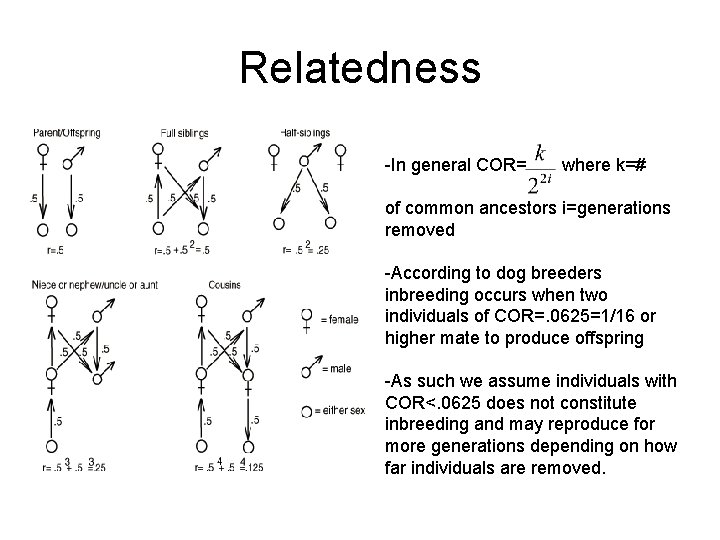
Relatedness -In general COR= where k=# of common ancestors i=generations removed -According to dog breeders inbreeding occurs when two individuals of COR=. 0625=1/16 or higher mate to produce offspring -As such we assume individuals with COR<. 0625 does not constitute inbreeding and may reproduce for more generations depending on how far individuals are removed.
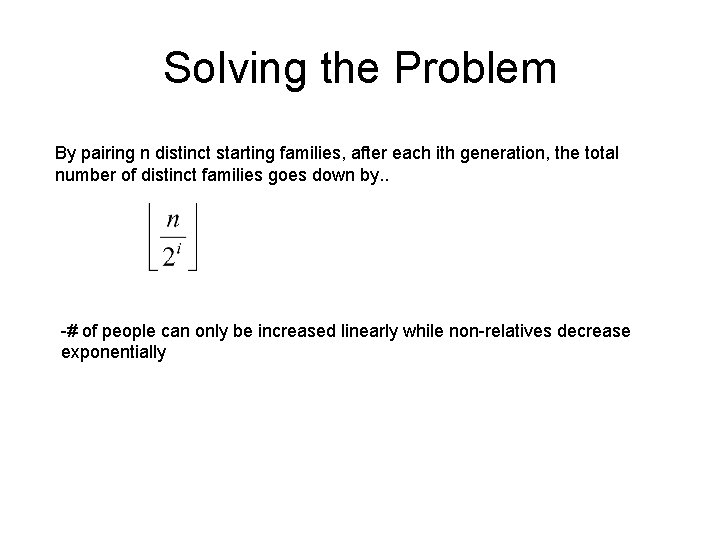
Solving the Problem By pairing n distinct starting families, after each ith generation, the total number of distinct families goes down by. . -# of people can only be increased linearly while non-relatives decrease exponentially

Solving the Problem --Re-writing n in binary tells us when and where families are in danger of not passing on their genetic information e. g. for n=6 1 ---2 3 ---4 5 ---6 --1 st generation. . Family (5 ---6) has noone to pair with --2 nd generation nobody can pair up --In 1 st generation, descendents of 2 of the original 6 families cannot pair up to pass on their genes since 6/2=3 3/2= 1 +1 remainder --Essentially each 2^i term of writing n in binary signifies that at the ith generation, 2^I pieces of the original DNA will be lost
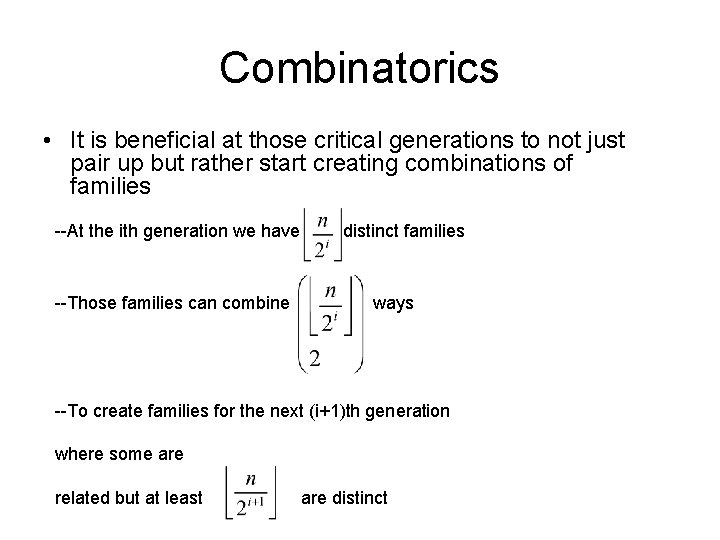
Combinatorics • It is beneficial at those critical generations to not just pair up but rather start creating combinations of families --At the ith generation we have --Those families can combine distinct families ways --To create families for the next (i+1)th generation where some are related but at least are distinct
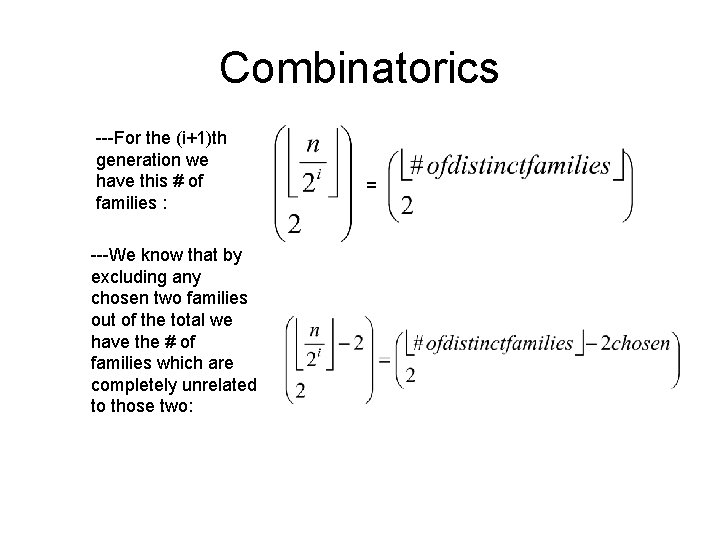
Combinatorics ---For the (i+1)th generation we have this # of families : ---We know that by excluding any chosen two families out of the total we have the # of families which are completely unrelated to those two: =
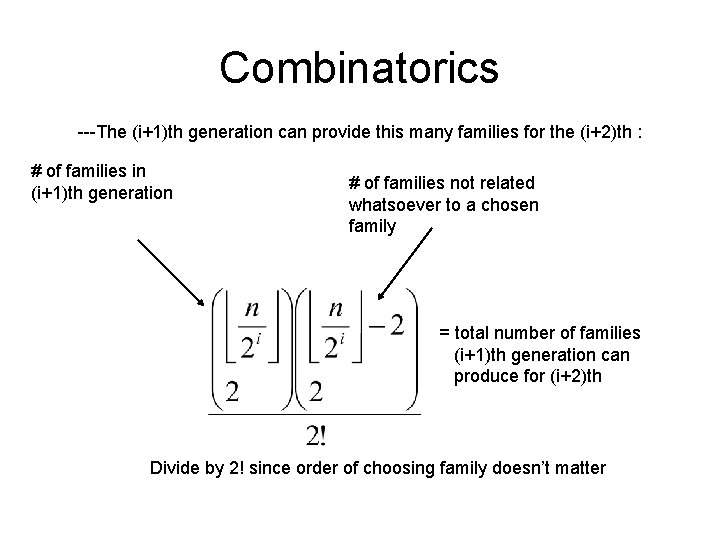
Combinatorics ---The (i+1)th generation can provide this many families for the (i+2)th : # of families in (i+1)th generation # of families not related whatsoever to a chosen family = total number of families (i+1)th generation can produce for (i+2)th Divide by 2! since order of choosing family doesn’t matter
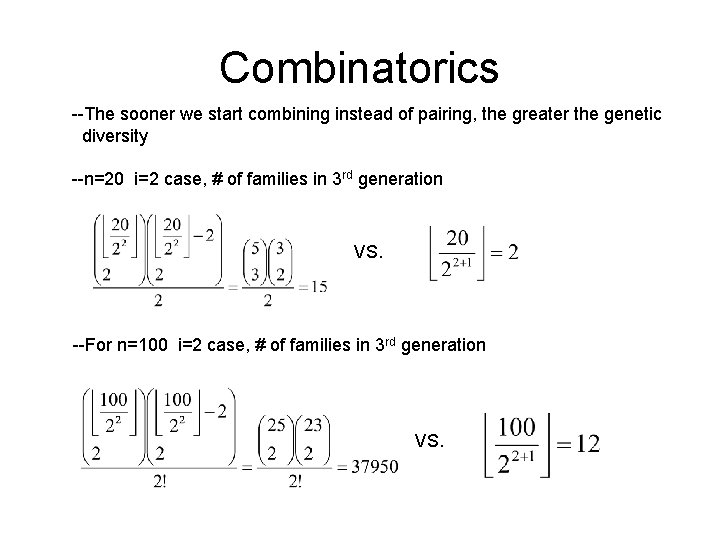
Combinatorics --The sooner we start combining instead of pairing, the greater the genetic diversity --n=20 i=2 case, # of families in 3 rd generation VS. --For n=100 i=2 case, # of families in 3 rd generation VS.
Conclusion • While this does not prevent inevitable sharing of DNA, it does show combining families can dilute DNA to enough levels such that if needed, two weakly related individuals can reproduce • This occurs since combinations of multiple partners leads to many halfsiblings • Given enough time these half siblings can produce offspring which become further and further removed as factorial increase overcomes the exponential decrease • This model can not only serve to show combining isolated populations can revitalize a species but. . It also shows that a drastic drop in population over a short time can do the opposite like cheetahs •
- Slides: 14