
Combinatorial docking approach for structure prediction of large
Combinatorial docking approach for structure prediction of large proteins and multi-molecular assemblies Yuval Inbar 1, Hadar Benyamini 2, Ruth Nussinov 2, 3 and Haim J Wolfson 1. J. Phys. Biol. 2 (2005) S 156 -S 165 1 School of Computer Science, The Raymond and Beverly Sackler Faculty of Exact Sciences, Tel Aviv University, Tel Aviv 69978, Israel 2 Sackler Institute of Molecular Medicine, Department of Human Genetics and Molecular Medicine, Sackler School of Medicine, Tel Aviv University, Tel Aviv 69978, Israel 3 Basic Research Program, SAIC - Frederick, Inc. , Laboratory of Experimental and Computational Biology, NCI-Frederick, Bldg 469, Rm 151 Frederick, MD 21702, USA Presented by Greg Goldgof
Purpose of Comb. Dock § To predict spatial arrangement of several subunits § Domain Assembly § Subunits: connected protein domains § Multi-Molecular Assembly § Subunits: separated protein chains § The algorithm cannot predict whether a given set of subunits actually bind to each other to form a single complex. § Assuming the subunits do form a complex, the program can predict a near-native assembly and to suggest it as one of the most preferable hypotheses.
Algorithm Flow § Predict pairwise interactions between each pair of subunits. § A dissection algorithm was used to cut protein structures into compact and stable substructures. § Combine different predicted pairwise interactions to produce a large set of candidate complexes. § Score solutions. § Cluster similar solutions to avoid redundancy.
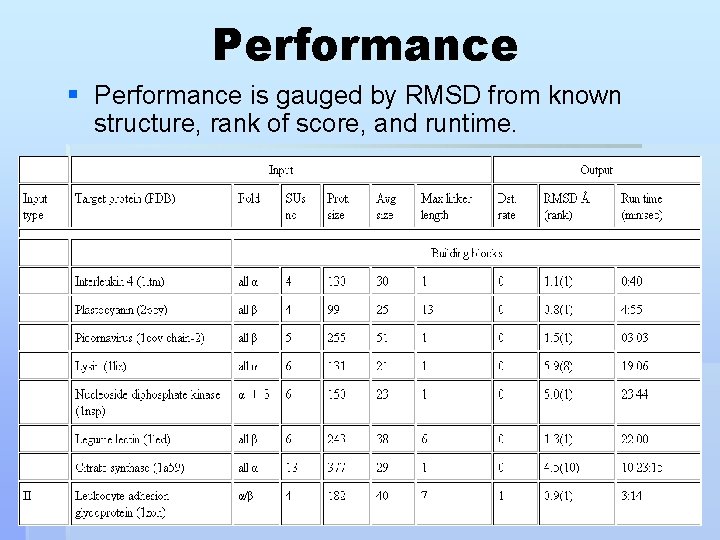
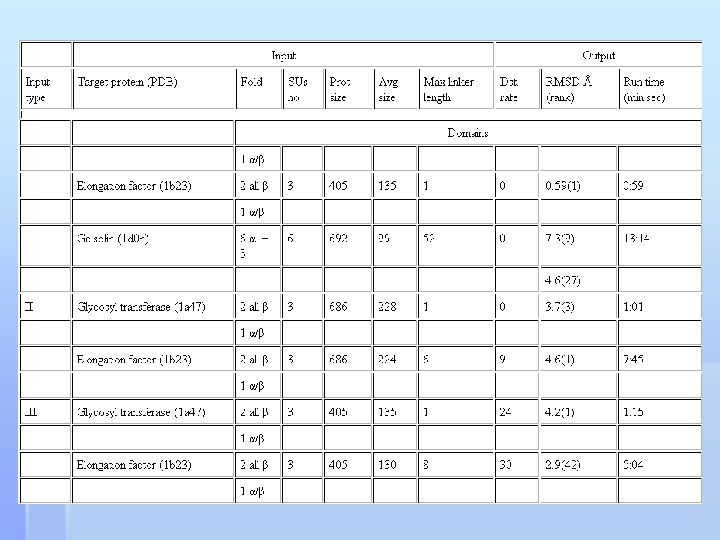
Performance § Performance is gauged by RMSD from known structure, rank of score, and runtime.
- Slides: 5