
Combinatorial Chemistry At SphinxLilly Why do Combinatorial Chemistry
Combinatorial Chemistry At Sphinx/Lilly Why do Combinatorial Chemistry? • Speed • Economics
Screening Speed Current High Efficiency Screening • 2000 compounds screened per day per assay (125, 000 tot. ) • Multiple assays run concurrently • 10 -30 screens per year projected to increase 5 to 10 -fold by the year 2000
Combinatorial Economics The classical cost/compound $2500 -$10, 000 each. (5 assays x 2000 compounds x $10, 000) = $100, 000. 00/day To take advantage of the screening capacity, we need to make compounds faster and cheaper.
New Requirements We needed to increase the compound synthesis rate by 50 to 1000 fold How? Old Engineering Maxim “good, fast, cheap - pick two”
Ground Rules • • • Drug-like molecules Single compounds 20 µmol each. Purity priorities Flexible synthesis methods Automation as needed
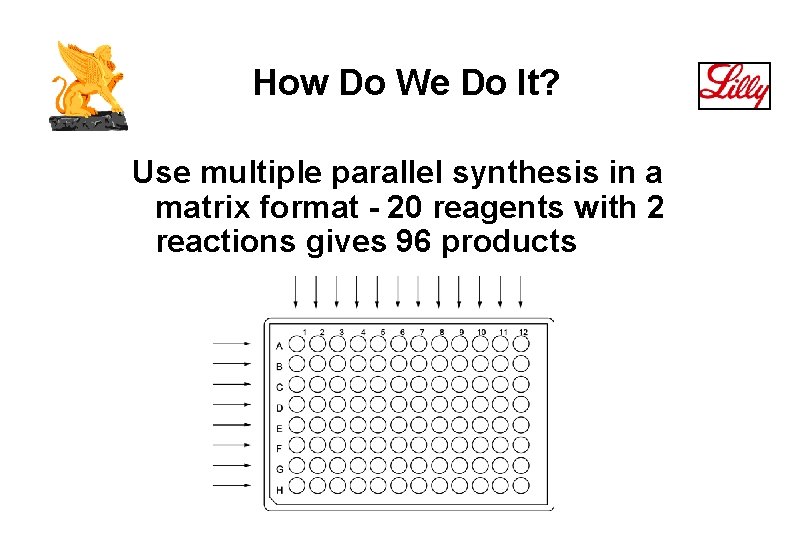
How Do We Do It? Use multiple parallel synthesis in a matrix format - 20 reagents with 2 reactions gives 96 products
How Do We Do It? Take as much technology from High Throughput Screening (HTS) as possible. pros • Experience with parallel formats • Experience with robotics cons • Materials compatibility issues
How Do We Do It? Use simple, disposable equipment Take some simple chemistry and start scaling it up until it hurts Identify the bottlenecks and work to open them up until some other part of the process becomes the slow part
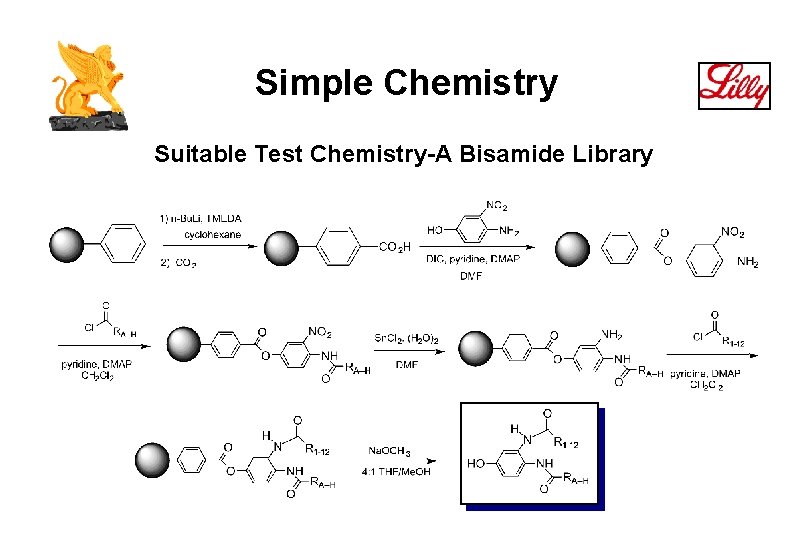
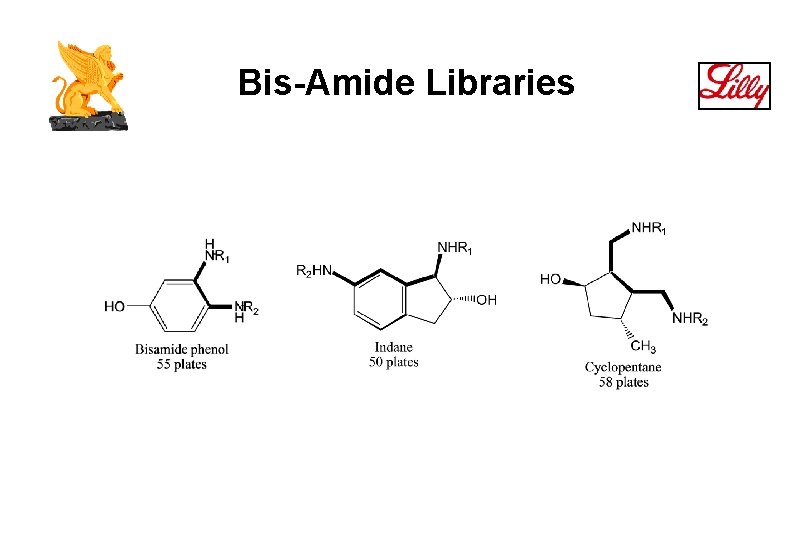
Simple Chemistry Suitable Test Chemistry-A Bisamide Library
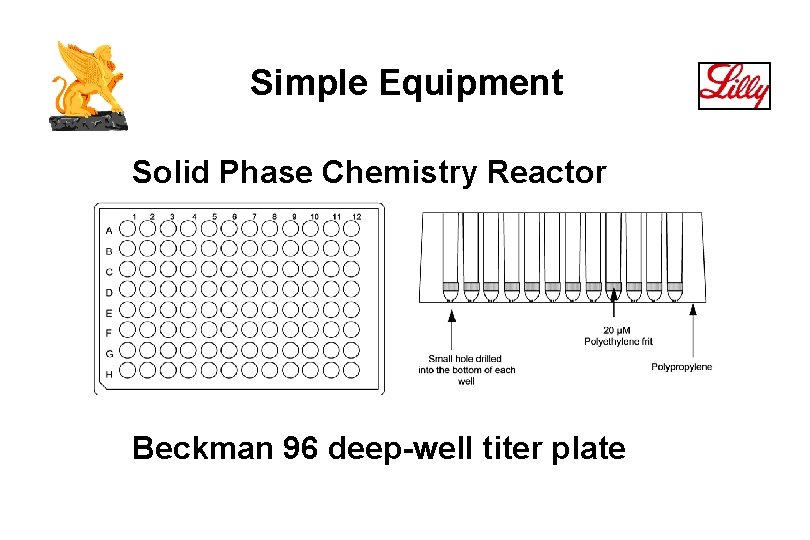
Simple Equipment Solid Phase Chemistry Reactor Beckman 96 deep-well titer plate
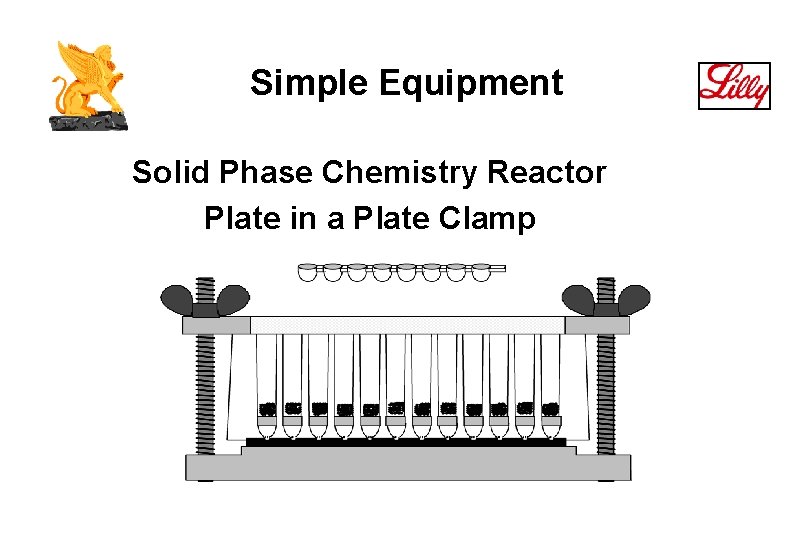
Simple Equipment Solid Phase Chemistry Reactor Plate in a Plate Clamp
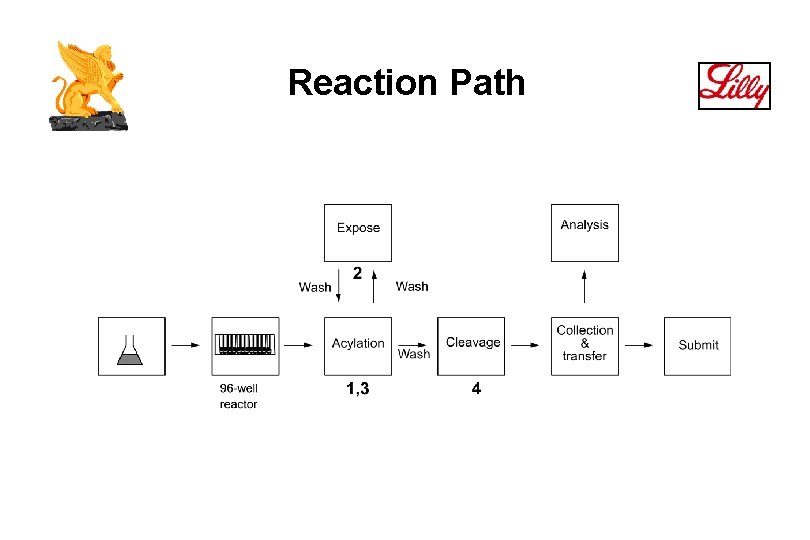
Reaction Path
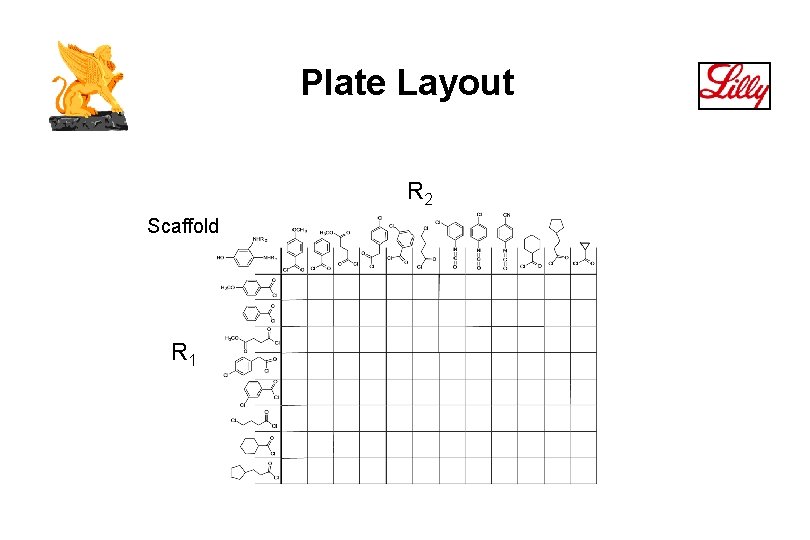
Plate Layout R 2 Scaffold R 1
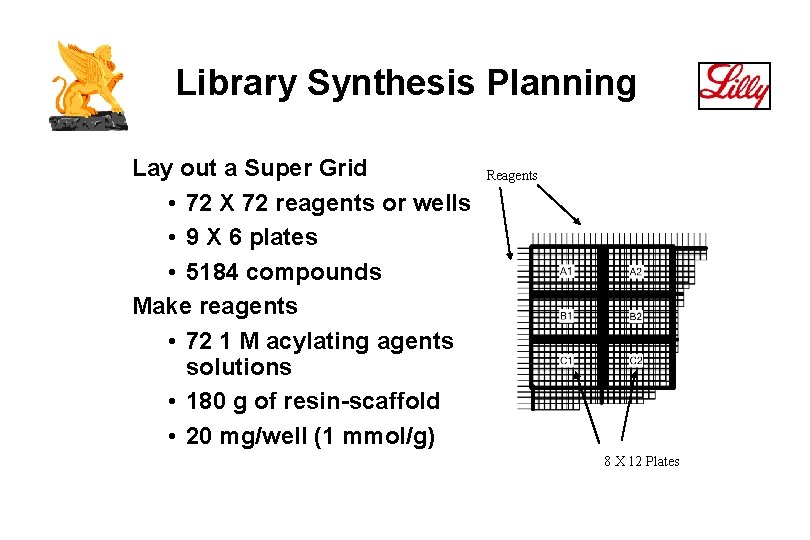
Library Synthesis Planning Lay out a Super Grid • 72 X 72 reagents or wells • 9 X 6 plates • 5184 compounds Make reagents • 72 1 M acylating agents solutions • 180 g of resin-scaffold • 20 mg/well (1 mmol/g) Reagents 8 X 12 Plates
Reagent Addition You need • a device that will take up a large amount of solution and easily deliver smaller quantities • compatibility with all organic materials • disposable • cheap?
Repeater Pipette Takes up large volume and quickly and accurately dispenses smaller quantities Disposable polypropylene liquid holder Dispenses in 1µL to 5 m. L per shot Adaptable to leur fittings Compatible with slurries
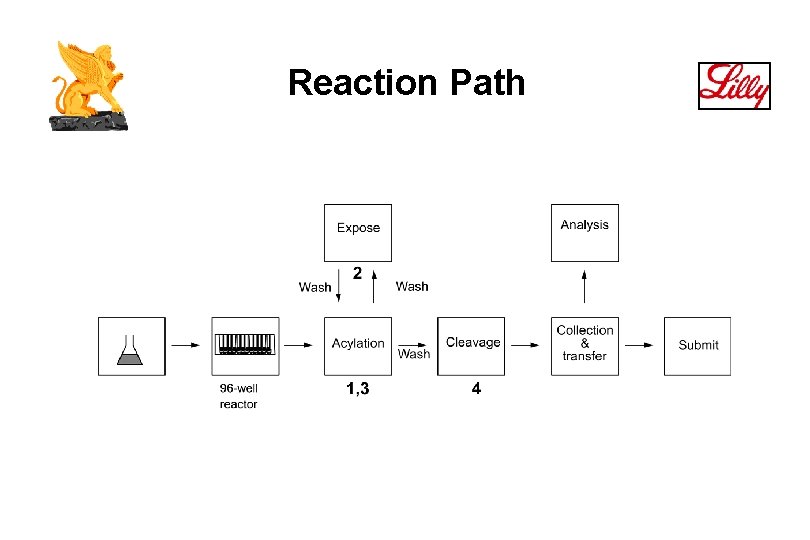
Reaction Path
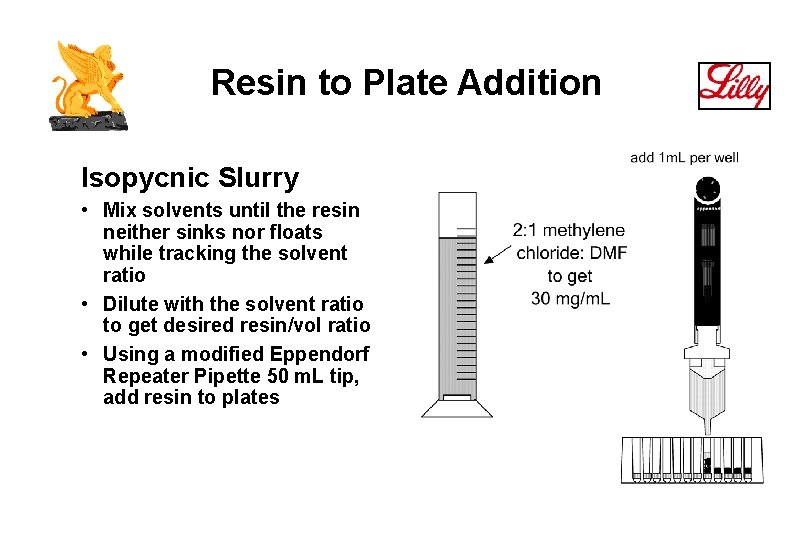
Resin to Plate Addition Isopycnic Slurry • Mix solvents until the resin neither sinks nor floats while tracking the solvent ratio • Dilute with the solvent ratio to get desired resin/vol ratio • Using a modified Eppendorf Repeater Pipette 50 m. L tip, add resin to plates
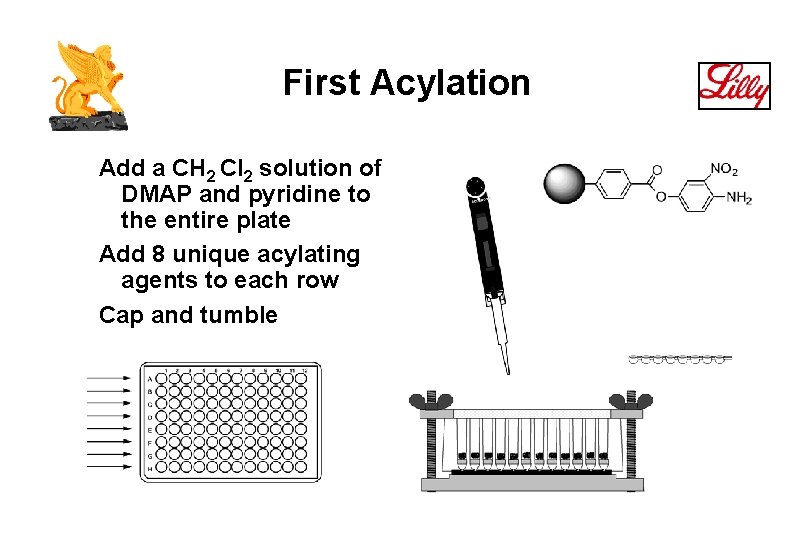
First Acylation Add a CH 2 Cl 2 solution of DMAP and pyridine to the entire plate Add 8 unique acylating agents to each row Cap and tumble
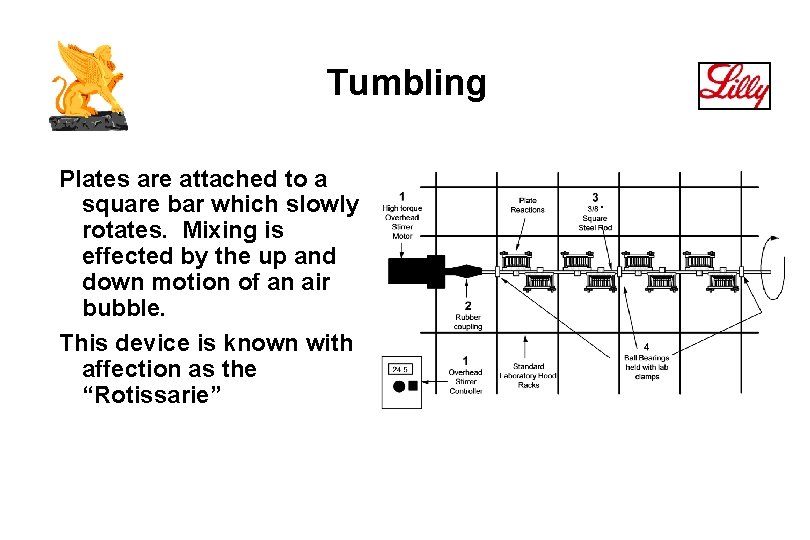
Tumbling Plates are attached to a square bar which slowly rotates. Mixing is effected by the up and down motion of an air bubble. This device is known with affection as the “Rotissarie”
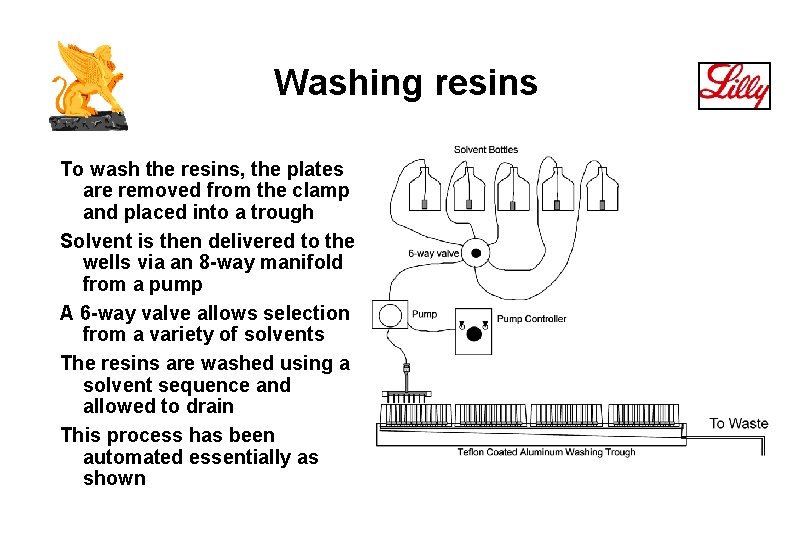
Washing resins To wash the resins, the plates are removed from the clamp and placed into a trough Solvent is then delivered to the wells via an 8 -way manifold from a pump A 6 -way valve allows selection from a variety of solvents The resins are washed using a solvent sequence and allowed to drain This process has been automated essentially as shown
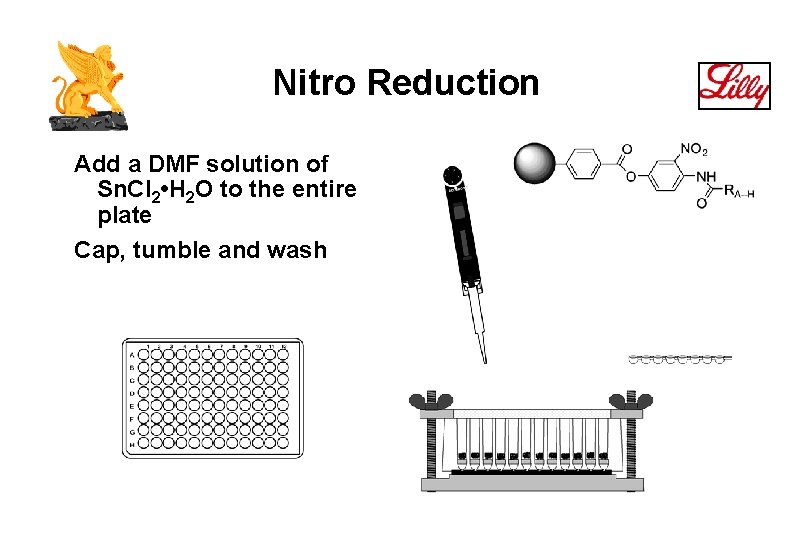
Nitro Reduction Add a DMF solution of Sn. Cl 2 • H 2 O to the entire plate Cap, tumble and wash
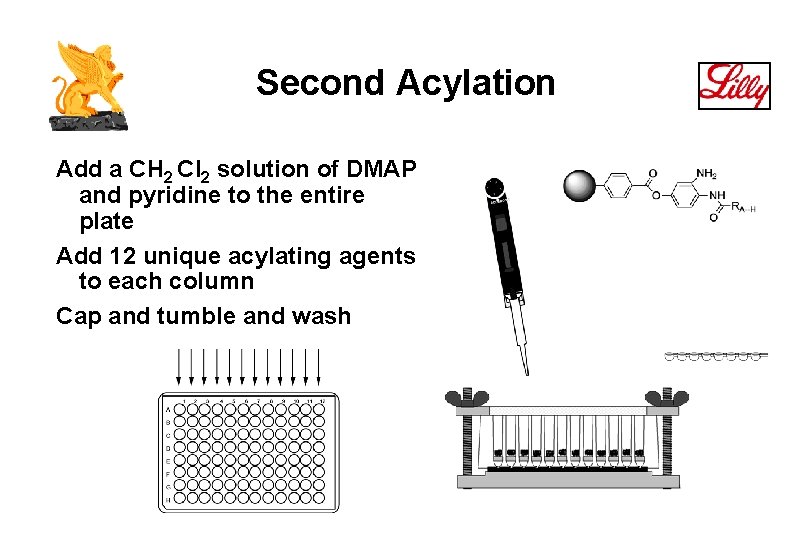
Second Acylation Add a CH 2 Cl 2 solution of DMAP and pyridine to the entire plate Add 12 unique acylating agents to each column Cap and tumble and wash
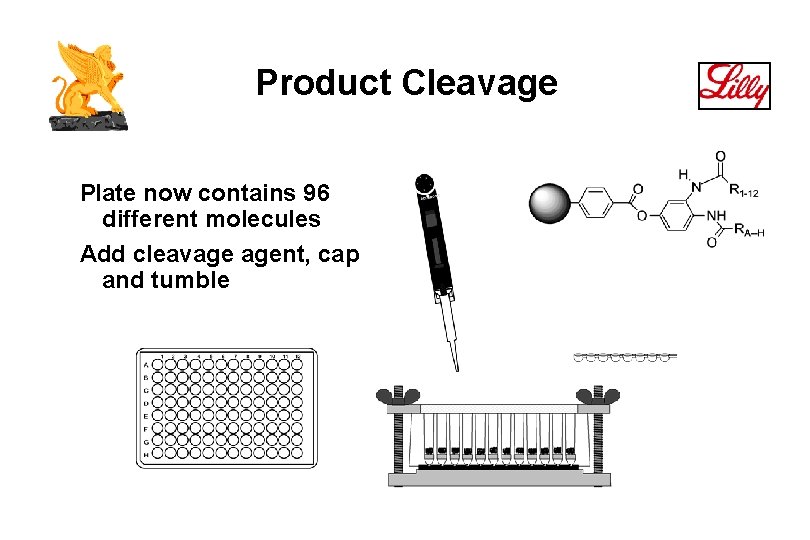
Product Cleavage Plate now contains 96 different molecules Add cleavage agent, cap and tumble
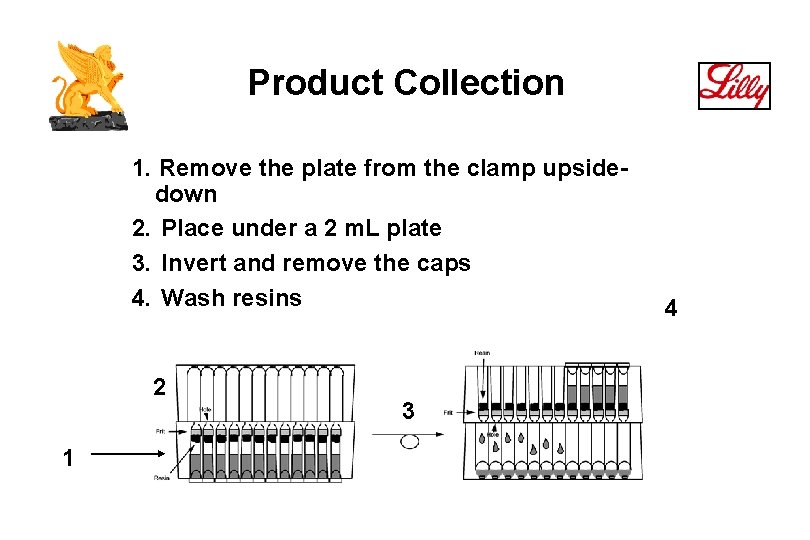
Product Collection 1. Remove the plate from the clamp upsidedown 2. Place under a 2 m. L plate 3. Invert and remove the caps 4. Wash resins 2 1 3 4
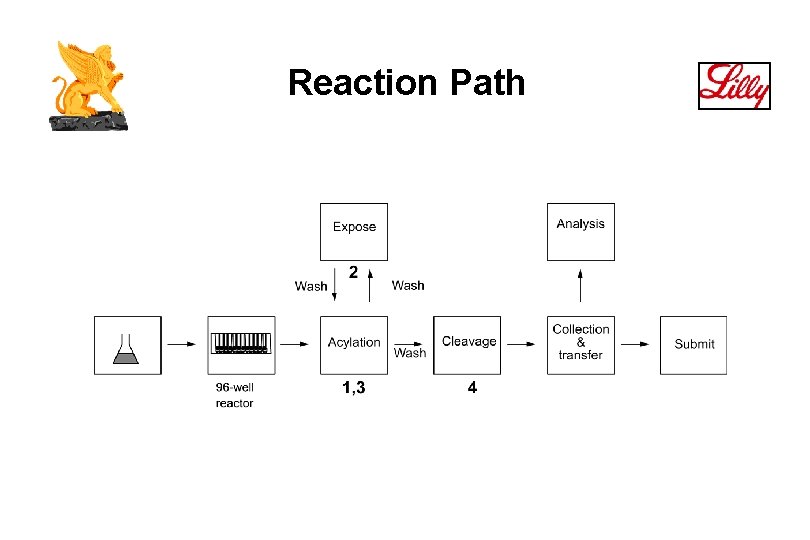
Reaction Path
Product Analysis On each Plate • 1 H-NMRs, 4 random samples • Mass Spects initially, 4 random samples FAB or IS Now, all wells • TLC, all wells • Weight, entire plate (well average)
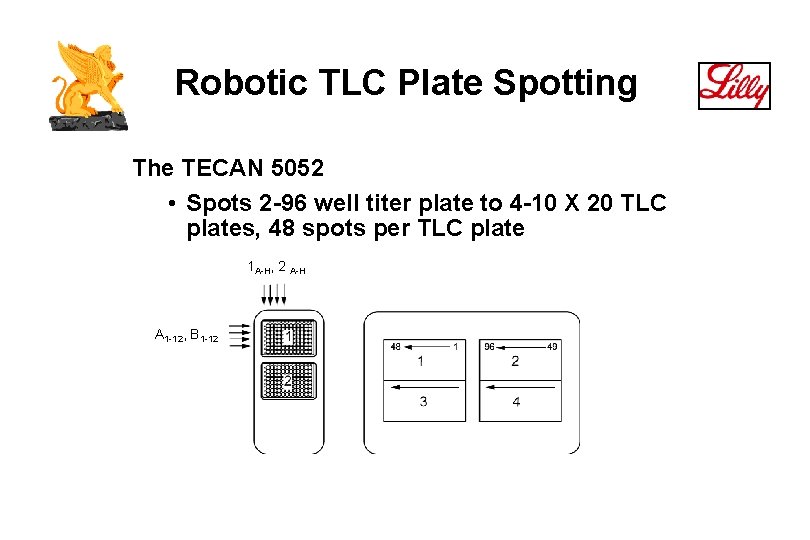
Robotic TLC Plate Spotting The TECAN 5052 • Spots 2 -96 well titer plate to 4 -10 X 20 TLC plates, 48 spots per TLC plate 1 A-H, 2 A-H A 1 -12, B 1 -12
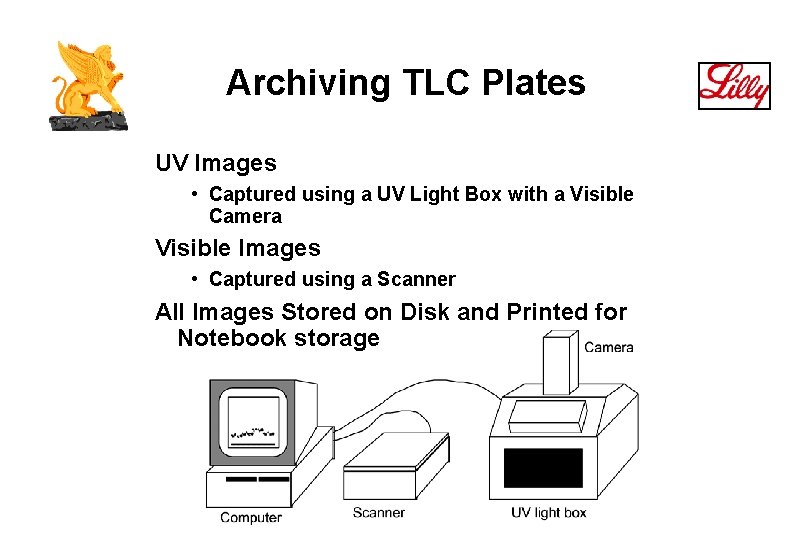
Archiving TLC Plates UV Images • Captured using a UV Light Box with a Visible Camera Visible Images • Captured using a Scanner All Images Stored on Disk and Printed for Notebook storage
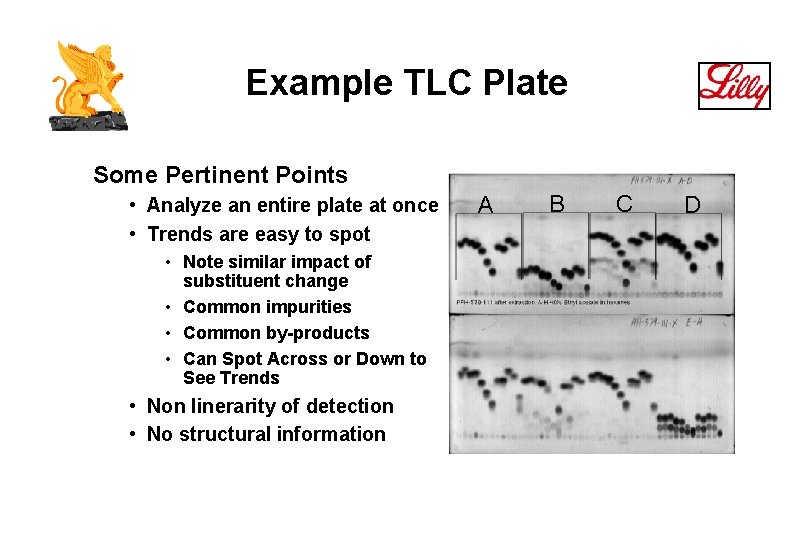
Example TLC Plate Some Pertinent Points • Analyze an entire plate at once • Trends are easy to spot • Note similar impact of substituent change • Common impurities • Common by-products • Can Spot Across or Down to See Trends • Non linerarity of detection • No structural information A B C D
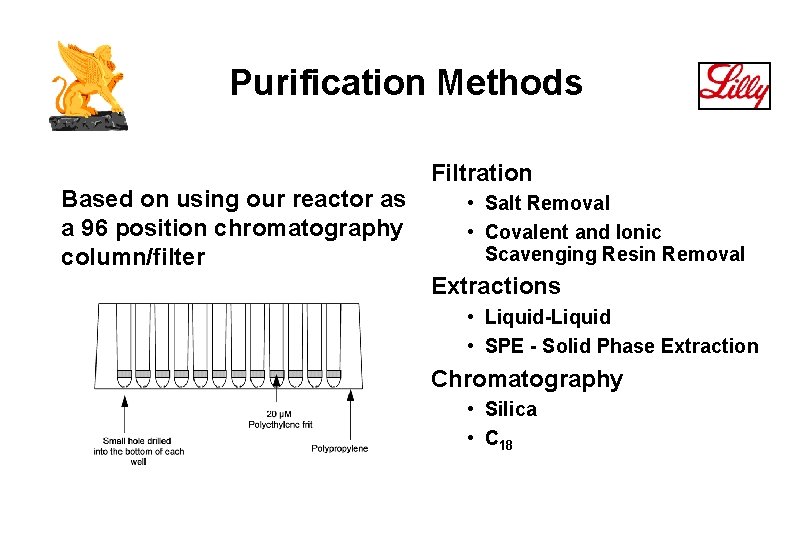
Purification Methods Based on using our reactor as a 96 position chromatography column/filter Filtration • Salt Removal • Covalent and Ionic Scavenging Resin Removal Extractions • Liquid-Liquid • SPE - Solid Phase Extraction Chromatography • Silica • C 18
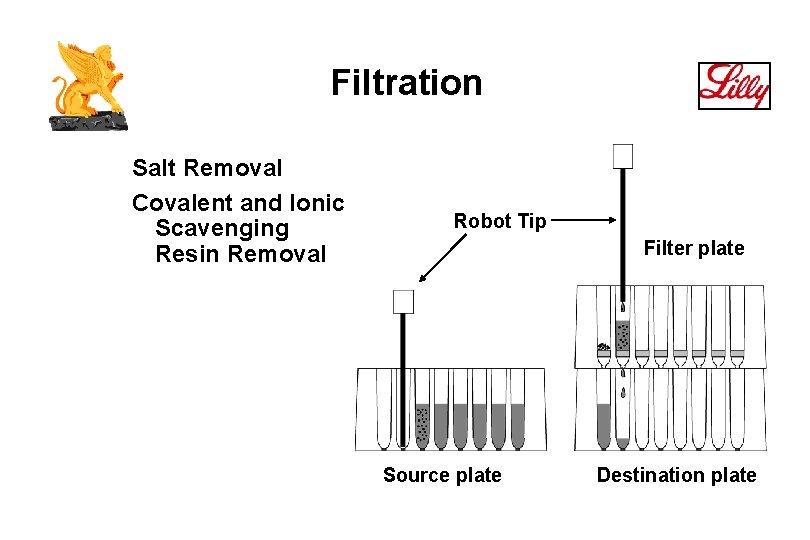
Filtration Salt Removal Covalent and Ionic Scavenging Resin Removal Robot Tip Filter plate Source plate Destination plate
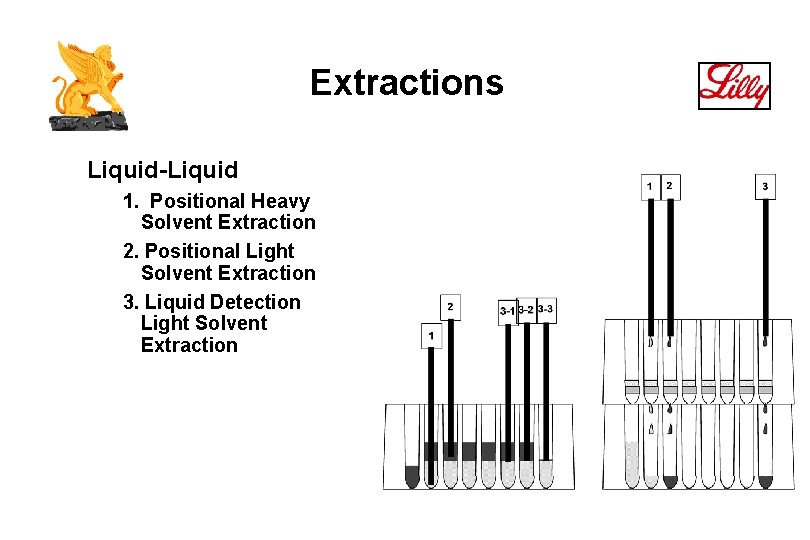
Extractions Liquid-Liquid 1. Positional Heavy Solvent Extraction 2. Positional Light Solvent Extraction 3. Liquid Detection Light Solvent Extraction
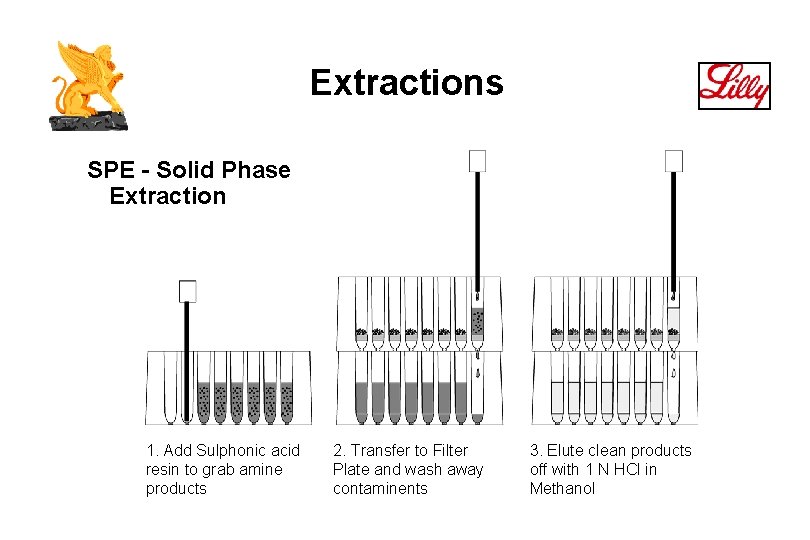
Extractions SPE - Solid Phase Extraction 1. Add Sulphonic acid resin to grab amine products 2. Transfer to Filter Plate and wash away contaminents 3. Elute clean products off with 1 N HCl in Methanol
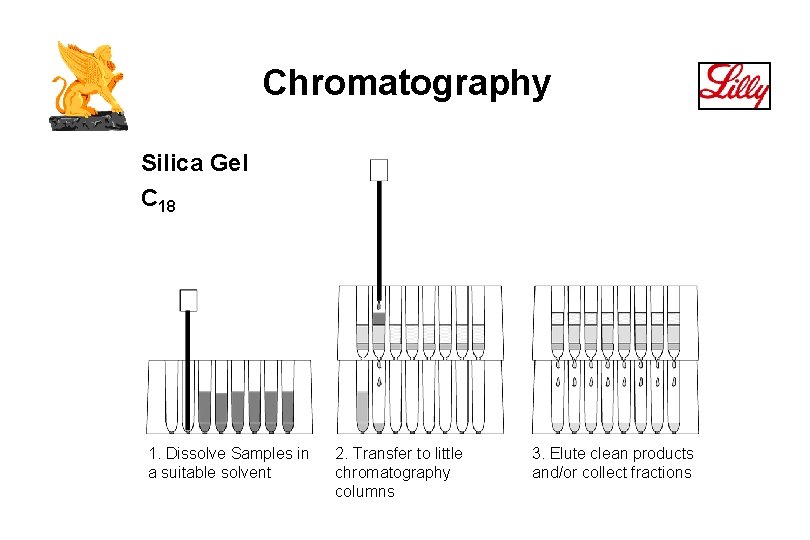
Chromatography Silica Gel C 18 1. Dissolve Samples in a suitable solvent 2. Transfer to little chromatography columns 3. Elute clean products and/or collect fractions
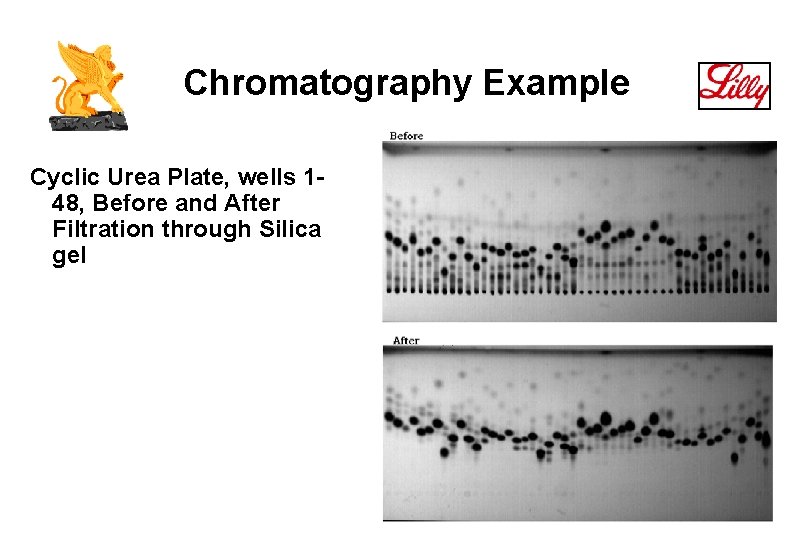
Chromatography Example Cyclic Urea Plate, wells 148, Before and After Filtration through Silica gel
Diamino Alcohol Super. Library
Bis-Amide Libraries
Other Chemistries
Other Chemistries
Summary Fast • Capacity for 100, 000 compounds/year Cheap • Inexpensive, flexible and often disposable equipment • 1 robot ($50 G) for 20 people Good • Good Enough • < µM Leads in CNS, cardiovascular and cancer screens
Acknowledgements The Sphinx Durham Chemistry Group Sean. Hollinshead Jean. Defauw The Sphinx Cambridge Chemistry Group Hal Meyers The Kaldor Group at Lilly in Indianapolis
- Slides: 42