
Combinatorial algorithms Torsten Mtze The Hamilton cycle problem

Combinatorial algorithms Torsten Mütze
The Hamilton cycle problem • Problem: Given a graph, does it have a Hamilton cycle? • fundamental problem with many applications (special case of travelling salesman problem) • computational point of view: • no efficient algorithm known (NP-complete [Karp 72]), i. e. brute-force approach essentially best possible
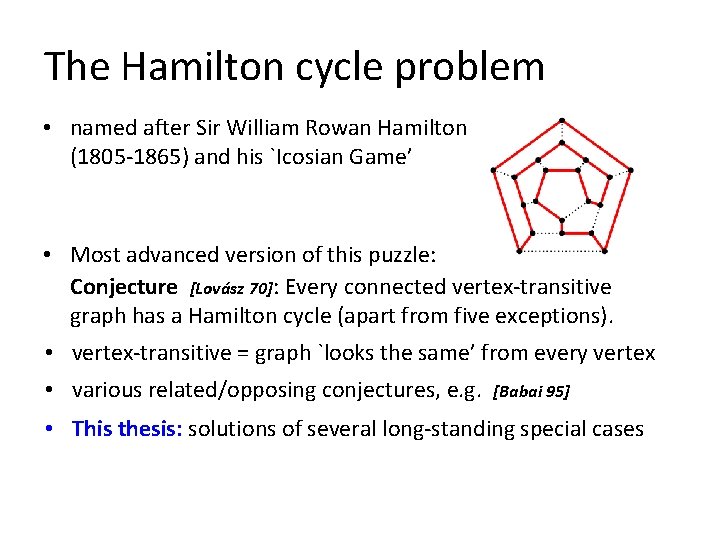
The Hamilton cycle problem • named after Sir William Rowan Hamilton (1805 -1865) and his `Icosian Game’ • Most advanced version of this puzzle: Conjecture [Lovász 70]: Every connected vertex-transitive graph has a Hamilton cycle (apart from five exceptions). • vertex-transitive = graph `looks the same’ from every vertex • various related/opposing conjectures, e. g. [Babai 95] • This thesis: solutions of several long-standing special cases
![Partial results • Known cases: and prime [Turner 67], [Alspach 79], [Marušič 86, 87],](http://slidetodoc.com/presentation_image_h2/912bbbc8e6009c1477b23735f39abd0d/image-4.jpg "Partial results • Known cases: and prime [Turner 67], [Alspach 79], [Marušič 86, 87],")
Partial results • Known cases: and prime [Turner 67], [Alspach 79], [Marušič 86, 87], [Chen 98], [Kutnar, Marušič 08] • Every connected and vertex-transitive graph has a cycle of length at least [Babai 79] • Many results known for Cayley graphs: • abelian groups [Marušič 83] • finite p-groups [Witte 86] • every finite group has gen. set of size [Pak, Radoičič 09]

Combinatorial algorithms • Goal: generate all objects of a combinatorial class efficiently • Examples: • binary trees • triangulations • permutations • words • partitions • linear extensions • spanning trees • matchings • … 1234 1243 1423 aabc ccba ccca
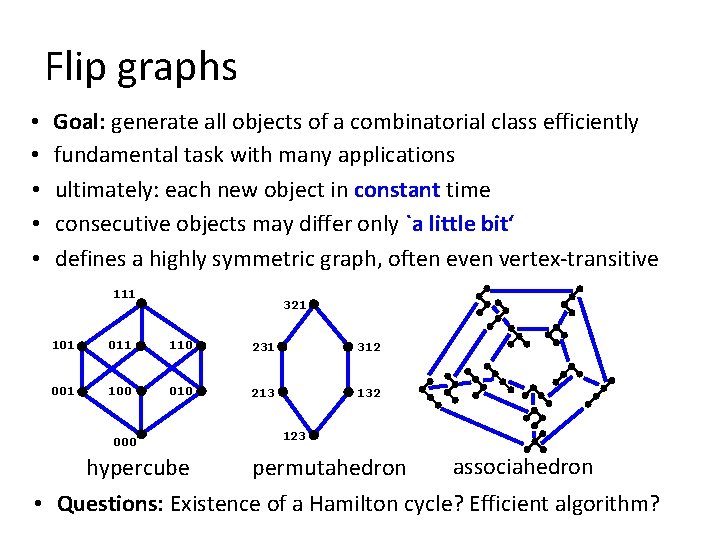
Flip graphs • • • Goal: generate all objects of a combinatorial class efficiently fundamental task with many applications ultimately: each new object in constant time consecutive objects may differ only `a little bit‘ defines a highly symmetric graph, often even vertex-transitive 111 321 101 011 110 231 312 001 100 010 213 132 000 hypercube 123 permutahedron associahedron • Questions: Existence of a Hamilton cycle? Efficient algorithm?
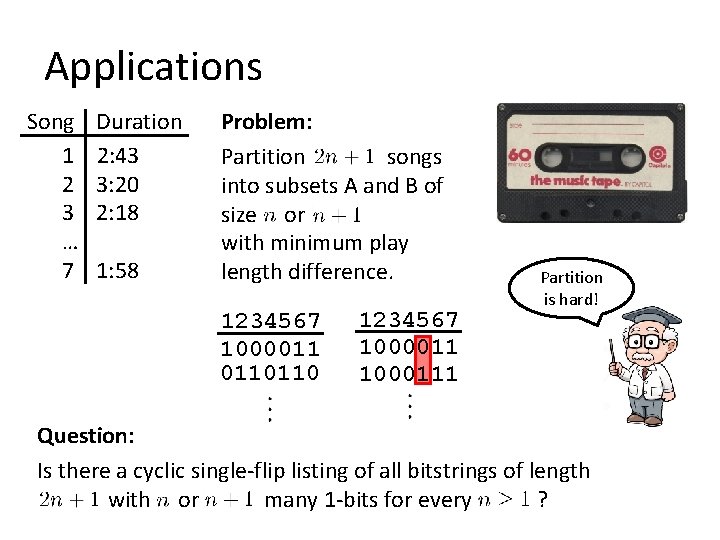
Applications Song 1 2 3 … 7 Duration 2: 43 3: 20 2: 18 1: 58 Problem: Partition songs into subsets A and B of size or with minimum play length difference. 1234567 1000011 0110110 1234567 1000011 1000111 Partition is hard! Question: Is there a cyclic single-flip listing of all bitstrings of length with or many 1 -bits for every ?
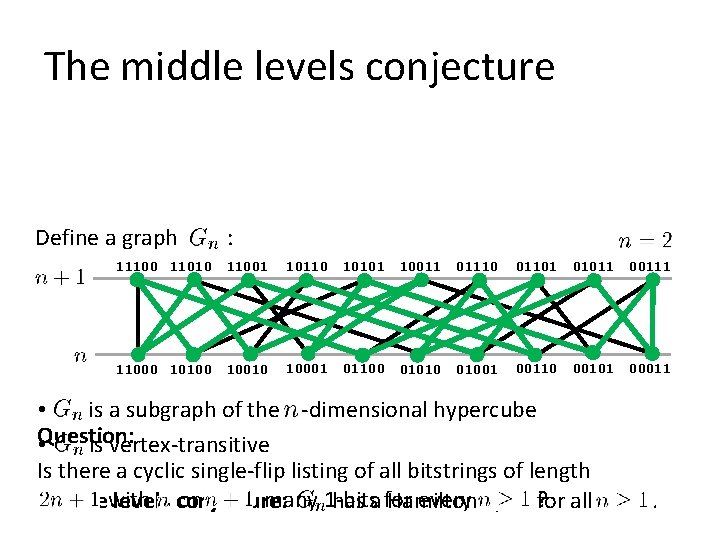
The middle levels conjecture Define a graph : 11100 11010 11001 10110 10101 10011 01110 01101 01011 00111 11000 10100 10010 10001 01100 01010 01001 00110 00101 00011 • is a subgraph of the -dimensional hypercube Question: • is vertex-transitive Is there a cyclic single-flip listing of all bitstrings of length or many 1 -bits every cycle for ? all Middlewith levels conjecture: has a for Hamilton .
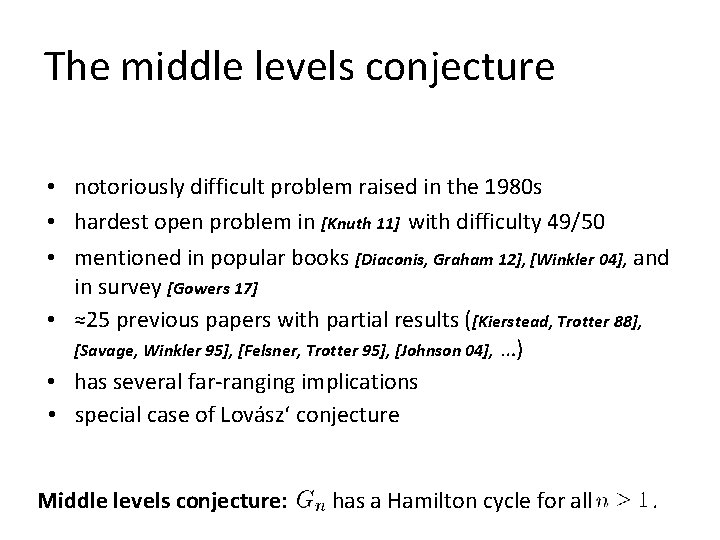
The middle levels conjecture • notoriously difficult problem raised in the 1980 s • hardest open problem in [Knuth 11] with difficulty 49/50 • mentioned in popular books [Diaconis, Graham 12], [Winkler 04], and in survey [Gowers 17] • ≈25 previous papers with partial results ([Kierstead, Trotter 88], [Savage, Winkler 95], [Felsner, Trotter 95], [Johnson 04], …) • has several far-ranging implications • special case of Lovász‘ conjecture Middle levels conjecture: has a Hamilton cycle for all .
![Our results Theorem 1 [M. 16; Proc. LMS]: The middle levels graph has a](http://slidetodoc.com/presentation_image_h2/912bbbc8e6009c1477b23735f39abd0d/image-10.jpg "Our results Theorem 1 [M. 16; Proc. LMS]: The middle levels graph has a")
Our results Theorem 1 [M. 16; Proc. LMS]: The middle levels graph has a Hamilton cycle for every Theorem 2 [M. 16; Proc. LMS]: The middle levels graph has . distinct Hamilton cycles. Remarks: number of automorphisms is only , so Theorem 2 is not an immediate consequence of Theorem 1
![Our results Theorem 1 [M. 16; Proc. LMS]: The middle levels graph has a](http://slidetodoc.com/presentation_image_h2/912bbbc8e6009c1477b23735f39abd0d/image-11.jpg "Our results Theorem 1 [M. 16; Proc. LMS]: The middle levels graph has a")
Our results Theorem 1 [M. 16; Proc. LMS]: The middle levels graph has a Hamilton cycle for every Theorem 2 [M. 16; Proc. LMS]: The middle levels graph has distinct Hamilton cycles. Remarks: number of Hamilton cycles is at most so Theorem 2 is best possible , .
![Our results Theorem 1 [M. 16; Proc. LMS]: The middle levels graph has a](http://slidetodoc.com/presentation_image_h2/912bbbc8e6009c1477b23735f39abd0d/image-12.jpg "Our results Theorem 1 [M. 16; Proc. LMS]: The middle levels graph has a")
Our results Theorem 1 [M. 16; Proc. LMS]: The middle levels graph has a Hamilton cycle for every Theorem 2 [M. 16; Proc. LMS]: The middle levels graph has . distinct Hamilton cycles. Remarks: We recently found a short and more accessible proof for those theorems [Gregor, M. , Nummenpalo 18; Discrete Analysis] • 40 pages 9 pages • 27 lemmas 2 lemmas • 88 formulas 9 formulas
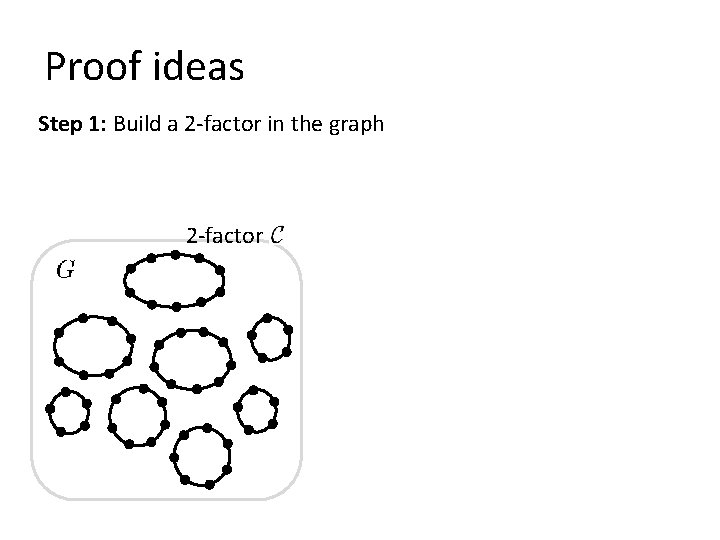
Proof ideas Step 1: Build a 2 -factor in the graph 2 -factor
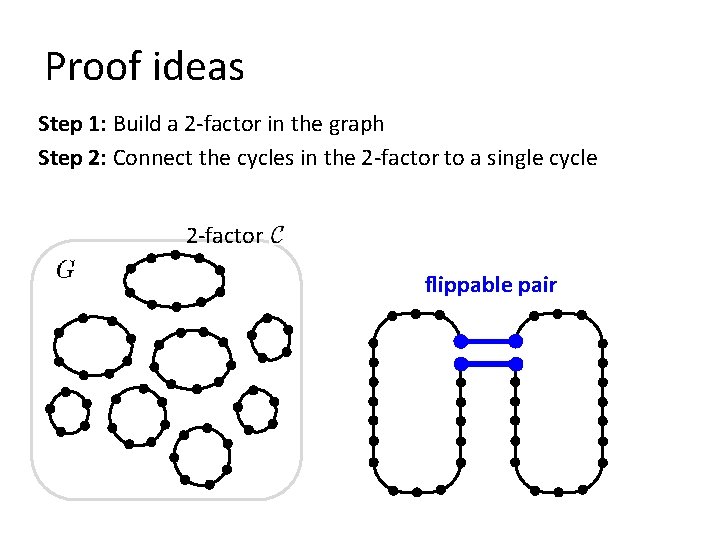
Proof ideas Step 1: Build a 2 -factor in the graph Step 2: Connect the cycles in the 2 -factor to a single cycle 2 -factor flippable pair
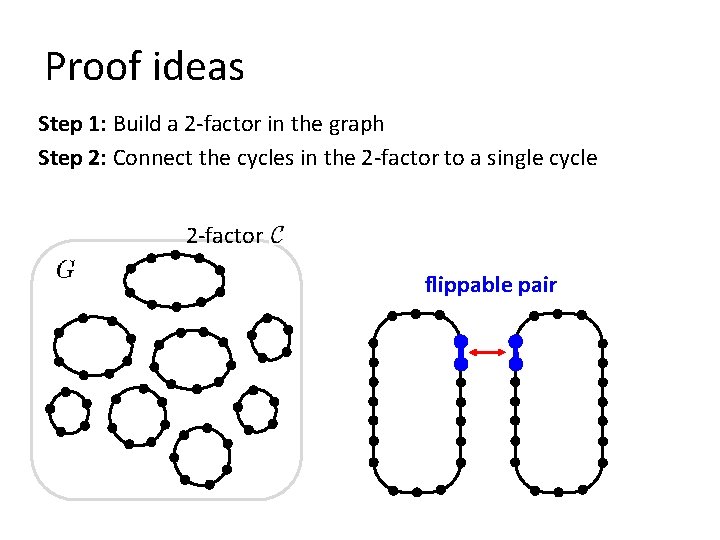
Proof ideas Step 1: Build a 2 -factor in the graph Step 2: Connect the cycles in the 2 -factor to a single cycle 2 -factor flippable pair
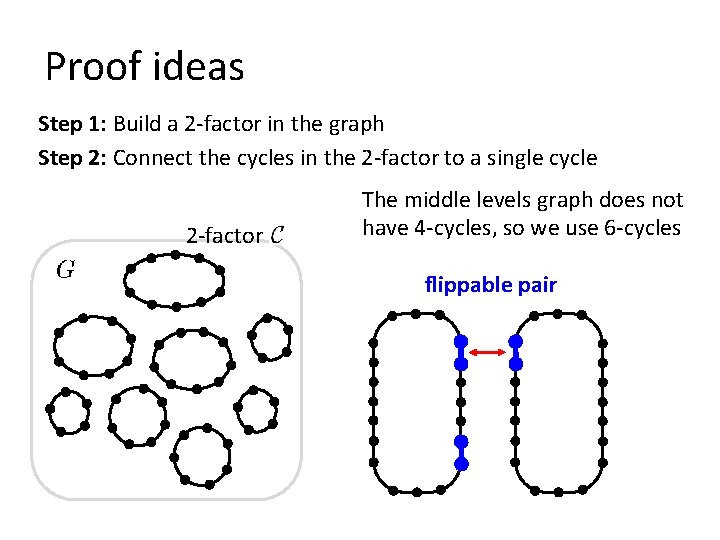
Proof ideas Step 1: Build a 2 -factor in the graph Step 2: Connect the cycles in the 2 -factor to a single cycle 2 -factor The middle levels graph does not have 4 -cycles, so we use 6 -cycles flippable pair
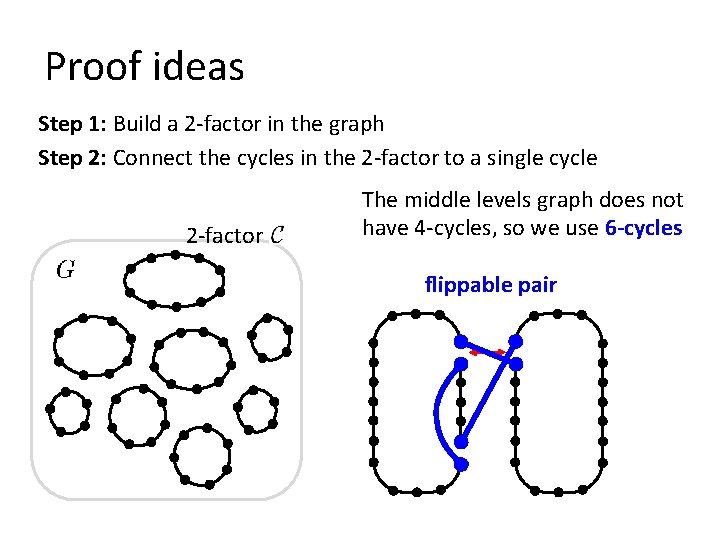
Proof ideas Step 1: Build a 2 -factor in the graph Step 2: Connect the cycles in the 2 -factor to a single cycle 2 -factor The middle levels graph does not have 4 -cycles, so we use 6 -cycles flippable pair
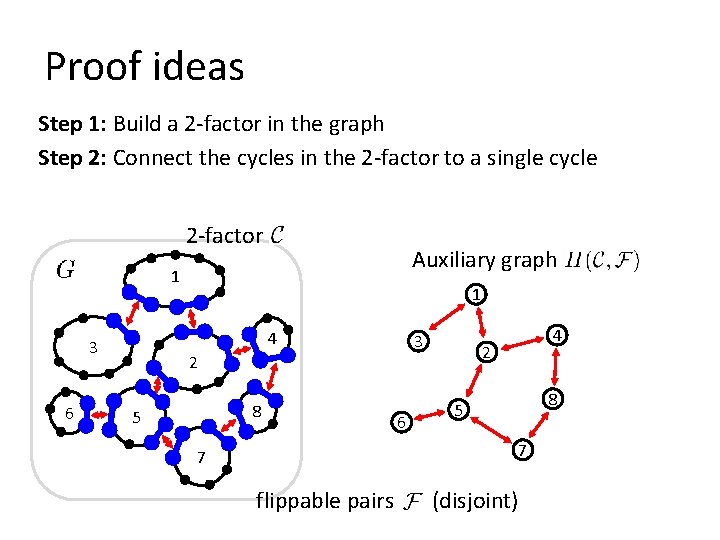
Proof ideas Step 1: Build a 2 -factor in the graph Step 2: Connect the cycles in the 2 -factor to a single cycle 2 -factor Auxiliary graph 1 4 3 6 1 3 2 8 5 6 4 2 8 5 7 7 flippable pairs (disjoint)
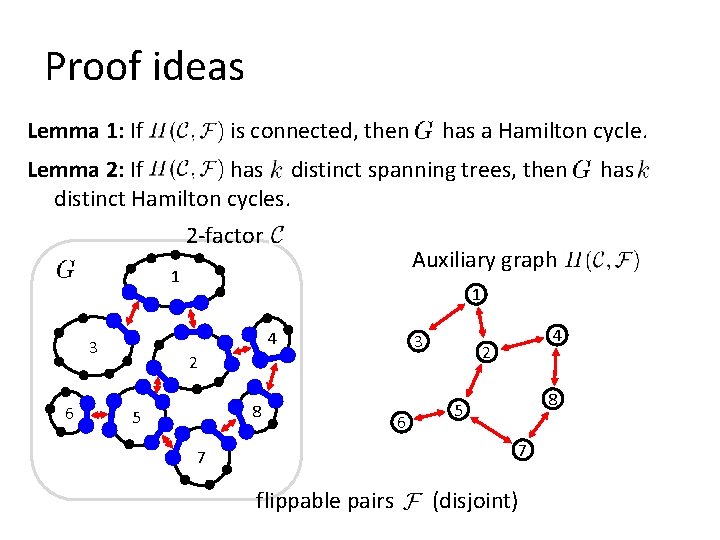
Proof ideas Lemma 1: If is connected, then has a Hamilton cycle. Lemma 2: If has distinct spanning trees, then distinct Hamilton cycles. 2 -factor Auxiliary graph 1 4 3 6 1 3 2 8 5 6 4 2 8 5 7 7 flippable pairs (disjoint) has
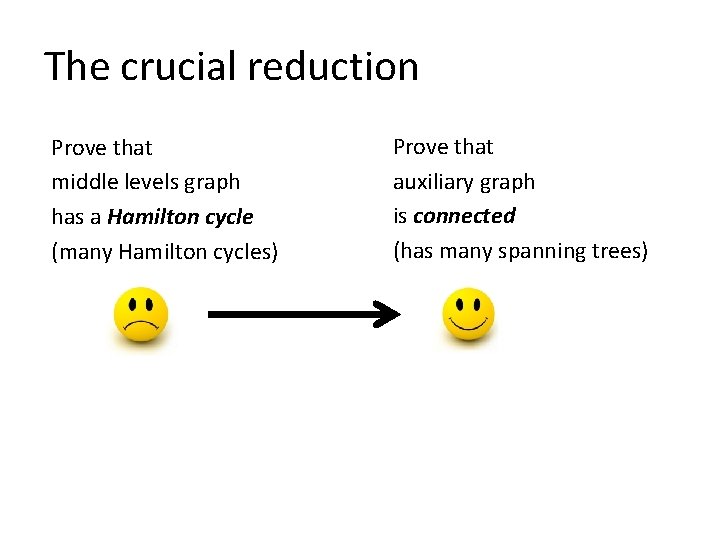
The crucial reduction Prove that middle levels graph has a Hamilton cycle (many Hamilton cycles) Prove that auxiliary graph is connected (has many spanning trees)
![Algorithmic results Theorem 3 [M. , Nummenpalo 17; SODA]: There is an algorithm which](http://slidetodoc.com/presentation_image_h2/912bbbc8e6009c1477b23735f39abd0d/image-21.jpg "Algorithmic results Theorem 3 [M. , Nummenpalo 17; SODA]: There is an algorithm which")
Algorithmic results Theorem 3 [M. , Nummenpalo 17; SODA]: There is an algorithm which for a given vertex of the middle levels graph computes the next one on a Hamilton cycle in time. • Remarks • initialization time is and required space is • C++ code available on our website
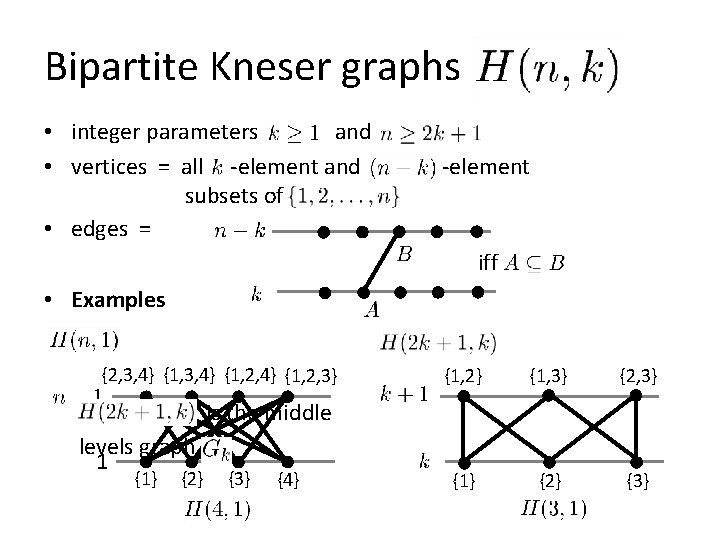
Bipartite Kneser graphs • integer parameters and • vertices = all -element and subsets of • edges = -element iff • Examples {2, 3, 4} {1, 2, 3} {1, 2} {1, 3} {2, 3} {1} {2} {3} is the middle levels graph 1 {1} {2} {3} {4}
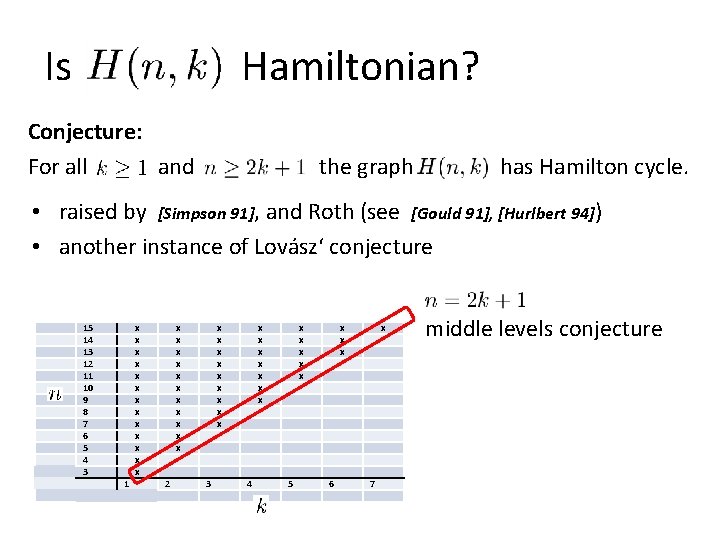
Is Hamiltonian? Conjecture: For all and the graph has Hamilton cycle. • raised by [Simpson 91], and Roth (see [Gould 91], [Hurlbert 94]) • another instance of Lovász‘ conjecture 15 14 13 12 11 10 9 8 7 6 5 4 3 1 x x x x x x 2 x x x x x 3 x x x x 4 x x x 5 x x x 6 x 7 middle levels conjecture
![Is Hamiltonian? Known results: has a Hamilton cycle if • [Shields, Savage 94] •](http://slidetodoc.com/presentation_image_h2/912bbbc8e6009c1477b23735f39abd0d/image-24.jpg "Is Hamiltonian? Known results: has a Hamilton cycle if • [Shields, Savage 94] •")
Is Hamiltonian? Known results: has a Hamilton cycle if • [Shields, Savage 94] • [Chen 03] (following earlier work by [Simpson 94], [Hurlbert 94], [Chen 00]) ? ? ? 15 14 13 12 11 10 9 8 7 6 5 4 3 1 x x x x x x 2 x x x x x 3 x x x x 4 x x x 5 x x x 6 x 7
![Our results Theorem 4 [M. , Su 17; Combinatorica]: For all and the graph](http://slidetodoc.com/presentation_image_h2/912bbbc8e6009c1477b23735f39abd0d/image-25.jpg "Our results Theorem 4 [M. , Su 17; Combinatorica]: For all and the graph")
Our results Theorem 4 [M. , Su 17; Combinatorica]: For all and the graph has Hamilton cycle. Remark: simple induction proof, assuming the validity of the middle levels conjecture
![11. . . 1 Generalized MLC Conjecture [Savage 93], [Gregor, Škrekovski 10]: For any](http://slidetodoc.com/presentation_image_h2/912bbbc8e6009c1477b23735f39abd0d/image-26.jpg "11. . . 1 Generalized MLC Conjecture [Savage 93], [Gregor, Škrekovski 10]: For any")
11. . . 1 Generalized MLC Conjecture [Savage 93], [Gregor, Škrekovski 10]: For any and , the middle levels of have a Hamilton cycle. levels • Known results: 00. . . 0 [Gray 53] [El-Hashash, Hassan 01], [Locke, Stong 03] [Gregor, Škrekovski 10] ? [Gregor, Jäger, M. ; ICALP 18] [M. 16] Middle levels conjecture
![Generalized MLC 11. . . 1 Conjecture [Savage 93], [Gregor, Škrekovski 10]: For any](http://slidetodoc.com/presentation_image_h2/912bbbc8e6009c1477b23735f39abd0d/image-27.jpg "Generalized MLC 11. . . 1 Conjecture [Savage 93], [Gregor, Škrekovski 10]: For any")
Generalized MLC 11. . . 1 Conjecture [Savage 93], [Gregor, Škrekovski 10]: For any and , the middle levels of have a Hamilton cycle. levels 00. . . 0 Theorem 5 [Gregor, M. 17; STACS+TCS]: For any and any interval not part of this conjecture, the subgraph of with levels in this interval has an `almost‘ Hamilton cycle, and we have corresponding constant-time generation algorithms.
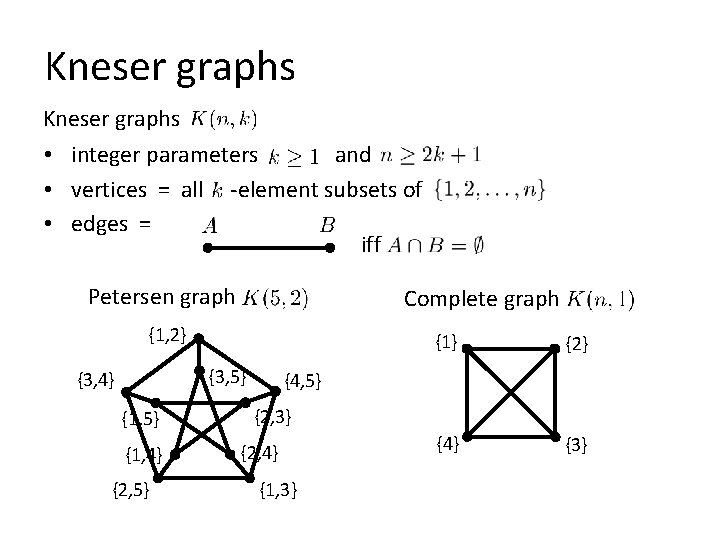
Kneser graphs • integer parameters and • vertices = all -element subsets of • edges = iff Petersen graph Complete graph {1, 2} {3, 5} {3, 4} {1, 5} {1, 4} {2, 5} {1} {2} {4} {3} {4, 5} {2, 3} {2, 4} {1, 3}
![Kneser graphs • introduced by [Lovász 78] to prove Kneser‘s conjecture • have long](http://slidetodoc.com/presentation_image_h2/912bbbc8e6009c1477b23735f39abd0d/image-29.jpg "Kneser graphs • introduced by [Lovász 78] to prove Kneser‘s conjecture • have long")
Kneser graphs • introduced by [Lovász 78] to prove Kneser‘s conjecture • have long been conjectured to have Hamilton cycle, with one notable exception, the Petersen graph • another instance of Lovász‘ conjecture • sparsest and therefore hardest case is when • odd graphs • degree , which is logarithmic in number of vertices Observation: Hamiltonicity of implies Hamiltonicity of .
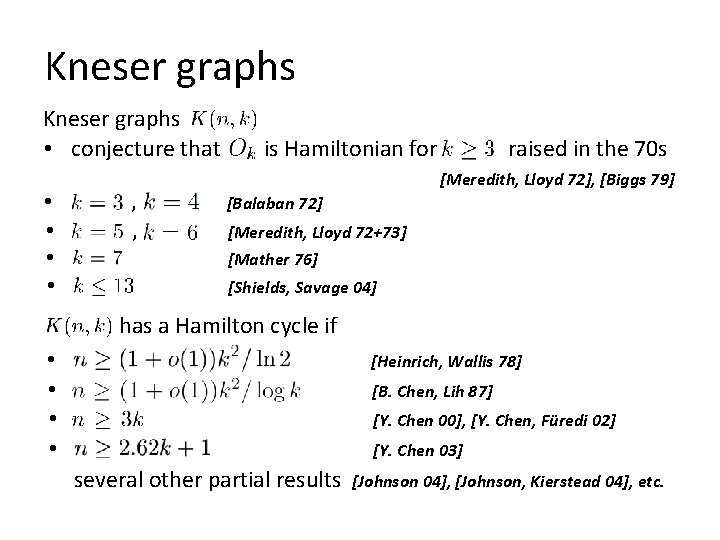
Kneser graphs • conjecture that • • , , is Hamiltonian for raised in the 70 s [Meredith, Lloyd 72], [Biggs 79] [Balaban 72] [Meredith, Lloyd 72+73] [Mather 76] [Shields, Savage 04] has a Hamilton cycle if • • [Heinrich, Wallis 78] [B. Chen, Lih 87] [Y. Chen 00], [Y. Chen, Füredi 02] [Y. Chen 03] several other partial results [Johnson 04], [Johnson, Kierstead 04], etc.
![Our results Theorem 6 [M. , Nummenpalo, Walczak 18; STOC]: For all , the](http://slidetodoc.com/presentation_image_h2/912bbbc8e6009c1477b23735f39abd0d/image-31.jpg "Our results Theorem 6 [M. , Nummenpalo, Walczak 18; STOC]: For all , the")
Our results Theorem 6 [M. , Nummenpalo, Walczak 18; STOC]: For all , the odd graph Hamilton cycle. Theorem 7 [M. , Nummenpalo, Walczak 18; STOC]: For all and , the graph Hamilton cycle. Theorem 8 [M. , Nummenpalo, Walczak 18; STOC]: For all , the odd graph has at least Hamilton cycles. has a distinct
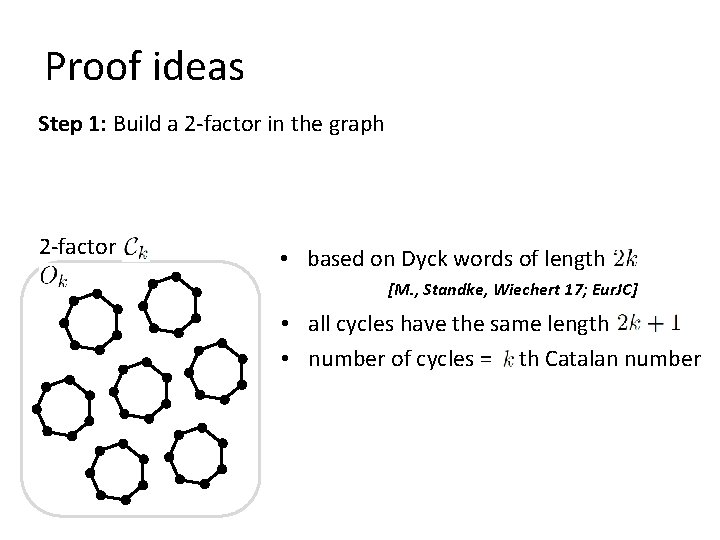
Proof ideas Step 1: Build a 2 -factor in the graph 2 -factor • based on Dyck words of length [M. , Standke, Wiechert 17; Eur. JC] • all cycles have the same length • number of cycles = th Catalan number
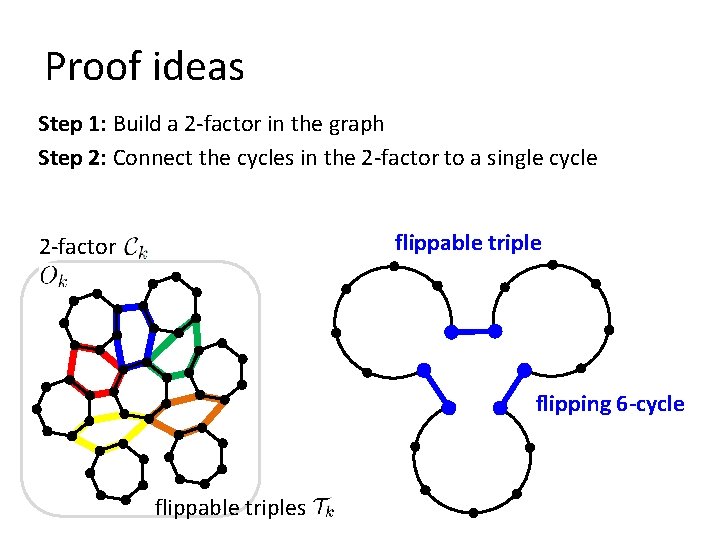
Proof ideas Step 1: Build a 2 -factor in the graph Step 2: Connect the cycles in the 2 -factor to a single cycle flippable triple 2 -factor flipping 6 -cycle flippable triples
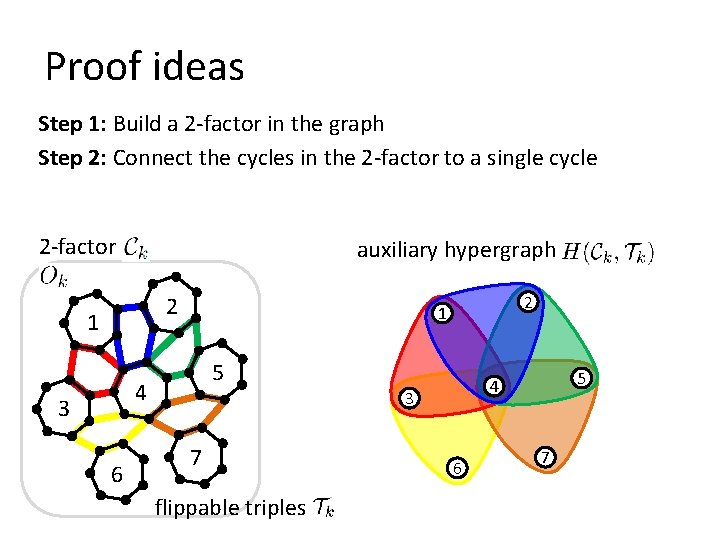
Proof ideas Step 1: Build a 2 -factor in the graph Step 2: Connect the cycles in the 2 -factor to a single cycle 2 -factor auxiliary hypergraph 2 1 5 4 3 6 2 1 3 7 flippable triples 5 4 6 7
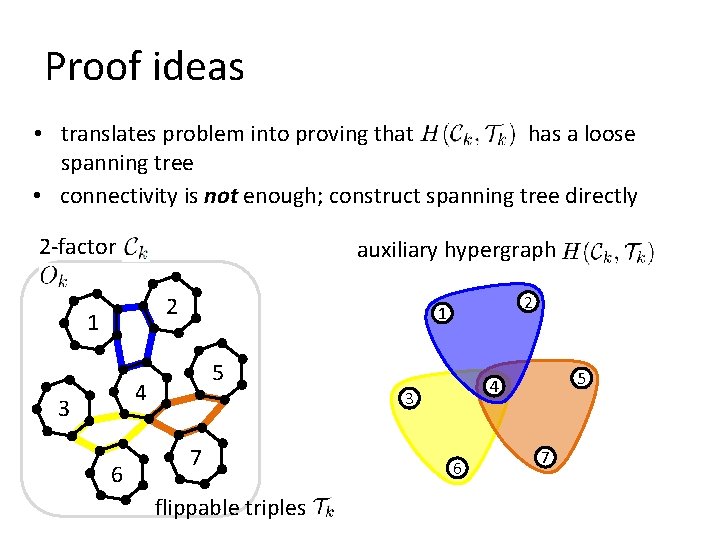
Proof ideas • translates problem into proving that has a loose spanning tree • connectivity is not enough; construct spanning tree directly 2 -factor auxiliary hypergraph 2 1 5 4 3 6 2 1 3 7 flippable triples 5 4 6 7
Results summary • Middle levels conjecture • • • [M. , Weber 2012; Journal of Combinatorial Theory Series A] [M. 2016; Proceedings of the London Mathematical Society] [Gregor, M. , Nummenpalo 2018; Discrete Analysis] [M. , Nummenpalo 2015; ESA] [M. , Nummenpalo 2017; SODA] [Gregor, M. 2017; STACS], [Gregor, M. 2017; Theoretical Computer Science] • (Bipartite) Kneser graphs • • • [M. , Su 2017; Combinatorica] [M. , Standke, Wiechert 2018; European Journal of Combinatorics] [M. , Nummenpalo, Walczak 2018; STOC]

Thank you!
- Slides: 37