
Combinations of Lenses Physics Copyright 2009 Pearson Education
Combinations of Lenses Physics Copyright © 2009 Pearson Education, Inc.

Combinations of Lenses In lens Combinations: 1. The image formed by the first lens becomes the object for the second lens (this is where object distances may be negative). 2. The total magnification is the product of the magnification of each lens. Copyright © 2009 Pearson Education, Inc.
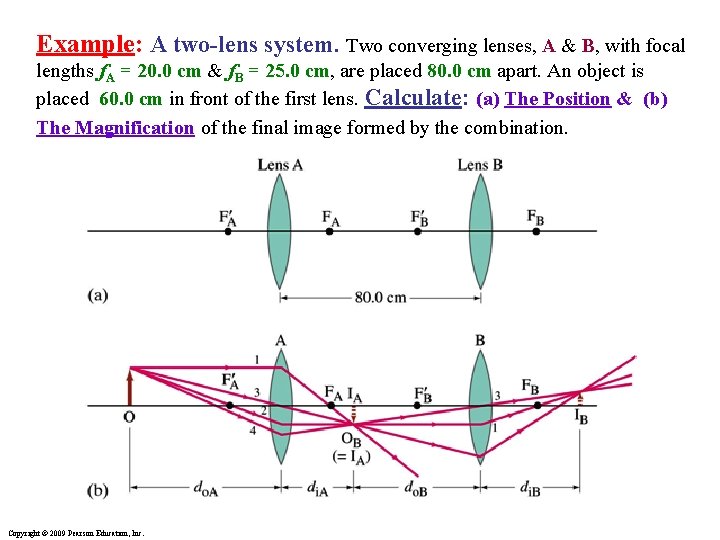
Example: A two-lens system. Two converging lenses, A & B, with focal lengths f. A = 20. 0 cm & f. B = 25. 0 cm, are placed 80. 0 cm apart. An object is placed 60. 0 cm in front of the first lens. Calculate: (a) The Position & (b) The Magnification of the final image formed by the combination. Copyright © 2009 Pearson Education, Inc.
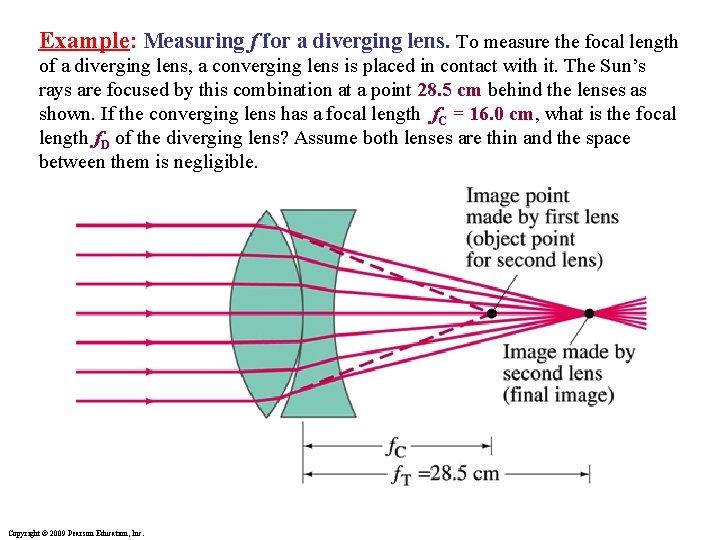
Example: Measuring f for a diverging lens. To measure the focal length of a diverging lens, a converging lens is placed in contact with it. The Sun’s rays are focused by this combination at a point 28. 5 cm behind the lenses as shown. If the converging lens has a focal length f. C = 16. 0 cm, what is the focal length f. D of the diverging lens? Assume both lenses are thin and the space between them is negligible. Copyright © 2009 Pearson Education, Inc.
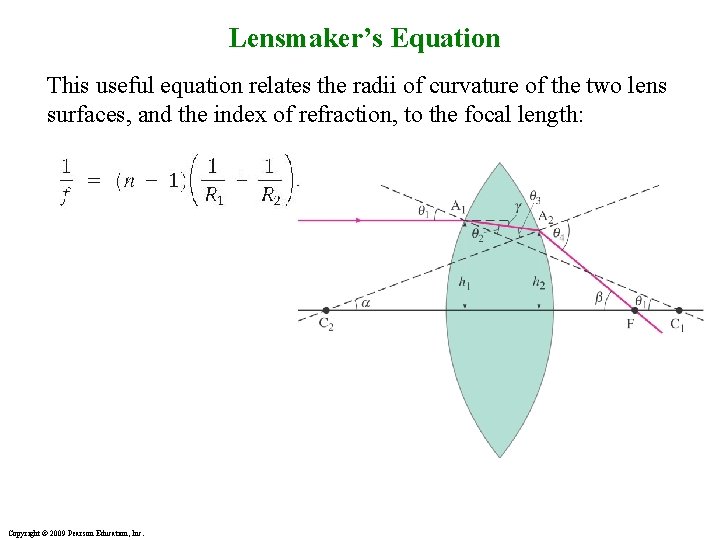
Lensmaker’s Equation This useful equation relates the radii of curvature of the two lens surfaces, and the index of refraction, to the focal length: Copyright © 2009 Pearson Education, Inc.

Example : Calculating f for a converging lens. A convex meniscus lens is made from glass with n = 1. 50. The radius of curvature of the convex surface is 22. 4 cm and that of the concave surface is 46. 2 cm. (a) What is the focal length? (b) Where will the image be for an object 2. 00 m away? Copyright © 2009 Pearson Education, Inc.
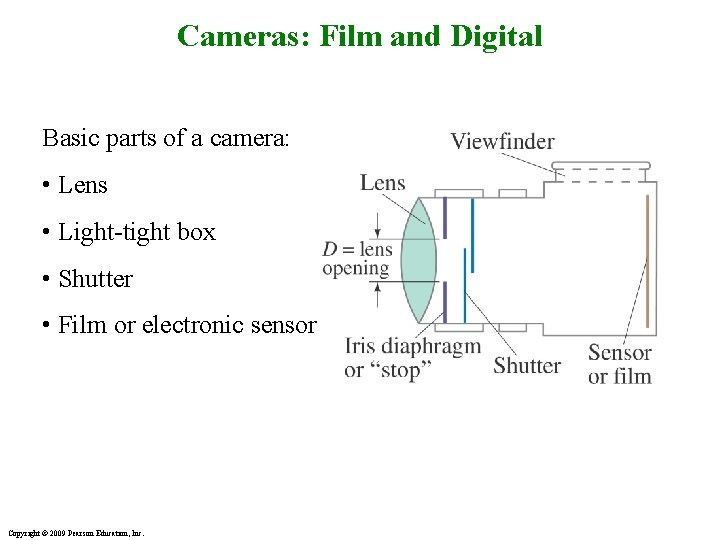
Cameras: Film and Digital Basic parts of a camera: • Lens • Light-tight box • Shutter • Film or electronic sensor Copyright © 2009 Pearson Education, Inc.
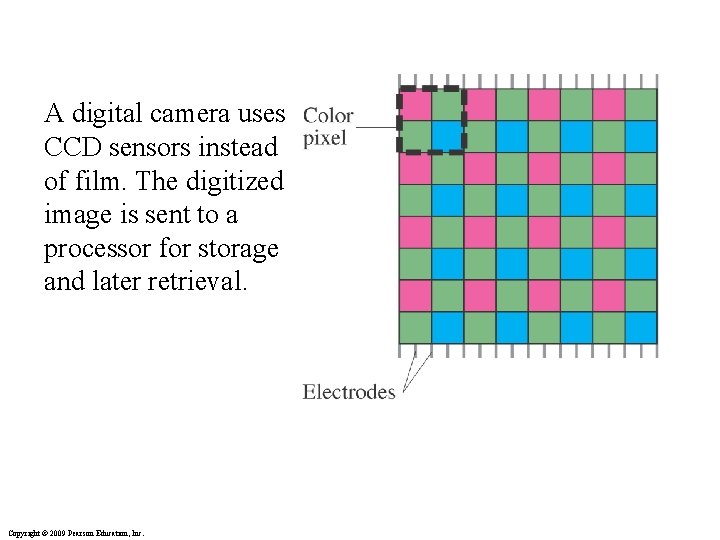
A digital camera uses CCD sensors instead of film. The digitized image is sent to a processor for storage and later retrieval. Copyright © 2009 Pearson Education, Inc.
Camera adjustments • Shutter speed: Controls the amount of time light enters the camera. A faster shutter speed makes a sharper picture. • f-stop: Controls the maximum opening of the shutter. This allows the right amount of light to enter to properly expose the film, and must be adjusted for external light conditions. • Focusing: This adjusts the position of the lens so that the image is positioned on the film. Copyright © 2009 Pearson Education, Inc.
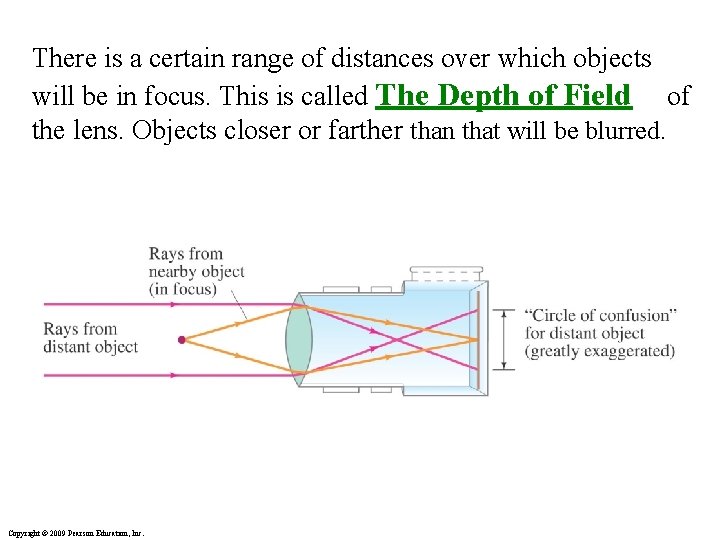
There is a certain range of distances over which objects will be in focus. This is called The Depth of Field of the lens. Objects closer or farther than that will be blurred. Copyright © 2009 Pearson Education, Inc.
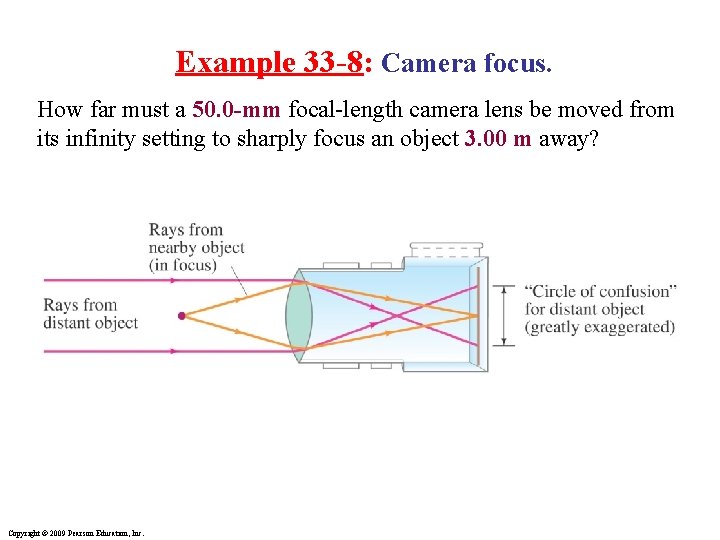
Example 33 -8: Camera focus. How far must a 50. 0 -mm focal-length camera lens be moved from its infinity setting to sharply focus an object 3. 00 m away? Copyright © 2009 Pearson Education, Inc.
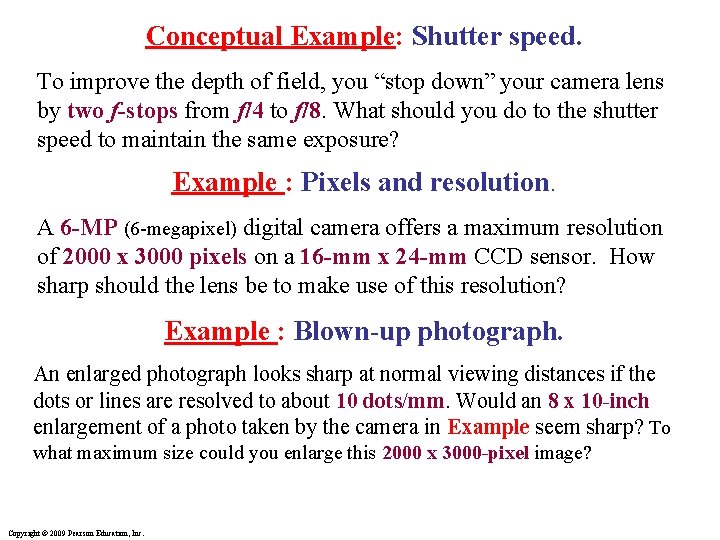
Conceptual Example: Shutter speed. To improve the depth of field, you “stop down” your camera lens by two f-stops from f/4 to f/8. What should you do to the shutter speed to maintain the same exposure? Example : Pixels and resolution. A 6 -MP (6 -megapixel) digital camera offers a maximum resolution of 2000 x 3000 pixels on a 16 -mm x 24 -mm CCD sensor. How sharp should the lens be to make use of this resolution? Example : Blown-up photograph. An enlarged photograph looks sharp at normal viewing distances if the dots or lines are resolved to about 10 dots/mm. Would an 8 x 10 -inch enlargement of a photo taken by the camera in Example seem sharp? To what maximum size could you enlarge this 2000 x 3000 -pixel image? Copyright © 2009 Pearson Education, Inc.
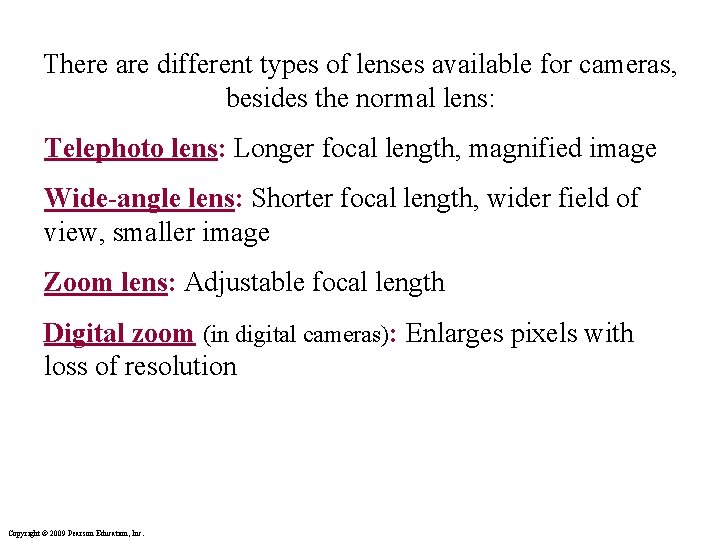
There are different types of lenses available for cameras, besides the normal lens: Telephoto lens: Longer focal length, magnified image Wide-angle lens: Shorter focal length, wider field of view, smaller image Zoom lens: Adjustable focal length Digital zoom (in digital cameras): Enlarges pixels with loss of resolution Copyright © 2009 Pearson Education, Inc.
- Slides: 13