
Combinations of Functions Composite Functions Objectives Add subtract
Combinations of Functions Composite Functions
Objectives § Add, subtract, multiply, and divide functions. § Find compositions of one function with another function.
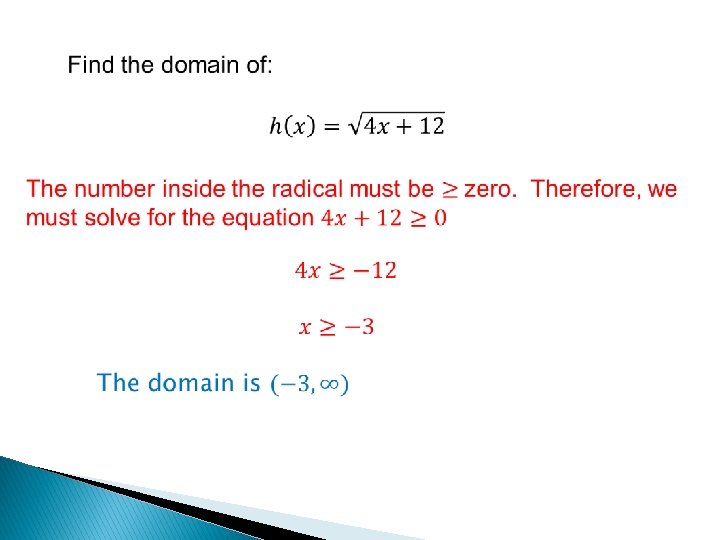
Finding a Function’s Domain Unless a function has a stated domain, its domain is the set of real numbers.

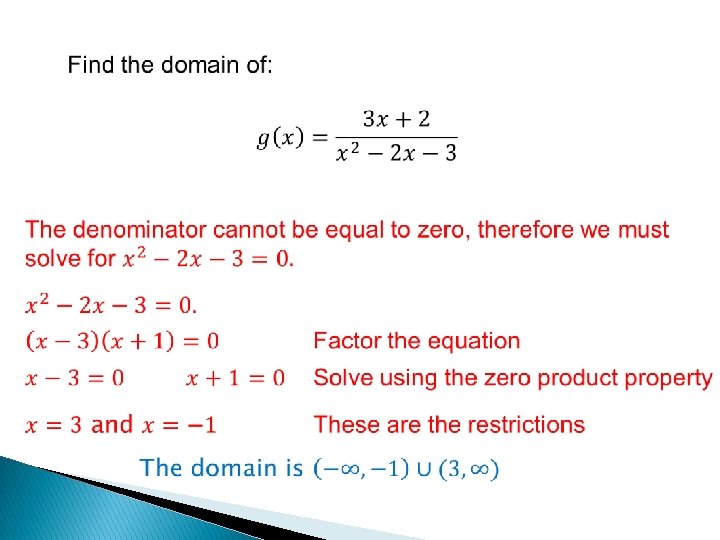
Domain Clues ● The denominator cannot be zero. Numbers that cause the denominator to be zero are called restrictions. ● An even root cannot have a negative result within the radical sign. These, too, are called restrictions. ● Unless we have these previous two conditions resulting in restrictions, then all other equations have a domain of all real numbers. ● All real numbers are denoted by (∞, - ∞)

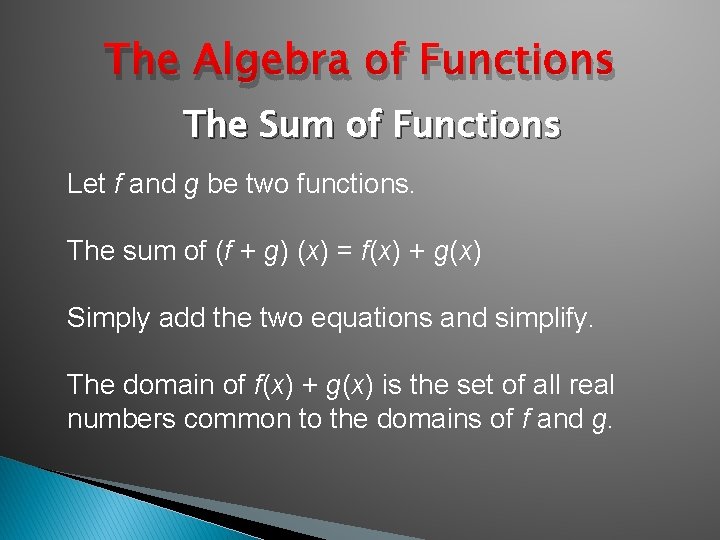
The Algebra of Functions The Sum of Functions Let f and g be two functions. The sum of (f + g) (x) = f(x) + g(x) Simply add the two equations and simplify. The domain of f(x) + g(x) is the set of all real numbers common to the domains of f and g.
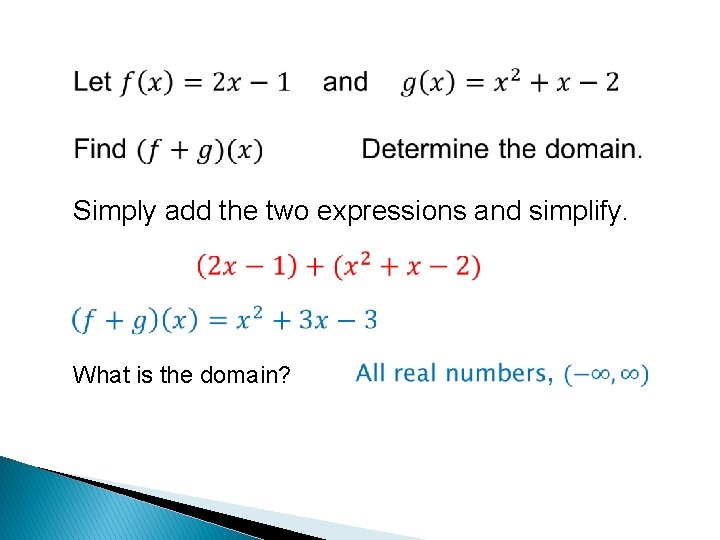
Simply add the two expressions and simplify. What is the domain?
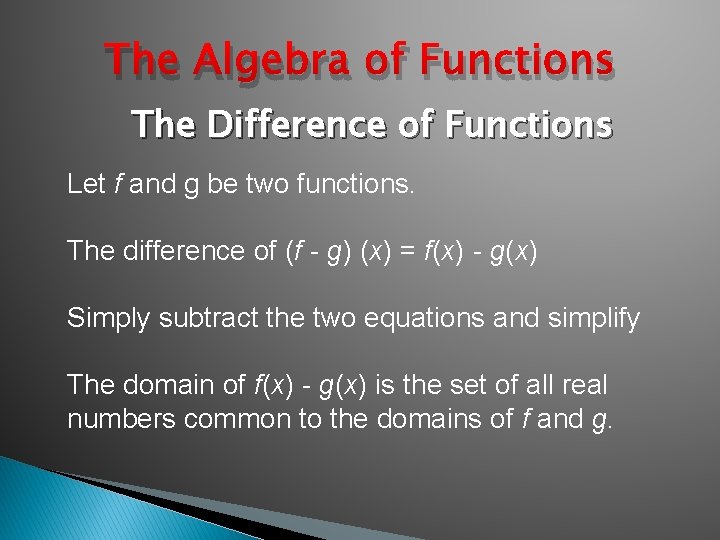
The Algebra of Functions The Difference of Functions Let f and g be two functions. The difference of (f - g) (x) = f(x) - g(x) Simply subtract the two equations and simplify The domain of f(x) - g(x) is the set of all real numbers common to the domains of f and g.
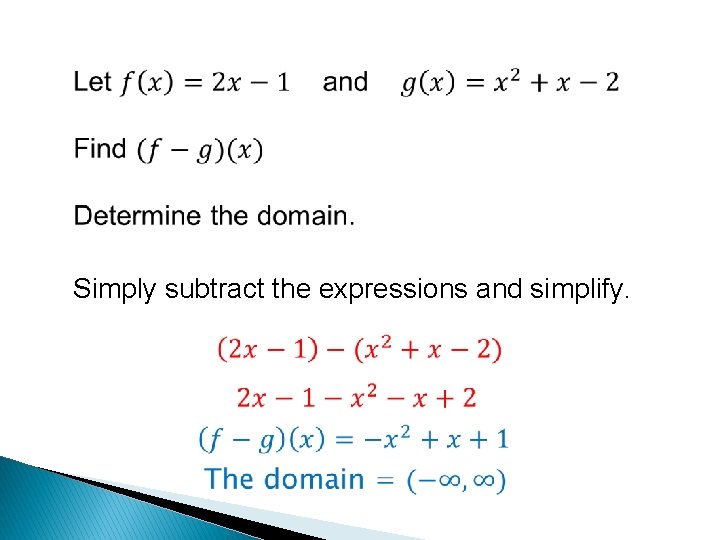
Simply subtract the expressions and simplify.

The Algebra of Functions The Product of Functions Let f and g be two functions. The product of (fg) (x) = f(x) • g(x) Simply multiply the two equations and simplify The domain of f(x) • g(x) is the set of all real numbers common to the domains of f and g.
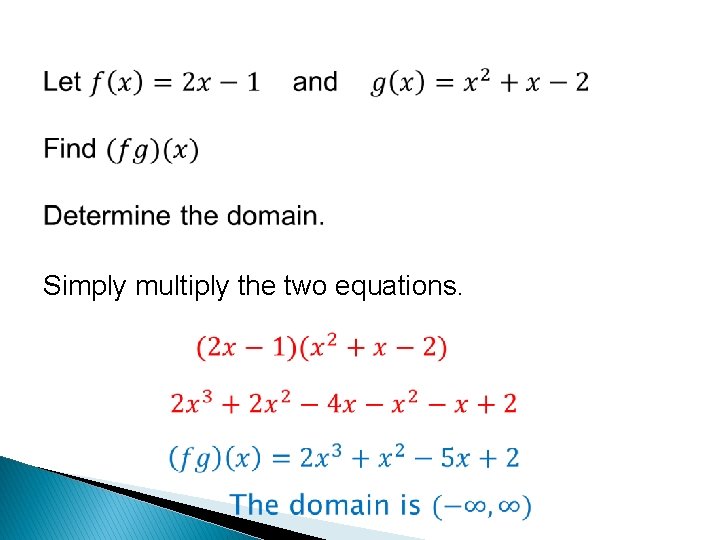
Simply multiply the two equations.
The Algebra of Functions The Quotient of Functions Let f and g be two functions. The quotient of (f/g) (x) = f(x)/g(x) Simply divide the two equations and simplify The domain of f(x) / g(x) is the set of all real numbers common to the domains of f and g, provided g(x) is not equal to zero.
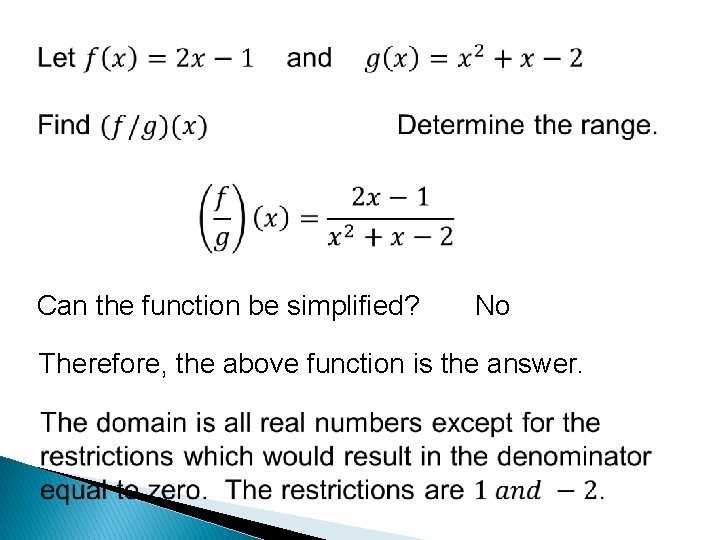
Can the function be simplified? No Therefore, the above function is the answer.
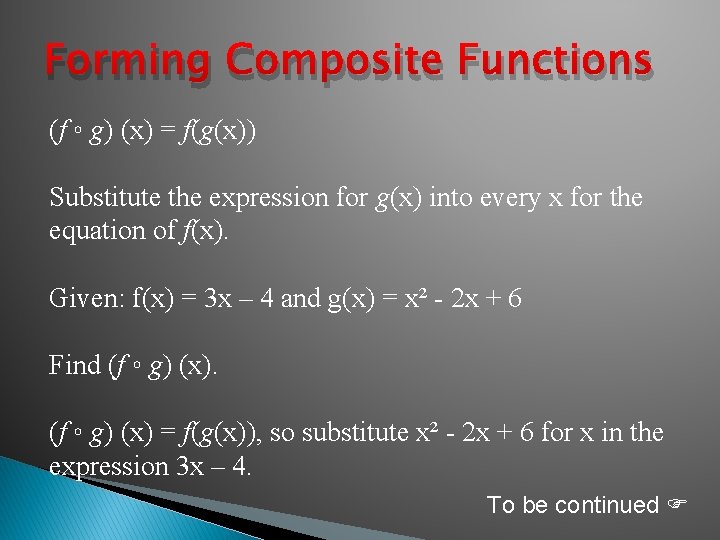
Forming Composite Functions (f ◦ g) (x) = f(g(x)) Substitute the expression for g(x) into every x for the equation of f(x). Given: f(x) = 3 x – 4 and g(x) = x² - 2 x + 6 Find (f ◦ g) (x) = f(g(x)), so substitute x² - 2 x + 6 for x in the expression 3 x – 4. To be continued
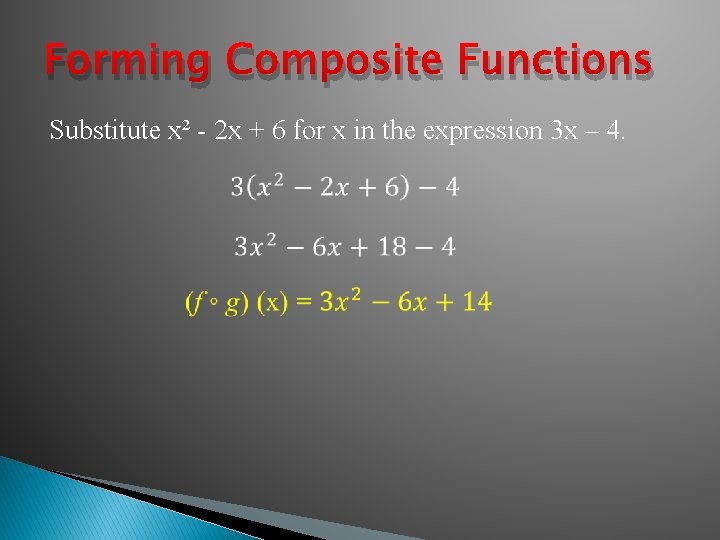
Forming Composite Functions Substitute x² - 2 x + 6 for x in the expression 3 x – 4.
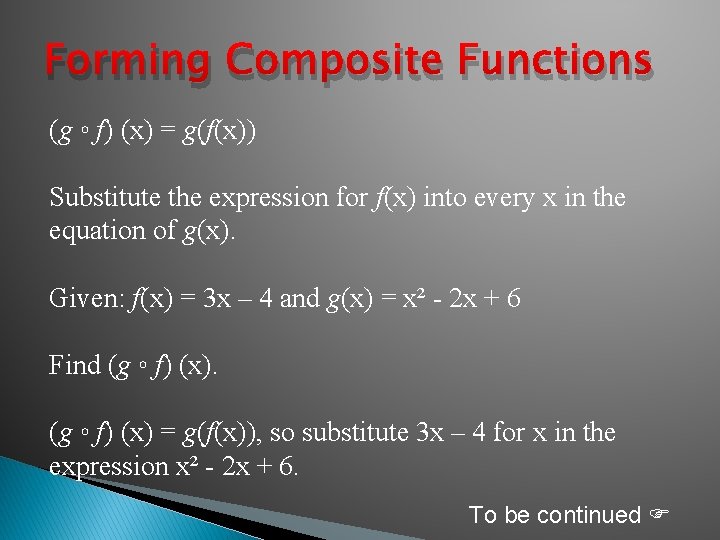
Forming Composite Functions (g ◦ f) (x) = g(f(x)) Substitute the expression for f(x) into every x in the equation of g(x). Given: f(x) = 3 x – 4 and g(x) = x² - 2 x + 6 Find (g ◦ f) (x) = g(f(x)), so substitute 3 x – 4 for x in the expression x² - 2 x + 6. To be continued
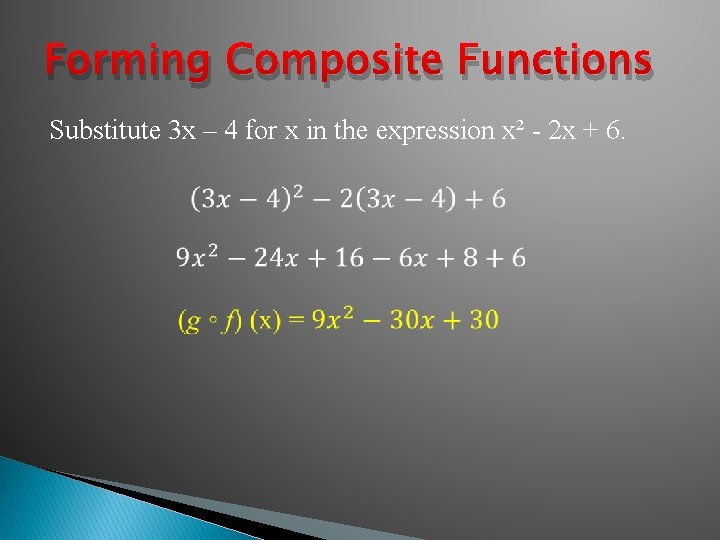
Forming Composite Functions Substitute 3 x – 4 for x in the expression x² - 2 x + 6.
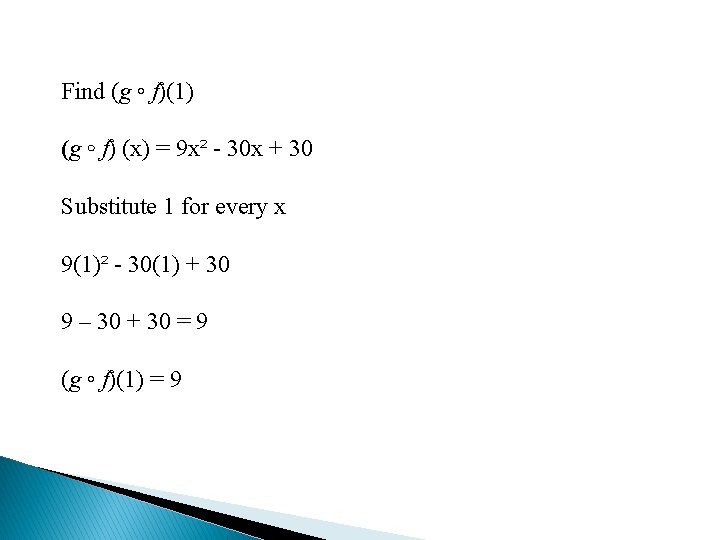
Find (g ◦ f)(1) (g ◦ f) (x) = 9 x² - 30 x + 30 Substitute 1 for every x 9(1)² - 30(1) + 30 9 – 30 + 30 = 9 (g ◦ f)(1) = 9

- Slides: 21