
COMBINATION AND PERMUTATIONS GPS Standard MM 1 D
COMBINATION AND PERMUTATIONS GPS Standard MM 1 D 1 Calculate and use simple permutations and combinations
GEORGIA PREFORMANCE STANDARD Standard MM 1 D 1 A) Apply the addition and multiplication principles of counting B) Calculate and use simple permutations and combinations
OBJECTIVE 1. To relate compound events to counting principles 2. To relate counting principles to permutations and combinations
ESSENTIAL QUESTION… How many different ways can I arrange PROBABILITY? How can we relate counting principles to compound events?
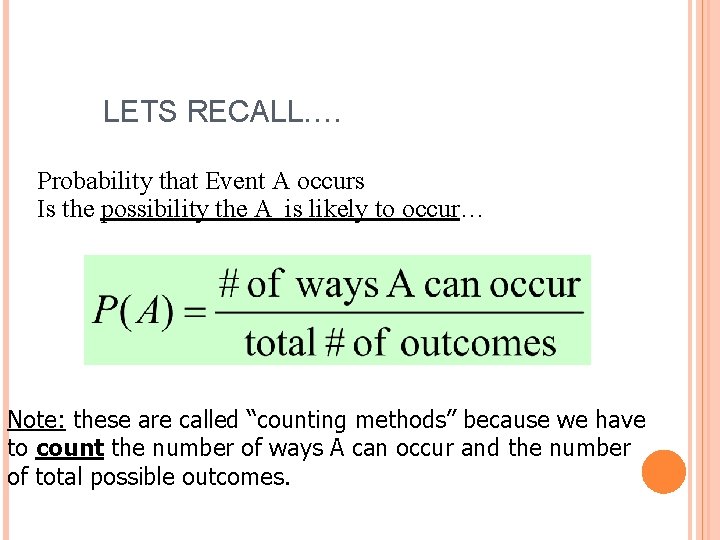
LETS RECALL…. Probability that Event A occurs Is the possibility the A is likely to occur… Note: these are called “counting methods” because we have to count the number of ways A can occur and the number of total possible outcomes.
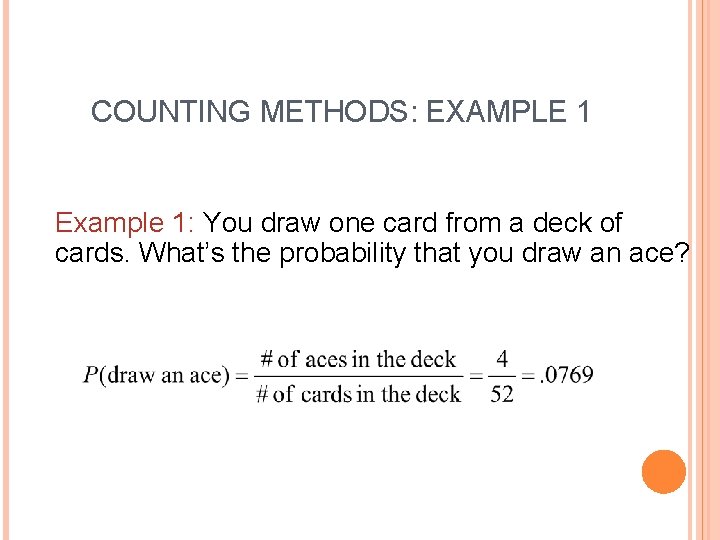
COUNTING METHODS: EXAMPLE 1 Example 1: You draw one card from a deck of cards. What’s the probability that you draw an ace?
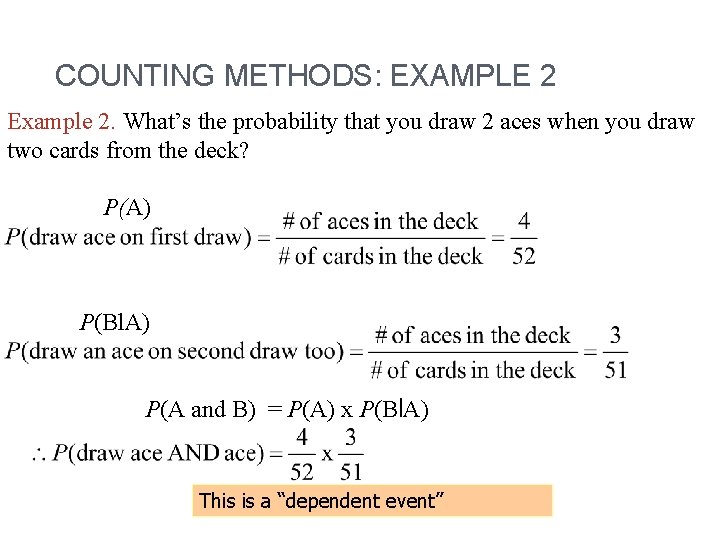
COUNTING METHODS: EXAMPLE 2 Example 2. What’s the probability that you draw 2 aces when you draw two cards from the deck? P(A) P(Bl. A) P(A and B) = P(A) x P(Bl. A) This is a “dependent event”
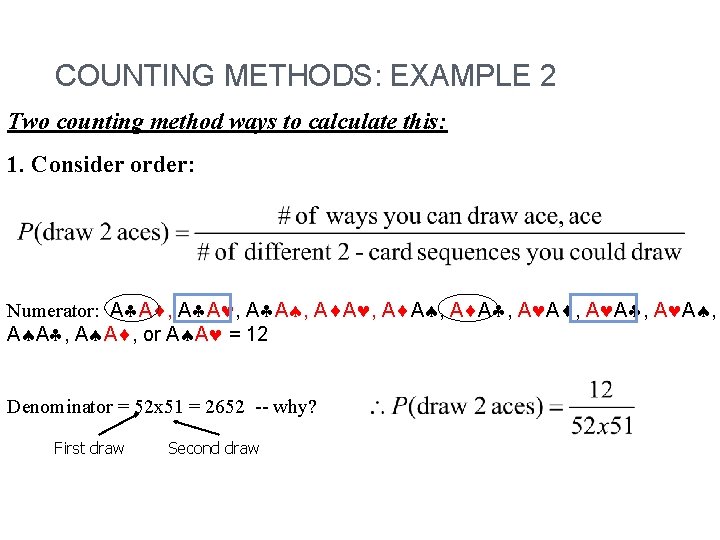
COUNTING METHODS: EXAMPLE 2 Two counting method ways to calculate this: 1. Consider order: Numerator: A A , A A , A A , or A A = 12 Denominator = 52 x 51 = 2652 -- why? First draw Second draw
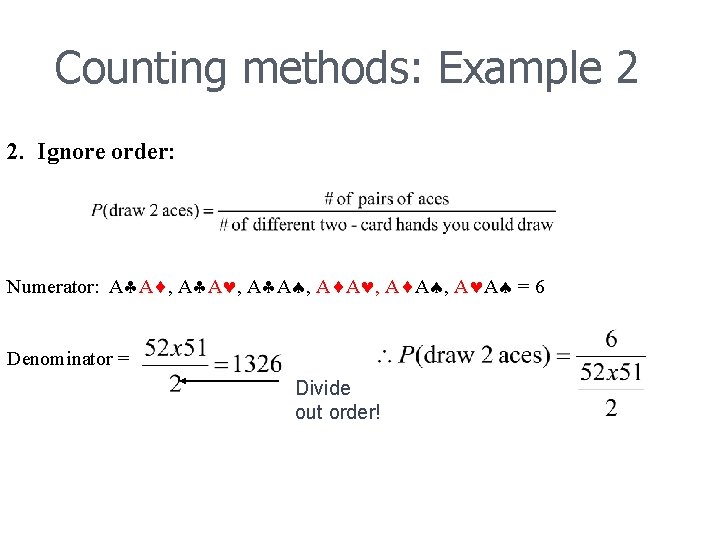
Counting methods: Example 2 2. Ignore order: Numerator: A A , A A , A A = 6 Denominator = Divide out order!
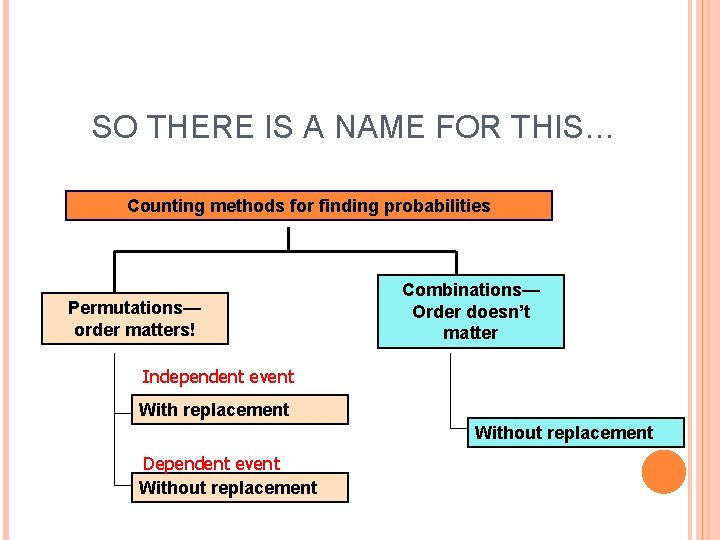
SO THERE IS A NAME FOR THIS… Counting methods for finding probabilities Permutations— order matters! Combinations— Order doesn’t matter Independent event With replacement Without replacement Dependent event Without replacement
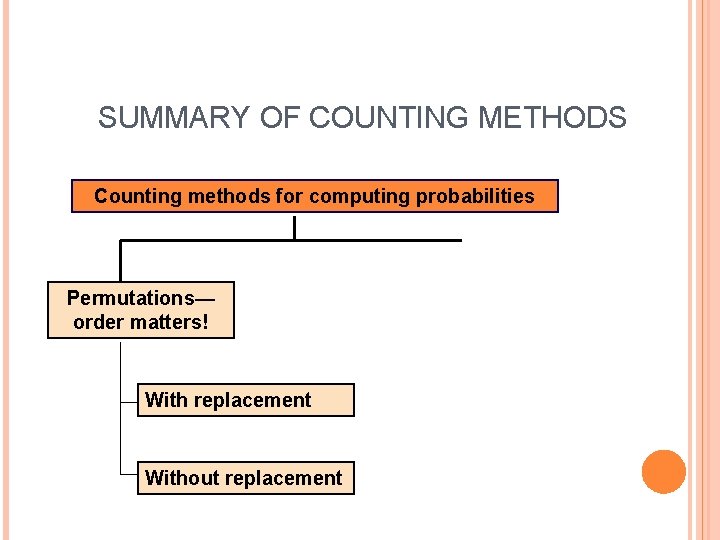
SUMMARY OF COUNTING METHODS Counting methods for computing probabilities Permutations— order matters! With replacement Without replacement
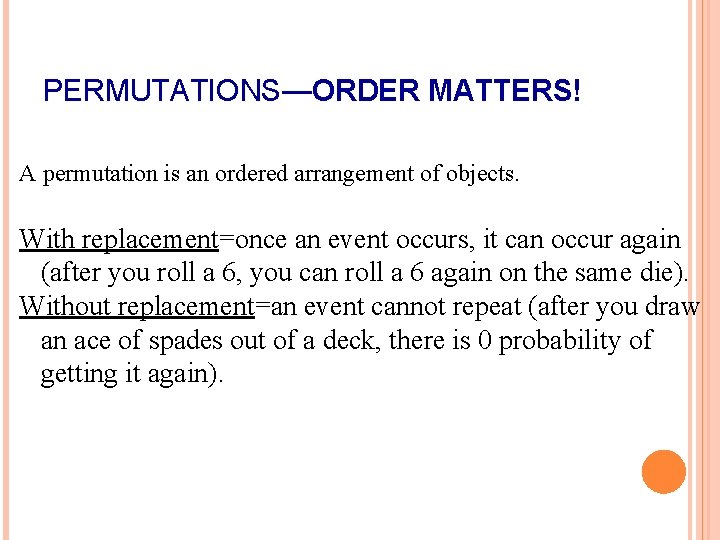
PERMUTATIONS—ORDER MATTERS! A permutation is an ordered arrangement of objects. With replacement=once an event occurs, it can occur again (after you roll a 6, you can roll a 6 again on the same die). Without replacement=an event cannot repeat (after you draw an ace of spades out of a deck, there is 0 probability of getting it again).
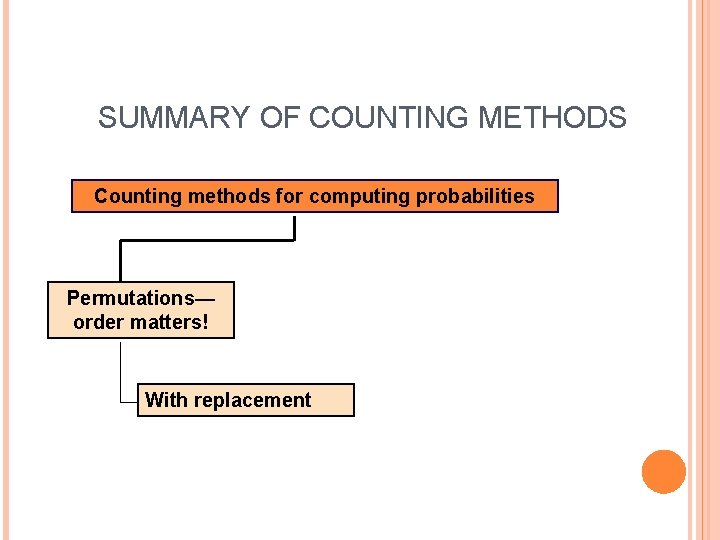
SUMMARY OF COUNTING METHODS Counting methods for computing probabilities Permutations— order matters! With replacement
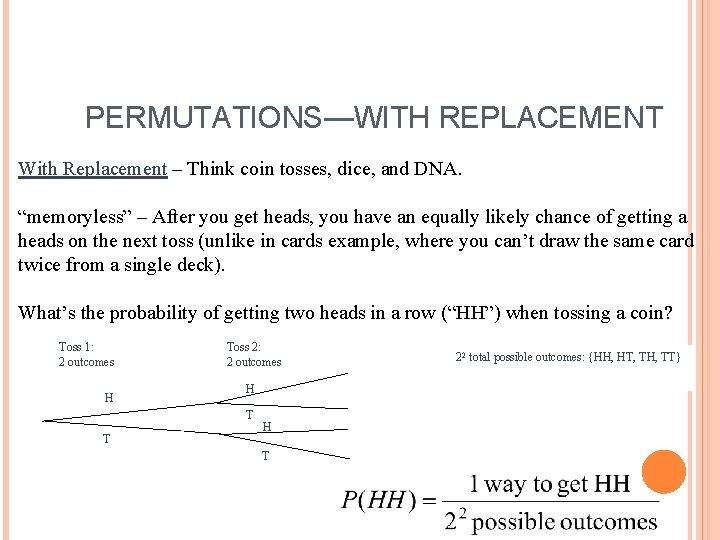
PERMUTATIONS—WITH REPLACEMENT With Replacement – Think coin tosses, dice, and DNA. “memoryless” – After you get heads, you have an equally likely chance of getting a heads on the next toss (unlike in cards example, where you can’t draw the same card twice from a single deck). What’s the probability of getting two heads in a row (“HH”) when tossing a coin? Toss 1: 2 outcomes H Toss 2: 2 outcomes H T T H T 22 total possible outcomes: {HH, HT, TH, TT}
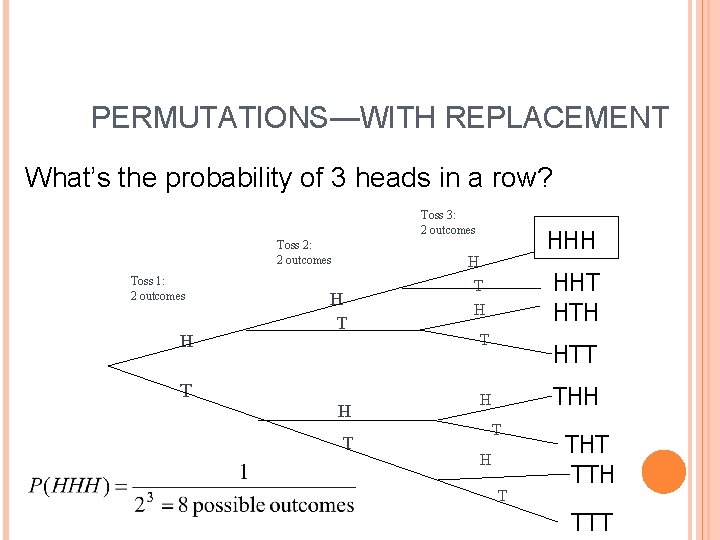
PERMUTATIONS—WITH REPLACEMENT What’s the probability of 3 heads in a row? Toss 3: 2 outcomes Toss 2: 2 outcomes H T H Toss 1: 2 outcomes T HHH H T H HHT HTH T HTT THH H T THT TTH TTT

PERMUTATIONS—WITH REPLACEMENT When you roll a pair of dice (or 1 die twice), what’s the probability of rolling 2 sixes? What’s the probability of rolling a 5 and a 6?
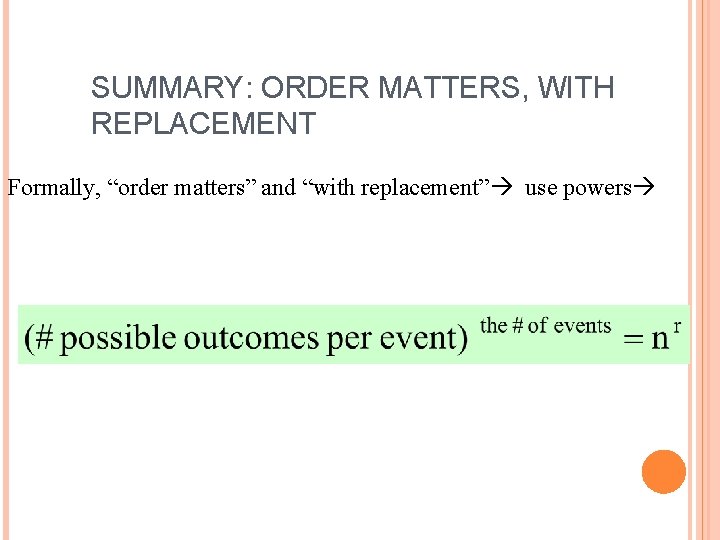
SUMMARY: ORDER MATTERS, WITH REPLACEMENT Formally, “order matters” and “with replacement” use powers
SUMMARY OF COUNTING METHODS Counting methods for computing probabilities Permutations— order matters! Without replacement
PERMUTATIONS—WITHOUT REPLACEMENT Without replacement—Think cards (w/o reshuffling) and seating arrangements. Example: You are moderating a debate of gubernatorial candidates. How many different ways can you seat the panelists in a row? Call them Arianna, Buster, Camejo, Donald, and Eve.
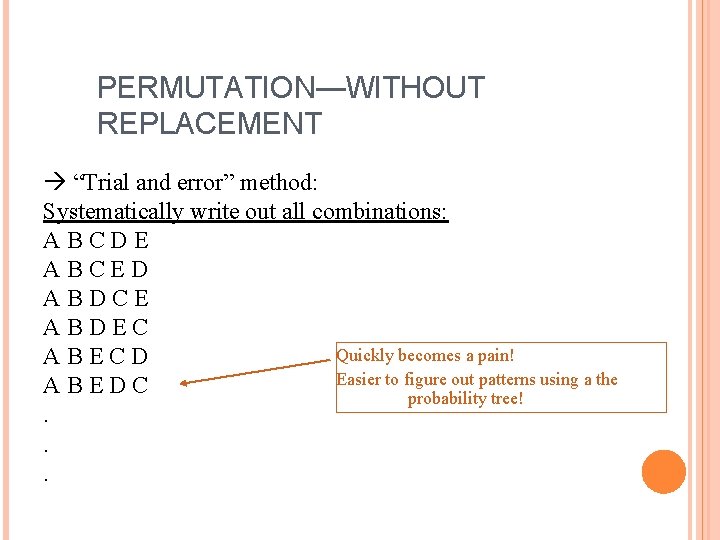
PERMUTATION—WITHOUT REPLACEMENT “Trial and error” method: Systematically write out all combinations: ABCDE ABCED ABDCE ABDEC Quickly becomes a pain! ABECD Easier to figure out patterns using a the ABEDC probability tree!. . .
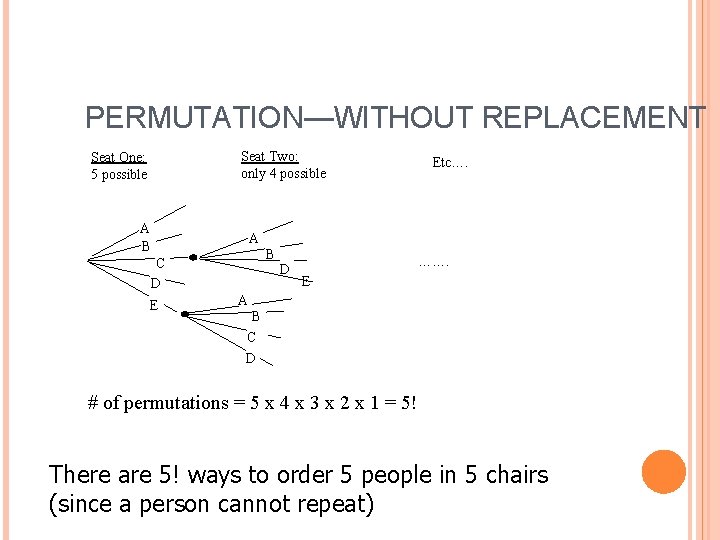
PERMUTATION—WITHOUT REPLACEMENT Seat Two: only 4 possible Seat One: 5 possible A B C D E Etc…. D ……. E A B C D # of permutations = 5 x 4 x 3 x 2 x 1 = 5! There are 5! ways to order 5 people in 5 chairs (since a person cannot repeat)
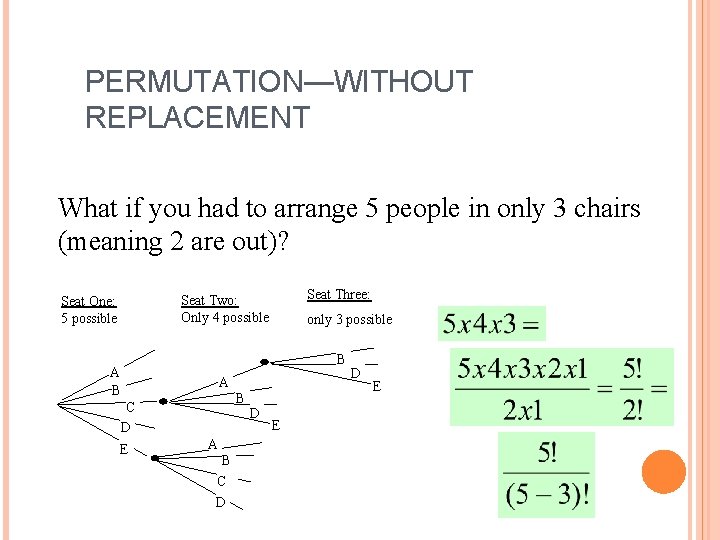
PERMUTATION—WITHOUT REPLACEMENT What if you had to arrange 5 people in only 3 chairs (meaning 2 are out)? Seat Three: Seat Two: Only 4 possible Seat One: 5 possible B A B C D E only 3 possible A B C D D E
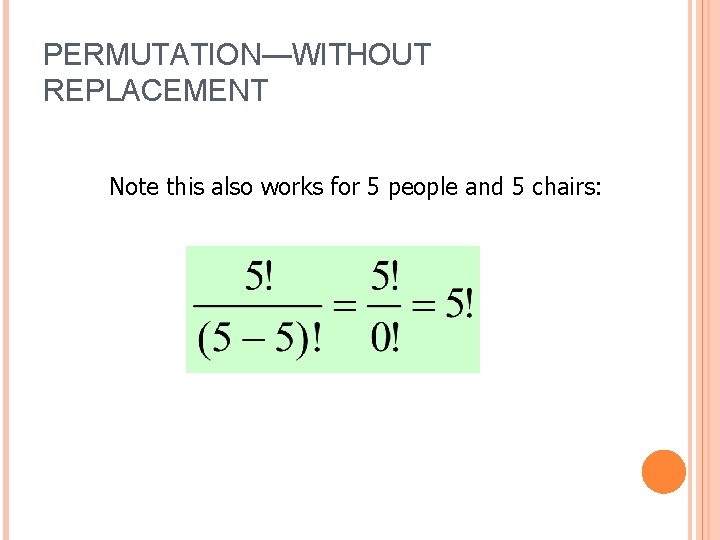
PERMUTATION—WITHOUT REPLACEMENT Note this also works for 5 people and 5 chairs:
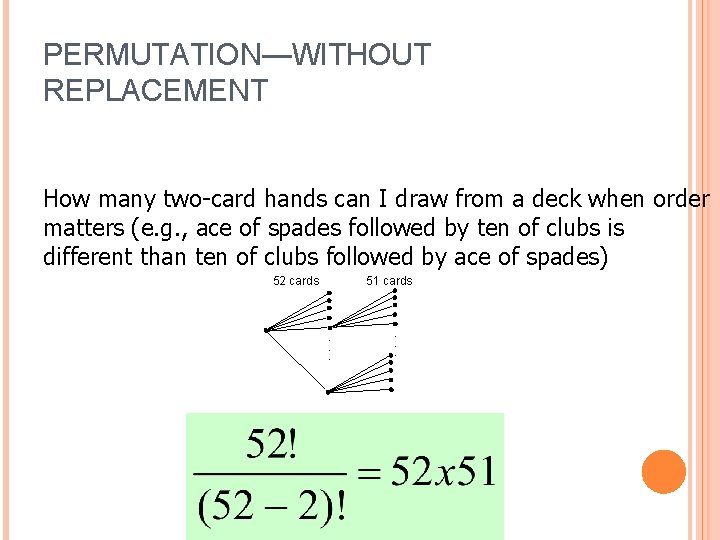
PERMUTATION—WITHOUT REPLACEMENT How many two-card hands can I draw from a deck when order matters (e. g. , ace of spades followed by ten of clubs is different than ten of clubs followed by ace of spades) 52 cards 51 cards . . .
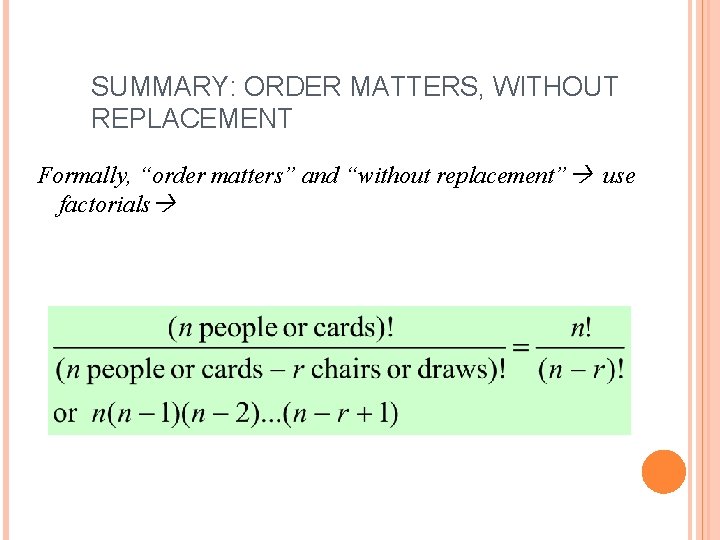
SUMMARY: ORDER MATTERS, WITHOUT REPLACEMENT Formally, “order matters” and “without replacement” use factorials
PRACTICE PROBLEMS: 1. 2. A wine taster claims that she can distinguish four vintages or a particular Cabernet. What is the probability that she can do this by merely guessing (she is confronted with 4 unlabeled glasses)? (hint: without replacement: could be used for discussion. ) In some states, license plates have six characters: three letters followed by three numbers. How many distinct such plates are possible? (hint: with replacement)
ANSWER 1 1. A wine taster claims that she can distinguish four vintages or a particular Cabernet. What is the probability that she can do this by merely guessing (she is confronted with 4 unlabeled glasses)? (hint: without replacement) P(success) = 1 (there’s only way to get it right!) / total # of guesses she could make Total # of guesses one could make randomly: glass one: 4 choices glass two: 3 vintages left glass three: 2 left = 4 x 3 x 2 x 1 = 4! P(success) = 1 / 4! = 1/24 =. 04167 glass four: no “degrees of freedom” left
ANSWER 2 2. In some states, license plates have six characters: three letters followed by three numbers. How many distinct such plates are possible? (hint: with replacement) 263 different ways to choose the letters and 103 different ways to choose the digits total number = 263 x 103 = 17, 576 x 1000 = 17, 576, 000
SUMMARY OF COUNTING METHODS Counting methods for computing probabilities Combinations— Order doesn’t matter Without replacement
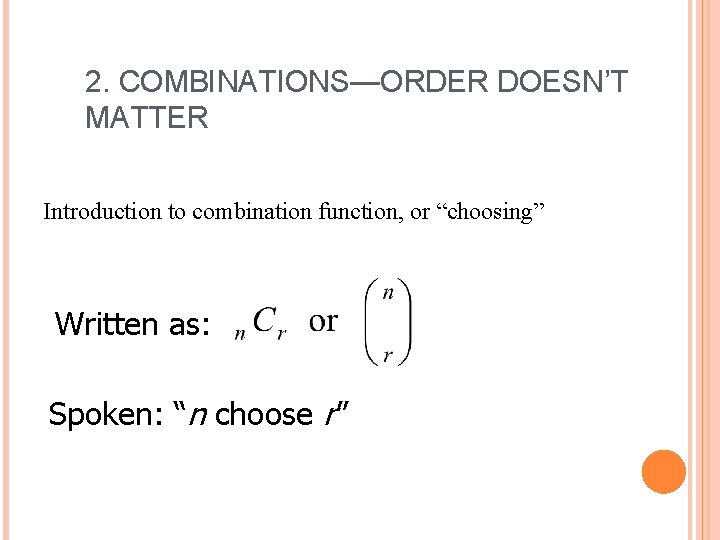
2. COMBINATIONS—ORDER DOESN’T MATTER Introduction to combination function, or “choosing” Written as: Spoken: “n choose r”
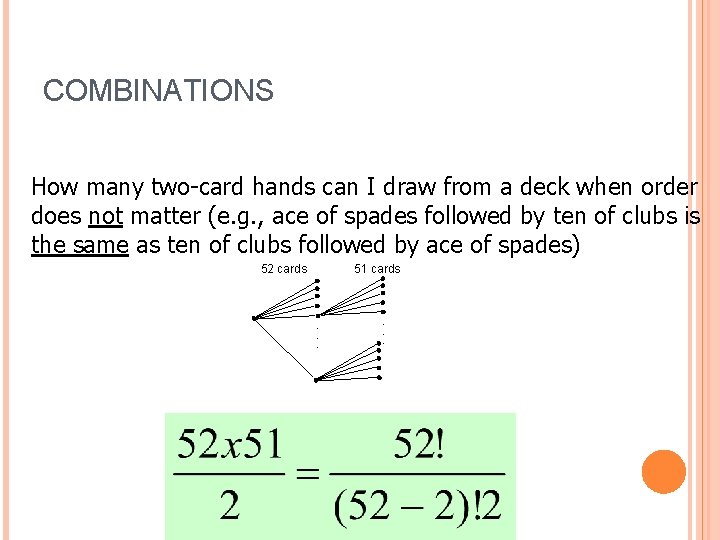
COMBINATIONS How many two-card hands can I draw from a deck when order does not matter (e. g. , ace of spades followed by ten of clubs is the same as ten of clubs followed by ace of spades) 52 cards 51 cards . . .
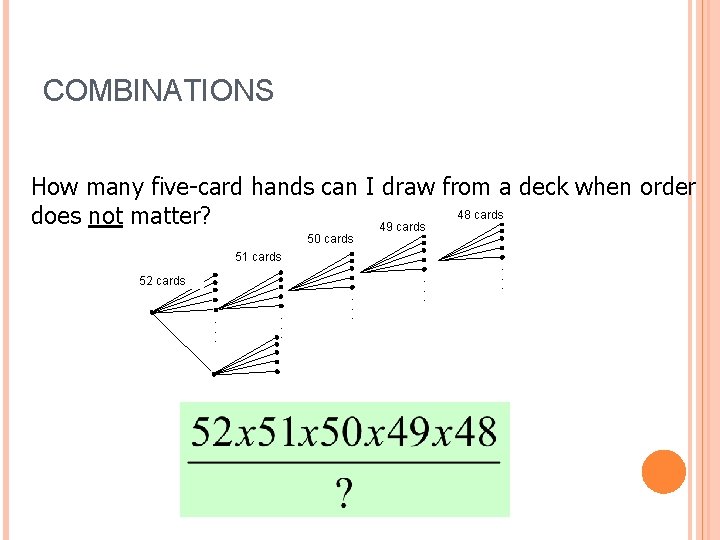
COMBINATIONS How many five-card hands can I draw from a deck when order 48 cards does not matter? 49 cards 50 cards 51 cards 52 cards. . . .
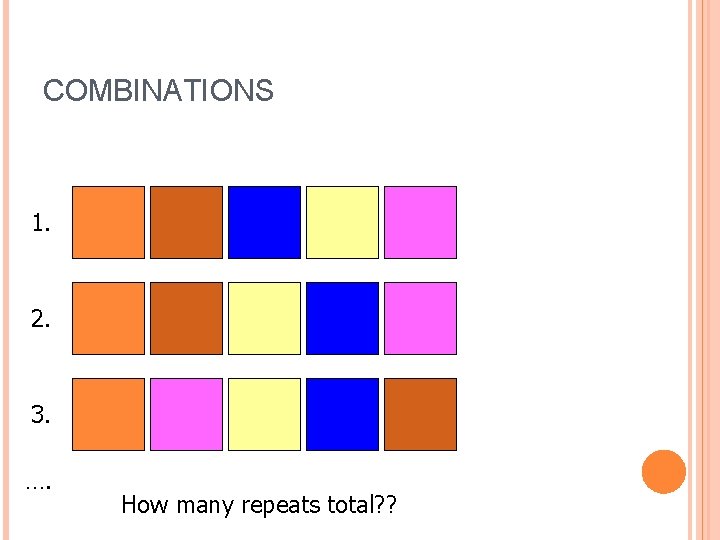
COMBINATIONS 1. 2. 3. …. How many repeats total? ?
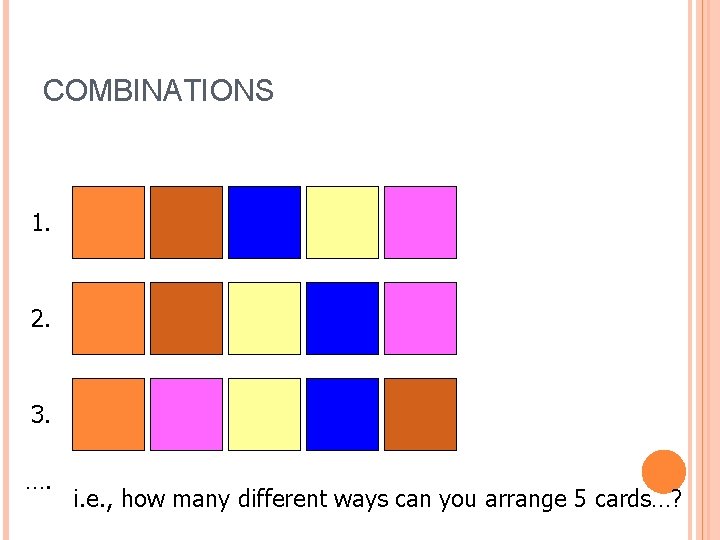
COMBINATIONS 1. 2. 3. …. i. e. , how many different ways can you arrange 5 cards…?
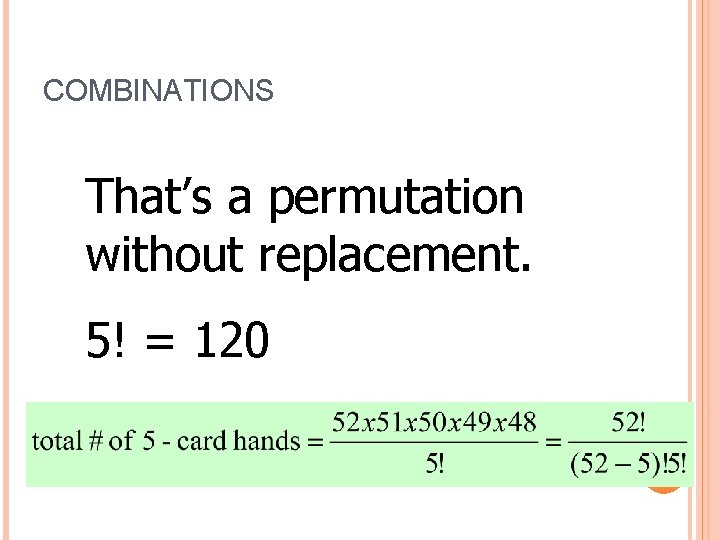
COMBINATIONS That’s a permutation without replacement. 5! = 120
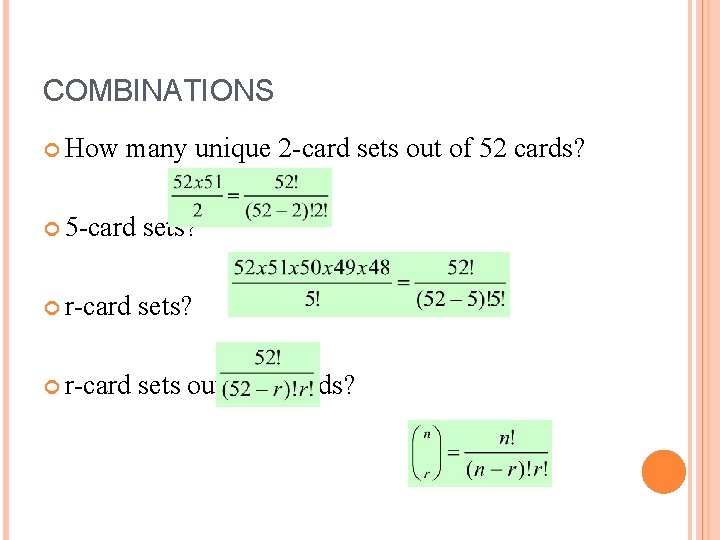
COMBINATIONS How many unique 2 -card sets out of 52 cards? 5 -card sets? r-card sets out of n-cards?
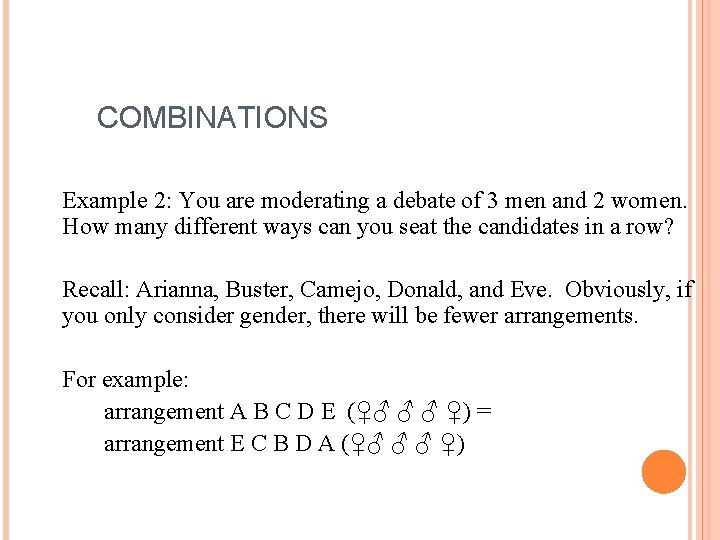
COMBINATIONS Example 2: You are moderating a debate of 3 men and 2 women. How many different ways can you seat the candidates in a row? Recall: Arianna, Buster, Camejo, Donald, and Eve. Obviously, if you only consider gender, there will be fewer arrangements. For example: arrangement A B C D E (♀♂ ♂ ♂ ♀) = arrangement E C B D A (♀♂ ♂ ♂ ♀)
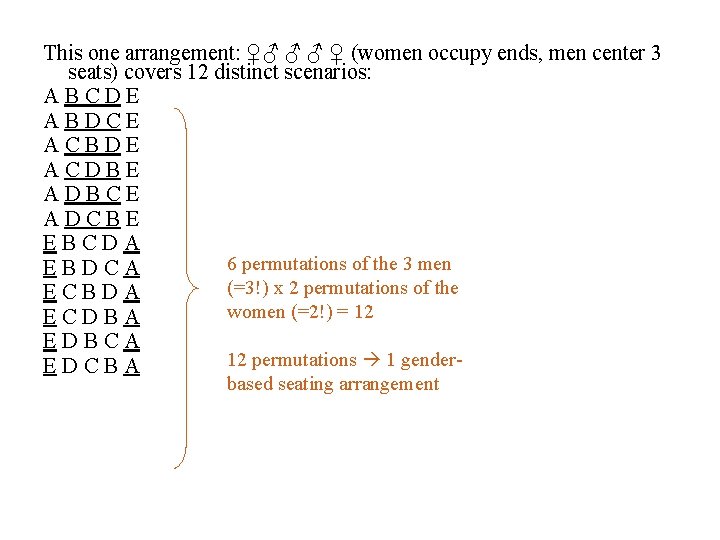
This one arrangement: ♀♂ ♂ ♂ ♀ (women occupy ends, men center 3 seats) covers 12 distinct scenarios: ABCDE ABDCE ACBDE ACDBE ADBCE ADCBE EBCDA 6 permutations of the 3 men EBDCA (=3!) x 2 permutations of the ECBDA women (=2!) = 12 ECDBA EDBCA 12 permutations 1 gender. EDCBA based seating arrangement
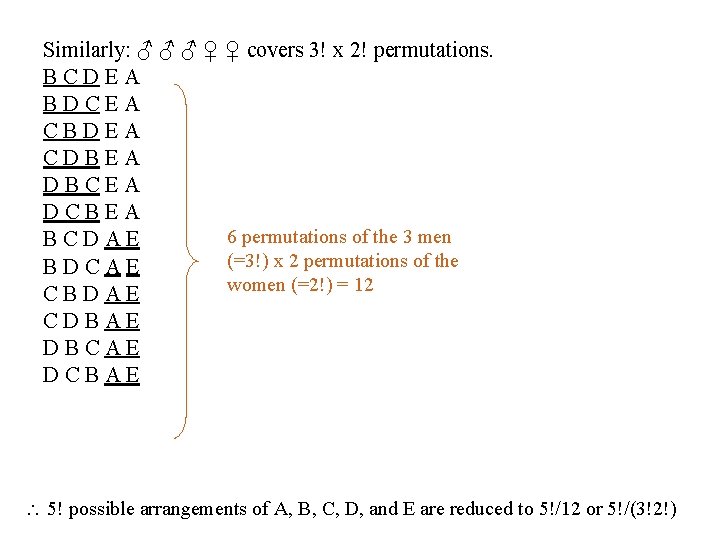
Similarly: ♂ ♂ ♂ ♀ ♀ covers 3! x 2! permutations. BCDEA BDCEA CBDEA CDBEA DBCEA DCBEA 6 permutations of the 3 men BCDAE (=3!) x 2 permutations of the BDCAE women (=2!) = 12 CBDAE CDBAE DBCAE DCBAE 5! possible arrangements of A, B, C, D, and E are reduced to 5!/12 or 5!/(3!2!)
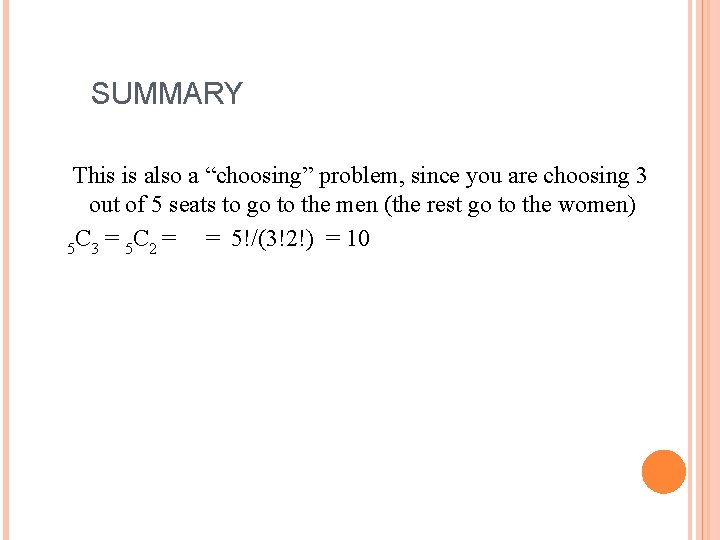
SUMMARY This is also a “choosing” problem, since you are choosing 3 out of 5 seats to go to the men (the rest go to the women) = 5!/(3!2!) = 10 5 C 3 = 5 C 2 =
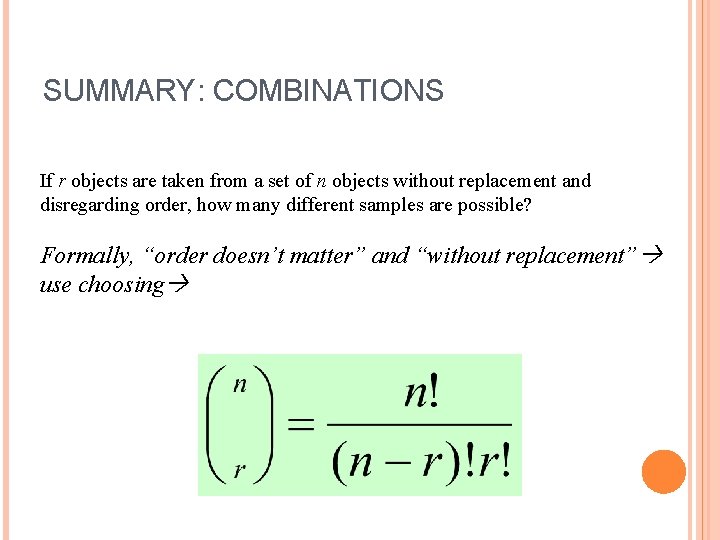
SUMMARY: COMBINATIONS If r objects are taken from a set of n objects without replacement and disregarding order, how many different samples are possible? Formally, “order doesn’t matter” and “without replacement” use choosing
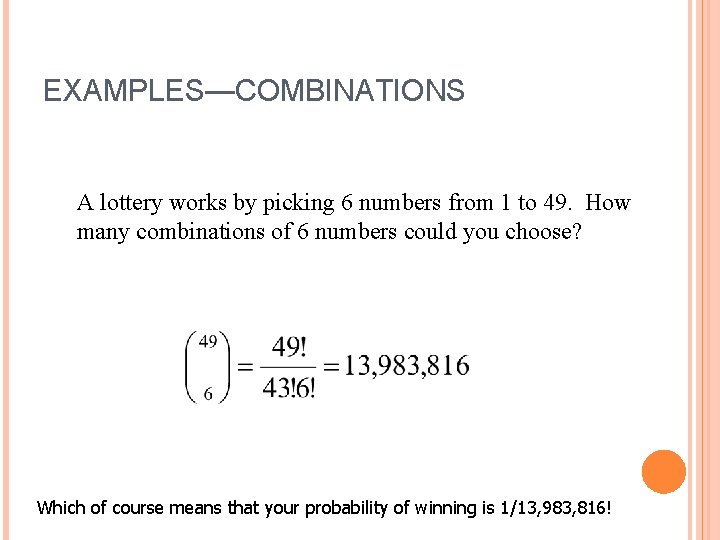
EXAMPLES—COMBINATIONS A lottery works by picking 6 numbers from 1 to 49. How many combinations of 6 numbers could you choose? Which of course means that your probability of winning is 1/13, 983, 816!
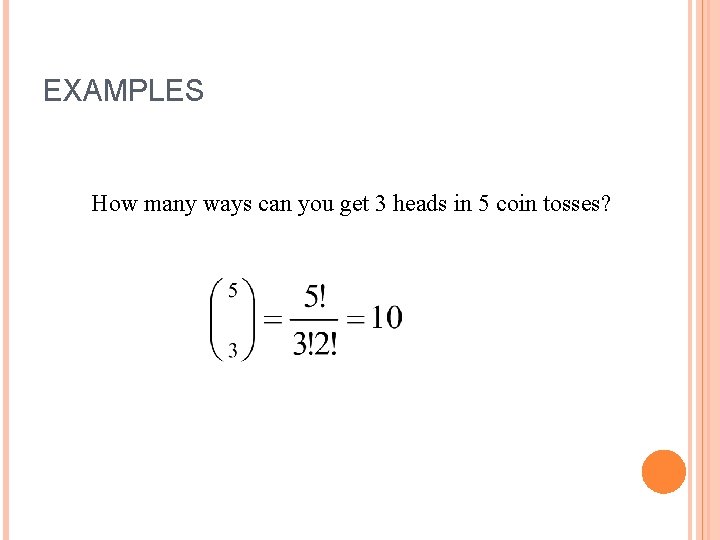
EXAMPLES How many ways can you get 3 heads in 5 coin tosses?
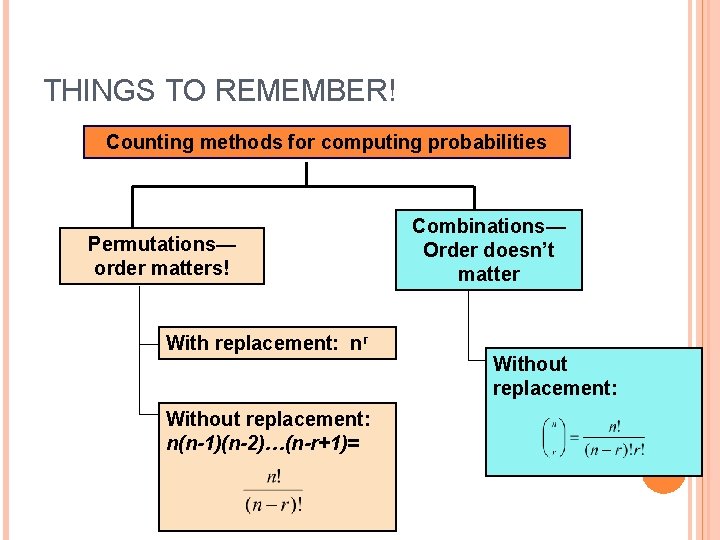
THINGS TO REMEMBER! Counting methods for computing probabilities Permutations— order matters! With replacement: nr Without replacement: n(n-1)(n-2)…(n-r+1)= Combinations— Order doesn’t matter Without replacement:
NEXT CLASS Continue to work with Permutations Continue to work with Combinations Focus on relating these principles to real world
- Slides: 45