
Combating Refund Fraud Recent Trends and Successful Prevention
Combating Refund Fraud: Recent Trends and Successful Prevention Techniques Revenue Solutions, Inc. 2017 MSATA Annual Conference Indianapolis, IN August 22, 2017 © 2017 Revenue Solutions, Inc.
Introduction David Casey • Executive Consulting Manager, RSI • 9+ years with Revenue Solutions, Inc. • 22+ years experience in tax & revenue
Agenda • • Refund Fraud Problem Types of Refund Fraud Industry Best Practices Proven Solution Approaches RSI Experience Recent Activities/Results Future Trends Q&A
Refund Fraud: The Problem… • As refund fraud schemes become more sophisticated, so must the methods of deterrence to stop fraudulent refund checks before they go out, while at the same time maintaining expected turnaround time and avoiding disruption or inconvenience for compliant taxpayers. ‘Tax-refund fraud to hit $21 billion, and there's little the IRS can do’ – CNBC February 11, 2015 4
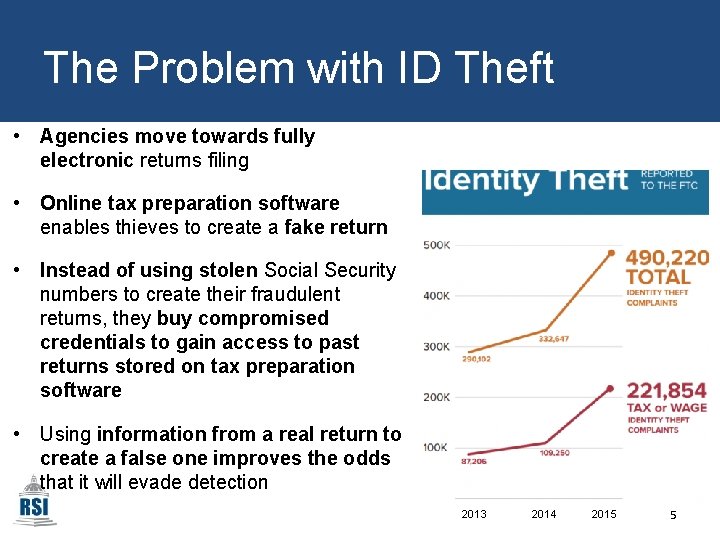
The Problem with ID Theft • Agencies move towards fully electronic returns filing • Online tax preparation software enables thieves to create a fake return • Instead of using stolen Social Security numbers to create their fraudulent returns, they buy compromised credentials to gain access to past returns stored on tax preparation software • Using information from a real return to create a false one improves the odds that it will evade detection 2013 2014 2015 5
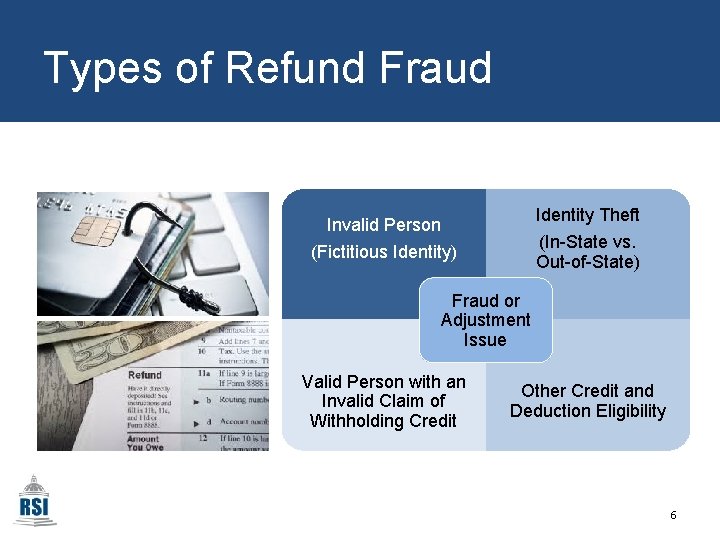
Types of Refund Fraud Identity Theft Invalid Person (In-State vs. Out-of-State) (Fictitious Identity) Fraud or Adjustment Issue Valid Person with an Invalid Claim of Withholding Credit Other Credit and Deduction Eligibility 6
IRS Tax Scams/Consumer Alerts • Soliciting Form W-2 information from payroll and human resources professionals • IRS-Impersonation Telephone Scams • Surge in Email, Phishing and Malware Schemes • Tax Refund Scam Artists Posing as Taxpayer Advocacy Panel • Scams Targeting Tax Professionals • See IRS Dirty Dozen Tax Scams – https: //www. irs. gov/uac/tax-scams-consumer-alerts – https: //www. justice. gov/tax/stolen-identity-refund-fraud 7
Best Practices… … based on Lessons Learned • Historically, Agencies tax processing systems have had limited access to external data sources during returns processing • Balance service to Individual Income Taxpayers, with need to prevent fraud • Agencies have a lot more information at their disposal to confirm identities, employers, wages, withholding credits, other claims, etc. pre-refund • Use data from: prior filing history, IRS, other agencies (DMV, Labor, etc. ), employers, etc. • Analyze and validate information in advance • Implement rules to definitively release returns and to identify clear issues; with full transparency • Automate case handling where possible, manage follow-up actions, and integrate with returns processing flow 8
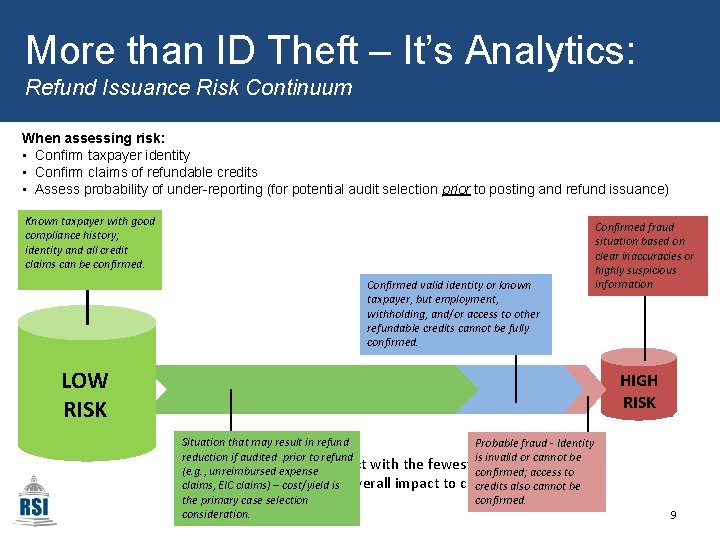
More than ID Theft – It’s Analytics: Refund Issuance Risk Continuum When assessing risk: • Confirm taxpayer identity • Confirm claims of refundable credits • Assess probability of under-reporting (for potential audit selection prior to posting and refund issuance) Known taxpayer with good compliance history; identity and all credit claims can be confirmed. Confirmed valid identity or known taxpayer, but employment, withholding, and/or access to other refundable credits cannot be fully confirmed. LOW RISK . Situation that may result in refund Probable fraud - Identity reduction if audited prior to refund invalid or cannot be Goals… review or interact with the fewest isconfirmed; returns, stop the (e. g. , unreimbursed expense access to most. EICfraud, reduce claims, claims)and – cost/yield is overall impact to compliant credits alsotaxpayers cannot be the primary case selection confirmed. consideration. Confirmed fraud situation based on clear inaccuracies or highly suspicious information HIGH RISK 9
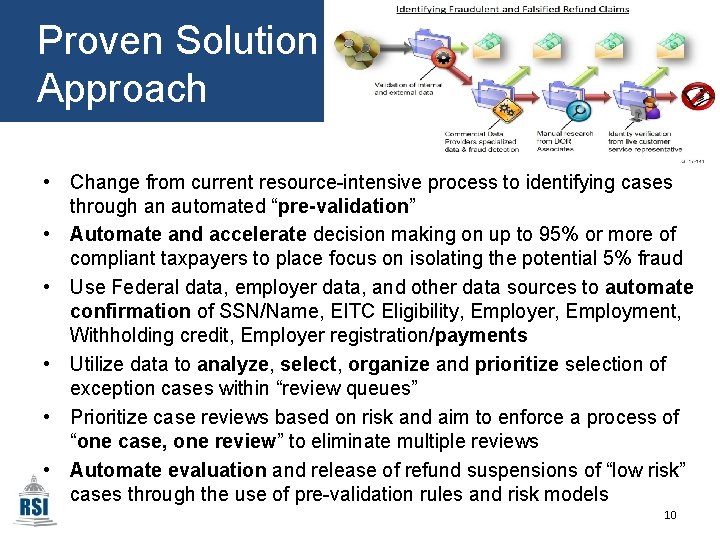
Proven Solution Approach • Change from current resource-intensive process to identifying cases through an automated “pre-validation” • Automate and accelerate decision making on up to 95% or more of compliant taxpayers to place focus on isolating the potential 5% fraud • Use Federal data, employer data, and other data sources to automate confirmation of SSN/Name, EITC Eligibility, Employer, Employment, Withholding credit, Employer registration/payments • Utilize data to analyze, select, organize and prioritize selection of exception cases within “review queues” • Prioritize case reviews based on risk and aim to enforce a process of “one case, one review” to eliminate multiple reviews • Automate evaluation and release of refund suspensions of “low risk” cases through the use of pre-validation rules and risk models 10
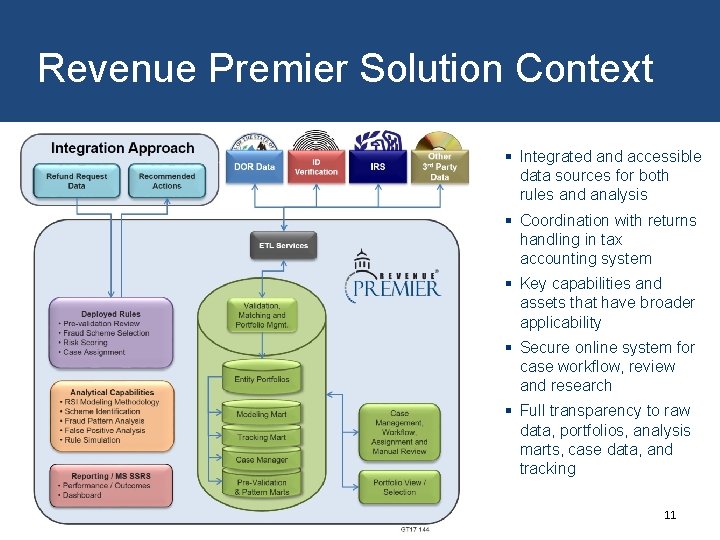
Revenue Premier Solution Context § Integrated and accessible data sources for both rules and analysis § Coordination with returns handling in tax accounting system § Key capabilities and assets that have broader applicability § Secure online system for case workflow, review and research § Full transparency to raw data, portfolios, analysis marts, case data, and tracking 11
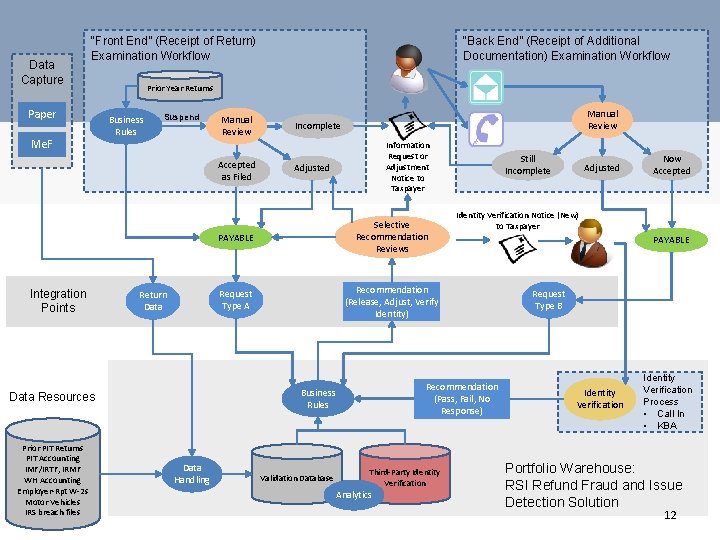
Data Capture “Front End” (Receipt of Return) Examination Workflow Paper Me. F Prior Year Returns Business Rules Suspend Manual Review Accepted as Filed Integration Points Return Data Manual Review Incomplete Information Request or Adjustment Notice to Taxpayer Adjusted PAYABLE Selective Recommendation Reviews Request Type A Recommendation (Release, Adjust, Verify Identity) Data Handling Validation Database Still Incomplete Third-Party Identity Verification Analytics Adjusted Now Accepted Identity Verification Notice (New) to Taxpayer Recommendation (Pass, Fail, No Response) Business Rules Data Resources Prior PIT Returns PIT Accounting IMF/IRTF, IRMF WH Accounting Employer-Rpt W-2 s Motor Vehicles IRS breach files “Back End” (Receipt of Additional Documentation) Examination Workflow PAYABLE Request Type B Identity Verification Process • Call In • KBA Portfolio Warehouse: RSI Refund Fraud and Issue Detection Solution 12
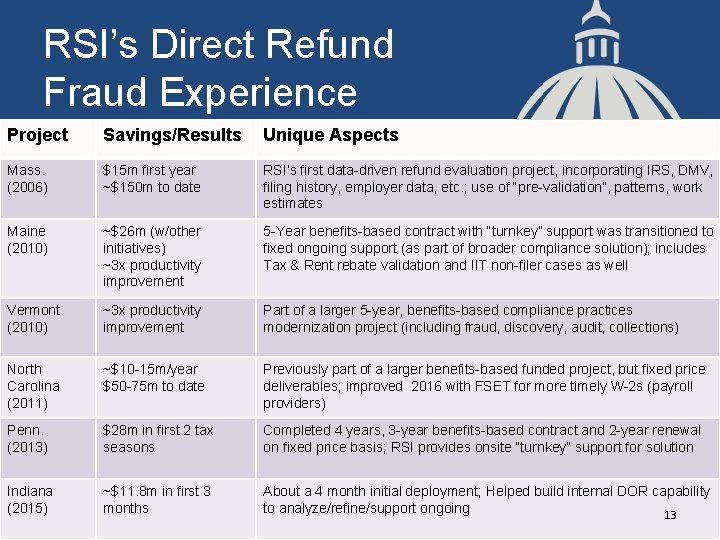
RSI’s Direct Refund Fraud Experience Project Savings/Results Unique Aspects Mass. (2006) $15 m first year ~$150 m to date RSI’s first data-driven refund evaluation project, incorporating IRS, DMV, filing history, employer data, etc. ; use of “pre-validation”, patterns, work estimates Maine (2010) ~$26 m (w/other initiatives) ~3 x productivity improvement 5 -Year benefits-based contract with “turnkey” support was transitioned to fixed ongoing support (as part of broader compliance solution); includes Tax & Rent rebate validation and IIT non-filer cases as well Vermont (2010) ~3 x productivity improvement Part of a larger 5 -year, benefits-based compliance practices modernization project (including fraud, discovery, audit, collections) North Carolina (2011) ~$10 -15 m/year $50 -75 m to date Previously part of a larger benefits-based funded project, but fixed price deliverables; improved 2016 with FSET for more timely W-2 s (payroll providers) Penn. (2013) $28 m in first 2 tax seasons Completed 4 years, 3 -year benefits-based contract and 2 -year renewal on fixed price basis; RSI provides onsite “turnkey” support for solution Indiana (2015) ~$11. 8 m in first 3 months About a 4 month initial deployment; Helped build internal DOR capability to analyze/refine/support ongoing 13
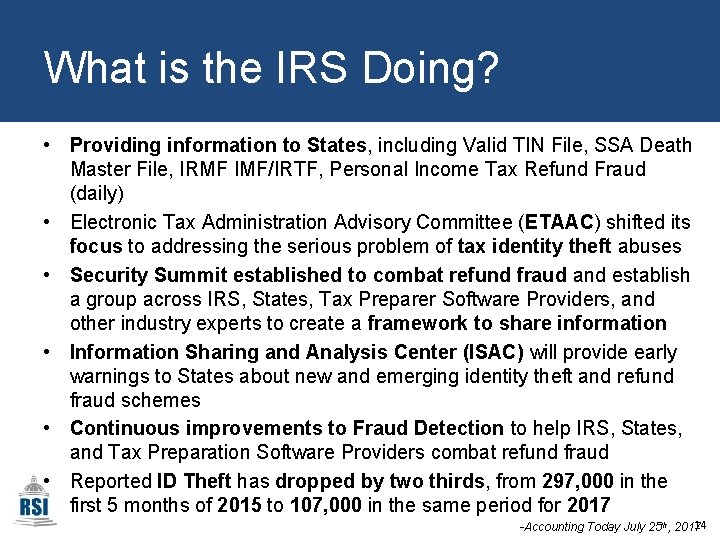
What is the IRS Doing? • Providing information to States, including Valid TIN File, SSA Death Master File, IRMF IMF/IRTF, Personal Income Tax Refund Fraud (daily) • Electronic Tax Administration Advisory Committee (ETAAC) shifted its focus to addressing the serious problem of tax identity theft abuses • Security Summit established to combat refund fraud and establish a group across IRS, States, Tax Preparer Software Providers, and other industry experts to create a framework to share information • Information Sharing and Analysis Center (ISAC) will provide early warnings to States about new and emerging identity theft and refund fraud schemes • Continuous improvements to Fraud Detection to help IRS, States, and Tax Preparation Software Providers combat refund fraud • Reported ID Theft has dropped by two thirds, from 297, 000 in the first 5 months of 2015 to 107, 000 in the same period for 2017 14 -Accounting Today July 25 th, 2017
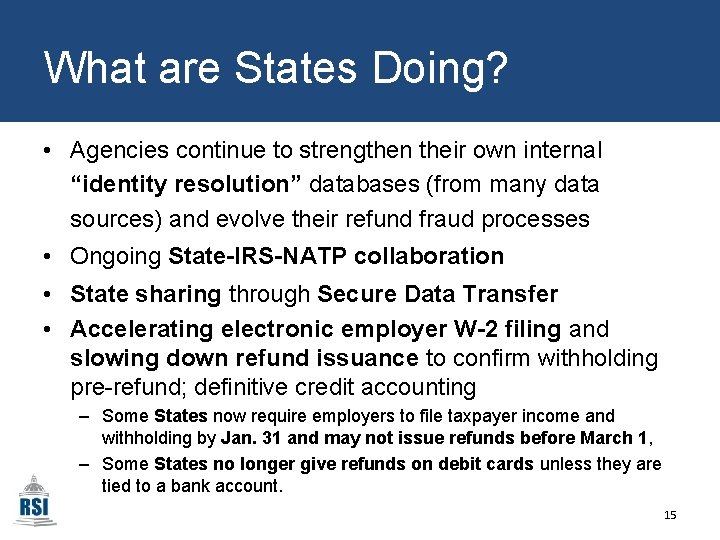
What are States Doing? • Agencies continue to strengthen their own internal “identity resolution” databases (from many data sources) and evolve their refund fraud processes • Ongoing State-IRS-NATP collaboration • State sharing through Secure Data Transfer • Accelerating electronic employer W-2 filing and slowing down refund issuance to confirm withholding pre-refund; definitive credit accounting – Some States now require employers to file taxpayer income and withholding by Jan. 31 and may not issue refunds before March 1, – Some States no longer give refunds on debit cards unless they are tied to a bank account. 15
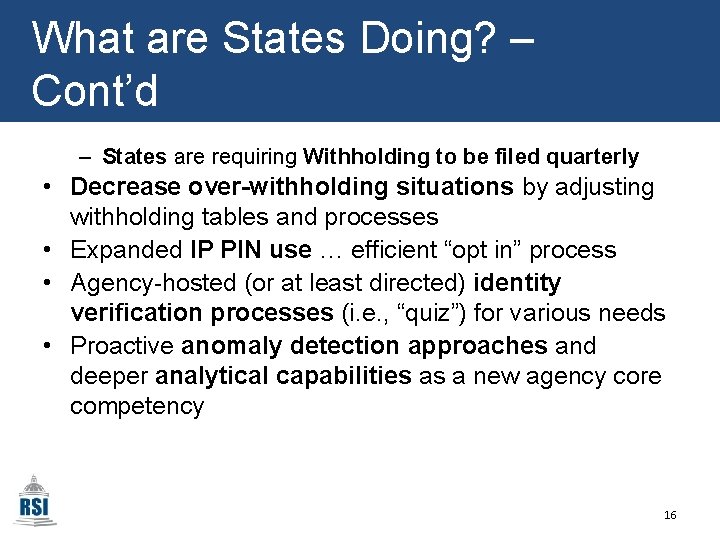
What are States Doing? – Cont’d – States are requiring Withholding to be filed quarterly • Decrease over-withholding situations by adjusting withholding tables and processes • Expanded IP PIN use … efficient “opt in” process • Agency-hosted (or at least directed) identity verification processes (i. e. , “quiz”) for various needs • Proactive anomaly detection approaches and deeper analytical capabilities as a new agency core competency 16
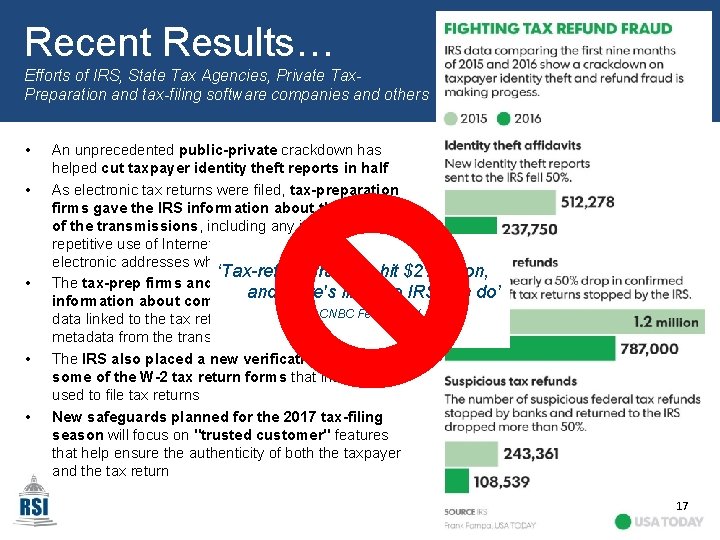
Recent Results… Efforts of IRS, State Tax Agencies, Private Tax. Preparation and tax-filing software companies and others • • • An unprecedented public-private crackdown has helped cut taxpayer identity theft reports in half As electronic tax returns were filed, tax-preparation firms gave the IRS information about their review of the transmissions, including any improper or repetitive use of Internet Protocol numbers, the electronic addresses where the returns originated ‘Tax-refund fraud to hit $21 billion, The tax-prep firms and the IRS also shared and there's little the IRS can do’ information about computer device identification CNBC February 11, 2015 data linked to the tax returns' origin, as–well as metadata from the transmissions The IRS also placed a new verification code on some of the W-2 tax return forms that individuals used to file tax returns New safeguards planned for the 2017 tax-filing season will focus on "trusted customer" features that help ensure the authenticity of both the taxpayer and the tax return 17
What does the future hold? • • Increased public/private collaboration using multi-layered approach Increased electronic data sharing and therefore improved opportunities to confirm the identities of valid taxpayers – State-to-state exchanges (e. g. , to confirm non-resident refund requests) – Other agencies (e. g. , motor vehicle licenses) – Payer reporting (e. g. , W-2 s, 1099 s, etc. ) – Federal data (e. g. , issuance of valid ITINs, valid SSN/Name combinations from SSA, near real-time data exchanges, etc. ) Increased automation of desk examination prior to posting and refund processing, given: – Improved technology: data availability, processing capacity, decision management services, integration options (e. g. , web services), face recognition software, etc. – Increased validation across: employer withholding tax payments, employerissued W-2 s, and taxpayer-claimed withholding credits Increased fraud schemes: more sophistication, exploiting web-based filing channels, from other states and foreign countries, and focusing now on business taxes 20

Questions? David Casey Executive Consulting Manager Revenue Solutions, Inc. (888) 826 -1541 ext. 262 DCasey@rsimail. com
- Slides: 19