
COM 1008 AN OVERVIEW OF CLOUD COMPUTING Hans
- Slides: 13
COM 1008 AN OVERVIEW OF CLOUD COMPUTING Hans Yip
Learning Objectives ◦ Introduction ◦ What is Cloud Computing? ◦ Cloud Everywhere ◦ Pay-as-you-go model ◦ Business values of cloud computing ◦ Economies of scale ◦ Capital expenditure (Cap. Ex) versus operational expenditure (Op. Ex)
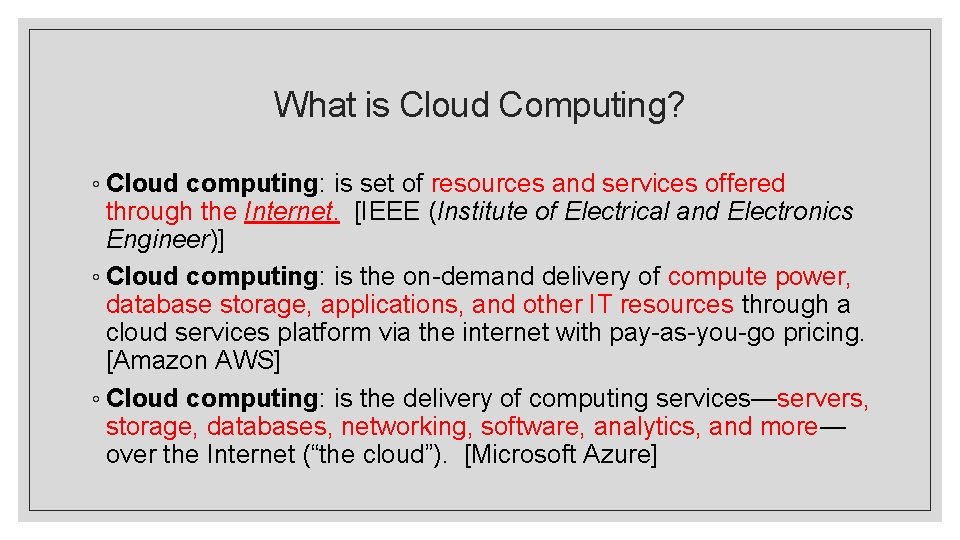
What is Cloud Computing? ◦ Cloud computing: is set of resources and services offered through the Internet. [IEEE (Institute of Electrical and Electronics Engineer)] ◦ Cloud computing: is the on-demand delivery of compute power, database storage, applications, and other IT resources through a cloud services platform via the internet with pay-as-you-go pricing. [Amazon AWS] ◦ Cloud computing: is the delivery of computing services—servers, storage, databases, networking, software, analytics, and more— over the Internet (“the cloud”). [Microsoft Azure]
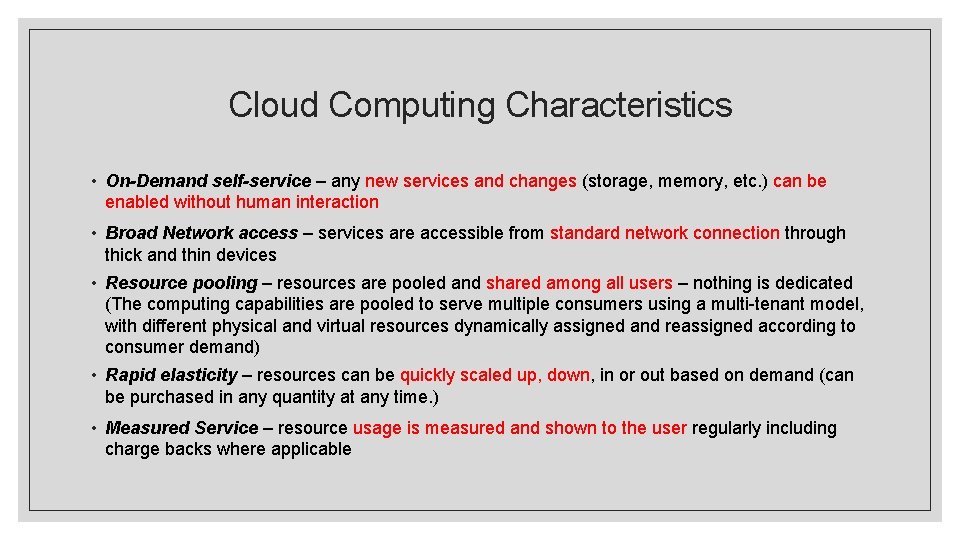
Cloud Computing Characteristics • On-Demand self-service – any new services and changes (storage, memory, etc. ) can be enabled without human interaction • Broad Network access – services are accessible from standard network connection through thick and thin devices • Resource pooling – resources are pooled and shared among all users – nothing is dedicated (The computing capabilities are pooled to serve multiple consumers using a multi-tenant model, with different physical and virtual resources dynamically assigned and reassigned according to consumer demand) • Rapid elasticity – resources can be quickly scaled up, down, in or out based on demand (can be purchased in any quantity at any time. ) • Measured Service – resource usage is measured and shown to the user regularly including charge backs where applicable
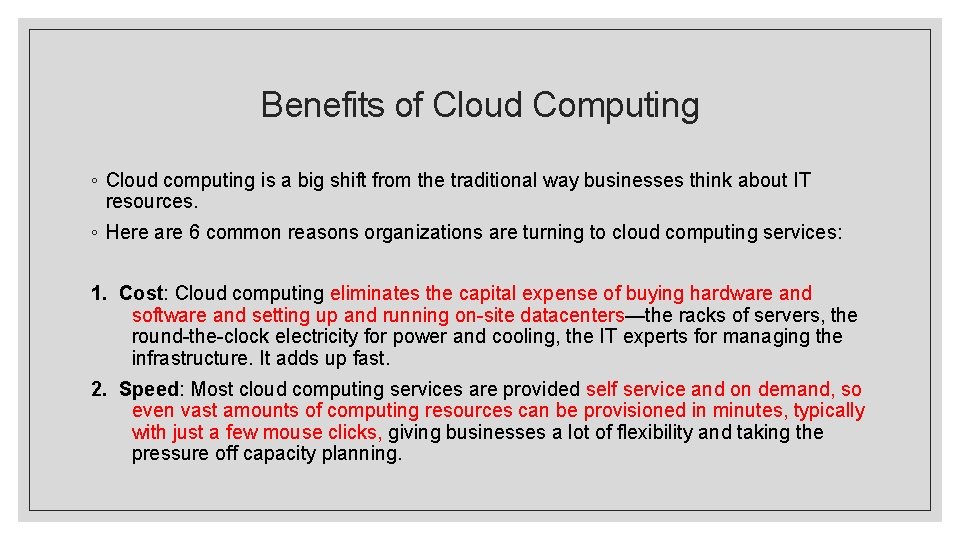
Benefits of Cloud Computing ◦ Cloud computing is a big shift from the traditional way businesses think about IT resources. ◦ Here are 6 common reasons organizations are turning to cloud computing services: 1. Cost: Cloud computing eliminates the capital expense of buying hardware and software and setting up and running on-site datacenters—the racks of servers, the round-the-clock electricity for power and cooling, the IT experts for managing the infrastructure. It adds up fast. 2. Speed: Most cloud computing services are provided self service and on demand, so even vast amounts of computing resources can be provisioned in minutes, typically with just a few mouse clicks, giving businesses a lot of flexibility and taking the pressure off capacity planning.
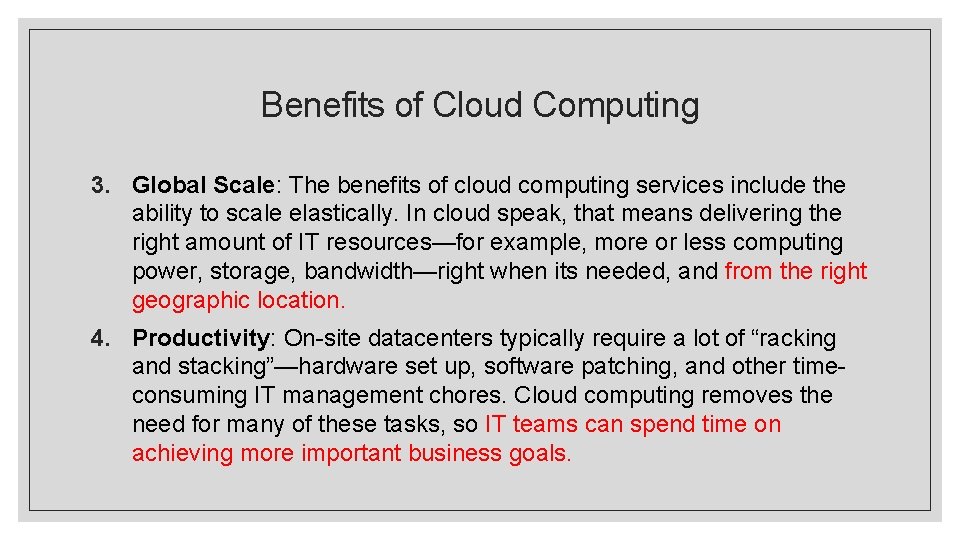
Benefits of Cloud Computing 3. Global Scale: The benefits of cloud computing services include the ability to scale elastically. In cloud speak, that means delivering the right amount of IT resources—for example, more or less computing power, storage, bandwidth—right when its needed, and from the right geographic location. 4. Productivity: On-site datacenters typically require a lot of “racking and stacking”—hardware set up, software patching, and other timeconsuming IT management chores. Cloud computing removes the need for many of these tasks, so IT teams can spend time on achieving more important business goals.
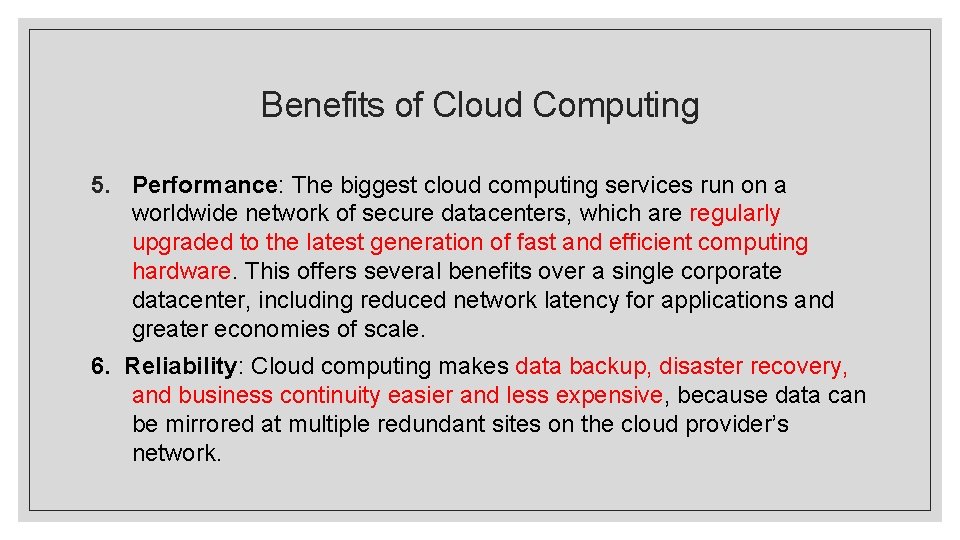
Benefits of Cloud Computing 5. Performance: The biggest cloud computing services run on a worldwide network of secure datacenters, which are regularly upgraded to the latest generation of fast and efficient computing hardware. This offers several benefits over a single corporate datacenter, including reduced network latency for applications and greater economies of scale. 6. Reliability: Cloud computing makes data backup, disaster recovery, and business continuity easier and less expensive, because data can be mirrored at multiple redundant sites on the cloud provider’s network.
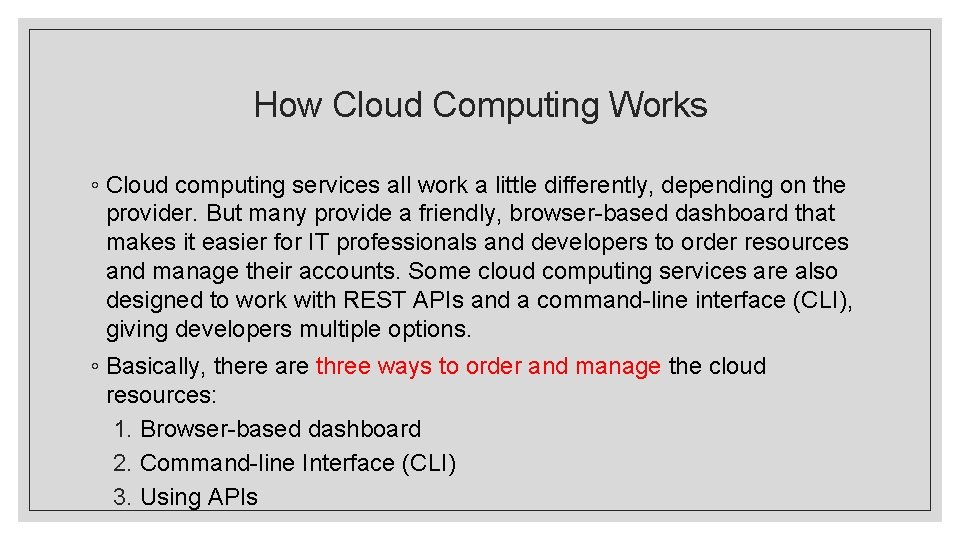
How Cloud Computing Works ◦ Cloud computing services all work a little differently, depending on the provider. But many provide a friendly, browser-based dashboard that makes it easier for IT professionals and developers to order resources and manage their accounts. Some cloud computing services are also designed to work with REST APIs and a command-line interface (CLI), giving developers multiple options. ◦ Basically, there are three ways to order and manage the cloud resources: 1. Browser-based dashboard 2. Command-line Interface (CLI) 3. Using APIs
Pay-as-you-go Model (Consumption-based model) ◦ Cloud service providers operate on a consumption-based model, which means that end users only pay for the resources that they use. Whatever they use is what they pay for. ◦ This consumption-based model brings with it many benefits, including: ◦ No upfront costs ◦ No need to purchase and manage costly infrastructure that they may or may not use to its fullest ◦ The ability to pay for additional resources if and when they are needed ◦ The ability to stop paying for resources that are no longer needed
Economies of Scale ◦ The concept of economies of scale is the ability to do things more cheaply and more efficiently when operating at a larger scale in comparison to operating at a smaller scale. ◦ Cloud providers such as Microsoft, Google, and AWS are very large businesses, and are able to leverage the benefits of economies of scale, and then pass those benefits on to their customers. ◦ This is apparent to end users in a number of ways, one of which is the ability to acquire hardware at a lower cost than if a single user or smaller business were purchasing it. ◦ Storage costs, for example, have decreased significantly over the last decade due in part to cloud providers' ability to purchase larger amounts of storage at significant discounts. They are then able to use that storage more efficiently, and pass on those benefits to end users in the form of lower prices. ◦ There are limits to the benefits large organizations can realize through economies of scale. A product will inevitably have an underlying core cost, as it becomes more of a commodity, based on what it costs to produce. Competition is also another factor which has an effect on costs of cloud services. ◦ E. g. Computer manufacturer sells a computer to individual for $1, 000 and it will last for 1 year. So, the cost for individual is $1, 000 for one year. Cloud provider purchased 3 computers from the manufacturer at $900 each. 3 individuals sign up to use one computer for one year at $400 each, therefore, the total revenue for cloud provider is $1, 200 and making profit of $300. In addition, individual saved $600 per year.
Capital Expenditure (Cap. Ex) versus Operational Expenditure (Op. Ex) ◦ In previous years, startup companies needed to acquire a physical premises and infrastructure to start their business and begin trading. Large amounts of money were need to get a new business up and running, or to grow an existing company. They would have to buy new datacenters or new servers to allow them build out new services, which they could then deliver to their customers. That is no longer the case. ◦ Today, organizations can sign up for a service from a cloud provider to get up and running. This enables them to begin selling or providing services to their customers more quickly, without the need for significant upfront costs. ◦ These two approaches to investment are referred to as: ◦ Capital Expenditure (Cap. Ex): This is the spending of money on physical infrastructure up front, and then deducting that expense from your tax bill over time. Cap. Ex is an upfront cost which has a value that reduces over time. ◦ Operational Expenditure (Op. Ex): This is spending money on services or products now and being billed for them now. You can deduct this expense from your tax bill in the same year. There is no upfront cost, you pay for a service or product as you use it.
Capital Expenditure (Cap. Ex) versus Operational Expenditure (Op. Ex) ◦ Companies wanting to start a new business or grow their business do not have to incur upfront costs to try out a new product or service for customers. Instead, they can get into a market immediately and pay as much or as little for the infrastructure as the business requires. They also can terminate that cost if and when they need to. ◦ If your service is busy and you consume a lot of resources in a month, then you receive a large bill. If those services are minimal and don't use a lot of resources, then you will receive a smaller bill. ◦ A business can still use the Cap. Ex expenditure strategy if they wish, but it is no longer a requirement that they do so.
Questions ◦ What is a definition of Cloud Computing? ◦ What are the characteristics of Cloud Computing? ◦ What are the benefits of Cloud Computing? ◦ What is a definition of Pay-as-you-go? ◦ What is Capital Expenditure vs Operational Expenditure?