
Column Data Column The most common way to


- Slides: 9
Column Data Column
The most common way to organize data on disk is as a column data file. Column data can be stored as either: • binary • ASCII
The most common way to organize data on disk is as a column data file. Column data frequently consists of: Header lines Title line Actual data values
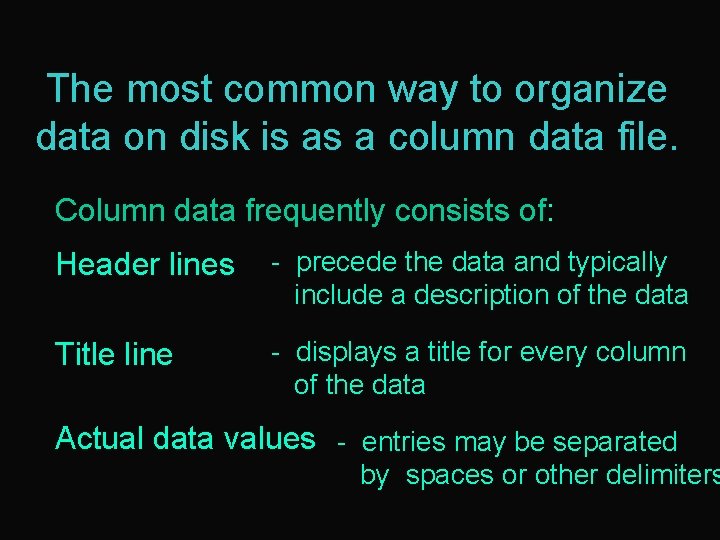
The most common way to organize data on disk is as a column data file. Column data frequently consists of: Header lines - precede the data and typically include a description of the data Title line - displays a title for every column of the data Actual data values - entries may be separated by spaces or other delimiters
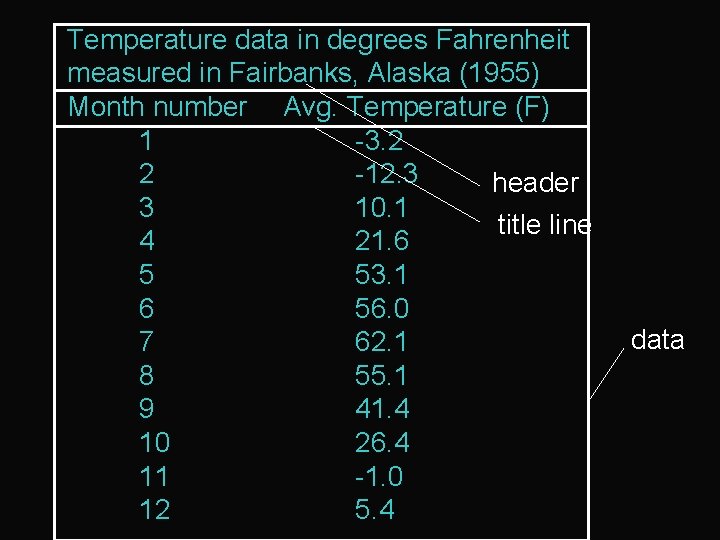
Temperature data in degrees Fahrenheit measured in Fairbanks, Alaska (1955) Month number Avg. Temperature (F) 1 -3. 2 2 -12. 3 header 3 10. 1 title line 4 21. 6 5 53. 1 6 56. 0 7 62. 1 8 55. 1 9 41. 4 10 26. 4 11 -1. 0 12 5. 4 data
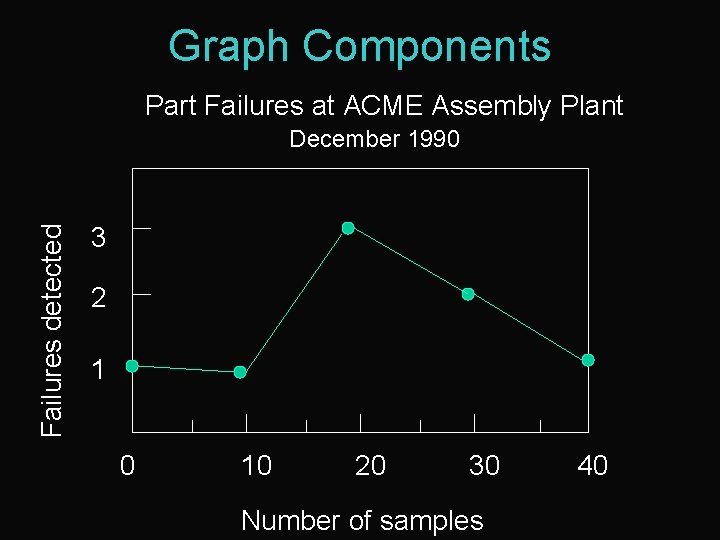
Graph Components Part Failures at ACME Assembly Plant Failures detected December 1990 3 2 1 0 10 20 30 Number of samples 40
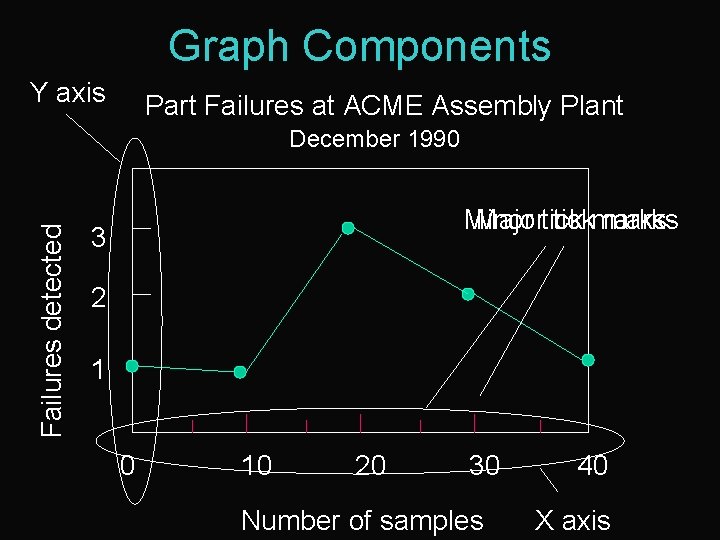
Graph Components Y axis Part Failures at ACME Assembly Plant Failures detected December 1990 Minor Majortickmarks 3 2 1 0 10 20 30 Number of samples 40 X axis
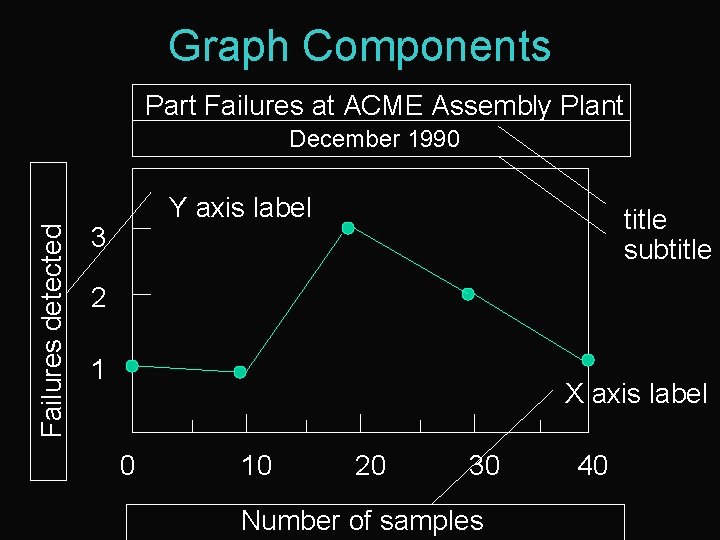
Graph Components Part Failures at ACME Assembly Plant Failures detected December 1990 Y axis label 3 title subtitle 2 1 X axis label 0 10 20 30 Number of samples 40
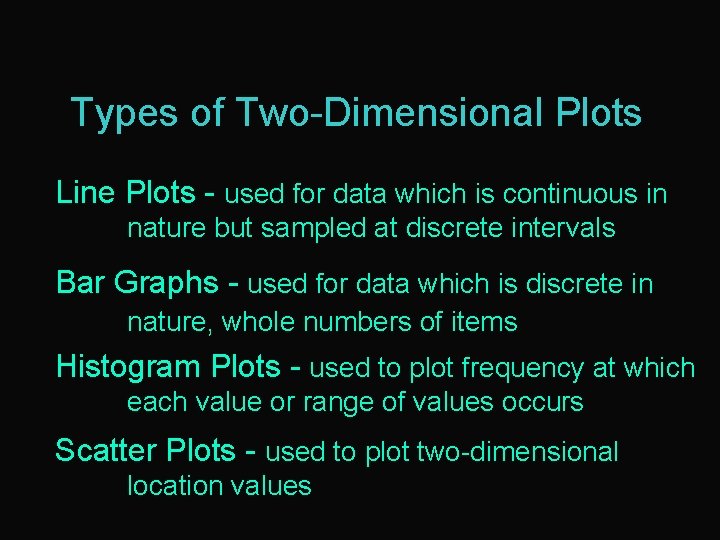
Types of Two-Dimensional Plots Line Plots - used for data which is continuous in nature but sampled at discrete intervals Bar Graphs - used for data which is discrete in nature, whole numbers of items Histogram Plots - used to plot frequency at which each value or range of values occurs Scatter Plots - used to plot two-dimensional location values