
Columbia Suicide Severity Risk Scale CSSRS Pathway The
Columbia Suicide Severity Risk Scale C-SSRS Pathway The Department of Behavioral Health
Goal • To instruct and empower the nurse on administering Columbia Suicide Severity Risk Scale (C-SSRS), identify patients at risk for suicide, understanding when to initiate and utilize the Suicide Prevention pathway appropriately.
Objectives • By completion of education, the nurse will be able to: – Identify signs and symptoms of Suicidal Ideation – Administer Columbia Suicide Severity Risk Scale utilizing the appropriate terminology and verbiage. – Demonstrate process of initiating the C-SSRS Pathway – Articulate the importance of patient/family care regarding follow up treatment and safety plan.
Importance of the C-SSRS • Provides consistent language to enable tracking and measurement of suicide prevention efforts and patient population risk over time. • Allows for multiple sources of information (subject, family members, caregivers, records, etc. ) • Meets Accreditation and regulatory requirements • It is well-validated and reduces false positives, enabling us to focus on the right patients. (Foote, M. , Intermountain Healthcare, 2014)
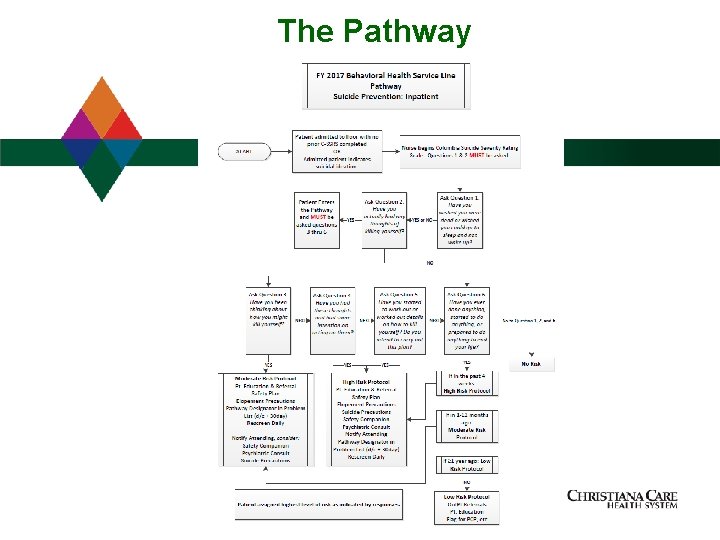
The Pathway
The Pathway • Patient is admitted to the floor with no prior C-SSRS completed OR admitted patient indicates suicidal ideation. • The Nurse would begin the Columbia Suicide Severity Rating Scale via Powerchart Admission Referral Process or Ad Hoc a CSSRS if the ARP was previously completed. • The Ad Hoc Screener looks and functions like the ARP version.
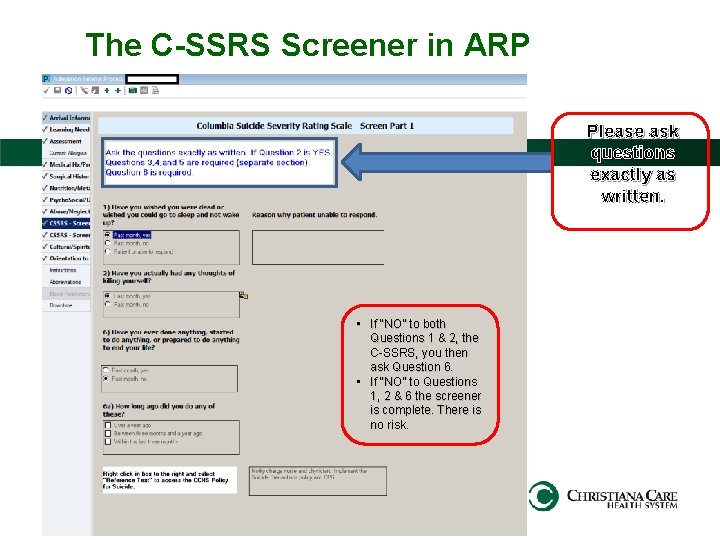
The C-SSRS Screener in ARP Please ask questions exactly as written. • If “NO” to both Questions 1 & 2, the C-SSRS, you then ask Question 6. • If “NO” to Questions 1, 2 & 6 the screener is complete. There is no risk.
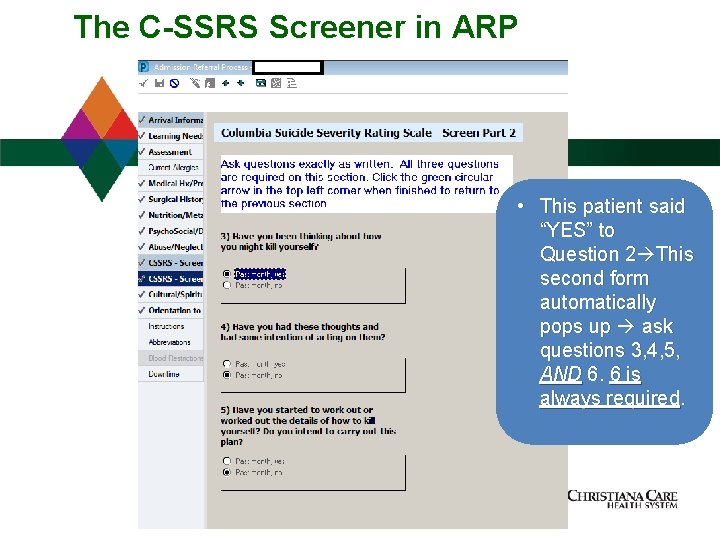
The C-SSRS Screener in ARP • This patient said “YES” to Question 2 This second form automatically pops up ask questions 3, 4, 5, AND 6. 6 is always required.
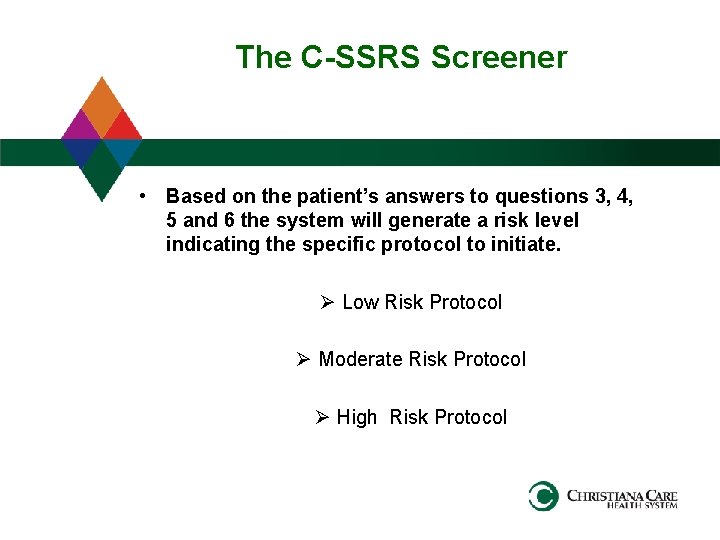
The C-SSRS Screener • Based on the patient’s answers to questions 3, 4, 5 and 6 the system will generate a risk level indicating the specific protocol to initiate. Ø Low Risk Protocol Ø Moderate Risk Protocol Ø High Risk Protocol
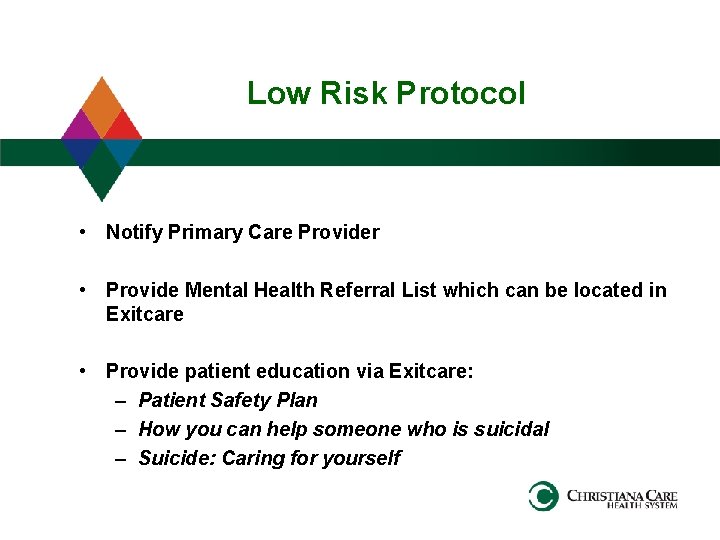
Low Risk Protocol • Notify Primary Care Provider • Provide Mental Health Referral List which can be located in Exitcare • Provide patient education via Exitcare: – Patient Safety Plan – How you can help someone who is suicidal – Suicide: Caring for yourself
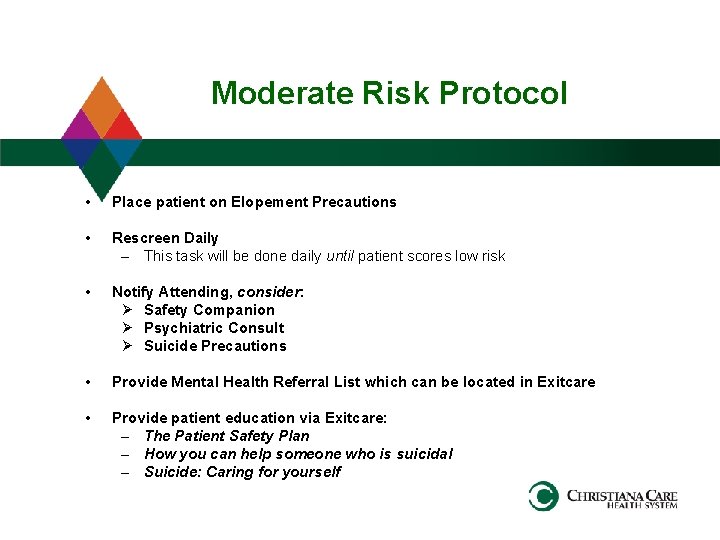
Moderate Risk Protocol • Place patient on Elopement Precautions • Rescreen Daily – This task will be done daily until patient scores low risk • Notify Attending, consider: Ø Safety Companion Ø Psychiatric Consult Ø Suicide Precautions • Provide Mental Health Referral List which can be located in Exitcare • Provide patient education via Exitcare: – The Patient Safety Plan – How you can help someone who is suicidal – Suicide: Caring for yourself
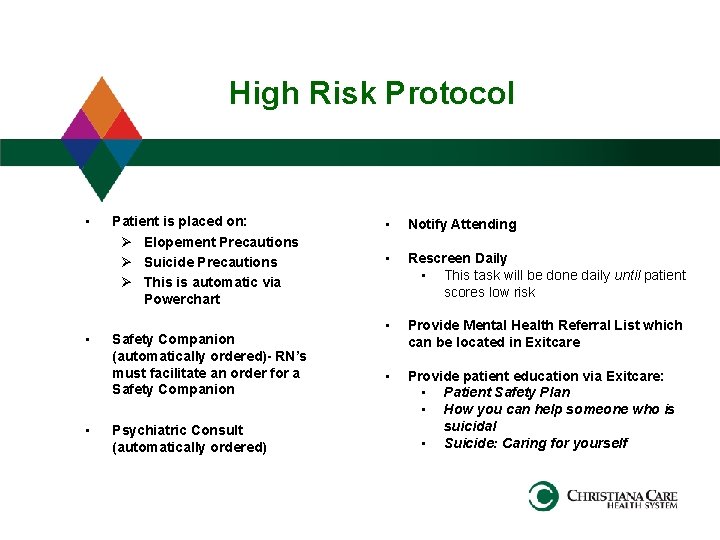
High Risk Protocol • • • Patient is placed on: Ø Elopement Precautions Ø Suicide Precautions Ø This is automatic via Powerchart Safety Companion (automatically ordered)- RN’s must facilitate an order for a Safety Companion Psychiatric Consult (automatically ordered) • Notify Attending • Rescreen Daily • This task will be done daily until patient scores low risk • Provide Mental Health Referral List which can be located in Exitcare • Provide patient education via Exitcare: • Patient Safety Plan • How you can help someone who is suicidal • Suicide: Caring for yourself

Go-Live is March 1, 2017
For Questions Contact: Dr. Linda Lang, MD Chair, Dept. of Behavioral Health (302) 320 -6263 LLang@Christiana. Care. org Brady Shuert, BHS Behavioral Health Specialist/ Co-Project Manager Bshuert@Christianacare. org Lori Jones, LCSW Program Coordinator of Psychiatric Services/ Co-Project Manager (302) 320 -4755 Lo. Jones@Christianacare. org Aliesha Rivera, MSN, RN-C Staff Development Specialist Department of Behavioral Health Arivera@Christiana. Care. org (302) 320 -4601
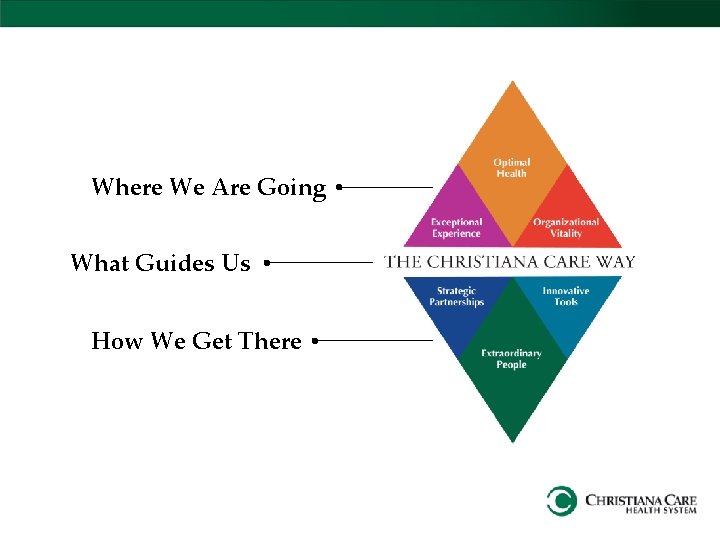
Where We Are Going What Guides Us How We Get There
- Slides: 16