
Colt International Ltd Smoke and environmental ventilation of


- Slides: 54
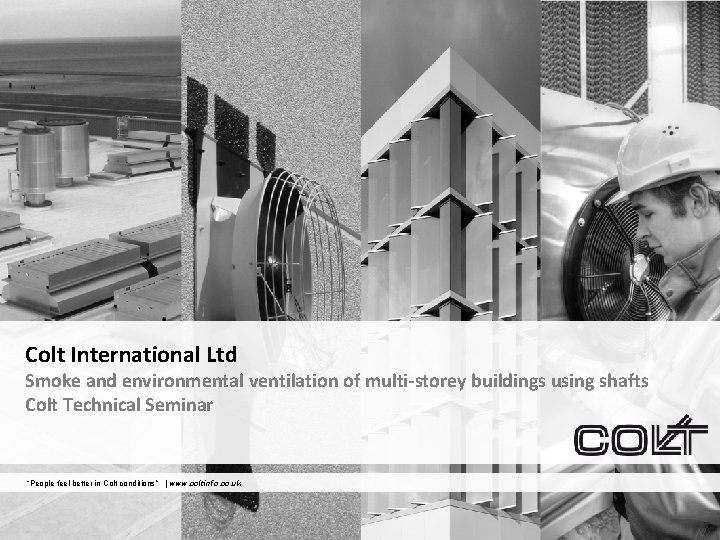
Colt International Ltd Smoke and environmental ventilation of multi-storey buildings using shafts Colt Technical Seminar “People feel better in Colt conditions ” | www. coltinfo. co. uk “Peoplefeelbetterinin. Coltconditions” ” | |www. coltgroup. com www. coltinfo. co. uk
A brief history of Colt • A private company founded in 1931 • I J O’Hea OBE (1897 - 1984) • 2014 Group turnover £ 146 million • Manufactures in the UK, Holland, Germany and China I J O’Hea Colt Founder “Peoplefeelbetterinin. Coltconditions” ” | |www. coltgroup. com www. coltinfo. co. uk
Current UK Business Markets • Smoke Control • Solar Shading • Natural Ventilation • Louvre • Environmental Comfort Control “Peoplefeelbetterinin. Coltconditions” ” | |www. coltgroup. com www. coltinfo. co. uk
Ventilation using shafts – covering: 1. Ventilation of Fire Fighting Stairs: • Natural Ventilation to BS 5588 Part 5 and BS 9999 • Natural Shafts to BS 5588 Part 5 and BS 9999 • BRE Shafts to BS 5588 Part 5 and BS 9999 • Mechanical Shafts 2. Ventilation of Common Corridors in Residential Developments: • Natural Ventilation to ADB 2006 and BS 9991 • Natural Shafts to ADB 2006 and BS 9991 • Mechanical Ventilation to ADB 2006 3. Extended Travel Distances in Common Corridors Using Mechanical Shafts 4. Day to day ventilation and cooling 5. Pressurisation “Peoplefeelbetterinin. Coltconditions” ” | |www. coltgroup. com www. coltinfo. co. uk
Ventilation using shafts - general Description: • A common shaft passing through multiple levels allowing natural or mechanical ventilation to the fire floor via the use of dampers or automatic opening devices on each level. Used for: • • Ventilating fire fighting lobbies to assist fire fighting operations from a fire fighting shaft and/or Ventilating common corridors in high rise residential developments. “Peoplefeelbetterinin. Coltconditions” ” | |www. coltgroup. com www. coltinfo. co. uk
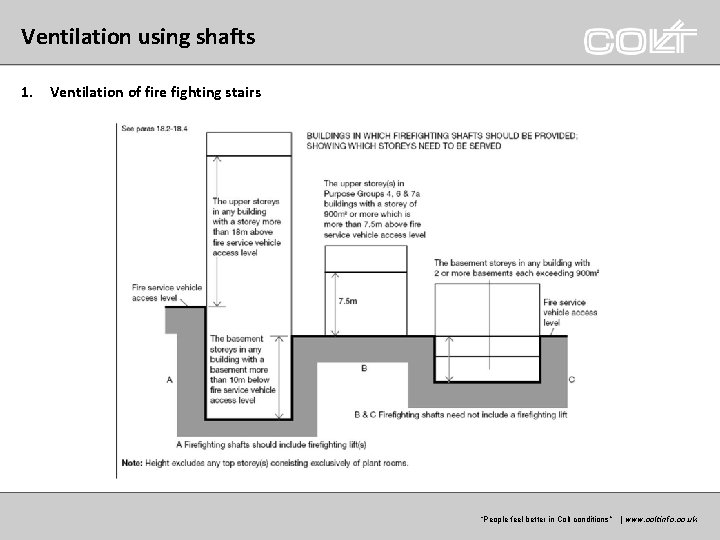
Ventilation using shafts 1. Ventilation of fire fighting stairs “Peoplefeelbetterinin. Coltconditions” ” | |www. coltgroup. com www. coltinfo. co. uk
Ventilation using shafts 1. Ventilation of fire fighting stairs Fire Fighting: In fire fighting shafts the fire and rescue services need clear access to every level. Usual fire fighting protocol is to take the lift to a floor below the fire floor, connect to the dry riser and then ascend to the fire floor by stair. The primary objectives of the ventilation system are, therefore: • • to prevent smoke spread into the staircase to improve conditions in the fire fighting lobby “Peoplefeelbetterinin. Coltconditions” ” | |www. coltgroup. com www. coltinfo. co. uk
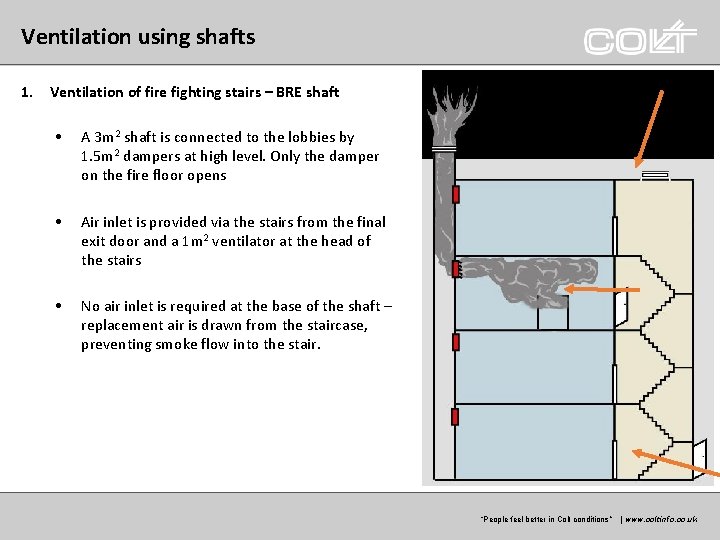
Ventilation using shafts 1. Ventilation of fire fighting stairs BS 5588 Part 5 and BS 9999 provide prescriptive ventilation recommendations Stairwell ventilation Lobby ventilation • • A 1 m 2 vent (OV) in the fire fighting lobby; or • A 3 m 2 shaft with 1. 5 m 2 dampers on each level with openings at the top and bottom of the shaft; or • The BRE Method, which is as above, but omits the opening at the bottom of the shaft. • A 1. 5 m 2 openable vent at the head of the stairwell; or A 1 m 2 openable window at each storey (OV) “Peoplefeelbetterinin. Coltconditions” ” | |www. coltgroup. com www. coltinfo. co. uk
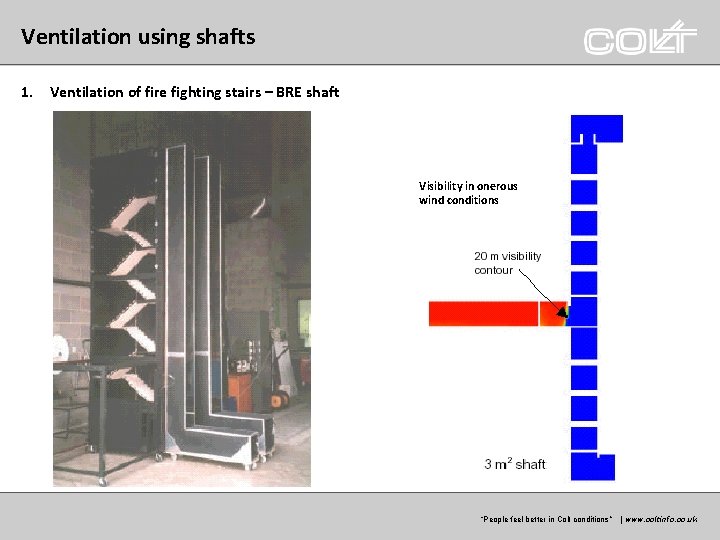
Ventilation using shafts 1. Ventilation of fire fighting stairs – BRE shaft • A 3 m 2 shaft is connected to the lobbies by 1. 5 m 2 dampers at high level. Only the damper on the fire floor opens • Air inlet is provided via the stairs from the final exit door and a 1 m 2 ventilator at the head of the stairs • No air inlet is required at the base of the shaft – replacement air is drawn from the staircase, preventing smoke flow into the stair. “Peoplefeelbetterinin. Coltconditions” ” | |www. coltgroup. com www. coltinfo. co. uk
Ventilation using shafts 1. Ventilation of fire fighting stairs – BRE shaft Visibility in onerous wind conditions “Peoplefeelbetterinin. Coltconditions” ” | |www. coltgroup. com www. coltinfo. co. uk
Ventilation using shafts 1. Ventilation of fire fighting stairs – Colt shaft • The next obvious step • Offers a further reduction in the occupied space taken up by the system • If effective could be used for both fire fighting and means of escape “Peoplefeelbetterinin. Coltconditions” ” | |www. coltgroup. com www. coltinfo. co. uk
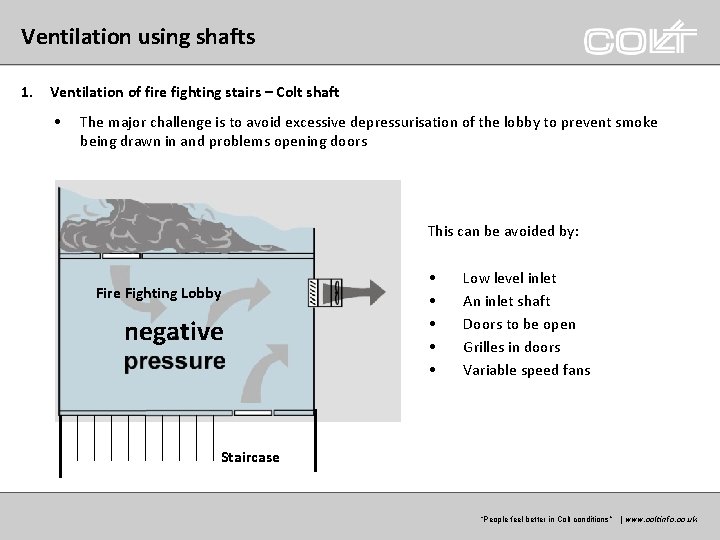
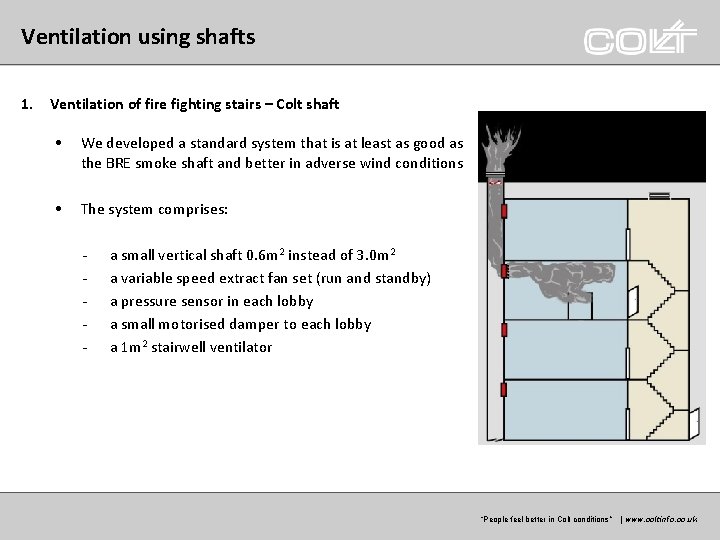
Ventilation using shafts 1. Ventilation of fire fighting stairs – Colt shaft • The major challenge is to avoid excessive depressurisation of the lobby to prevent smoke being drawn in and problems opening doors This can be avoided by: Fire Fighting Lobby negative • • • Low level inlet An inlet shaft Doors to be open Grilles in doors Variable speed fans Staircase “Peoplefeelbetterinin. Coltconditions” ” | |www. coltgroup. com www. coltinfo. co. uk
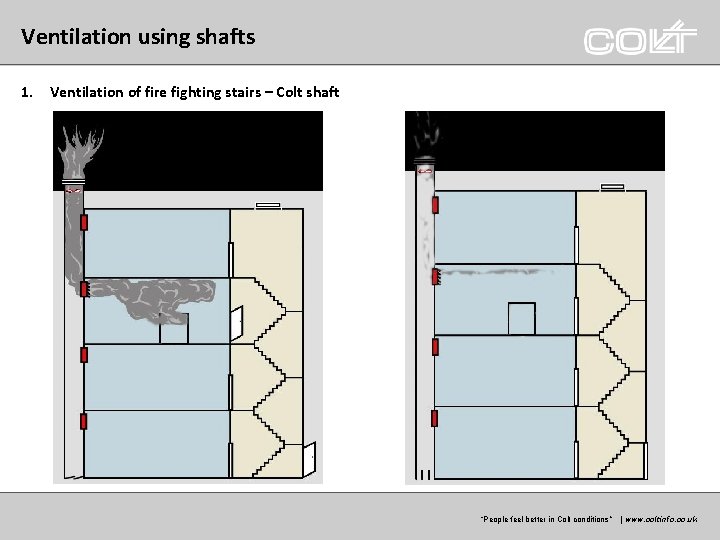
Ventilation using shafts 1. Ventilation of fire fighting stairs – Colt shaft • We developed a standard system that is at least as good as the BRE smoke shaft and better in adverse wind conditions • The system comprises: - a small vertical shaft 0. 6 m 2 instead of 3. 0 m 2 a variable speed extract fan set (run and standby) a pressure sensor in each lobby a small motorised damper to each lobby a 1 m 2 stairwell ventilator “Peoplefeelbetterinin. Coltconditions” ” | |www. coltgroup. com www. coltinfo. co. uk
Ventilation using shafts 1. Ventilation of fire fighting stairs – Colt shaft “Peoplefeelbetterinin. Coltconditions” ” | |www. coltgroup. com www. coltinfo. co. uk
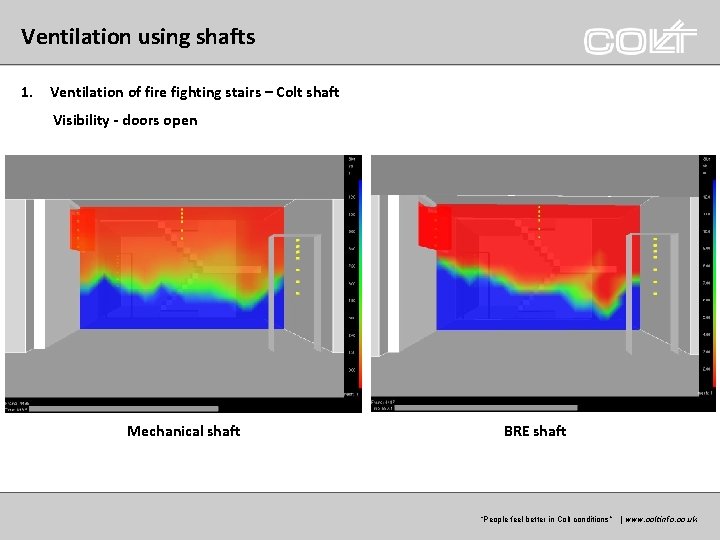
Ventilation using shafts 1. Ventilation of fire fighting stairs – Colt shaft • The design has been proven by CFD analysis • By replicating the BRE shaft CFD analysis after discussion with BRE • By optimising the air flow rate and shaft and damper dimensions to match the BRE shaft By modelling closed door conditions to ensure that the system: • Does not draw excess smoke into the lobby with doors closed (smoke seal doors between lobby and accommodation are needed for this) “Peoplefeelbetterinin. Coltconditions” ” | |www. coltgroup. com www. coltinfo. co. uk
Ventilation using shafts 1. Ventilation of fire fighting stairs – Colt shaft Visibility - doors open Mechanical shaft BRE shaft “Peoplefeelbetterinin. Coltconditions” ” | |www. coltgroup. com www. coltinfo. co. uk
Ventilation using shafts “Peoplefeelbetterinin. Coltconditions” ” | |www. coltgroup. com www. coltinfo. co. uk
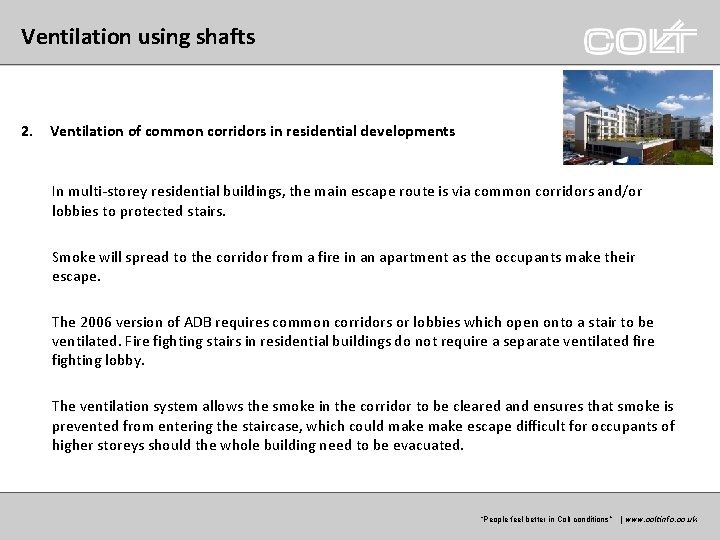
Ventilation using shafts 2. Ventilation of common corridors in residential developments In multi-storey residential buildings, the main escape route is via common corridors and/or lobbies to protected stairs. Smoke will spread to the corridor from a fire in an apartment as the occupants make their escape. The 2006 version of ADB requires common corridors or lobbies which open onto a stair to be ventilated. Fire fighting stairs in residential buildings do not require a separate ventilated fire fighting lobby. The ventilation system allows the smoke in the corridor to be cleared and ensures that smoke is prevented from entering the staircase, which could make escape difficult for occupants of higher storeys should the whole building need to be evacuated. “Peoplefeelbetterinin. Coltconditions” ” | |www. coltgroup. com www. coltinfo. co. uk
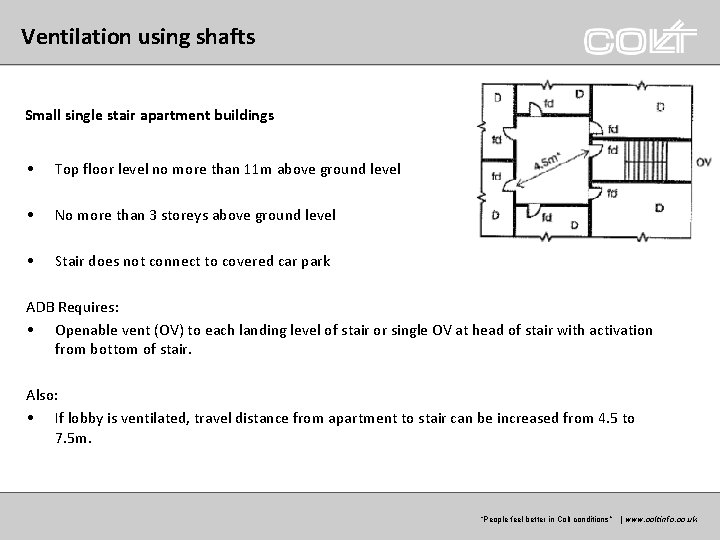
Ventilation using shafts Small single stair apartment buildings • Top floor level no more than 11 m above ground level • No more than 3 storeys above ground level • Stair does not connect to covered car park ADB Requires: • Openable vent (OV) to each landing level of stair or single OV at head of stair with activation from bottom of stair. Also: • If lobby is ventilated, travel distance from apartment to stair can be increased from 4. 5 to 7. 5 m. “Peoplefeelbetterinin. Coltconditions” ” | |www. coltgroup. com www. coltinfo. co. uk
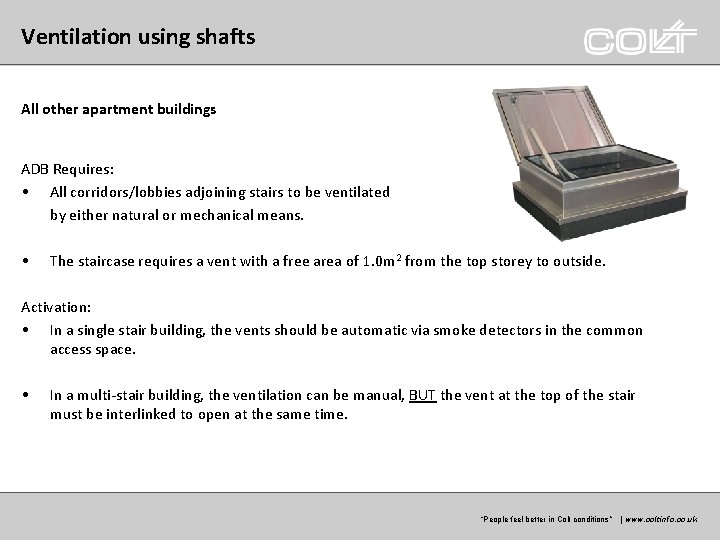
Ventilation using shafts All other apartment buildings ADB Requires: • All corridors/lobbies adjoining stairs to be ventilated by either natural or mechanical means. • The staircase requires a vent with a free area of 1. 0 m 2 from the top storey to outside. Activation: • In a single stair building, the vents should be automatic via smoke detectors in the common access space. • In a multi-stair building, the ventilation can be manual, BUT the vent at the top of the stair must be interlinked to open at the same time. “Peoplefeelbetterinin. Coltconditions” ” | |www. coltgroup. com www. coltinfo. co. uk
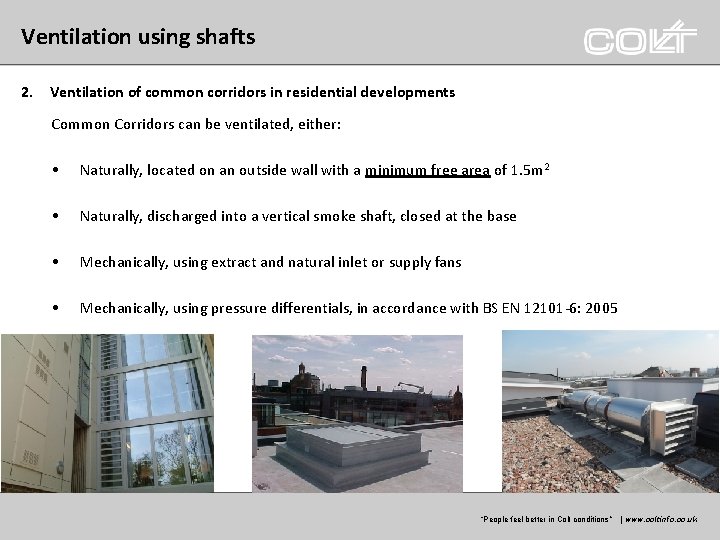
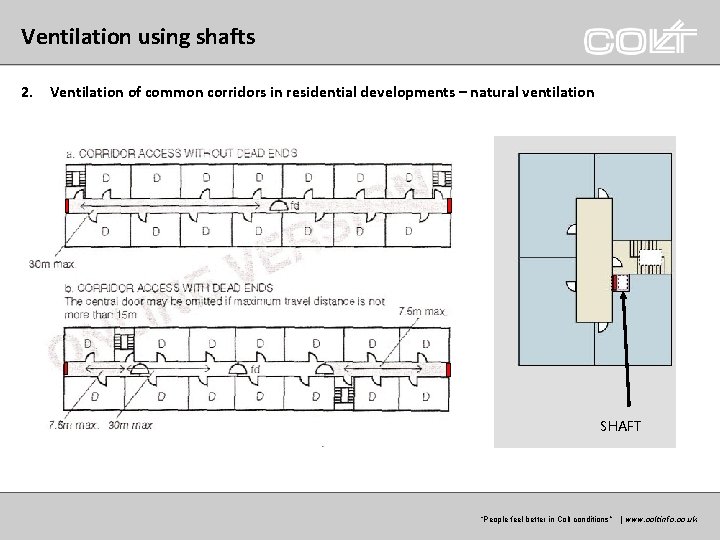
Ventilation using shafts 2. Ventilation of common corridors in residential developments Common Corridors can be ventilated, either: • Naturally, located on an outside wall with a minimum free area of 1. 5 m 2 • Naturally, discharged into a vertical smoke shaft, closed at the base • Mechanically, using extract and natural inlet or supply fans • Mechanically, using pressure differentials, in accordance with BS EN 12101 -6: 2005 “Peoplefeelbetterinin. Coltconditions” ” | |www. coltgroup. com www. coltinfo. co. uk
Ventilation using shafts 2. Ventilation of common corridors in residential developments – natural ventilation SHAFT “Peoplefeelbetterinin. Coltconditions” ” | |www. coltgroup. com www. coltinfo. co. uk
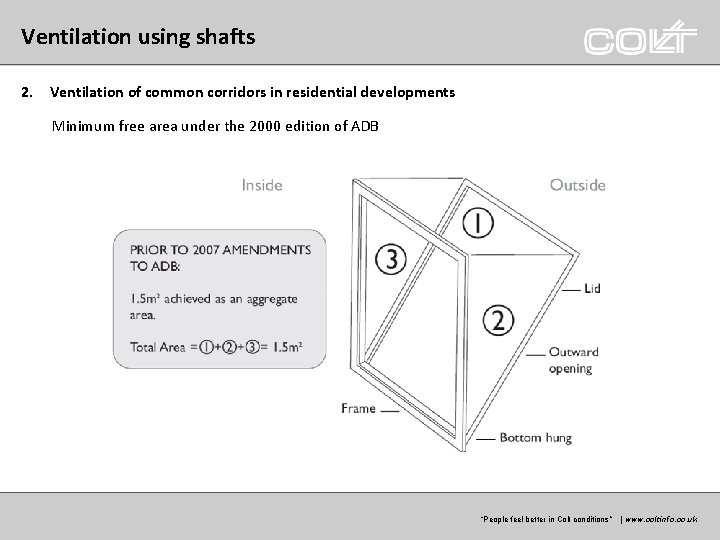
Ventilation using shafts 2. Ventilation of common corridors in residential developments Minimum free area under the 2000 edition of ADB “Peoplefeelbetterinin. Coltconditions” ” | |www. coltgroup. com www. coltinfo. co. uk
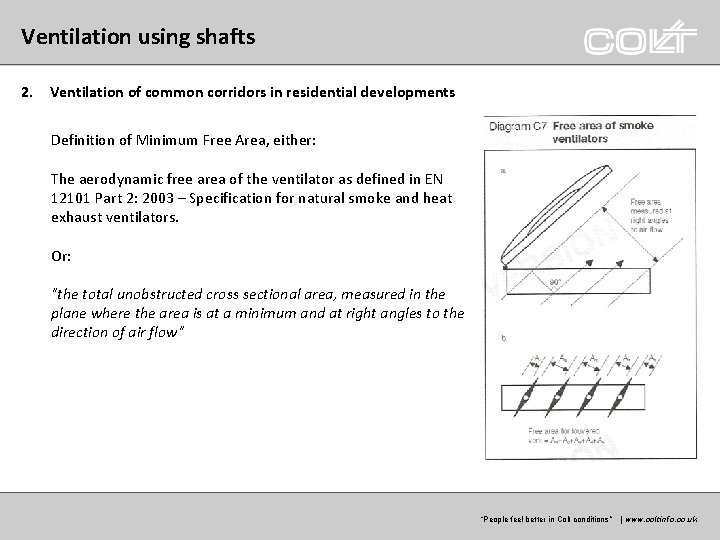
Ventilation using shafts 2. Ventilation of common corridors in residential developments Definition of Minimum Free Area, either: The aerodynamic free area of the ventilator as defined in EN 12101 Part 2: 2003 – Specification for natural smoke and heat exhaust ventilators. Or: "the total unobstructed cross sectional area, measured in the plane where the area is at a minimum and at right angles to the direction of air flow" “Peoplefeelbetterinin. Coltconditions” ” | |www. coltgroup. com www. coltinfo. co. uk
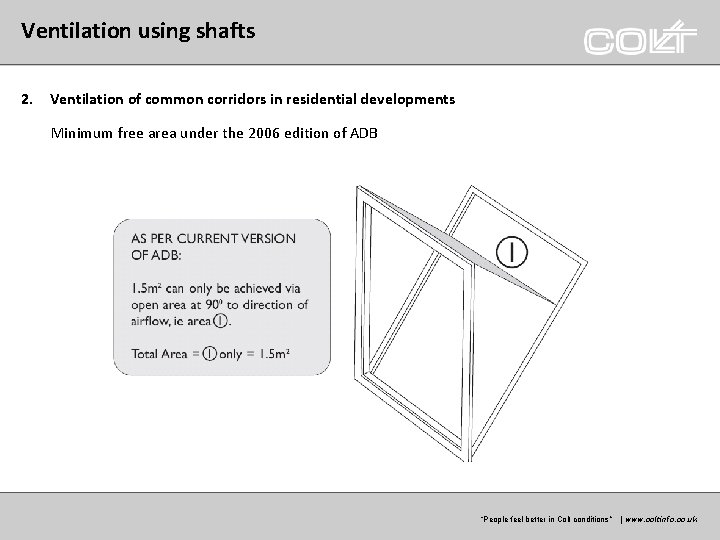
Ventilation using shafts 2. Ventilation of common corridors in residential developments Minimum free area under the 2006 edition of ADB “Peoplefeelbetterinin. Coltconditions” ” | |www. coltgroup. com www. coltinfo. co. uk
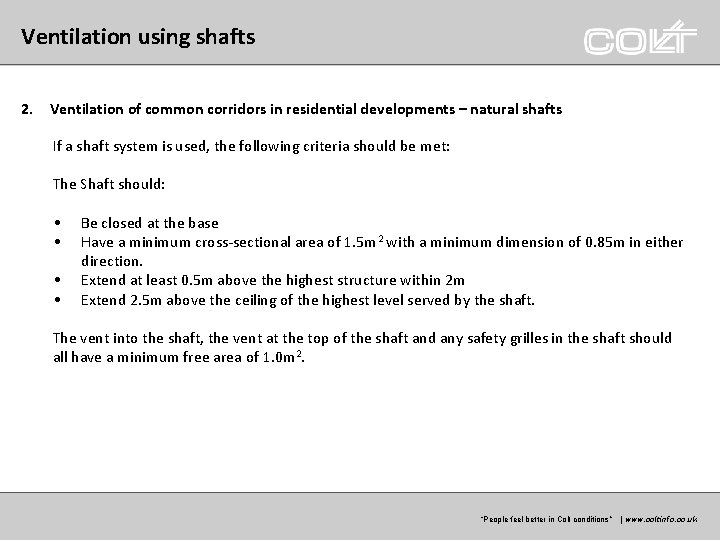
Ventilation using shafts 2. Ventilation of common corridors in residential developments – natural shafts If a shaft system is used, the following criteria should be met: The Shaft should: • • Be closed at the base Have a minimum cross-sectional area of 1. 5 m 2 with a minimum dimension of 0. 85 m in either direction. Extend at least 0. 5 m above the highest structure within 2 m Extend 2. 5 m above the ceiling of the highest level served by the shaft. The vent into the shaft, the vent at the top of the shaft and any safety grilles in the shaft should all have a minimum free area of 1. 0 m 2. “Peoplefeelbetterinin. Coltconditions” ” | |www. coltgroup. com www. coltinfo. co. uk
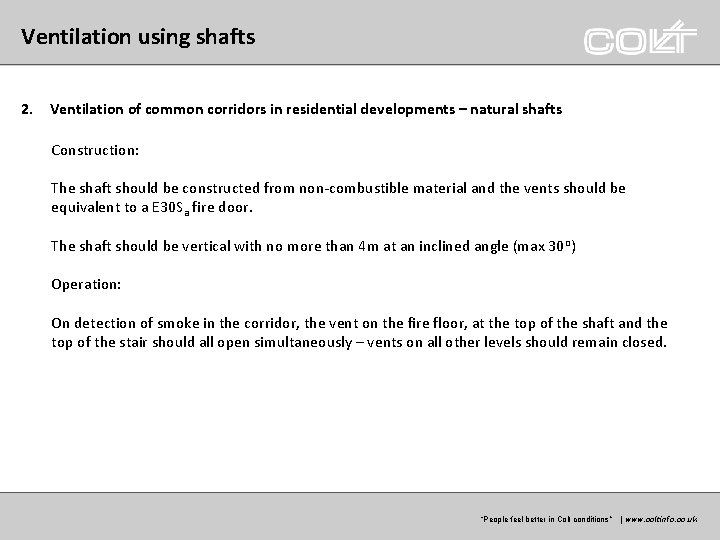
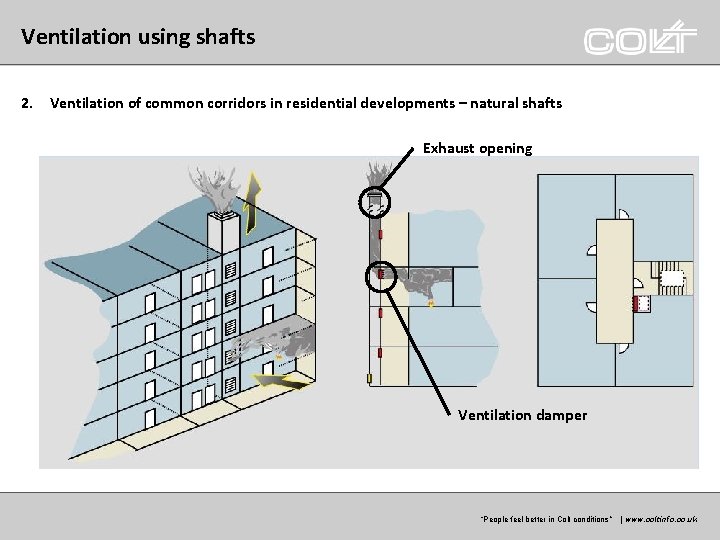
Ventilation using shafts 2. Ventilation of common corridors in residential developments – natural shafts Construction: The shaft should be constructed from non-combustible material and the vents should be equivalent to a E 30 Sa fire door. The shaft should be vertical with no more than 4 m at an inclined angle (max 30 o) Operation: On detection of smoke in the corridor, the vent on the fire floor, at the top of the shaft and the top of the stair should all open simultaneously – vents on all other levels should remain closed. “Peoplefeelbetterinin. Coltconditions” ” | |www. coltgroup. com www. coltinfo. co. uk
Ventilation using shafts 2. Ventilation of common corridors in residential developments – natural shafts Exhaust opening Ventilation damper “Peoplefeelbetterinin. Coltconditions” ” | |www. coltgroup. com www. coltinfo. co. uk
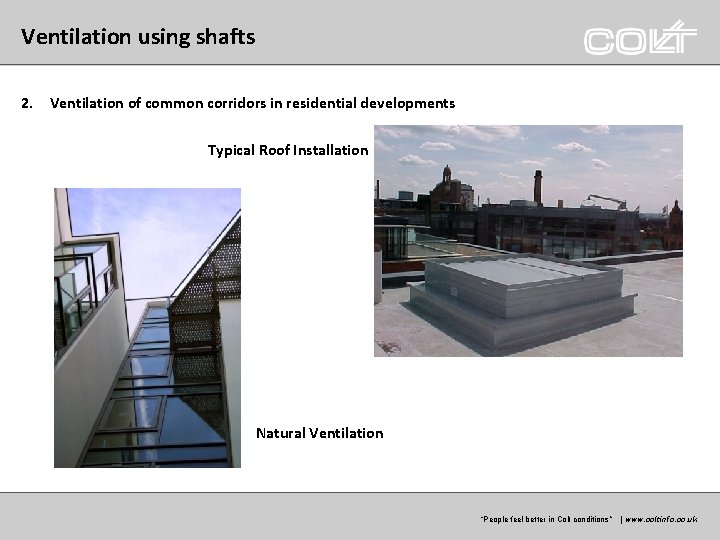
Ventilation using shafts 2. Ventilation of common corridors in residential developments Typical Roof Installation Natural Ventilation “Peoplefeelbetterinin. Coltconditions” ” | |www. coltgroup. com www. coltinfo. co. uk
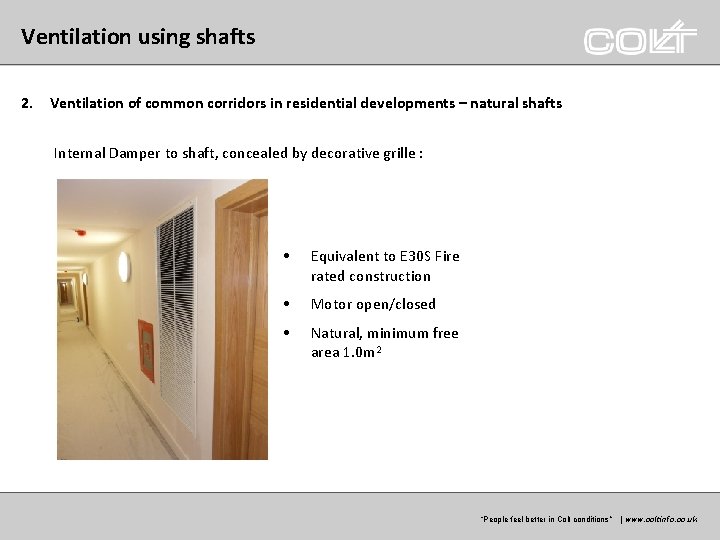
Ventilation using shafts 2. Ventilation of common corridors in residential developments – natural shafts Internal Damper to shaft, concealed by decorative grille : • Equivalent to E 30 S Fire rated construction • Motor open/closed • Natural, minimum free area 1. 0 m 2 “Peoplefeelbetterinin. Coltconditions” ” | |www. coltgroup. com www. coltinfo. co. uk
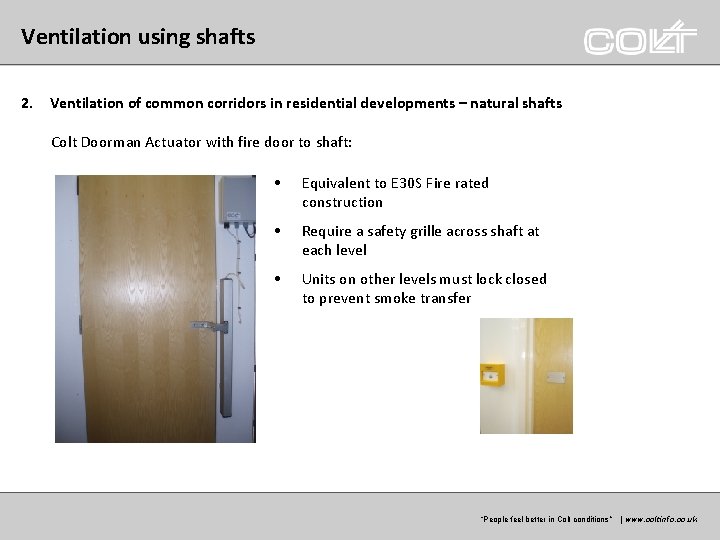
Ventilation using shafts 2. Ventilation of common corridors in residential developments – natural shafts Colt Doorman Actuator with fire door to shaft: • Equivalent to E 30 S Fire rated construction • Require a safety grille across shaft at each level • Units on other levels must lock closed to prevent smoke transfer “Peoplefeelbetterinin. Coltconditions” ” | |www. coltgroup. com www. coltinfo. co. uk
Ventilation using shafts 2. Ventilation of common corridors in residential developments – natural shafts Approved Document B permits the use of mechanical ventilation for smoke control of common escape routes but gives no design guidance on how to design such a system. However based on the experience gained in developing the Colt Shaft for fire fighting applications, several options are available to reduce the natural shaft from 1. 5 m 2 to 0. 6 m 2 using a mechanical system. As with the fire fighting system, the main objective is to keep smoke from entering the staircase. “Peoplefeelbetterinin. Coltconditions” ” | |www. coltgroup. com www. coltinfo. co. uk
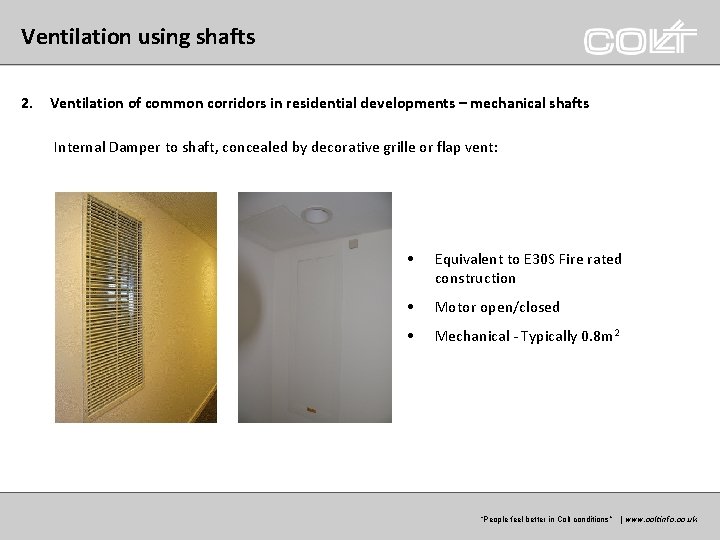
Ventilation using shafts 2. Ventilation of common corridors in residential developments – mechanical shafts Internal Damper to shaft, concealed by decorative grille or flap vent: • Equivalent to E 30 S Fire rated construction • Motor open/closed • Mechanical - Typically 0. 8 m 2 “Peoplefeelbetterinin. Coltconditions” ” | |www. coltgroup. com www. coltinfo. co. uk
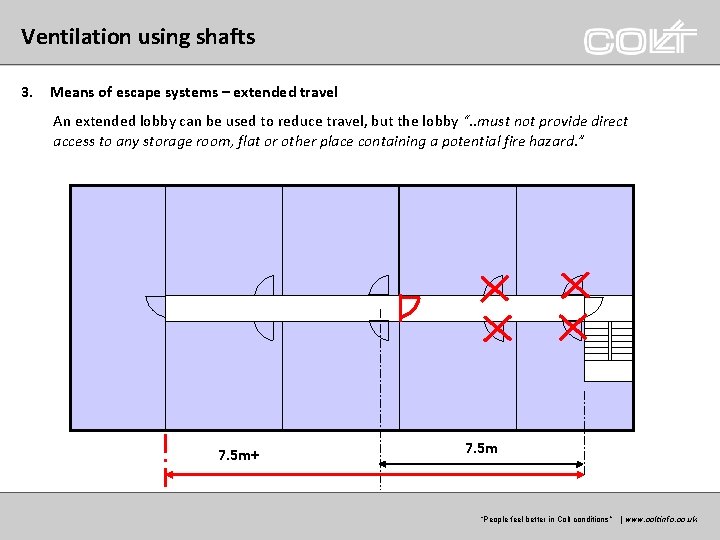
Ventilation using shafts 3. Means of escape systems – extended travel An extended lobby can be used to reduce travel, but the lobby “. . must not provide direct access to any storage room, flat or other place containing a potential fire hazard. ” 7. 5 m+ 7. 5 m “Peoplefeelbetterinin. Coltconditions” ” | |www. coltgroup. com www. coltinfo. co. uk
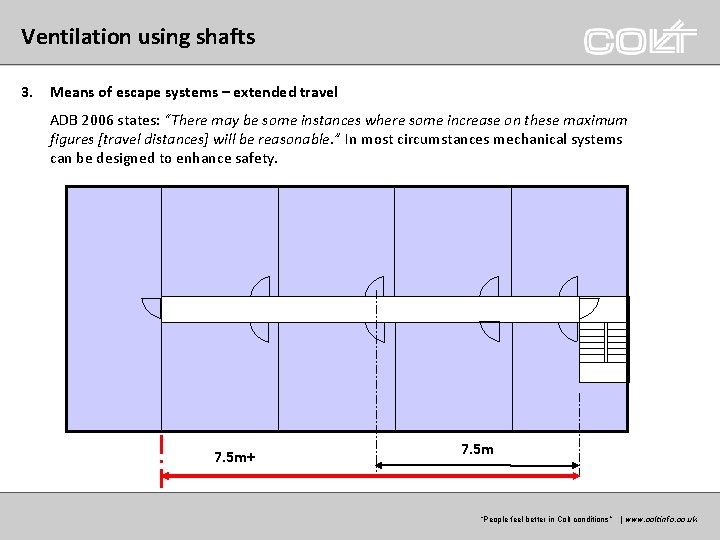
Ventilation using shafts 3. Means of escape systems – extended travel ADB 2006 states: “There may be some instances where some increase on these maximum figures [travel distances] will be reasonable. ” In most circumstances mechanical systems can be designed to enhance safety. 7. 5 m+ 7. 5 m “Peoplefeelbetterinin. Coltconditions” ” | |www. coltgroup. com www. coltinfo. co. uk
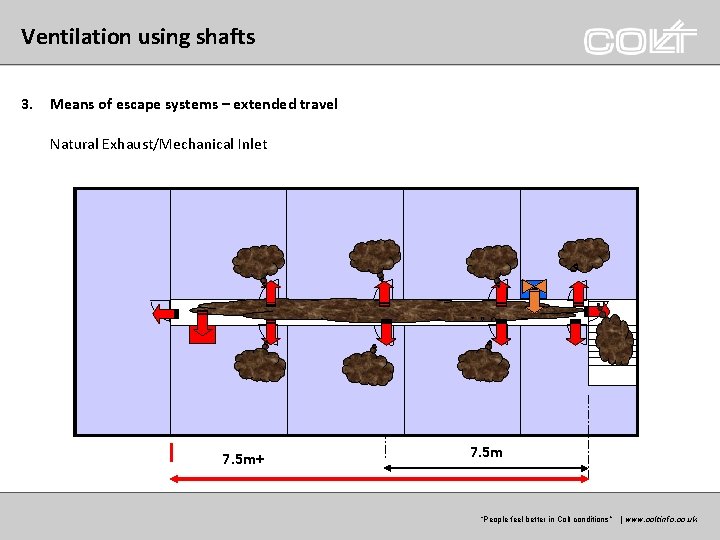
Ventilation using shafts 3. Means of escape systems – extended travel Options: • Natural Exhaust/Mechanical Inlet • Mechanical Extract/Natural Inlet • Mechanical Extract/Mechanical Inlet “Peoplefeelbetterinin. Coltconditions” ” | |www. coltgroup. com www. coltinfo. co. uk
Ventilation using shafts 3. Means of escape systems – extended travel Natural Exhaust/Mechanical Inlet Has been used by various fire engineers with varying degrees of success. Positively pressurises the corridor, therefore can risk pushing smoke into other apartments and staircase. “Peoplefeelbetterinin. Coltconditions” ” | |www. coltgroup. com www. coltinfo. co. uk
Ventilation using shafts 3. Means of escape systems – extended travel Natural Exhaust/Mechanical Inlet 7. 5 m+ 7. 5 m “Peoplefeelbetterinin. Coltconditions” ” | |www. coltgroup. com www. coltinfo. co. uk
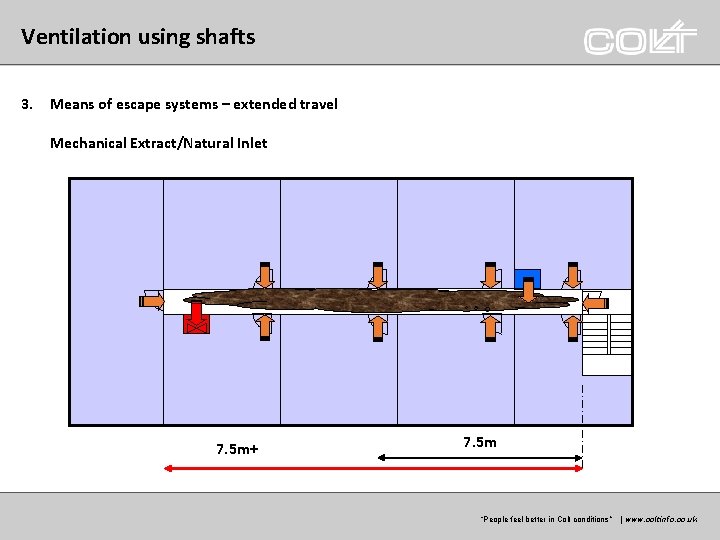
Ventilation using shafts 3. Means of escape systems – extended travel Mechanical Extract/Natural Inlet Slightly depressurises the corridor, therefore inlet shaft and dampers need to be sized carefully to avoid creating a pressure greater than 50 Pa. Typically, inlet shaft will need to be in order of 1. 5 m 2. “Peoplefeelbetterinin. Coltconditions” ” | |www. coltgroup. com www. coltinfo. co. uk
Ventilation using shafts 3. Means of escape systems – extended travel Mechanical Extract/Natural Inlet 7. 5 m+ 7. 5 m “Peoplefeelbetterinin. Coltconditions” ” | |www. coltgroup. com www. coltinfo. co. uk
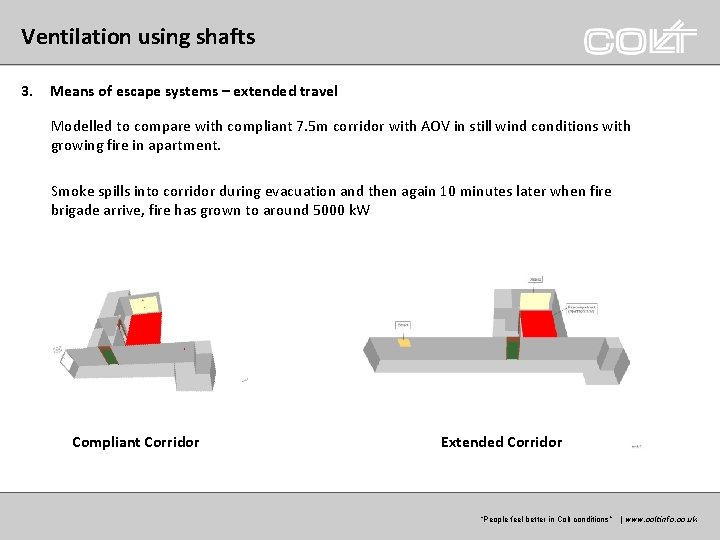
Ventilation using shafts 3. Means of escape systems – extended travel Mechanical Extract/Natural Inlet • On one typical project the Travel Distance was successfully extended from 7. 5 m to 18 m in one direction • System modelled in both escape and fire-fighting mode and compared with a compliant corridor with a natural AOV system. • System out-performs natural AOV for both evacuation and for fire-fighting “Peoplefeelbetterinin. Coltconditions” ” | |www. coltgroup. com www. coltinfo. co. uk
Ventilation using shafts 3. Means of escape systems – extended travel Modelled to compare with compliant 7. 5 m corridor with AOV in still wind conditions with growing fire in apartment. Smoke spills into corridor during evacuation and then again 10 minutes later when fire brigade arrive, fire has grown to around 5000 k. W Compliant Corridor Extended Corridor “Peoplefeelbetterinin. Coltconditions” ” | |www. coltgroup. com www. coltinfo. co. uk
Ventilation using shafts 3. Means of escape systems – extended travel Compliant AOV Extended Mechanical System 7. 5 m “Peoplefeelbetterinin. Coltconditions” ” | |www. coltgroup. com www. coltinfo. co. uk
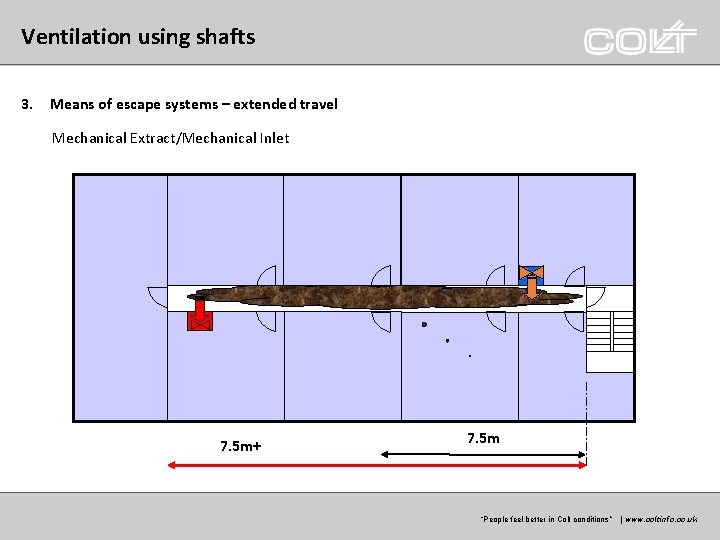
Ventilation using shafts 3. Means of escape systems – extended travel Mechanical Extract/Mechanical Inlet Reduces size of inlet shaft to 0. 6 m 2 typically. Extract to be designed as Colt Shaft without pressure sensing, inlet fan to match extract rate. “Peoplefeelbetterinin. Coltconditions” ” | |www. coltgroup. com www. coltinfo. co. uk
Ventilation using shafts 3. Means of escape systems – extended travel Mechanical Extract/Mechanical Inlet 7. 5 m+ 7. 5 m “Peoplefeelbetterinin. Coltconditions” ” | |www. coltgroup. com www. coltinfo. co. uk
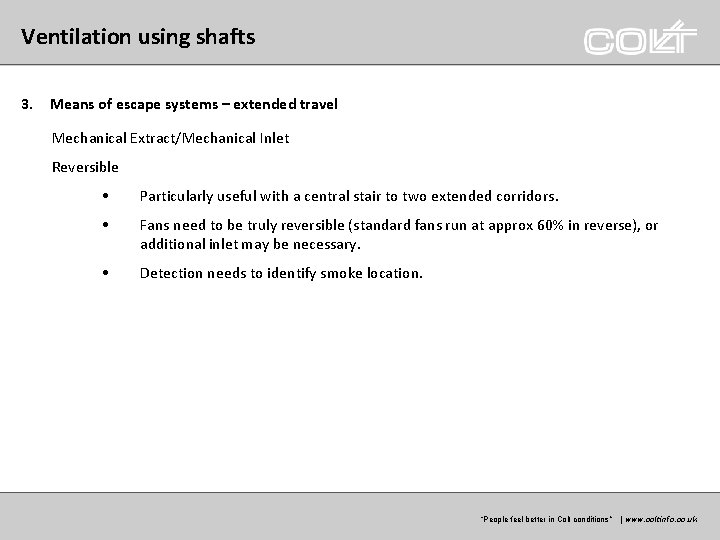
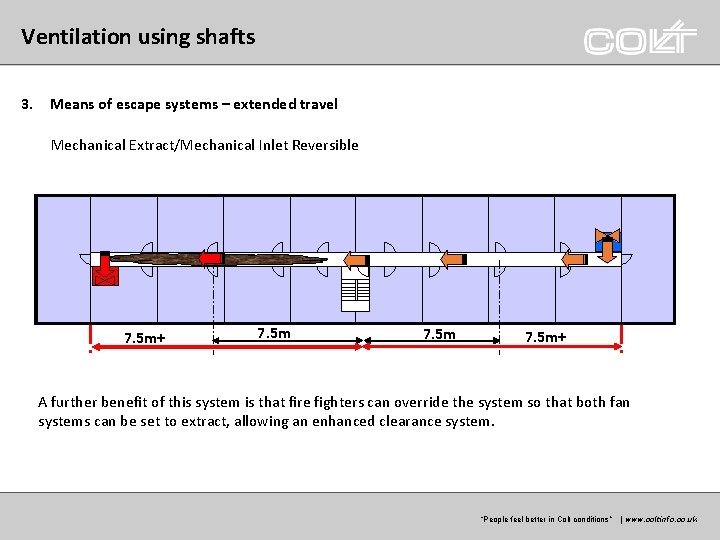
Ventilation using shafts 3. Means of escape systems – extended travel Mechanical Extract/Mechanical Inlet Reversible • Particularly useful with a central stair to two extended corridors. • Fans need to be truly reversible (standard fans run at approx 60% in reverse), or additional inlet may be necessary. • Detection needs to identify smoke location. “Peoplefeelbetterinin. Coltconditions” ” | |www. coltgroup. com www. coltinfo. co. uk
Ventilation using shafts 3. Means of escape systems – extended travel Mechanical Extract/Mechanical Inlet Reversible 7. 5 m+ 7. 5 m+ A further benefit of this system is that fire fighters can override the system so that both fan systems can be set to extract, allowing an enhanced clearance system. “Peoplefeelbetterinin. Coltconditions” ” | |www. coltgroup. com www. coltinfo. co. uk
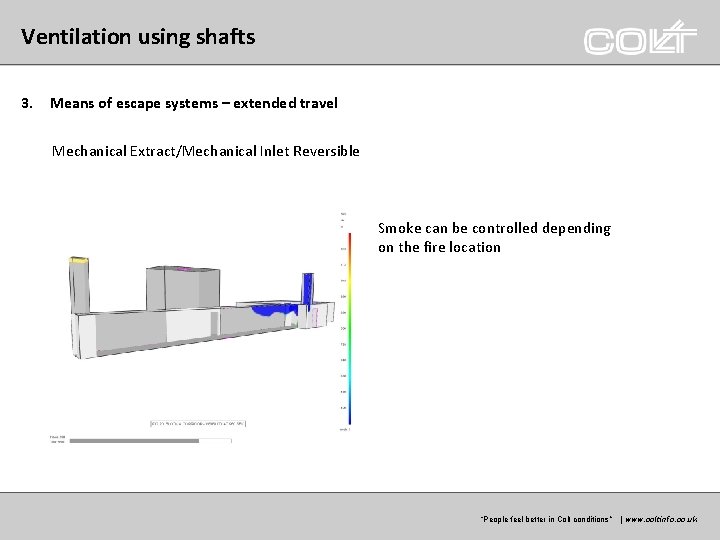
Ventilation using shafts 3. Means of escape systems – extended travel Mechanical Extract/Mechanical Inlet Reversible Smoke can be controlled depending on the fire location “Peoplefeelbetterinin. Coltconditions” ” | |www. coltgroup. com www. coltinfo. co. uk
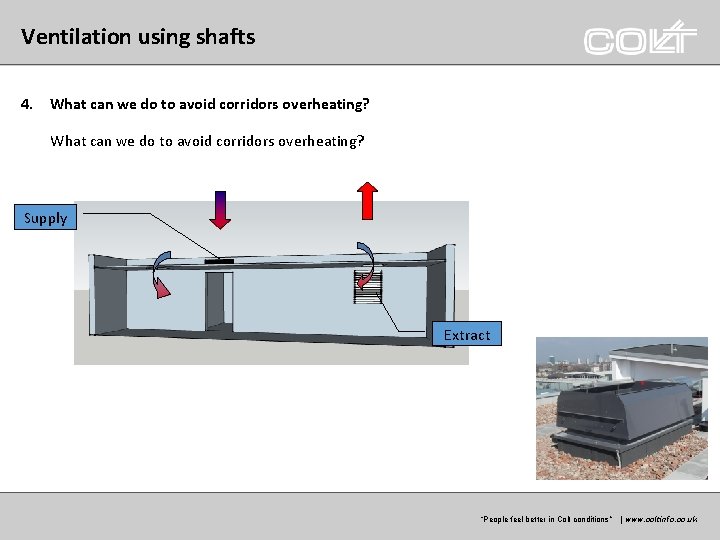
Ventilation using shafts 4. What can we do to avoid corridors overheating? Supply Extract “Peoplefeelbetterinin. Coltconditions” ” | |www. coltgroup. com www. coltinfo. co. uk
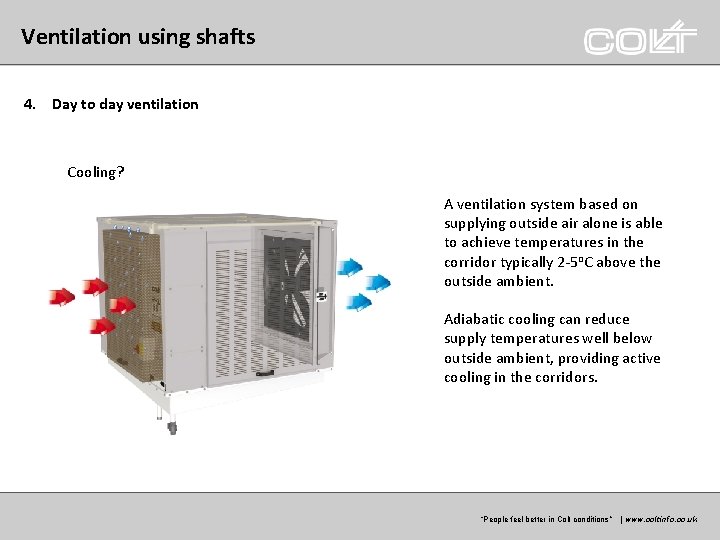
Ventilation using shafts 4. Day to day ventilation Cooling? A ventilation system based on supplying outside air alone is able to achieve temperatures in the corridor typically 2 -5 o. C above the outside ambient. Adiabatic cooling can reduce supply temperatures well below outside ambient, providing active cooling in the corridors. “Peoplefeelbetterinin. Coltconditions” ” | |www. coltgroup. com www. coltinfo. co. uk
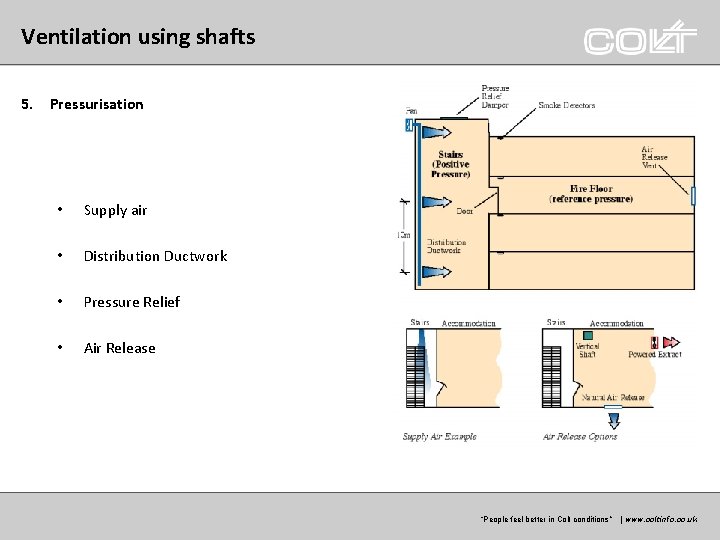
Ventilation using shafts 5. Pressurisation • Supply air • Distribution Ductwork • Pressure Relief • Air Release “Peoplefeelbetterinin. Coltconditions” ” | |www. coltgroup. com www. coltinfo. co. uk
Ventilation using shafts 5. Pressurisation • Optimum protection • Expensive • Complex design • Puts more demands on quality of building construction “Peoplefeelbetterinin. Coltconditions” ” | |www. coltgroup. com www. coltinfo. co. uk
Ventilation using shafts Conclusions The work of the BRE resulted in alternative methods of ventilation being considered, which have been incorporated into Approved Document B. This has paved the way for many new developments in the use of mechanical ventilation shafts in numerous applications. • If space is tight and a shaft system is needed, a mechanical shaft is the solution • If dead end corridor lengths exceed prescriptive limits, a mechanical shaft system with improved performance is the solution • Further guidance can be found in a free Smoke Control Association guide, downloadable from the SCA page at www. feta. co. uk “Peoplefeelbetterinin. Coltconditions” ” | |www. coltgroup. com www. coltinfo. co. uk
Pressurisation Systems Ventilation In Car Parks– Performnce testing Q&A Session… “People feel better in Colt conditions ” | www. coltgroup. com “Peoplefeelbetterinin. Coltconditions” ” | |www. coltgroup. com www. coltinfo. co. uk