
Colostomy Prepared by Baraah Yaseen Jafar Meshal Ehab
Colostomy Prepared by : Bara’ah Yaseen Jafar Meshal Ehab Aldohni Supervised by : Dr. Ali Jad

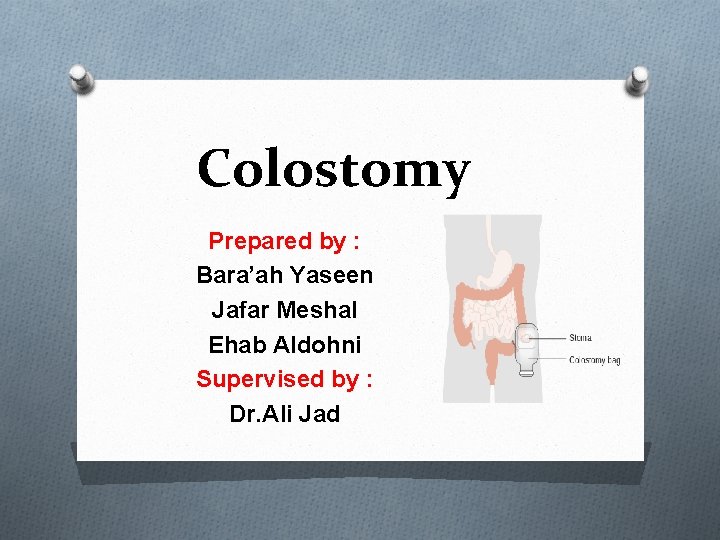
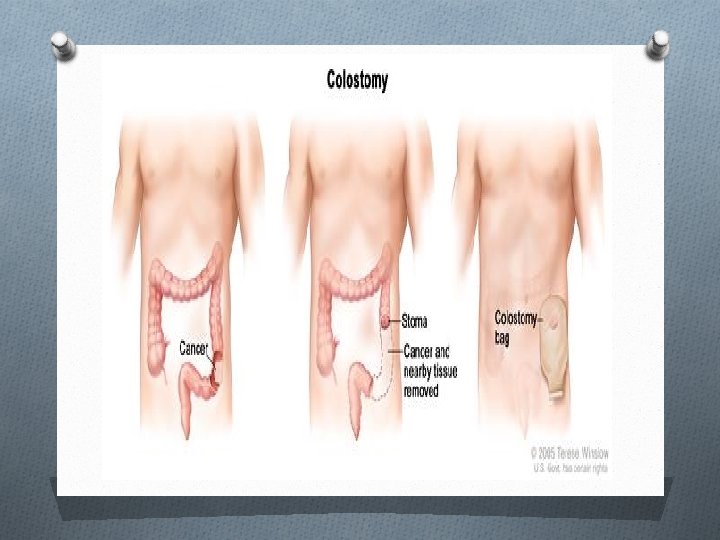
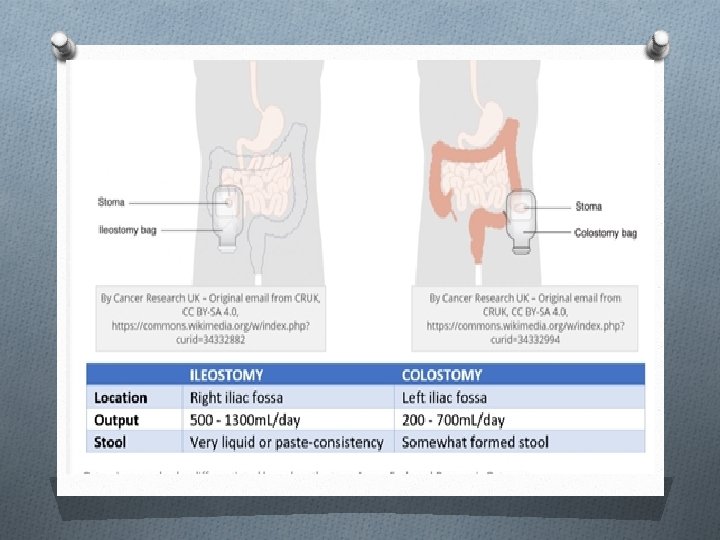
OA colostomy : is an artificial opening made in the colon to divert faeces and flatus outside the abdomen where they can be collected in an external appliance
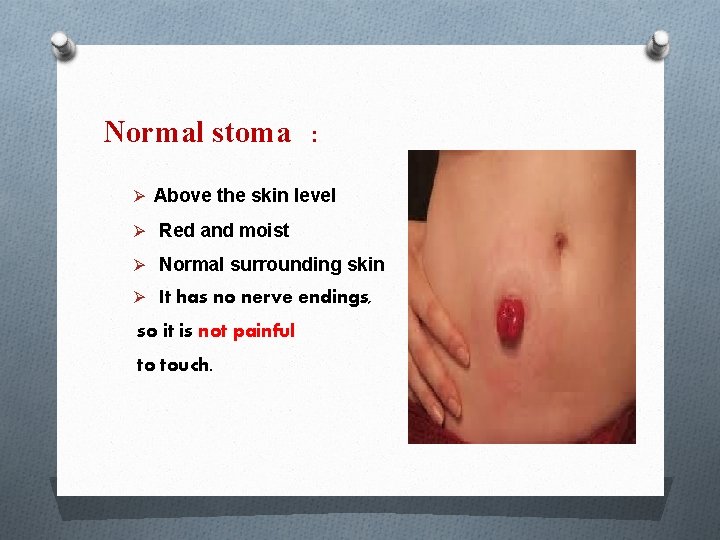
Normal stoma : Ø Above the skin level Ø Red and moist Ø Normal surrounding skin Ø It has no nerve endings, so it is not painful to touch.

Choosing a stoma site O The optimum site of stoma will depend on the type of stoma, previous incisions, scars, the patient’s build, and clothing habits O The optimum stoma site must be accessible, visible, and comfortable to the patient.
A stoma site should have the following criteria: O It should be at least 5 cm away from the planned incision line to reduce the risk of prolapse, hernia, and stoma retraction. O The stoma site should be away from creases, scars, the umbilicus, and bony prominences.
Examination of patient presenting with intestinal stoma O 1 – Inspection : O site : RIF , LIF O Number of opening O Color : Red , black O Output : O Surrounding skin : clean and dry O Spout : present or not O Any evidence of complication : hernia, prolapse , , ,
O 2 – palpation : O Feel around the stoma site for any tenderness O Ask patient to cough and feel for a cough impulse for any O parastomal hernia O 3 – Auscultation : O Auscultate for bowel sound
Digital examination of stoma O It includes the insertion of a gloved lubricated index finger into the stoma lumen. O At times, this may be all that is needed to relieve an obstruction due to adhesions or fibrosis. O The removed gloved finger is then inspected for feces, blood or mucus.
Types of colostomy : 1 - according to anatomical location 2 - according to function 3 - according to appearance 4 - according to duration
1 - According to anatomical location : 1 - end sigmoid colostomy : left iliac fossa 2 - end descending colostomy : left iliac fossa 3 – transverse colostomy : above and right to umbilicus 4 – caecostomy : right iliac fossa

2 – according to duration : Temporary colostomy: May be required to give a portion of the bowel a chance to rest and heal. When healing has occurred, the colostomy can be reversed and normal bowel function restored. Permanent colostomy: May be required when a disease affects the end part of the colon or rectum.

3 - according to morphology: O 1 – end colostomy : O The proximal end of transected colon brought to the skin for stool drainage. O Single opening (permanent usually) O The site usually in the left iliac fossa.
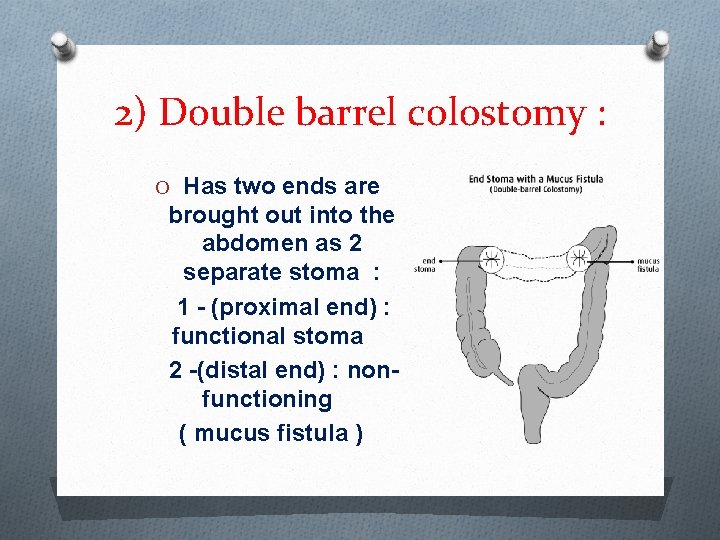
2) Double barrel colostomy : O Has two ends are brought out into the abdomen as 2 separate stoma : 1 - (proximal end) : functional stoma 2 -(distal end) : nonfunctioning ( mucus fistula )
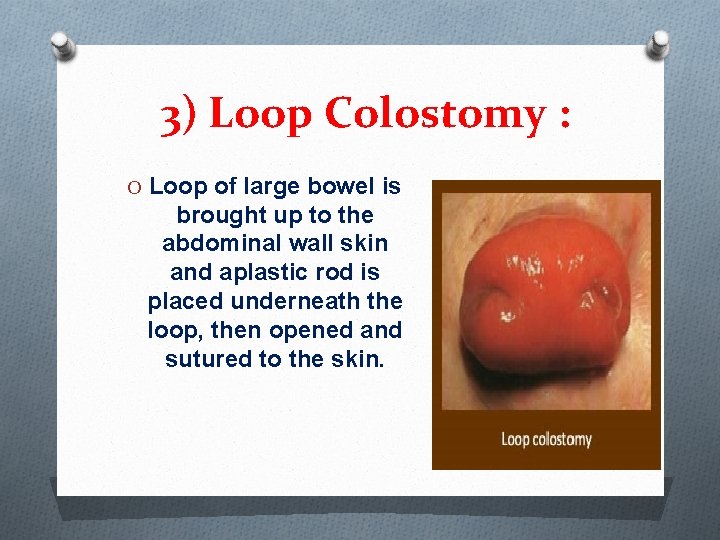
3) Loop Colostomy : O Loop of large bowel is brought up to the abdominal wall skin and aplastic rod is placed underneath the loop, then opened and sutured to the skin.
O It is now less commonly employed, as it is difficult to manage and potentially disrupts the marginal arterial supply to the anastomosis. O Loop transverse colostomies are also particularly prone to prolapse. O A loop ileostomy is now more commonly used.
Indications for colostomy. Done by Jafar Mashal Supervised by: DR Ali Jad
A colostomy is created as a mean to treat various disorders of the large intestine.
Colostomy goals O 1. to relive a distal obstruction of the sigmoid colon due to any cause O 2. to defunction the distal colon O 3. to prevent fecal peritonitis O 4. to facilitate the operative repair of high fistula in ano O 5. to prevent spoiling of the urinary bladder in vesico-colic fistula or vagina in vagino-colic fistula.
Some of the most common conditions that might necessitate a stoma are: O - Imperforate anus O - Hirschsprungs disease O - Inflammatory bowel disease O - Colitis
O- Neonatal necrotising enterocolitis O- Spina bifida
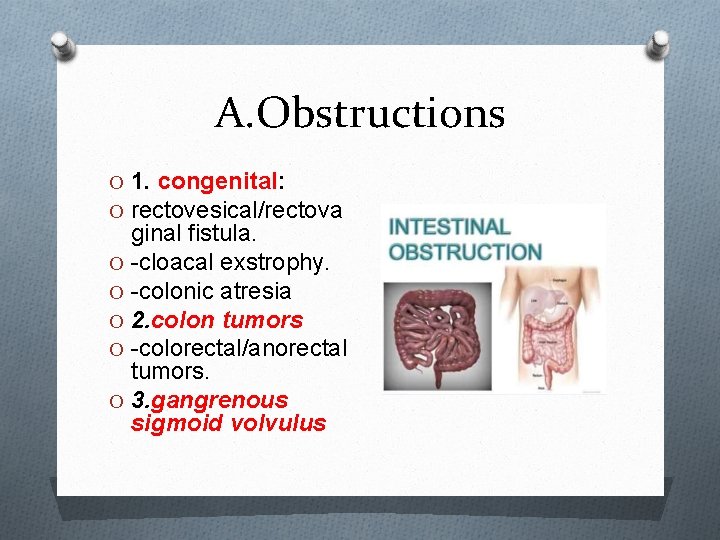
A. Obstructions O 1. congenital: O rectovesical/rectova ginal fistula. O -cloacal exstrophy. O -colonic atresia O 2. colon tumors O -colorectal/anorectal tumors. O 3. gangrenous sigmoid volvulus
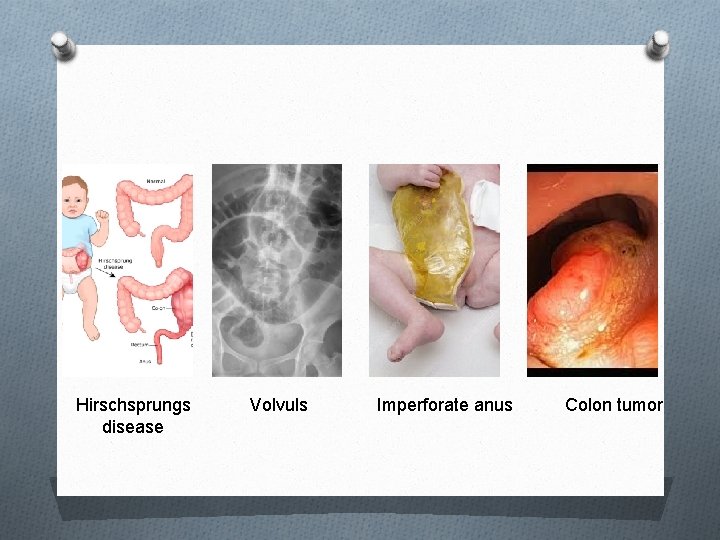
Hirschsprungs disease Volvuls Imperforate anus Colon tumor
B. Inflammation O 1. Crohn’s O 2. ulcerative colitis O 3. diverticular disease If diverticula become infected this is called diverticulitis.
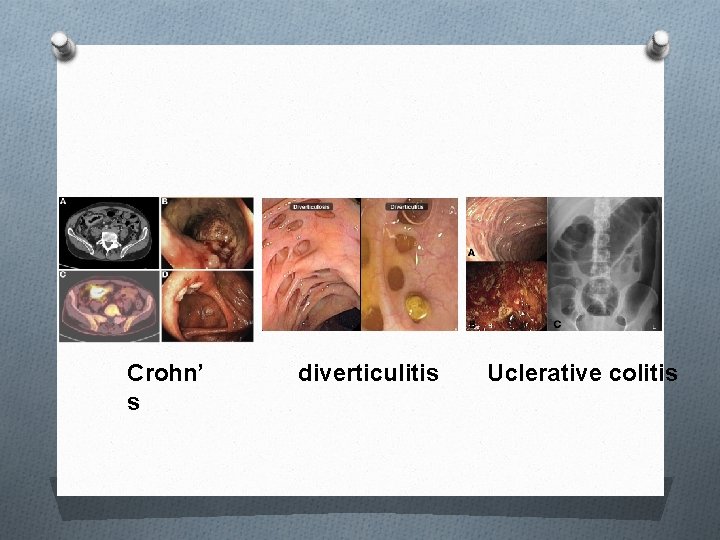
Crohn’ s diverticulitis Uclerative colitis
C. operative O 1. distal anastomosis O 2. distal repair O 3. Hartmann's operation
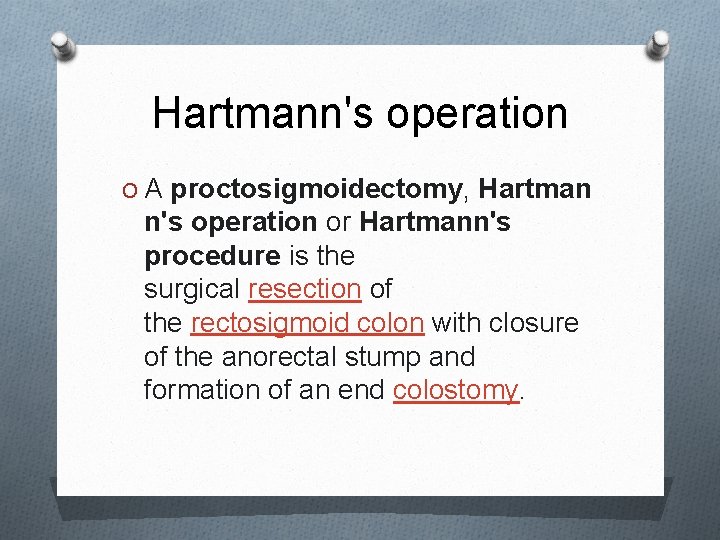
Hartmann's operation O A proctosigmoidectomy, Hartman n's operation or Hartmann's procedure is the surgical resection of the rectosigmoid colon with closure of the anorectal stump and formation of an end colostomy.
The indications for this procedure include: O a. Localized or generalized peritonitis O b. Viable but injured proximal bowel. O c. Complicated diverticulitis.
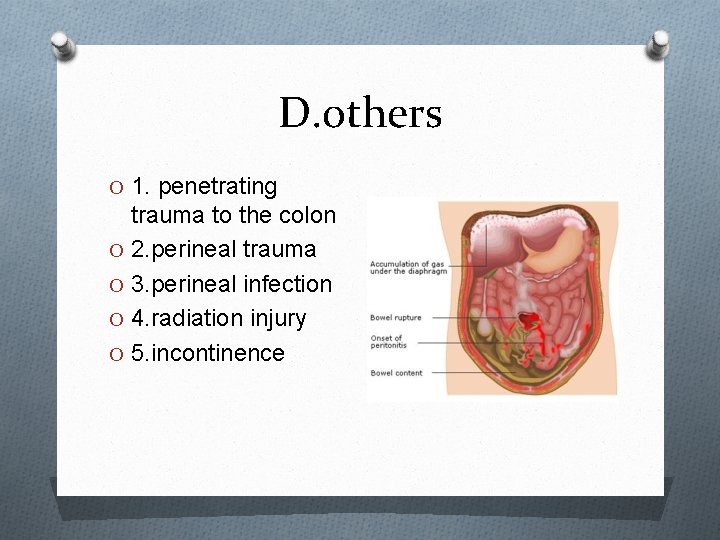
D. others O 1. penetrating trauma to the colon O 2. perineal trauma O 3. perineal infection O 4. radiation injury O 5. incontinence
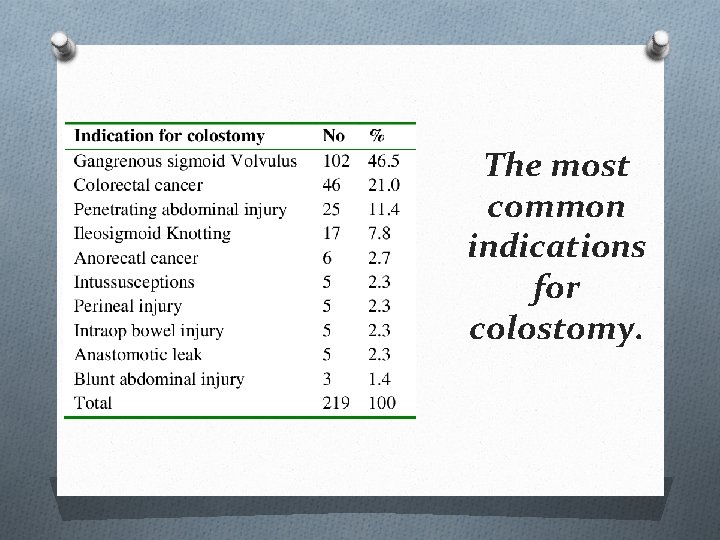
The most common indications for colostomy.
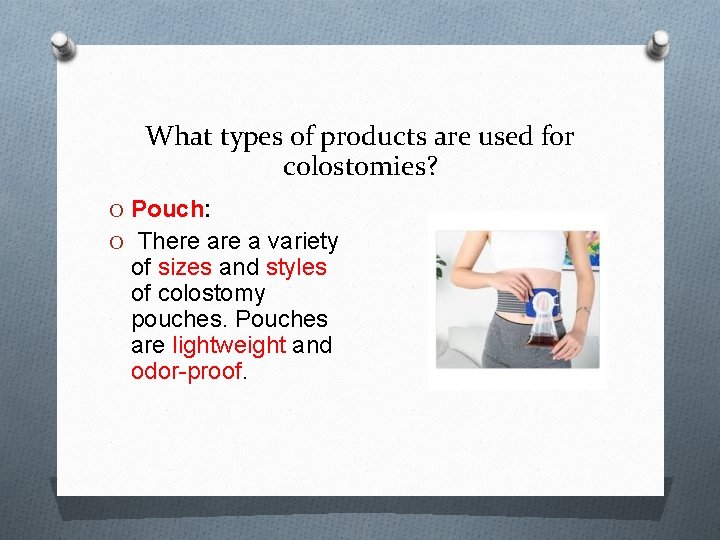
What types of products are used for colostomies? O Pouch: O There a variety of sizes and styles of colostomy pouches. Pouches are lightweight and odor-proof.
The following are general information about types of colostomy pouches: Open-ended pouch: This type of pouch allows you to open the bottom of the pouch to drain the output. The open end is usually closed with a clamp.
Close-ended pouch: This type of pouch is removed and thrown away when the pouch is filled. One-piece: A onepiece pouch contains the pouch and adhesive skin barrier together as one unit.
Pre-cut or cut-to-fit pouches: Some pouches have pre-cut holes so you do not have to cut the opening yourself. Other pouches can be cut to fit the size and shape of your stoma Two-piece: The two-piece pouch has two parts: an adhesive flange and pouch. The adhesive flange stays in place while the pouch is removed and new pouch is attached to the flange.
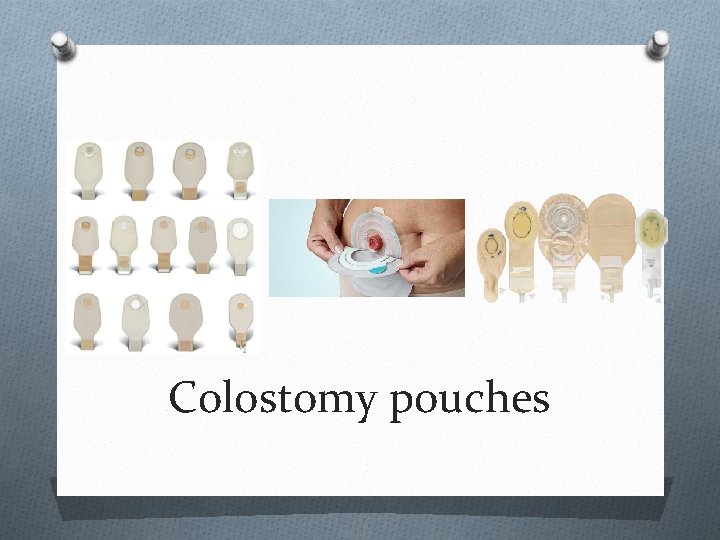
Colostomy pouches
Complications Prepared by : Ehab AL-dohni Supervised by : Dr. ALI Jad
Complications O I. Intraoperative—occurring immediately in the operative room. O II. Early—occur 1– 30 days after surgery. O III. Late—occur after more than 1 month of surgery.
Peristomal dermatitis O It is the most common stoma complication. It is characterized by skin irritation around the stoma.
Peristomal dermatitis (causes) 1 - Irritation. 2 - Contact with the products used in colostomy. 3 - Contact allergy. 4 - Mechanical trauma. 5 - Bacterial or fungal skin infection.
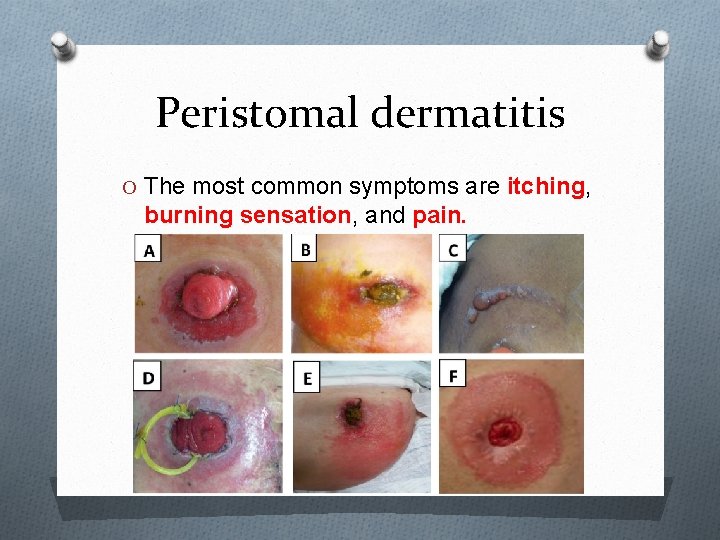
Peristomal dermatitis O The most common symptoms are itching, burning sensation, and pain.
Peristomal dermatitis (management) O The use of azoles is the best first-line treatment. O If antifungal treatment does not clear the problem, it is likely to be bacterial and an antibacterial powder is indicated such as sucralfate powder.
Necrosis/Ischemia O Necrosis may occur when the blood flow to or from the stoma is impaired or interrupted, resulting in severe tissue ischemia with impairment of stoma viability or tissue death. O Initially the mucosa turns pale evolving to a purple, brown, and black color. The consistency becomes soft or hard and dry with loss of the characteristic brightness of a normal mucosa.
Necrosis (causes) O tension or stripping. O Sutures too narrowly spaced, or constricting sutures. O embolization. O Abdominal structure anomalies
Necrosis (management) O In cases of superficial or partial mucosal necrosis observation is the best approach. O In cases of deep mucosal necrosis, a surgical intervention is indicated.
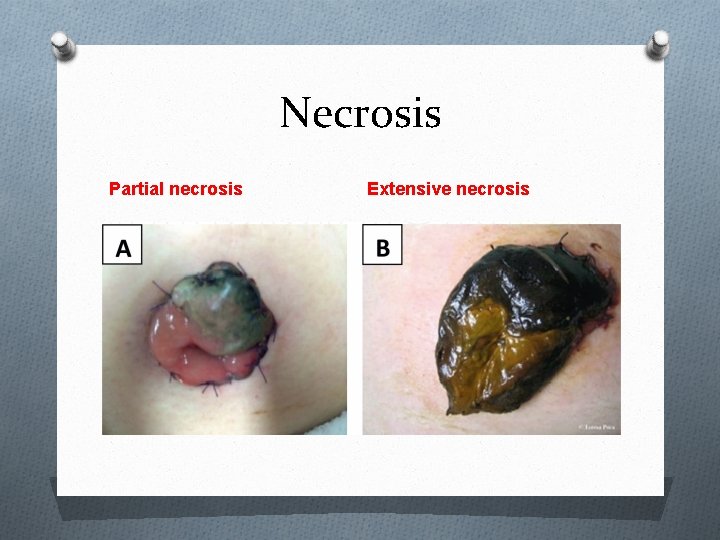
Necrosis Partial necrosis Extensive necrosis
Retraction O A retraction of the stoma occurs when the stoma lays flat to the skin or below the skin surface level. O Can be partial or complete. O can occur early or late.
Retraction (causes) O Exteriorization of intestinal loop under tension, insufficient stomal length, poor fixation of the loop to the abdominal wall, or lack of stoma support. O Secondary to abdominal structure anomalies. O The premature removal of the loop device to support the intestine outside the abdominal wall. O later scar formation
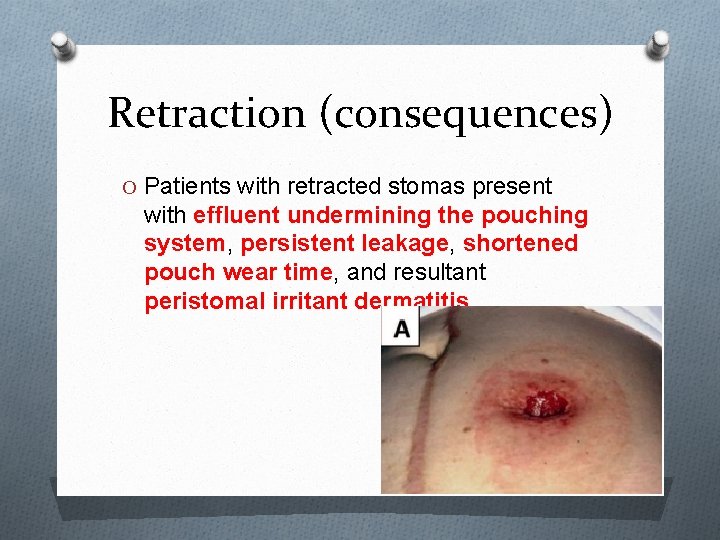
Retraction (consequences) O Patients with retracted stomas present with effluent undermining the pouching system, persistent leakage, shortened pouch wear time, and resultant peristomal irritant dermatitis.
Retraction (management) O Conservative treatment with convex devices attached to the belt and protective skin pastes. O Surgical intervention (stoma revision).
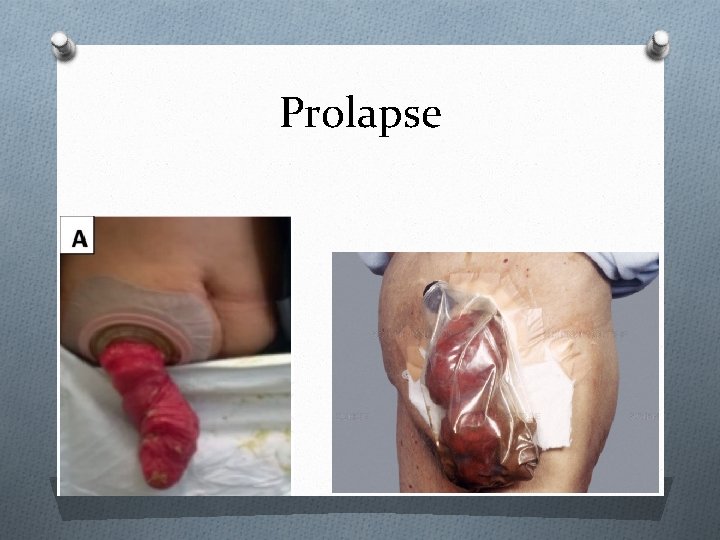
Prolapse O Is the telescoping of the bowel out through the stoma. O Prolapse can be partial or complete, and either the distal or the proximal segment of the loop ostomy may prolapse. O Can be classified as sliding or fixed.
Prolapse (causes) O Weak abdominal wall O Creation of excessively large opening in the abdominal wall. O Positioning the stoma out of the rectus abdominal muscle. O Postoperative increase of the abdominal pressure. O Bowel edema. O Inadequate fixation.
Prolapse (clinical manifestation) O Makes the stoma longer and more susceptible to abrasion or infection. O Makes the patient’s ability to conceal the stoma beneath clothing difficult. O Makes the stoma more susceptible to bleeding and more prone to trauma. O A prolapsed stoma could also become obstructed.
Prolapse (management) O Conservative management. O Surgical correction of prolapse.
Prolapse
Parastomal hernia (PSH) O A protrusion of the bowel or loops of intestine through the fascial opening into the subcutaneous tissue around the stoma. O may be partial or circumferential. O The hernia change in position. O Occurs months to years after surgery because of surgical technical error or following gradual enlargement of the fascial defect.
PSH (risk factors) O Intra-abdominal pressure. O Advanced age. O Obesity. O Chronic cough. O Long-term use of corticosteroids.
PSH (clinical manifestation) O Most patients are asymptomatic. O Symptoms include mild peristomal discomfort, stoma appliance issues with leaks and skin irritation , obstruction, and strangulation.
PSH (management) O CT scan with oral contrast confirms the diagnosis. O Asymptomatic patients can be treated conservatively. O If signs of obstruction, incarceration, perforation, or recurrent pouching difficulties are present, the patient should be referred to a surgeon.
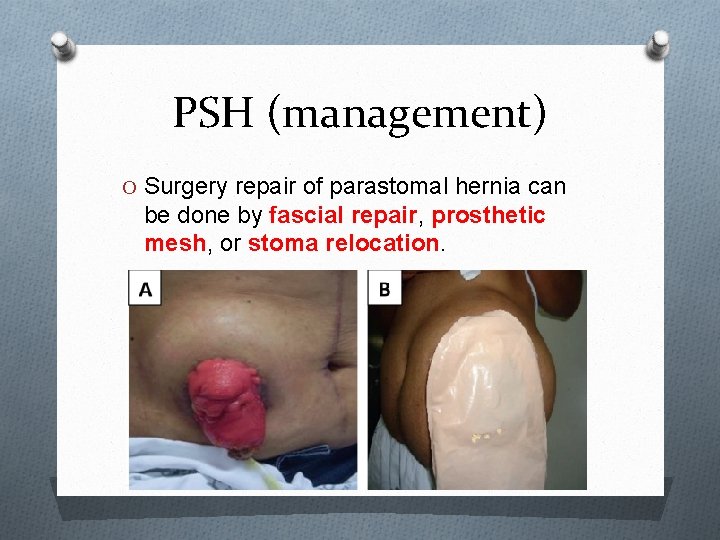
PSH (management) O Surgery repair of parastomal hernia can be done by fascial repair, prosthetic mesh, or stoma relocation.
stenosis O Is a stricture or retraction of the stomal opening. O The symptoms include abdominal excess of gases, frequent cramps and diarrhea, as well as thin feces.
Stenosis (causes) O Inadequate excision of the skin during construction of a stoma or poor stoma site. O Stomal ischemia, necrosis, or retraction. O Recurrent disease. O Recurrent episodes of skin irritation. O Weight gain. O Radiotherapy.
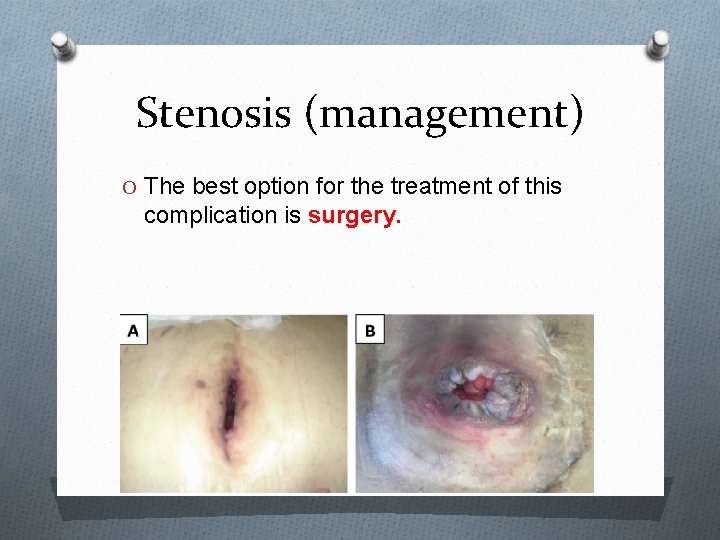
Stenosis (management) O The best option for the treatment of this complication is surgery.

Thank you
- Slides: 69