
Colors RED n GREEN n BLUE n PURPLE
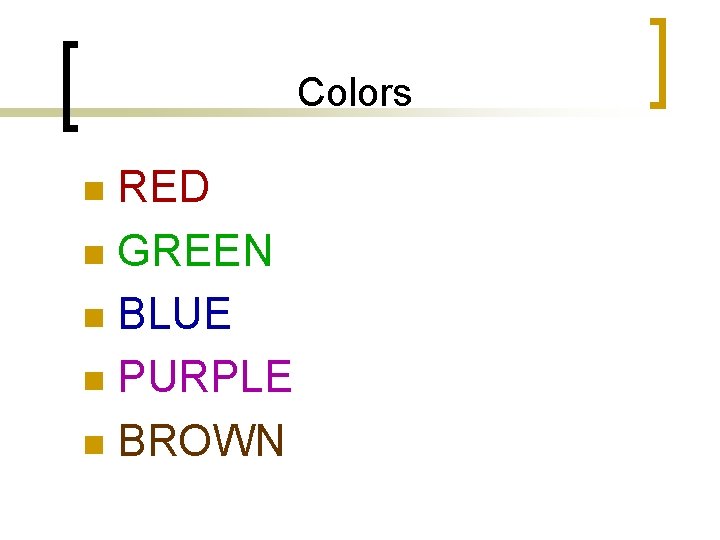
Colors RED n GREEN n BLUE n PURPLE n BROWN n
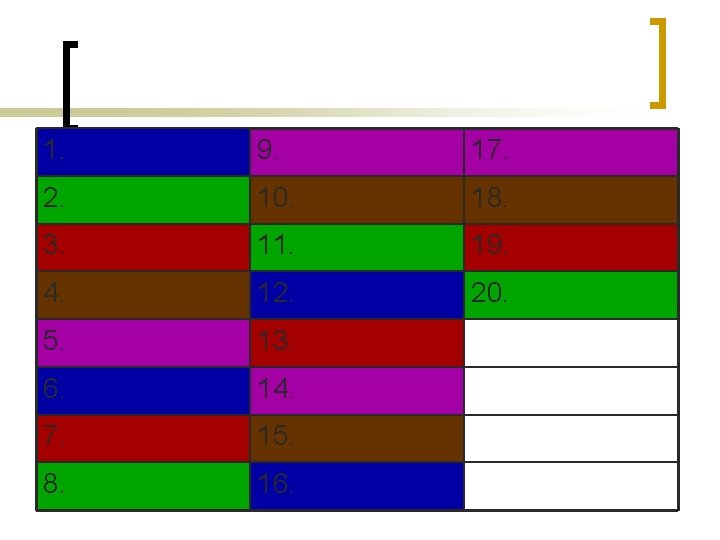
1. 9. 17. 2. 10. 18. 3. 11. 19. 4. 12. 20. 5. 13. 6. 14. 7. 15. 8. 16.
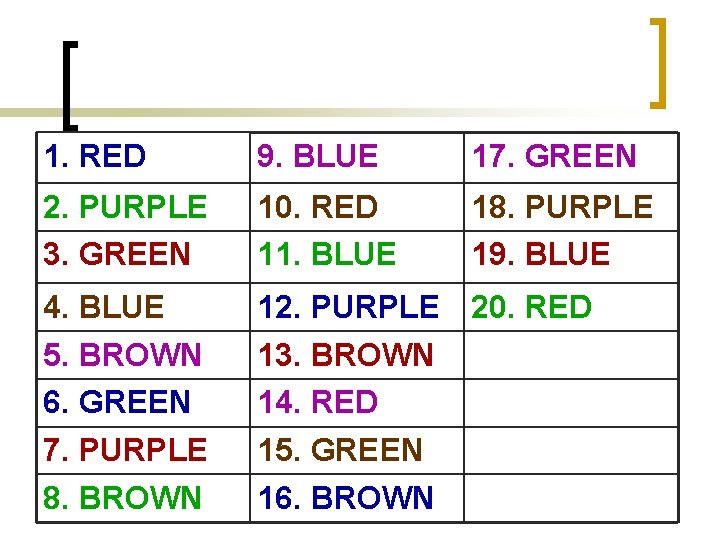
1. RED 9. BLUE 17. GREEN 2. PURPLE 3. GREEN 10. RED 11. BLUE 18. PURPLE 19. BLUE 4. BLUE 5. BROWN 6. GREEN 7. PURPLE 8. BROWN 12. PURPLE 20. RED 13. BROWN 14. RED 15. GREEN 16. BROWN
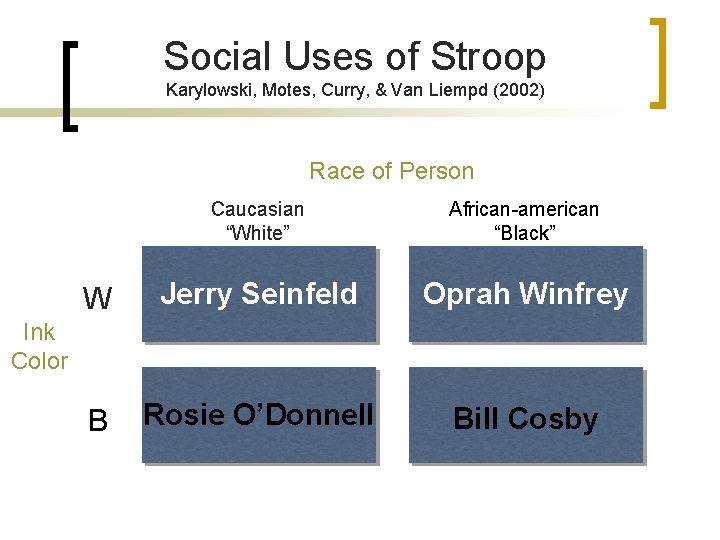
Social Uses of Stroop Karylowski, Motes, Curry, & Van Liempd (2002) Race of Person Caucasian “White” African-american “Black” W Jerry Seinfeld Oprah Winfrey B Rosie O’Donnell Bill Cosby Ink Color
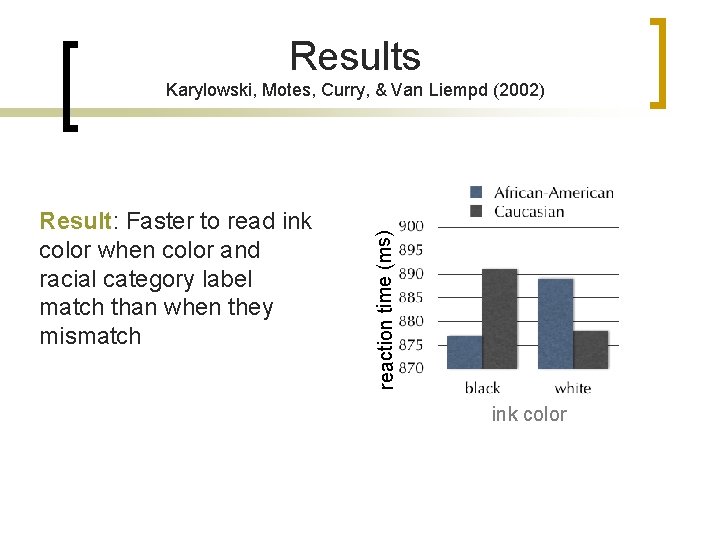
Results Result: Faster to read ink color when color and racial category label match than when they mismatch reaction time (ms) Karylowski, Motes, Curry, & Van Liempd (2002) ink color
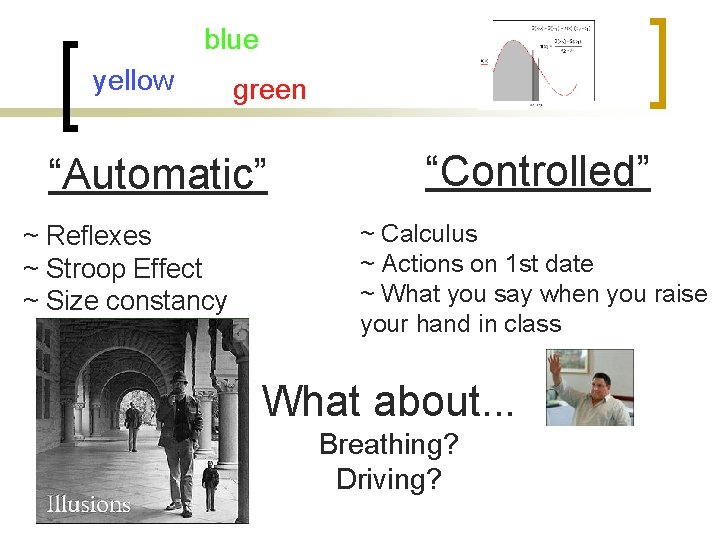
blue yellow green “Automatic” ~ Reflexes ~ Stroop Effect ~ Size constancy “Controlled” ~ Calculus ~ Actions on 1 st date ~ What you say when you raise your hand in class What about. . . Breathing? Driving?
Automatic Effects on Social Judgment (Kelley, 1950) n Warm/Cold Study ¡ ¡ ¡ n TA read description of guest lecturer before 2 different classes 4 characteristics same in both classes 1 class - described as WARM - other class described as COLD Results ¡ WARM professor rated more favorably and had more interaction after class
Automatic Effects on Social Judgment (Srull & Wyer, 1979) n. The classic “Donald” study n. Part 1: Scrambled sentences task; words either related to hostility (e. g. , “he kicked her bit”) or not ¡ n. Part 2: Read paragraph about “Donald” and form judgments about him ¡
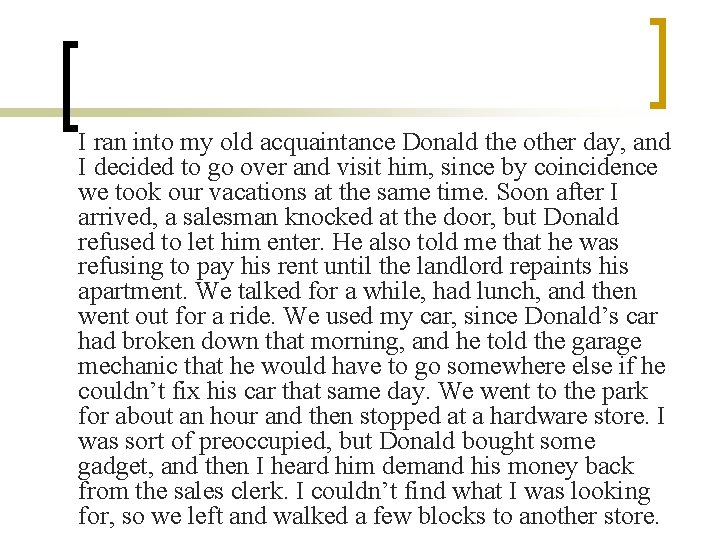
I ran into my old acquaintance Donald the other day, and I decided to go over and visit him, since by coincidence we took our vacations at the same time. Soon after I arrived, a salesman knocked at the door, but Donald refused to let him enter. He also told me that he was refusing to pay his rent until the landlord repaints his apartment. We talked for a while, had lunch, and then went out for a ride. We used my car, since Donald’s car had broken down that morning, and he told the garage mechanic that he would have to go somewhere else if he couldn’t fix his car that same day. We went to the park for about an hour and then stopped at a hardware store. I was sort of preoccupied, but Donald bought some gadget, and then I heard him demand his money back from the sales clerk. I couldn’t find what I was looking for, so we left and walked a few blocks to another store.
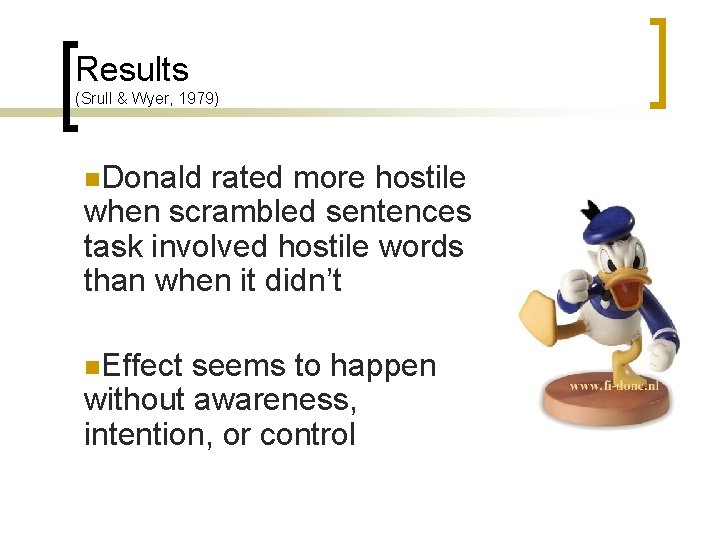
Results (Srull & Wyer, 1979) n. Donald rated more hostile when scrambled sentences task involved hostile words than when it didn’t n. Effect seems to happen without awareness, intention, or control
Becoming Famous Overnight. . . (Jacoby et al. , 1989) n. Part 1: Pronounce 40 non-famous names (e. g. , Sebastian Weisdorf) ¡ n. Part 2: ¡ Test either immediately or 24 hours later ¡ Moderately famous names and non-famous names ¡ Some old and some new non-famous names ¡“Is this person famous? ”
Results (Jacoby et al. , 1989) n. Immediate ¡ Mistakes less common for old non-famous names than new ones n 24 ¡ test: hours later: Mistakes MORE common for old non-famous names than new ones
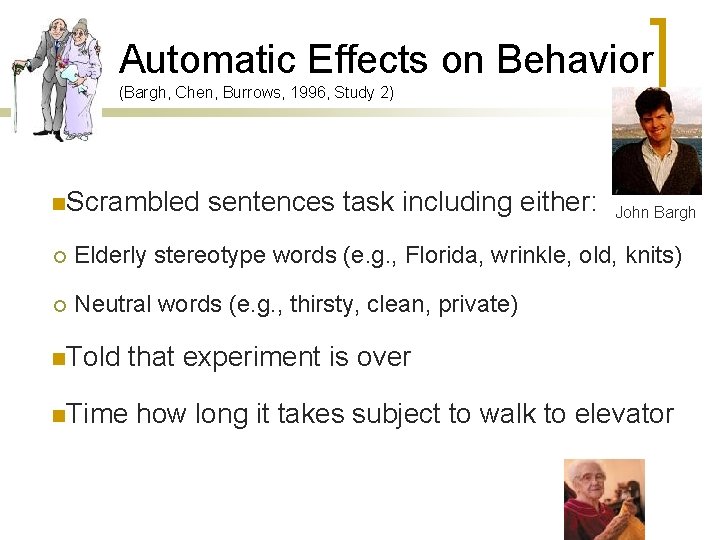
Automatic Effects on Behavior (Bargh, Chen, Burrows, 1996, Study 2) n. Scrambled sentences task including either: John Bargh ¡ Elderly stereotype words (e. g. , Florida, wrinkle, old, knits) ¡ Neutral words (e. g. , thirsty, clean, private) n. Told n. Time that experiment is over how long it takes subject to walk to elevator
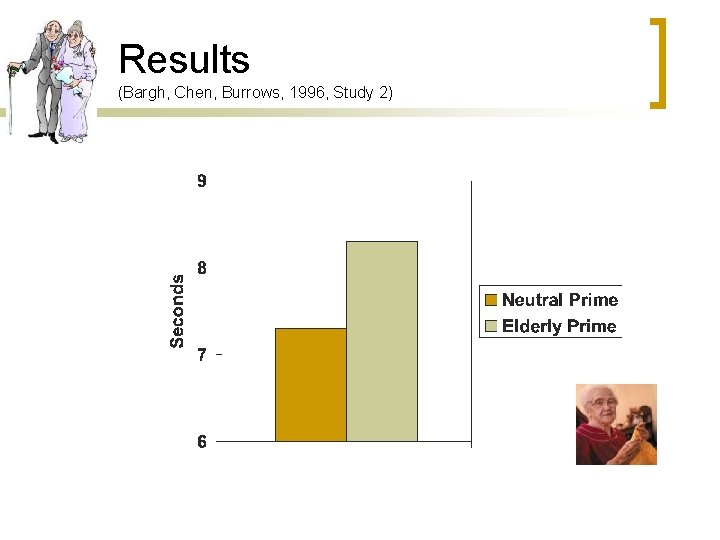
Results (Bargh, Chen, Burrows, 1996, Study 2)
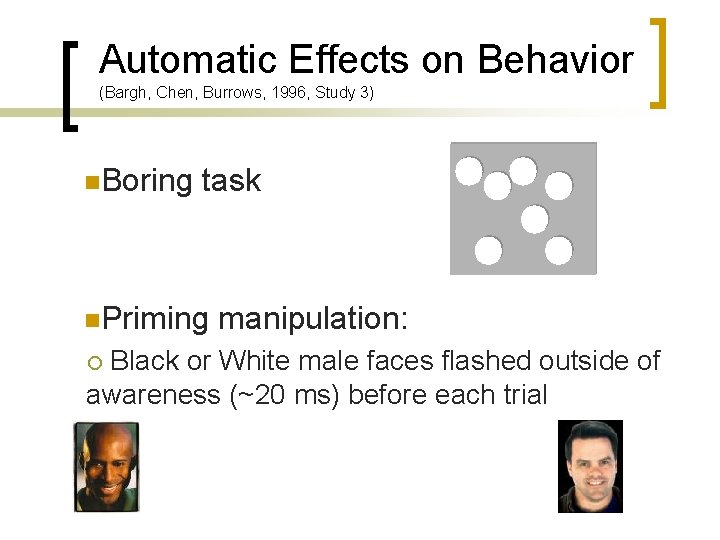
Automatic Effects on Behavior (Bargh, Chen, Burrows, 1996, Study 3) n. Boring task n. Priming manipulation: Black or White male faces flashed outside of awareness (~20 ms) before each trial ¡
Automatic Effects on Behavior (Bargh, Chen, Burrows, 1996, Study 3) n After 300 th trial ¡ I’m sorry, but it looks like you’ll have to do the experiment over F 1 Error: Failure saving data
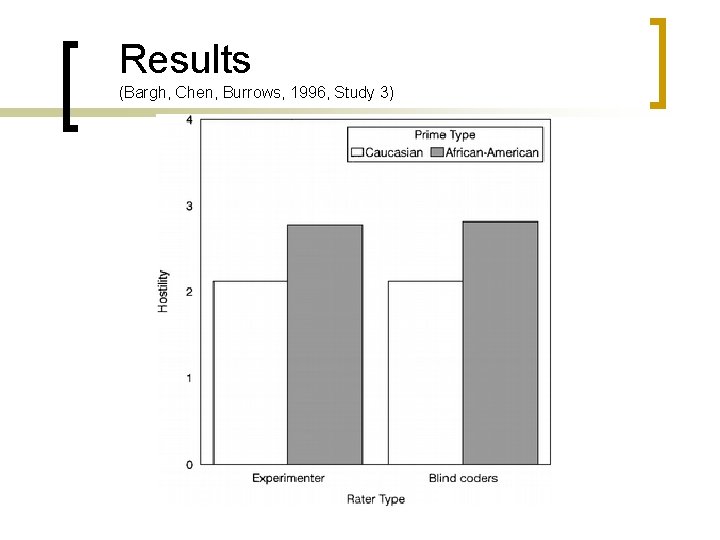
Results (Bargh, Chen, Burrows, 1996, Study 3)
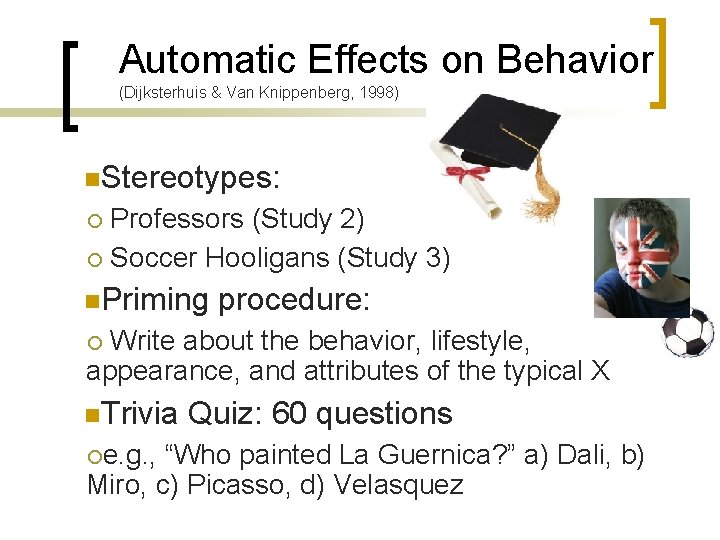
Automatic Effects on Behavior (Dijksterhuis & Van Knippenberg, 1998) n. Stereotypes: Professors (Study 2) ¡ Soccer Hooligans (Study 3) ¡ n. Priming procedure: Write about the behavior, lifestyle, appearance, and attributes of the typical X ¡ n. Trivia ¡e. g. , Quiz: 60 questions “Who painted La Guernica? ” a) Dali, b) Miro, c) Picasso, d) Velasquez
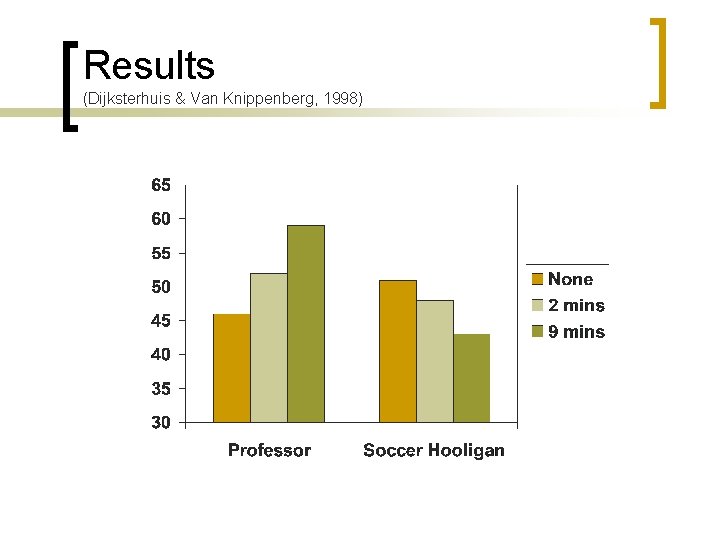
Results (Dijksterhuis & Van Knippenberg, 1998)
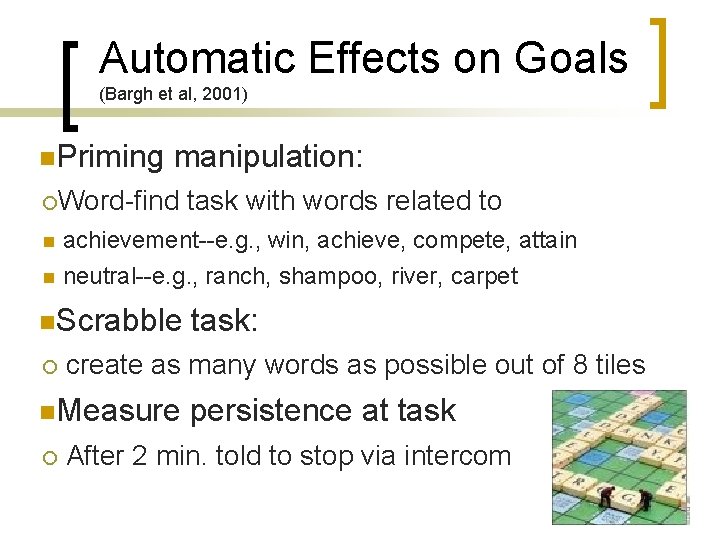
Automatic Effects on Goals (Bargh et al, 2001) n. Priming manipulation: ¡Word-find task with words related to n achievement--e. g. , win, achieve, compete, attain n neutral--e. g. , ranch, shampoo, river, carpet n. Scrabble ¡ create as many words as possible out of 8 tiles n. Measure ¡ task: persistence at task After 2 min. told to stop via intercom
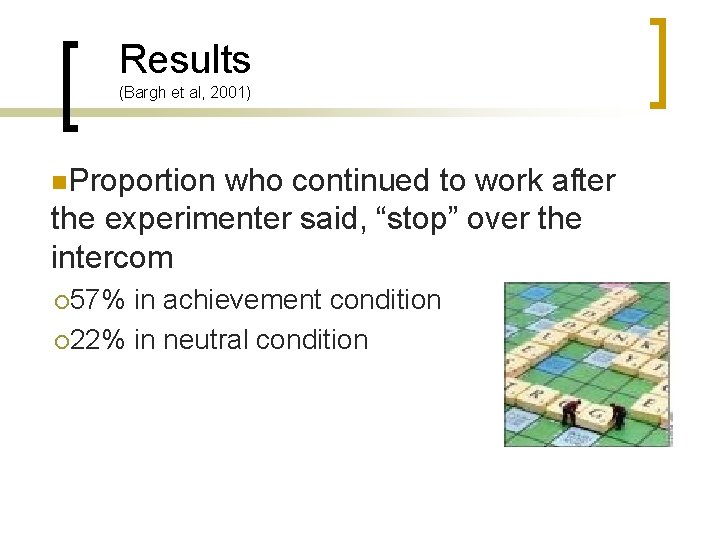
Results (Bargh et al, 2001) n. Proportion who continued to work after the experimenter said, “stop” over the intercom ¡ 57% in achievement condition ¡ 22% in neutral condition
Observation of the Invisible n The Implicit Association Test is designed to tap automatic associations between concepts and attributes (e. g. , male: science female: liberal arts)
Implicit Association Test
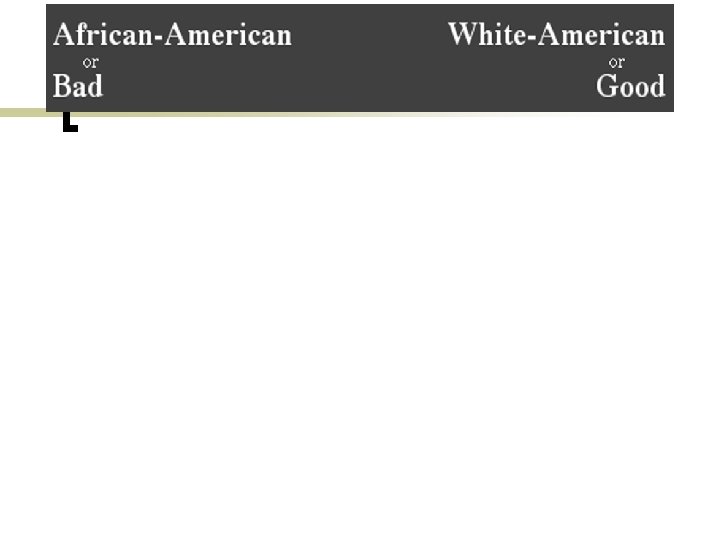
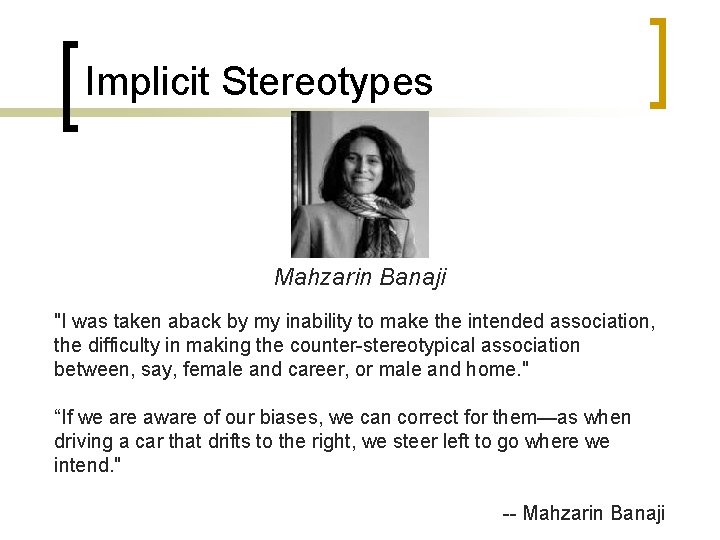
Implicit Stereotypes Mahzarin Banaji "I was taken aback by my inability to make the intended association, the difficulty in making the counter-stereotypical association between, say, female and career, or male and home. " “If we are aware of our biases, we can correct for them—as when driving a car that drifts to the right, we steer left to go where we intend. " -- Mahzarin Banaji
- Slides: 34