
Coloring random graphs online without creating monochromatic subgraphs
Coloring random graphs online without creating monochromatic subgraphs Torsten Mütze, ETH Zürich Joint work with Thomas Rast (ETH Zürich) and Reto Spöhel (MPI Saarbrücken)
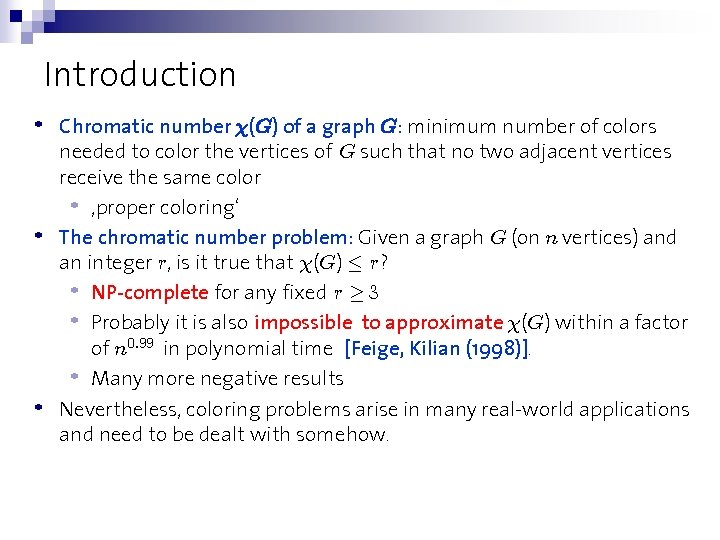
Introduction • • • Chromatic number (G) of a graph G: minimum number of colors needed to color the vertices of G such that no two adjacent vertices receive the same color • ‚proper coloring‘ The chromatic number problem: Given a graph G (on n vertices) and an integer r, is it true that (G) · r? • NP-complete for any fixed r ¸ 3 • Probably it is also impossible to approximate (G) within a factor of n 0. 99 in polynomial time [Feige, Kilian (1998)]. • Many more negative results Nevertheless, coloring problems arise in many real-world applications and need to be dealt with somehow.
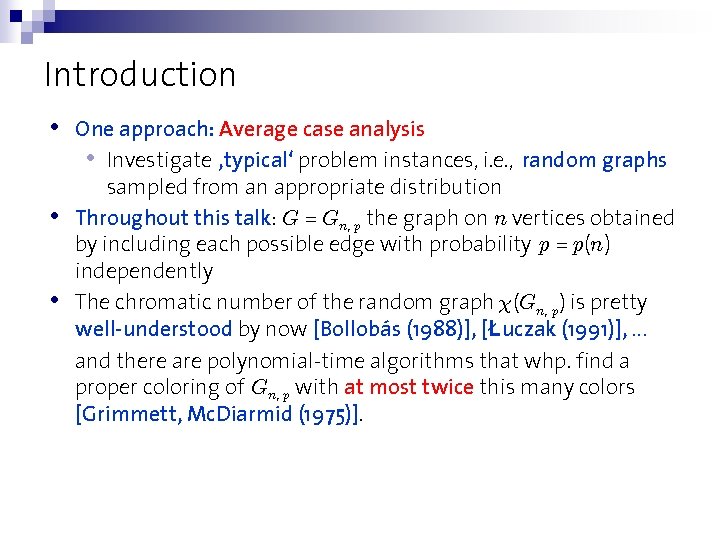
Introduction • • • One approach: Average case analysis • Investigate ‚typical‘ problem instances, i. e. , random graphs sampled from an appropriate distribution Throughout this talk: G = Gn, p the graph on n vertices obtained by including each possible edge with probability p = p(n) independently The chromatic number of the random graph (Gn, p) is pretty well-understood by now [Bollobás (1988)], [Łuczak (1991)], … and there are polynomial-time algorithms that whp. find a proper coloring of Gn, p with at most twice this many colors [Grimmett, Mc. Diarmid (1975)].
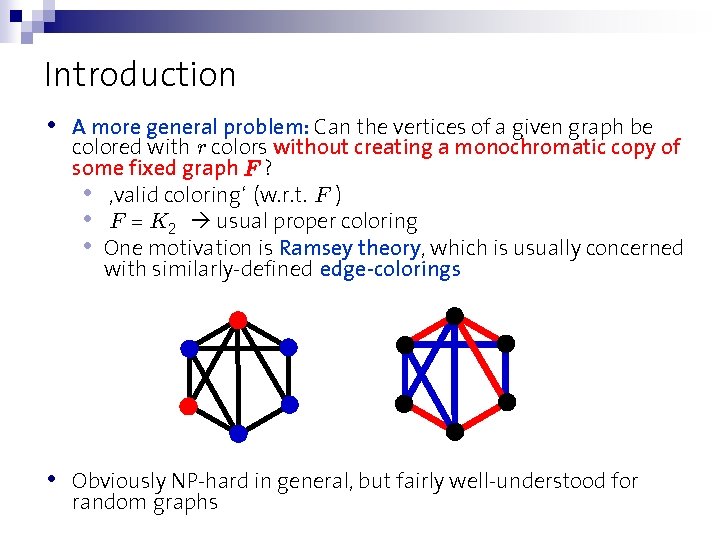
Introduction • A more general problem: Can the vertices of a given graph be colored with r colors without creating a monochromatic copy of some fixed graph F ? • ‚valid coloring‘ (w. r. t. F ) • F = K 2 usual proper coloring • One motivation is Ramsey theory, which is usually concerned with similarly-defined edge-colorings • Obviously NP-hard in general, but fairly well-understood for random graphs
![Introduction • [Łuczak, Ruciński, Voigt (1992)]: For any fixed graph F and any fixed](http://slidetodoc.com/presentation_image/b4f64e041fa84cc9a99880fcf5186912/image-5.jpg "Introduction • [Łuczak, Ruciński, Voigt (1992)]: For any fixed graph F and any fixed")
Introduction • [Łuczak, Ruciński, Voigt (1992)]: For any fixed graph F and any fixed number of colors r ¸ 2, there are explicit threshold functions p 0(F, r, n) such that • e. g. , p 0(K 3, 2, n) = n-2/3 • Lower bound proof is algorithmic, i. e. , there is a polynomial-time algorithm that whp. finds a valid coloring of Gn, p if p ¿ p 0
![Introduction • [Łuczak, Ruciński, Voigt (1992)]: For any fixed graph F and any fixed](http://slidetodoc.com/presentation_image/b4f64e041fa84cc9a99880fcf5186912/image-6.jpg "Introduction • [Łuczak, Ruciński, Voigt (1992)]: For any fixed graph F and any fixed")
Introduction • [Łuczak, Ruciński, Voigt (1992)]: For any fixed graph F and any fixed number of colors r ¸ 2, there are explicit threshold functions p 0(F, r, n) such that • Lower bound proof is algorithmic, i. e. , there is a polynomial-time algorithm that whp. finds a valid coloring of Gn, p if p ¿ p 0. • We transfer these results into an online setting, where the vertices of Gn, p have to be colored one by one before seeing the entire graph.
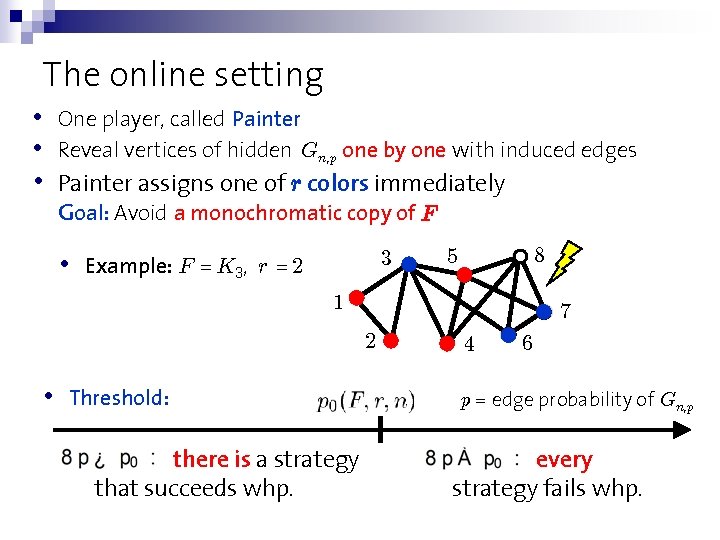
The online setting • • • One player, called Painter Reveal vertices of hidden Gn, p one by one with induced edges Painter assigns one of r colors immediately Goal: Avoid a monochromatic copy of F • 3 Example: F = K 3, r = 2 8 5 1 7 2 • Threshold: there is a strategy that succeeds whp. 4 6 p = edge probability of Gn, p every strategy fails whp.
![The online setting • [Marciniszyn, Spöhel (SODA ’ 07)]: • Explicit threshold functions p](http://slidetodoc.com/presentation_image/b4f64e041fa84cc9a99880fcf5186912/image-8.jpg "The online setting • [Marciniszyn, Spöhel (SODA ’ 07)]: • Explicit threshold functions p")
The online setting • [Marciniszyn, Spöhel (SODA ’ 07)]: • Explicit threshold functions p 0(F, r, n) for a large class of graphs F, including cliques and cycles • e. g. , p 0(K 3, 2, n) = n-3/4 • For these graphs, a simple greedy strategy is best possible for Painter. • can easily be implemented as a polynomial-time algorithm • The greedy strategy is not optimal for every graph. greedy strategy optimal the general case remained open ?
![The online setting • [M. , Rast, Spöhel (SODA ’ 11)] (this talk): •](http://slidetodoc.com/presentation_image/b4f64e041fa84cc9a99880fcf5186912/image-9.jpg "The online setting • [M. , Rast, Spöhel (SODA ’ 11)] (this talk): •")
The online setting • [M. , Rast, Spöhel (SODA ’ 11)] (this talk): • For any fixed F and r, we can compute a rational number such that the threshold is. • • We can also compute explicit Painter strategies that succeed for all p ¿ p 0 whp. and can be implemented as polynomial-time algorithms. Key insight: The probabilistic problem is closely related to an appropriately defined deterministic two-player game. greedy strategy optimal we solve the problem in full generality !
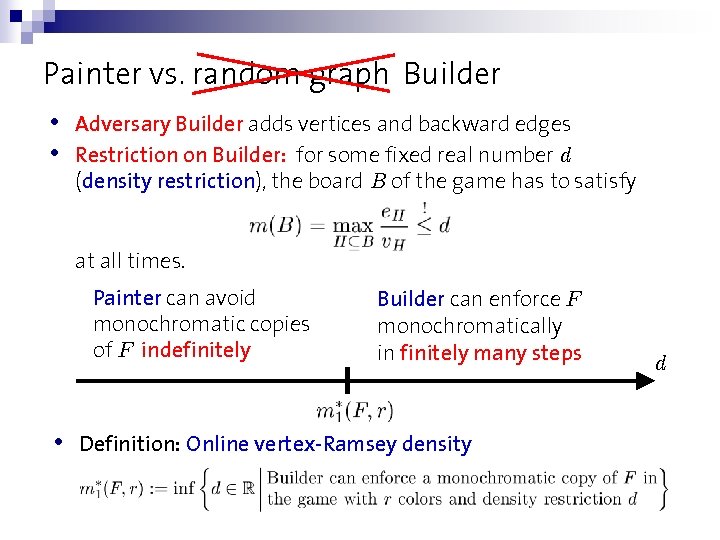
Painter vs. random graph Builder • Adversary Builder adds vertices and backward edges • Restriction on Builder: for some fixed real number d (density restriction), the board B of the game has to satisfy at all times. Painter can avoid monochromatic copies of F indefinitely • Builder can enforce F monochromatically in finitely many steps Definition: Online vertex-Ramsey density d
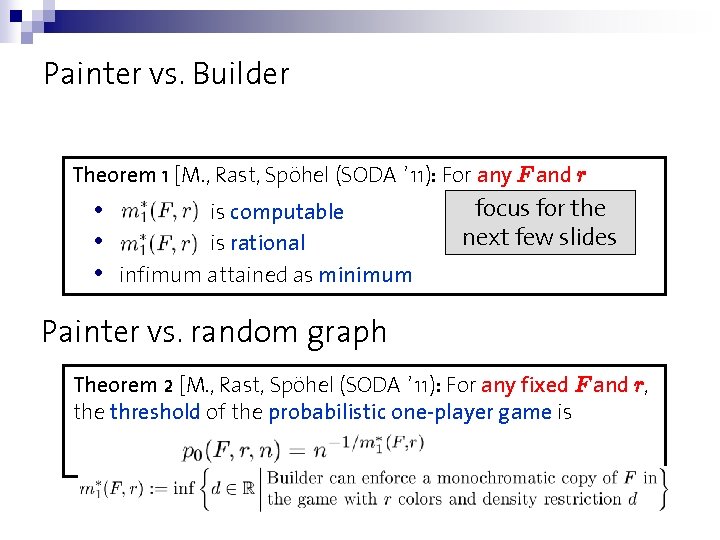
Painter vs. Builder Theorem 1 [M. , Rast, Spöhel (SODA ’ 11): For any F and r • • • is computable is rational infimum attained as minimum focus for the next few slides Painter vs. random graph Theorem 2 [M. , Rast, Spöhel (SODA ’ 11): For any fixed F and r, the threshold of the probabilistic one-player game is
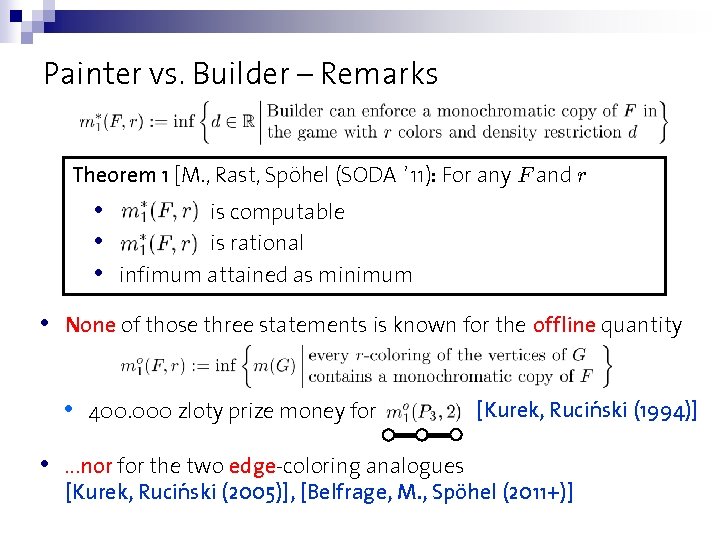
Painter vs. Builder – Remarks Theorem 1 [M. , Rast, Spöhel (SODA ’ 11): For any F and r • • None of those three statements is known for the offline quantity • • is computable is rational infimum attained as minimum 400. 000 zloty prize money for [Kurek, Ruciński (1994)] …nor for the two edge-coloring analogues [Kurek, Ruciński (2005)], [Belfrage, M. , Spöhel (2011+)]
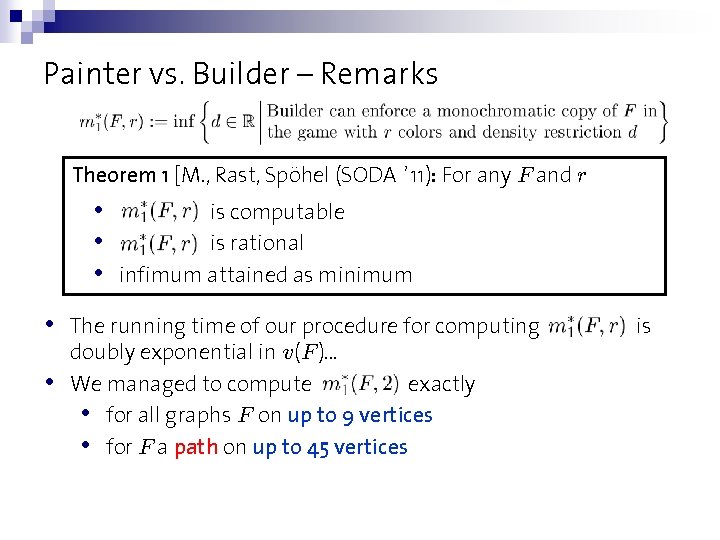
Painter vs. Builder – Remarks Theorem 1 [M. , Rast, Spöhel (SODA ’ 11): For any F and r • • • is computable is rational infimum attained as minimum The running time of our procedure for computing doubly exponential in v(F )… We managed to compute exactly • for all graphs F on up to 9 vertices • for F a path on up to 45 vertices is
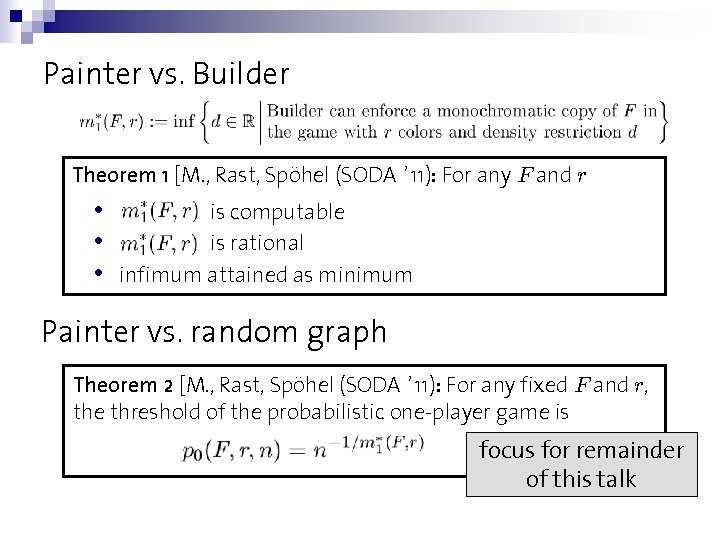
Painter vs. Builder Theorem 1 [M. , Rast, Spöhel (SODA ’ 11): For any F and r • • • is computable is rational infimum attained as minimum Painter vs. random graph Theorem 2 [M. , Rast, Spöhel (SODA ’ 11): For any fixed F and r, the threshold of the probabilistic one-player game is focus for remainder of this talk
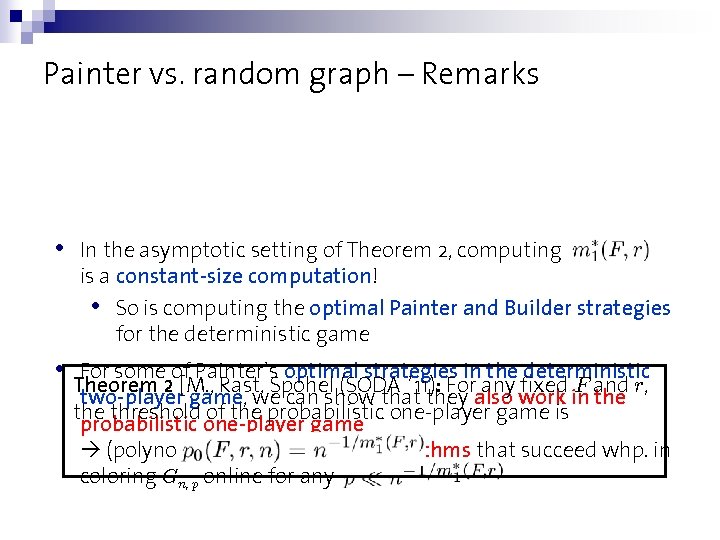
Painter vs. random graph – Remarks • In the asymptotic setting of Theorem 2, computing is a constant-size computation! • So is computing the optimal Painter and Builder strategies for the deterministic game • Theorem For some of Painter’s optimal strategies in the deterministic 2 [M. , Rast, Spöhel (SODA ’ 11): For any fixed F and r, two-player game, we can show that they also work in the threshold of the probabilistic one-player game is probabilistic one-player game (polynomial-time) coloring algorithms that succeed whp. in coloring Gn, p online for any
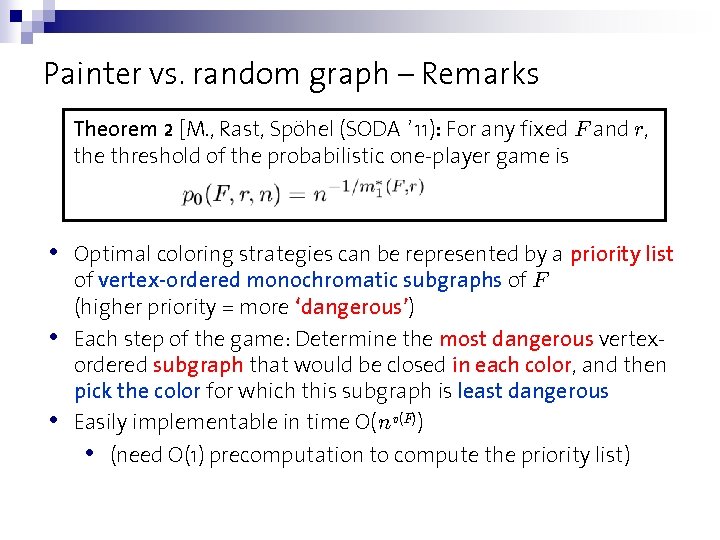
Painter vs. random graph – Remarks Theorem 2 [M. , Rast, Spöhel (SODA ’ 11): For any fixed F and r, the threshold of the probabilistic one-player game is • • • Optimal coloring strategies can be represented by a priority list of vertex-ordered monochromatic subgraphs of F (higher priority = more ‘dangerous’) Each step of the game: Determine the most dangerous vertexordered subgraph that would be closed in each color, and then pick the color for which this subgraph is least dangerous Easily implementable in time O(nv(F)) • (need O(1) precomputation to compute the priority list)
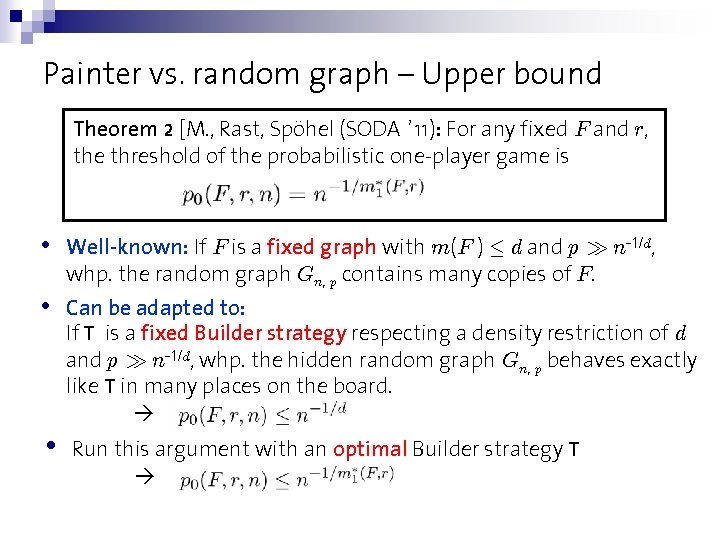
Painter vs. random graph – Upper bound Theorem 2 [M. , Rast, Spöhel (SODA ’ 11): For any fixed F and r, the threshold of the probabilistic one-player game is • • • Well-known: If F is a fixed graph with m(F ) · d and p À n-1/d, whp. the random graph Gn, p contains many copies of F. Can be adapted to: If T is a fixed Builder strategy respecting a density restriction of d and p À n-1/d, whp. the hidden random graph Gn, p behaves exactly like T in many places on the board. Run this argument with an optimal Builder strategy T
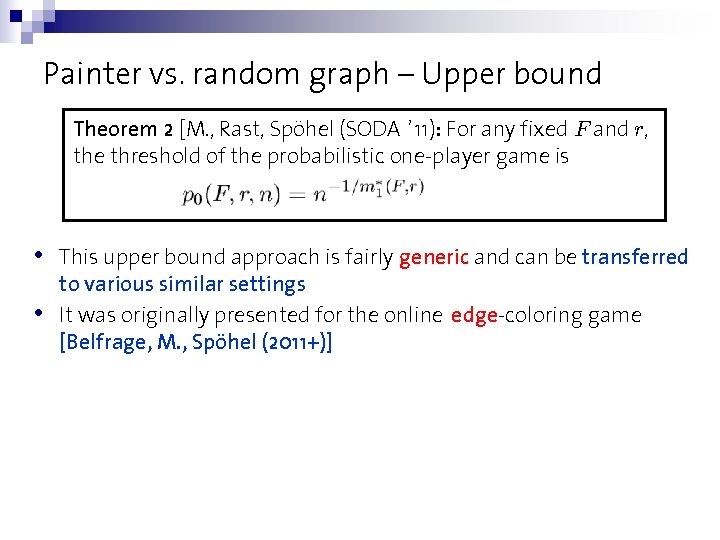
Painter vs. random graph – Upper bound Theorem 2 [M. , Rast, Spöhel (SODA ’ 11): For any fixed F and r, the threshold of the probabilistic one-player game is • • This upper bound approach is fairly generic and can be transferred to various similar settings It was originally presented for the online edge-coloring game [Belfrage, M. , Spöhel (2011+)]
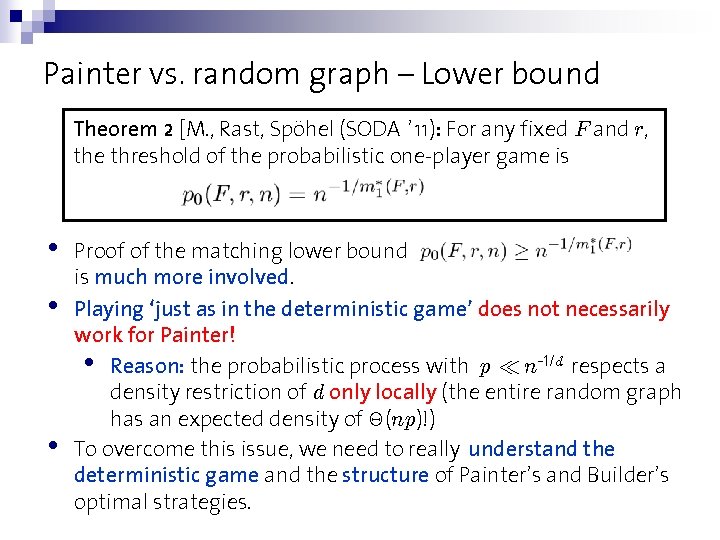
Painter vs. random graph – Lower bound Theorem 2 [M. , Rast, Spöhel (SODA ’ 11): For any fixed F and r, the threshold of the probabilistic one-player game is • • • Proof of the matching lower bound is much more involved. Playing ‘just as in the deterministic game’ does not necessarily work for Painter! • Reason: the probabilistic process with p ¿ n-1/d respects a density restriction of d only locally (the entire random graph has an expected density of £(np)!) To overcome this issue, we need to really understand the deterministic game and the structure of Painter’s and Builder’s optimal strategies.
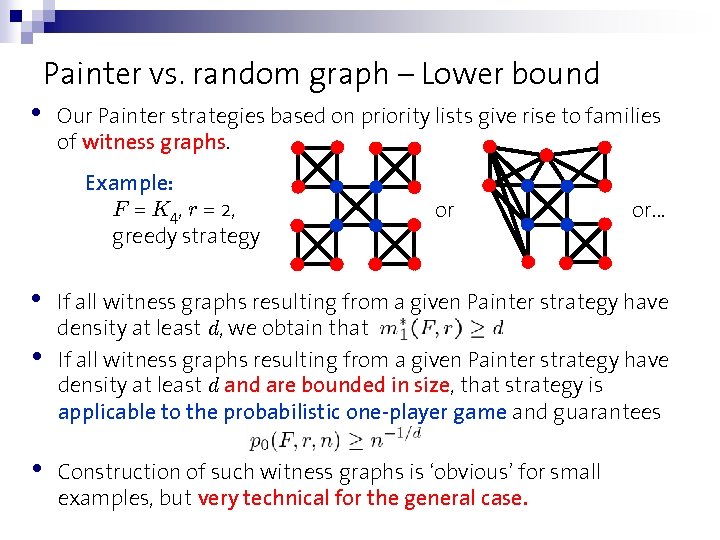
• Painter vs. random graph – Lower bound Our Painter strategies based on priority lists give rise to families of witness graphs. Example: F = K 4, r = 2, greedy strategy • • • or or… If all witness graphs resulting from a given Painter strategy have density at least d, we obtain that If all witness graphs resulting from a given Painter strategy have density at least d and are bounded in size, that strategy is applicable to the probabilistic one-player game and guarantees Construction of such witness graphs is ‘obvious’ for small examples, but very technical for the general case.
![Summary Theorem 1 [M. , Rast, Spöhel (SODA ’ 11)]: For any F and](http://slidetodoc.com/presentation_image/b4f64e041fa84cc9a99880fcf5186912/image-21.jpg "Summary Theorem 1 [M. , Rast, Spöhel (SODA ’ 11)]: For any F and")
Summary Theorem 1 [M. , Rast, Spöhel (SODA ’ 11)]: For any F and r • • • is computable is rational infimum attained as minimum Theorem 2 [M. , Rast, Spöhel (SODA ’ 11)]: For any fixed F and r, the threshold of the probabilistic one-player game is • Open question: Under what conditions are analogous statements true for other settings? In particular, are they true for the online edge-coloring game?
Thank you! Questions?
- Slides: 23