
Colorful interference herrings and butterfly wings 200 microns
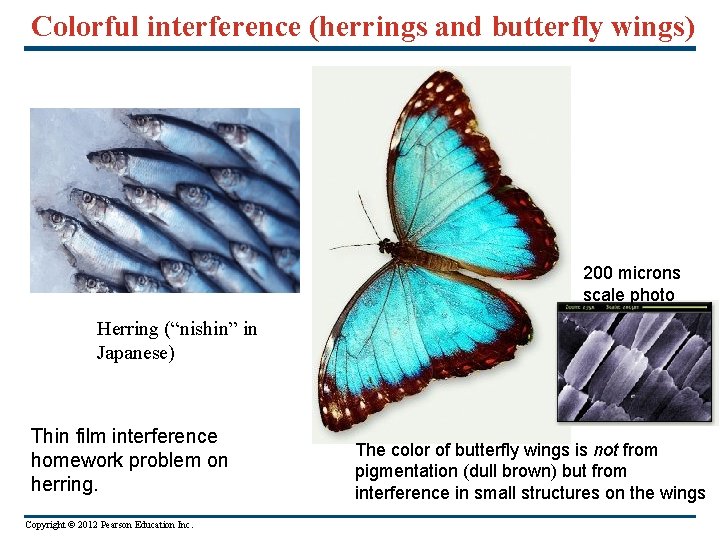
Colorful interference (herrings and butterfly wings) 200 microns scale photo Herring (“nishin” in Japanese) Thin film interference homework problem on herring. Copyright © 2012 Pearson Education Inc. The color of butterfly wings is not from pigmentation (dull brown) but from interference in small structures on the wings
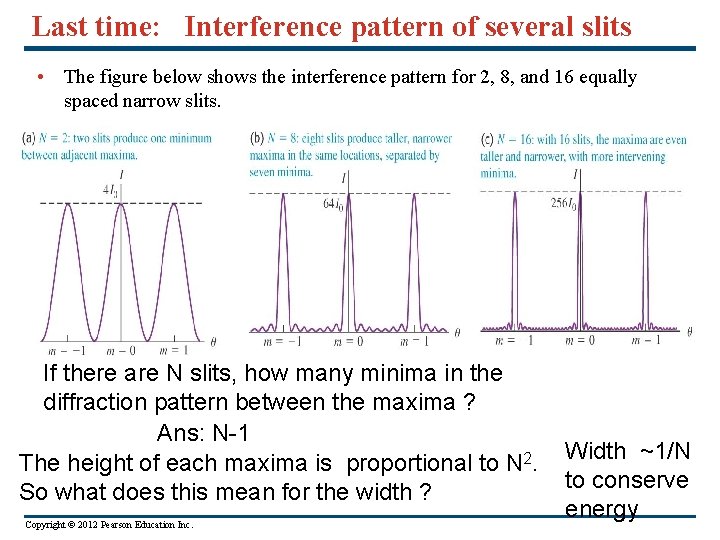
Last time: Interference pattern of several slits • The figure below shows the interference pattern for 2, 8, and 16 equally spaced narrow slits. If there are N slits, how many minima in the diffraction pattern between the maxima ? Ans: N-1 The height of each maxima is proportional to N 2. So what does this mean for the width ? Copyright © 2012 Pearson Education Inc. Width ~1/N to conserve energy
Today • Diffraction grating • Diffraction limit and Rayleigh criterion. • Crystal Diffraction. • Next time: Holography, review of diffraction (Chap 36) Copyright © 2012 Pearson Education Inc.
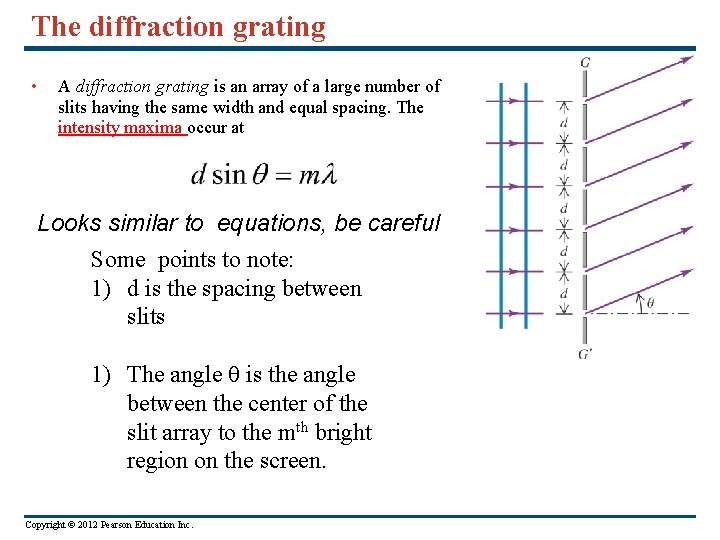
The diffraction grating • A diffraction grating is an array of a large number of slits having the same width and equal spacing. The intensity maxima occur at Looks similar to equations, be careful Some points to note: 1) d is the spacing between slits 1) The angle θ is the angle between the center of the slit array to the mth bright region on the screen. Copyright © 2012 Pearson Education Inc.
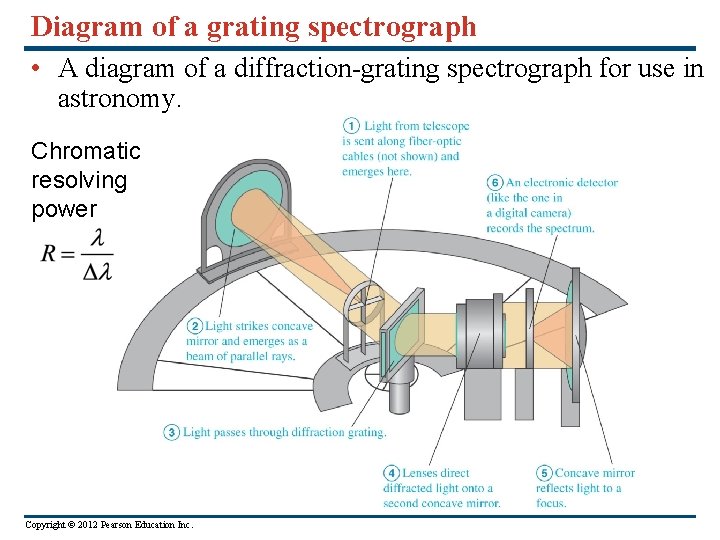
Diagram of a grating spectrograph • A diagram of a diffraction-grating spectrograph for use in astronomy. Chromatic resolving power Copyright © 2012 Pearson Education Inc.
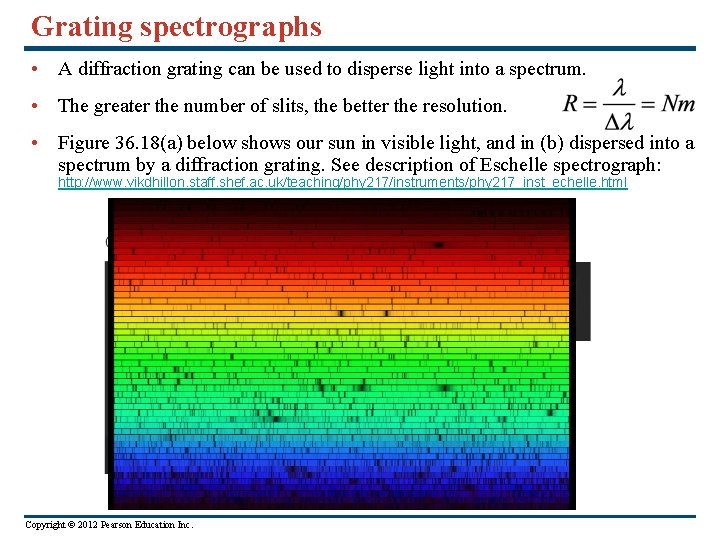
Grating spectrographs • A diffraction grating can be used to disperse light into a spectrum. • The greater the number of slits, the better the resolution. • Figure 36. 18(a) below shows our sun in visible light, and in (b) dispersed into a spectrum by a diffraction grating. See description of Eschelle spectrograph: http: //www. vikdhillon. staff. shef. ac. uk/teaching/phy 217/instruments/phy 217_inst_echelle. html Copyright © 2012 Pearson Education Inc.
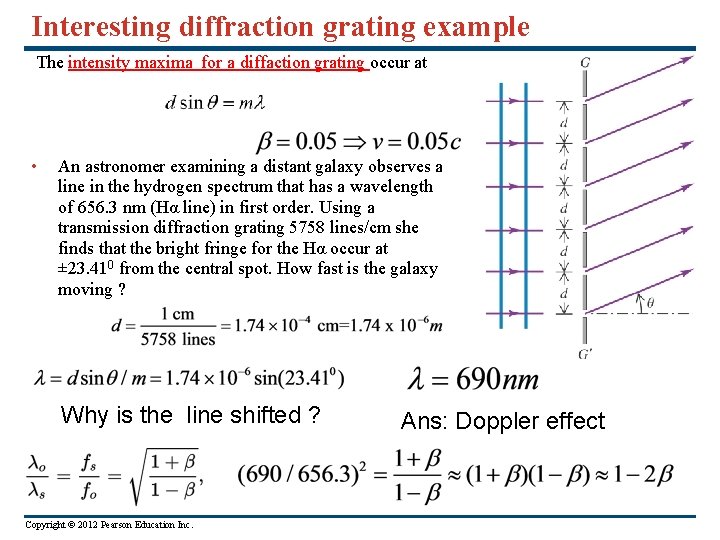
Interesting diffraction grating example The intensity maxima for a diffaction grating occur at • An astronomer examining a distant galaxy observes a line in the hydrogen spectrum that has a wavelength of 656. 3 nm (Hα line) in first order. Using a transmission diffraction grating 5758 lines/cm she finds that the bright fringe for the Hα occur at ± 23. 410 from the central spot. How fast is the galaxy moving ? Why is the line shifted ? Copyright © 2012 Pearson Education Inc. Ans: Doppler effect
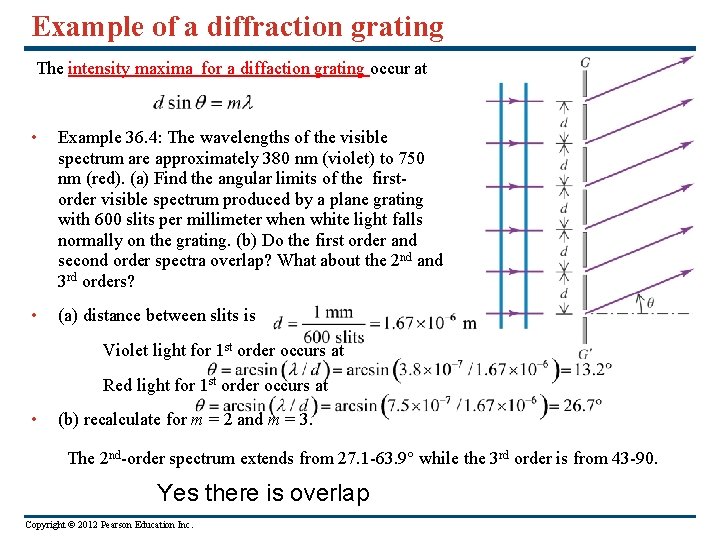
Example of a diffraction grating The intensity maxima for a diffaction grating occur at • Example 36. 4: The wavelengths of the visible spectrum are approximately 380 nm (violet) to 750 nm (red). (a) Find the angular limits of the firstorder visible spectrum produced by a plane grating with 600 slits per millimeter when white light falls normally on the grating. (b) Do the first order and second order spectra overlap? What about the 2 nd and 3 rd orders? • (a) distance between slits is Violet light for 1 st order occurs at Red light for 1 st order occurs at • (b) recalculate for m = 2 and m = 3. The 2 nd-order spectrum extends from 27. 1 -63. 9° while the 3 rd order is from 43 -90. Yes there is overlap Copyright © 2012 Pearson Education Inc.
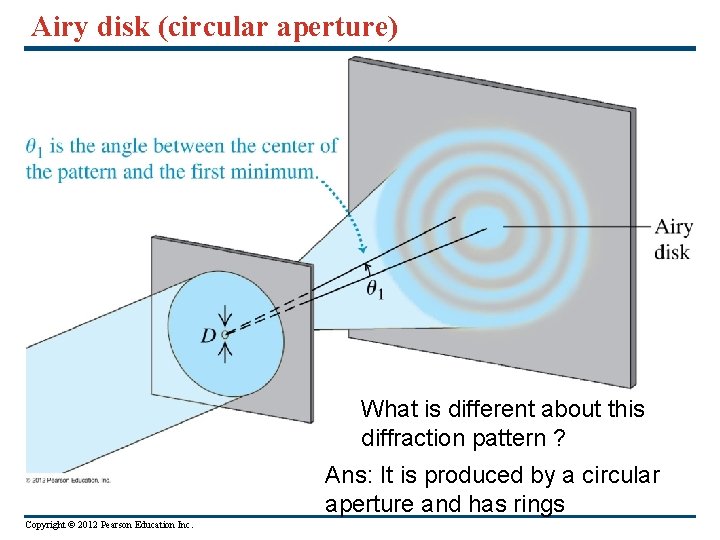
Airy disk (circular aperture) What is different about this diffraction pattern ? Ans: It is produced by a circular aperture and has rings Copyright © 2012 Pearson Education Inc.
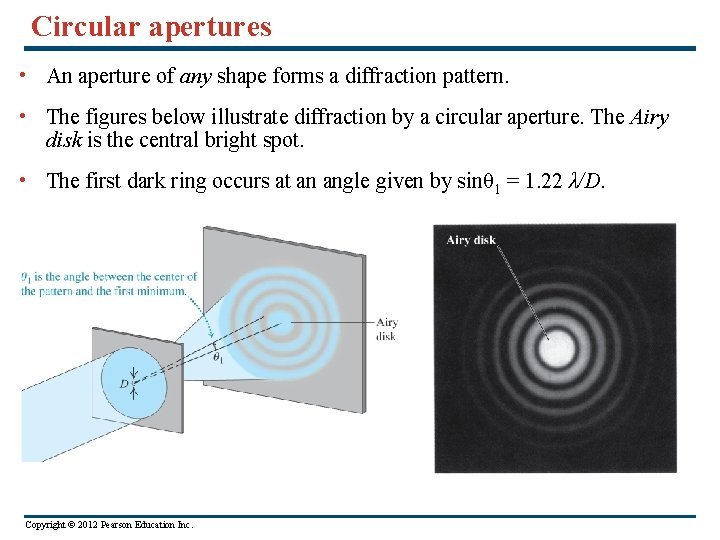
Circular apertures • An aperture of any shape forms a diffraction pattern. • The figures below illustrate diffraction by a circular aperture. The Airy disk is the central bright spot. • The first dark ring occurs at an angle given by sinθ 1 = 1. 22 λ/D. Copyright © 2012 Pearson Education Inc.
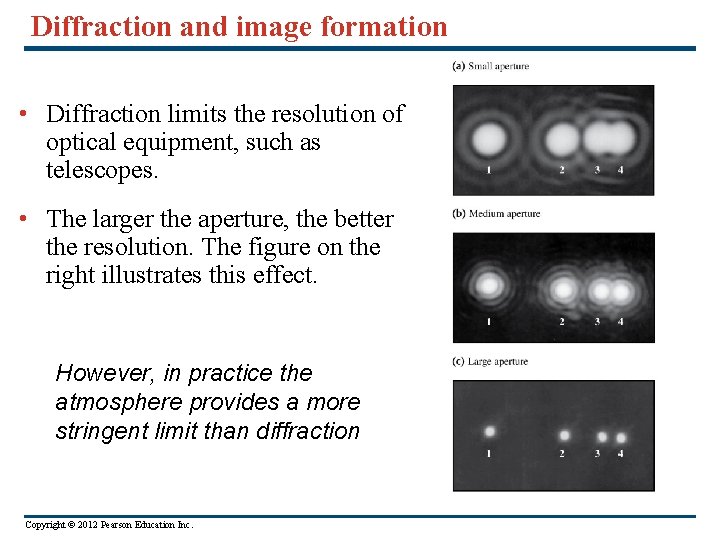
Diffraction and image formation • Diffraction limits the resolution of optical equipment, such as telescopes. • The larger the aperture, the better the resolution. The figure on the right illustrates this effect. However, in practice the atmosphere provides a more stringent limit than diffraction Copyright © 2012 Pearson Education Inc.
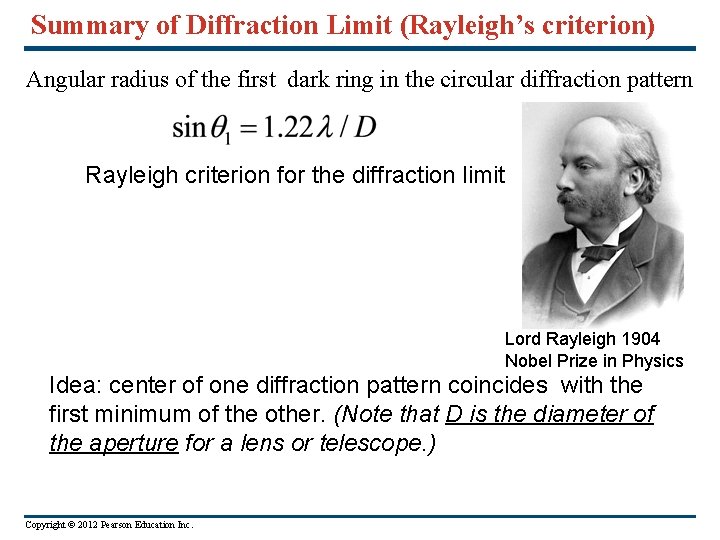
Summary of Diffraction Limit (Rayleigh’s criterion) Angular radius of the first dark ring in the circular diffraction pattern Rayleigh criterion for the diffraction limit Lord Rayleigh 1904 Nobel Prize in Physics Idea: center of one diffraction pattern coincides with the first minimum of the other. (Note that D is the diameter of the aperture for a lens or telescope. ) Copyright © 2012 Pearson Education Inc.
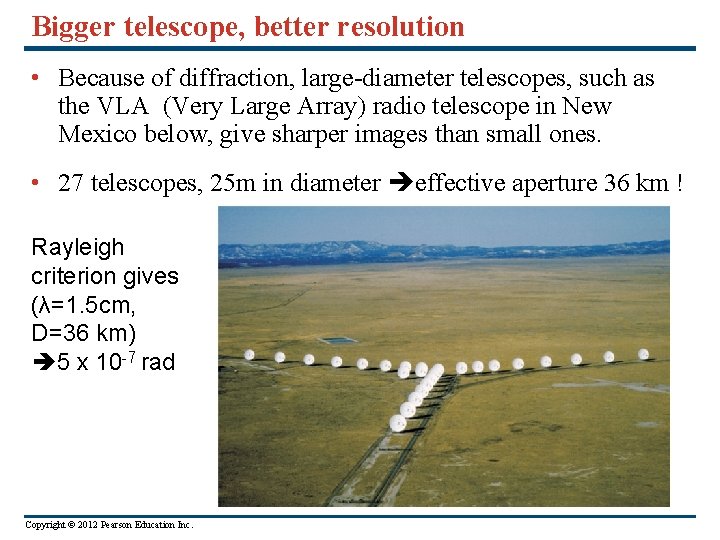
Bigger telescope, better resolution • Because of diffraction, large-diameter telescopes, such as the VLA (Very Large Array) radio telescope in New Mexico below, give sharper images than small ones. • 27 telescopes, 25 m in diameter effective aperture 36 km ! Rayleigh criterion gives (λ=1. 5 cm, D=36 km) 5 x 10 -7 rad Copyright © 2012 Pearson Education Inc.
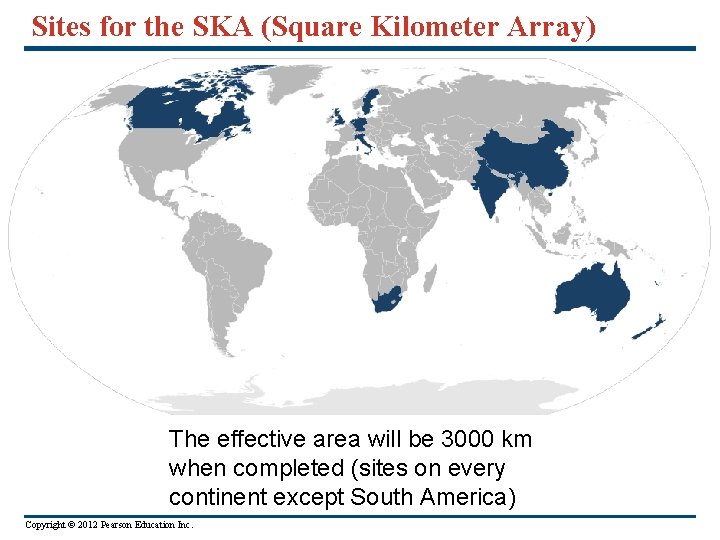
Sites for the SKA (Square Kilometer Array) The effective area will be 3000 km when completed (sites on every continent except South America) Copyright © 2012 Pearson Education Inc.
Crystal Diffraction Basics • Can we observe crystal diffraction with visible or ultraviolet light ? (Hint: what is the typical spacing of the components of a crystal. ) Ans: No, for example the wavelength of visible light is 400 -700 nm, but the plane spacing in Na. Cl is 0. 28 nm. UV is 100 nm to 380 nm so that won’t work either. How can we observe crystal diffraction and understand the atomic structure of a crystal (or a protein) ? Ans: use coherent x-rays Copyright © 2012 Pearson Education Inc.
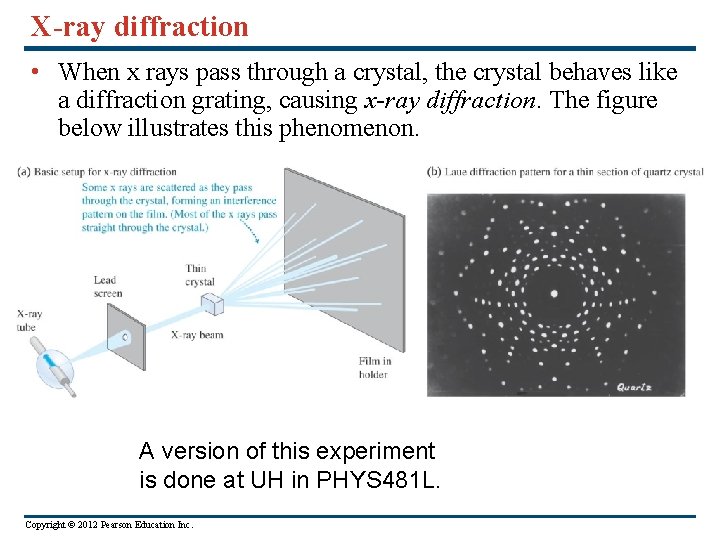
X-ray diffraction • When x rays pass through a crystal, the crystal behaves like a diffraction grating, causing x-ray diffraction. The figure below illustrates this phenomenon. A version of this experiment is done at UH in PHYS 481 L. Copyright © 2012 Pearson Education Inc.
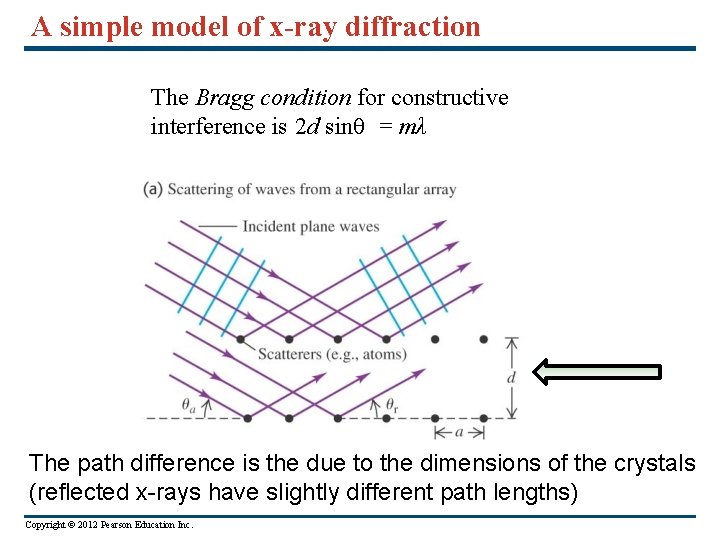
A simple model of x-ray diffraction The Bragg condition for constructive interference is 2 d sinθ = mλ The path difference is the due to the dimensions of the crystals (reflected x-rays have slightly different path lengths) Copyright © 2012 Pearson Education Inc.
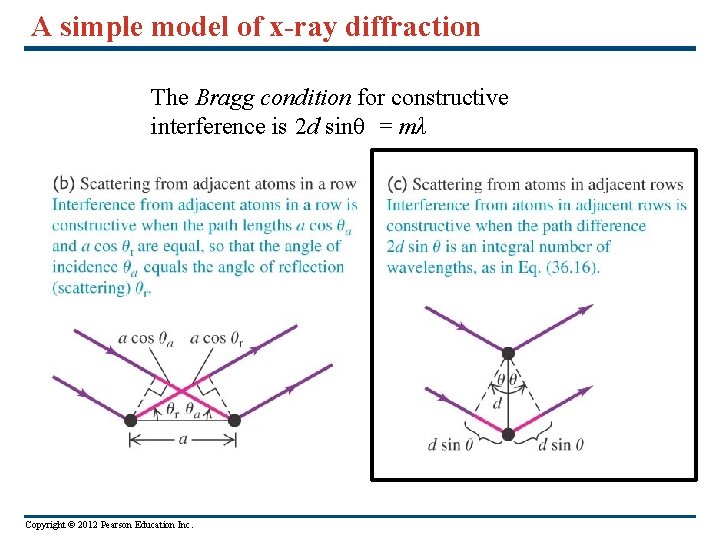
A simple model of x-ray diffraction The Bragg condition for constructive interference is 2 d sinθ = mλ Copyright © 2012 Pearson Education Inc.
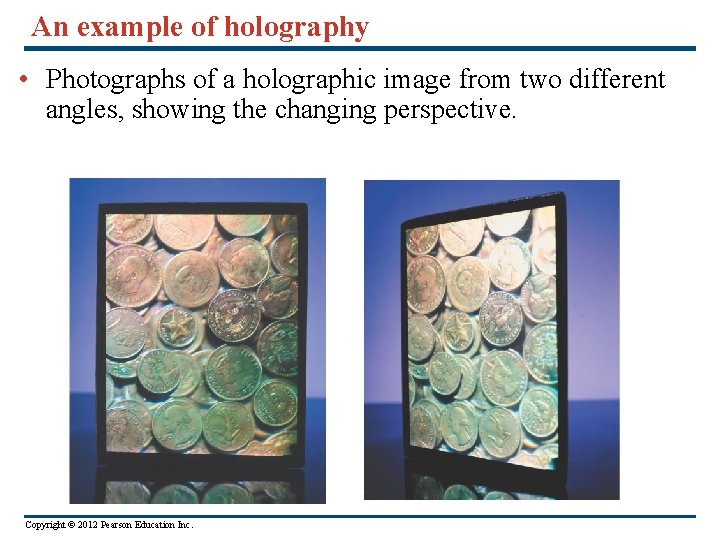
An example of holography • Photographs of a holographic image from two different angles, showing the changing perspective. Copyright © 2012 Pearson Education Inc.
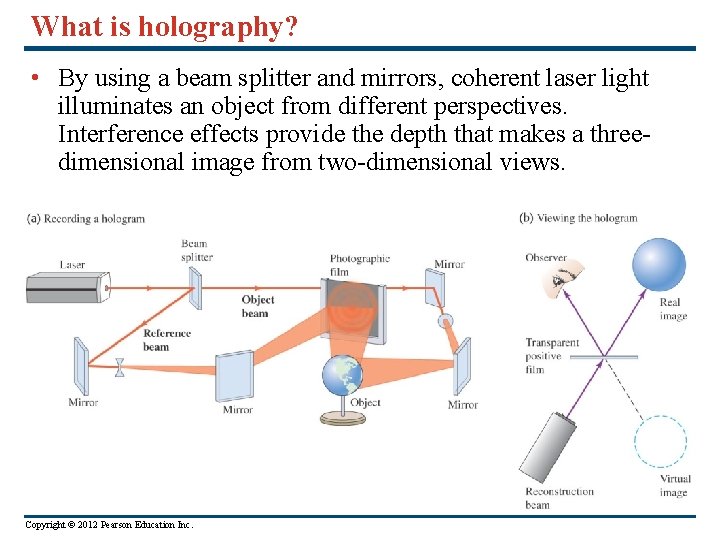
What is holography? • By using a beam splitter and mirrors, coherent laser light illuminates an object from different perspectives. Interference effects provide the depth that makes a threedimensional image from two-dimensional views. Copyright © 2012 Pearson Education Inc.
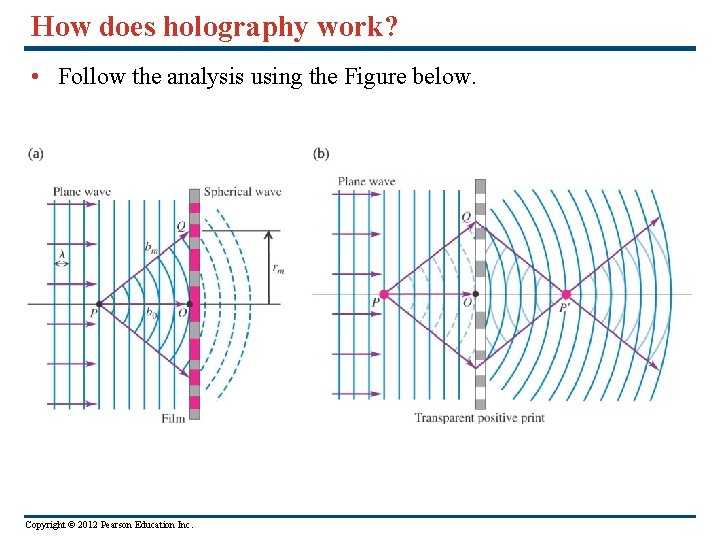
How does holography work? • Follow the analysis using the Figure below. Copyright © 2012 Pearson Education Inc.
- Slides: 21