
Colorectal cancer Three pathways Molecular genetics lab Kwak
Colorectal cancer : Three pathways Molecular genetics lab Kwak bomi
Index • Introductoin • Three pathways -CIN pathway -CIMP pathway -MSI pathway • Colorectal polyps: pathway precursors • summary
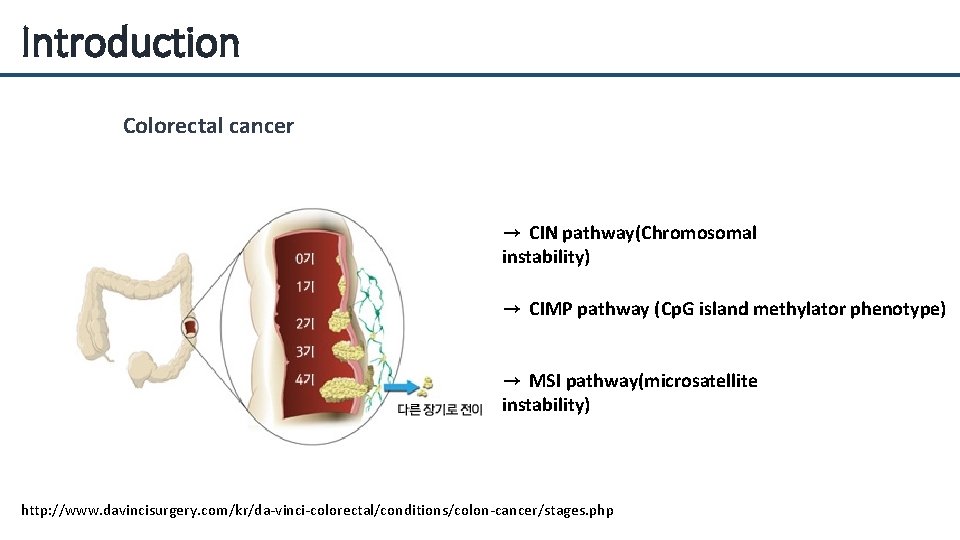
Introduction Colorectal cancer → CIN pathway(Chromosomal instability) → CIMP pathway (Cp. G island methylator phenotype) → MSI pathway(microsatellite instability) http: //www. davincisurgery. com/kr/da-vinci-colorectal/conditions/colon-cancer/stages. php
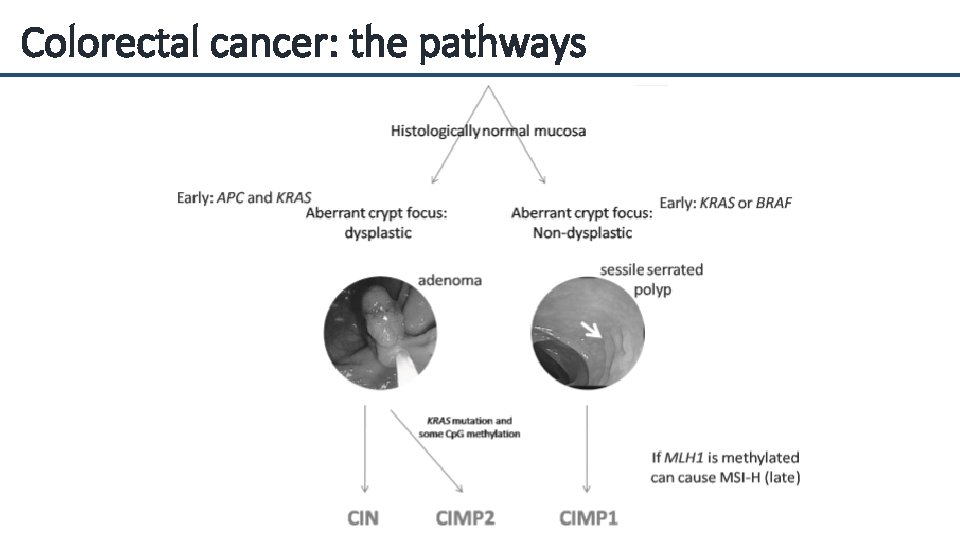
Colorectal cancer: the pathways
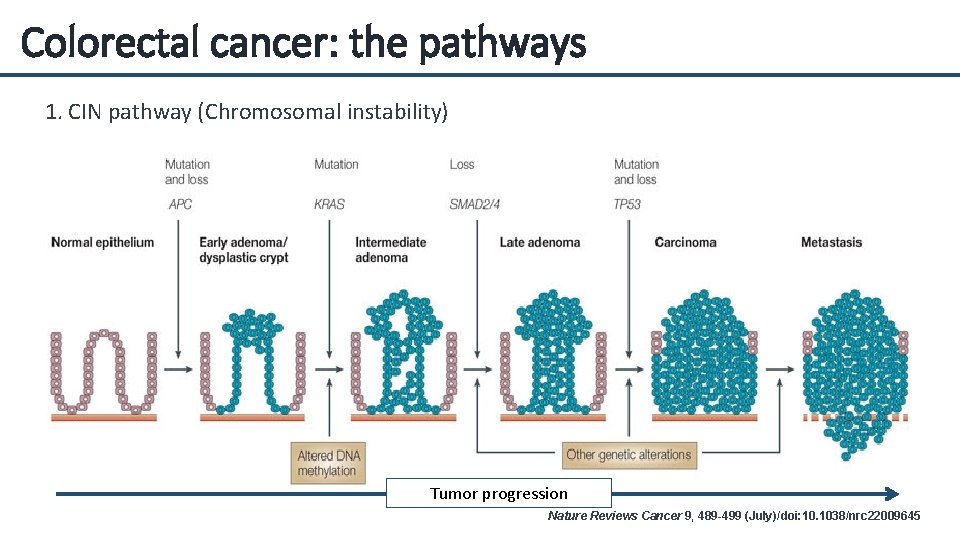
Colorectal cancer: the pathways 1. CIN pathway (Chromosomal instability) Tumor progression Nature Reviews Cancer 9, 489 -499 (July)/doi: 10. 1038/nrc 22009645
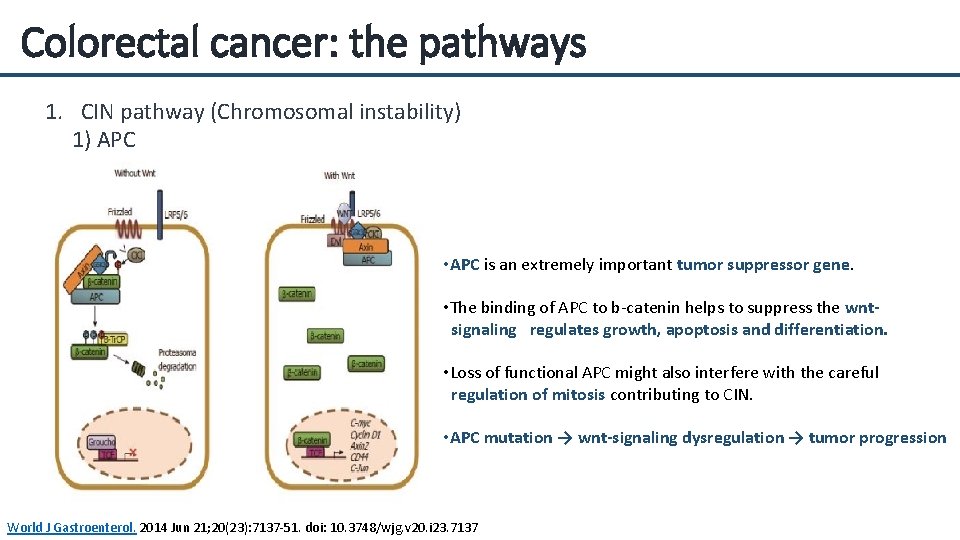
Colorectal cancer: the pathways 1. CIN pathway (Chromosomal instability) 1) APC • APC is an extremely important tumor suppressor gene. • The binding of APC to b-catenin helps to suppress the wntsignaling regulates growth, apoptosis and differentiation. • Loss of functional APC might also interfere with the careful regulation of mitosis contributing to CIN. • APC mutation → wnt-signaling dysregulation → tumor progression World J Gastroenterol. 2014 Jun 21; 20(23): 7137 -51. doi: 10. 3748/wjg. v 20. i 23. 7137
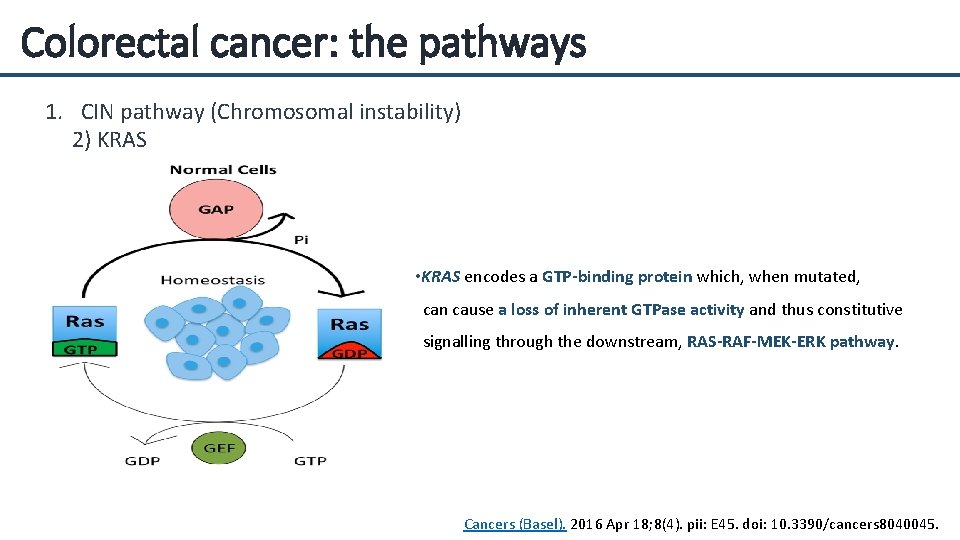
Colorectal cancer: the pathways 1. CIN pathway (Chromosomal instability) 2) KRAS • KRAS encodes a GTP-binding protein which, when mutated, can cause a loss of inherent GTPase activity and thus constitutive signalling through the downstream, RAS-RAF-MEK-ERK pathway. Cancers (Basel). 2016 Apr 18; 8(4). pii: E 45. doi: 10. 3390/cancers 8040045.
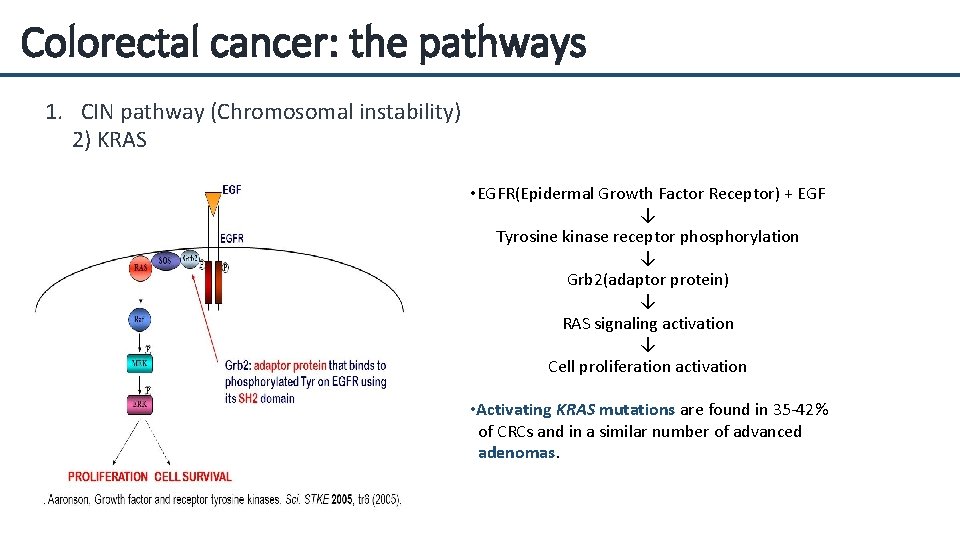
Colorectal cancer: the pathways 1. CIN pathway (Chromosomal instability) 2) KRAS • EGFR(Epidermal Growth Factor Receptor) + EGF ↓ Tyrosine kinase receptor phosphorylation ↓ Grb 2(adaptor protein) ↓ RAS signaling activation ↓ Cell proliferation activation • Activating KRAS mutations are found in 35 -42% of CRCs and in a similar number of advanced adenomas.
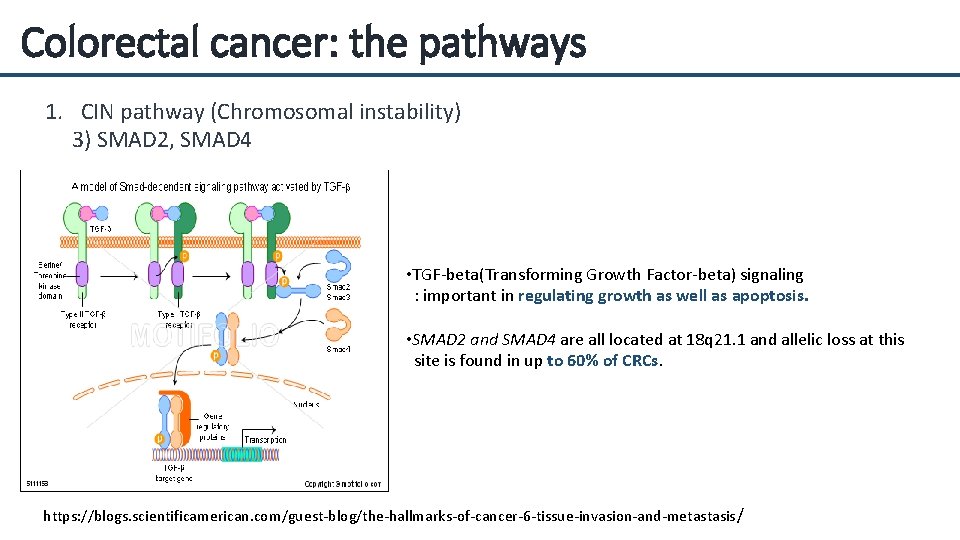
Colorectal cancer: the pathways 1. CIN pathway (Chromosomal instability) 3) SMAD 2, SMAD 4 • TGF-beta(Transforming Growth Factor-beta) signaling : important in regulating growth as well as apoptosis. • SMAD 2 and SMAD 4 are all located at 18 q 21. 1 and allelic loss at this site is found in up to 60% of CRCs. https: //blogs. scientificamerican. com/guest-blog/the-hallmarks-of-cancer-6 -tissue-invasion-and-metastasis /
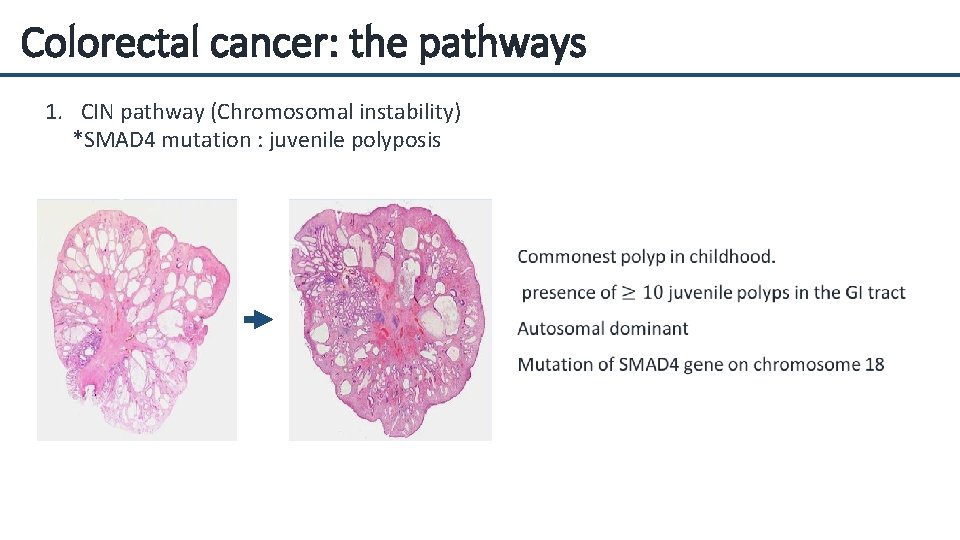
Colorectal cancer: the pathways 1. CIN pathway (Chromosomal instability) *SMAD 4 mutation : juvenile polyposis
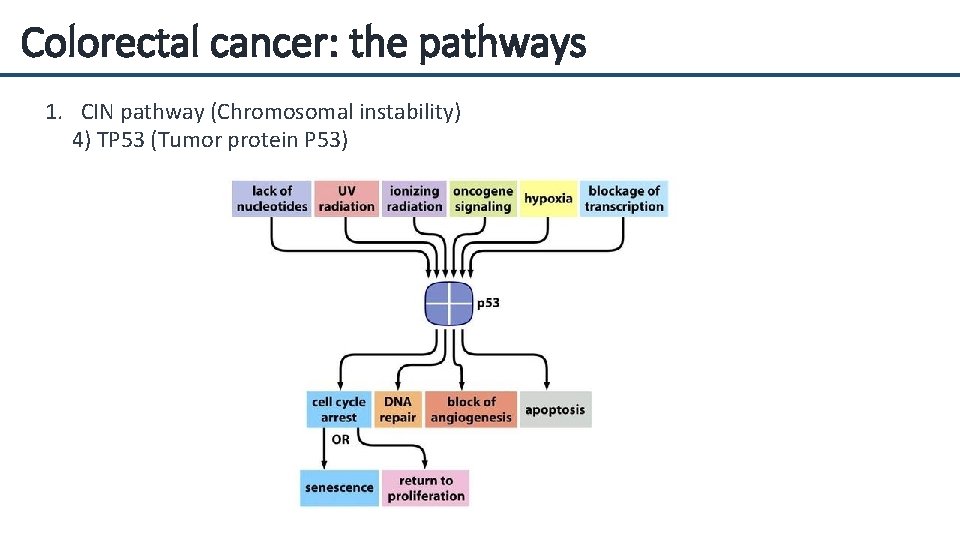
Colorectal cancer: the pathways 1. CIN pathway (Chromosomal instability) 4) TP 53 (Tumor protein P 53)
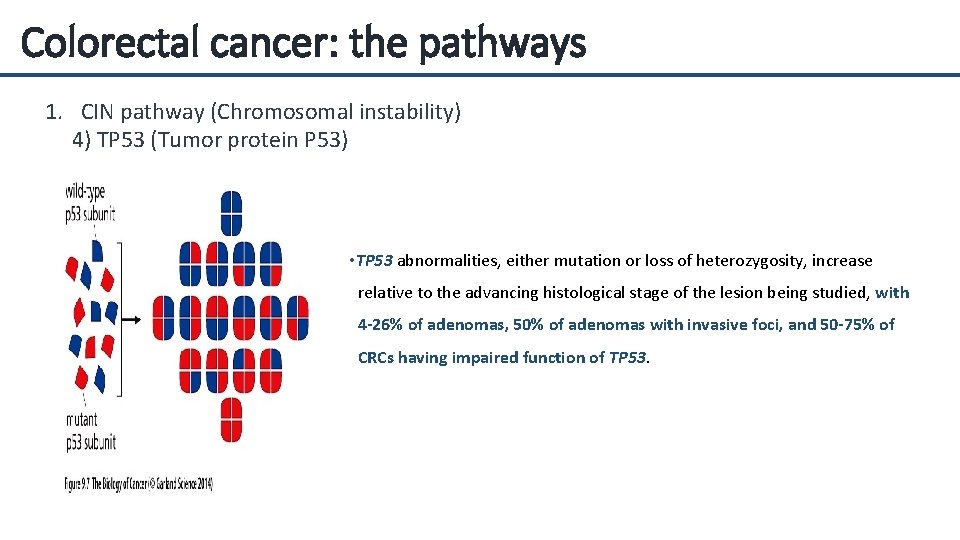
Colorectal cancer: the pathways 1. CIN pathway (Chromosomal instability) 4) TP 53 (Tumor protein P 53) • TP 53 abnormalities, either mutation or loss of heterozygosity, increase relative to the advancing histological stage of the lesion being studied, with 4 -26% of adenomas, 50% of adenomas with invasive foci, and 50 -75% of CRCs having impaired function of TP 53.
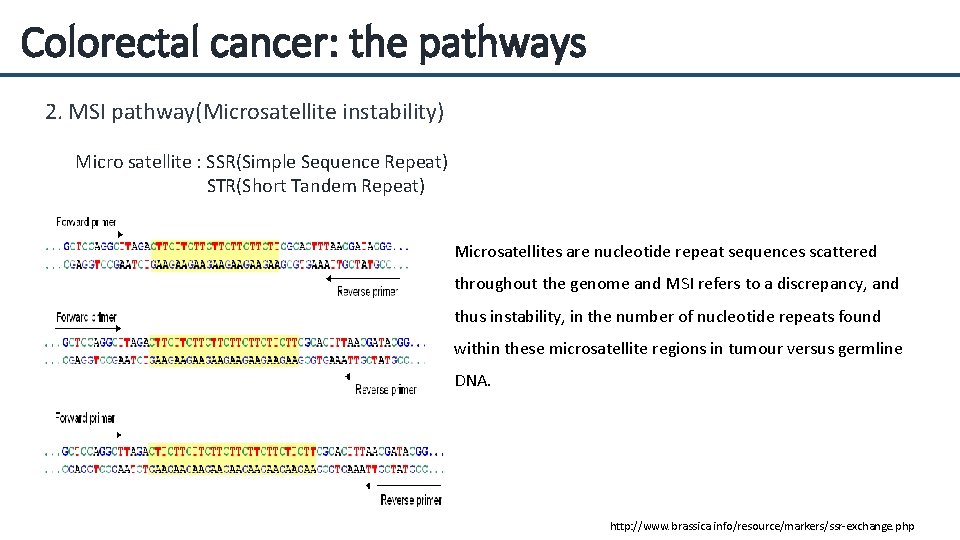
Colorectal cancer: the pathways 2. MSI pathway(Microsatellite instability) Micro satellite : SSR(Simple Sequence Repeat) STR(Short Tandem Repeat) Microsatellites are nucleotide repeat sequences scattered throughout the genome and MSI refers to a discrepancy, and thus instability, in the number of nucleotide repeats found within these microsatellite regions in tumour versus germline DNA. http: //www. brassica. info/resource/markers/ssr-exchange. php
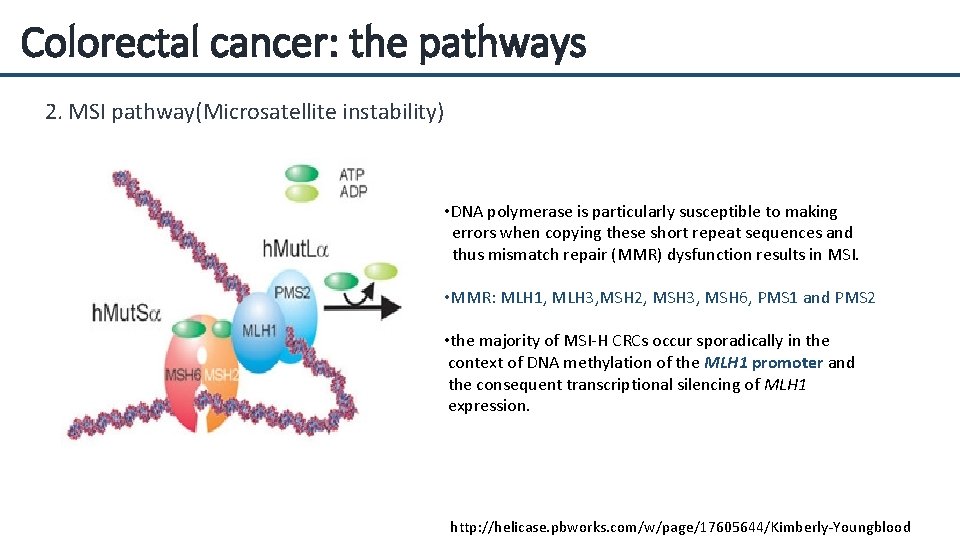
Colorectal cancer: the pathways 2. MSI pathway(Microsatellite instability) • DNA polymerase is particularly susceptible to making errors when copying these short repeat sequences and thus mismatch repair (MMR) dysfunction results in MSI. • MMR: MLH 1, MLH 3, MSH 2, MSH 3, MSH 6, PMS 1 and PMS 2 • the majority of MSI-H CRCs occur sporadically in the context of DNA methylation of the MLH 1 promoter and the consequent transcriptional silencing of MLH 1 expression. http: //helicase. pbworks. com/w/page/17605644/Kimberly-Youngblood
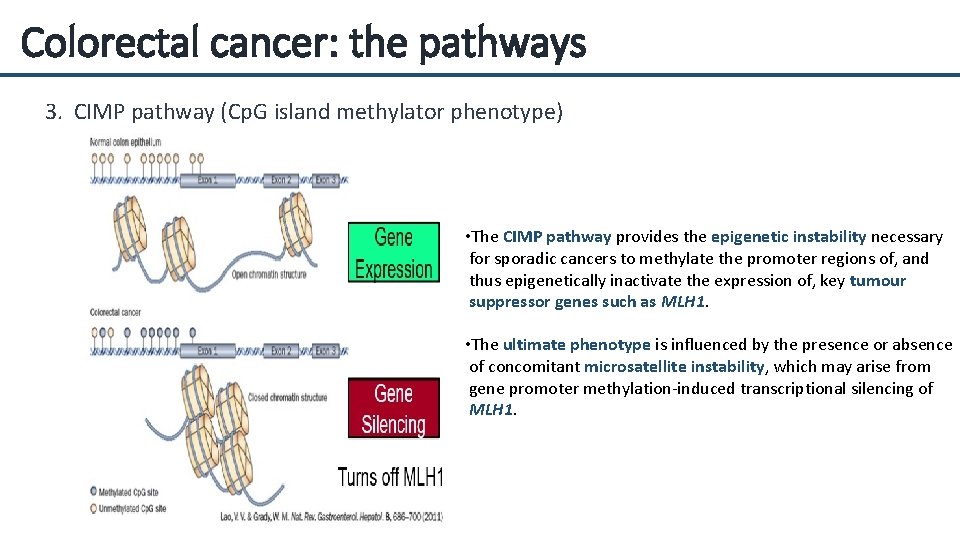
Colorectal cancer: the pathways 3. CIMP pathway (Cp. G island methylator phenotype) • The CIMP pathway provides the epigenetic instability necessary for sporadic cancers to methylate the promoter regions of, and thus epigenetically inactivate the expression of, key tumour suppressor genes such as MLH 1. • The ultimate phenotype is influenced by the presence or absence of concomitant microsatellite instability, which may arise from gene promoter methylation-induced transcriptional silencing of MLH 1.
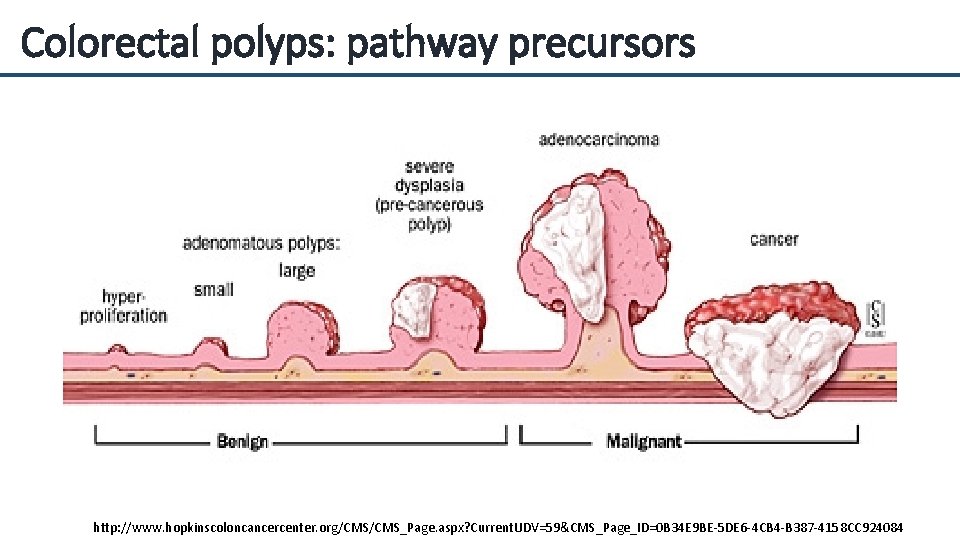
Colorectal polyps: pathway precursors http: //www. hopkinscoloncancercenter. org/CMS_Page. aspx? Current. UDV=59&CMS_Page_ID=0 B 34 E 9 BE-5 DE 6 -4 CB 4 -B 387 -4158 CC 924084
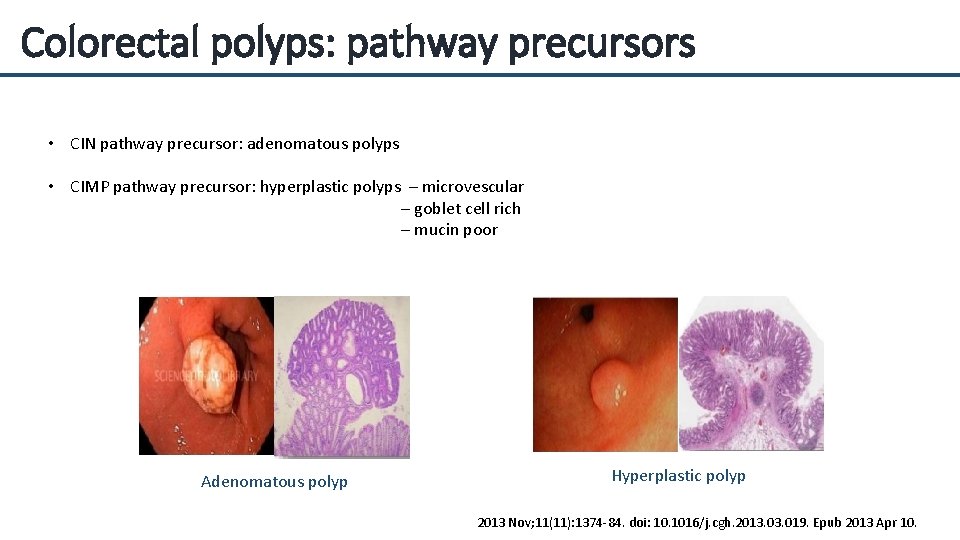
Colorectal polyps: pathway precursors • CIN pathway precursor: adenomatous polyps • CIMP pathway precursor: hyperplastic polyps – microvescular – goblet cell rich – mucin poor Adenomatous polyp Hyperplastic polyp 2013 Nov; 11(11): 1374 -84. doi: 10. 1016/j. cgh. 2013. 019. Epub 2013 Apr 10.
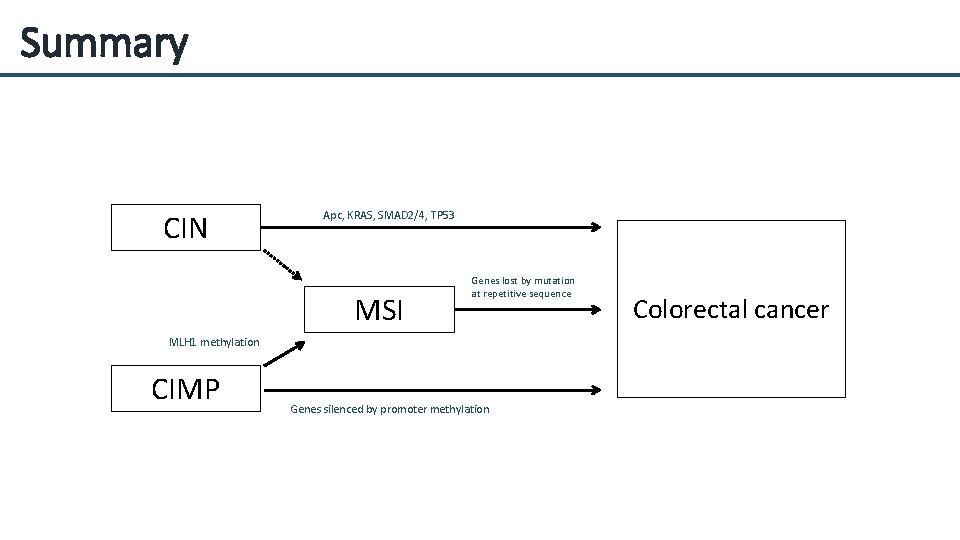
Summary CIN Apc, KRAS, SMAD 2/4, TP 53 MSI Genes lost by mutation at repetitive sequence MLH 1 methylation CIMP Genes silenced by promoter methylation Colorectal cancer
reference Clin Biochem Rev. 2010 May; 31(2): 31 -8. /Colorectal cancer: molecular features and clinical opportunities. /Worthley DL 1, Leggett BA. Oncogene. 2015 Mar 19; 34(12): 1608. doi: 10. 1038/onc. 2014. 462. World J Gastroenterol. 2014 Jun 21; 20(23): 7137 -51. doi: 10. 3748/wjg. v 20. i 23. 7137 Cancers (Basel). 2016 Apr 18; 8(4). pii: E 45. doi: 10. 3390/cancers 8040045. Current State-of-the-Science Adjuvant and Neoadjuvant Therapy in Surgically Resected Colorectal Cancer/By I. H. Sahin and C. R. Garrett /DOI: 10. 5772/57481 J Biomed Sci. 2011 Jun 7; 18: 36. doi: 10. 1186/1423 -0127 -18 -36. 2013 Nov; 11(11): 1374 -84. doi: 10. 1016/j. cgh. 2013. 019. Epub 2013 Apr 10.

Thank you
- Slides: 20