
COLORECTAL CANCER SCREENING 2021 WEBINAR FEBRUARY 25 2021
COLORECTAL CANCER SCREENING 2021 WEBINAR FEBRUARY 25, 2021 • WELCOME • AWARD ANNOUNCEMENT • SPEAKERS - Jacob Quail, MD - Joy Christensen, local cancer survivor
INTRODUCTION Early Detection Health Equity Task Force • • Draft Early Onset Colorectal Cancer Clinical Briefing Lung Cancer Screening Assessment Back on Track Cancer Screenings Join us! Contact Chair: Jill. Ireland@cancer. org 2021 SD Colorectal Cancer Screening Achievement Awards • Organization of the Year • Champion of the Year
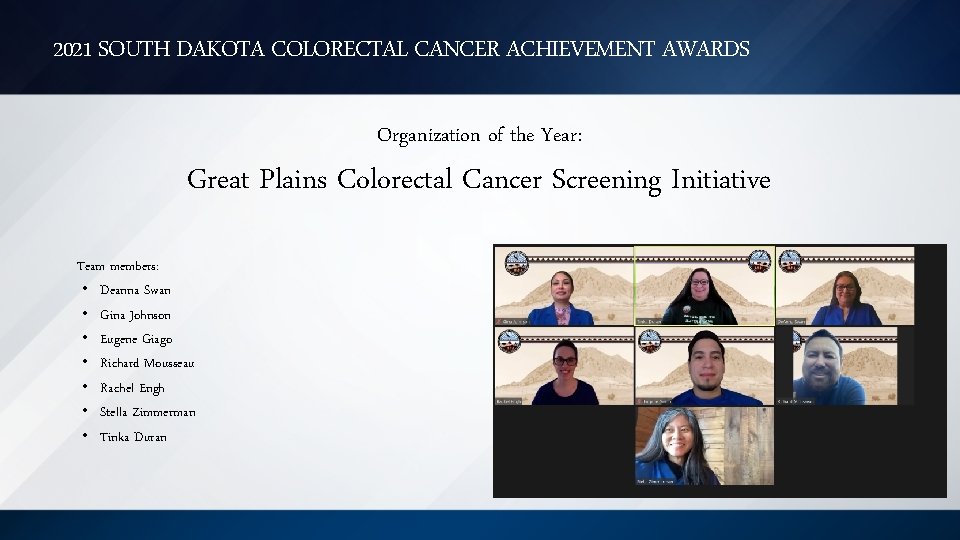
2021 SOUTH DAKOTA COLORECTAL CANCER ACHIEVEMENT AWARDS Organization of the Year: Great Plains Colorectal Cancer Screening Initiative Team members: • Deanna Swan • Gina Johnson • Eugene Giago • Richard Mousseau • Rachel Engh • Stella Zimmerman • Tinka Duran
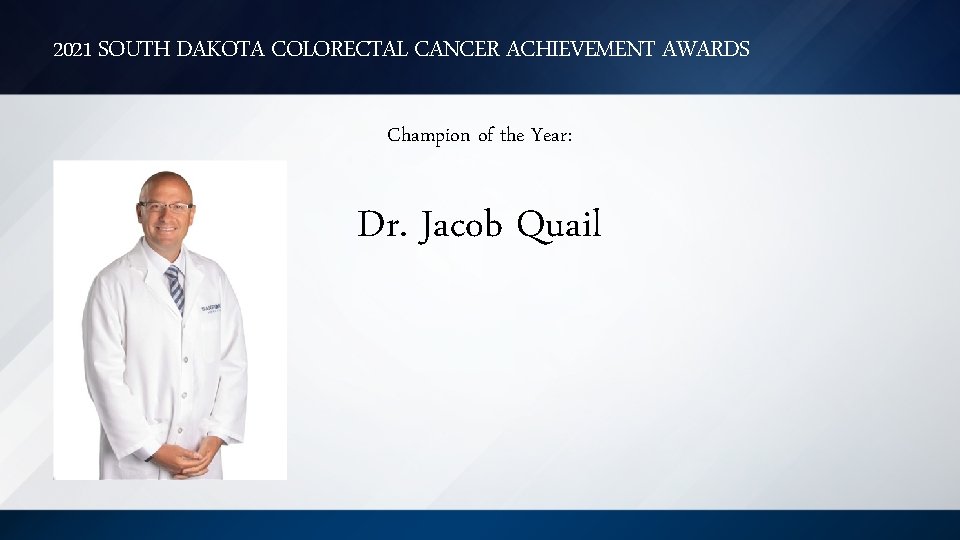
2021 SOUTH DAKOTA COLORECTAL CANCER ACHIEVEMENT AWARDS Champion of the Year: Dr. Jacob Quail
COLORECTAL CANCER SCREENING FOR HEALTHCARE PROFESSIONALS JACOB QUAIL, MD, FACS GENERAL SURGEON SANFORD HEALTH VERMILLION 25 FEBRUARY 2021
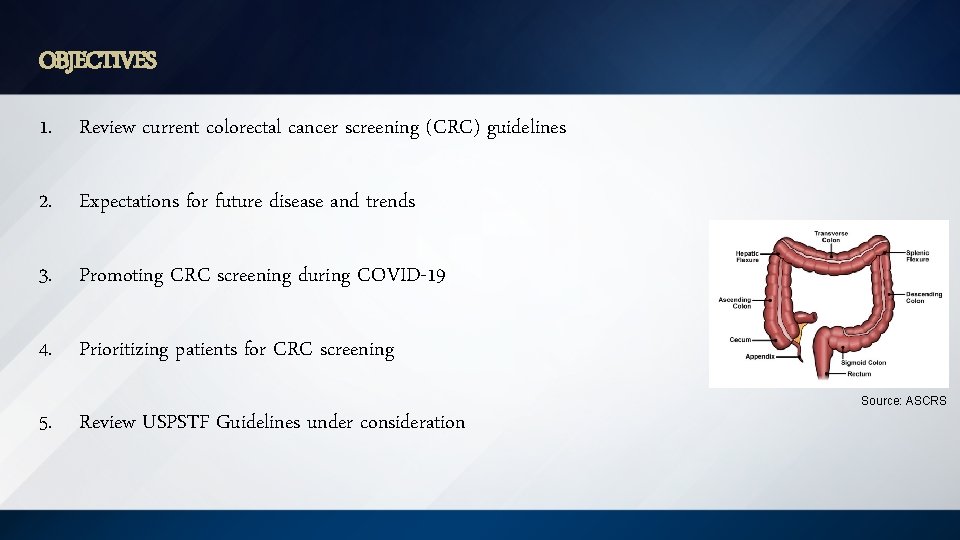
OBJECTIVES 1. Review current colorectal cancer screening (CRC) guidelines 2. Expectations for future disease and trends 3. Promoting CRC screening during COVID-19 4. Prioritizing patients for CRC screening Source: ASCRS 5. Review USPSTF Guidelines under consideration
COLORECTAL CANCER SCREENING • Why is this important for us and our communities? • Colorectal cancer is the second-leading cause of death from cancer in the United States • Estimated 149, 500 adults expected to be diagnosed in 2021 • Screening for CRC reduces the incidence of and death from the disease • Only 68. 8% of age-eligible adults report being up-to-date • Screening can detect disease early and also prevent cancer by removing precancerous polyps American Cancer Society Cancer Facts and Figures 2020. https: //www. cancer. org/content/dam/cancer-org/research/cancer-facts-and-statistics/annual-cancer-facts-and-figures/2020/cancer-facts-and-figures-2020. pdf

COLON POLYP PROGRESSION Source: BJM
COLORECTAL CANCER IN SOUTH DAKOTA • Estimates for 2021: • Cases • 450 new cases of colorectal cancer to be diagnosed in South Dakota • 149, 500 new cases of colorectal cancer to be diagnosed in the US • Approximately 13 x the population of Vermillion, SD • Deaths • 170 deaths due to colorectal cancer to occur in South Dakota • 52, 980 deaths due to CRC to occur in the US American Cancer Society Cancer Facts and Figures 2020. https: //www. cancer. org/content/dam/cancer-org/research/cancer-facts-and-statistics/annual-cancer-facts-and-figures/2020/cancer-facts-and-figures-2020. pdf
CRC SCREENING GUIDELINES LAST USPSTF UPDATE IN 2016 • Current USPSTF recommendations: • Screen for colorectal cancer starting at age 50 years old • For adults aged 76 to 85 years old, screening is individualized • Varies depending upon patient’s life expectancy, comorbid conditions and prior screening status • Greatest benefit for those that have never been screened before • USPSTF screening update is currently pending

CRC SCREENING TESTS • Advantage for CRC screening -> Many different options • Stool-based tests • Guaiac-based fecal occult blood test (g. FOBT) every year • Fecal immunochemical test (FIT) every year • Multi-targeted stool DNA test every 3 years • Cologuard/FIT-DNA • Direct visualization tests • Colonoscopy every 10 years • Flexible sigmoidoscopy every 5 years • CT colonography every 5 years • Positive stool-based test should be followed by a diagnostic colonoscopy Best screening test is the one that gets done!
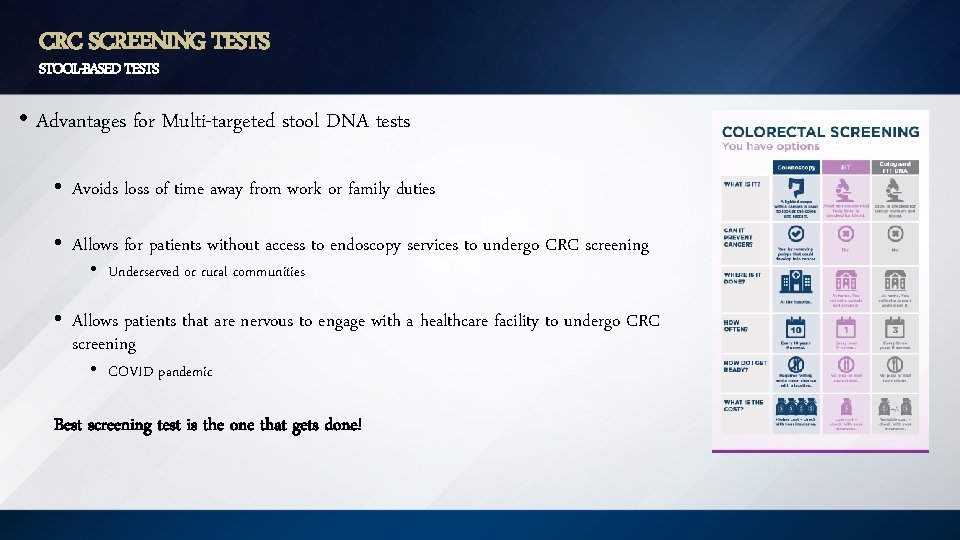
CRC SCREENING TESTS STOOL-BASED TESTS • Advantages for Multi-targeted stool DNA tests • Avoids loss of time away from work or family duties • Allows for patients without access to endoscopy services to undergo CRC screening • Underserved or rural communities • Allows patients that are nervous to engage with a healthcare facility to undergo CRC screening • COVID pandemic Best screening test is the one that gets done!
INCREASED RISK FOR CRC • Factors associated with an increased risk: • Older age, male sex and black race • Nearly 94% of new CRC cases occur in adults 45 years and older 1 • Median age of diagnosis is 68 years 2 • A personal history or family history of CRC or certain colon polyps (size > 1 cm) • Screening can begin at age 40 years (or 10 years before the age at diagnosis of a family member, whichever is earlier) in persons with a family history of CRC • Certain genetic syndromes have increased risk of developing CRC • A personal history of inflammatory bowel disease (IBD) 1 US 2 US Preventive Services Task Force. Colorectal Cancer: Screening Draft Recommendation Statement. October 27 th, 2020. Preventive Services Task Force. Screening for Colorectal Cancer. JAMA. June 21 st, 2016. Volume 315, Number 23.
EARLY-AGE ONSET COLORECTAL CANCER • Rate of CRC in young adults under the age of 55 has been increasing • Adults born in the 1990 s have double the lifetime risk of colon cancer and quadruple the risk of rectal cancer, compared to adults born in the 1950 s • Approximately 20% of all CRCs diagnosed in the US are among those under the age of 55 • Patients diagnosed with CRC prior to age 55 are 58% more likely to be diagnosed with more advanced disease This is due to a delay in diagnostic evaluation of symptoms and less access to medical care. Siegel, R et al. Colorectal Cancer Incidence Patterns in the United States, 1974 -2013 JNCI J Natl Cancer Inst (2017) 109(8); djw 322.
RED FLAG SIGNS AND SYMPTOMS • Early recognition of red flag symptoms may save lives… • • Rectal bleeding (Let’s talk about hemorrhoids) Change in bowel habits (i. e. constipation/diarrhea, change in stool caliber) Rectal or abdominal mass (Never forget the 24 year-old Marine) Lab abnormalities • Iron-deficiency anemia (Low MCV), Elevated platelets and inflammatory markers, Abnormal liver function tests • Abdominal pain • Must review the Family History • These patients should be evaluated with a diagnostic colonoscopy
CRC SCREENING DURING COVID 19 EXPECTATIONS FOR FUTURE DISEASE • Estimated 90% drop in colonoscopies and biopsies in March through mid-April 2020 compared to same period in 2019 • 1. 7 million missed colonoscopies from March to June 5 th, 2020 • 18, 000 missed or delayed diagnoses of CRC from mid-March through early June, 2020 • > 4, 500 excess deaths from CRC over next decade Cancer Screening During the COVID-19 Pandemic, American Cancer Society, October 2020
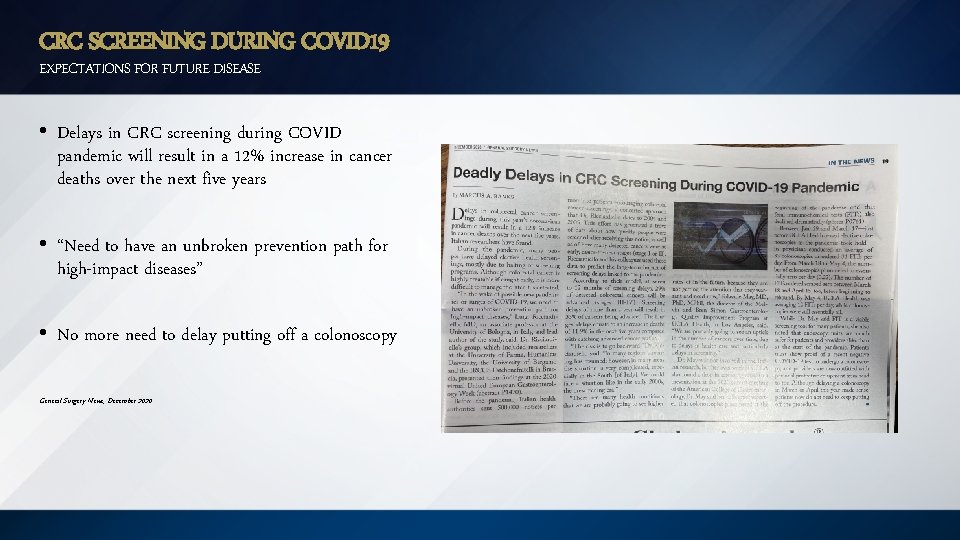
CRC SCREENING DURING COVID 19 EXPECTATIONS FOR FUTURE DISEASE • Delays in CRC screening during COVID pandemic will result in a 12% increase in cancer deaths over the next five years • “Need to have an unbroken prevention path for high-impact diseases” • No more need to delay putting off a colonoscopy General Surgery News, December 2020
CRC SCREENING DURING COVID 19 A UNITED MESSAGE • Cancer screening must remain a public health priority • Must be able to identify patients who should receive higher priority for CRC screening • Screening disparities are likely to increase as a result of the COVID-19 pandemic • Barriers to screening must be identified and strategies developed to overcome • Local data must be reviewed to identify screening disparities • Engaging patients to resume cancer screening requires effective and trustworthy messaging • Saying “We are open” is not enough, must be proactive in educating public • Implement of process and policy changes to sustain access to primary care and return screening to pre-COVID rates • Addressing missed screenings, prioritizing patients and expanding screening capacity Cancer Screening During the COVID-19 Pandemic, American Cancer Society, October 2020
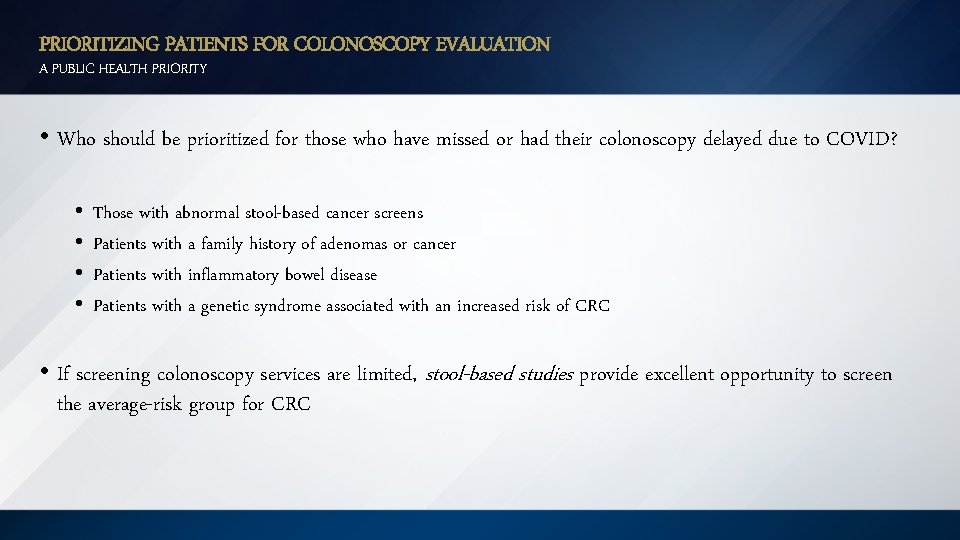
PRIORITIZING PATIENTS FOR COLONOSCOPY EVALUATION A PUBLIC HEALTH PRIORITY • Who should be prioritized for those who have missed or had their colonoscopy delayed due to COVID? • • Those with abnormal stool-based cancer screens Patients with a family history of adenomas or cancer Patients with inflammatory bowel disease Patients with a genetic syndrome associated with an increased risk of CRC • If screening colonoscopy services are limited, stool-based studies provide excellent opportunity to screen the average-risk group for CRC
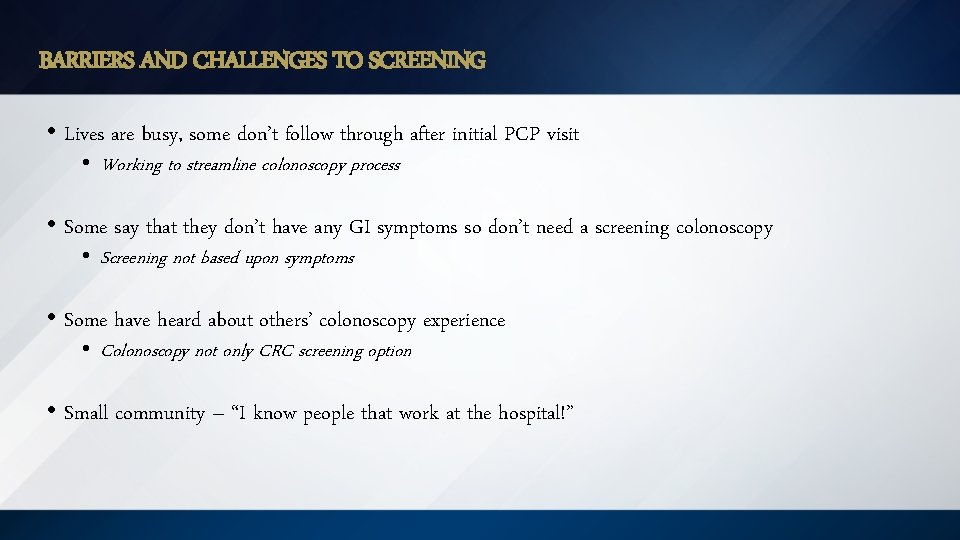
BARRIERS AND CHALLENGES TO SCREENING • Lives are busy, some don’t follow through after initial PCP visit • Working to streamline colonoscopy process • Some say that they don’t have any GI symptoms so don’t need a screening colonoscopy • Screening not based upon symptoms • Some have heard about others’ colonoscopy experience • Colonoscopy not only CRC screening option • Small community – “I know people that work at the hospital!”
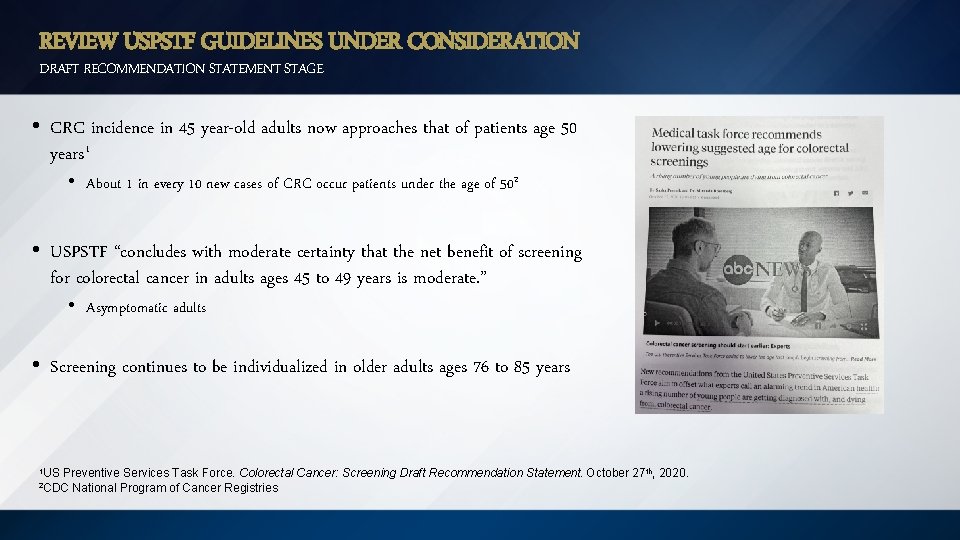
REVIEW USPSTF GUIDELINES UNDER CONSIDERATION DRAFT RECOMMENDATION STATEMENT STAGE • CRC incidence in 45 year-old adults now approaches that of patients age 50 years 1 • About 1 in every 10 new cases of CRC occur patients under the age of 50 2 • USPSTF “concludes with moderate certainty that the net benefit of screening for colorectal cancer in adults ages 45 to 49 years is moderate. ” • Asymptomatic adults • Screening continues to be individualized in older adults ages 76 to 85 years 1 US Preventive Services Task Force. Colorectal Cancer: Screening Draft Recommendation Statement. October 27 th, 2020. National Program of Cancer Registries 2 CDC
#BACK ON TRACK CONCLUSIONS • USPSTF CRC screening guidelines are changing • Focusing on prevention of early-age CRC and Red Flag symptoms • We need a United Message going forward given the delays and missed screening opportunities due to COVID • • Prioritizing patients Screening disparities likely will be magnified Consistent messaging Implementation of screening policies and processes
A PATIENT’S PERSPECTIVE Joy Christensen Sioux Falls, SD
THANK YOU! Questions?
- Slides: 24